Horridculture (deferred from Wednesday) – Bad Garden Tour

The Jungalow, as I wrote six years ago, is Brent’s home and associated gardens. It is an overgrown mess of lush foliage. I perceive it to be a frivolous waste of very limited space. Everyone else perceives it to be a phenomenally luxuriant urban oasis.

The house next door is more my style. It is a compact and simple home with simple bisymmetric architecture and an even simpler landscape. If Brent had not installed a symmetrical pair of tipu trees at the curb, a symmetrical pair of Tolleson’s weeping junipers flanking the porch and a foundation planting of star jasmine, it would have no landscape at all. It might be my favorite house in the neighborhood. Brent hates it.

More specifically, he hates that it is right next door. He would prefer it to be a bit farther away, so that a home with a landscape that is more compatible with his could be next door instead.

Anyway, sadly, a back bedroom of the house next door that I am so fond of burned a few days ago. Fortunately, Brent was in his office behind his home when it happened. He noticed a red glow and heard a window break. When he investigated, he could see the fire and smoke through the hedge between the backyards, so called 911. A fire crew arrived within only a few minutes to extinguish the fire before it ruined more of the home.

Brent sent this brief and blurry video of the situation shortly after the fire was extinguished. It resembles a hasty video garden tour, but speeds past some of the more interesting features of the garden, including my homeless camp, before turning back to show smoke rising from the house next door. It is a saddening situation for the next door neighbor.

New Guinea Impatiens

New Guinea impatiens can be perennial.

Busy Lizzie had been unavailable for years because of a downy mildew epidemic. It has only recently been regaining availability and popularity. During its absence, New Guinea impatiens, Impatiens hawkeri, became more popular. Although a closely related species of the same genus, the two are actually very different. Resistance to mildew is important.

Besides that, New Guinea impatien is about as foliar as it is floral. Its bolder and slightly bigger flowers are notably less abundant than those of busy LIzzie. Also, its floral color range is limited to white, pink, red, lavender, magenta or orange. Its rich green or bronze foliage below compensates though. Many cultivars are variegated with yellow or salmon.

New Guinea impatiens are unfortunately a bit more expensive than most other annuals. The smallest that are available are in four-inch pots. They are unavailable in smaller and less expensive cell packs. They can grow about a foot wide and slightly taller if crowded. During winter, they deteriorate; but they can be tender perennials with shelter from frost.

Annuals Change With The Seasons

Several perennials are useful as annuals.

Winter continues. It will not end until March 19. Wintry weather is unconcerned with such dates though. It could end at any time, or continue a bit later. Vegetation is more aware of this than we are. It wants to be ready regardless. Cool season annuals linger as long as they can. As they no longer can, warm season annuals should be ready to replace them.

Warm season annuals, or summer annuals, include both bedding plants and vegetables. They perform seasonally as cool season annuals do, but through warm seasons instead. They perform for only one annual cycle, although several have potential to be perennial. Removal of perennials is necessary only because subsequent annuals need the space.

All sorts of annuals are available in cell packs from nurseries. They become available as they become seasonable. Those that bloom for late winter and early spring are available now. More of those that bloom best during warm weather should become available soon. It is still a bit too cool and early for most of them. It is not too early for their seed, however.

Although plugging cell pack seedlings into a garden is easier, some prefer to sow seed. Those who do so should begin about now so that the new seedlings are ready by spring. Many seedlings require the warmth and shelter of a greenhouse to grow. As they mature, and the weather warms, they relocate into their garden. Other seed prefer direct sowing.

Many more varieties of annuals are available as seed than as seedlings from nurseries. Even if only a few varieties of seed are in nurseries, countless more are available online. Also, some flowers from previous seasons provide viable seed for subsequent seasons. There are a few reasons to justify the extra effort of growing annual seedlings from seed.

Sunflower and nasturtium are among the warm season annuals that prefer direct sowing. Their roots dislike confinement within cell packs. They recover slowly from transplanting. Cosmos and alyssum do not mind transplanting, but also grow easily from direct sowing. Seed for many varieties can start now because the weather will be warmer as they grow. Petunia, impatien, zinnia and lobelia are easier from cell packs later.

Hard Hat

This is a harsh reminder.

This is why arborists wear hard hats. It is more than eight feet tall. I do not know how much of it extends into the wet sand. Nor do I know how much it weighs. It might have fallen from about twenty-five feet up. I do not know how far the pole saw that it was plucked down with was extended. Even with a hard hat, this would have been potentially very dangerous. I am glad that it is now on the ground, or will be when it falls over.

Nature is naturally hazardous. We try to make some of it safer. We can not eliminate all hazards though. Some, like this one before it fell, are not obviously hazardous. Some are not visible from the ground. As frequently as some hazards are eliminated, others are developing. Trees are always growing and shedding limbs that get shaded out. Old trees are always dying and deteriorating. It never ends.

The alder that dropped this necrotic limb took quite a beating when the creek flooded last winter. Water was higher than this broken limb now stands. Massive trunks of trees that fell upstream floated through here, battering any tree trunks that they encountered, including the trunk of the tree that dropped this limb, which is now at the edge of the water at its current depth. Such pummelling should have dislodged such decayed limbs. Perhaps this limb was not so decayed last winter, and therefore more firmly attached.

The intention of the minor tree work that was done in this area was merely to neaten the scenery a bit. Hazards such as this were not a consideration, since the trees appeared to be reasonably safe, and because they are located on the bank of a creek where no one else goes.

Mycology

I have no idea what fungi this is.

Mycology was a topic that we horticulture students did not study much in school. We learned about some of the more important fungal diseases of vegetation, but that was about all. We could not take the time to study it any more extensively than mycologists could take the time to study horticulture or even botany.

Yet, horticulturists are often expected to know more about mycology than we should be expected to know. Perhaps it is because fungal organisms seem to grow sort of like botanical organisms grow. In ancient history, mycology actually was more closely related to botany, but needed to become a separate discipline as more was learned about each of the two. Perhaps that was at a time when entomology still included arachnids, myriapods and crustaceans. Heck, there was a time when earth, air, water and fire were considered to be the only four primary elements.

I have no idea what this mushroom is. It got my attention because it is so weird. It is such a weird mix of pastel purple, gray and white, with such a distinctly flat top. It was solitary. Not only did I see no others like it, but I noticed no other terrestrial mushrooms of any sort nearby. It appeared amongst blackberry bramble and naturalized English ivy, on the bank of a creek, under bay trees, with bigleaf maples, white alders, red alders and a deceased Douglas fir nearby. The area was quite damp from all the rainy weather this winter. Large and likely old rusty ruddy brown basidiocarps extend from the rotting bases of some of the bay trees. Smaller and likely younger brown and white basidiocarps extend from the rotting trunk of the deceased Douglas fir. All of this is irrelevant, since I still have no idea what this is.

Six on Saturday: Strange Times

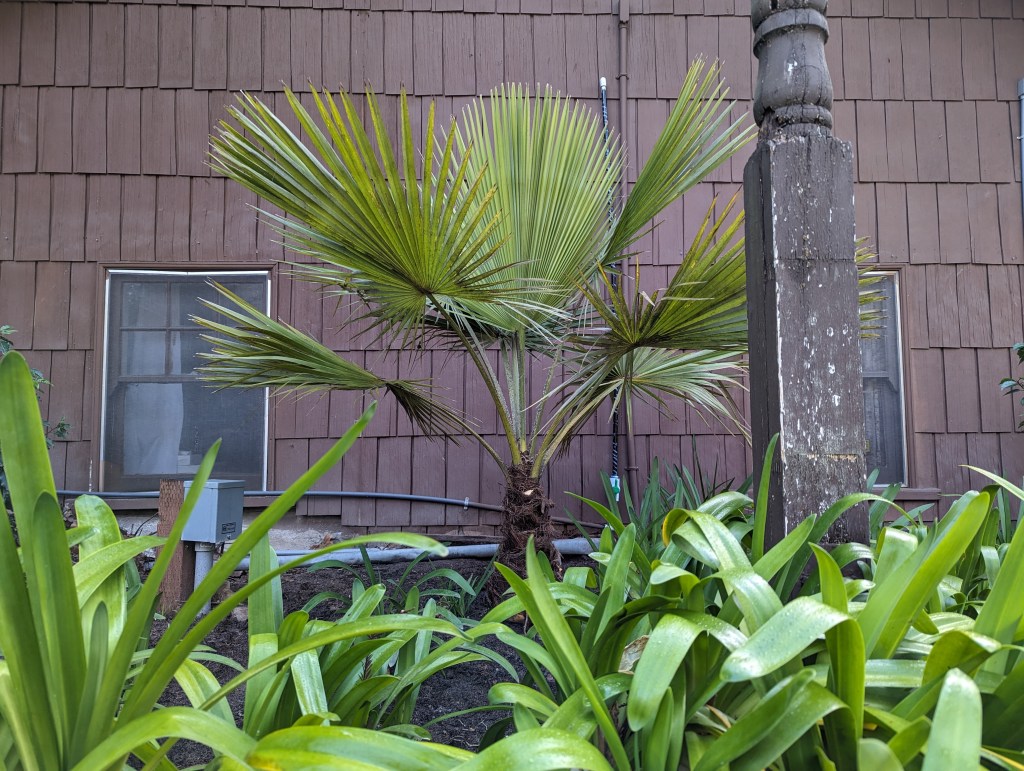
Some flowers are blooming strangely this year. Well actually, one bloomed strangely last year, and is now blooming normally. Flowers that prefer more winter chill than they can experience here are blooming quite nicely this year, even after less frost than last winter. I can neither make sense of it all, nor complain about it. I mean, it may be strange, but it is strange in a good way. We added a windmill palm that I mentioned two weeks ago to a landscape. I like palms, especially this palm, but I am not sure that I like them here with the redwoods. Palms are strange with redwoods.

1. Trachycarpus fortunei, windmill palm is strange because it is one of only three palms here. Palms and redwoods should not mix. It remains canned, so will be removed as the unseen angel’s trumpet behind it grows. I featured it two weeks ago, before it came here.

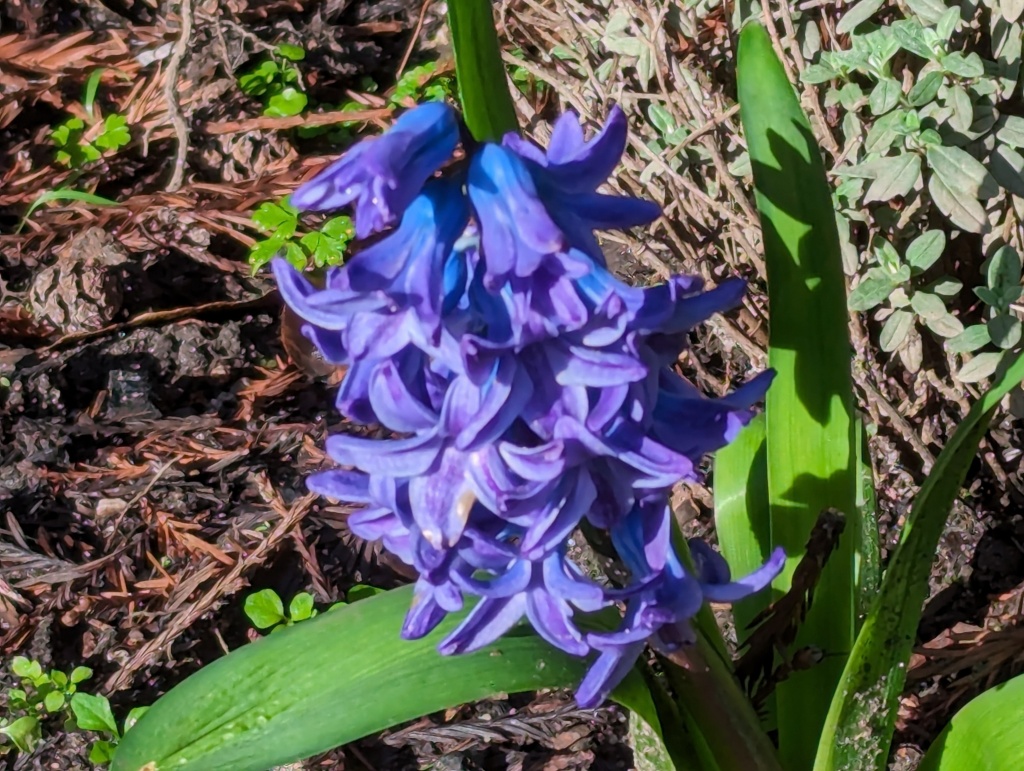
2. Hyacinthus orientalis, hyacinth is not so strange either, but it performs strangely well and reliably with only minor chill. Several have been blooming like this for several years.

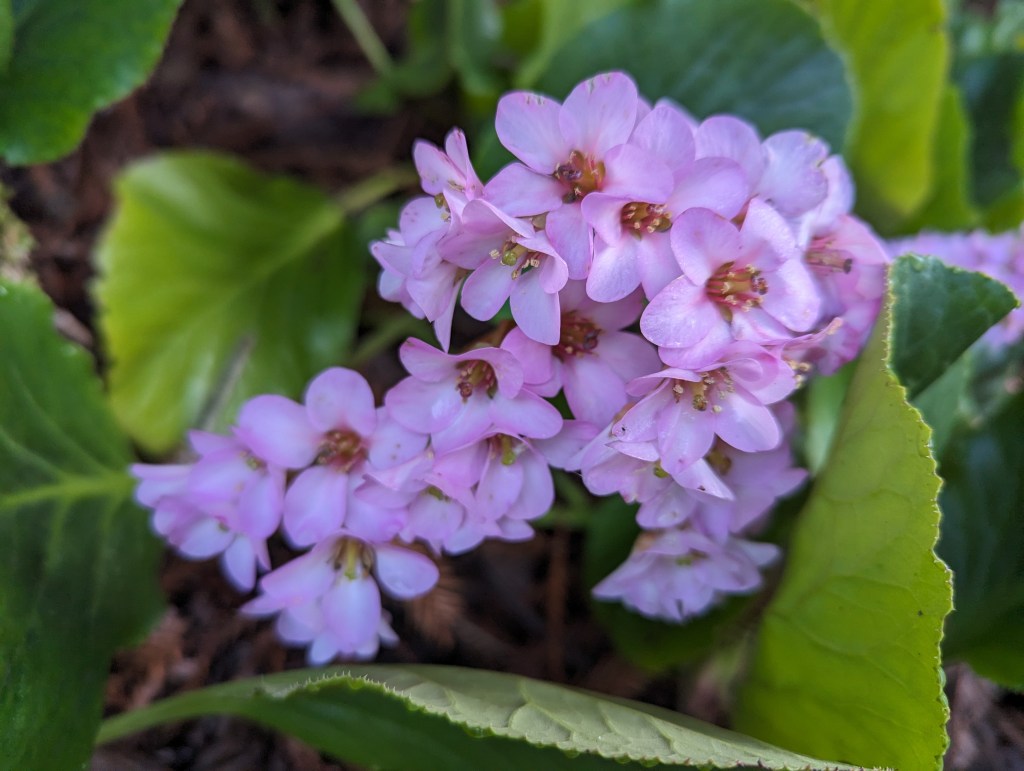
3. Bergenia crassifolia, pig squeak is blooming strangely late with a strangely light pink floral color. Otherwise, it blooms a bit better now that a sycamore that shaded it is gone.

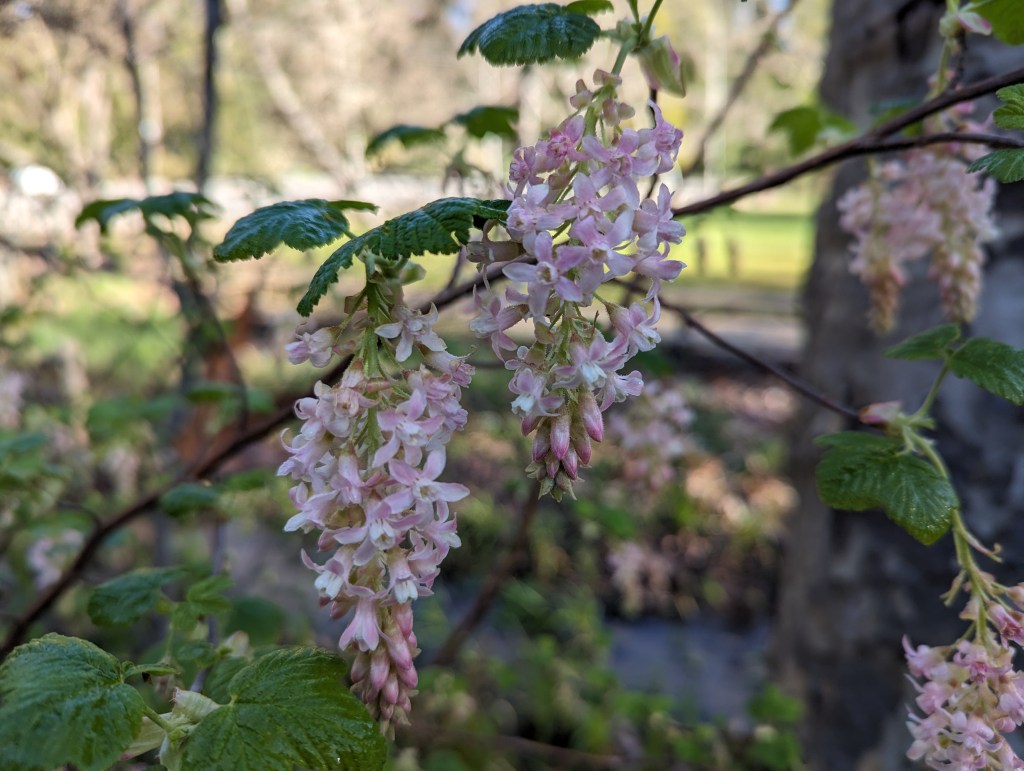
4. Ribes sanguineum, red currant is blooming with a strangely light pink floral color too. It is not much more than white, but is not white. All are this same strangely pallid color.

5. Brugmansia X cubensis ‘Charles Grimaldi’ angel’s trumpet did just the opposite. After blooming strangely pallid peachy orange since spring, it now blooms yellow as it should.

6. Helleborus orientalis, Lenten rose is blooming strangely well this year. Typically, only a few bloom like this. Now, many are. This is one of a uniform colony that is likely feral.

This is the link for Six on Saturday, for anyone else who would like to participate: https://thepropagatorblog.wordpress.com/2017/09/18/six-on-saturday-a-participant-guide/