Wind Is Messy And Hazardous

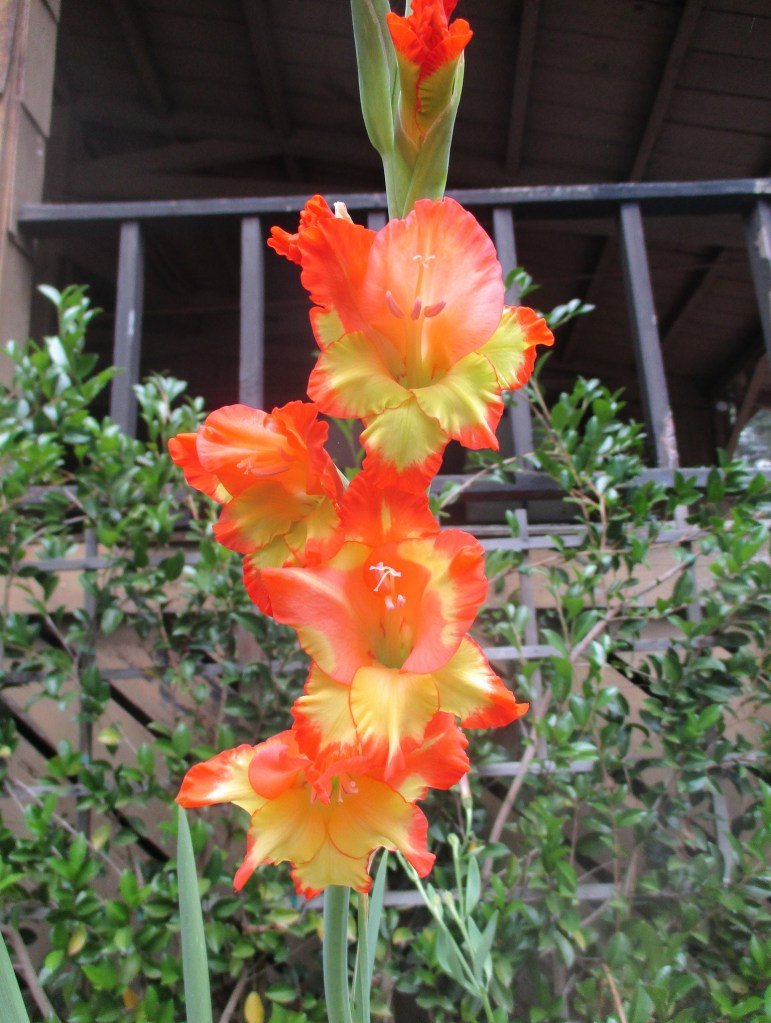
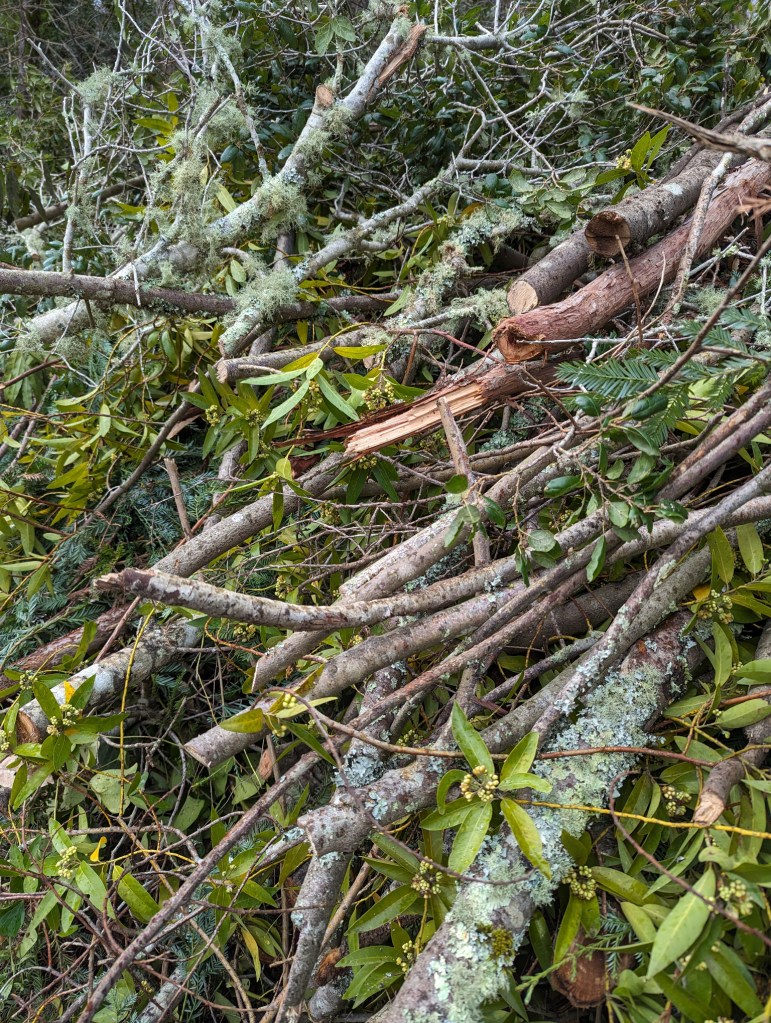
Trees lose limbs to strong wind.

Arborists become more popular after storms. That is when consequences of negligent tree maintenance become more apparent. Wind dislodges limbs and destabilizes whole trees. Unfortunately, the most diligent of tree maintenance can not prevent all damage. Trees and other vegetation are naturally vulnerable to frequently stormy winter weather.

Deciduous trees try to be less vulnerable to wind by defoliating prior to winter. Without foliage, they are less resistant to wind. In other words, they are more aerodynamic. Wind blows through them rather than against them. Some unfortunately defoliate slowly within the mild climate here. With such minor chill, some retain foliage until spring replacement.

For example, some sweetgum still retain much of their foliage. That is an advantage for the display of their autumn foliar color. It is a major disadvantage for their aerodynamics though. As a deciduous species, it does not expect to be so vulnerable to wind through wintry weather. What is worse is that sweetgum trees are innately structurally deficient.

Evergreen trees and other vegetation seem to be less concerned about wind. Actually, they merely employ different defensive tactics. Most cypress and some spruce are too dense and sturdy for wind to penetrate. Many pines develop sparse canopies that wind blows through. On the coast, coast live oak stays low and broad for wind to blow over.

Regardless of their efforts, trees of all sorts are vulnerable to damage from wind. Falling limbs or entire trees are very hazardous. Also, they can damage or destroy what they fall onto. That is why timely maintenance of trees is so very important. Any tree that becomes too hazardous to salvage necessitates removal. All trees eventually age and deteriorate.

Also, all trees, as well as all other vegetation, are messy. Some are messier than others; and many get messier as a result of wind. Some of such mess clogs eavestroughs and downspouts when they are most helpful. Detritus fills curbside gutters also. Actually, it gets everywhere. Its removal will be easier between the windy storms that generate it.
Mojave

Joshua trees seem to be scarce near Joshua Tree.

About a quarter of California is desert. Most of that desert is part of the Mojave Desert. Much of it is very sparsely populated. All of it is fascinating to those who appreciate it.

Not many people live in the desert because the climate is so harsh, and because there is not much reason for many people to be there. Not far north of Los Angeles, which is the second most populous city in America, is one of the most sparsely populated regions of America within the Mojave Desert. It is unpleasantly hot and dry there all summer. It is certainly not the sort of place that should be appealing to horticulturists, although it is.

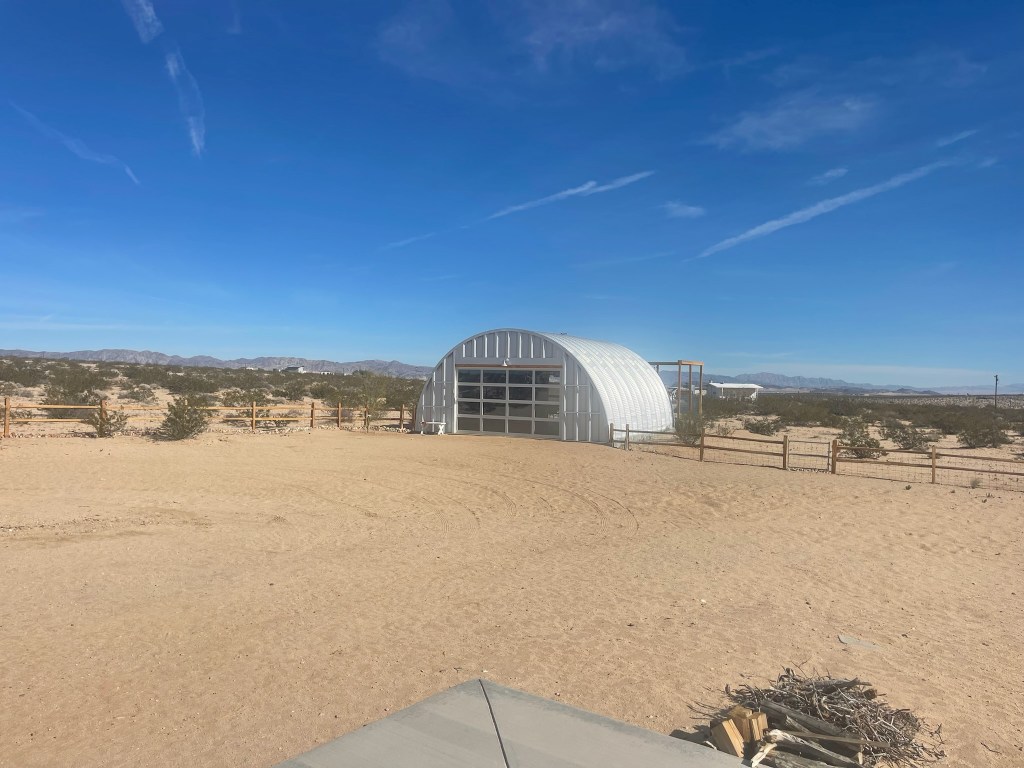
Brent sent me this picture from a place where he vacations near Joshua Tree. If there are Joshua trees near Joshua Tree, they are not visible within this picture. Actually, no trees are visible within this region where shade must be very important. The vegetation that is visible does not seem to be substantial. Vegetation is completely lacking within the fenced area. That small pile of firewood must have been brought from somewhere else. (Although nights are pleasant or warm between hot days, they can get very cold between cool days of winter.) I do not know what that building is. Without substantial vegetation, neighboring residences are visible in the distance.

Part of the allure of deserts for horticulturists is the very distinctive vegetation that lives only there. Part of the allure is the minimalism of such vegetation. Although many species live there, they are not very distinctive. Many resemble each other. In other words, much of the vegetation of the desert is easy to ignore. It is less distracting than that of other ecosystems that are more popular with those who are not horticulturists.

Ginger Ail

White butterfly ginger is still green.

At least seven gingers live here. Five are ornamental. Two are culinary. None have yet died back as they should for winter.

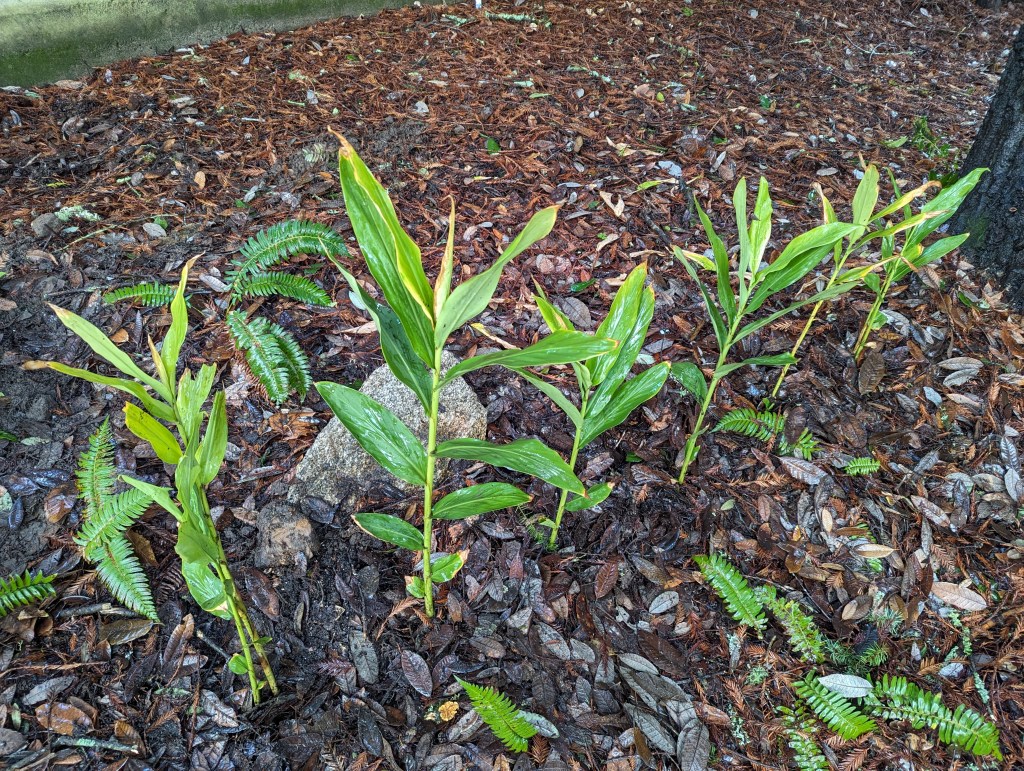
Now that it is time to divide them, I do not know what to do with their intact foliage. For this white butterfly ginger from Forest Garden, I divided the rhizomes and installed them into the landscape with their healthy foliage still attached. I do not want to cut it back until it succumbs to frost. I suppose that it can remain as long as it is healthy. It is likely promoting healthier secondary growth. Because none of the gingers are crowded yet, it should not be difficult to selectively groom out older growth as new growth develops. I doubt that older foliage absolutely must be pruned away during winter. If it were that important, the rhizomes would shed it naturally, with or without frost.

This is a mild climate, with very mild frost; but gingers should still die back for winter regardless. Cannas certainly do, even without significant frost. Even some of the banana trees were somewhat unhappy about the chill.

Actually, the banana trees seem to be bothered more by chill than the gingers. Is this normal? Angel’s trumpet, cup of gold vine and blue ginger (which is not related to ginger) also expressed more displeasure than the gingers.

I really should have sheltered some of these species better. Actually, I probably should not be growing so many species that are so sensitive to chill and frost. I will be going to Southern California again in about April, so could bring back even more tropical species. It is a bad habit.

Technically, the average last frost date is about a month and a half from now. Technically, a bit of frost is possible even after that.

Six on Saturday: Palm Springs

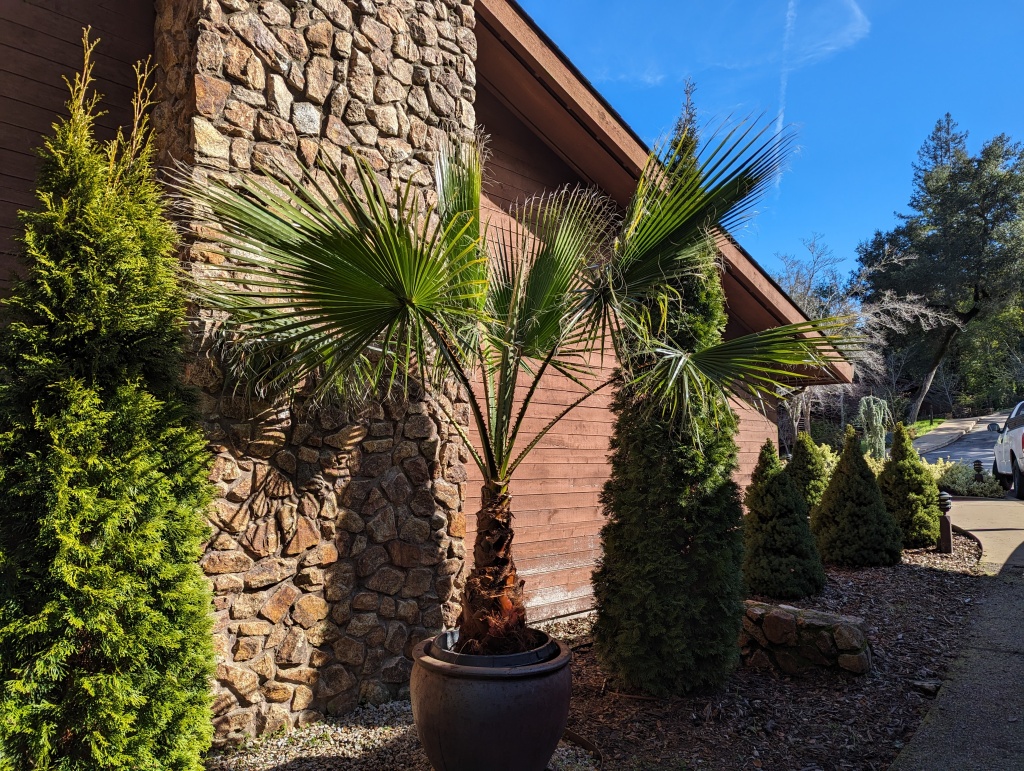
Palms spring up anywhere they want to. Only the fourth and sixth of my Six on Saturday are not feral. Incidentally, the last three are not my pictures; and Brent sent the last two. His curbside Mexican fan palm is at least one of the parents of my pair of seedlings here.

1. Washingtonia robusta, Mexican fan palm, which I wrote about earlier, was too pretty to stay in the recovery nursery where no one can see it. We put it here temporarily, until a pup from the Agave ovatifolia, whale’s tongue agave that bloomed and died here, gets large enough to replace it. It is canned within the big pot for ‘efficient’ removal, but is so heavy that I have no idea of how to get the can out of its pot. It will be a bit heavier later.

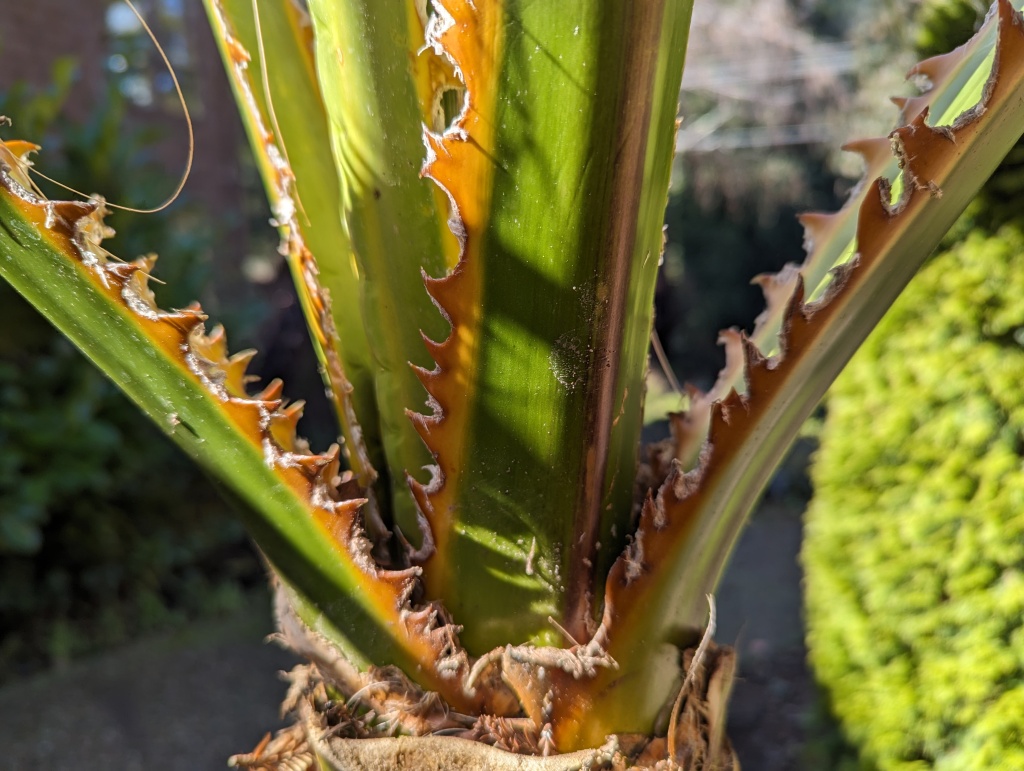
2. Wicked spines on its petioles contribute to the difficulty of relocating this heavy palm.

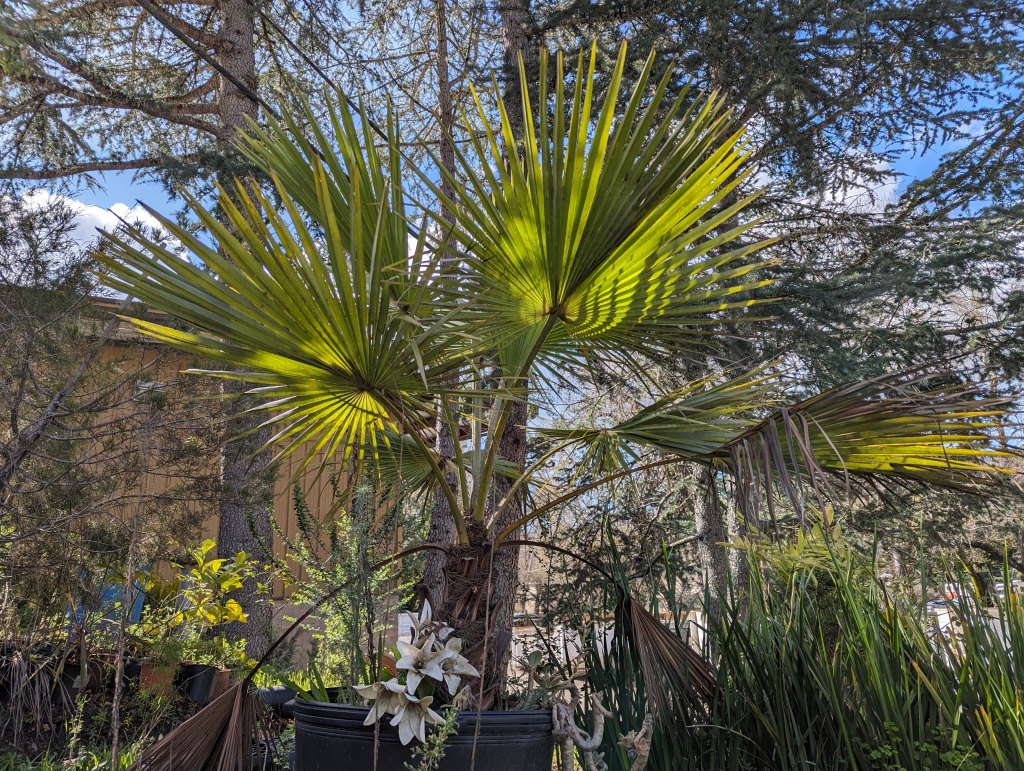
3. Trachycarpus fortunei, windmill palm is also too pretty to stay unseen in the nursery. It will also get groomed and relocated temporarily to a landscape next week. This young palm grew in the garden of the mother of childhood friends, so I am very protective of it.

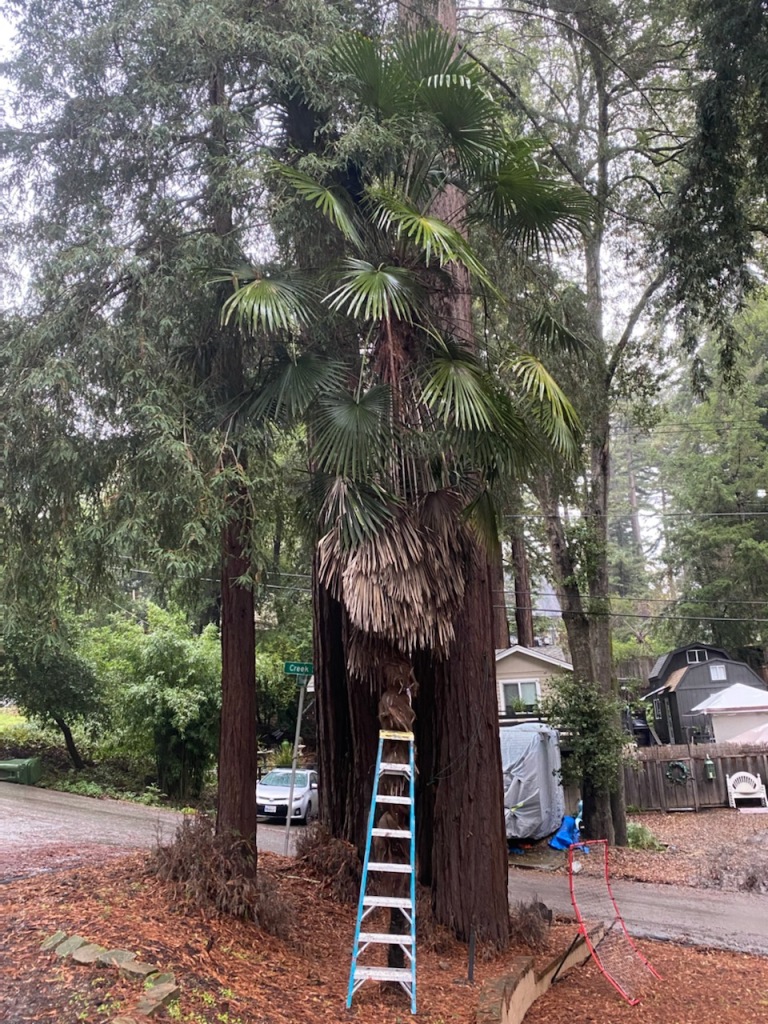
4. Palms and redwoods do not mix well. A colleague wants this windmill palm gone. It is about twenty four feet tall. That ladder is eight feet tall. It will be difficult to relocate, but I do not want it cut down and killed. Like the others, I have no idea of what to do with it.

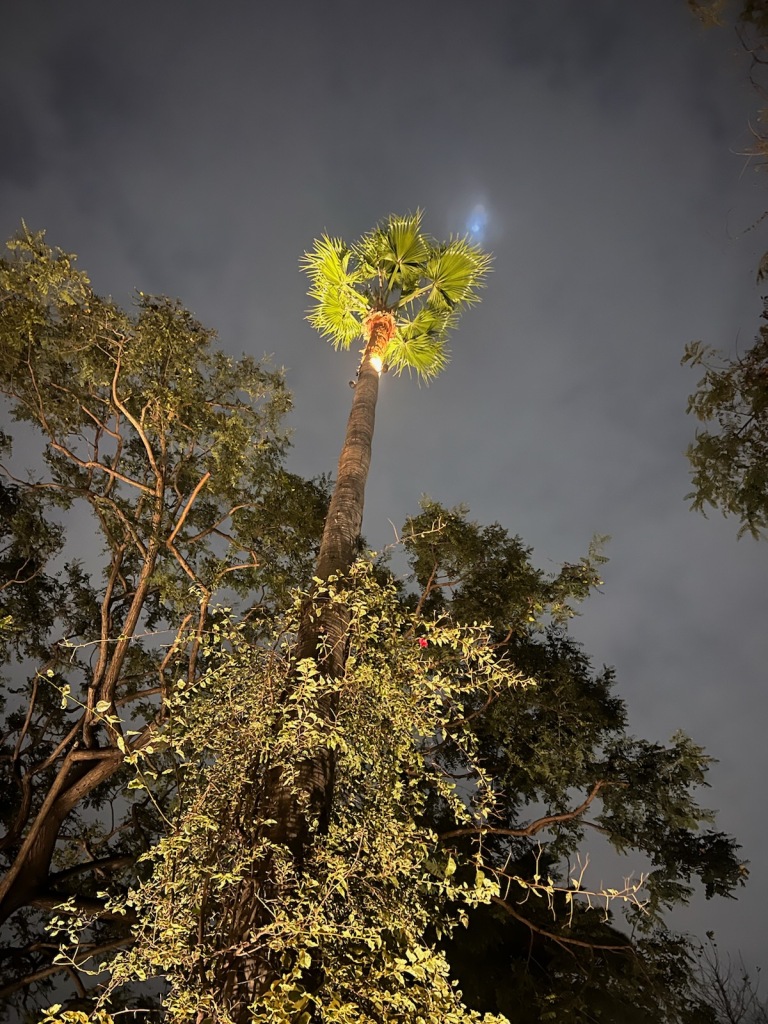
5. Brent’s curbside Mexican fan palm looks embarrassed with its silly uplighting. That is the moon above. This palm, which is a Memorial Tree for Brent’s brother, was about ten feet tall when relocated here because it grew under electrical cables several blocks away.

6. Bedford Drive, nearer to the original location of Brent’s curbside Mexican fan palm, is flanked by very old and alternating Mexican fan palms and Phoenix canariensis, Canary Island date palms. They were grandly uniform until the Canary Island date palms began to succumb to pink rot during the 1980s. The Beverly Hillbillies started their shows with a scene of their arrival in town on a similarly flanked street three blocks to the northeast.

This is the link for Six on Saturday, for anyone else who would like to participate: https://thepropagatorblog.wordpress.com/2017/09/18/six-on-saturday-a-participant-guide/

Chrysanthemum paludosum

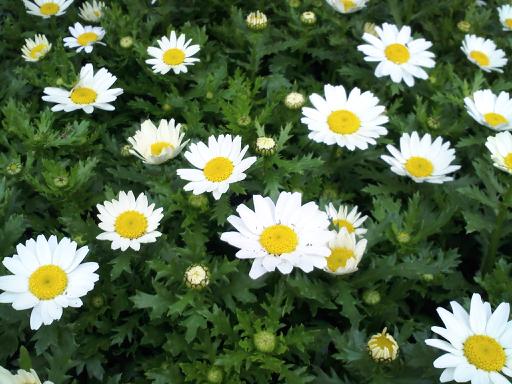
Chrysanthemum paludosum goes into the garden early here.

            In cooler climates, where winters are too harsh but summers are just right, Chrysanthemum paludosum is a warm season annual. Locally though, it gets planted about now like pansies, stock and Iceland poppies.  Chrysanthemum paludosum does just fine through late winter, and does even better as the weather gets warmer in spring. It can be replaced with real warm season annuals as weather eventually gets too warm and dry (lacking humidity) in summer. In cool and damp places, it can survive through summer. Chrysanthemum paludosum develops into six inch wide mounds of rich green and finely textured foliage adorned with small white daisy flowers with yellow centers.

Blackberry Canes Need Specialized Maintenance

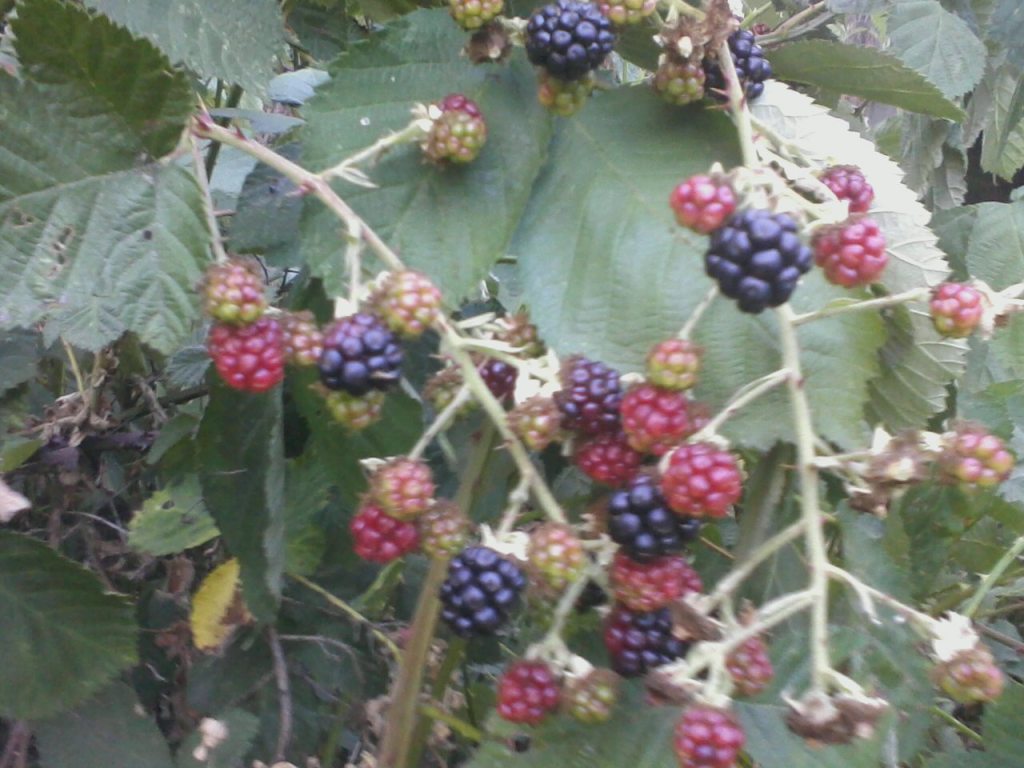
Dormant blackberry canes are now available with other bare root stock.

            One of my favorite modern California impressionistic paintings depicts suburban gardening of the post agricultural period in the Santa Clara Valley. It is a finger painting that I made in kindergarten at Bucknall School in about 1972 or 3, to illustrate some of my favorite features of my grandparents’ garden in Santa Clara. To the left is a vertical brown stripe below green squiggles with black spots; the avocado tree. To the right is a similar image with red instead of black spots; the cherry tree. Between and below these, and lacking a vertical stripe, is a flurry of green squiggles with more black spots. These are blackberry canes.

            Blackberries are not at all ‘low maintenance’ since they require rather intensive specialized pruning. Most of the work that they need gets done during summer; but bare-root blackberry plants become available and get planted this time of year with other bare-root plants. Blackberries produce fruit on biennial canes which grow during their first year, and then bloom and fruit during their second year before dieing out.

            Once the tough roots are established, there is no shortage of fresh new canes to replace the old canes. In fact, surplus young canes can be dug and divided with roots to propagate new plants during winter. Because they have a way of spreading outward, blackberries should not be planted too near to neighbors’ fences without root barriers to keep them contained.  

            The most popular blackberries locally are ‘trailing’ types such as ‘Boysen’, ‘Marion’ and ‘Olallie’, which are also known as ‘Boysenberry’, ‘Marionberry’ and ‘Olallieberry’.  Less common ‘erect’ types, such as ‘Arapaho’, ‘Chickasaw’, ‘Choctaw’ and ‘Navaho’, are more tolerant to cold winter weather, so are more popular where winters are more severe. Hybrids of trailing and erect blackberries are ‘semierect’, and are generally treated like trailing types.

            After they get planted in winter, trailing and semierect blackberry canes can do whatever they want to through their first year. In their second year, canes should be trained onto trellises or wires until they have finished fruiting in summer. When the fruit is finished, these canes should be cut to the ground.

            Some of the canes that were growing on the ground below the trellises while all this was going on should now be trained like the canes that were just removed. For trailing types, about ten to fifteen of the best canes should be selected, trained and pruned to about six or seven feet long. About half as many canes of semierect types should be selected and pruned about a foot shorter. All remaining canes should be cut to the ground. (A few of the smallest remaining canes may be left intact through summer to be divided for propagation in winter.)     

            Side branches grow from the pruned canes through late summer and early autumn. At the end of the following winter, these side branches should be pruned to about a foot long. New growth from these stems blooms and fruits during the following summer. Again, when fruit is gone, the spent canes get cut to the ground so that the process can be repeated.

            Erect blackberries do not need to be trained onto support. Canes that develop during their first year can be cut to about two and a half feet tall in the middle of summer. Resulting branches should be cut about a foot long in winter. During the following summer, these fruiting canes should be cut to the ground as fruit is depleted. New canes can then be pruned like the previous canes were.

Horridculture – Weather

So close to ripening!

The weather here made national news on Sunday night. It was apparently quite a storm, with unusually windy wind. A few trees fell in the neighborhood. The roads were messy with debris. The electricity at home was disrupted. Otherwise, to me, it did not seem like a particularly bad storm. After all, this is winter.

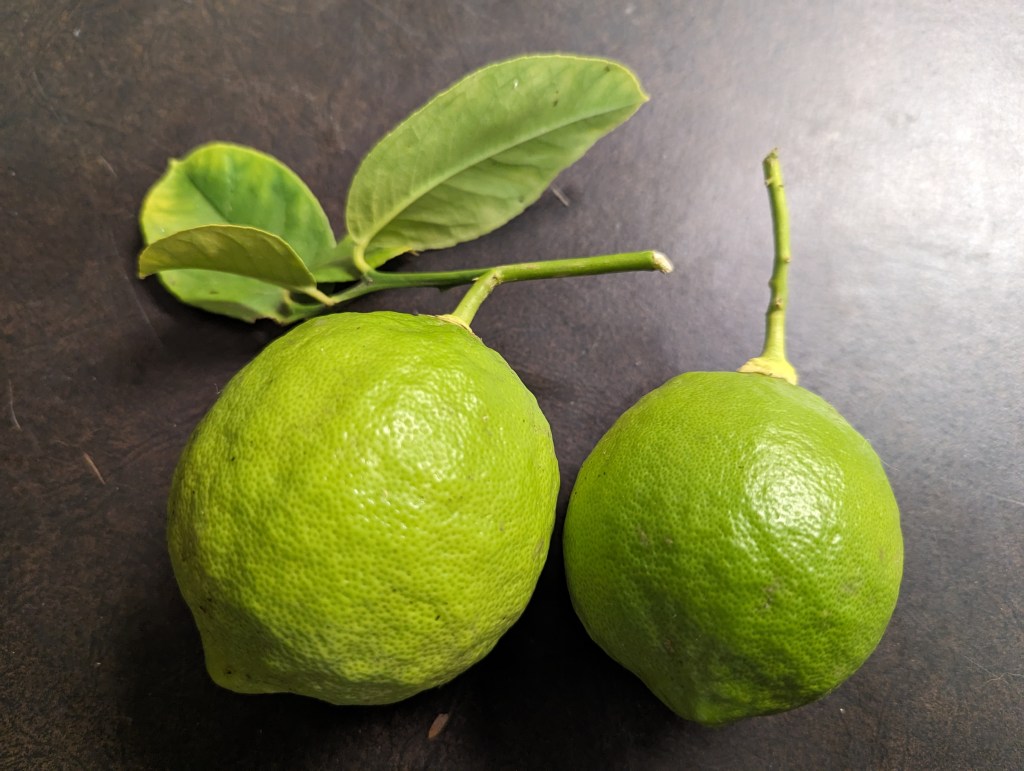
HOWEVER, on Saturday, even before the worst of the weather on Sunday, the wind knocked over my small ‘Ponderosa’ lemon, only a few hours after I posted a picture of one of its two developing fruit. It is a dinky tree in a #1 can, but its lemons are disproportionately large. As I mentioned on Saturday, I should have removed the lemons to divert resources to vegetative growth, but wanted to see if they would develop and ripen. The weather did it for me.

Now I am annoyed. I do not like to be one who complains about the weather. There is not much to complain about in that regard here. This is a pleasantly mild climate that lacks the sort of severe weather that other climates must contend with. The gust that blew over the small lemon tree was not nearly as strong as those that blew over trees within the surrounding forests and neighborhoods. I am just annoyed that after letting the lemons grow as much as they did, their effort will now be wasted.

The two lemons did not develop as they should have, but are still bigger than average ‘Eureka’ or ‘Lisbon’ lemons. I put them aside to ripen if they can. I doubt that they will. I can prune the small tree to remove the stems that had previously supported the two lemons, and make cuttings of them, to grow more small trees. Actually, I should have done this anyway.

Asian Taro

Asian taro leaves grow very big.

Both alocasias and colocasias are striking foliar plants. Alocasias generally develop big leaves that point upward. Colocasias generally develop even bigger leaves that hang downward. Alocasias are generally more colorful, perhaps with striking foliar patterns. Also, most tolerate more shade than colocasias. Of course, these are generalizations.

Asian taro, Alocasia odora, resembles colocasias as much as alocasias. Its big cordate leaves may point only slightly upward, and might sag downward. They can grow two feet long and a foot wide, on petioles as long as three feet. Collectively, foliage can get more than five feet tall. It is bright but monochromatic green, similar to that of Kermit the Frog.

Asian taro is only occasionally available from nurseries. Small plants are too delicate for nurseries to market too many of them for too long. Their dormant bulbs are more likely to become available with summer bulbs. They can be wider than three inches! They grow slowly though, especially while weather is cool. Foliage may not appear for two months.

Summer Bulbs Begin In Winter

Summer bulbs bloom after spring bulbs.

Spring bulbs begin to go into the garden during autumn to benefit from the chill of winter. Summer bulbs begin to go into the garden during late winter to avoid the chill of winter. Spring bulbs know to remain dormant through winter. Some summer bulbs do not. If they grow prematurely, they can be vulnerable to cool wintry weather. Late is better than early.

Frost is still possible within some climates. However, summer bulbs are now in season. That is because, like spring bulbs, they disperse roots prior to developing foliage. By the time they extend foliage in a month or so, the weather will not be so cool. Later phases of a few sorts bloom later to prolong bloom for the first season. They synchronize afterward.

That is because they establish themselves within the garden. Once they do, some types of summer bulbs become hardy perennials. Some might try to grow prematurely during subsequent winters. If they incur frost damage as established perennials, they can easily replace the damage. Ornamental gingers and cannas do so regularly in inland climates.

Ornamental gingers and cannas may eventually benefit from division. Even if they do not become too crowded, they can migrate where they are not wanted. Their surplus is easy to relocate or share while dormant for winter. Their foliage becomes shabby or dies back during dormancy anyway. Even if mostly green, its removal stimulates healthy refoliation.

Ornamental gingers and cannas also are oblivious to phasing. Gingers bloom only once for late summer or autumn. Cannas bloom randomly from spring until autumn. Gladiolus bloom only once like gingers, but are more conducive to phasing. Early planting allows early bloom. Late planting delays bloom. Unfortunately, they are much less sustainable.

If summer bulbs do not look like bulbs, it is because few actually are. Most are rhizomes. Dahlias, which, like cannas, bloom from spring until autumn, grow from tuberous roots. As the name implies, tuberous begonias grow from tubers. Crocosmias grow from corms. So do taros, which are large foliar perennials. Gingers and cannas are familiar rhizomes. Although alliums bloom as summer bulbs, they go into the garden along with earlier spring bulbs.

1986

Since 1986 (or so)

This is no ordinary daffodil. I realize that it looks just like the daffodils that I posted a picture of two Saturdays ago, and it could actually be the same variety, but it is quite distinct. I acquired this particular daffodil in about summer of 1986. It could have been a year or two earlier or later, and might not have been summer. The foliage was not completely shriveled as it should have been during summer, but it lasts longer in the coastal climate that I took it from. I really do not remember when I acquired it, but I know that it was a long time ago, about the summer of 1986.

Although we have not been acquainted for as long as I have been acquainted with my paternal paternal great grandfather’s rhubarb and my maternal maternal great grandmother’s Dalmatian iris, both of which I acquired prior to kindergarten, we have significant mutual history.

I ‘borrowed’ several large clumps of bulbs from an abandoned flower field to the east of my Pa’s home in Montara. The clumps were very overgrown and very crowded, but still in their original rows, as they had been arranged for cut flower production many years prior. Shortly afterward, all of the other bulbs were somehow and seemingly pointlessly removed from the field by an excavator. A monster home was built on the highest part of the field, with a view of the field, which remained completely uncultivated afterward. No one knows how or why all the daffodil bulbs were removed so completely, but none were ever seen again. The naturalized field of daffodils seemed like it would have been an attribute to the home.

Over many years, the bulbs grew at most of the homes that I lived in, until the last few years, after I left the last of them at a former home in town. Then, after bringing a few roses here from my old rose garden at a previous home, I noticed that a few bulbs came with them. I thought that they were fancier daffodils, but now that this one bloomed, it is obvious that they are the familiar daffodils from Montara.