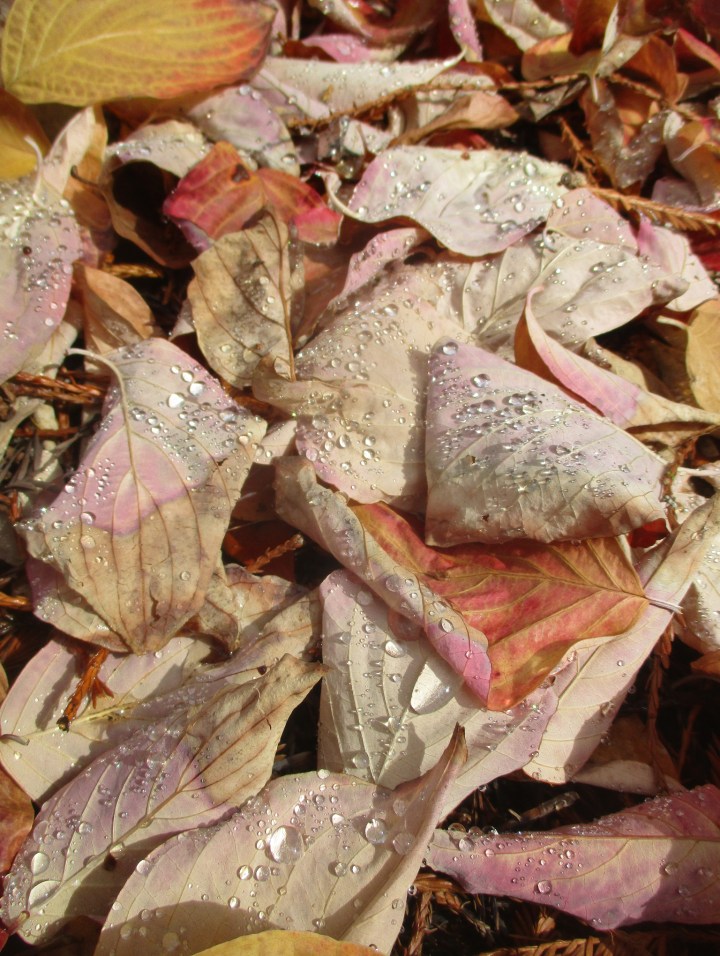
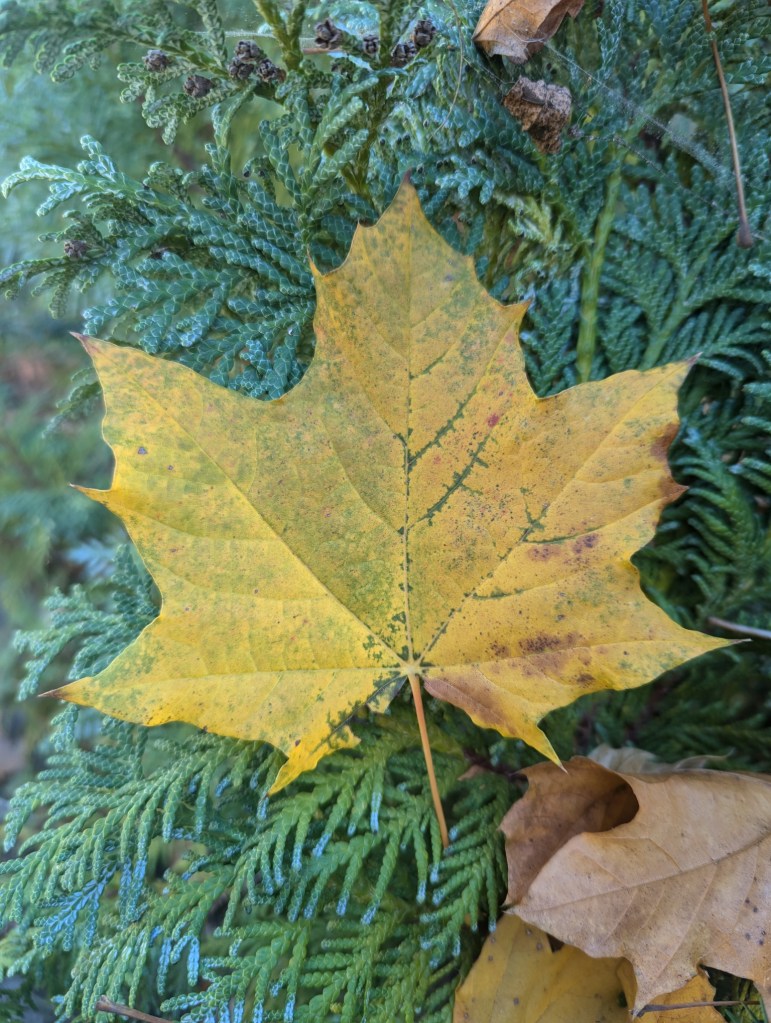
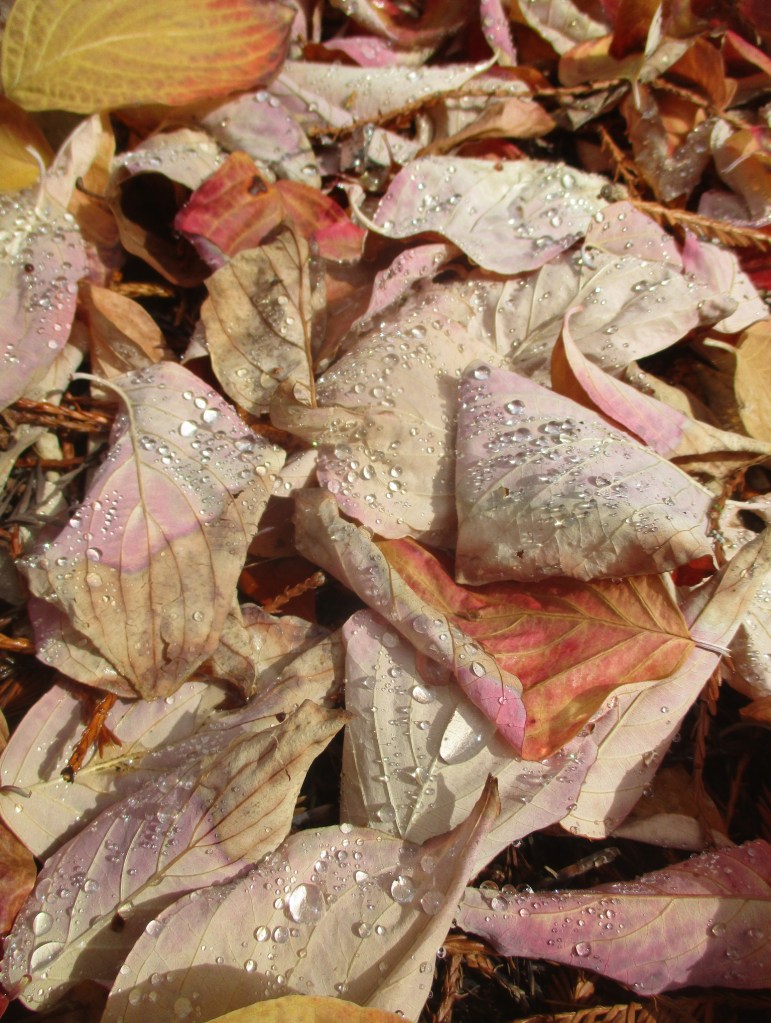
Chinese pistache, Pistacia chinensis, does not need too much chill to begin to turn color. In some climates, it is already yellowing. With cooler weather, it will develop fiery orange and red foliar color. Not only does it color reliably with mild weather, but it actually retains its color better. It could defoliate more efficiently within frostier, windier or rainier weather.
Chinese pistache grows about thirty feet tall and broad. Old trees can eventually grow to about forty feet tall. Some old trees are female, so can produce annoyingly abundant red berries. Modern trees should be fruitless male cultivars. Pinnately compound leaves are about nine inches long, with a dozen or so leaflets. Leaflets are two or three inches long.
Because of its resiliency, Chinese pistache is among the more popular shade trees here. Established trees do not need much irrigation and can likely survive with none. Frequent irrigation can promote shallow root dispersion, which can damage pavement. Otherwise, Chinese pistache is a good street tree. It merely needs pruning for clearance over roads, sidewalks and driveways.
Cool season annuals are not the only options for home garden color for autumn. Even in mild climates, deciduous foliage eventually notices increasing autumn chill. While some merely sheds, some first develops spectacular autumn foliar color. Such foliage is not as conducive to instant addition to gardens as annuals are. Yet some may already be there.
A few deciduous shade trees and street trees provide the best autumn foliar color. Some are less popular with those who prefer evergreen trees. However, they are quite practical for some situations. Some are less messy than evergreen trees. They only seem messier because they defoliate so much at once. Most evergreen trees shed throughout the year.
Sweetgum, or liquidambar, probably provides the most colorful autumn foliar color. It also happens to be among the messier deciduous trees. That is because it retains its colorful foliage later into autumn and winter. While prolonged mess is a disadvantage, prolonged foliar display is an advantage. It is an unwieldy large tree, though, with aggressive roots.
Chinese pistache is as colorful, with dazzling yellow, orange and red autumn foliar color. It seems a bit less messy because it defoliates a bit sooner. Also, it does not produce the spiky seed capsules that sweetgum trees produce. However, its smaller leaves require a bit more effort to rake than larger leaves. Chinese pistache is a rather popular street tree.
Flowering pear, or callery pear, produces similar autumn foliar color, with more deep red. It also provides billowy white spring bloom. Crepe myrtle is a smaller tree with both vivid autumn foliar color and summer bloom. Ginkgo is a tall and slender tree with exclusively brilliant yellow color. Boston ivy is a clinging vine that is as colorful as Chinese pistache.
Not all deciduous trees produce impressive autumn foliar color. Sycamore might already be defoliating with just a bit of pale yellow color. Valley oak does the same later. Both are quite messy as they defoliate slowly through much of autumn. However, both are notably sculptural while bare later through winter. There are other advantages to deciduousness.
Both work and home gardening were relatively mundane this week. Consequently, these six lack a theme. Irrigation is at that awkward phase when less is necessary, but it is still very necessary. No more rain came after the first storm of the season, but the weather is cooler, and the days are shorter. Autumn is arriving . . . slowly. Maybe I will get pictures of autumn foliar color for next Saturday.
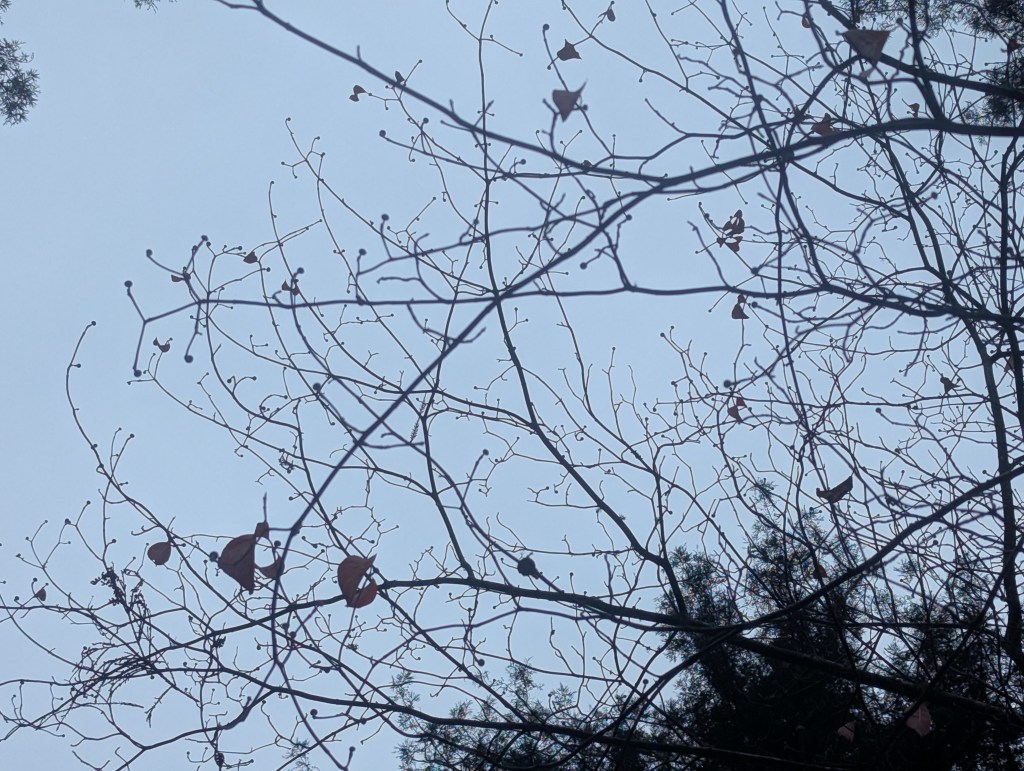
1. Robinia pseudoacacia, black locust is much more out of focus than I was aware of as I took this picture to show how blue the sky is without any rain in the foreseeable forecast.
2. Begonia X semperflorens–cultorum, wax begonia succumbed to a major infestation of fungus gnat larvae. These fresh cuttings were made from their unaffected upper growth.
3. Amaryllis belladonna, naked lady seedlings grew from seed from white flowers. They will not bloom for several more years. I am curious to see if they might also bloom white.
4. Saccharum officinarum, sugarcane probably should not have been bothered until the end of winter, but I separated five clumps. This is the traditional Purple Ribbon cultivar.
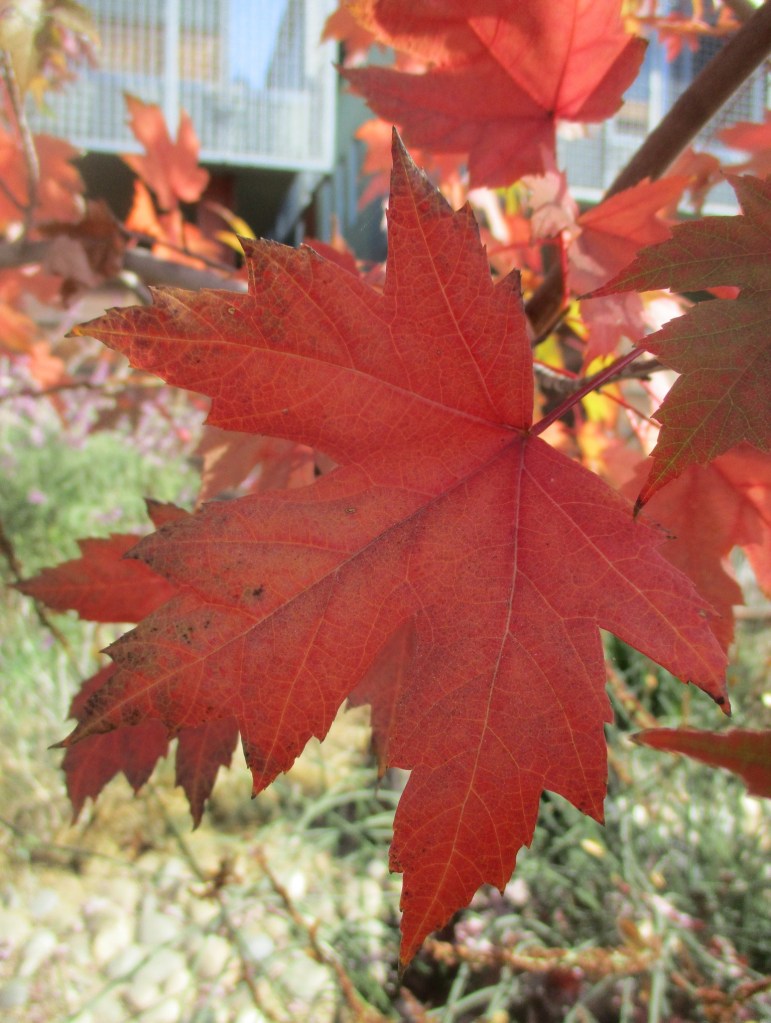
5. Acer rubrum, red maple is redundant to a picture of the same two Saturdays ago, but is too pretty to not get a last picture of before the end of its season. It is mostly bare now.
6. Rhody was busy with relaxation while I was at work on Thursday. He is commendably proficient with such tasks, while not being late for petting sessions and treats afterward.
Sticks on fire is a more colorful and more compact version of pencil tree.
The old fashioned pencil tree, with leafless, succulent stems is a strikingly strange plant already. In mild climates of coastal Southern California, it can get quite large, nearly ten feet broad and twice as high. Sticks on Fire, Euphorbia tirucalli ‘Sticks on Fire’, stays less than half as large, but is even weirder because the stems are so oddly colored.
The inconspicuous leaves drop almost as soon as they develop, leaving distended fleshy stems that are either reddish or yellowish orange. Stems fade to softer yellow through summer, and then turn red in winter. Size and growth rate are limited by a lack of chlorophyll. Although related to poinsettia, the flowers of sticks on fire are not significant.
Sticks on fire prefers full sun exposure and warmth, but unfortunately needs protection from frost during winter. It can be happy under an eave on a south or west facing wall, or in a large tub that can be moved to shelter during winter. Plants in tubs are a bit more sensitive to rot if watered too frequently. The sap of sticks on fire is very caustic to skin and can be dangerous if it gets in the eyes.
The Santa Clara Valley was formerly famous for fruit and nut production.
(This article is recycled from several years ago, so contains outdated information.)
The vast orchards that formerly inhabited the Santa Clara Valley were here because this is among the best places on Earth to grow apricots, cherries, prunes, almonds and walnuts. Actually, there are not many fruit trees that would prefer to be somewhere else. Home gardens continue to produce the many traditional fruits, as well as many other types of fruit that were not so common in the orchards; such as citrus, figs, apples, pears, persimmons, avocados, peaches, nectarines and too many more to fit into a brief list.
Those of us who enjoy growing fruit trees do not need to be reminded of how well they do here. Some trees produce too much and can become overwhelming. It is not always possible to can, dry, freeze or share with friends and neighbors all the fruit from the more productive trees. Leaving the fruit out in the garden is not only wasteful, but also bad for the garden, attractive to vermin, very messy and smelly.
Besides, there are other people in the community who could use it. During this past year, Village Harvest has harvested from local gardens, and distributed to those who can use the produce, approximately 156,000 pounds of fruit. The record for distribution of produce may be exceeded this year after apples, persimmons and citrus are harvested.
Volunteers make Village Harvest possible, by collecting excessive fruit from home gardens. Some of the people with productive trees like to retain some of the fruit. Volunteers are also welcome to take some of the fruit. The vast majority of fruit gets dispersed to others in the community who can use it.
(Most of the following information is outdated.)
The next apple harvest event in the Cupertino orchard on October 22 may no longer be able to accommodate additional volunteers; but the next major apple harvest in the Woodside Orchard on October 29 may still be in need of volunteers. Harvests take about three and a half to four hours, between 9:00 a.m. and 12:30 p.m.. Volunteers must be at least sixteen years old.
Volunteers can register for harvest events, or get more information at villageharvest.org. Early registration is recommended since space is limited. Volunteer instructions, including meeting location addresses will be e-mailed to volunteers a few days prior to each event. Those of us with excessively productive fruit trees who happen to be within range of harvest events can possibly make arrangements to get fruit harvested.
The next few neighborhood harvests will be on October 25 in Central San Jose, October 31 in Sunnyvale, November 1 in Central San Jose, November 6 in Mountain View, November 8 in Central San Jose, and November 14 in Sunnyvale. Sunnyvale harvests begin at 8:00 a.m.. Some harvests are repeated. For example, the Central San Jose harvests are weekly on Tuesday.
As mentioned in September of last year, comparisons of the growth of the Memorial Tree of Felton Covered Bridge Park are probably more accurate about now, at the end of its growing season, rather than in the middle of July, as I have been conducting them. So, like last year, I did comparisons at both times this year. A minor difference this year from last year is that this secondary comparison is fourteen weeks after the primary comparison instead of seven weeks, and more completely after the Tree has finished noticeable growth for the year. The first pair of comparison pictures compares the Memorial Tree now to July 12. The second pair of comparison pictures compares the Memorial Tree now to August 30 of last year. While the second pair demonstrates approximately how much the Tree has grown during the past year, the first pair demonstrates how much the Tree has grown since July 12. Strangely, most of the growth seems to have occurred after July 12. This is a good indication that the Tree has extended roots below the nearby lawn, so is exploiting irrigation there. (This species typically exhibits most of its growth during spring and early summer while the endemic soil remains moist from winter rain, but then decelerates its growth as the soil dries through summer.)
Most flowers that must attract pollinators do so with either color or fragrance. Hyacinth is an exception that does both. It is as fragrant as it is colorful. Its intensely rich fragrance is supposedly comparable to that of lilac. Its floral color range includes many hues and tints of most colors but green. It blooms for very early spring along with many types of daffodil.
Dormant hyacinth bulbs go into their gardens about now, but do nothing until after winter. They then bloom with several narrowly tubular florets on stoutly cylindrical trusses. Each floral stem is only about half a foot tall, but stands above its narrow leaves. Foliage lasts for merely two months or so after bloom. It eventually withers with the warmth of summer.
Hyacinth crave rich soil, sunny exposure and regular irrigation after the winter rain stops. They can work nicely with cool season annuals, such as pansies or violas. They appear and bloom just before pansies and violas finish their seasons. Alternatively, hyacinth are conducive to forcing. Unfortunately, they like more winter chill than they experience here after prechilling.
Summer bulbs, such as canna, calla and dahlia, can wait until spring. They do not enjoy winter chill during their dormancy like spring bulbs do. Spring bulbs become available at nurseries now because this is the time to plant them. They wait patiently for winter to end before blooming. A bit of winter chill actually helps them to maintain their strict schedule.
That certainly does not mean that their strict schedule is not adjustable. Most early bulbs prefer interment into their shallow graves within weeks of Halloween. However, they can wait as late as New Year’s Day. This allows for successive planting, which prolongs their ultimate bloom. Early planting promotes early bloom. Late planting promotes late bloom.
Most spring bulbs from nurseries are prechilled because winters are relatively mild here. They are therefore less reliant on significant winter chill. However, some of such bulbs in several of the milder climates may bloom only once. They lack the winter chill they need to bloom for subsequent springs. Avid garden enthusiasts compensate with refrigeration.
That requires major diligence, though. Most who enjoy gardening do not want to dig and refrigerate dirty spring bulbs. Consequently, most who grow them enjoy them as annuals or disposable perennials. Unfortunately though, spring bulbs do not bloom for very long, and are not inexpensive. That is why they are not as prevalent here as in other climates.
Freesia and narcissus, including daffodil, do not need much chill. They can settle in and bloom for many years after their initial planting. Ranunculus and anemone may not need much chill either, but are less likely to regenerate from year to year. Dutch iris and Dutch crocus are unpredictable. They might become reliably perennial, but may not cooperate.
Tulip and hyacinth may be more disappointing, since they require significant winter chill. If they can not experience such chill naturally from the weather, they require refrigeration. Otherwise, they bloom only once for their primary season, and only after prechilling. Yet, both are among the most popular of spring bulbs. Their blooms are simply too appealing.