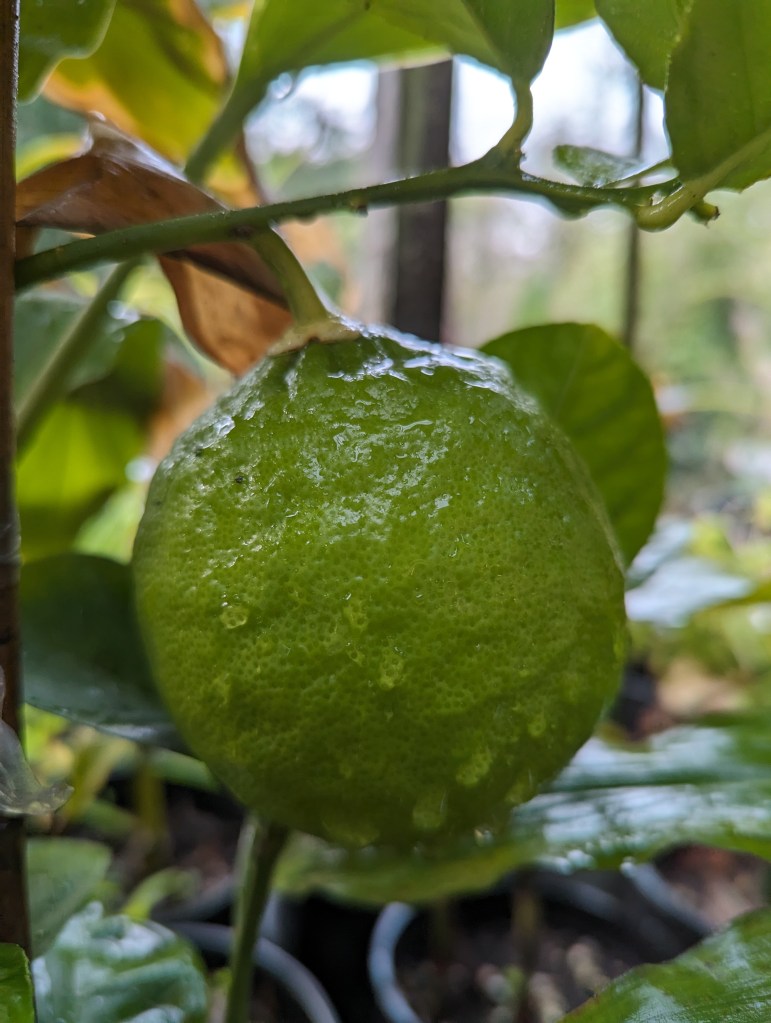
Ponderosa

‘Ponderosa’ for the Ponderosa

Citrus ripen through winter. This ‘Ponderosa’ lemon is taking its time, probably because it is still growing. Individual ‘Ponderosa’ lemons commonly weigh two pounds, and can potentially get a bit heavier than five pounds. That is heavier than some of Rhody’s chihuahua friends. I doubt that this particular lemon will get much larger than it is now, but it is already bigger than an average ‘Eureka’ lemon. It is about as big as a baseball.

The problem with this fruit is that it is on a tiny lemon tree in a #1 can. It is one of two fruits. I should not have allowed them to develop as much as they have. I should have removed them when they first appeared in order to divert resources into vegetative growth, rather than fruit development. Now that they grew this much, I sort of want them to finish ripening. It would be a waste to remove them now. After they ripen, I can prune their stems from the tiny tree, and process them as cuttings to grow more new trees.

I would like to install this little ‘Ponderosa’ lemon tree into a landscape at Ponderosa Lodge. Not only is its name appropriate, but the weirdly huge fruit might be interesting to the children who come to ‘Outdoor Science’ school there. Contrary to the huge size of its fruits, ‘Ponderosa’ lemon trees do not grow very large or very fast. However, a mature ‘Eureka’ lemon already inhabits the garden there, and we recently installed a ‘Bearss’ lime. Another lemon tree would redundant. We would prefer to grow a more edible citrus within the limited space that is available, such as a sweet orange, Mandarin orange or kumquat. For now, we will just enjoy this tiny lemon tree with its huge lemons right here.
Six on Saturday: Tree Circus

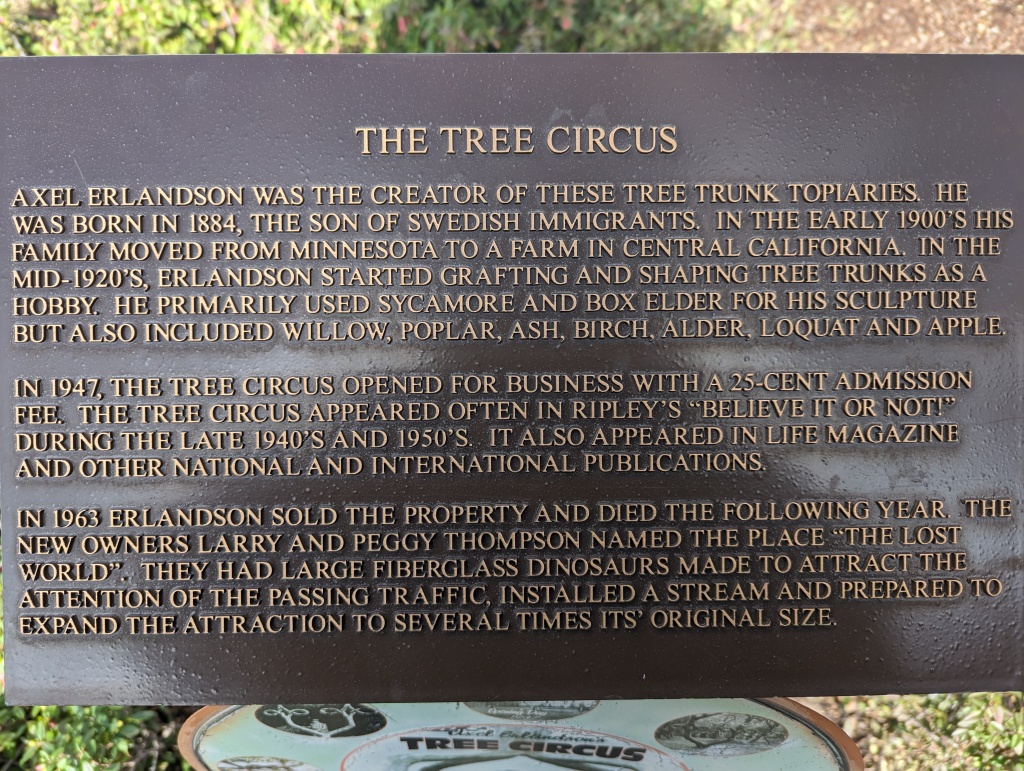
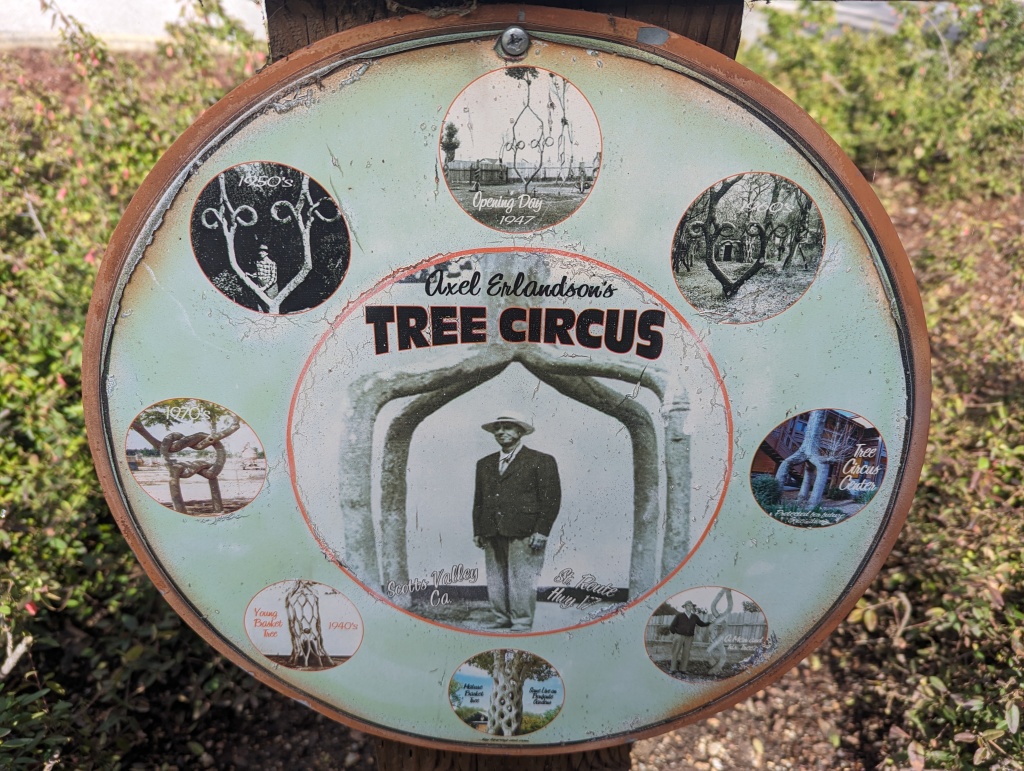
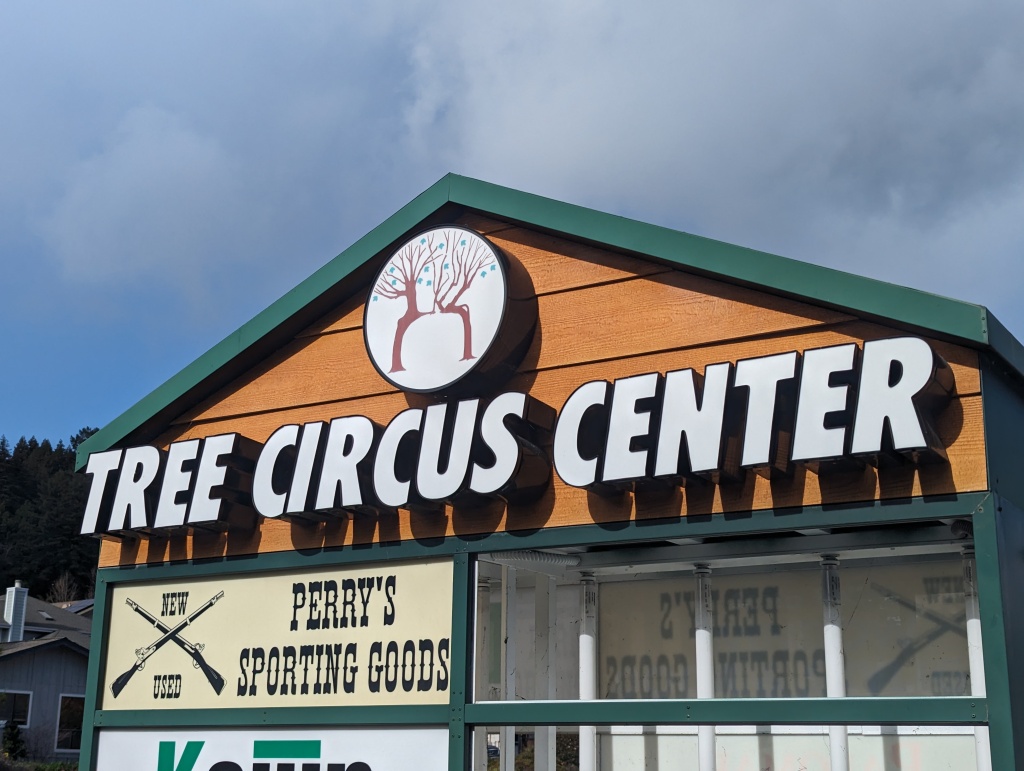
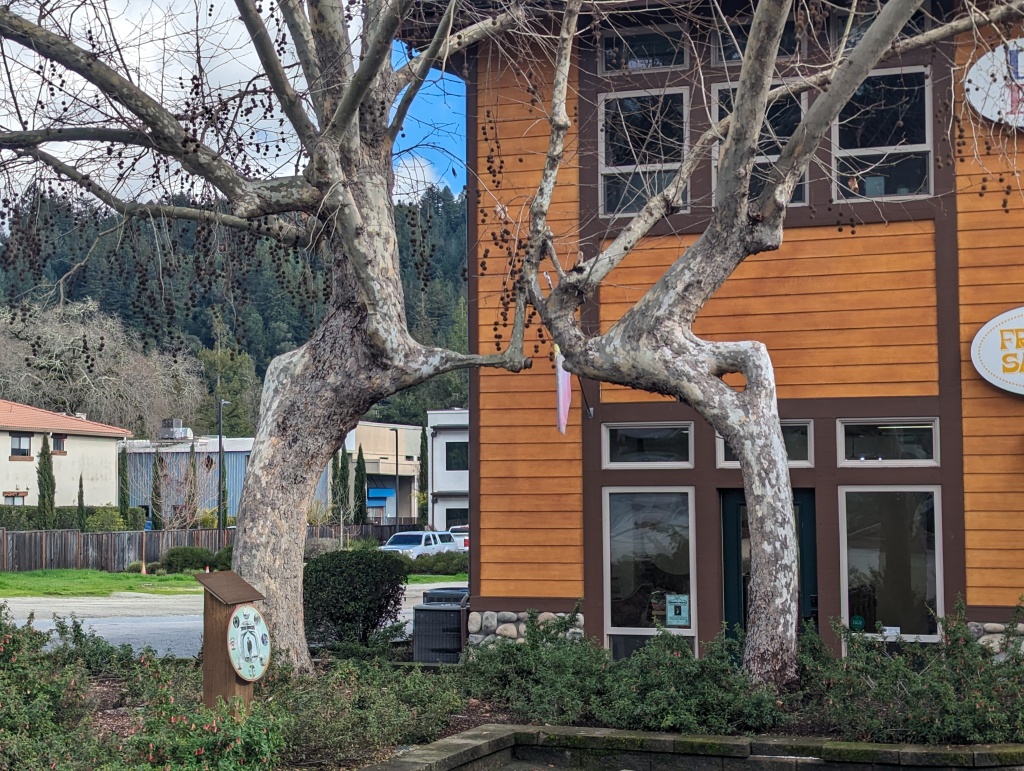
‘Crazy Great Ideas From Crazy Green Thumbs 6’ featured four sculptural tree specimens that had been relocated to Gilroy Gardens, which was formerly Bonfante Gardens, from the now defunct Lost World, which was formerly Tree Circus. While getting gasoline for Morgan in Scotts Valley, I stopped at the former site of Tree Circus for these six pictures. Not much remains to suggest that Tree Circus was ever there. Of these six pictures, only one shows real vegetation, which is a single London plane, Platanus X acerifolia, with a pair of trunks, which form an arch. (Incidentally, Crazy Green Thumbs sent me seed for poinciana and esperanza, which I featured for Six on Saturday almost two years earlier.)

1. Tree Circus Center now occupies the former location of Tree Circus, and subsequently, the Lost World. Progress can be so trivializing. Notice the emblem at the top of this sign.

2. The emblem depicts this last tree of the Tree Circus, which was a pair of trees that got grafted together and separated and grafted together. Notice the plaques to the lower left.

3. This upper plaque very briefly explains the history of Tree Circus and the Lost World, although without mention of what happened afterwards. Notice the other plaque below.

4. This lower plaque features illustrations of a few of the many sculpted trees of the Tree Circus, although woefully weathered. Notice the illustrations to the far right and far left.

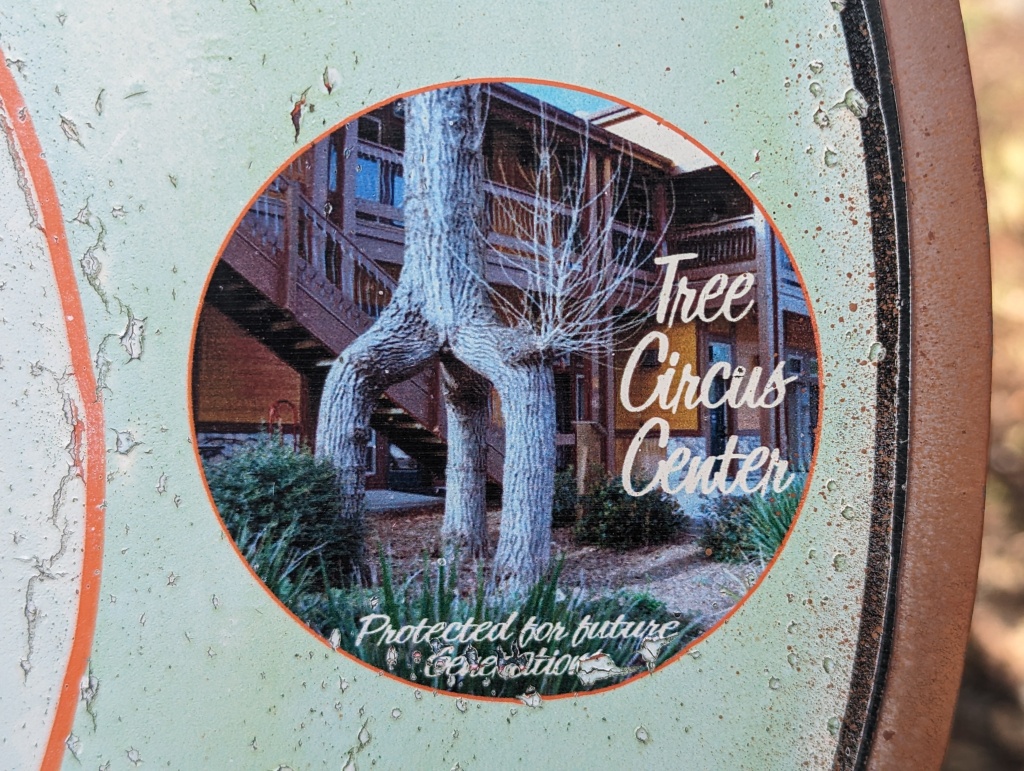
5. This illustration to the far right shows the only other tree of the Tree Circus to remain at the site, although it is now gone. Notice the caption, ‘Protected for future generations’.

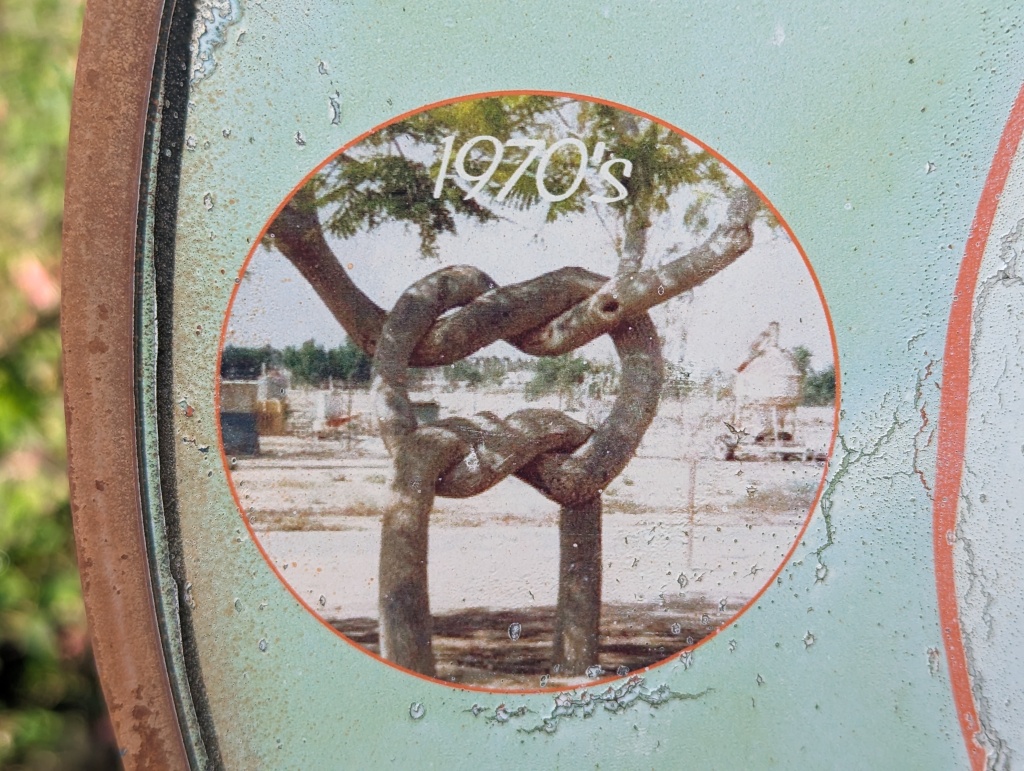
6. This illustration to the far left shows one of the Tree Circus trees that was exhibited in the context of ‘Crazy Great Ideas From Crazy Green Thumbs 6’ by Crazy Green Thumbs.

This is the link for Six on Saturday, for anyone else who would like to participate: https://thepropagatorblog.wordpress.com/2017/09/18/six-on-saturday-a-participant-guide/

Mexican Weeping Bamboo

Mexican weeping bamboo is more appealing in abundance.

Like junipers, bamboos have gotten a bad reputation from only a few of their problematic specie. Many of the traditional running bamboos really are too aggressively invasive. However, there are many clumping bamboos that are much more adaptable to confined and refined garden areas. Even these complaisant bamboos remain uncommon though, both because of the unpopularity of bamboos, and because they are not so easily produced.

            Mexican weeping bamboo, Otatea acuminata aztecorum, is certainly one of the more interesting of these clumping bamboos. Their limber inch and half wide stems are not nearly as rigid as those of most other bamboos are, and may bend down to the ground under the weight of their abundant and remarkably finely textured foliage. The four or five inch long leaves may be only an eighth of an inch wide. Both the stems and foliage move nicely in even slight breezes.

            Established plants are somewhat resilient to neglect, but can get rather yellowish and will likely stay less than ten feet tall without regular watering. With regular watering and monthly application of nitrogen fertilizer, such as lawn fertilizer, during warm weather, they can get twice as tall. Old canes should be pruned to the ground as they begin to deteriorate. There should be plenty of fresh new stems to replace them.   

Sustainable Vegetable Gardening

It will be time to add warm season vegetables to the garden soon.

This article is recycled from several years ago, so the information about the class is no longer relevant.

            Just as we are getting accustomed to winter, it is already time to begin to get ready for spring. The first of the six sessions of the Sustainable Vegetable Gardening class with Master Gardener Ann Northrup at Guadalupe River Park and Gardens will be from 7:00 to 9:00 p.m. on February 10. Subsequent sessions continue weekly at the same time until the sixth session on March 17, in time for warm season vegetables to replace cool season vegetables.  

            Topics include: soil preparation, amendments and fertilizers; irrigation methods and systems; working with both seeds and seedlings; cultural requirements of specific warm and cool season crops and varieties that do well locally; and how to identify and manage common pests, weeds and diseases of vegetable crops in the Santa Clara Valley. Sustainable Vegetable Gardening emphasizes sustainable gardening techniques, such as mulching, efficient watering techniques, composting, integrated pest management and organic fertilizers and soil amendments. Participants will learn how to manage a successful and environmentally responsible food garden that will produce vegetables and herbs throughout the year.  

            Sustainable Vegetable Gardening will be at the Guadalupe River Park and Gardens Visitor and Education Center at 438 Coleman Avenue in San Jose. Admission is $72. Pre-registration is required and can be arranged by telephoning 298 7657. More information about this and other classes can be found at www.grpg.org.  

            Another reminder of the distant but eventual spring is that seed catalogues start to arrive. Some arrive by email as links to online catalogues. It seems that the best still arrive by mail though. I have yet to receive two of my favorite catalogues from Baker Creek Heirloom Seed and Park Seed. Baker Creek not only has some of the oldest heirloom seeds, including Early American seeds, but also some of the weirdest vegetable, herb and flower seeds from all over the world. Park Seed supplies the more contemporary traditional seeds that I grew up with, as well as all sorts of bulbs and plants.

            It may be too late by the time their catalogues arrive, because the Renee’s Garden Seed Catalogue is already here! The online catalogue can be found at www.reneesgarden.com. Even though I typically do not like mixed seeds, I do like Renee’s Garden color coded mixes with the different types within the mixes dyed different colors. I simply separate the different seeds as I plant them. It is like getting two or three packets of seed in one.

            I think I like Renee’s flowers as much as the vegetables. There is an entire page of sweet peas to choose from! I also like the selection of sunflowers, nasturtiums and morning glories. This last year, the delicate blue stars in the centers of the big white flowers of ‘Glacier Star’ morning glory were my favorite.

Lime

Most ripe limes are greenish yellow.

Among citrus, limes are the most diverse. They include more species and hybrids than other types of citrus. Only a few of countless cultivars from centuries of development are available here. Yet, each of these few is very distinct from the others. Most provide juice for culinary application. At least one provides herbal foliage. Few limes are eaten intact.

Dwarfing understock is one commonality of almost all home garden lime trees. Not many grow more than twelve feet tall. With occasional pruning, most might stay less than eight feet tall. All have bright green evergreen foliage and small white flowers. Most have tiny but sharp thorns. Some are more bothersomely thorny. Fruit is green or greenish yellow.

‘Bearss’ lime is the most popular. Its ripe fruits are about three inches long, and resemble greenish lemons. ‘Mexican’ lime provides fruits that are about an inch and a half wide, on thorny stems. ‘Palestine’ lime is thorny also, with round and yellowish fruit that is edible intact. ‘Rangpur’ lime produces bright orange fruit because it is really a sour mandarine.

Citrus Fruit Ripens Through Winter

Unharvested lemons stay fresh for months.

Winter is bare root season, which is the best time for installation of deciduous fruit trees. It is also the best time for dormant pruning of deciduous fruit trees. Evergreen fruit trees do not get much attention. Installation and any pruning of evergreen fruit trees happens after winter. However, regardless of perceived neglect, winter is actually citrus season.

Technically, citrus are always in season here. That is because most citrus fruits last so long on their trees after ripening. Also, some types produce a few fruits sporadically after their primary season. The latest ‘Lisbon’ lemons can still be good as the earliest of the following season ripen. ‘Eureka’ lemons ripen in minor phases after their primary phase.

Therefore, winter is citrus season merely because it is when most citrus fruit ripens. The schedule is ideal. It begins as pear and apple season finishes. It finishes as cherry and apricot season begins. Pears and apples, and especially cherries and apricots, are less predictable than citrus. Fortunately, citrus can begin a bit early or finish late if necessary.

All citrus are species or hybrids of the same genus of Citrus. Kumquats also classify as Fortunella though. The primary components of the flavors of their fruits are sweet, sour and bitter. The most familiar oranges are sweet oranges, but sour and bitter oranges also exist. Most lemons and limes are sour, but there are also sweet lemons and sweet limes.

Oranges, which are generally sweet oranges, are the most popular citrus. Navel oranges are traditional eating oranges. ‘Valencia’ is a traditional juicing orange. Blood oranges are a bit more tart, with blushed or red flesh and juice. ‘Seville’ sour orange is useful for marmalade. Rare bitter oranges provide flavoring for teas, and fragrance for perfumery.

Lemons are the second most popular citrus. Mandarin oranges, or mandarines, should probably be more popular. They are the more perishable of citrus though, because their rinds are relatively loose. Tangerines are merely mandarines of the Americas. ‘Rangpur’ lime is a sour mandarine. Real limes are very diverse, but mostly ripen greenish yellow. Grapefruits combine sweet, sour and bitter.

Inner Beauty

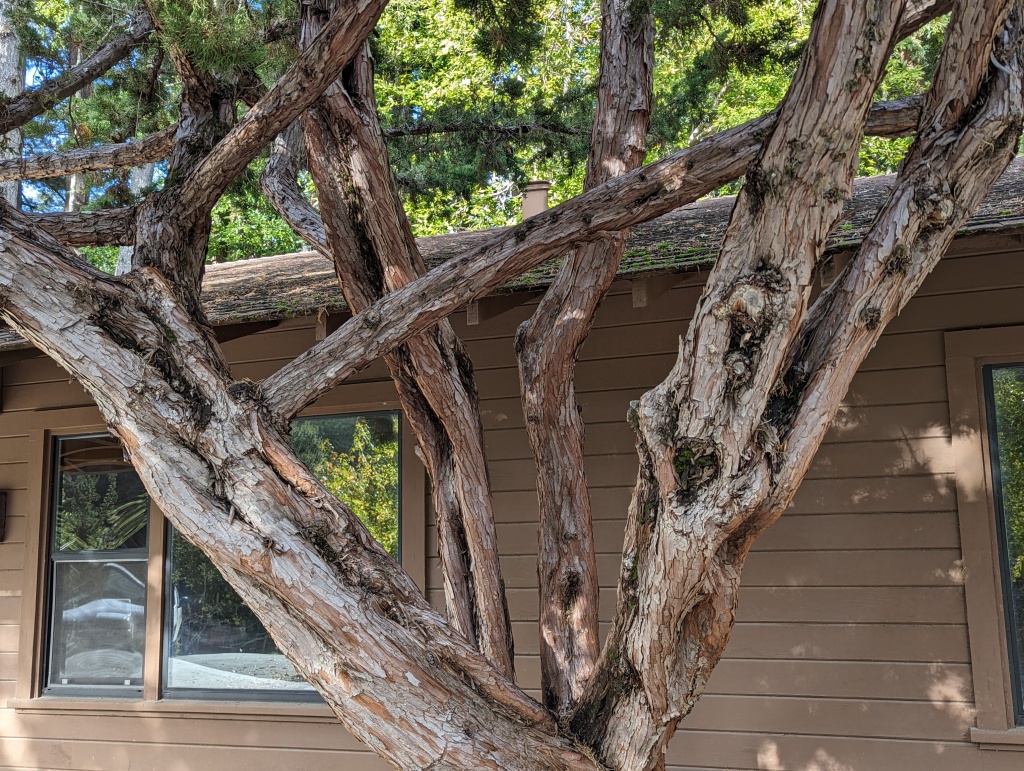
This is an exemplary specimen of Juniperus chinensis ‘Kaizuka’, Hollywood juniper

Juniperus chinensis ‘Kaizuka’, Hollywood juniper is one of my favorite junipers. The few North American junipers that I prefer more are not as appealing for prominent positions within refined landscapes. Hollywood juniper is distinctly sculptural with its strikingly gnarly form. The dense, finely textured and deep green foliage contrasts stylishly with the more coarsely textured and rusty reddish brown bark. Whether a large shrub or a small tree, properly groomed Hollywood juniper can be an elegant trophy tree.

The illustration above is from my ‘Six on Saturday’ post from two weeks ago. It shows one of the largest specimens of Hollywood juniper that I have ever worked with. Initially, I pruned it for clearance from the roof and parking spaces that it extends its canopy over. I also thinned it somewhat. I intended to elevate and thin it a bit more this year or next.

Instead, it became firewood. Sadly, it grew too big and obtrusive for its situation. One of its large roots was displacing the asphalt pavement of the parking spaces in front of it. Another was beginning to do the same. It was very saddening to see it dismembered and processed, as the foliar canopy was discarded to compost into the forest, and the trunk and limbs were taken to a woodpile.

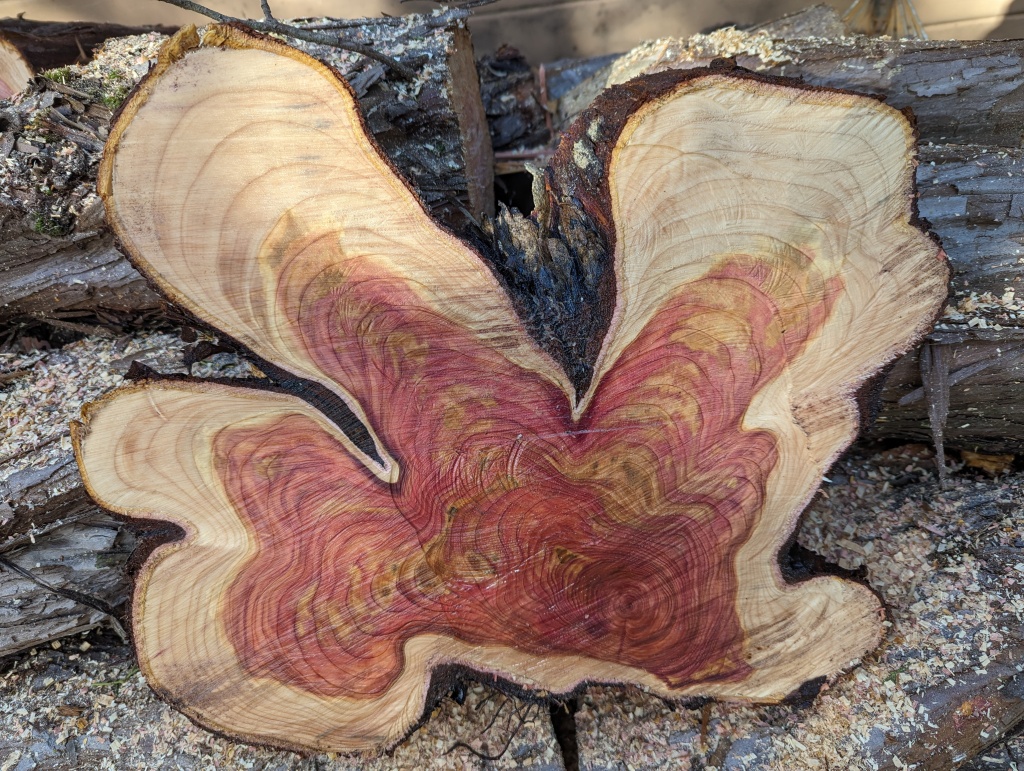
Even as firewood, it retained unique beauty. The illustration below shows the contrast of the red heartwood and blond younger wood within the interior of the gnarly trunk. If it resembles the interior of a cedar chest, it is because it is related to the Juniperus virginiana, Eastern redcedar, which is the cedar within cedar chests (but is not actually a real cedar). Although not visible within the illustration, the woodsy aroma of the exposed wood is very similar to that of a cedar chest.

Even its firewood is appealing.

Proof of Seasons

Daffodil bloom here as if they were in the Pacific Northwest.

Narcissus make me wonder. Both paperwhite and common daffodil, as well as a few fancier daffodil, bloom here as if they were in a climate that is more conducive to such performance. The happiest naturalize and slowly multiply. Not many bulbs do so where winter weather is so mild. That is why I do not bother with tulip or hyacinth, although a few hyacinth have also been performing reliably here for many years.

Peony is very marginal here. I know that they perform inexplicably well for some neighbors, but none have ever done well for me. I really do believe that they prefer more chill than they experience here. Realistically, winter weather is relatively mild here.

Yet, I am not convinced that it is as mild as I have always believed it to be. Some who are unfamiliar with California believe that we experience only two seasons, which are summer, and a few days annually that are not summer. I know better. No one argues that the warm and dry summers here last longer than elsewhere. Prior to summer though, spring is likely comparably to spring within other climates. After summer, autumn, although mild, is cool enough to initiate autumn foliar color. Then, winter is cool. Really, it is cool enough for deciduous species to defoliate, and for mild frost. It may not get as cold as it does in other climates, but how cold does it need to be to qualify as winter?

I am satisfied with the winters here. I can grow all of the deciduous fruit trees that I want to grow. This is one of the best climates in the World for roses. These daffodils seem to be quite satisfied as well. In fact, they sometimes stay dormant later here than in climates with cooler winters!

Six on Saturday: Plugging Along

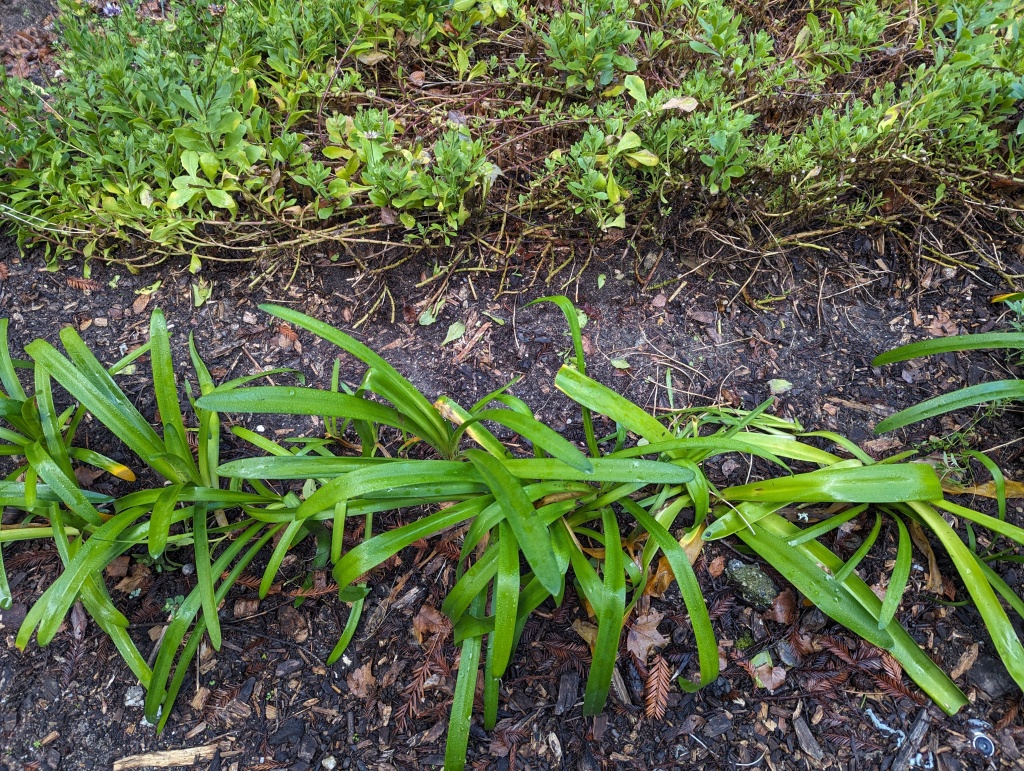
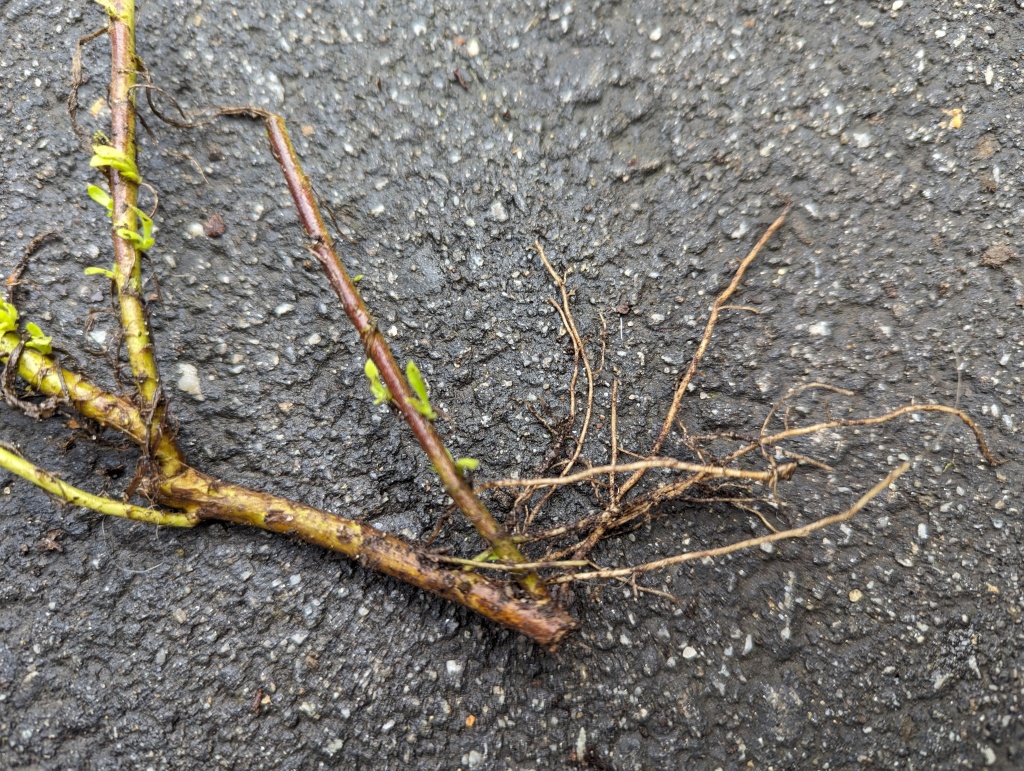
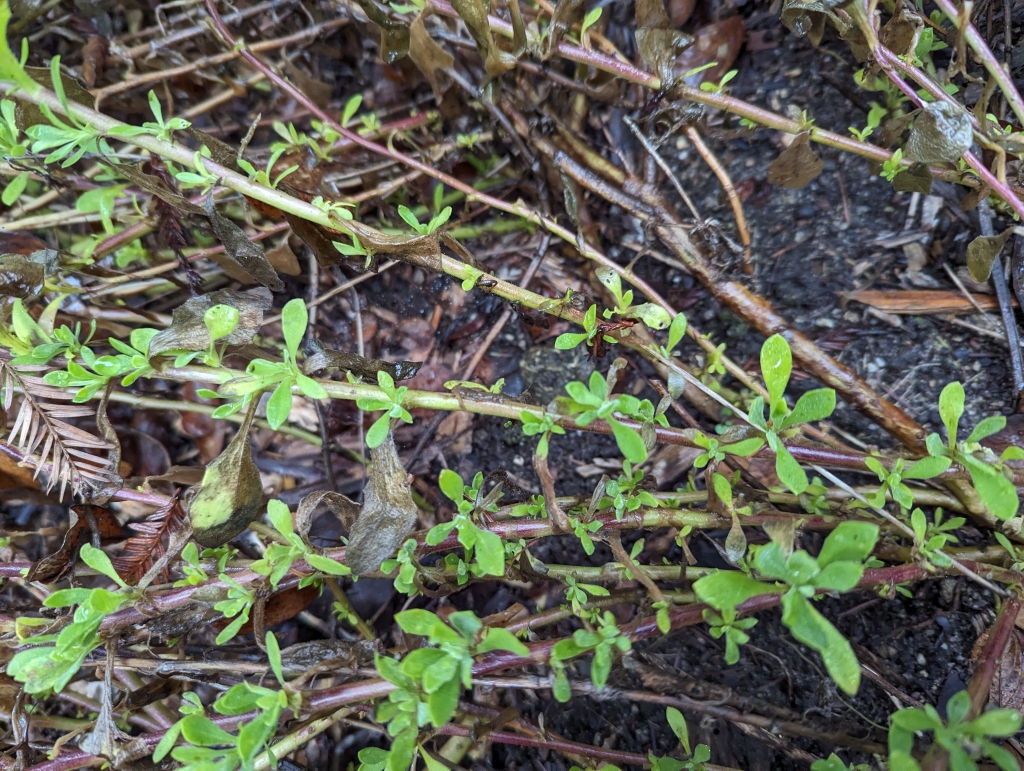
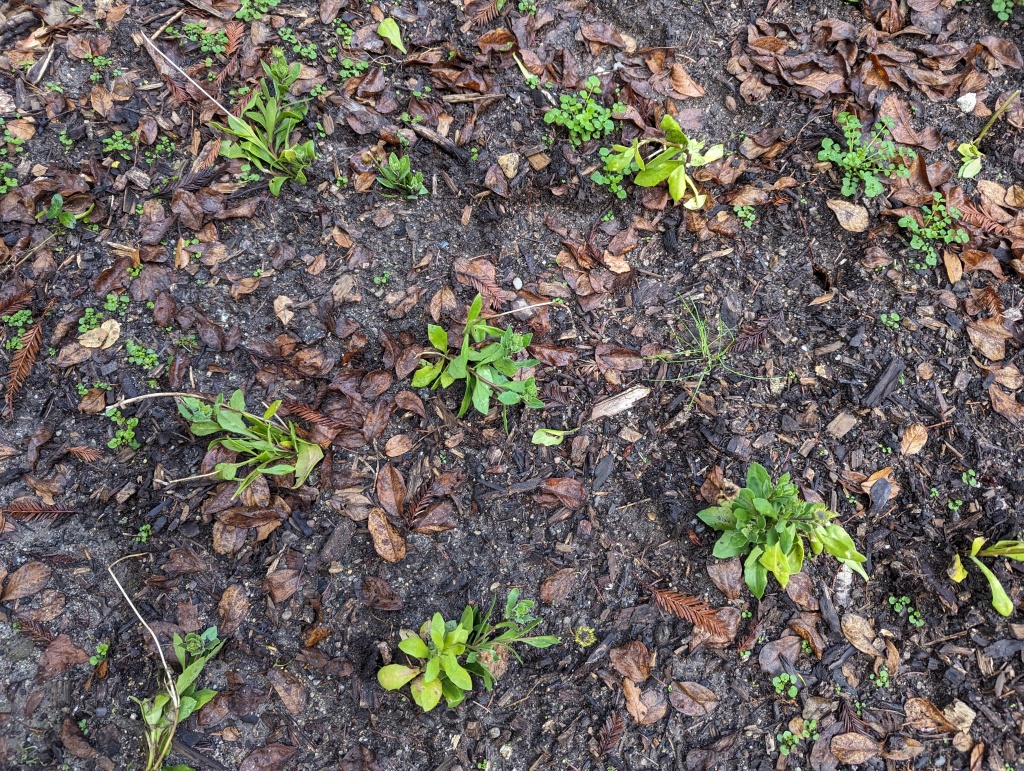
Agapanthus orientalis, lily of the Nile and Osteospermum ecklonis, African daisy are all there is to my Six for this Saturday. Lily of the Nile is in the first three. African daisy is in all but the first. Both are in the second and third. Both are from South Africa. Both have been getting recycled from where they are migrating a bit too much, and getting plugged into more appropriate situations. It is nursery production directly within the landscapes where the finished products are desired. Processing African daisy cuttings and lily of the Nile shoots takes time, but is still less expensive than purchasing nursery stock. They are byproducts of our normal landscape maintenance.

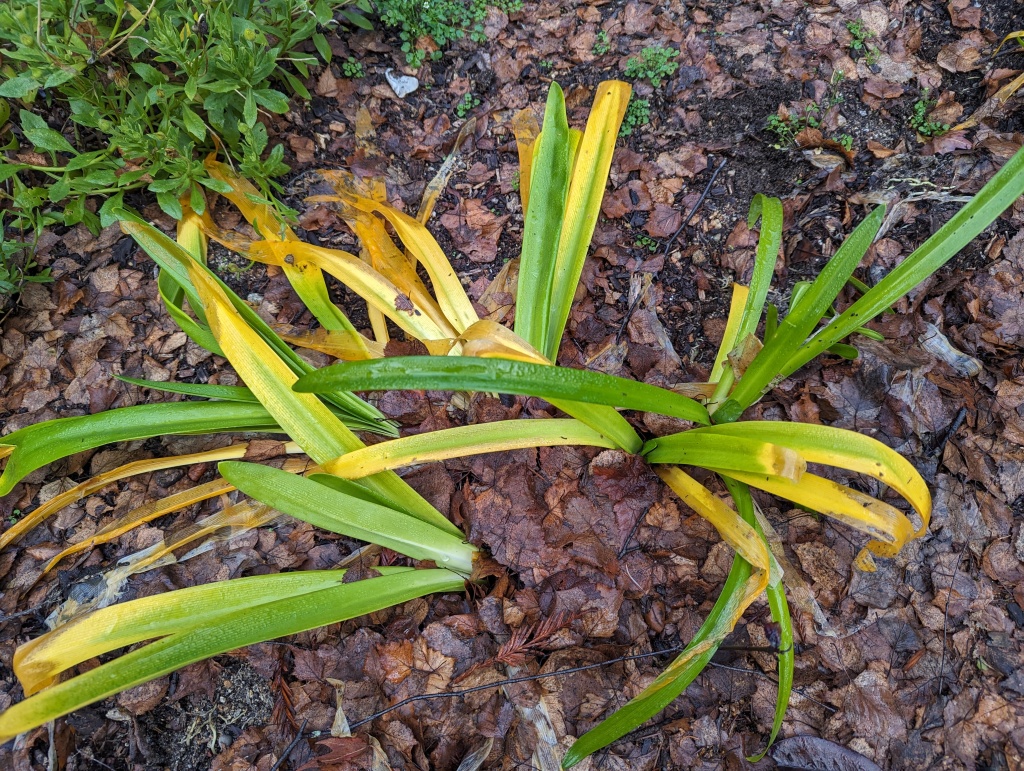
1. Gophers are killing fewer lily of the Nile than they killed last year. I must plug some of the spare shoots from last Saturday here though. Gophers ate the thick rhizomes below.

2. African daisy is performing as well as the majority of lily of the Nile in this landscape. It migrates nicely, but also encroaches somewhat into the adjacent row of lily of the Nile.

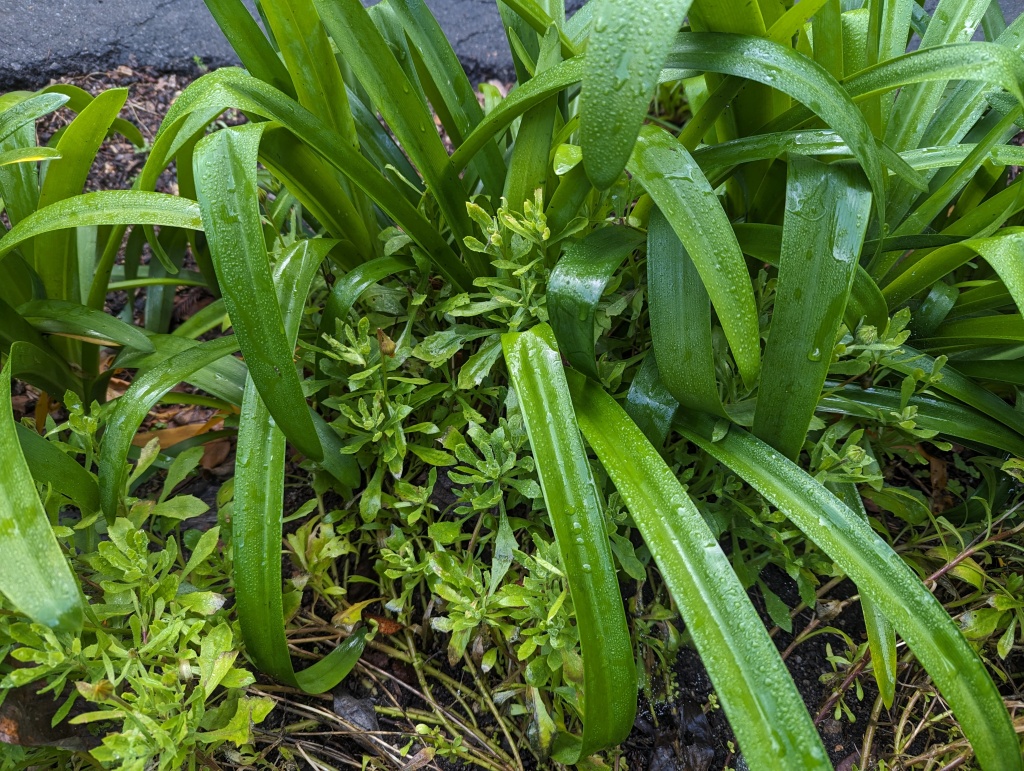
3. Edging is now necessary to separate the African daisy from the lily of the Nile. The lily of the Nile should grow to become too dense for the African daisy to encroach next year.

4. Some of the pruning scraps of the African daisy had already developed roots, as if they belong there. Their roots can be useful somewhere else. These scraps became cuttings.

5. Remaining stems are generating axillary growth for this year. We should apply a layer of compost over the stems to hold some against the soil so that they can develop roots.

6. Pruning debris from the African daisy was processed into unrooted cuttings that were plugged wherever we wanted more African daisy. They will develop roots prior to spring.

This is the link for Six on Saturday, for anyone else who would like to participate: https://thepropagatorblog.wordpress.com/2017/09/18/six-on-saturday-a-participant-guide/