Horridculture – WWW

Online, bay laurel often passes for culinary bay.

Anyone can say anything online. There is no shortage of inaccurate information. Much of it is stupidly inaccurate. Much of this stupidly inaccurate information is more popular and more efficiently dispersed than conflictingly accurate information. To make matters worse, some accurate information that seems like it should be readily available is notably lacking. For example, I can not determine if the native blue elderberry requires a pollinator for fruit production. It is a simple question that seemingly lacks an answer.

Facebook shared a link to an article about the twenty worst trees to select for home gardens. The article does not say where this information is relevant. Nor does it bother to mention that trees perform differently within different climates. It is presented as universally accurate information.

Chinese flame tree is first on the list. What is a Chinese flame tree? The article does not provide that information. This is what botanical taxonomy was invented for.

Eucalyptus is next on the list. What species of Eucalyptus? The article does not say. Nor does it mention any of the many species of Eucalyptus that are quite practical small trees. That is like saying that France, Spain, Italy, Greece and Portugal are all countries of Europe, but Africa is just Africa. (That happens also within other contexts.)

Tulip poplar is apparently dangerous because it drops branches. That sounds reasonable. However, coast live oak, blue gum eucalyptus, California sycamore and red willow are much more likely to do so here.

Black walnut is toxic. Although true, and some naturalized black walnuts remain from understock of the now extinct English walnut orchards, black walnuts are not commonly planted, and are not even available from nurseries.

Mulberry is messy. However, the only mulberry that is commonly planted is the fruitless mulberry. Fruiting cultivars are very rare, and mostly planted by those who actually want the fruit, and maintain them so that they do not get too big and messy.

Eastern cottonwood drops limbs. However, as the name suggests, it is Eastern, so is nowhere near here. Western cottonwood is a variety of the same species, and behaves similarly, but like black walnut, is neither planted intentionally nor is commonly available from nurseries.

The list goes on to include many trees that are not available here or that are simply not problematic. After describing all of the diverse species of Eucalyptus as one, it mentions a few species of similar cottonwoods as if they are more distinct from each other than they actually are. It shows a picture of common Mediterranean olive for Russian olive, which is not even remotely related. It says nothing about palms, which are good trees within appropriate situations, but require expensive maintenance by arborists who can climb them.

The internet is a useful tool, but is not perfect.
Apple

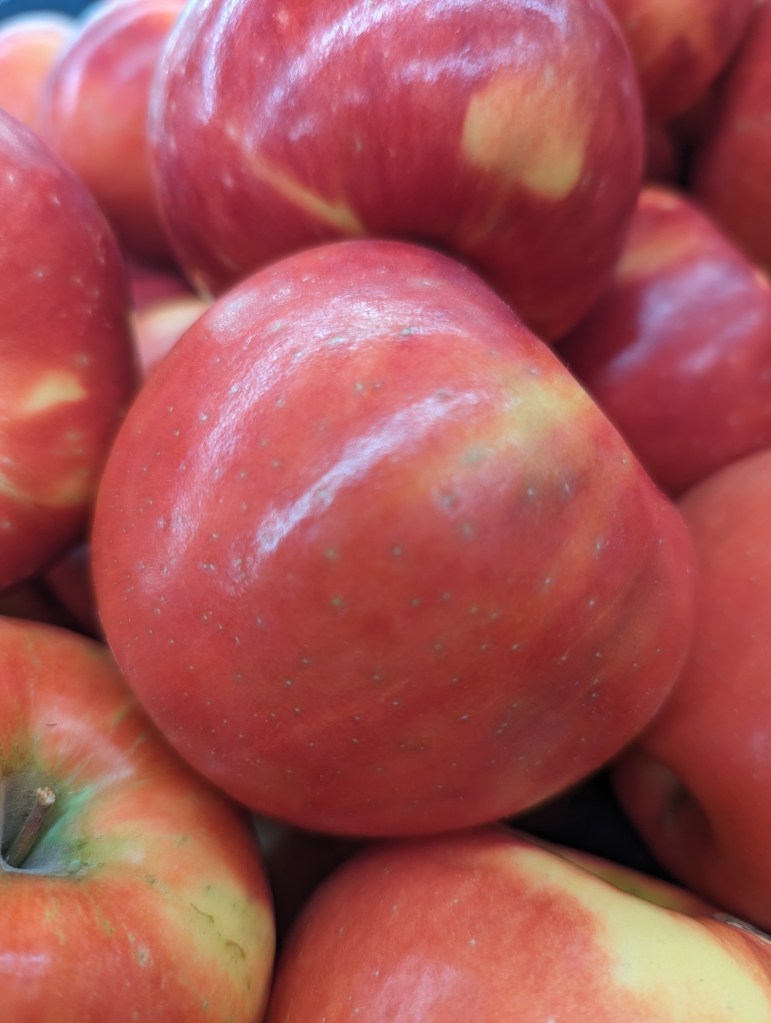
There are countless varieties of apple.

Apples are amazingly diverse. They have been in cultivation for thousands of years. Too many cultivars to document developed during that time. Some ripen as early as summer, while others ripen for late autumn. Some are best for eating fresh, while others are better for cooking, baking or juicing. Some are sugary sweet, while others are impressively tart.

Malus domestica is the general botanical name for most domesticated apples. However, this classification includes countless hybrids of a few species. Some are products of very extensive breeding. Most can grow as large as small shade trees. Grafting onto rootstock limits their size accordingly. Most ‘semi dwarf’ home garden trees are relatively compact.

Apple trees bloom with small but profuse and brilliant white flowers for spring. Flowering crabapple trees generally bloom pink or reddish pink, but produce dinky fruit. Otherwise, apples are about as big as baseballs. Some are significantly bigger or smaller. They can be variable shades of red, yellow or green. Some are striped or blushed with two colors. Their deciduous foliage turns yellow through autumn, and defoliates through winter.

Dormant Pruning Exploits Winter Dormancy

Fruit trees become congested without pruning.

Bare root season begins as the year ends for a simple reason. That is when deciduous plants are dormant. They are unaware of the otherwise distressful process of relocation. This is also why winter is the season for dormant pruning. Such pruning would be very distressful at any other time of year. While dormant, deciduous plants are unaware of it.

Dormant pruning of fruit trees is also important for a simple reason. Extensive breeding has increased reliance on horticultural intervention. In other words, deciduous fruit trees now generate more fruit than they can support. Their fruit is both unnaturally abundant and unnaturally large. It is both too heavy and too consumptive for its unpruned stems.

Dormant pruning enhances the quality of fruit by concentrating resources. Although less copious, fruit is bigger and better. Also, dormant pruning enhances structural integrity of supportive stems. Although more vigorous, vegetative growth is more compact. Stouter stems endure less leverage from fruit weight. As a bonus, more fruit is easier to reach.

Almost all deciduous fruit trees require very specialized dormant pruning. This includes some nut trees, as well as grapevines, kiwi vines, cane berries and roses. However, it does not include evergreen fruit trees, like citrus and avocados. They do not need such aggressive pruning. Besides, pruning stimulates new growth that is vulnerable to frost.

Unfortunately, dormant pruning is too specialized to describe in a few paragraphs. For most deciduous fruit trees, it is quite aggressive. Peach and nectarine trees may benefit from removal of half of their stem growth! Apricot and plum trees need a bit less pruning. Cherry and almond trees may need only minor pruning. Yet, all six are stone fruit trees.

Apple, pear and quince are all pomme fruits. Their trees require similar dormant pruning. Their many varieties require various degrees of such pruning though. Fig, mulberry and persimmon trees all require particular types of dormant pruning as well. Deciduous fruit trees are certainly not low maintenance. This should be considered before planting any.

No Bad Habit

Washingtonia robusta, Mexican fan palm

Technically, this one is different. I did not get it from a situation that it needed to be removed from at work, and then can it because I did not want it to be discarded. I did not grow it from seed or cutting that I ‘borrowed’ from a landscape somewhere else. I did not ‘borrow’ it from Brent’s gardens at the Jungalow. I did not find it for free on Craigslist.

I found it for free on the Marketplace of Facebook, which is NOT Craigslist or any other familiar source. Therefore, technically, it is not a bad habit.

It is a Mexican fan palm, Washingtonia robusta. It was too appealing to ignore. I noticed its post several days ago, but did not respond immediately. I thought that someone else would claim it if I ignored it long enough. No one claimed it; so it is here now. Actually though, I am very pleased with it.

It came from the Willow Glen neighborhood of San Jose, so is accustomed to excellent soil and climate. Its species is remarkably adaptable though. It will be as satisfied with the slightly cooler climate and sandier soil here. I will need to provide it with plenty of water while it disperses its new roots. It is only canned now because the situation that it will be installed into is not yet ready for it. A few deteriorating black locusts and box elders will need to be pruned or removed first.

As it recovers from transplant, the presently healthy leaves will likely desiccate and need to be pruned away. I will leave them until they do so because they may not, and they help to sustain new root growth and dispersion. The process is actually less stressful through the cool and rainy season of winter.

‘Yuletide’

Camellia sasanqua ‘Yuletide’

‘Yuletide’ Camellia sasanqua should bloom for Christmas, as the name implies. It typically does. However, it sometimes blooms early or late. It might be slightly late this year, but has been blooming for quite a while, and was beginning to bloom by Christmas.

It certainly is a delightful red. It seems to me that it can be slightly more reddish, with less of a pink influence, in some situations. Perhaps the bright yellow of the staminate centers cause it to appear as such within certain weather conditions or sunlight exposures. This particular flower may seem to be slightly pinkish as a result of distress. The hedge that it bloomed on had been infested with red spider mite earlier.

This particular cultivar of Camellia sasanqua develops distinctly upright and perhaps ovoid form, and can get quite tall. Most other cultivars develop more irregular or sprawling form, with long and limber stems, and relatively short stature.

I am impressed that this bloom is so resilient to wintry weather. Although much of the foliage is under a wide eave, most of the bloom is not under the eave, so has been exposed to both rain and frost. Apparently, Camellia sasanqua bloom is resilient to frost that is colder than it gets here. Camellia flower blight is common regionally, but mysteriously does not damage many flowers within the landscapes here. White and light pink Camellia japonica flowers are more vulnerable, but even they bloom quite nicely here, with only a few flowers succumbing before they finish bloom, and generally as their cumulative bloom cycle is finishing anyway.

Deer eat any cultivar of any species of Camellia, but avoid camellias here more mysteriously than camellia flower blight. I do not remember ever encountering damage that was caused by deer; and there are many camellias here.

Six on Saturday: Old School

Bauhinia punctata, Tupidanthus calyptratus, Olmediella betschleriana and Oreopanax capitatus are a few species that Brent and I studied in school during the late 1980s, then encountered only very rarely afterward. Actually, neither of us have encountered a single specimen of Oreopanax capitatus since 1990. Brent managed to procure a Tupidanthus calyptratus for his driveway. I may eventually procure a Bauhinia punctata. Nowadays, I work with Cocculus laurifolius and Pittosporum crassifolium, which, previously, I had not seen since school. Agapanthus orientalis and Juniperus chinensis ‘Kaizuka’ could be just as old fashioned, but never really got scarce. Perhaps I should post more pictures of species here that are actually rare instead.

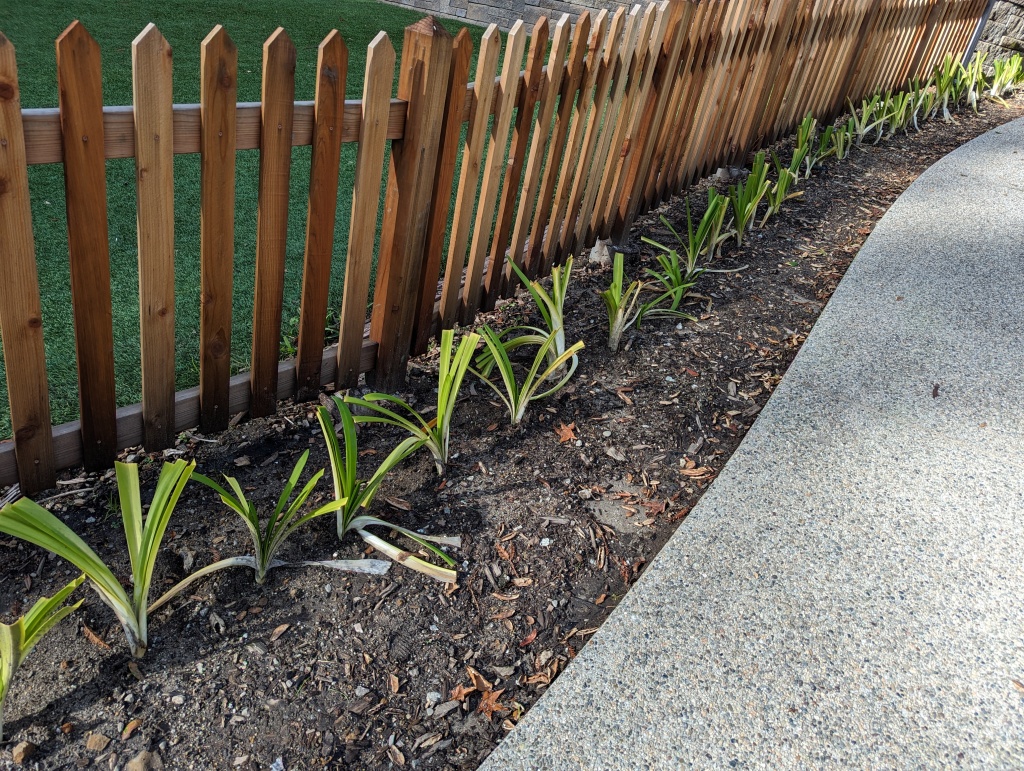
1. Agapanthus orientalis, lily of the Nile has been very popular and even common longer than anyone can remember, and still is. This picture of these divided and plugged shoots is here because I neglected to post it as I discussed them in Six on Saturday a month ago

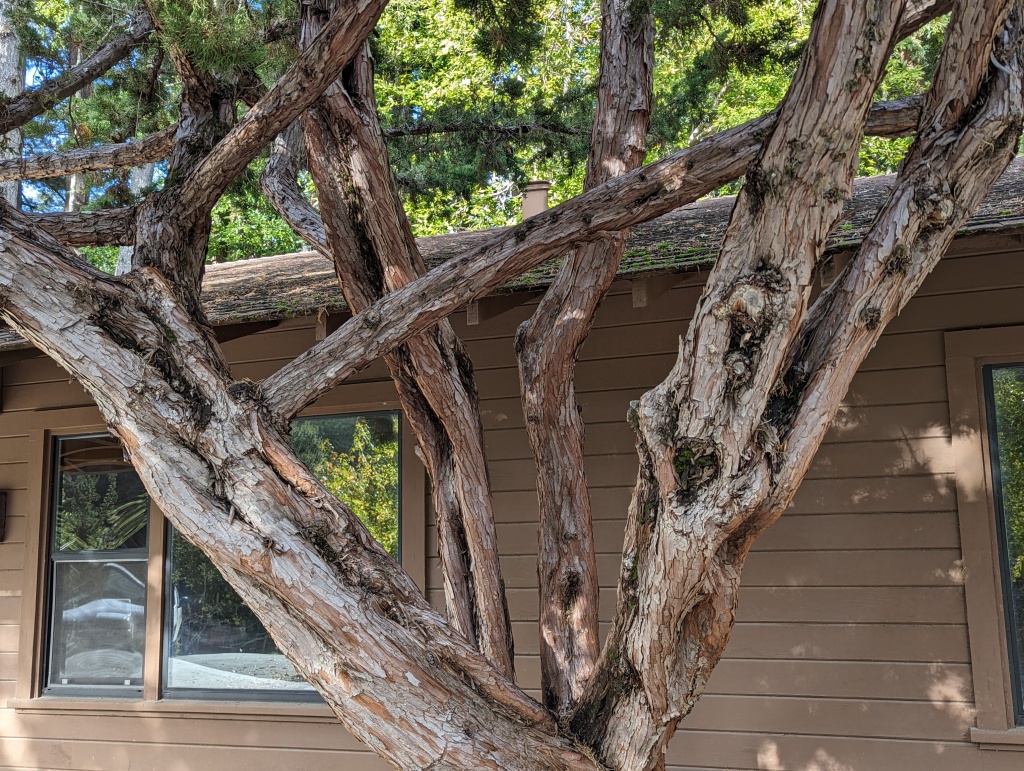
2. Juniperus chinensis ‘Kaizuka’, Hollywood juniper was passe prior to when Brent and I were in school, but older specimens remain. They are like sculptural small cypress trees.

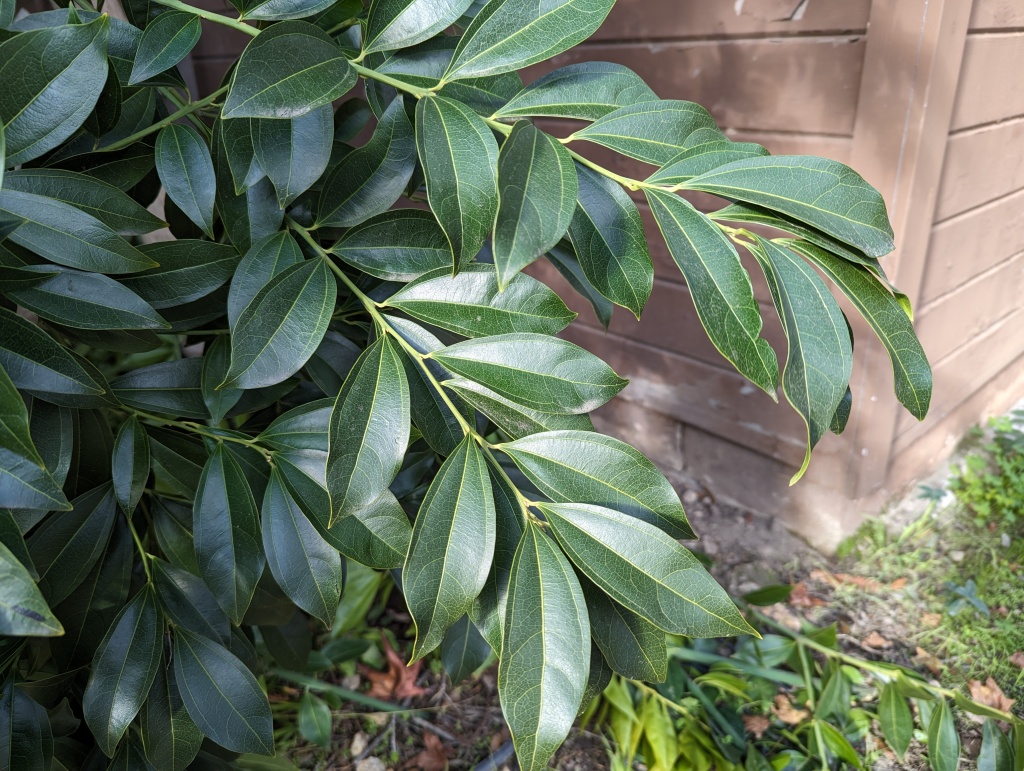
3. Cocculus laurifolius, laurel leaved snailseed is a species that we studied in school, but have seen in only a few situations since then. I happen to be acquainted with a few now.

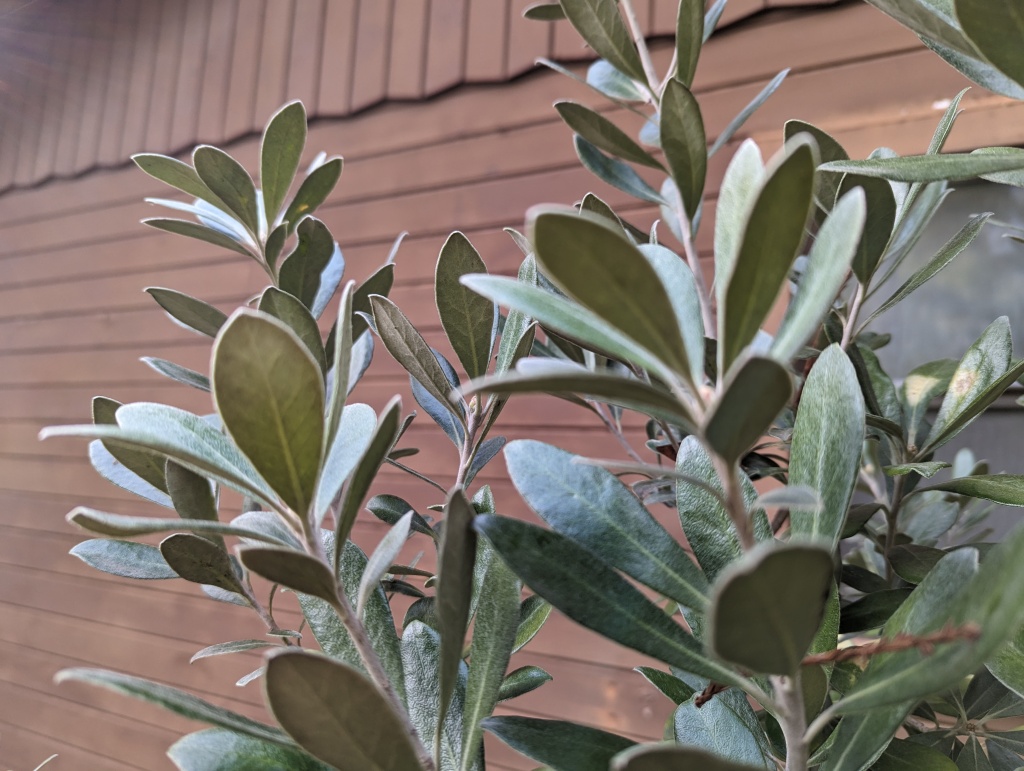
4. Pittosporum crassifolium, karo is very similar in that regard. It might have been more popular a long time ago, but lost popularity as more interesting species were introduced.

5. Pittosporum crassifolium, karo produces annoyingly abundant and annoyingly sticky seeds. ‘Pittosporum’ translates to ‘pitchy seed’. If they germinate, they do not do it here.

6. Rhody’s Roady got its new license plate with the colors of 1969. ‘O’ is for ‘Occidentale’, which is Rhody’s last name. It is irrelevant to an Isuzu or a downtown shopping district.

This is the link for Six on Saturday, for anyone else who would like to participate: https://thepropagatorblog.wordpress.com/2017/09/18/six-on-saturday-a-participant-guide/

Holly-Leaf Osmanthus

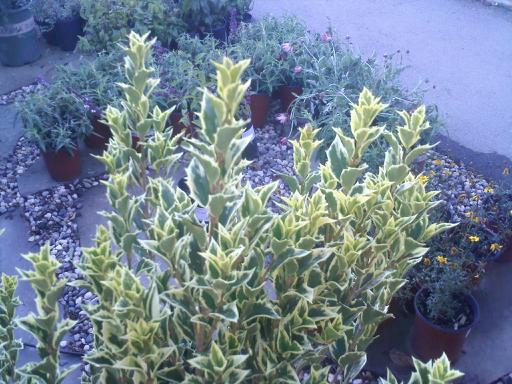
Holly-leaf osmanthus resembles both English holly and Euonymus.

English holly happens to be one of my all time favorite plants, even though it rarely produces the abundant berries that are expected of hollies. Its deep rich green foliage is so glossy and distinctively textured. Because English holly does not mind partial shade, the variegated varieties can add a bit of color where it is too dark for most other plants to bloom. I really do not mind that it is so prickly.

For those who do mind, the holly-leaf osmanthus, Osmanthus heterophyllus (or ilicifolius) is a worthy substitute for English holly that is just as happy with partial shade. The foliage is very similar in appearance, but a bit less glossy, and much less irritating. Holly-leaf osmanthus is sometimes mistaken for English holly, but can be distinguished by its opposite leaves. English holly has alternate leaf arrangement.

Mature holly-leaf osmanthus can get as large as English holly, but rarely does. It is more often less than 10 feet tall and wide, and is somewhat more adaptable to shearing into hedges. ‘Variegatus’, the most popular variety with pale white leaf margins, grows a bit slower and stays more compact, and actually looks better in partial shade than out where it is too exposed. Holly-leaf osmanthus flowers that bloom about now are not much to look at, but produce a delicate fragrance if the weather gets warm.

Bare Root Stock

Bare root stock is none too pretty in the beginning.

Now that Christmas trees have been moved out of the nurseries, it is time for bare root plants to move in! As the term implies, bare root plants have ‘bare roots’, lacking typical media (such as potting soil) which is typically contained in cans or pots. All sorts of deciduous fruit trees, roses, grapes and berries can be purchased bare root, either bagged with moist wood shavings, or out of the ‘sand boxes’ that they are heeled into in the nurseries. Even more are available from mail order catalogues. (Just check climate zone ratings for mail order stock.)

I purchased all of my deciduous fruit trees bare root mainly to save money. Bare root stock typically costs about half of what canned stock (grown in a nursery can or pot) does. Also, because bare root stock does not take up as much space as canned stock does, more varieties can be brought in and made available during bare root season.

Bare root stock gets established into the garden more efficiently than canned stock does. It gets dug, transported and planted while dormant; and can disperse roots into relatively uniform soil immediately after dormancy. However, stock that gets canned wakes up in spring in uncomfortably warm and confining nursery cans. After adapting to nursery conditions, it must then adapt to new garden environments, and disperse roots into soil that is very different from what it already rooted into.

Bare root stock should be planted as soon as possible after it leaves the nursery so that roots do not get too dry. If they can not get planted immediately, plants that were pulled from sand boxes in nurseries should get their roots heeled into (covered with) damp soil. Bagged stock in original packaging is safe for a few days in the shade.

Roots should be soaked a few hours before planting. I prefer to instead keep roots well watered for a day after planting. Broken or damaged roots should be pruned away before planting. Damaged and superfluous stems should be pruned away after planting.

Planting holes for bare root stock can be wide enough to loosen surrounding soil, but should be no deeper than necessary. Plants are likely to settle too deeply if the soil below is too loose. All roots should be buried while graft unions (the odd ‘kinks’ low on the trunks of grafted trees) remain exposed. Soil can be mounded firmly into a ‘volcano’ in the middle of each hole to spread roots over. Backfill soil can be amended lightly; not so much that it is too different from surrounding soil.

A basin should be formed around each new bare root plant so that roots can be soaked and settled in by filling the basins with water twice. Bare root plants are initially dormant and lack foliage, so do not need water again until they develop foliage, and the soil gets dry in spring. Besides, rain and cool weather will keep the soil wet through winter.

Leyland Cypress

Leyland cypress ‘was’ an intergeneric hybrid.

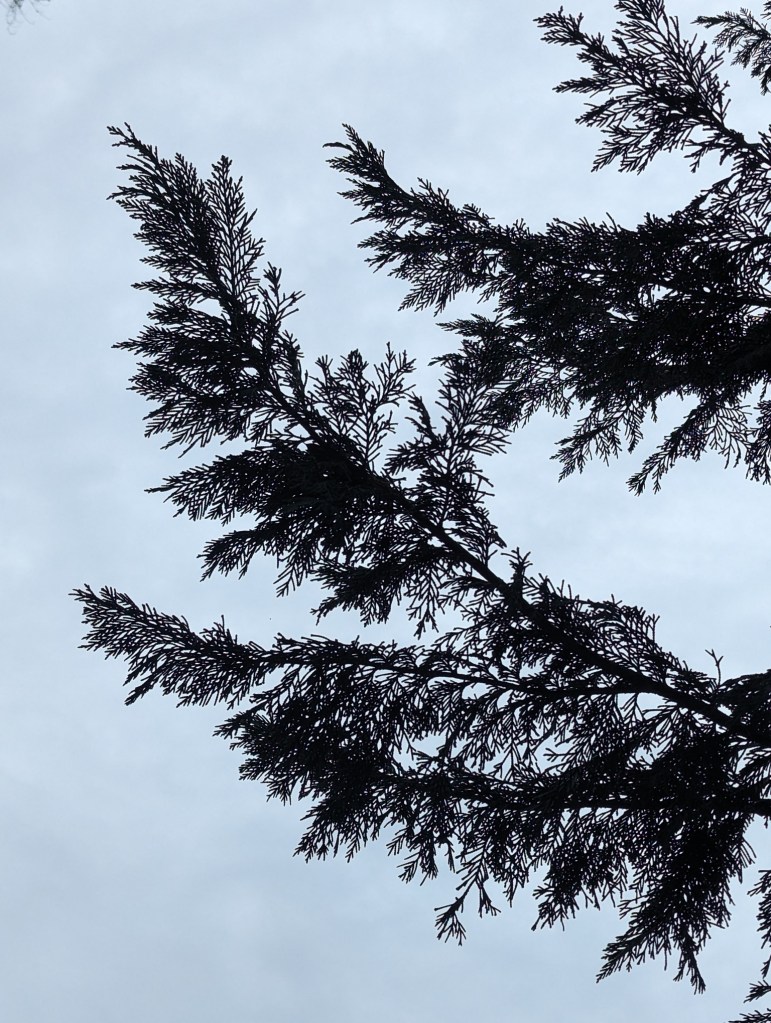
Taxonomy is a mess for Leyland cypress, X Cupressocyparis leylandii. The X preceding its genus name indicates that it is an intergeneric hybrid. Monterey cypress, Cupressus macrocarpa is the paternal parent of the original hybrid. Nootka cypress, Chamaecyparis nootkatensis, is the maternal parent. However, its name is now Cupressus nootkatensis.

Therefore, Leyland cypress is now Cupressus X leylandii, and an interspecific hybrid. It inherited attributes from both parents, as well as innate vulnerabilities. It can grow very vigorously to more than thirty feet tall in fifteen years. However, it may not live for another fifteen years afterward. It is very susceptible to cypress canker and a few other diseases.

This is why Leyland cypress often accompanies more permanent but slower vegetation. By the time it finishes its life cycle, the other vegetation is ready to replace it. Most large specimens are less than forty feet tall, with densely conical form. The evergreen foliage is grayish deep green. Less common cultivars are more grayish, yellowish or variegated.