Sugarless

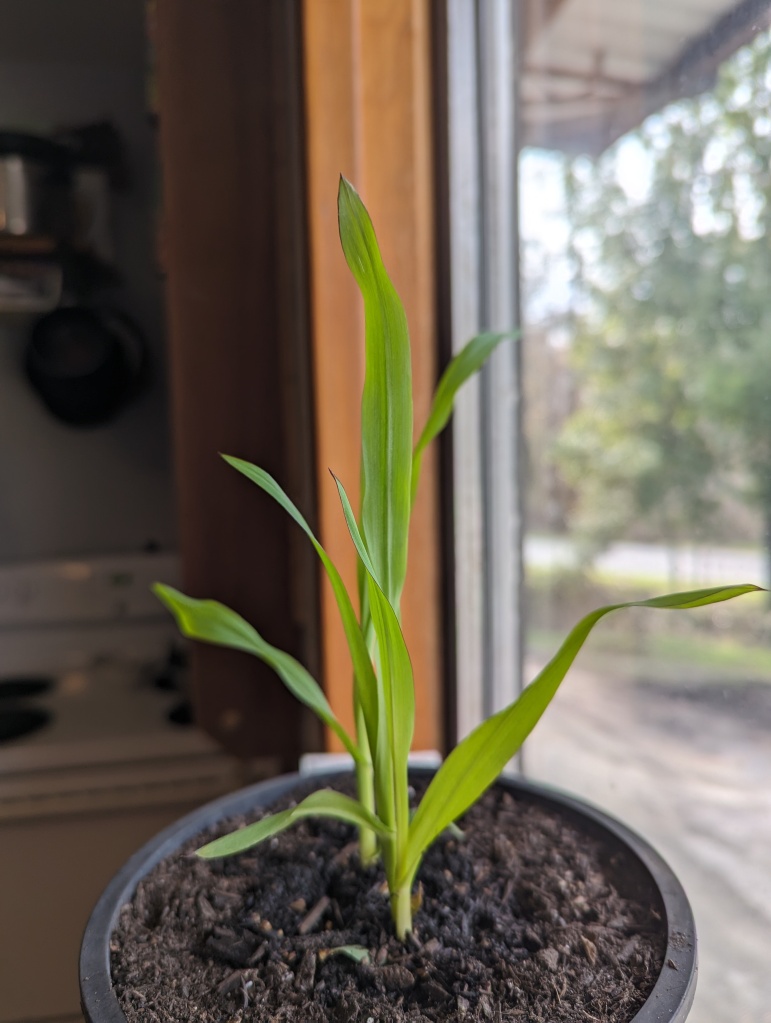
‘Pele’s Smoke’ is an ornamental sugarcane that should bronze with better exposure.

The internet is surprisingly deficient. It contains an amazing abundance of information, including a majority of information that most of us should not want. No one can filter out all the previews to disturbingly violent cinema, disturbingly idiotic political scandal, disturbingly aberrative sexual content, and so on. Yet, some of the simplest information remains mysteriously elusive.

I grow ‘Pele’s Smoke’ sugarcane only because it is what I obtained first. I grew it from scraps that I pruned from a specimen in the garden of a colleague in the Los Angeles region. It grows like a weed. I happen to enjoy growing it. It is primarily an ornamental cultivar though. With its bronze foliage, it is intended to be prettier than it is functional. Although it is considered to be productive, the canes are small and relatively tough.

I would like to grow a variety of sugarcane that is more utilitarian than ornamental. There are many varieties within three types of sugarcane that I should be able to choose from. Chewing cane is the sort that develops a soft and chewable pulp within its canes that can be chewed like a confection, leaving less inedible fibrous pith than other varieties. I do not want to bother growing chewing cane. Syrup cane may produce a bit more fibrous pith, but generates an abundance of sugar syrup, which unfortunately does not crystalize as readily as that of other varieties. I do not want to bother growing syrup cane. Crystal cane is the sort that produces the most sucrose, which should crystalize more readily than the combinations of sugars that other varieties produce. That is what I am still trying to find! Several varieties of sugarcane are available online, but very few are classified as chewing, syrup or crystal canes! I am still searching!
Six on Saturday: Bad Botany

These six lack a common theme. I do find the botany of four of them to be annoying, but that is no theme. Leyland cypress has a new genus name, which I did not mention. I still do not believe that the native blue elderberry is the same species as the black elderberry of the East. I still do not know for certain if the double white angel’s trumpet is a hybrid, although I do believe that it is. Although I exceeded my preferred word count limit here, I tried to abbreviate some of the redundancy of nomenclature while including both Latin and common names with the same cultivar name. Otherwise, the first of these six would be Saccharum officinarum ‘Pele’s Smoke’, ‘Pele’s Smoke’ sugarcane, with ‘Pele’s Smoke’ mentioned twice, with a comma in between. I may continue this technique in the future.

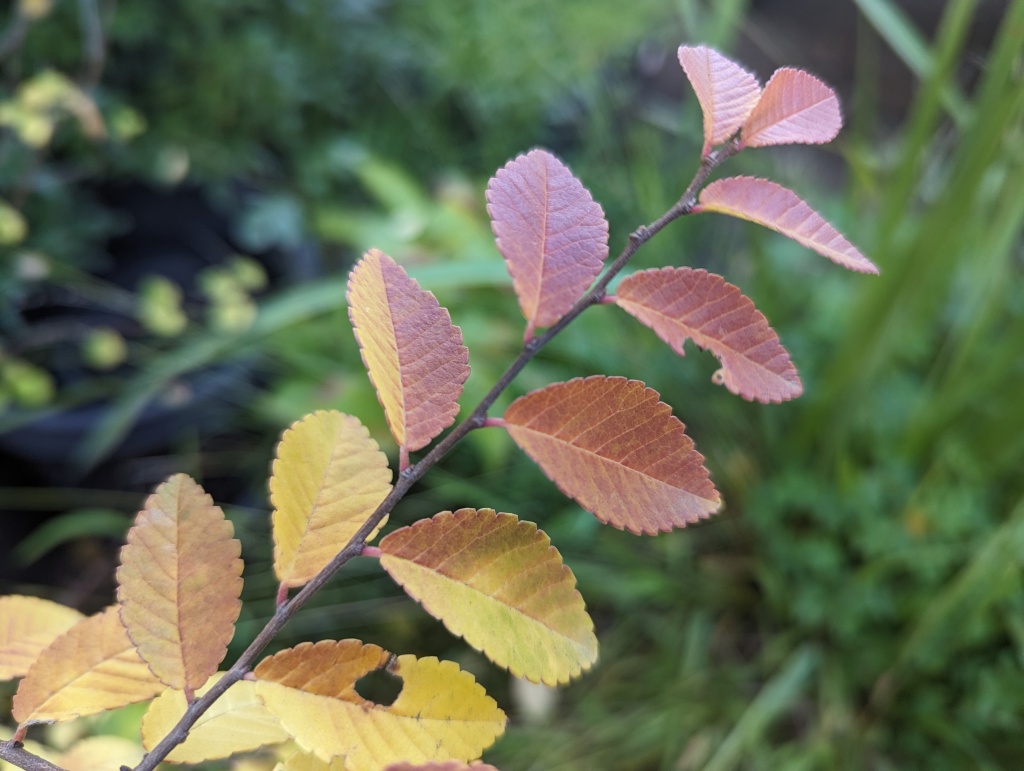
1. Saccharum officinarum ‘Pele’s Smoke’ sugarcane continues to grow like a weed on the warm windowsill in the galley at work. It is not bronzing though. I suspect that this fresh new foliage will be too tender to survive outside even after early spring. It is no problem. It will simply make more. Many more cuttings are growing outside. They are slower but more resilient. For less redundancy, I used its same cultivar name after its species name and before its common name. Of course this explanation is longer than any redundancy.

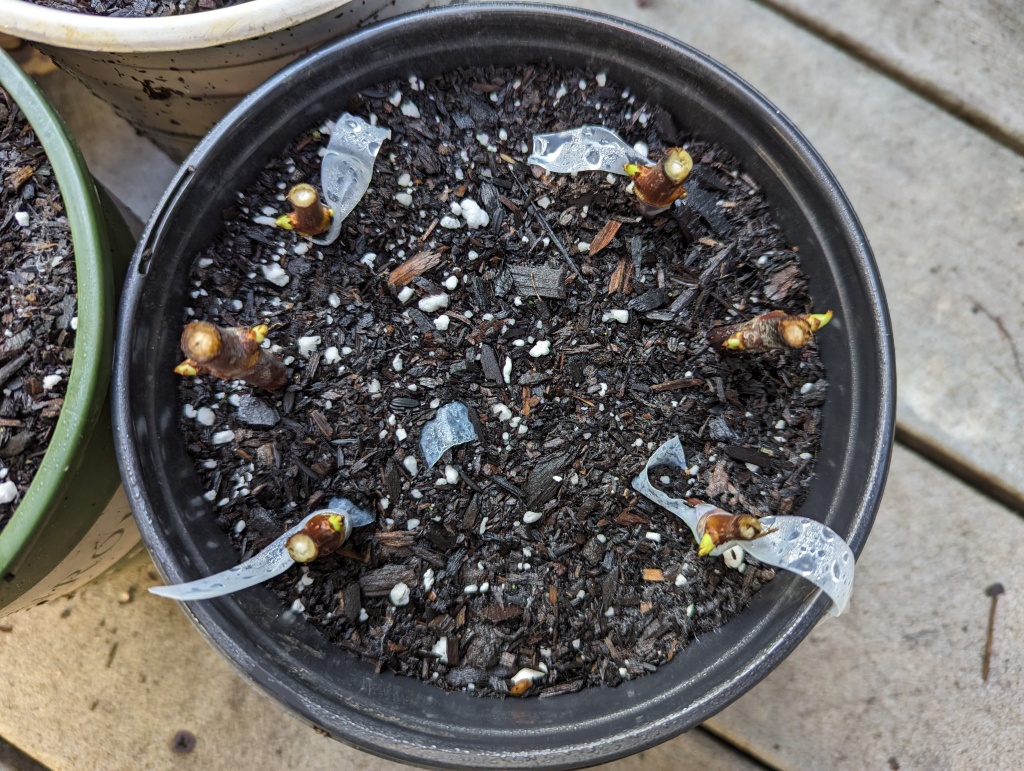
2. Sambucus cerulea, blue elderberry is classified by most botanists as a Western variety of American black elderberry. I know better. I am Californian. Regardless, I am growing a few cuttings from a few different parents because no one seems to know if they should be more productive with pollinators, like European black elderberry is. Four tagged bits are from the same very productive specimen, which must be removed from a landscape. The other pair is from a random roadside specimen. Three other pairs were added later.

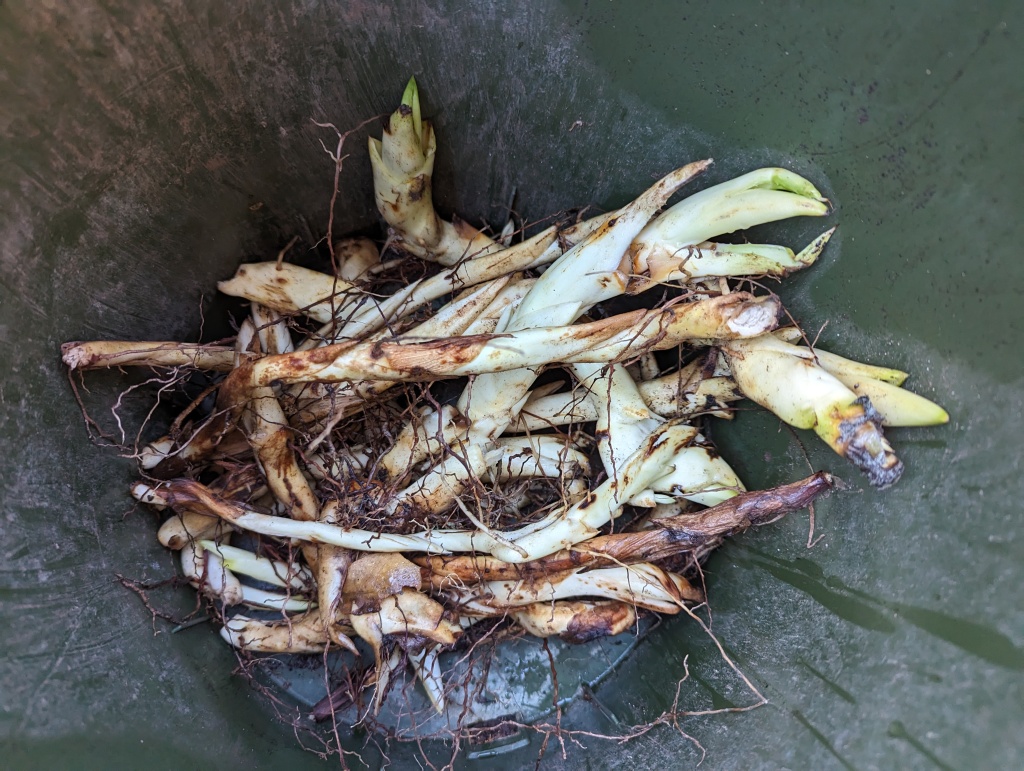
3. Agave americana, century plant is too prolific. We installed one of several ‘unwanted’ specimens and found all these pups within its can underneath. We can not use them all.

4. Ulmus parvifolia, Chinese elm became unavailable years ago after it was identified as a host for Dutch elm disease. Watersprouts continue to grow from a stump of a tree that was cut down years ago. If I could, I would grow several of this formerly familiar species.

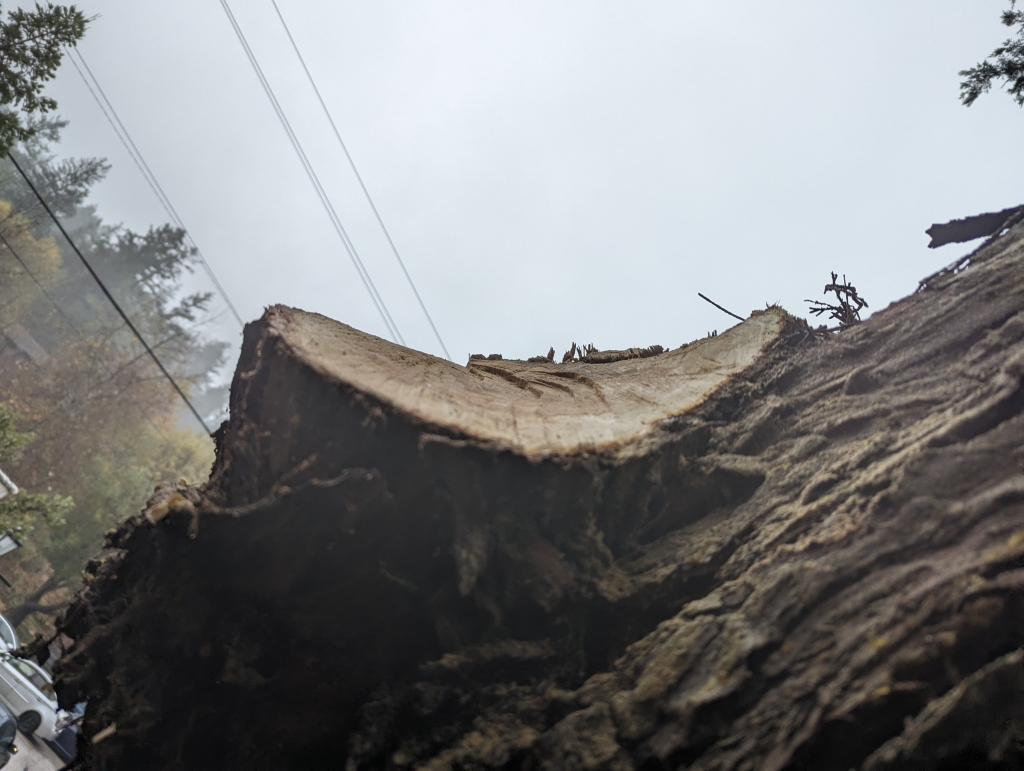
5. X Cupressocyparis leylandii, Leyland cypress is irrelevant to this illustration of how a chainsaw cuts if one side is sharper than the other. Another saw cut the flatter surface to the left. Incidentally, the ‘X’ preceding the genus name indicates an intergeneric hybrid.

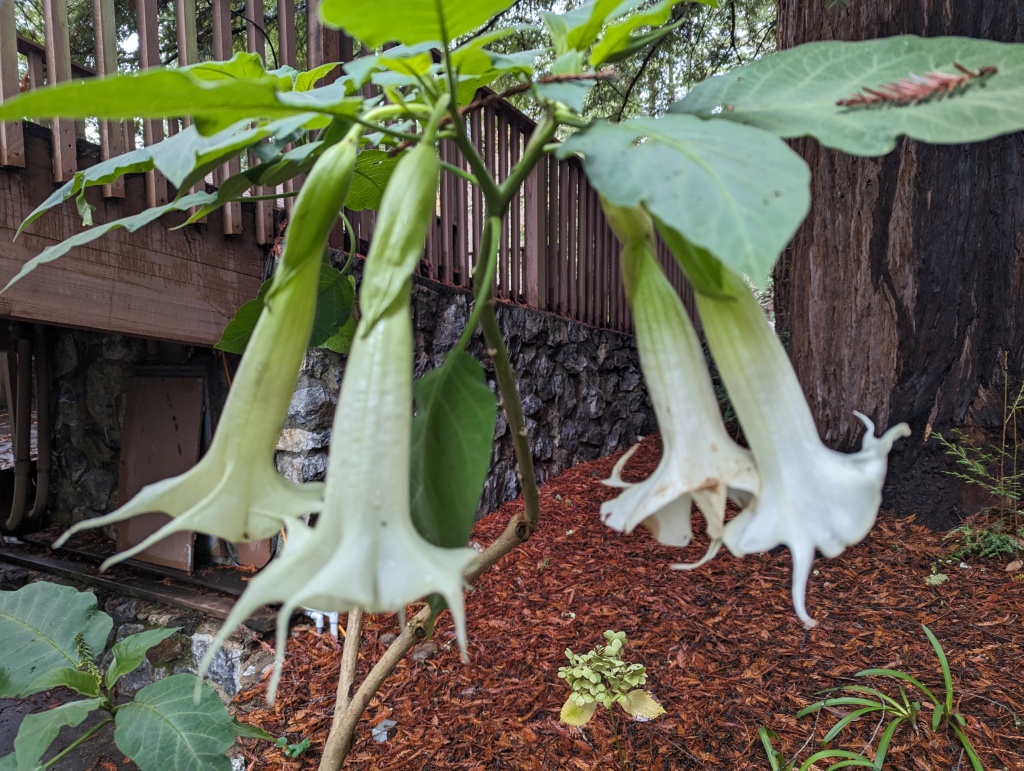
6. Brugmansia X candida ‘Double White’ angel’s trumpet should not bloom now. Either it does not know, or it does not care. Incidentally, the ‘X’ between the genus and species names indicates an interspecific hybrid. Like for the sugarcane, I used the same cultivar name after its species name, and before its common name. Is such abbreviation proper?

This is the link for Six on Saturday, for anyone else who would like to participate: https://thepropagatorblog.wordpress.com/2017/09/18/six-on-saturday-a-participant-guide/

White Alder

White alder is not exactly . . . white.

During the summer, the native white alder, Alnus rhombifolia, is a nice shade tree that looks bigger than it really is. By late winter, the bare deciduous canopy has an appealingly picturesque silhouette. This time of year is actually when white alder is typically less appealing, with dead foliage that provides no interesting fall color, but lingers until knocked down by rain or late frost. Yet, even now, it sometimes surprises with these funny looking floral structures that are interesting both in the early winter landscape, and with cut flowers.

In past decades, white alder was an ´expendable’ tree that was put into landscapes for quick gratification while slower but more desirable trees matured. By the time the desirable trees matured, the alders were removed to make more space for the desirables. This technique was practical because, like many fast growing trees, alders do not live very long, so start to deteriorate after about twenty five years anyway. However, alders often live longer than expected.

Mature alders are usually less than fifty feet tall where they are well exposed. They can get at least twice as tall where shaded by other trees or big buildings. Their plump trunks with mostly smooth silvery gray bark make them seem larger than they really are though. Too much water promotes buttressed roots which can displace pavement.

Bare Root Begins As Christmas Ends

Bare root stock is exactly what it sounds like.

Now that nurseries and garden centers are no longer selling Christmas trees, they have plenty of room for bare root stock. All sorts of deciduous fruit trees, a few deciduous shade trees, shrubs and vines, and even a few perennials can now be purchased while dormant and without the cumbersome media (soil) that the roots need at all other times of the year. Not only is bare root stock easier to handle and transport in small cars, but it is also much less expensive than canned stock (that has roots contained in media, which is contained in nursery cans). Bare root stock typically costs about a third of what canned stock costs.

Bare root stock also has the advantage of adapting to new garden easier, since it does not need to leave the comfort zone of the media that it would have grown into (within a can) in order to venture out into unfamiliar soil. Instead, it starts to disperse roots into the new home soil immediately as it emerges from dormancy in late winter. Without cans, bare root stock can not get root bound. Instead of developing branch structure that is appealing to nursery marketing, bare root stock can get an early start on developing branch structure that is most practical and efficient for the gardens that it gets installed into.

It seems that all of the ´stone’ fruit can be found as bare root stock. These include apricot, cherry, plum, prune, peach, nectarine, almond (which is the seed, or ´stone’, of a peach like fruit) and the odd hybrids of these. The pomme fruits, apple, pear and quince, are perhaps the second most popular of bare root stock, although quince is still rather rare. Ornamental trees, shrubs and vines include flowering crabapple, flowering cherry, flowering quince, alder, poplar, willow, lilac, forsythia, wisteria and clematis. Perennials include rhubarb and artichoke.

Bare root stock can be purchased as soon as it becomes available, but does not do much until it starts to grow in spring. It should get planted quickly and soaked in, but will get more water than it needs from rain afterward. It should not need water again until after it blooms or gets new leaves in late winter or early spring. Despite guarantees of fruit in the first year, none should be expected. The few fruit trees that might set fruit will probably produce only useless underdeveloped fruit because new plants are busy producing new roots and growing. Actually though, this apples to canned stock as well, except only for citrus, olives and other evergreen fruit trees.

Ornamental Kale (deferred from yesterday)

Flowering kale really seems to bloom.

Flowering cherry trees are prettier but fruitless versions of their fruiting counterparts. So are flowering peach trees. It seems only fair that some vegetables could also be prettier than culinarily useful. Gourds are ornamental squash fruit that can qualify as vegetables. Ornamental kale, Brassica oleracea, is an actual vegetable that is primarily ornamental.

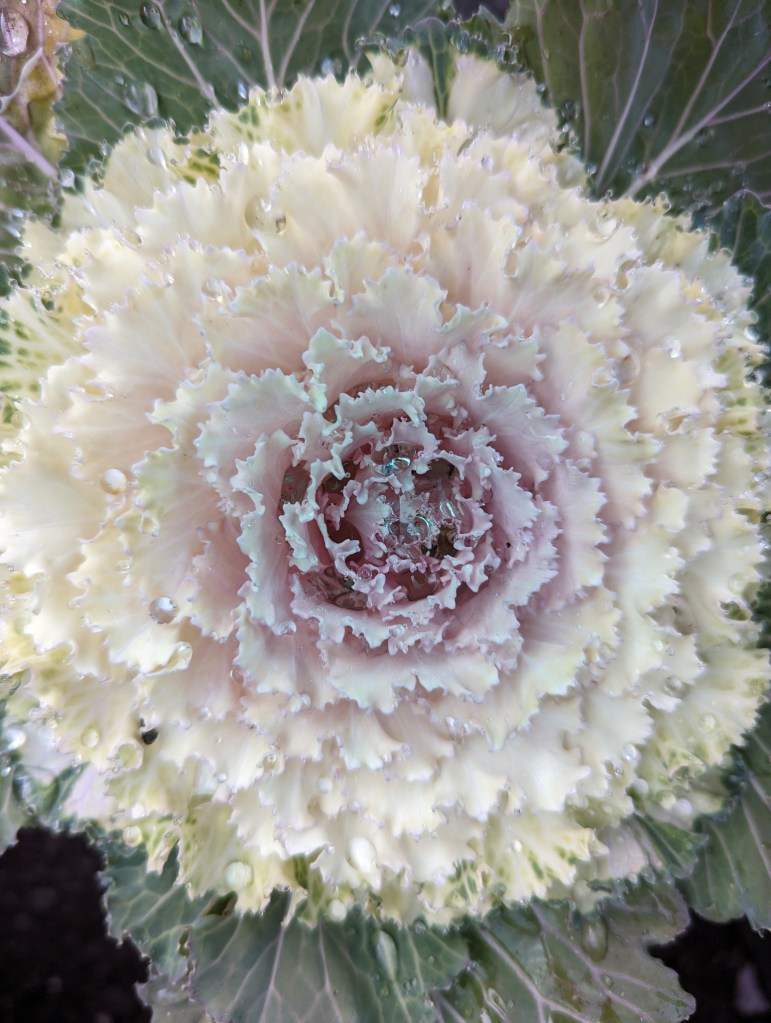
Ornamental kale is also known as flowering kale, or ornamental or flowering cabbage. It is more foliar than floral though. Its dense foliar rosettes unfurl like big ruffly roses. Some are very ruffly. Some are intricately lobed. Foliar color can be white, pink, red or purplish. Ornamental kale is as edible as culinary kale, but a bit more bitter. It is a splendid garni.

Like cool season annual flowers, ornamental kale performs between autumn and spring. It grows quite slowly though. Seed that starts in August grows into seedlings for October. Seedlings that start in October only begin to get colorful during November, a month later. Their seemingly floral but foliar display ironically ends as they actually bloom for spring.

Winter Bloom Might Be Limited (deferred from yesterday)

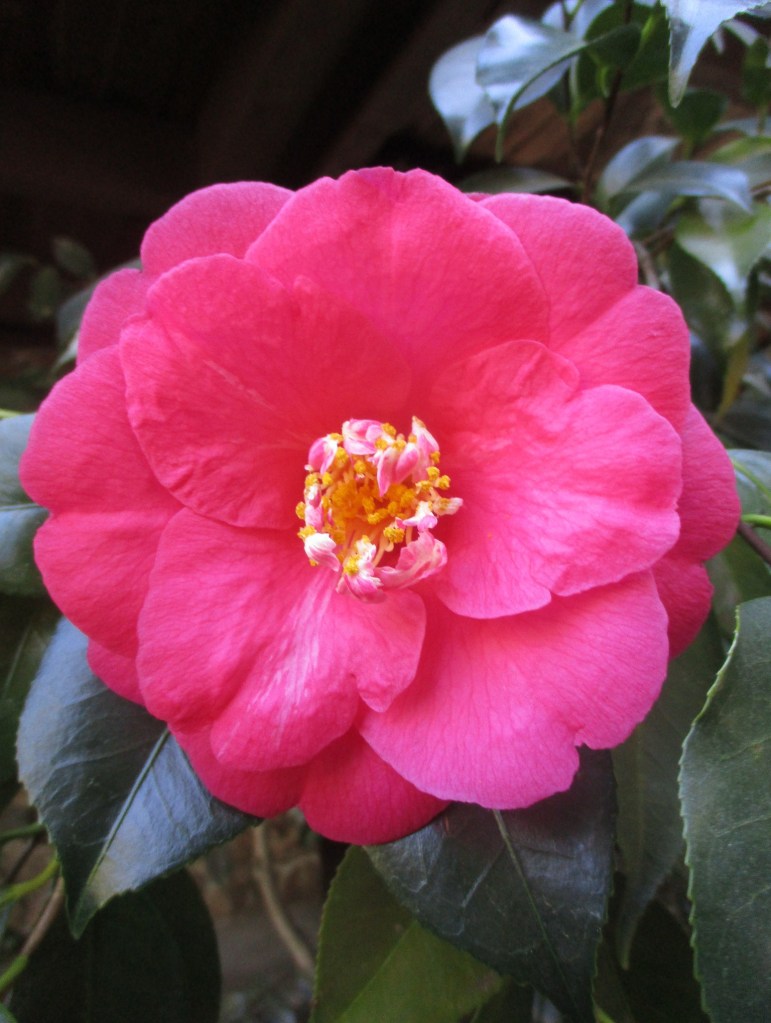
Some camellia varieties bloom for winter.

Except for flowers that bloom randomly throughout the year, most autumn bloom is done. Much of the formerly spectacular autumn foliar color succumbed to wintry rain and wind. Many colorful winter berries have already gone with migratory birds who consume them. Overwintering birds appreciate what lingers. Fortunately, some winter bloom continues.

Cool season annuals likely provide most winter flowers prior to spring. Ornamental kale generates a foliar display like a pastel version of summer coleus. Snowdrop bulbs bloom only white, but look sharp if other bloom is scarce. A few species contribute winter bloom merely because they lack regard for seasons. African daisy blooms whenever it wants to.

However, winter bloom is not comparable to spring bloom. That is an unfortunate reality. Most species that bloom randomly throughout the year bloom best for spring or summer. Most species that bloom specifically during winter are relatively subdued about doing so. Although pollinators are less active, competition for their pollination services is minimal.

Witch hazel is becoming more popular locally for its fragrant winter bloom on bare stems. Modern cultivars bloom with earthy tones of yellow, orange, red, and burgundy red. They prefer cool wintry weather though. Bloom may be inhibited somewhat within mild coastal climates. Winter jasmine bloom, although limited to only brilliant yellow, is more reliable.

Some species of Mahonia likewise bloom reliably but exclusively bright yellow. They are evergreen instead of deciduous. So is andromeda. Its pendulous ivory white or pale pink blooms are more striking in form than color. Daphne, which likely finished bloom already, is more striking in fragrance than color. Its light pink bloom is mostly obscured by foliage.

Camellias are among the most reliably colorful of winter bloom. Their floral color ranges through all hues between white and red. Floral form and abundance are notably diverse. Some bloom rather sparsely. Various cultivars bloom at various times throughout winter. Sasanqua camellias generally bloom earlier, with relatively smaller but profuse flowers. Camellias unfortunately lack fragrance.

Merry Christmas!

This was much more awesome than gold, frankincense or myrrh!

Happy Birthday Jesus!

What is a suitable birthday gift for Someone Who has no use for anything worldly, but lived like He did? Gold, frankincense and myrrh seemed like good ideas in the beginning, although they were presented a year prior to His first birthday. Contrary to modern commercialism, a Lexus or Mercedes Benz might not be so appropriate for Someone Who preferred to come into town on a colt, and not the Dodge sort. Perhaps that is why it is customary to present gifts to others instead. Such gifts are Christmas gifts because so few have the same birthday.

Although overly elaborate or abundant gifts are a tradition that I find to be objectionable, I enjoyed many relatively minor gifts when I was a kid. Within my first few years, although I do not remember exactly when, I received my first tree, which was a seedling of Calocedrus decurrens, California incense cedar, from Amador County. A year or two afterward, I received a ‘Meyer’ lemon tree. During the same time, I received seed for many types of vegetables and a few flowers, as well as a set of child-sized gardening tools of premium quality. They lasted long enough for my mother to use the shovel to clean ash from the woodstove long after I graduated to a real shovel.

The most awesomely awesome Christmas gift that I received back then was my deluxe Radio Flyer wagon! It was my first luxury sedan that worked like a pickup! It was as durable as the other gardening tools. After I went to college, my mother used it to bring in firewood. It is out back right now, more than half a century after I received it new. It may continue to work in my garden as long as I do.

Heather (not Calluna vulgaris)

Heather – rodent mitigation specialist

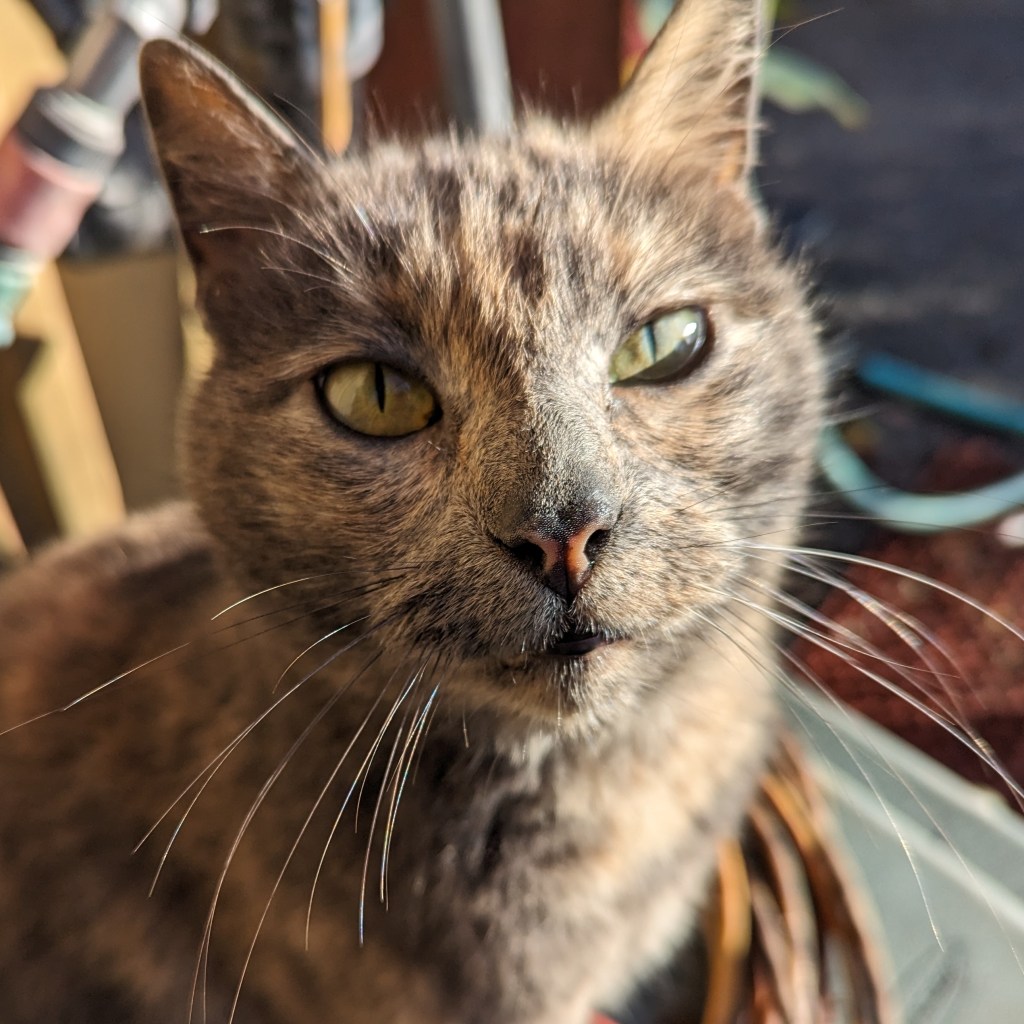
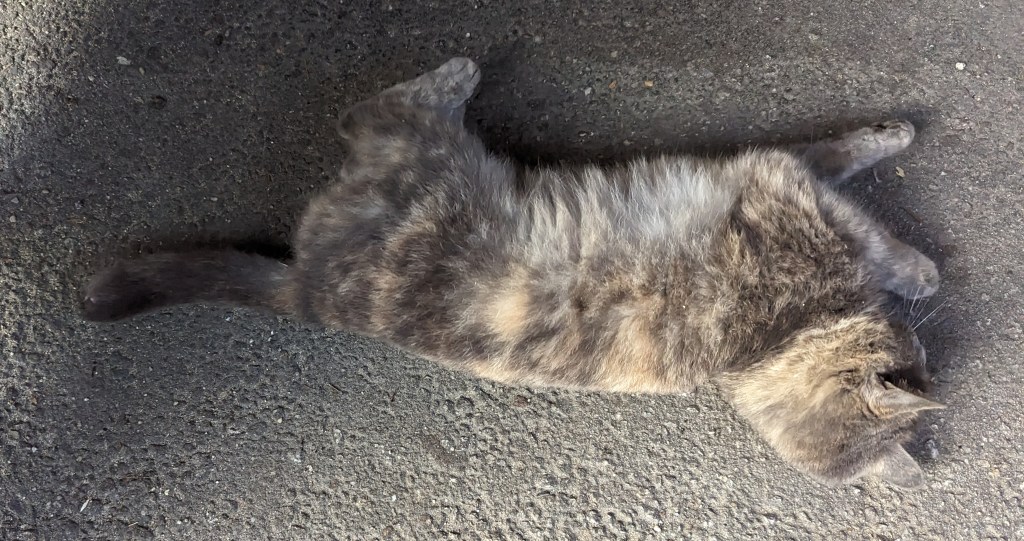
Heather is the new rodent mitigation specialist. She has been here for quite a while. We have been unable to determine where she originated from. Unless or until we do, she can stay here to dissuade rodent incursion. She has been remarkably effective with her expertise. None of the formerly bothersome rodents have been observed since her arrival. The seedlings and small perennials that the rodents had been eating previously have incurred no subsequent damage.

This will take some getting accustomed to. I am not particularly familiar with kitties. I give her a can of food in the evening, with dry food available at other times. She has a sheltered bunk out in the nursery, but might want to come into the foyer when the weather gets frosty or rainy. If so, I may put a warming pad for kitties under her bunk, since it will be close to an electrical outlet. She does not seem to be too demanding yet, but I have no idea how kitties operate. She could get demanding later, and because she is a kitty, I can not argue with her.

She does not have much to say though. She meows when hungry. When petted, she makes that weirdly distinctive purring sound that kitties make, but mysteriously, without actually speaking. She was quite fond of Rhody before people could get close to her, and seemed to enjoy how he chewed her head, but now that people regularly pet her, she avoids Rhody, and actually hisses at him if he wants to chew her head. She could not tell us what her name is, so, after some minor deliberation, we named her Heather.

Notice her tail.

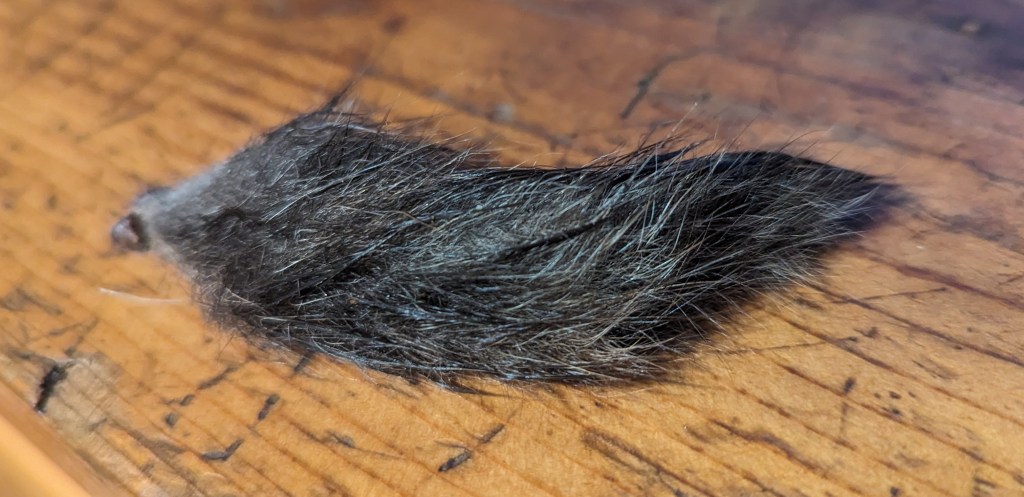
We do not know exactly how long Heather has been here, but after her arrival and prior to her socialization, we noticed that the tip of her tail was kinked. As she became socialized and pettable, we noticed that the tip of her tail beyond the kink seemed to be necrotic, and felt like an old fashioned rabbit’s foot keychain. A few days later, the kinked tip was no longer a concern.

tippy toupee

Stick in the Mud

Correction: two sticks in potting medium

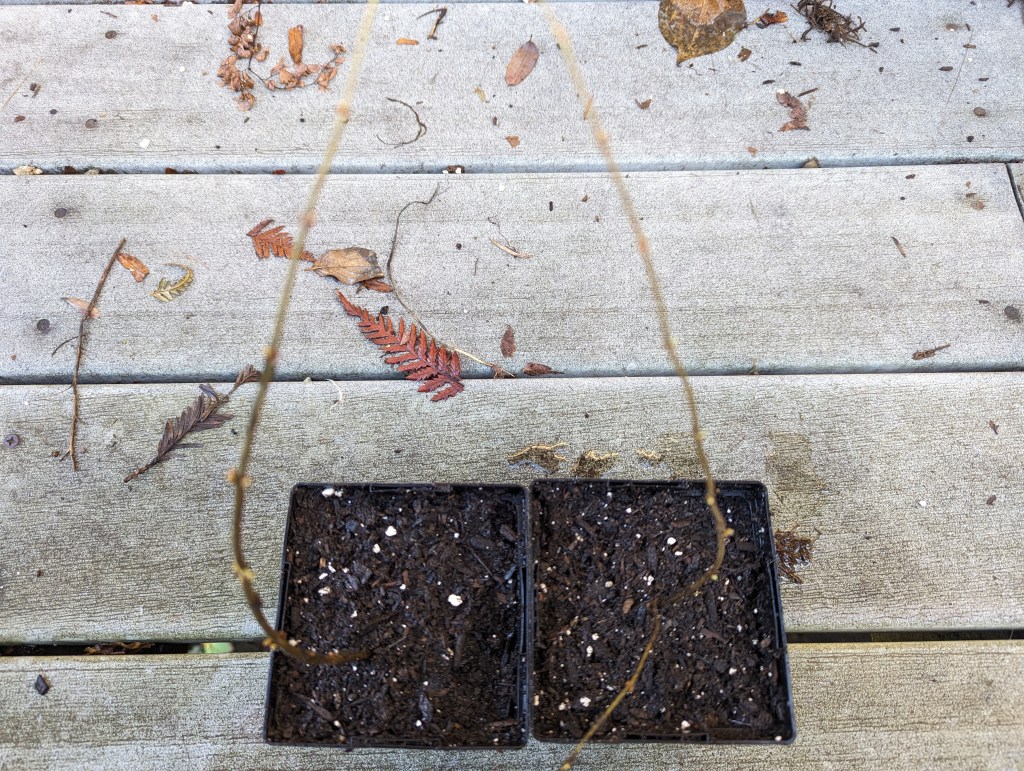
This is why I did not brag about my recently acquired snowberry within the context of my ‘Six on Saturday’ post this morning. They are not much to look at. Even if this illustration were more in focus, these bare twigs are indistinguishable from similar dormant twigs.

Nonetheless, I am pleased with their acquisition. I can not explain why, but I am pleased. The species, Symphoricarpos albus, is native, but not popular. I am beginning to realize why. Not only is it not much to look at in this particular condition, but it will unlikely ever become much to look at. It always looks scraggly, even while generating new foliage for spring. Its foliar color is unimpressively bland light green. Its twigs are very twiggy. Its dinky pale pink flowers are grungy and almost always infested with something or other. Its white berries, which is its primary attribute, are very scarce.

After so gleefully pulling this particular seedling from a landscape that it needed to be removed from, splitting it into two, and canning them as seen here, I realized that a rather large colony of snowberry inhabits another of the landscapes here. I could take as many rooted bits from it as I want without noticeably depleting it. For now, I am very satisfied with these. I have no plans for them, but will figure that out as they grow.

I suspect that snowberry can be more appealing in cultivation than in the wild. I intend to promote growth that is more vigorous than typical, which should enhance berry production. After this first winter, in which I dug and canned it, I will likely cut all of its growth to the ground annually during winter dormancy. I will not notice improvement this first year, but might after two years.

Six on Saturday: Colorful but Inedible Berries

Snowberry is native here. I have been wanting to grow it because I like its white berries. I just found a seedling where it could not stay, so brought it back here. I am very pleased with it, but did not want to share pictures of it as scrawny canned bare twigs. I got these pictures instead.

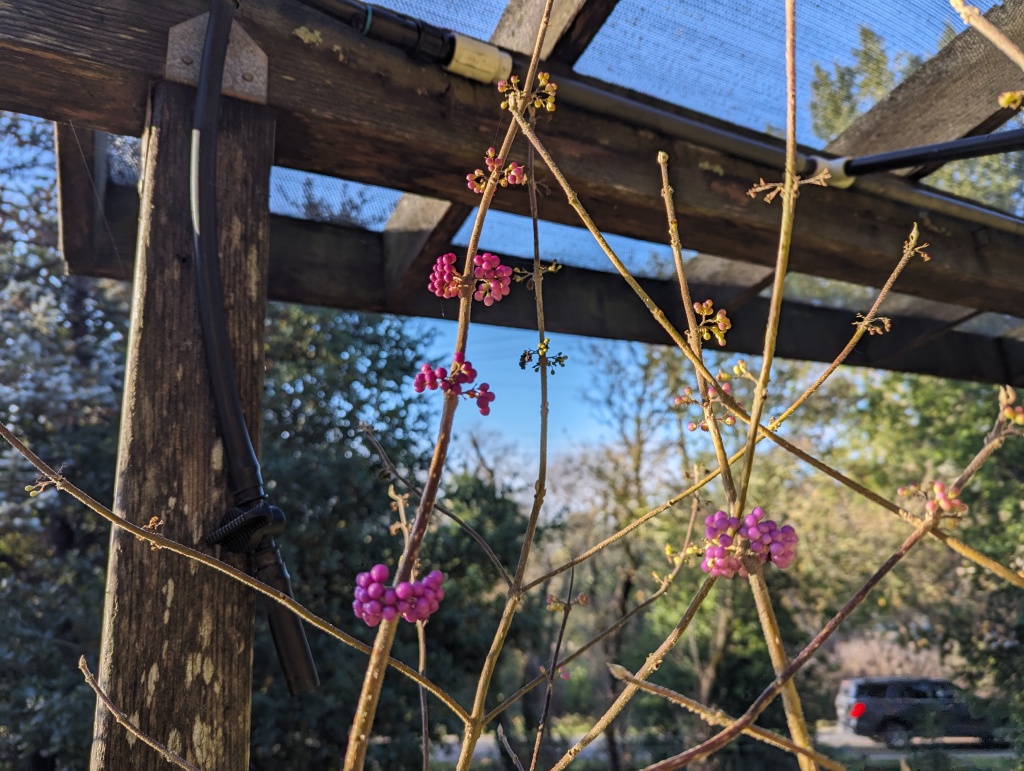
1. Callicarpa americana, American beautyberry is what compelled me to get pictures of berries for this week. I shared a closeup picture of the first of these berries as they began to ripen more than a month ago, which was about two months later than elsewhere. I do not mind. These are my first, and there are more of them now. Perhaps their berries will ripen on time when they are established within the landscapes. The seedlings, as well as white butterfly ginger and, recently, American holly, were gifts from Our Forest Garden.

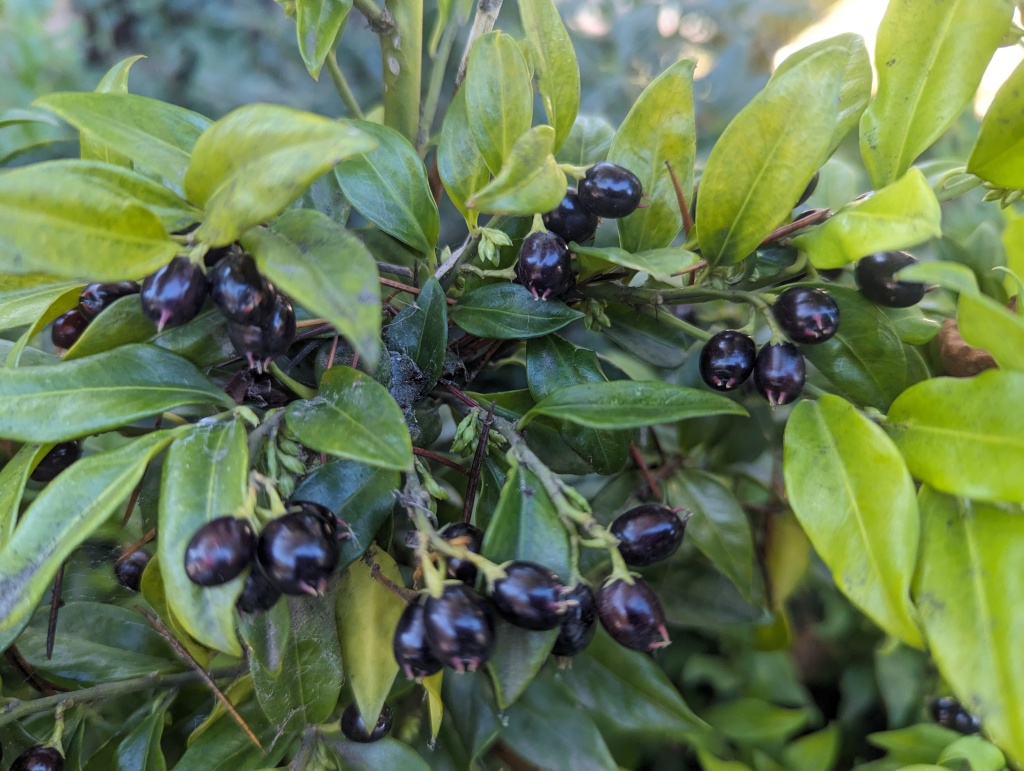
2. Sarcococca ruscifolia, sweet box typically produces very few red berries that typically fall off before turning black. They are both atypically abundant and atypically black now.

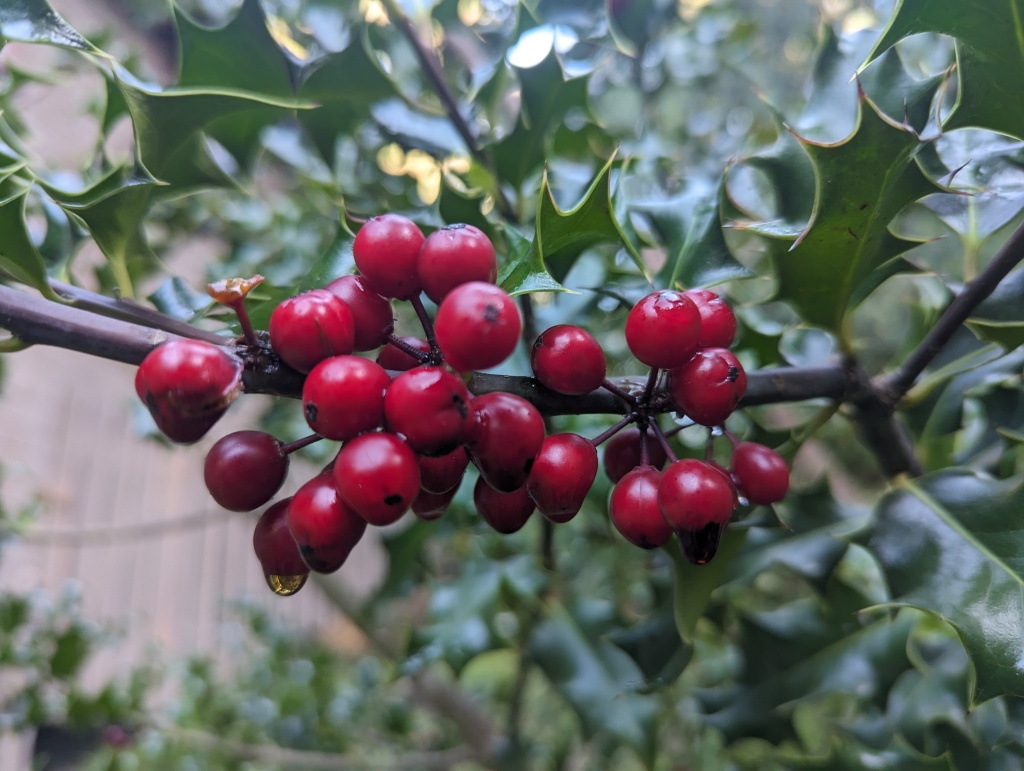
3. Ilex aquifolium, English holly self sows, but most feral specimens seem to be male, or produce only a few berries, in a few sparse clusters. Very few produce clusters like these.

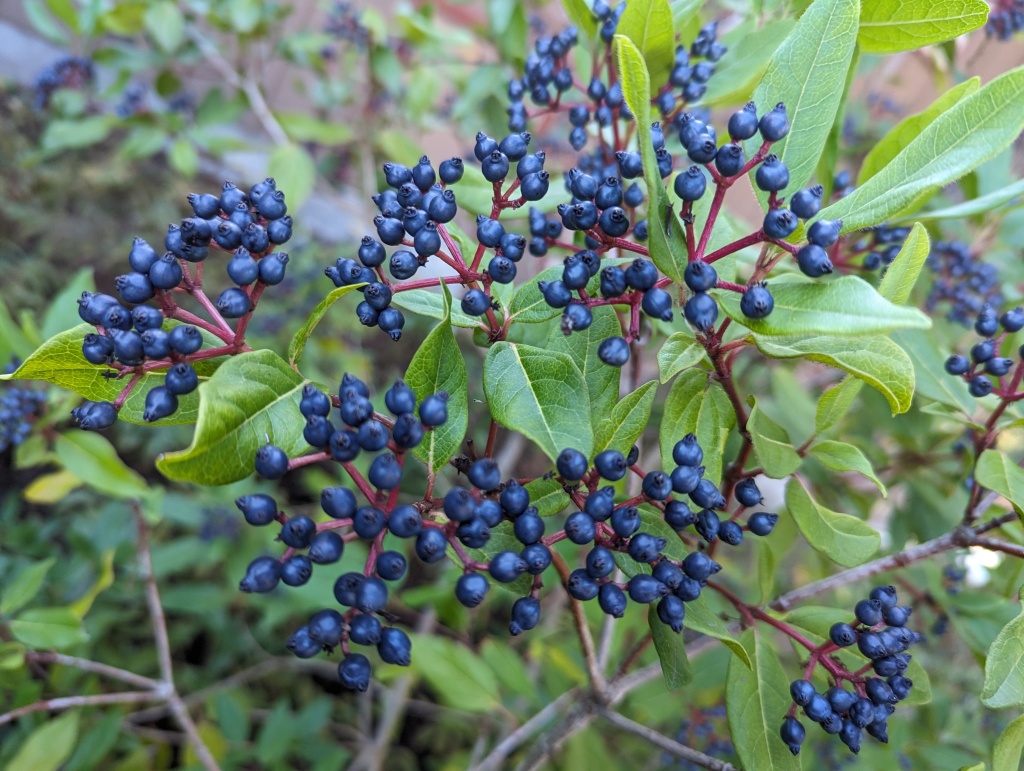
4. Viburnum tinus, laurustinus also self sows. I am not as impressed with it as I am with English holly, but have been learning to appreciate it more, as those in other regions do.

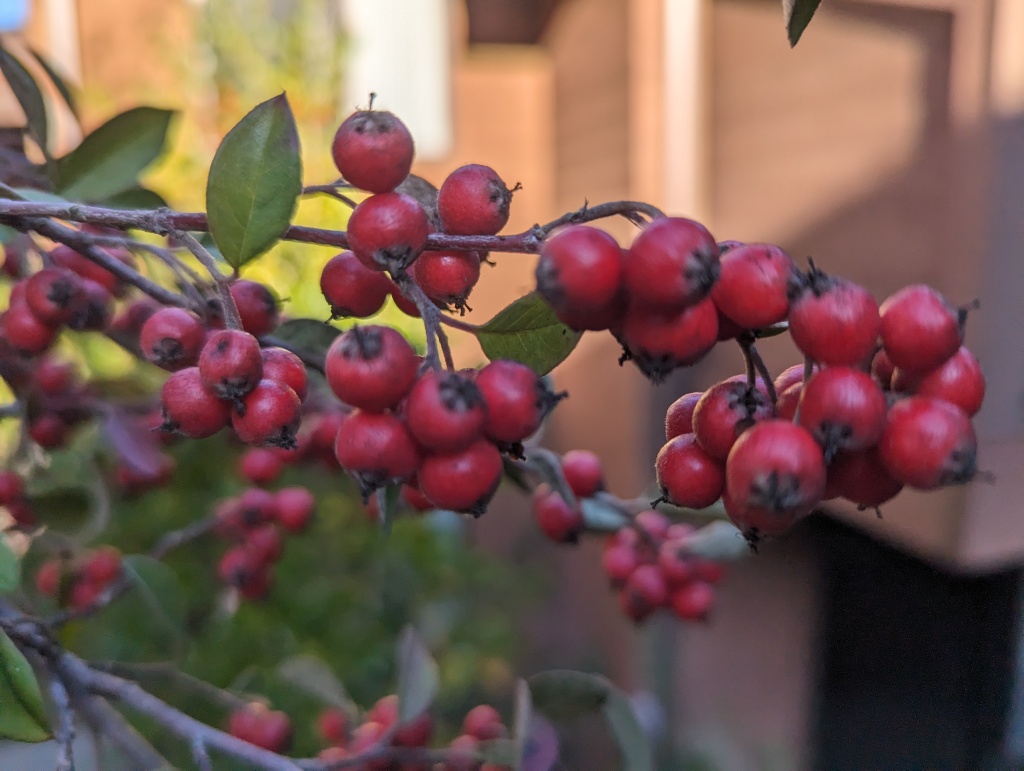
5. Cotoneaster pannosus, silverleaf cotoneaster is naturalized a bit more vigorously. It is not as pretty as I like to think it is. I should retain a few specimens but eradicate the rest.

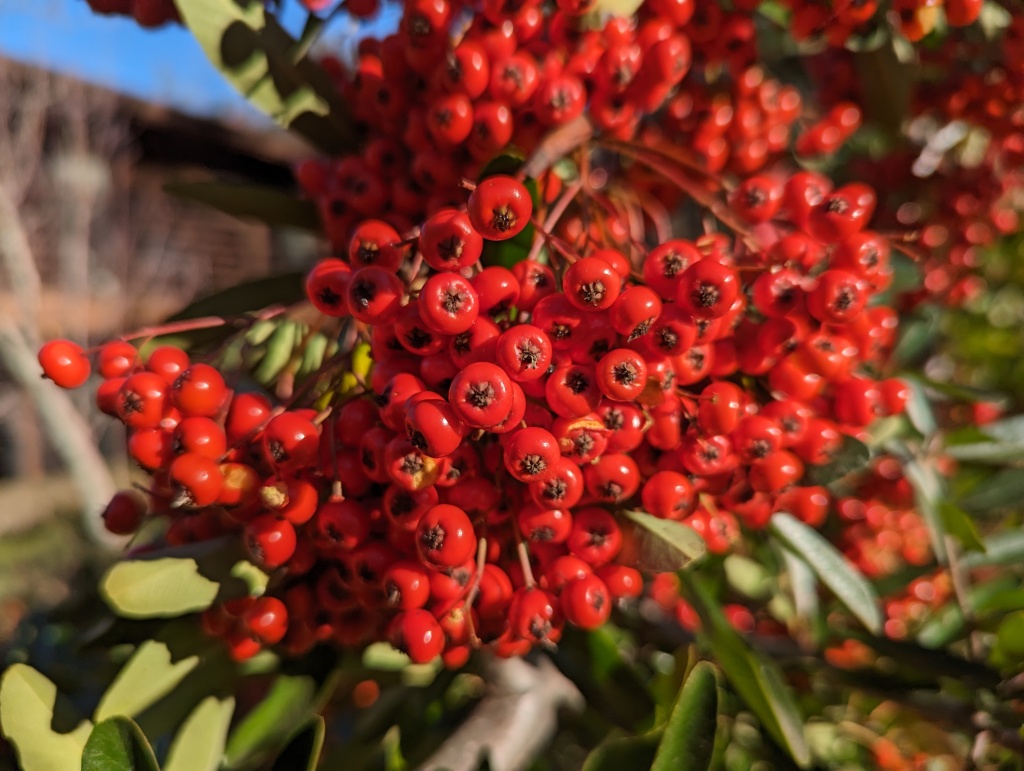
6. Pyracantha coccinea, firethorn is more colorful with similar but with more abundant and glossier berries. Unfortunately, it is also much thornier, so it is no fun to work with.

This is the link for Six on Saturday, for anyone else who would like to participate: https://thepropagatorblog.wordpress.com/2017/09/18/six-on-saturday-a-participant-guide/