Abutilon

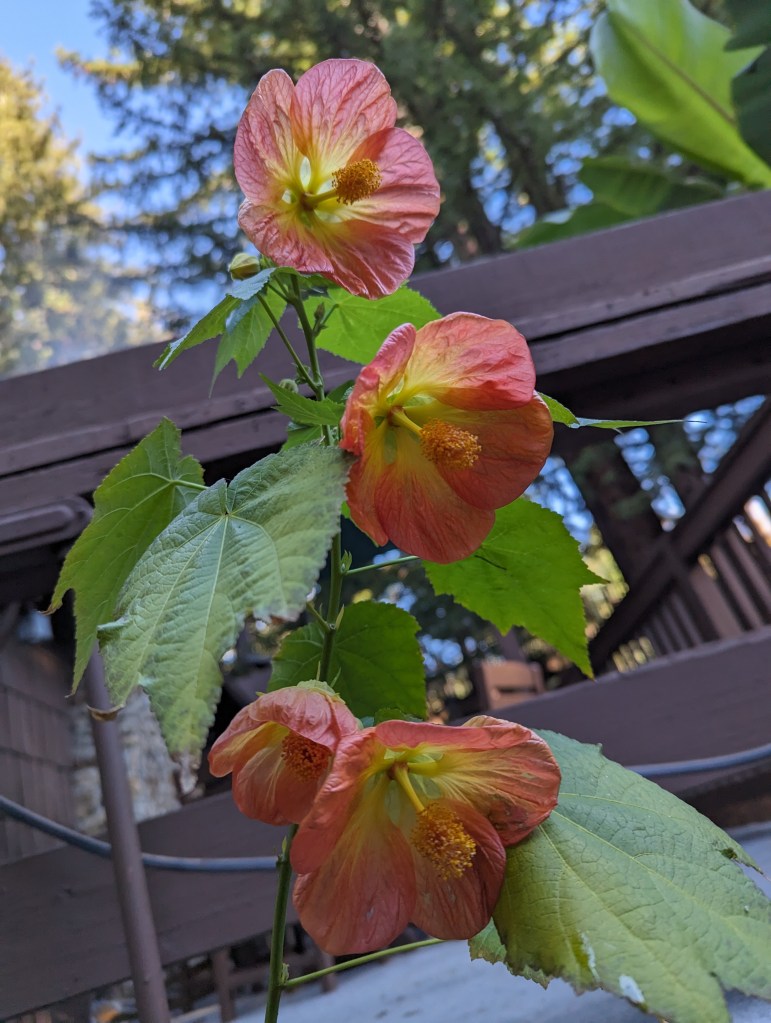
Bloom may become more scarce with cooling weather.

Abutilon X hybridum grows wild from seed within some of our landscapes. Although not prolific enough to be naturalized, dispersion of any viable seed seems odd for hybrids, since most hybrids are sterile. Of course, I do not know for certain if their ancestors were actually Abutilon X hybridum. They could have been other simple species of some sort. Besides, the name seems to apply to any cultivar of unknown parentage, including a few that are not actually hybrids.

Furthermore, even those that are generally sterile hybrids only needed to produce a single viable seed to start the process. Such a seed would likely grow into something that is more genetically stable, and therefore less sterile than its parents. Regardless of their supposed genetic stability, or because of their lack of it, their individual floral color is delightfully variable.

I am no more certain about the common name of this genus, species or group of hybris, which I know simply as flowering maple. Some know it as Chinese lantern. A few may know it as Indian mallow or parlor maple.

I am not so keen on the flowering maple, or whatever it is, for refined landscapes. However, the landscapes here are not so refined, and some are quite rustic. They benefit from the relaxed style, sporadic bloom, and open form of whatever this is.

Bloom is always sporadic, but is a bit more abundant during warm weather. Conversely, it can get scant while the weather is cool through winter. I am impressed by the few flowers that continue to bloom on this particular specimen. So are the hummingbirds. Bloom will likely become more scarce now that the first mild frost occurred last night. Also, foliage may get sparse until warmer weather next spring initiates regeneration to continue the seasonal cycle.

Frost

Before

This elephant ear was happy and healthy as the sun set last night. As the sun rose this morning, it was sagging from frost damage. The picture that was taken prior to damage posted here (at my previous ‘Six on Saturday’ post) at midnight. Frost likely occurred shortly afterward. The picture that was taken after damage was taken only a few hours later.

Frost does not happen frequently enough to get much consideration here. When it does happen, it is not severe. This particular frost was only thirty- two degrees. Nonetheless, I should have sheltered the elephant ear. It would not have taken much effort to do so. I could have simply moved it over a few feet, so that it would have been under an eave. A few other species were likewise worthy of shelter. A few, though, should not even be grown here. The most practical means with which to avoid frost damage is to refrain from growing species that are vulnerable to it.

Fortunately, the elephant ear and all other species that were slightly damaged by frost early this morning should recover efficiently. Elephant ear typically loses its foliage through winter, and regenerates foliage for spring anyway. No more frost is predicted for the next week.

I am glad that I do not need to contend with the sort of frost that kills vulnerable species completely. The possibility of such weather would be much more limiting.

A pair of bougainvillea that I planted last autumn actually succumbed to frost last winter. Although bougainvillea commonly loses foliage and perhaps a few small stems to frost, basal stems should not have succumbed. I wanted to get them into their landscape during autumn, so that they could benefit from cool rain through winter, and be ready to grow in spring. Their replacements will get planted in spring.

After

Six on Saturday: Unidentifiable

Only Australian tree fern is identifiable. Another is just, well, . . . weird.

1. Alocasia odora, taro was installed by a tenant, into a situation that was too dark for it. Now that the tenant is gone, and before another arrives, I brought it back to the nursery for reassignment. The holes in the leaves are from redwood twigs that fell from very high up. I can not identify its cultivar, and am not ever sure if it is an Alocasia or a Colocasia.

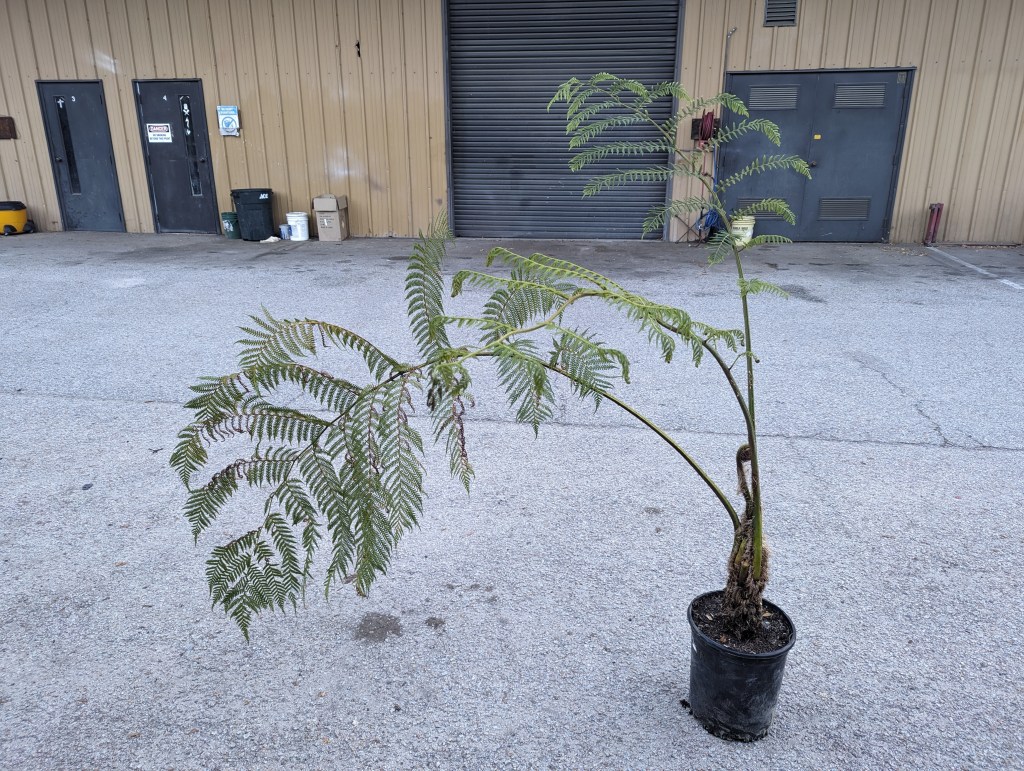
2. Sphaeropteris cooperi, Australian tree fern was next to the taro, so came here with it. Although otherwise healthy, its etiolated leaves were reaching towards limited sunlight.

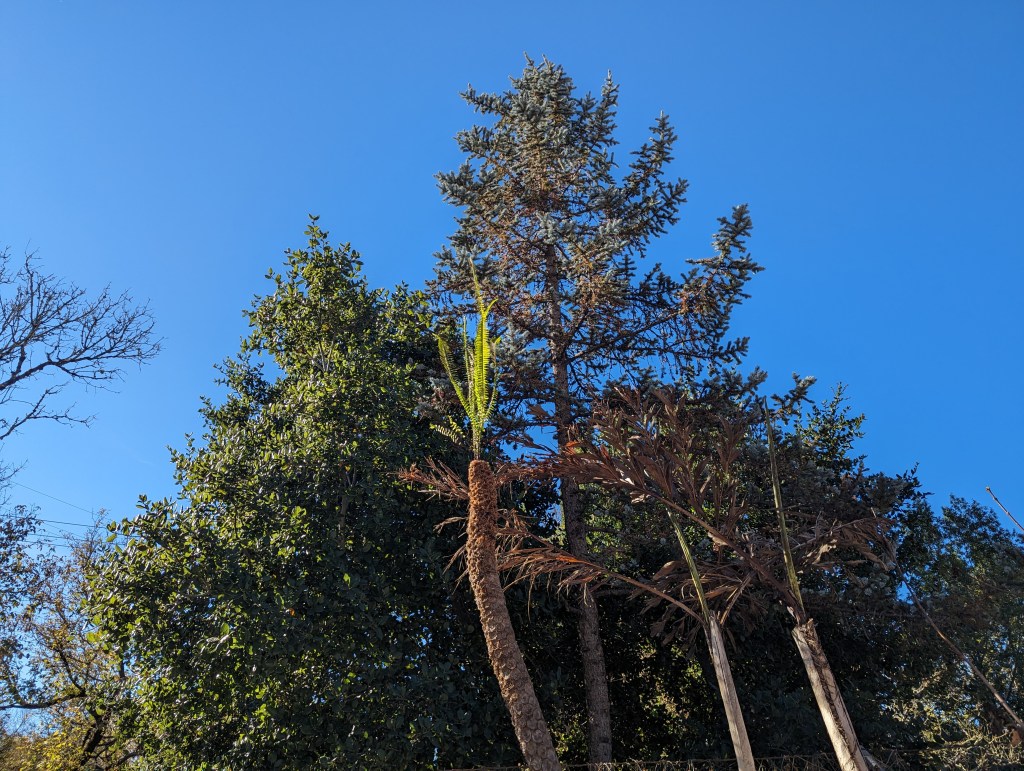
3. Sphaeropteris cooperi, Australian tree fern that I tried to recycle from the garden of a former neighbor did not survive. It is a saddening loss. It was an excellent tall specimen.

4. Nephrolepis cordifolia, sword fern might make good use of the trunk of this deceased Australian tree fern. Technically, the trunk is not actually a trunk at all; but is merely an accumulation of roots that extended downward through the decayed stem of the original fern. Perhaps the roots of this sword fern can do the same before the dead original roots deteriorate. It seems like a graft, but of course it is not. Nor is it a hybrid. It is just weird.

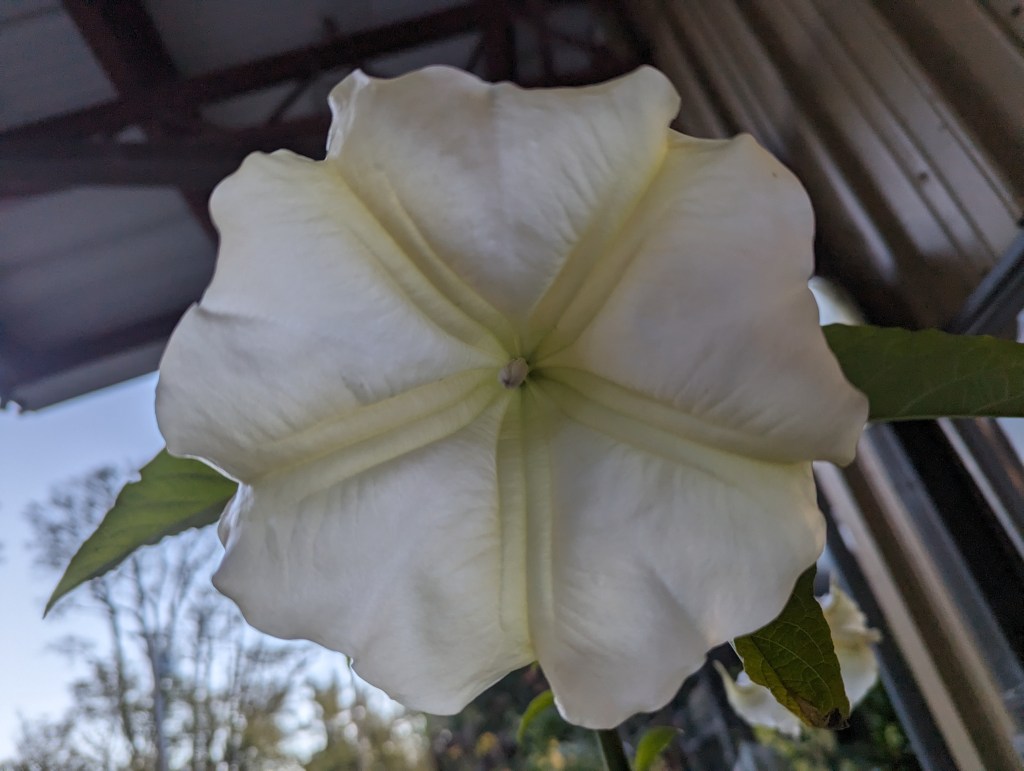
5. Brugmansia, angel’s trumpet of an unidentified cultivar is blooming for the first time. It has been with me for a few years, but dies back each winter. Before it recovers enough to bloom, it dies back again. I got it as a twig from a greenwaste recycle pile in San Jose.

6. Brugmansia, angel’s trumpet should be pastel orange. I took the original twig because I assumed that it was of a specimen that bloomed pastel orange. Does this look orange?!

This is the link for Six on Saturday, for anyone else who would like to participate: https://thepropagatorblog.wordpress.com/2017/09/18/six-on-saturday-a-participant-guide/

Catnip?

Is this actually catnip?

Is this catnip, Nepeta cataria? Again, I am baffled by something that should be very easy to identify. It certainly resembles catnip visually. It almost smells like catnip. If I did not get it from a small curbside garden that Rhody and others of his species leave messages for each other in, I would have confirmed that it tastes like catnip. Perhaps I should be more than adequately convinced that it actually is as I suspect.

Nonetheless, I am not yet convinced. Catnip is rare here. I know of no one who grows it. Those who have tried ultimately found it destroyed by frolicking cats. It really should be grown in hanging pots that cats can not reach. It seems unlikely that it could survive for long within a curbside garden near where a few cats live. It also seems unlikely that it would spontaneously appear where it had not been planted intentionally. Only small succulents were planted below a large camellia within its particular small garden. All the small weeds that grow nearby are common.

Regardless, I could not ignore a branched stem of this questionably identified species that had broken off and was laying limply over undamaged foliage. Obviously, it needed to be removed. Obviously, I obliged. I brought it back and processed it into several small cuttings. I collected the scraps of leaves and internodes for an associate to take to a feline acquaintance of his for possible confirmation of its slightly questionable identity. I await the assessment, although it will be from someone who can not decide to stay inside or go outside after meowing incessantly for someone to open a door. A second or more opinions may be necessary from other members of this innately indecisive species if the first attempt at confirmation is unsuccessful.

The foliage certainly resembles that of catnip.

Thanksgiving

Thanksgiving is a celebration of gratitude. It was created by early American settlers who were grateful for their harvest at a time when the exotic fruits, vegetables and grains that they brought with them from Europe were only beginning to get established in unfamiliar climates and soils. They were also grateful for the generosity of the indigenous people, as well as the native fruits, vegetables and game that they introduced them to. Regardless of how meager their resources now seem to be by modern American standards, early American settlers were very grateful for what they had.

Nowadays, for most Americans, sustenance from all over the World is so reliably available and in such abundance that many neglect to appreciate it. As in the past, those who lack such abundance are more grateful for what is available to them. Perhaps that is why Thanksgiving is still so relevant, and such an excellent Holiday. It is a reminder of the importance of gratitude.

Gardening to grow fruits and vegetables, even on a scale that is very minor relative to how early American settlers did so, facilitates gratitude for the sustenance and any surplus that it generates. Produce from the garden is so much more satisfying than produce from a supermarket. A pantry of canned surplus from the garden is so much more gratifying than a pantry of food that was purchased from a supermarket. Perhaps there should be no difference, since food from a supermarket is purchased with money that is earned from other work, which should be comparatively gratifying.

Realistically, there is so much to be grateful for, and so much gratitude to celebrate. In fact, there is enough to justify a specific Holiday for it. Work and gardening can be resumed tomorrow or later, after this celebration of gratitude, Thanksgiving.

Horridculture – Bay

Umbellularia californica is NOT Laurus nobilis.

Bay grows wild here. It is native. It is also known as bay tree, laurel, bay laurel, spice tree, pepperwood, myrtlewood, Pacific myrtle, Oregon myrtle and California bay. All these different common names demonstrate why simple botanical nomenclature is useful. In that regard, this native bay is Umbellularia californica.

Bay is also native to the Mediterranean region. Of course, it is a different species, Laurus nobilis. Like the bay that is native here, it is also known as bay tree, laurel and bay laurel. Furthermore, it is known as Grecian bay, true laurel and sweet bay, although it is not at all sweet.

Laurus nobilis is a common culinary herb though. Umbellularia californica is not. That does not mean that Umbellularia californica can not be useful as such. It merely means that it is not commonly used as such, and is very different from the bay that genuinely is. Some of us here in California and southwestern Oregon actually do sometimes find culinary applications for it.

Umbellularia california has a much more pungent and stronger flavor than Laurus nobilis. Although it has potential to be useful for similar applications, it is by no means a substitute, and should certainly not be used in comparable proportions. Most of us who use it are aware of the differences, and know how to use it, generally quite sparingly.

The problem is that fresh foliage of Umbellularia californica is sometimes available as culinary bay from supermarkets, and is typically labeled as sweet bay, true laurel or Grecian bay. This is no problem for those of us who recognize it, but we would not purchase it from a market while we can get it for free from the wild. Those who purchase it likely do so because they believe that it is genuine Laurus nobilis.

Variegated Boston Fern

Tiger fern is prettier up close.

Boston fern is merely one of several cultivars of Nephrolepis exaltata. Its cultivar name is ‘Bostoniensis’. Variegated Boston fern, or tiger fern, is reputedly a cultivar of this cultivar. Its cultivar name is either ‘Variegata’ or ‘Tiger’. From a distance, it seems to be a yellower version of the original. Prettily intricate stripes become apparent with closer observation.

Variegated Boston fern is a bit smaller and a bit less vigorous than common Boston fern. Like all variegated cultivars, it works with a bit less chlorophyll. Mature potted specimens might get no wider or higher than three feet. Unvariegated Boston fern can be more than four feet from top to bottom. Both could be larger if their long fronds were less pendulous.

In home gardens, variegated Boston fern can get rather tattered through winter. It is likely to defoliate if exposed to even minor frost. This is why it is more popular as houseplants, usually in hanging pots. Such potted specimens rely on consistent watering. Diffused but bright sunlight is best. Occasional application of fertilizer enhances foliar color and vigor.

Rainy Weather Begins With Autumn

Weather changes with the changing seasons.

Rain is at least as relevant as temperature is to the seasons here. Temperature does not change as much. The warmest of summer weather does not seem to be terribly hot. Low humidity helps. The coolest of winter weather is not too terribly cold. Some local climates lack frost. The difference between dry weather and rainy weather is much more obvious.

After all, rainy weather ends during spring, and does not resume until about now. Almost no rain occurs during the extensively arid summer season. This includes late spring and early autumn. Summer thundershowers are uncommon. Therefore, almost all rain occurs during winter. Some also occurs somewhat variably during late autumn and early spring.

This is quite normal for local chaparral climates. Comparatively to other climates, it might be both an advantage and a disadvantage. It is why most landscapes, particularly lawns, rely on irrigation. It is also why the growing season is so long here. This climate provides more pleasant weather to facilitate more gardening. It also necessitates more gardening.

Recent rainy weather is likely the beginning of the rainy season. If so, it is obviously also the end of the dry season. Transition from one season to the next is not on a very precise schedule, though. Dry weather could potentially resume for a while. Conversely, El Nino has potential to promote rainy weather. This winter could be even rainier than last winter!

Even if rainy weather does not resume for a while, irrigation requires seasonal reduction. This includes frequency and duration of automatic irrigation. Vegetation consumes much less moisture while dormant through winter. Less moisture evaporates from soil while the weather is cool. Rain may provide most of the garden with more moisture than it can use.

Unfortunately though, rain is also potentially messy. It makes soil muddy, and can cause erosion. It dislodges deteriorating deciduous foliage, especially in conjunction with wind. Colorful deciduous foliage is much less appealing on pavement or lawn than in its trees. Raking fallen leaves, and all other gardening, is less pleasurable during rainy weather of autumn.

End of Fire Season

Burned trees are visible on ridge tops within the CZU Fire zone.

Rain is gratifying at the beginning of the rainy season. We all know that it has potential to become excessive later in the season, but we are not yet concerned with flooding or mudslides. After a typically long and dry summer, we enjoy it while we can. A storm that finished earlier yesterday was relatively minor, but was nonetheless the first significant storm of this new rainy season of 2023 and 2024. Only minor drizzle preceded it.

The beginning of the rainy season is also the end of the fire season. Forest fires become less likely as the forests become more saturated through the season. However, rain also sustains growth of vegetation that will become combustible during the following fire season, especially if the weather becomes unusually warm and arid by then. Unfortunately, this is the natural pattern of the climate here. Fire is a major component of local ecosystems.

Three years ago, the CZU Fire was the most destructive forest fire within documented history of this region. Larger fires likely occurred prior to documented history, but burned forests that expect to occasionally burn, without damage to unnatural infrastructure that did not exist at that time. Prehistoric fires were likely less common than modern fires, but involved much larger areas. They also likely burned faster and less violently. Modern forest fires involve more fuel because of regeneration of hardwood species after clear cut redwood harvesting a century ago. That is why so many coastal redwoods that survived several fires during their long lives succumbed to the CZU Fire.

Much of the marginal area of the CZU Fire is regenerating efficiently enough to eliminate evidence that it burned so recently. The scenery of areas that burned more severely remind us why we are grateful for the beginning of the rainy season.

Poke

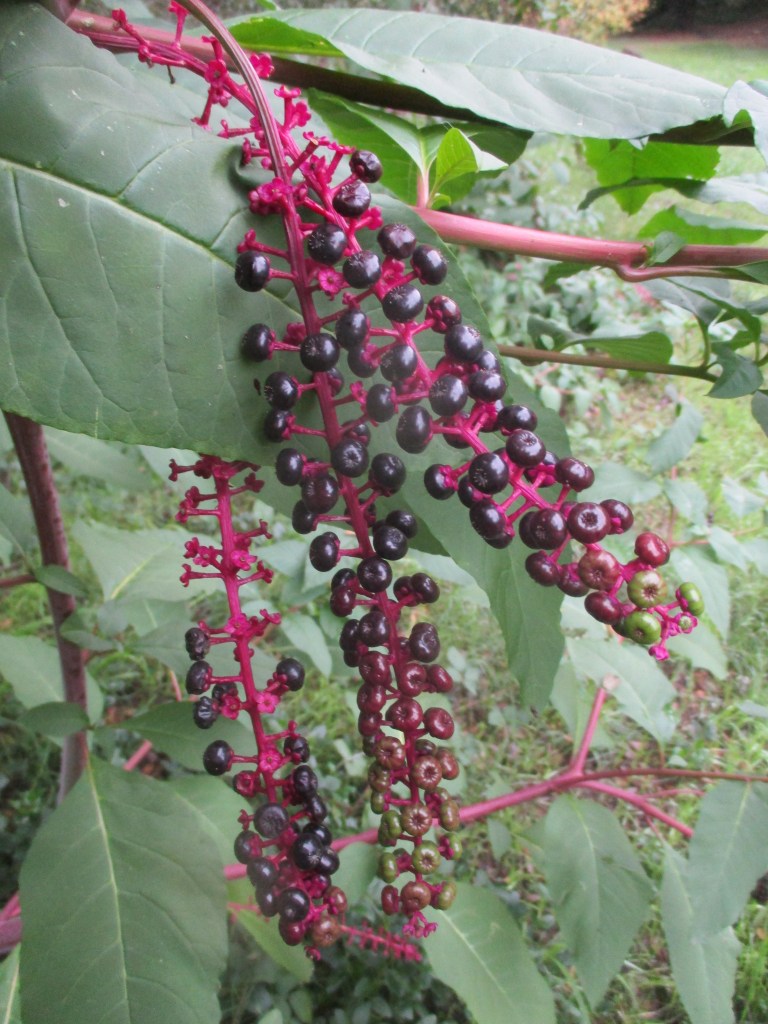
Phytolacca americana; pokeweed, pokeberry, pokebush, pokeroot, poke sallet, poke . . . or inkberry

Phytolacca americana is known by several names; pokeweed, pokeberry, pokebush, pokeroot, poke sallet, and simply, poke. I have no idea what poke is, but it is obviously famously associated with this species, which I know instead as inkberry. That is a more sensible name to me, since I made ink from the famously toxic berries. However, within its native range, a species of holly is also known as inkberry.

The ink is initially an obnoxiously bright magenta, but fades to a light brown. Those who prefer the bright magenta color can preserve it somehow. I prefer the faded brown. Because the ink is caustic, it should be used only with disposable quills. Inkberry is also used for dying fabric, either magenta or brown.

Weirdly, inkberry is both extremely poisonous and also edible. Tender young vegetative shoots can be collected as they begin to emerge after winter. They can be boiled and drained a few times to eliminate toxins that might have developed within them by that time. Such growth becomes more toxic as it matures. A few shoots must be left to grow through summer and autumn to sustain tuberous roots below, so that new shoots can grow for the following season. This sustaining growth gets quite large, after providing only a minor volume of edible shoots. In other words, inkberry is a large perennial that needs plenty of space but provides only a small amount of potentially edible but possibly toxic greens. There are plenty of safer and more efficient greens and vegetables to grow in the garden.

Inkberry has become a somewhat invasive exotic species here. We prefer to remove it from public landscapes because its poisonous but pretty berries might be tempting to those who are unfamiliar with it. They certainly look like they would be tasty.