Horridculture – Inappropriateness

Vines and annuals are not shrubbery and ground cover.

Vegetation within a planned landscape should serve a purpose. The form of such vegetation should be appropriate to such purpose. Trees provide shade. Shrubbery defines space and obscures undesirable scenery. Vines climb fences and other infrastructure. Annual bedding plants provide more seasonal color than most other vegetation. Turf grows into useful lawns. It is helpful to plan accordingly for a landscape.

Turf can not do much more than become useful lawn. It can not provide shade, obscure undesirable scenery, climb fences or provide more seasonal color than green. Nor can trees, shrubbery or vines become useful lawn. Again, each form of vegetation should be appropriate to its particular application.

Trellised rocktrumpet is not shrubbery. Rose periwinkle is not permanent ground cover.

There is so much other vegetation that would have been appropriate to this particular situation. Star jasmine, trailing lantana, trailing rosemary or even the dreaded English ivy would have been better and more permanent ground cover. Dwarf oleander, barberry, arborvitae or even dwarf New Zealand tea tree would have been better shrubbery.

Rose periwinkle is an annual bedding plant. Although it is somewhat pretty now, it will not likely survive through winter. Even if it does, it will not migrate far enough to reliably function as a ground cover.

Trellised rocktrumpet is a small but vigorous vine that will always be reliant on trellises for support. As its cheap trellises decay and deteriorate, it will eventually develop into shabby mounds of tangled vine stems, but will never be able to support itself as high as the new trellises are now. It can reach out to cover some of the ground that will be vacated by the rose periwinkle, but can not reliably function as a ground cover for this much area. It will bloom less if shorn for neatness.

Oleander

Most oleander blooms with single flowers.

Since their development, freeways had been prettier with oleander, Nerium oleander. No other comparably resilient and undemanding shrubbery is as colorful. Harsh exposure of medians and interchanges was no problem. Oleander became less common through the 1990s only because of oleander scorch. Big contiguous colonies were most susceptible.

Oleander is as resilient as it has always been. It is less susceptible to oleander scorch if remote from other specimens. It performs best if it can grow wild without pruning. Pruning is not actually harmful, but can disrupt bloom. Frequent shearing eliminates most bloom. However, with pruning to remove lower growth, big shrubs can become nice small trees.

Bloom is white, pink or red. Pink ranges through bright cherry pink to pastel peachy pink. Pale yellow remains quite rare. Single flowers are most common. Double flowers are not rare though. A few cultivars provide mildly fragrant bloom, but also generate seed. Large oleander can grow as tall as fifteen feet. Dwarf cultivars may stay shorter than three feet. Oleander leaves resemble those of native bay laurel. All parts of oleander are notoriously poisonous.

Autumn Bloom Is Remarkably Natural

Some bloom adapts to regional climate.

Most flowers bloom during spring. That seems to be most practical. It maximizes the time for their seed to develop prior to the following winter. It conforms to the schedules of their naturally preferred pollinators. Bloom is less likely to succumb to weather through spring. Deviancy is natural though. Many functional flowers quite naturally prefer autumn bloom.

Deviancy, of course, is as complicated as it is natural. Autumn bloom occurs for a variety of reasons among a variety of species. Many can be delightful assets for home gardens. They provide more options for floral color than the most popular of cool season annuals. Some autumn bloom continues as autumn foliar color develops, and perhaps into winter.

Many flowers bloom randomly as warm weather allows them to do so. They may seem to bloom almost continually here. Cool weather may disrupt their bloom only during winter. As weather fluctuates, bloom might resume before a previously disrupted bloom finishes. African daisies provide autumn bloom because autumn is too mild to disrupt their bloom.

Technically, such flowers do not necessarily prefer to bloom during autumn. They merely bloom whenever they can. Most actually bloom most profusely during spring or summer. Canna produces summer and autumn bloom, as it regenerates from its winter dormancy. Otherwise, within frostless tropical climates, it blooms continuously. It is quite adaptable.

Some flowers that are actually more responsive to seasons simply prefer autumn bloom. Joe Pye weed and goldenrod grow only vegetatively through spring and earlier summer. They only begin to bloom about now. Perhaps their seed prefer to grow through cool and damp winter weather. Their seedlings may be vulnerable to desiccating summer warmth.

Naked lady is more extreme. It maintains dormancy through most of summer to bloom as summer ends. Then it grows through winter until spring warmth initiates dormancy again. It seems to believe that it still inhabits its native range within South Africa. Summer there is winter here. Actually, summer weather there is more severe than winter weather there.

V8

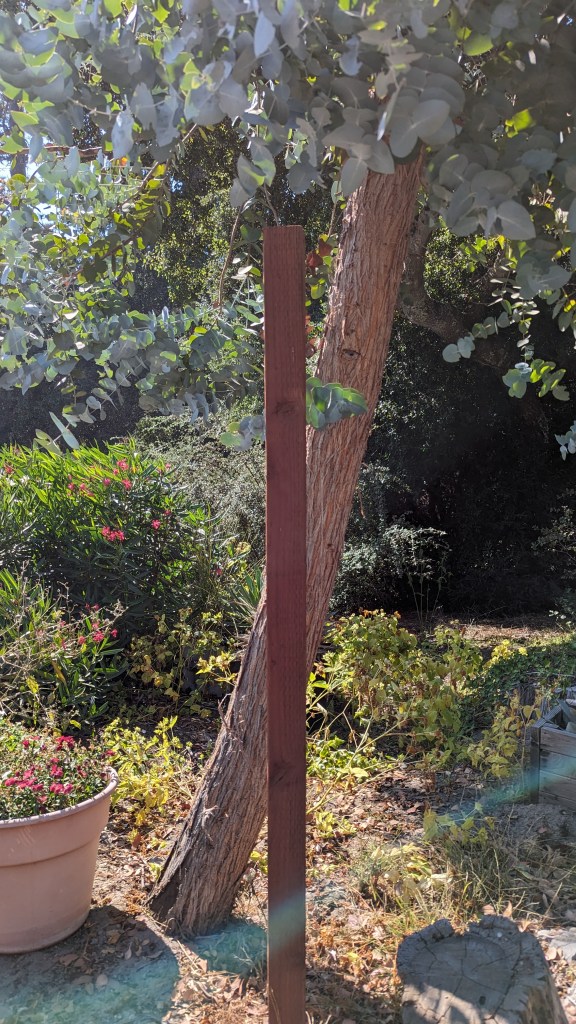
The vertical post demonstrates how much the tree trunk leans.

A few tree species should’ve had a V8. That includes more than a few individual trees. It applies to enough individuals of a species to indicate that the need is almost typical of the particular species.

The need for a V8 is derived from old advertisements for the V8 beverage that depicted those who were deficient in adequate consumption of V8 as leaning prominently. V8 is a juice beverage that is composed of juices of eight vegetables; tomatoes, carrots, celery, beets, parsley, lettuce, watercress and spinach. Hence, V8. It balances a diet so that those who consume it stand upright rather than lean.

In horticultural slang, the need for a V8 refers to a leaning trunk.

Any tree of any species has potential to develop a leaning trunk, and consequently appear to be in need of a V8. Some species innately develop leaning trunks though. No one seems to know why, but specimens of such species with vertical trunks are oddly uncommon or perhaps rare.

For example, so many ginkgo trees lean at such similar angles that, among some groups, their distinctive lean seems to be a normal characteristic of the species. It is variable though. Many individual trees that are isolated from others are quite vertical. So are some groups of street trees. However, many or most specimens of other groups of street trees lean at very similar angles, although in random directions.

Italian stone pines are more likely to lean, also at relatively similar angles, and also in random directions. Locally, vertical trunks are rare among this species. However, within their native range, vertical trunks are typical.

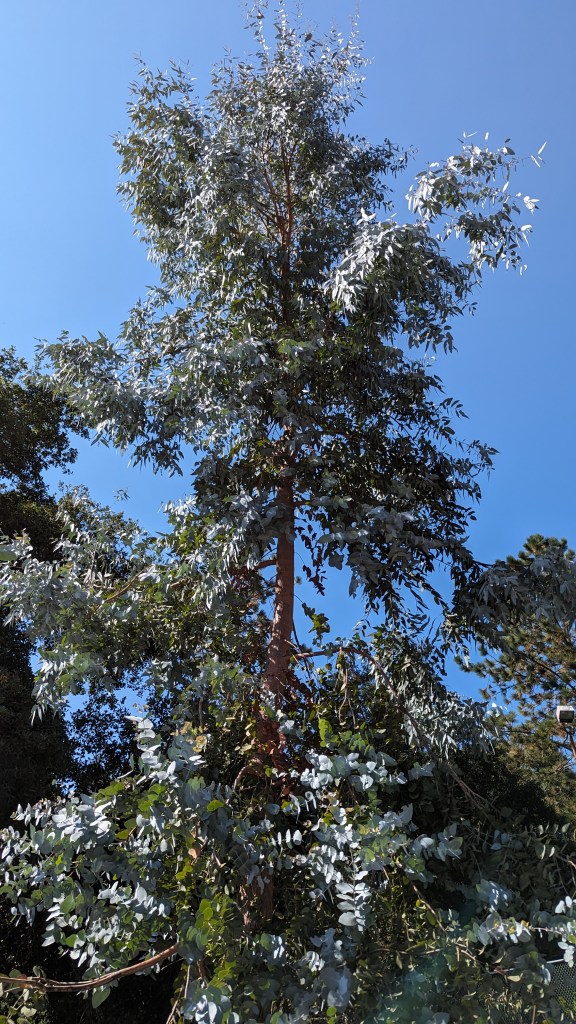
Argyle apple (eucalyptus) is almost comparable to Italian stone pine in regard to its typical need for a v8. I have seen a few with vertical trunks. I was determined for ours to be among them. I bound the trunk to keep it straight as it grew. I installed it with the trunk as vertical as the sign post next to it. When wind caused it to lean slightly while it was smaller than it is now, I pushed it back into position. Actually, I might have done that a few time. However, as it matured, it became more difficult to push back into position. Eventually, it refused to budge from its leaning position. Now, like most of the species, this specimen also seems to be in need of a V8.

After the base of the trunk insisted on leaning, the upper portion of the trunk assumed vertical posture.

What Is This?!

I have no idea what it is, but I intend to grow it.

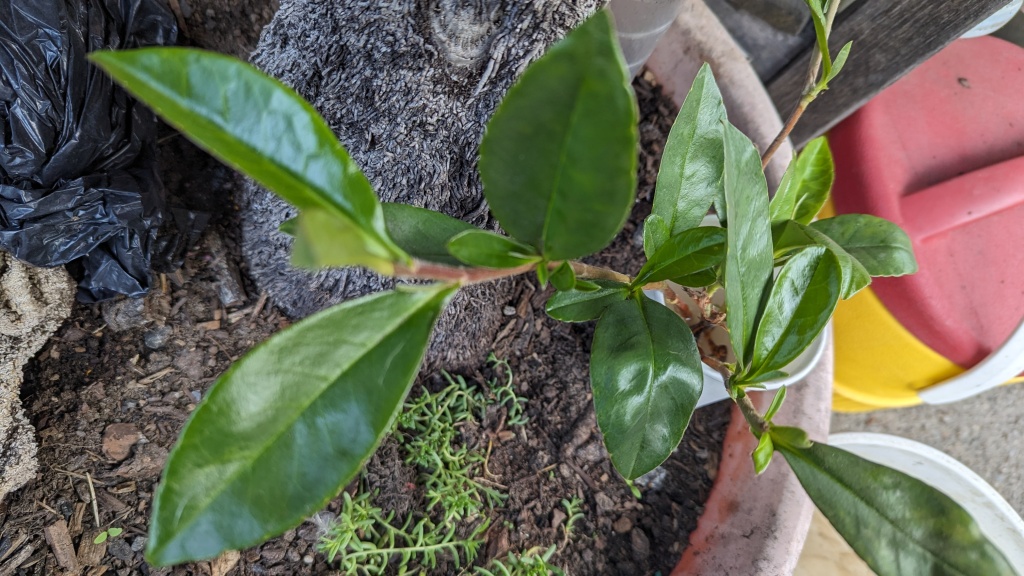
It is an evergreen vine that seems to sprawl over other vegetation rather than actually climb it. It lacks tendrils or other means with which to hold onto its support. It does not even seem to wrap around its support. Nor does it seem to get very high above the ground. It just sort of sprawls.

Its glossy leaves are rather simple, just like in the picture here.

Its bright yellow and staminate flowers, if I remember correctly, seem to resemble those of Saint John’s wort, but are a bit wider.

This vine, again if I remember correctly, seemed to be more popular years ago. I do not notice it much anymore. I can not remember when I last saw it in a nursery, or if I ever saw it a nursery. The few specimens that I am aware of inhabit old landscapes that have not been renovated in decades. I got these bits from where they were regenerating after their earlier removal from an old landscape.

Now that I have these bits, I intend to grow them, in order to get familiar with the species. I hope that I can eventually identify it. It should not be so difficult for something that had formerly been popular, or at least common enough for me to recognize it as something that had formerly been familiar.

I do not often encounter a species that I can not identify, and I even more rarely admit to it. If I do not recognize a species, I can typically recognize the genus, or at least the family, and then key it out. For this seemingly simple vine, I can not identify its family. I asked Brent, which I almost never do. He recognized it about like I did, but also could not remember its name.

Six on Saturday: the Wrath of Grapes

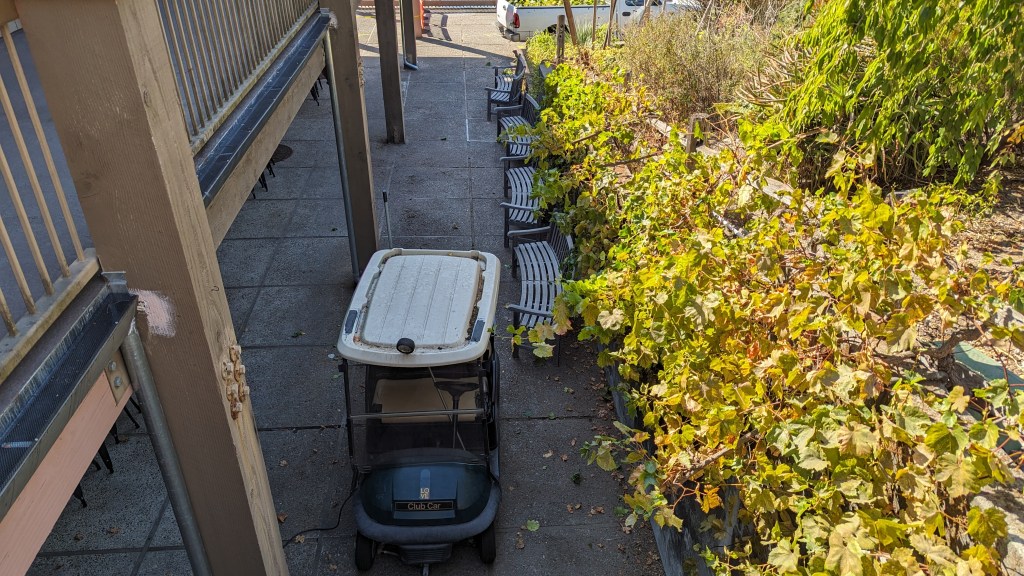
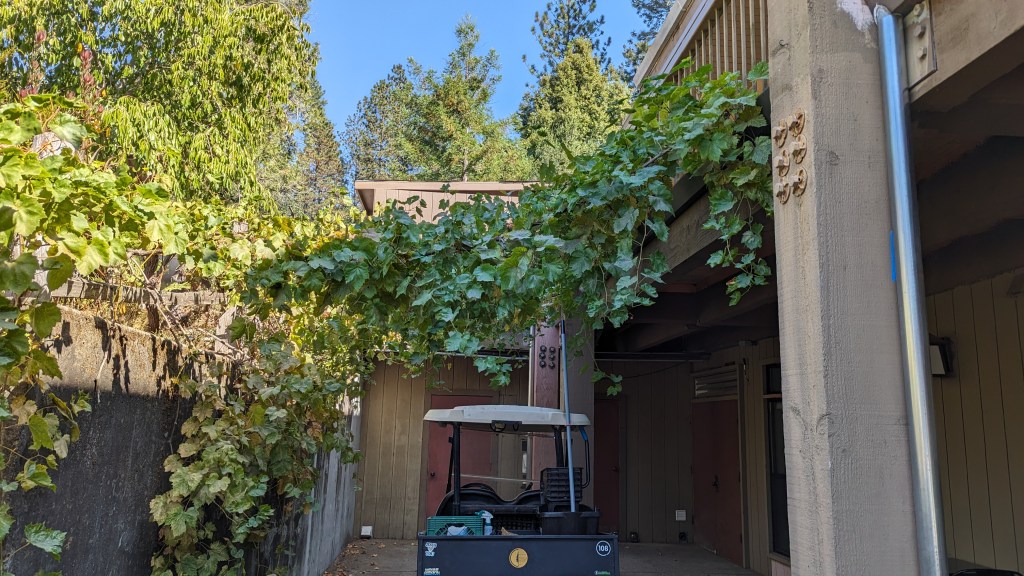
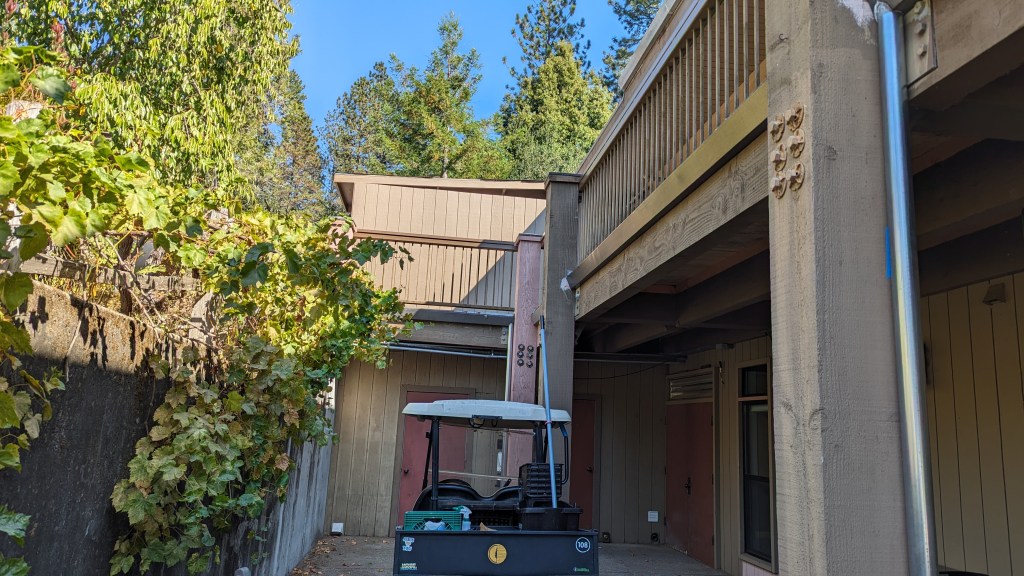
This was no easy project. I started pruning and maintaining this formerly neglected and very overgrown grapevine several years ago. It had been installed a few years earlier, but had never been pruned. Its first pruning may have generated two pickup loads of debris, as well as a dozen or so layers, which were shared with neighbors. I then trained its new growth to span horizontally over a lower deck, from a rail fence that it originally grew on to a parallel banister about twelve feet away. It was like a pergola without a pergola. The problem is that the banister needs to be painted. After training the grapevines for years, I needed to remove them.

1. It looks simpler than it was. Vines needed to grow long enough to reach from the fence to the banister. They then needed to be pulled across with a cord and tied onto balusters.

2. Between the fence and the banister, the vines required no support. They were pruned annually while dormant for winter, and groomed for summer, so did not get very heavy.

3. The vines sagged somewhat, but had plenty of space downstairs to do so. The banister to the left is horizontal. The fence to the right slopes downward away from this vantage.

4. From the same vantage without the spanning vines, the scenery is now very different. Old vines will get pruned for neater confinement to the fence while dormant this winter.

5. The vines formerly shaded the pavement downstairs nicely. This area gets quite warm without shade during summer. That was partly why we wanted these vines to span here.

6. As severe as this pruning was, it will be a bit more severe while the vines are dormant this winter. Vines will not extend so far outward, and may not cascade downward either.

This is the link for Six on Saturday, for anyone else who would like to participate: https://thepropagatorblog.wordpress.com/2017/09/18/six-on-saturday-a-participant-guide/

Mexican Fan Palm

Mexican fan palm is the most familiar palm of California.

It does not take long for Mexican fan palm, Washingtonia robusta, to get too big for most of the spaces it so often self sows its abundant seed into. The attractive lush foliage looks innocent enough, although the long petioles (leaf stalks) have nasty teeth. As trees get tall enough to get out of the way, they also get too big to manage, eventually reaching a hundred feet tall on elegantly curving trunks. No matter how tall they get though, their canopies always stay about eight feet wide. The problem is that the maintenance of such tall and aggressive trees can be costly.

Beards of old leaves can be allowed to accumulate on the trunks, but are combustible and can get infested with rats. Old leaves are more often pruned off, leaving a distinctive pattern of petiole bases. Old leaves can alternatively be ‘shaven’ to expose elegant bare trunks.

Cane Berries Require Diligent Maintenance

Without proper pruning, cane berries become wicked thickets.

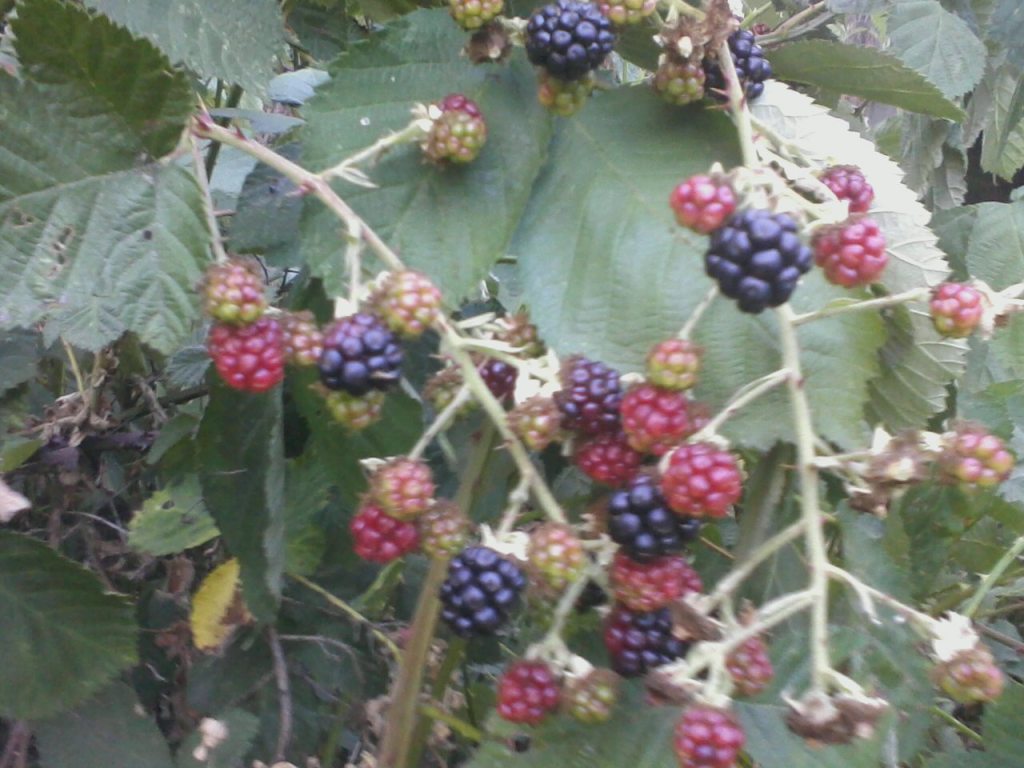
Given the opportunity, blackberry and raspberry canes become rampant thickets. The trick is to keep them contained and controlled so that they can produce berries without conquering the garden. Besides, proper pruning promotes production. Properly maintained canes are therefore both better behaved and more productive

Berry canes are certainly not low maintenance, and should be selectively pruned a few times through the year. The type of pruning needed is determined by the type of growth that the canes exhibit in particular seasons. Spent canes or upper portions of everbearing raspberry canes that produced berries through summer and early autumn will need to be removed by the end of winter while new canes that grew through this year get trained to replace them.

Pruning and thinning of new canes should be delayed until the end of winter; but removal or pruning of spent canes can begin as soon as their fruit gets depleted. Spent canes of traditional summer bearing raspberries like ‘Willamette’, ‘Tulameen’ and ‘Canby’ can be pruned to the ground. ‘September’, ‘Heritage’, ‘Summit’, ‘Fallgold’ and other everbearing raspberry canes should be pruned only as low as their fruit was produced. Lower portions that did not produce fruit should be left to bloom and produce berries next spring.

Just like raspberry canes, new blackberry canes that grew this year do not need to be pruned until late winter. However, the canes that grew last year and are finishing berry production this year can be pruned to the ground as their last berries get taken. There is no rush for this procedure, but getting it done early makes later pruning of new canes for next year a bit easier.

Of course, every different cultivar (cultivated variety) of raspberry and blackberry behaves differently. Some finish producing and are ready to be pruned sooner than others. Their behavior is also affected by climate and environmental conditions, so that the same variety may be earlier or later in different areas, or even different parts of the same garden.

Favorite berry canes are very easy to propagate by division of superfluous new shoots during winter. Alternatively, spent canes that should be removed can be ‘layered’ instead. They simply need to be bent down and partially buried, and can be dug and separated as they develop roots.

The top few inches of cane should extend above the soil. At least a few inches of cane below the top should be buried a few inches below the surface of the soil. The length of cane between the buried portion and the base of the parent plant can remain exposed.

Layering can be done at any time of year if the layer (buried section of cane) gets watered while developing roots. Layering this time of year is easiest though, because layers get plenty of water from rain through winter, and develop roots most efficiently as they come out of dormancy late in winter or early in spring. If layers are buried where new plants are desired, they do not need to be dug and moved next year.

Horridculture – Green Walls

It would have been easier to paint the wall green.

Foundation plantings were quite functional while eavestroughs and downspouts were prohibitively expensive prior to about the Victorian Period. They dispersed rain water as it fell from eaves above, in order to limit surface erosion and muddy splatter onto foundations, basement windows, and lower portions of walls.

Most foundation plantings were tough perennials, such as lily of the Nile, or low and densely evergreen shrubbery, such as English boxwood or Indian hawthorne. Some did not stay so low though. Long after eavestroughs and downspouts became common, some foundation plantings grew into obtrusive hedges in front of exterior walls. Some even obscured windows. Instead of dispersing moisture, they retain moisture and damp detritus that promotes rot of associated walls and infrastructure. Furthermore, they require maintenance, such as shearing. It would be more practical to paint a wall green than to leave overgrown foundation planting pressed up against it.

Vines are no better. They can be practical on reinforced concrete and cinder block, but not much more. Not only do they promote rot, but some destroy paint, siding and stucco. Vermin can get anywhere that vines provide access to.

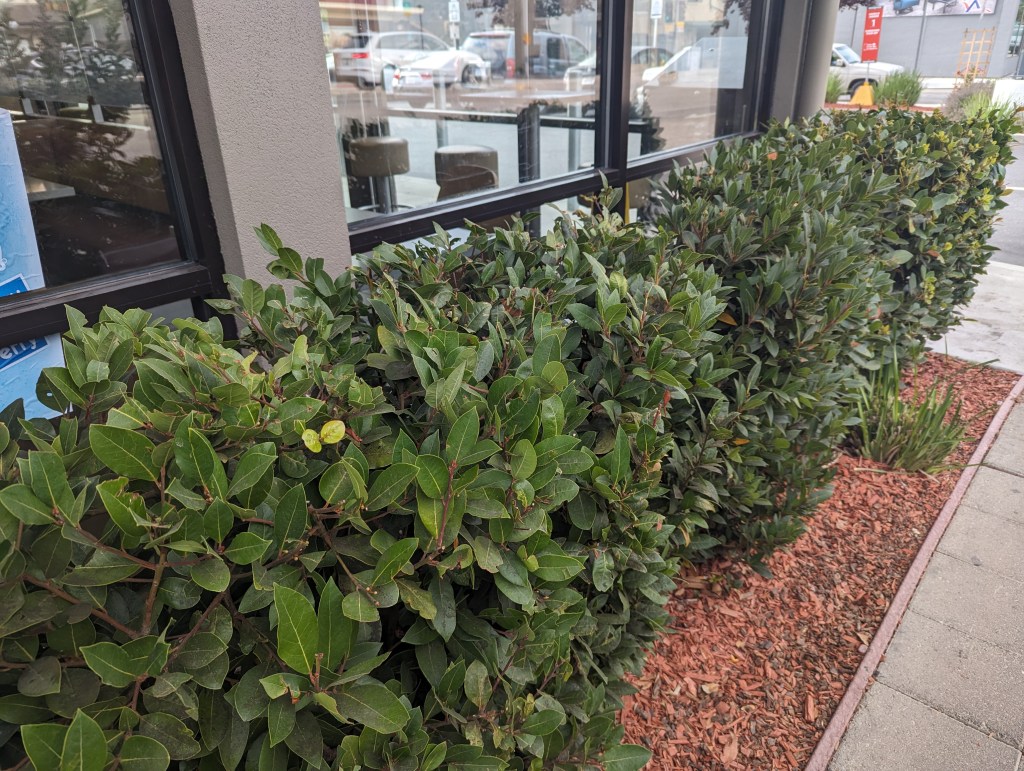
This is neither about vines nor foundation planting though. It is about this hedge in front of this glass facade. It got my attention because it did not grow slowly into this form from overgrown foundation planting, but was intentionally installed and shorn as such. Then, I realized that it is actually practical. It did not require modification of the wall. It is shorn to maintain a slight bit of clearance from the glass facade, to facilitate cleaning of the glass, and inhibit accumulation of detritus against the glass. Therefore, it does not look so bad from within. Perhaps it is comparable to painting the glass wall green, but is actually more visually appropriate.

Naked Lady

Naked lady foliage grows after bloom.

They can be quite a surprise when they bloom for late summer. The tops of their dormant bulbs previously seemed to be dead at the surface of the soil. Then, suddenly, their bare floral stems emerge to bloom without foliage. That is why Amaryllis belladonna is naked lady. Foliage grows a bit later in summer or autumn. It shrivels during late spring warmth.

Naked lady flowers stand about two feet tall, on simple green or brown stalks. Their mild fragrance is easy to miss. A profusion of bloom is only slightly fragrant during humid and warm weather. Their vividly pink color more than compensates. Fleshy seed that mature now that flowers are deteriorating are perishable. They prefer almost immediate sowing.

After naked lady flowers imitate lily flowers, their leaves will imitate lily of the Nile leaves. Naked lady and lily of the Nile are related, but neither are related to lily. The strap leaves of naked lady are more fragile than those of lily of the Nile. If damaged, they can lay flatly for quite a while. After defoliation during spring, dormant bulbs are conducive to division. It might delay bloom for that year.