Seed Collection For Another Season

Less hybridized canna produce more seed.

Deadheading conserves resources that would otherwise sustain production of seed. For species that bloom more than once, it promotes continued bloom. For others, it promotes healthier vegetative growth. Also, it inhibits proliferation of potentially invasive seed. It is neater anyway. However, several species might forego deadheading for seed collection.

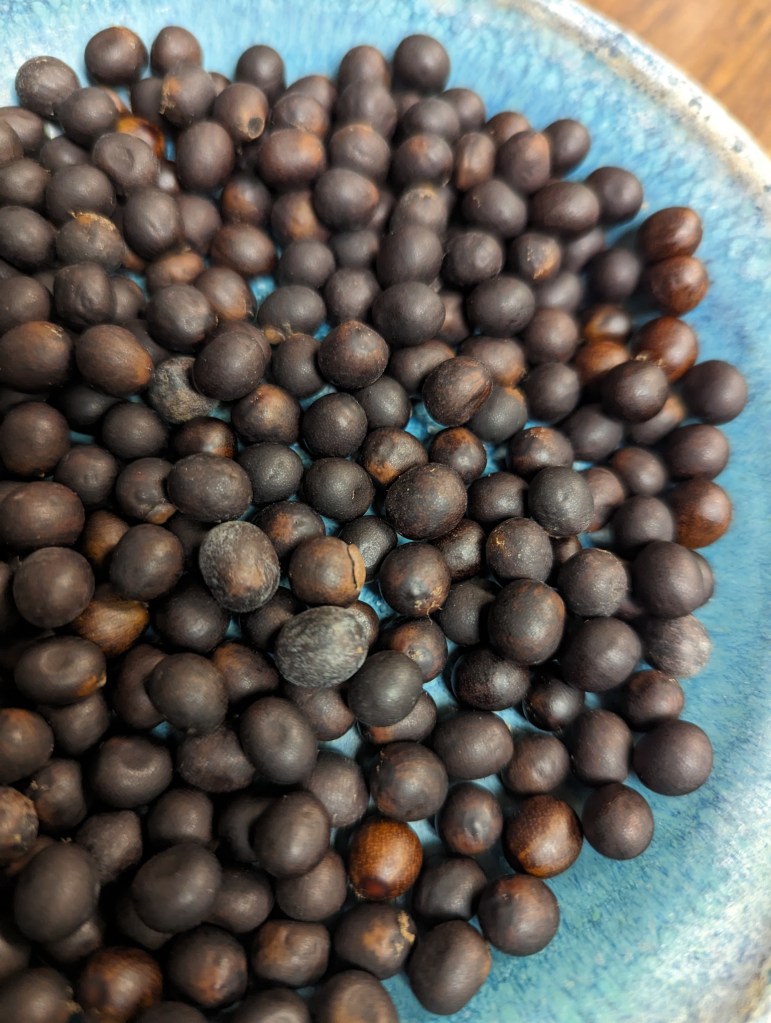
Flowers that bloom only once for a brief season generate all their seed at the same time. Flowers that bloom for an extensive season generate seed for a more extensive season. Some seed is obtainable from ripe fruit. Some is obtainable from unharvested vegetable plants that go to seed. Seed collection involves various sources during various seasons.

Regardless of its season and source, most seed is too abundant for complete collection. A single fruiting vegetable, such as a true to type chile, provides more than enough seed. A few stalks of naked lady might provide more seed than one garden can accommodate. Wildflowers are an exception. Their seed collection is rarely too excessive to broadcast.

Many species do not reliably generate viable seed though. Some require pollination by a very specific pollinator that does not live here. Yuccas that are from Central America rely on moths that live only in Central America. Some bamboos generate seed only once in a century or so. Most hybrids are too genetically dysfunctional to produce any viable seed.

Hybrids that can generate viable seed are very unlikely true to type. In other words, their progeny will be very different from them. Such progeny tend to revert to a simpler or more primitive form. The same applies to progeny of cultivars of extensive breeding within one species. Genetic aberration, such as variegation, is likewise unlikely inheritable by seed.

To complicate seed collection, some species begin life with juvenile growth. Some might take several years to mature. Avocado seedlings initially grow very fast, and tall, without blooming. By the time they mature, bloom and produce fruit, such fruit can be too high to harvest. Trees from nurseries are fruitful lower only because of grafting with adult growth.
Palm Reading

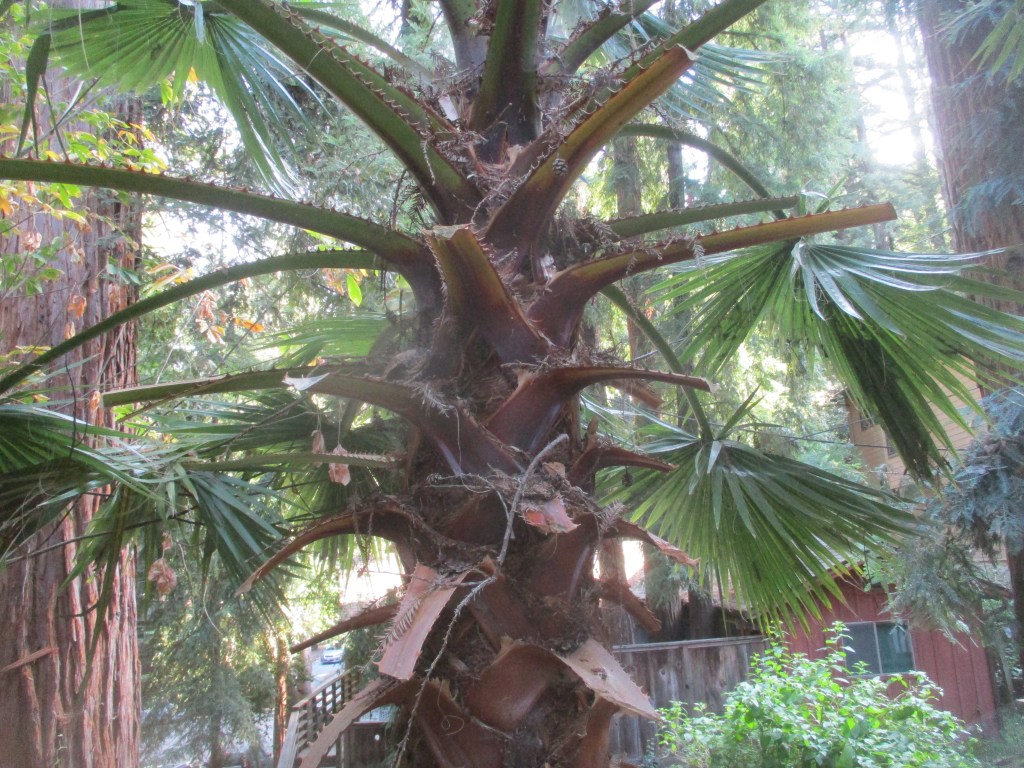
This is painful to look at.

Not everyone is interested in horticulture. Most enjoy other interests, such as sports, arts or cooking. They may know no more about horticulture than a garden enthusiast knows about the Seattle SeaMonkeys. Unfortunately though, some are not as aware of their lack of horticultural expertise as garden enthusiasts are aware of their lack of proficiency with other interests.

For example, I can grow just about any fruit or vegetable or perhaps grain that can grow here, but if I can not eat some of them fresh, I am aware that I do not know how to cook them. I must rely on someone who does know how. Yet, someone who is proficient with cooking is likely to believe that it is practical to grow fresh vegetables on a kitchen windowsill because it seems so easy on television gardening shows.

Someone I work with found this young Mexican fan palm to be bothersomely obtrusive to a confined situation within which he was working. He is, incidentally, a sports enthusiast. Naturally, as a sports enthusiast, he believed that he was qualified to groom the obtrusive fronds from the trunk of the Mexican fan palm. This was the result.

The necrotic but nonetheless harmless and relatively pliable foliage was removed to expose the wickedly sharp teeth of its rigid petioles, which extended outwardly in all directions from the trunk. This could have been quite dangerous for anyone who might have been so unfortunate as to bump into it. The thorns curve inward, to maximize damage to victims who pull back, which is, of course, the natural response to an encounter with such thorns. It was painful to merely look at! It seriously reminded me that I am no expert on sports or cooking. I pruned the petioles cleanly back to the main trunk.

2 / 3

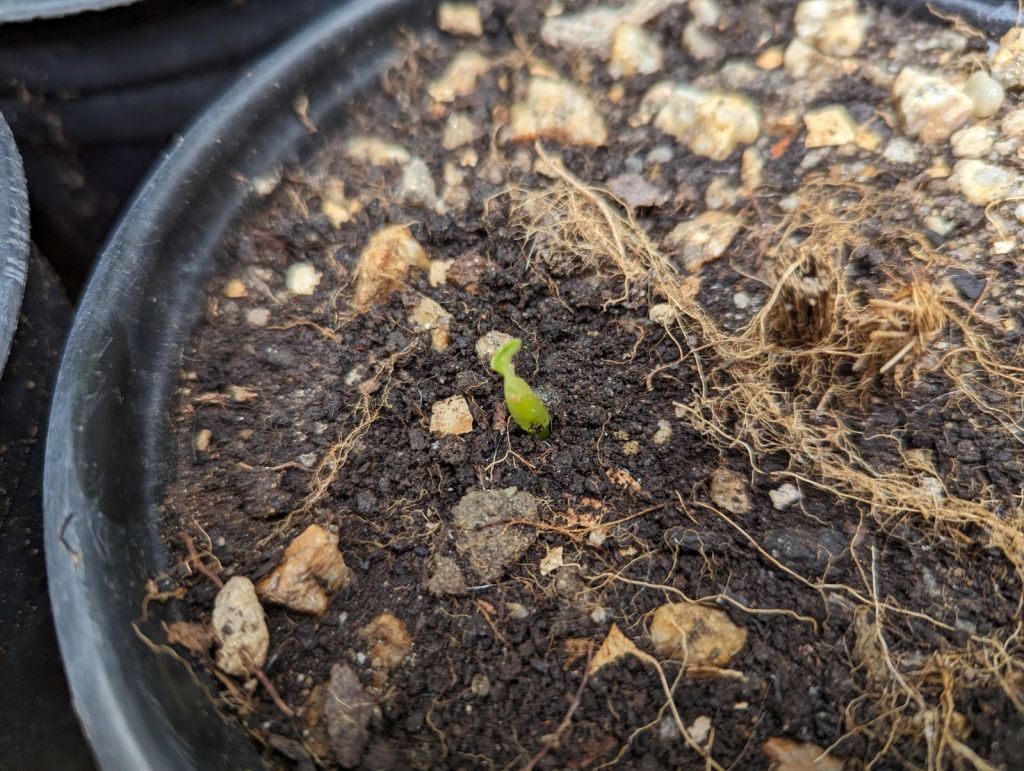
This is the wimpiest of the sixteen survivors.

Sixteen of the twenty-four mixed dinnerplate dahlias that I did not expect favorable performance from have survived! Only eight have failed to exhibit any indication of viability. Two thirds are growing. Only one third is not.

I am impressed. I expected less than half to survive. They arrived in embarrassingly shabby condition. I canned all of them regardless, including several that were obviously completely necrotic. I wanted to give all a chance to survive before discarding any. Those that were obviously completely necrotic are among those that have not exhibited any indication of viability. However, I am not ready to discard any yet. Although I still believe that some are completely necrotic, a few others may not be. As I dump any that do not at least try to grow prior to winter, I will inspect their tubers for any indication of viability, no matter how minor.

The survivors will be pampered. I want them to generate as much vegetative growth prior to frost as possible. That should sustain the regeneration of their wimpy tubers so that they will be ready to grow next spring. I am aware that even the healthiest may not survive winter if their tubers are inadequate.

Those that survive through winter are likely to grow and bloom as if they were always healthy. In a few years, they could be ready for division. Perhaps after a few more years, I will regret the procurement of so many.

In this mild climate, it is not necessary to dig dahlia tubers for winter. We only do so because it has become a habit, and perhaps to relocate the dahlias.

Dinnerplate dahlias are certainly not my favorite type, but they are more appropriate to the landscapes that they will inhabit than they types that I would prefer.

This is the most vigorous of the sixteen survivors.

Six on Saturday: Naked or White or Dead

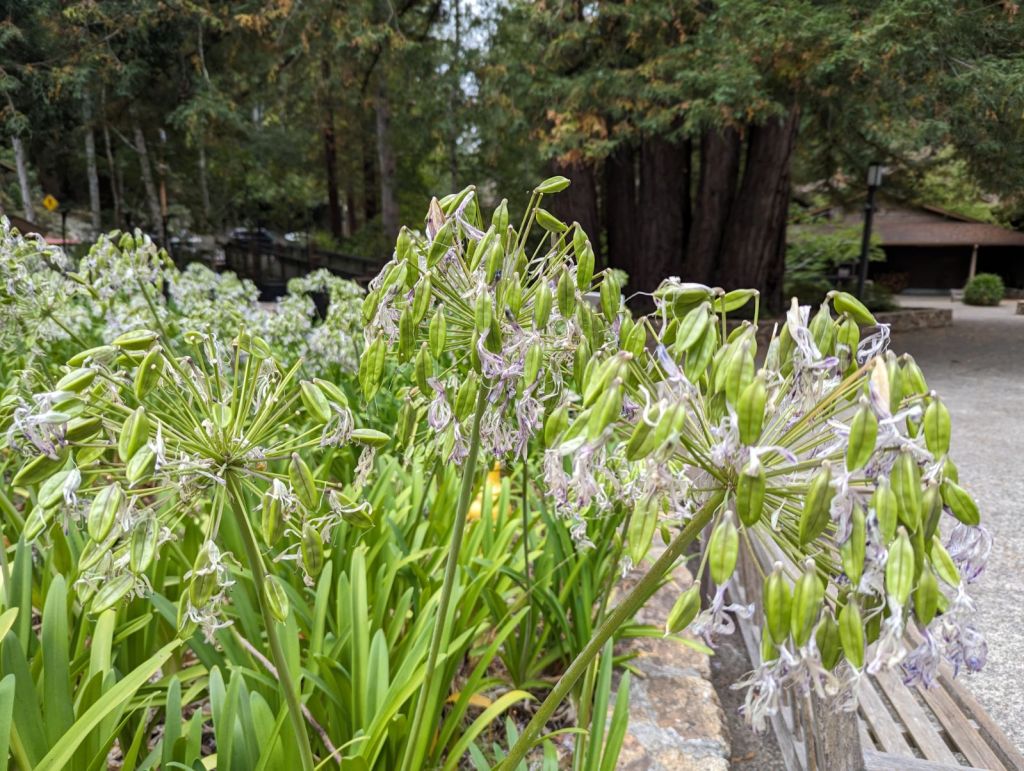
Three of these six are naked ladies, Amaryllis belladonna. Two of these six bloom white. Three of these six need deadheading. Three qualify as two categories. Two qualify as one category. One qualifies as none. None qualify as three. Alternatively, three are lily of the Nile, Agapanthus orientalis, two bloom blue, two bloom pink, and three do not yet need deadheading.

1. 1 – dead but neither naked nor white. Lily of the Nile, with few exceptions, is in need of deadheading at this time of year. All but one cloned colony here are mixed blue varieties.

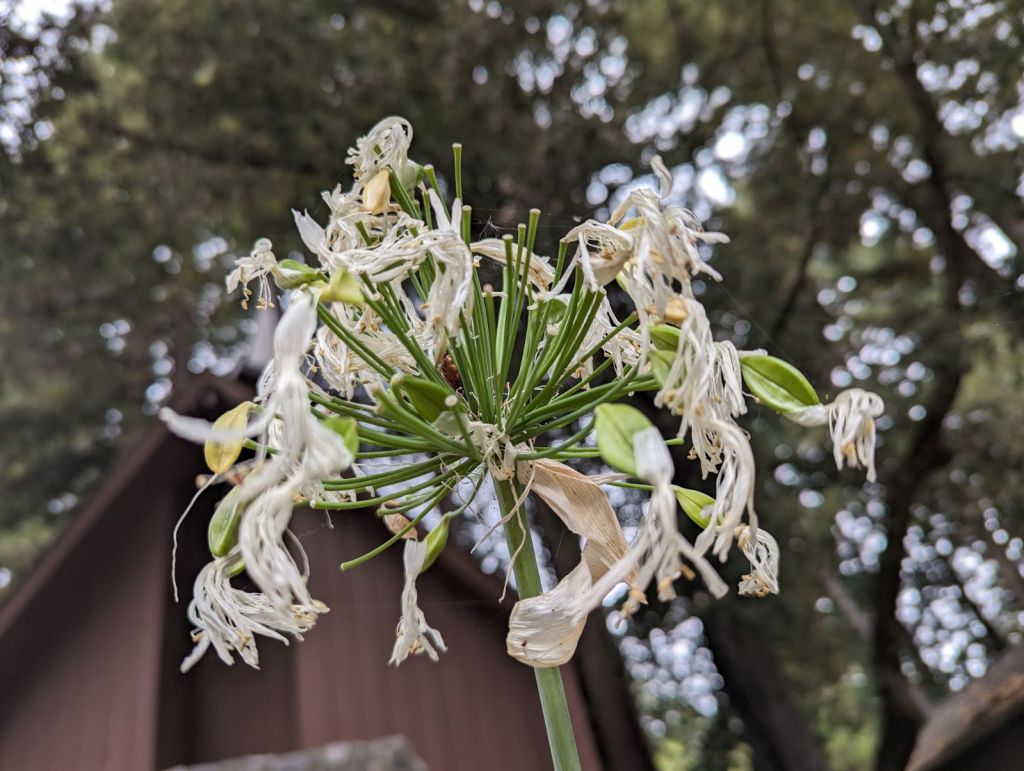
2. 2 – white and dead but not naked. This deteriorating floral truss is one of merely three that bloomed within the one cloned colony of white lily of the Nile. This colony is young.

3. 0 – not naked, white or dead. This is the lowest score because bloom deteriorates a bit slower in the shade. Blue lily of the Nile could score no more than a single point anyway.

4. 2 – naked and dead but not white. This is the common naturalized naked lady here. It bloomed annoyingly bright pink, but is not the brightest pink. It should be deadheaded.

5. 1 – naked but neither white nor dead. This is a brighter pink naked lady that is not yet in need of deadheading because it blooms a bit later. It has slightly stouter brown stems.

6. 2 – naked and white but not dead. This is merely one of three highest scores, but is my favorite! I had wanted a white version for a long time. It seems to bloom late like #5, but blooms on a green stalk like #4. Its primary bulb already generated four pups, so will be relocated to a more prominent location to develop as a colony. It will not bloom much if split annually, but will multiply most efficiently by such technique. I want more of them!

This is the link for Six on Saturday, for anyone else who would like to participate: https://thepropagatorblog.wordpress.com/2017/09/18/six-on-saturday-a-participant-guide/

Redgum Eucalyptus

Red gum eucalyptus is notably drought tolerant. Apparently, it can also temporarily tolerate saturation.

Although not quite as aggressive, sloppy, big or structurally deficient as the notorious blue-gum eucalyptus, the red-gum eucalyptus, Eucalyptus camadulensis, is one of the ‘other’ eucalyptus that give eucalyptus a bad reputation. It is realistically too big and messy for refined urban gardens, and can be combustible if overgrown or too abundant. It is consequently probably not available in nurseries, despite being one of the most common species of eucalyptus (second only to blue-gum) in California. Red-gum eucalyptus has the advantage of being one of the most resilient large scale trees for unrefined or semi-wild landscapes, and works well where it has space to grow in many of the local county parks.

Cool Season Vegetables Will Hopefully Do Better Than Warm Season Vegetables Did

Tomatoes were adequate, and perhaps quite good, but not as vigorous as they should have been.

Now that it is half way through September, it is impossible to ignore that tomatoes did not have a good season. Most of us who grow tomatoes were embarrassed by their performance until we realized that everyone else who grows them was also experiencing similar disappointing results. It was not because we did not water them properly. Nor was it because they lacked particular nutrients. They simply wanted warmer weather.

Plants that were put out early before the warm weather last spring did much better at first, but then decelerated as the weather became milder instead of warmer. Cool nights certainly did not help. Mildew, which typically slows a bit as weather becomes drier (less humid) though summer, instead continued to proliferate so that new foliage became infected almost as soon as it developed.

Earlier predictions that the weather would eventually get warm were not accurate enough for many of us who are only now getting enough tomatoes for fresh use, but not an abundance for canning, drying or freezing. There is still some time for most of the tomatoes that are on the vines now to ripen; but many will probably remain green by autumn. Some but not all of the last green tomatoes can ripen off the vine. Perhaps the only good news about all this is that there should be plenty of green tomatoes for pickling.

Sadly, tomatoes were not the only warm season vegetables to be dissatisfied with the weather. Green bean vines and bushes were generally healthy and made good beans, but did not produce very abundantly. Corn was likewise of adequate quality, but on smaller ears and less abundant. Even zucchini, which typically produces too much, was a bit subdued. Marginal vegetables that really prefer warmth, like eggplant and bell pepper, were downright disappointing.

Even if the weather gets warmer in the last days of summer, languishing tomato plants can not ketchup on production. They can be left to make a few more tomatoes, but will eventually need to get out of the way of cool season vegetables. Cabbage, kale, turnip greens, beets, radishes and all the slower growing vegetables that take their time through autumn, winter and early spring will want their space back soon. They will hopefully have a better season.

If possible, cabbage, broccoli, cauliflower and some of the larger cool season vegetable plants can be plugged in amongst the finishing warm season vegetable plants. Then, by the time the finishing warm season vegetable plants need to be removed, the next phase of cool season vegetable plants is already somewhat rooted and has a head start. This process works well in small spaces with good quality soil.

The main problem with this procedure is that it prevents potentially depleted soil from getting amended and well mixed between planting. It can also be a bit awkward to get the spacing of rows, furrows or mounds of the next phase of vegetable plants to match up with the previous phase. Smaller vegetable plants that get sown directly from seed into rows, like turnip greens, carrots, beets and radishes, really prefer customized bed preparation, after the warm season vegetables have been removed.

Wax Begonia

Wax begonia is potentially a perennial.

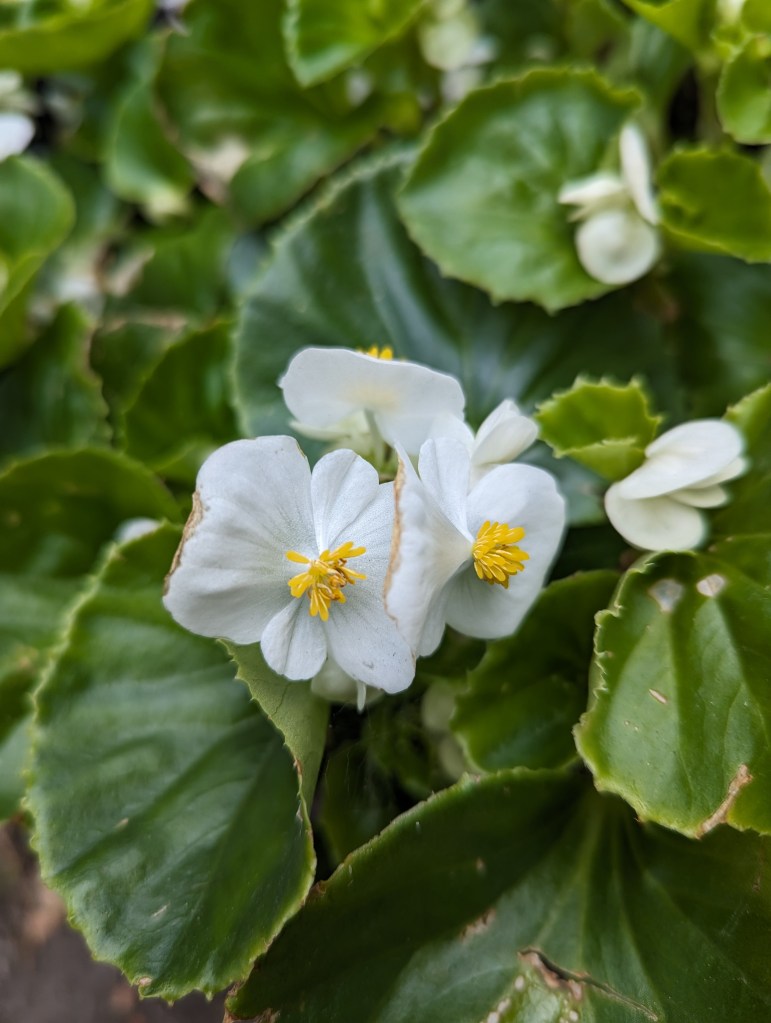
Simplicity is a recurring theme among wax begonia, Begonia X semperflorenscultorum. Floral color is white, pink or red. Foliar color is green, bronze or dark bronze. Each floral color combines with each foliar color. Variation within this simple color range is minimal. So is variation of foliar or floral form. Cultivars with slightly fluffier double bloom are rare.

Perfection eliminated the potential for improvement. Regardless of such simple variation, wax begonia is among the most popular annuals. Technically, it is perennial. Technically, it prefers warm weather. It remains available as cool season color after summer because it blooms until frost. Later, it can recover from minor frost. Without frost, it blooms all year.

Mature wax begonia rarely grows higher or wider than a foot, with densely rounded form. Flowers are small but abundant. Both leaves and stems are succulent and tender, with a waxy sheen. Propagation is remarkably easy by cuttings or division. Consistent watering is very important. Partial shade is tolerable, but if too shady, can inhibit bloom somewhat.

Cool Season Color Returns Seasonally

Pansies and violas like cool weather.

Cool season vegetables are the first clue. Now that they are seasonal, cool season color is also seasonal. Both comply with similar schedules. Their cool season centers around winter, including portions of spring and autumn. Some prefer to start early. Some prefer a later start. They also finish at variable times through spring. Some perform until summer.

Warm season color also complies with distinct schedules. Some might finish a bit earlier than their cool season replacements begin. Conversely, some could continue to perform a bit later than their replacement allows. It is gratifying when color of one season finishes as color of the next season begins. That will become more likely later within the season.

Cool season color has a few designations. Winter commonly replaces cool season. Yet, it includes adjacent portions of autumn and spring. Bedding plants or annuals commonly replaces color. Yet, many are actually perennials, and none are limited to bedding. Large homogenous beds are passe anyway. Some perennials linger after their primary season.

Also, some species behave differently here than within other climates. Wax begonias are warm season color, but may dislike locally arid warmth. They perform better for spring or autumn than for summer here. Actually, they become as popular as summer ends as they are when winter ends. They bloom until frost, or continually and perennially without frost.

Growth is slower during cool weather. Therefore, seed for cool season color should start early. For most, small plants, such as those from cell packs, are more efficient than seed. Cyclamen grow so slowly that they are only available in expensive four inch pots. Some cool season color is better for autumn or spring. This includes marigold and snapdragon.

Pansy and viola are the most popular of cool season color. Pansy are a type of viola with fewer but bigger flowers. Various types of primrose are nearly as popular, and can bloom until summer heat. Iceland poppy can grow a bit later in autumn to bloom through winter. Sweet William is a perennial that blooms now until spring, and can resume next autumn. Ornamental cabbage is bold foliar cool season color.

Early Rain

This could be a sequel to ‘Late Summer’ from yesterday. It happened shortly afterward. It certainly adds another interesting component to this already odd year of weather. Although not impossible, rain at this time of year is rare. Almost all of the rain here occurs between late autumn and early spring.

Weirdly, if rain does occur during summer, it typically does so around the fifteenth of August. Seriously, it is very prompt about that schedule. It typically either begins or ends on that same date.

The first flash of lightning of the storm that started the CZU Fire occurred at 11:59 p.m. on the night of the fifteenth of August of 2020, less than a minute prior to midnight. So, although the storm occurred during the early morning of the sixteenth, it technically began on the night of the fifteenth.

This brief rain shower was minimal, but by local standards, it was surprising. I sort of wanted it to continue long enough to dampen and contain the dust of summer. It might have done so briefly, but could not prevent the dust from becoming dusty again shortly afterward. The aroma of damp asphalt dissipated even before that happened. It was fun while it lasted.

Perhaps this rain shower will be the last of this unusually autumnish weather. Warm and dry summery weather typically resumes immediately after brief rain showers that happen during the middle of August. Technically, for a summer rain shower, it is only half a month late. So far, the forecast does not suggest that pattern, but it has been wrong before, even here. I doubt that there will be any more rain prior to autumn, even if cool autumnish weather resumes until then. But of course, I have been wrong more often than weather forecasts.