In eastern North America where it grows wild as a native, garden phlox, Phlox paniculata, is modest but classic perennial that gets more than four feet tall with pinkish lavender flowers from late summer through early autumn. Modern garden varieties are mostly somewhat more compact with pink, red, light purple or white flowers. Many have fragrant flowers; and some have flowers with lighter or darker centers. Butterflies and hummingbirds dig them all.
Locally, garden phlox probably looks best with slight shade or among other lush plants, only because humidity is so minimal. Otherwise, it would be just as happy out in the open. In well watered gardens with rich soil, it sometimes self sows a bit, but rarely naturalizes continually enough to revert to a more natural (wild) state like it can in gardens on the west coast of Oregon and Washington. Garden phlox can be propagated by division of mature plants either after bloom in autumn or in spring.
Without deadheading roses divert resources from continued bloom to fruiting and seeding.
It takes quite a bit of effort for flowers to bloom. It takes even more effort and resources for pollinated flowers to produce seed and the fruiting structures that contain the seed. If the seed of certain aggressive plants get dispersed, we need to put even more effort into pulling up the seedlings. It just never seems to end!
Removal of deteriorating flowers, commonly known (even by those of us who missed that generation) as ‘deadheading’, can eliminate so much of this extra work. Not many plants benefit from deadheading; but most that do are really grateful for it. Others that do not care one way or the other simply look better without their deteriorating flowers.
It is of course impossible to deadhead large flowering trees or vast areas of ground cover. Regularly shorn hedges should never need deadheading because they never get the opportunity to bloom or develop fruit. Plants that are appreciated for the ornamental quality of their fruit should of course not be deadheaded.
Most roses get deadheaded as they bloom because the development of their fruiting structures, known as ‘hips’, takes enough resources to compromise subsequent bloom. Removal of these hips therefore promotes bloom. Only the few types of roses that are grown for their showy hips should not get deadheaded. Phlox, daisies, zinias, dianthus and all sorts of plants with long continual bloom seasons likewise benefit from deadheading.
Some types of iris that produce seed perform better with deadheading, not because they will bloom again during the same season, but because they can divert resources to vegetative growth (like rhizomes and foliage) that will sustain bloom during the following year. Most bearded iris (that do not produce seed) and lily-of-the-Nile do not seem to care if they get deadheaded, but are generally more appealing without their finished flower trusses.
Four o’ clocks can not be deadheaded without also removing developing flowers, so can only be allowed to bloom and throw their invasive seed all over the garden. It is easier to pull their seedlings later. We have a bit more control over crocosmia. Even though they do not need to be deadheaded, they are less invasive and more appealing without their scraggly brown stalks and seed capsules.
This is such a visually appealing trellis at the Cavallaro Transit Center in Scotts Valley. It is so very visually appealing that no one wanted to obscure its visual appeal with the two vines that it was intended to support. It is very well designed also. Neat holes were left in the concrete pavement for the two vines that were not planted. Capped terminuses of the irrigation system that was intended to provide the absent vines with water are ready for installation of emitters. The otherwise exposed ground was covered neatly with gravel. It is all well executed.
All that is missing is the vines.
Realistically though, who notices? It really is a visually appealing trellis. Vines would be visually appealing also, but would also clutter the landscape more. Besides, they would require more maintenance, and the surrounding landscape already lacks adequate maintenance. The empty trellis actually seems to be an asset to the otherwise bland landscape. I only notice the absence of vines because I am a horticulturist.
I will say that I am not so keen on such structures in other landscapes. Most are overbuilt. Many such as this are within situations that trees would be more practical.
I have encountered several similar structures, but with single pillars, in downtown Livermore. Grapevines climbed them to form inadequately and improperly pruned grape trees to flank the main streets. Honeylocusts that flanked the same streets would have been more than adequate alone. The grapevines were intended to commemorate the formerly vast regional vineyard that were replaced by equally vast tracts of home, but their shabbiness was too insulting.
Landscape designers and architects should realize that vines require significant specialized maintenance. Architects rely on landscape designers to select vines for their trellises. Landscape designers rely on gardeners to maintain their vines.
Each flower lasts for only a day. That is why the common name of Hemerocallis is simply daylily. Each floral stalk provides several flowers that bloom continually for several days. As one flower deteriorates, another replaces it. Because floral stalks shed so continually, they are not very practical as cut flowers. They are splendidly colorful in gardens though.
Most popular daylily cultivars are products of breeding that is too extensive to document. That is why almost all lack species names. Their cultivars names generally suffice. Most daylilies bloom for a month or so. Also, most bloom best for early summer. A few bloom a bit earlier. Some bloom as late as autumn. Some can bloom randomly or twice annually.
Daylily bloom can be yellow, orange, red, pink, almost purplish or combinations of these. Yellow or pink can be so pale that it seems to be almost white. Flowers can stand as tall as three feet, on bare stem. Their arching grassy foliage stays somewhat lower, in dense mounds. Most cultivars are evergreen. Some are deciduous. They propagate by division. Some migrate by vigorous stolons.
Aridity is the opposite of humidity. It is why summer warmth is not as unpleasant here as in humid climates. It does not get so much consideration though. Most of the populace of California inhabits arid chaparral or desert climates. Aridity is so typical that any absence gets more attention. Humid warmth is both uncomfortable and relatively uncommon here.
Hurricane Hilary recently demonstrated how unusual humid weather can be here. It was merely a tropical storm as it left Mexico, but was significant nonetheless. Humidity briefly remained elevated after torrential rain in Southern California. It may have lingered longer in regions that lacked rain in Northern California. It caused warmth to seem a bit warmer.
This humidity would have been more horticulturally influential if it had lasted a bit longer. Obviously, irrigation is temporarily unnecessary for saturated landscapes. Some flooded. Some simply absorbed rain. Less obviously, landscapes that received no rain need a bit less water with humidity. Humid weather reduces evaporation from active foliar surfaces.
Humidity also reduces the volatilization of floral fragrance. Fragrant flowers are therefore more fragrant during humid weather. Delicate floral structures also last a bit longer. Many flowers are more turgid and colorful with humidity. All sorts of foliage, particularly tropical foliage and fern foliage, is more lush. After all, most vegetation is from less arid climates.
Humidity influences allergens also, both positively and negatively. Some allergens, such as fungal spores, are more abundant with humid weather. Some allergens, such as dust and pollen, are more abundant with less humidity. That is why humidifiers are helpful for dust or pollen allergies. It is also why dehumidifiers are helpful for fungal spore allergies.
Spontaneous limb failure can be another consequence of humid warmth. It is hazardous because it occurs very unexpectedly without wind. Warmth accelerates vascular activity, which increases foliar weight. Humidity with slow air circulation inhibits evaporation from foliage. If unable to shed enough weight, foliage becomes too heavy for limbs to support.
Perennial pea is a somewhat naturalized exotic species here. It may not be aggressively invasive enough to be classified as a weed though. However, I would classify some of it that I can not exterminate from at least one of our landscapes as weeds. Once it gets established, it is very persistent.
It seems to prefer to grow on roadsides or fences. It is not so common in flat open spaces. It rarely gets big enough to overwhelm or otherwise damage other vegetation. It dies back when the weather gets too inhospitable for it. It regenerates when the weather is more comfortable.
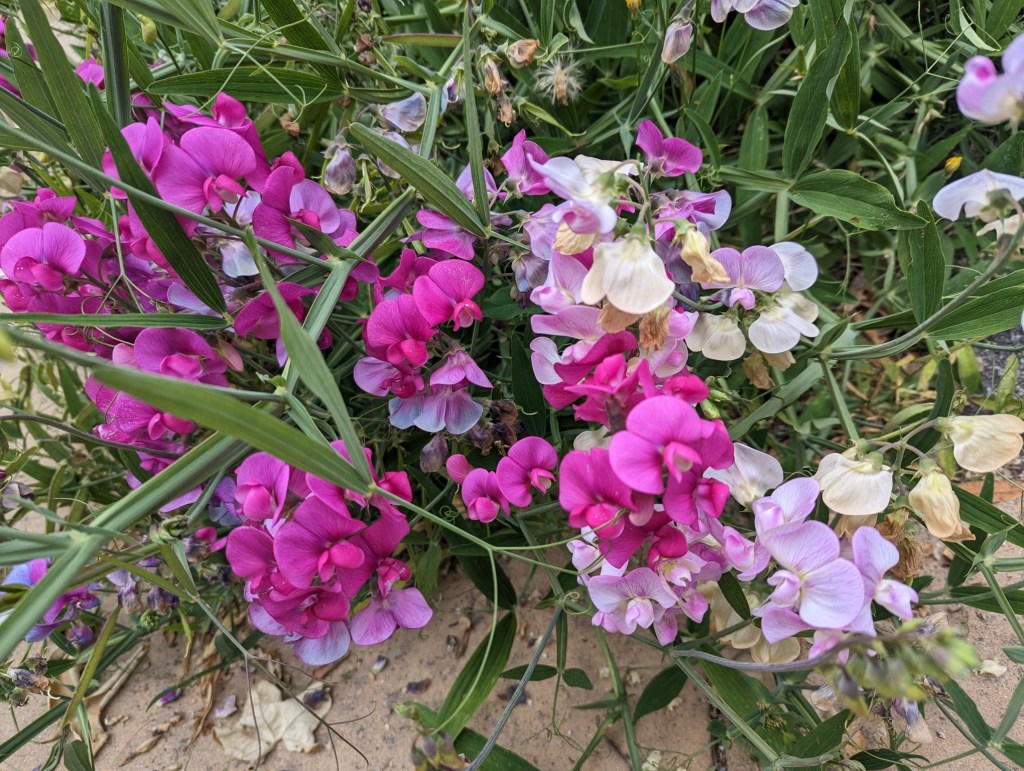
Perennial pea certainly is pretty. Almost all of it blooms with typical bright purplish pink flowers. A few uncommon specimens bloom with variations of lighter pink. White is even more rare. Only red is more rare than white. I have never seen it growing wild. Although seed for red perennial pea is available, I know of no one who has actually grown it.
Therefore, until someone can prove that red actually exists amongst naturalized perennial pea, white is the rarest color. It might also be my favorite. I can not decide. White is my favorite color. Also, perennial pea happens to look great in white. Yet, the familiar obnoxiously bright pink is so typical of the species. It is the color that everyone expects to see growing wild on local roadsides.
I was fortunate to find a specimen at work that blooms white. I grew a few copies of it, but kept them canned. I shared some with colleagues in other regions until only two remained here. I was not too alarmed when these last two were overwhelmed by other vegetation and died, since I thought I could grow more copies from the original specimen. That was until I found that the original was destroyed by excavation to mitigate erosion from last winter!
I believe that another specimen that blooms white lives nearby. Its particular colony has already finished bloom for the season. I must therefore wait for it to resume bloom, or look for errant bloom through winter. After getting so involved with it, perhaps it really will be my favorite.
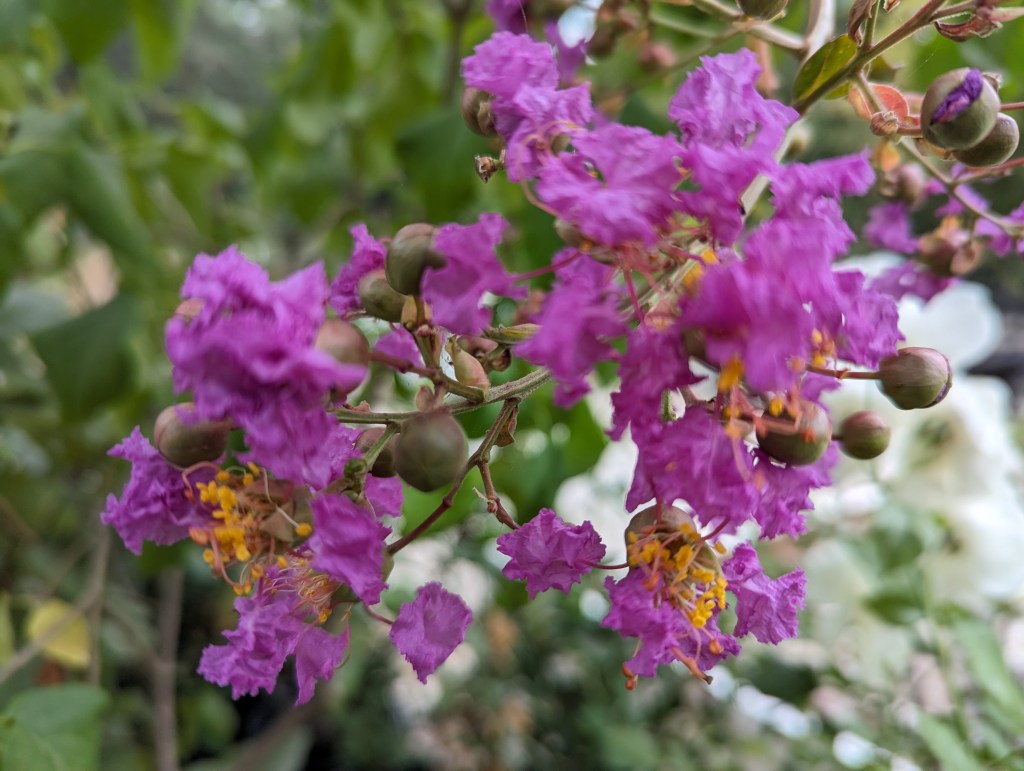
What cultivar of crape myrtle is this?! I realize that this picture is blurred, which is why it was not included within my ‘Six on Saturday’ post this morning, but it is the floral color that is important. Is it purplish pink, or just bright pink? What cultivar does it look like?
I expected this crape myrtle to be one of the old reliable cultivars because it was a gift from the Arbor Day Foundation. The primary old reliable cultivar that blooms with similar floral color is ‘Muskogee’. Yet, even with my limited ability to discern color quality, this floral color seems to be a bit too rich. I sort of expect a milder and scarcely purplish pink from ‘Muskogee’. I suppose that the Arbor Day Foundation can also grow modern cultivars like the rest of us.
Regardless of its identity, it is certainly pretty. The foliar color during autumn is comparable to that of old reliable cultivars. Because neighbors like it, I grew a few copies for them. We would like to incorporate more crape myrtles into the landscapes at work. The abundance of spring color from other species there mostly finishes prior to the summer bloom of crape myrtle. Summer is the busiest season, so justifies flashy color.
Embarrassingly though, I am still none too keen on crape myrtle. If I did not typically spell ‘crape’ as ‘crepe’, I would prefer to spell it without the ‘e’ at the end. I was impressed with it when I first started to notice it through the 1980s, but then realized that it was becoming too common through the 1990s. That was long after Brent told me that it had become too common throughout the Los Angeles region significantly earlier. Decades later, it is still too much of a good thing.
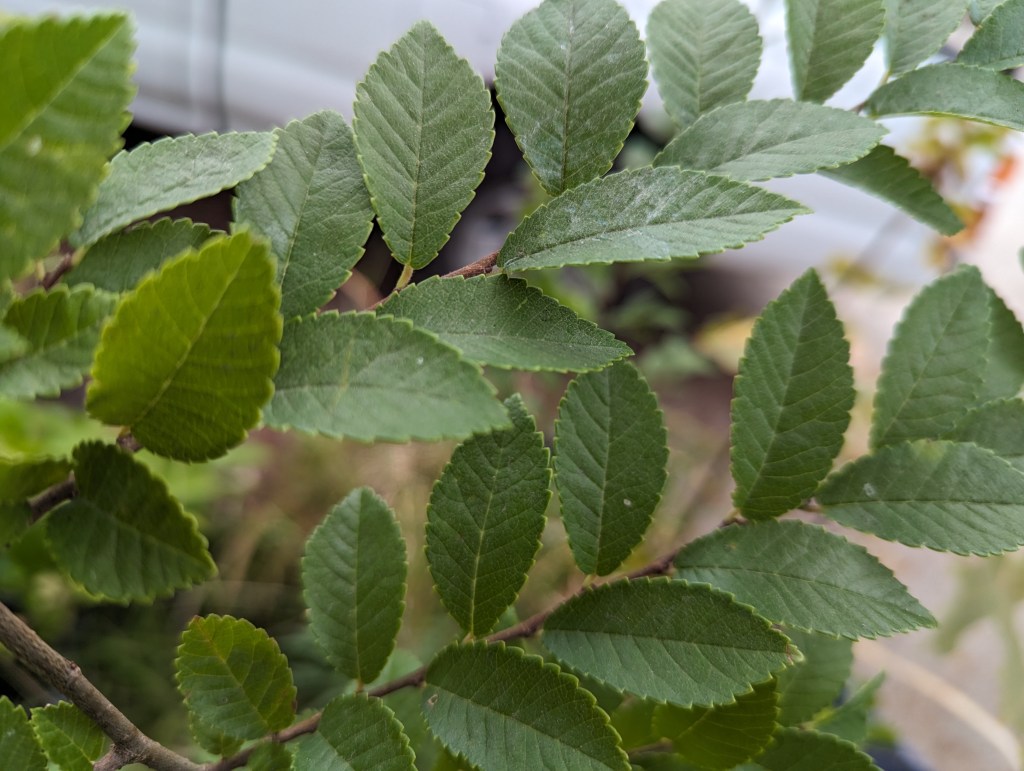
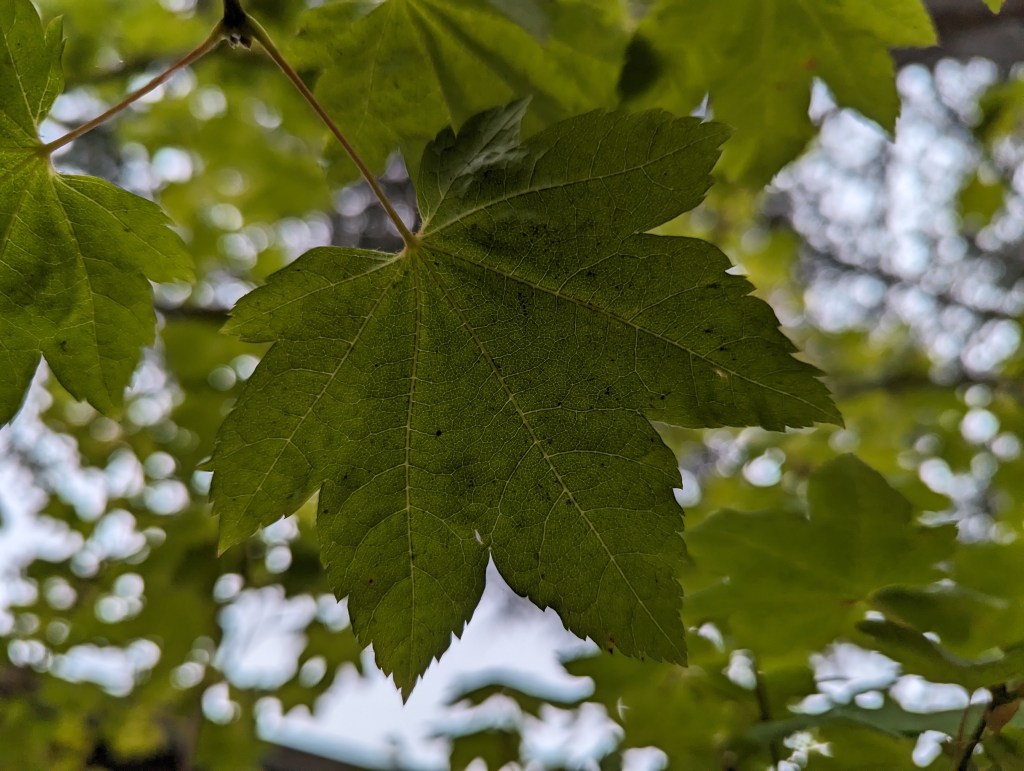
So much of the vegetation that we work with is unidentified. I know most of the species, but not all. Cultivars and varieties are more difficult to distinguish. There are too many! I am completely unfamiliar with some of the most modern of them. Of my Six this week, only the second might be a cultivar. The others are likely straight species. I am uncertain of their identities though, because I am unfamiliar with them. Actually, the third is not as labeled! That is because I thought it was something else until it foliated last spring. This Six on Saturday is about six questions of identity. I hope that someone might identify #1 for me.
1. Opuntia littoralis, prickly pear came from the Bat Cave in Los Angeles County, where a few other species of this genus are also native. I do not know if I identified it correctly.
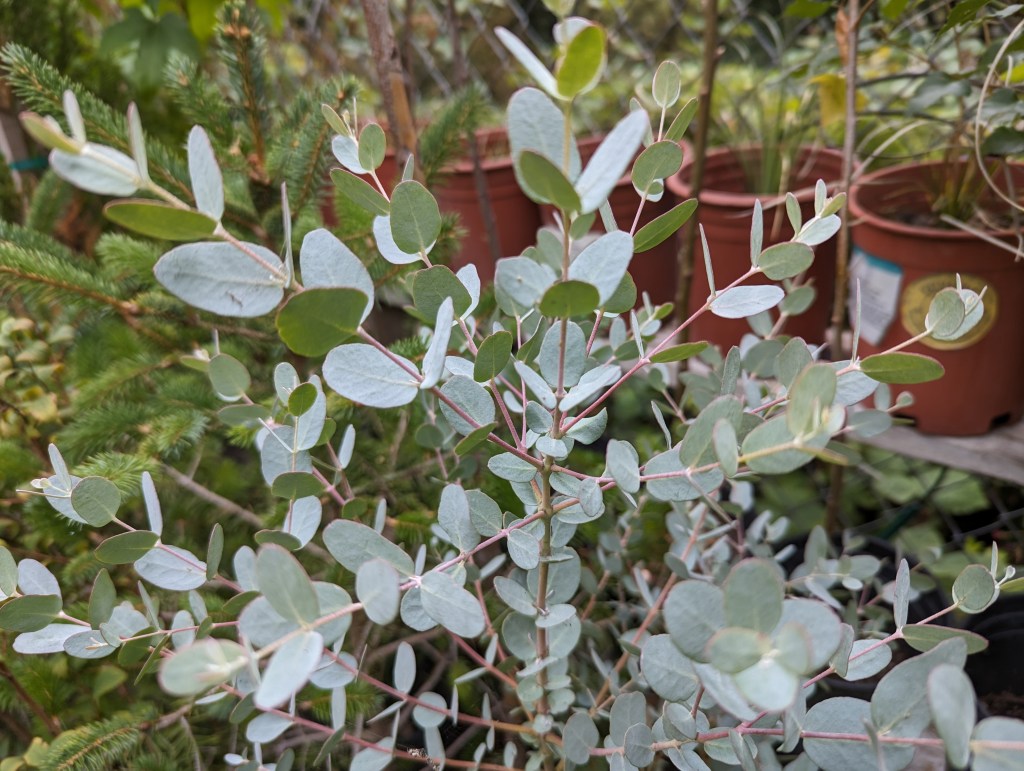
2. Eucalyptus gunnii, cider gum looks just like this while young, but so does the juvenile foliage of a few other species. Adult foliage and associated bloom is easier to distinguish.
3. Vitus californica, California grape looks nothing like this. I brought this here from the roadside while it was defoliated for winter. I hoped that it would be the California grape.
4. Ulmus parvifolia, Chinese elm was common when I was a kid. Only modern cultivars and hybrids are available nowadays. If this is common Chinese elm, it is now quite rare.
5. Populus alba, silver poplar is what I believe this might be. I grew it from cutting from a tree that I met in San Jose a few years ago. I am unfamiliar with this particular species.
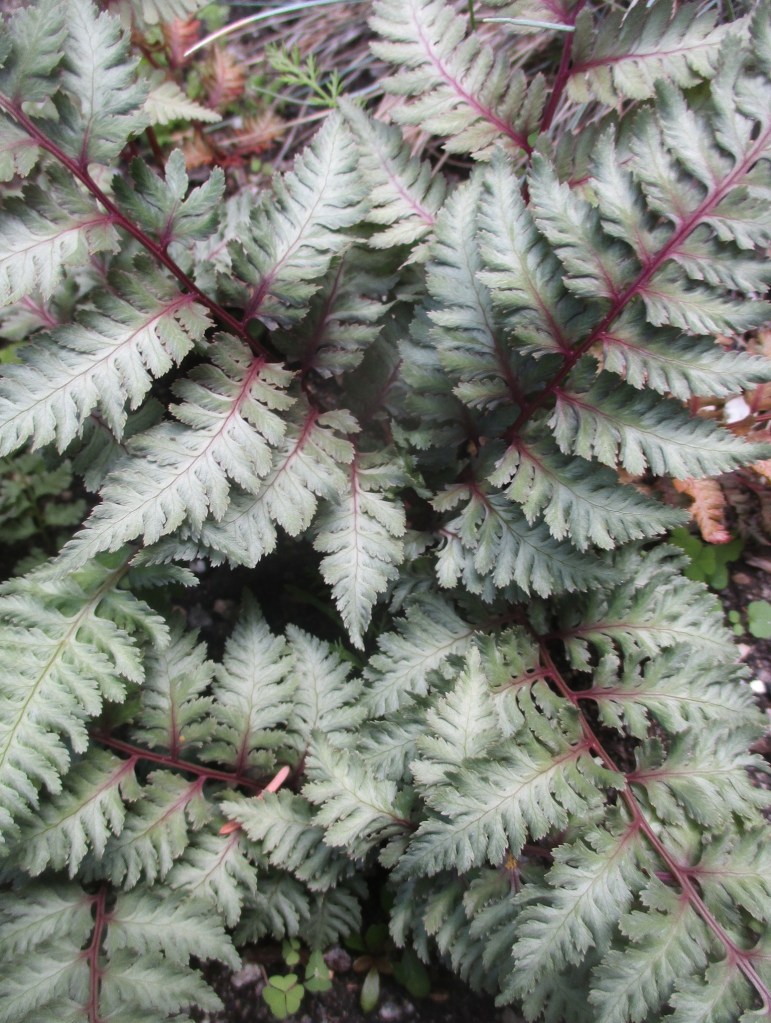
6. Acer circinatum, vine maple should be a gratifying alternative for another ubiquitous Japanese maple. I could be disappointed if this is merely another passe Japanese maple.
My neighbor describes sweet alyssum, Lobularia maritima, as a ‘polite’ weed. It naturalized over an area of her vegetable garden that was not in use at the time, but was easy to get rid of when the space was needed for something else. A few plants that were left in the perimeter bloom almost continuously and fill in other unused space between herbs and perennials without interfering with them.
As a bedding planting, sweet alyssum is most often planted from cell packs like most other annuals. Yet, seed is so easy to sow in bare spots among mixed annuals or perennials. Naturalized sweet alysssum sows seed so abundantly that new plants replace old plants before the old plants deteriorate.
Bloom is most often white, but can be shades of pink or purple. However, naturalized sweet alyssum eventually reverts to classic white. The minute, sweetly fragrant flowers form small, round clusters over the delicate mounds of finely textured and sometimes sparse foliage. The tiny leaves are only about an inch long and quite narrow. The largest naturalized plants are not often more than a foot tall.
Vegetation that survives within untended gardens is truly sustainable.
Sustainability is a good idea gone bad. It is so often used as a marketing gimmick by those who actually have the least to gain from it. Really, landscapers and gardeners would not have much business if landscapes really were sustainable and able to function without their help. The best landscapes probably compromise between being as sustainable as possible with a few more conventional but less sustainable features to make them functional.
For example, lawn happens to be among the least sustainable of landscape features. It needs ridiculous volumes of water and continual maintenance, typically with gasoline powered mowers. Many lawns are gluttons of fertilizer. Yet, almost all landscapes have lawn of some sort. Lawns are certainly justifiable for children and dogs.
The trick is to use lawn like rugs for the landscape instead of like wall to wall carpeting. If possible, it should not be an all purpose ground cover for whatever area is not landscaped with something else. It should cover only areas that will get used as lawn.
Bedding annuals are likewise far from sustainable. They need too much water and work, and get replaced seasonally. Even those that sometimes naturalize where a bit of water is available, like sweet alyssum, godetia and nasturtium, really do not perform quite like more pampered bedding plants do.
The best way to see sustainability in action is not in the pretty pictures in the brochures of landscape companies with something to sell, but in the worst of landscapes. Plants that survive in abandoned landscapes where lawns and bedding plants have died off are obviously more sustainable.
Bottlebrush, oleander and various junipers and yuccas may be stigmatized as ‘gas station’ plants, but earned that stigma by being so resilient and sustainable. The many types of cotoneaster, manzanita, wild lilac and rockrose are also worth investigating, (although wild lilac and rockrose do not live as long as the other shrubbery does.) Redwood, California laurel, strawberry tree, incense cedar and many types of eucalyptus, oak , cypress and acacia are among the more sustainable of trees.










 Tony Tomeo