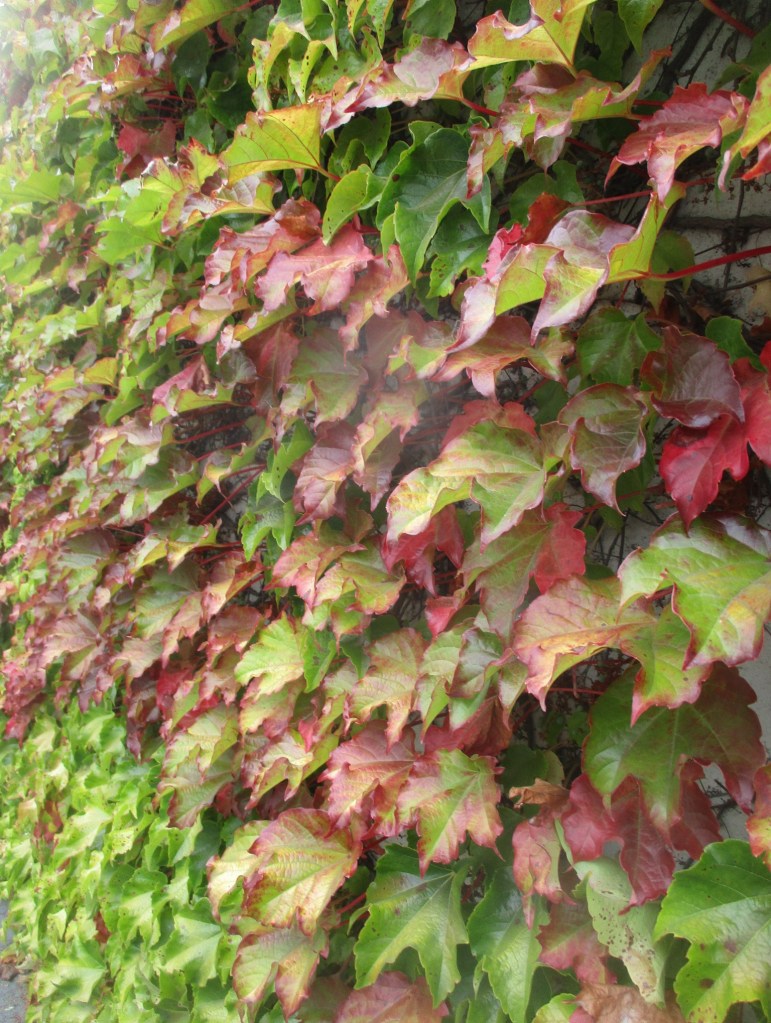
Vines are very diverse. A few are annuals. A few are perennials. Many are woody vines. Some climb by twining their stems, leaves or tendrils. Some cling onto their support with aerial roots or suction discs. Within home gardens, some need the support of trellises or arbors. Most vines are naturally aggressive, so should get all the support that they need.
Vines that cling onto their supports with roots or suction discs need no trellises or arbors. They climb regardless. English ivy clings with aerial roots. Boston ivy clings with suction discs. Both can be destructive to their support. They ruin paint and promote rot in wood. Therefore, they should only climb surfaces that they can not damage, such as concrete.
Vines that climb by twining their stems, leaves or tendrils are the sorts that need support. On trellises, some can cover otherwise bare walls or fences, or stand freely like hedges. On arbors, vines frame gateways. On pergolas, they mostly shade patios like small trees. Vines are not low maintenance, though. Actually, they require specialized maintenance.
Vines, by nature, seek the top of their support, where they grow the most. Consequently, vines on trellises tend to get top heavy. Carolina jessamine, lilac vine and mandevilla all need grooming to limit upper growth. Then, their lower growth is fuller and more uniform. Star jasmine is naturally more uniform, but even it may get somewhat overgrown on top.
Upper overgrowth may not be so undesirable on arbors or pergolas. However, pruning is as important. Grapevines need annual dormant pruning during winter. Such pruning is a bit more complicated at the height of a pergola. Wisteria can be spectacular on pergolas. It needs aggressive pruning, though, so that it will not become too overgrown and heavy.
Bougainvillea is one of several vines that does not actively climb. It requires guidance to follow trellises or arbors, or to reach the top of pergolas. Then, it needs frequent pruning to avoid overgrowth. Its various cultivars behave differently, though. Some stay compact enough for small trellises and arbors. Some grow large enough for substantial pergolas.

