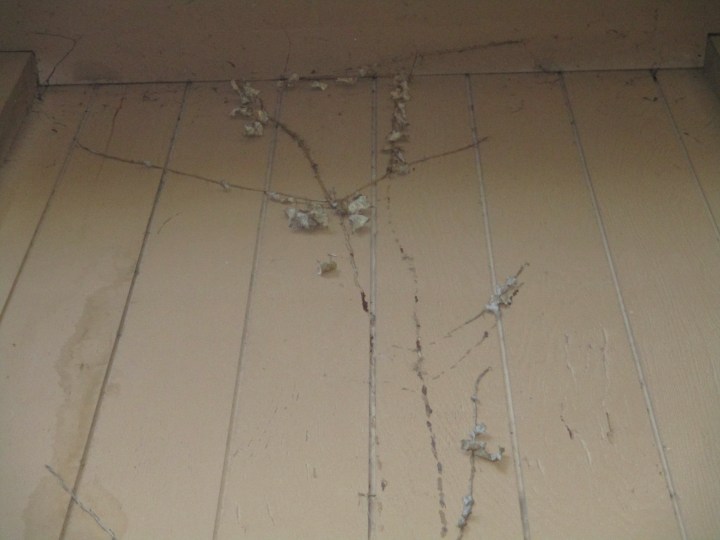
Just because it ‘can’ be grown as a houseplant does not meant that it ‘should’ be. That is a lesson that Brent and I never learned in college. He and I were roommates in the dorms at Cal Poly in San Luis Obispo, which, as you can imagine, was a problem. Our room on the top floor of Fremont Hall was known as the Jungle Room. It was so stuffed full of weird houseplants, as well as a few plants that had no business inside. We had a blue gum eucalyptus bent up against the ceiling, an espaliered Southern magnolia, a Monterey cypress, and a herd of camellias that we rescued from a compost pile on campus.
After college, our own homes were no better. Because my dining room was rather small, Brent gave me tall weeping figs that had unobtrusively bare trunks down low, and plenty of fluffy foliage pressed up against the ceiling; a technique we did not quite perfect with our Jungle Room blue gum. I had a giant yucca in the guest suite, a redwood in my bedroom, king palms in the parlor, and a lemon gum eucalyptus over my desk in the office. The bathroom was the worst, with pothos and Algerian ivy hanging over the shower curtain, and billbergias up over the shower. A pair of small birds nested in the billbergias, and before I realized that they were there and evicted them, they started a family!
At least Brent kept most of his plants outside where they belong. The staghorn ferns grab onto the walls when they get the chance. Wisteria vines grab onto anything else. The flame vine climbed up the chimney (appropriately), and before Brent knew it, had sneakily spread to the opposite side of the parapet roof! Then there was the giant timber bamboo. Yes, that is what I said; giant timber bamboo. I know what you are thinking right now, so there is no need to say it.
There is a narrow space between north side of Brent’s home and the concrete driveway next door. It is almost three feet wide. Brent though that if he planted the bamboo there, it would not get to the other side of the driveway. He was actually correct.
Did I ever mention how vain Brent is? Well, that is another topic for another time. I will say for now that he has more clothes than his teenaged daughter Grace. A lot more. They do not all fit in his big closet. He hangs some of his longer coats that he does not need very often in Grace’s much smaller closet. One day, he was reaching around the clutter that is common in a teenaged girl’s room, and groping for one of his coats in Grace’s closet, when he grabbed a hold of something that should not have been there. He was not certain what it was at first, but when he found his coat and pulled it out, a few dried bamboo leaves came with it and fell onto the floor!
The bamboo did not even try to go under the neighbor’s driveway. Instead, it went under the foundation of the house. Where it came up, it had nowhere to go, so somehow weaseled in next to a water pipe, and followed it up behind the bathroom washbasin. Once inside, it somehow weaseled past a valve access panel behind Grace’s closet, and straight up to the ceiling. What is even funnier is that Grace knew it was there, but figured that it was just another one of Brent’s crazy landscaping ideas!
Just in case you are wondering, giant timber bamboo is a very bad houseplant!
The bamboo is gone now. It got so tall that the wind would blow it against the terracotta tiles on top of the parapet wall. Also, the foliar litter was too messy on the parapet roof and the neighbor’s driveway. It did not contribute much to the landscape anyway, and shaded only a driveway that is seldom used.
 Himalayan blackberry is to cane berries what blue gum is to eucalypti. It is what gives all cane berries a bad reputation, and is why so few of us want to grow them. Himalayan blackberry grows as an extremely vigorous weeds, extending sharply thorny canes over anything within reach. When the canes are removed, the tough roots are extremely difficult to remove and kill.
 English ivy, Hedera helix, is probably the nastiest and most aggressively invasive exotic species that I work with. It climbs high into redwood trees and overwhelms understory plants (that live below the trees). It invades many of the landscapes, and worst of all, it climbs building where it ruins paint and causes rot. It grows faster than we can keep up with it.