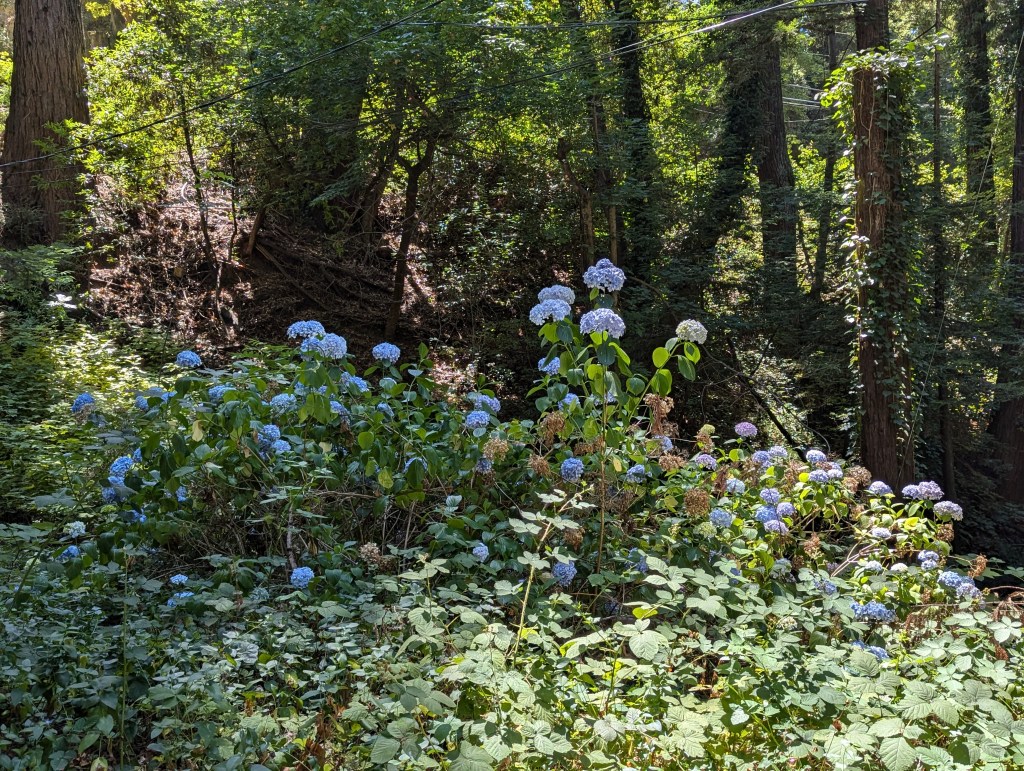
Hydrangeas were so much more predictable only a few decades ago. They were either colored or white. White was obviously white. In the Santa Clara Valley, colored was pink. We knew them as colored only because they technically had potential to be blue, whether or not we actually saw it. Application of aluminum sulfate was necessary for blue floral color. Such color was only temporary, and could fade in the process of bloom if the dosage of aluminum sulfate was inadequate. Consequently, blue hydrangeas were rare. However, within the redwood forests of the Santa Cruz Mountains to the south and west of the Santa Clara Valley, most colored hydrangeas were blue. Application of lime was necessary to make them pink. Just like blue floral color within the Santa Clara Valley, pink floral color within the redwood forests was only temporary, and could fade in the process of bloom if the dosage of lime was inadequate. Nowadays modern hydrangeas are not so sensitive to soil pH. Blue hydrangeas bloom a bit more purplish in the Santa Clara Valley, but are still mostly blue. Pink hydrangeas likewise bloom a bit more purplish in the Santa Cruz Mountains, but are still mostly pink.
 Environment is what determines what plants grow where. It may sound simple enough, but environment is a combination of many different factors, including but not limited to climate, soil quality and exposure. Each of these factors is a complicated combination of other factors. For example, climate includes temperature, humidity, rainfall, frost dates, winter chill duration, wind and so on.
 Tony Tomeo