
Among the many garden chores that I neglected so far this summer is the ‘processing’ of many of the bits and pieces of unusual succulent plants that I acquired from earlier volunteer work days at the Arizona Garden at Stanford. Volunteers are always welcome to take any of the debris that we generate. After everyone present took what they could, I could not bear to waste what was left; so I took more than I should. Cacti, agaves and yuccas cannot be recycled as green waste, so would otherwise have been disposed of.
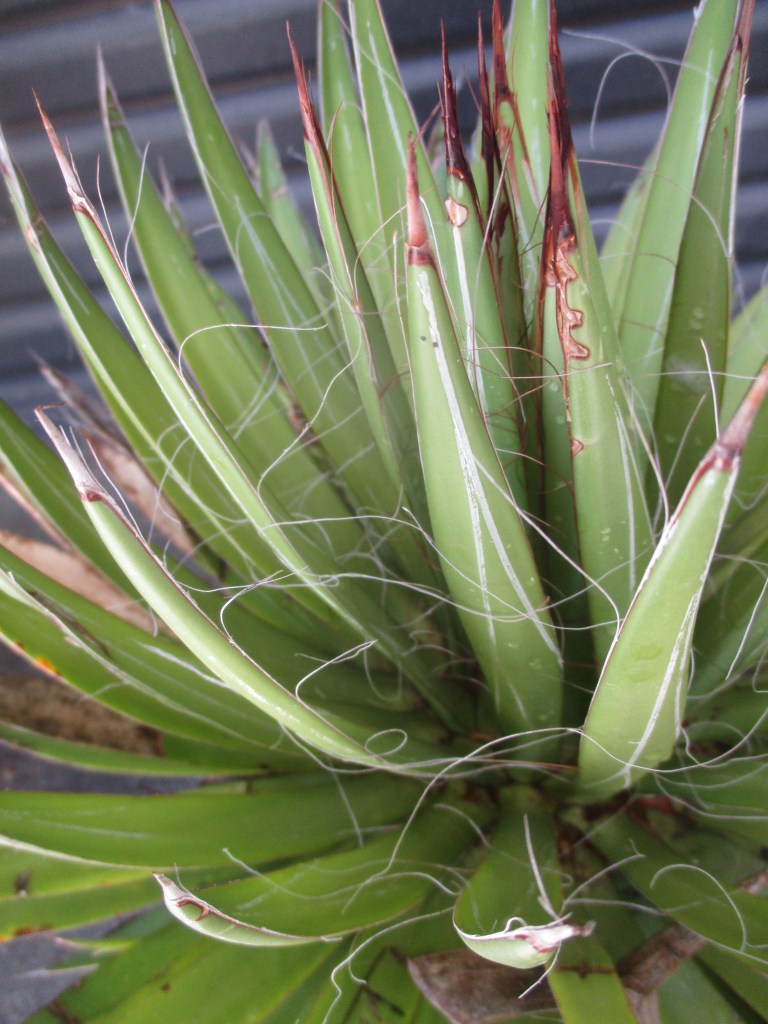
I really wanted large canes of a particular unusual yucca, so processed them as large cuttings first. I only needed to cut away all but the foliage on top, stick them in the ground and keep them watered until roots grow. This particular desert yucca does not grow roots as efficiently as tropical yuccas do, though.
Meanwhile, many pieces of cacti, ice plant, and succulents that I can not even tell you the names of remain out in a pile in the driveway. However, as I was looking them over today, I noticed that they are not only alive, but actually seem to doing quite well. Some are even blooming!
This is just too weird. There is no soil. There is no watering. Even if there were, there are no roots to exploit the resources that are necessary to keep plants alive. These bits and pieces of various succulents get only sunlight and warmth during the day. Apparently, this is all they need for now.
They know that it will eventually rain. When it does, they will develop new roots into the soil wherever they are. Since I do not intend to let them do this in my driveway, I will eventually get them into the garden, and water them in to hasten the rooting process. I will groom them and strip lower foliage from agaves and aloes, so that they look better than the debris that they are. They should actually grow slightly and look pretty good by autumn.
There are so many different kinds of ‘succulent plants’ or ‘succulents’, that the definition is not always so clear. All cacti are succulents that are equipped with spines. Many relatives of poinsettia (euphorbs) have fleshy green stems just like cacti, so are also succulents. Some of these even look like cacti, with comparable spines. Aloes and agaves are succulents as well, with large fleshy leaves, some with very sharp leaf tips and teeth on their leaf margins. The list goes on, including sedums, sempervivums, echiverias, aeoniums, crassulas, lithops, ice plants and more.
Simply speaking, succulents store water in distended ‘succulent’ leaves, stems or even roots, in order to survive long dry seasons. Most happen to be remarkably easy to propagate from cuttings. Some can even be grown from relatively large cuttings. In the desert where water is a very limited commodity, many succulents defend themselves with spines or teeth.
Yuccas, which are related to aloes and agaves, are considered (by ‘some’) to be succulents as well, even though they lack fleshy leaves or stems. Some yuccas that form trunks and branches, particularly those that are from tropical or forest environments, and especially the common Yucca elephantipes, are just as easy to propagate from cuttings as other succulents are.
 Tony Tomeo