Because winters here are so mild, Iceland poppy, Papaver nudicaule, gets planted out in the garden in autumn to bloom through winter and into early spring. Where winters are cold, bloom must wait until after winter, whether plants are put out in autumn or sown from seed as winter ends. Iceland poppy prefers good drainage because it is out in the garden during the coldest and rainiest time of year, but is otherwise not too demanding. Picking the flowers and removal of deteriorating flowers (deadheading) promote continual bloom.
Circular flowers up to three inches wide in shades of orange, yellow, pink, white and nearly red hover up to a foot high on wiry and hairy stems. Prominent fuzzy stamens are bright yellow at the center of each flower. Some varieties have brighter colors and taller stems. The hairy and deeply lobed leaves form basal rosettes about five inches wide.
Is exclusive bloom becoming redundant? Well, one of these is actually foliar rather than floral, although it resembles real floral bloom enough to qualify for the title above. Most of these six are annuals.
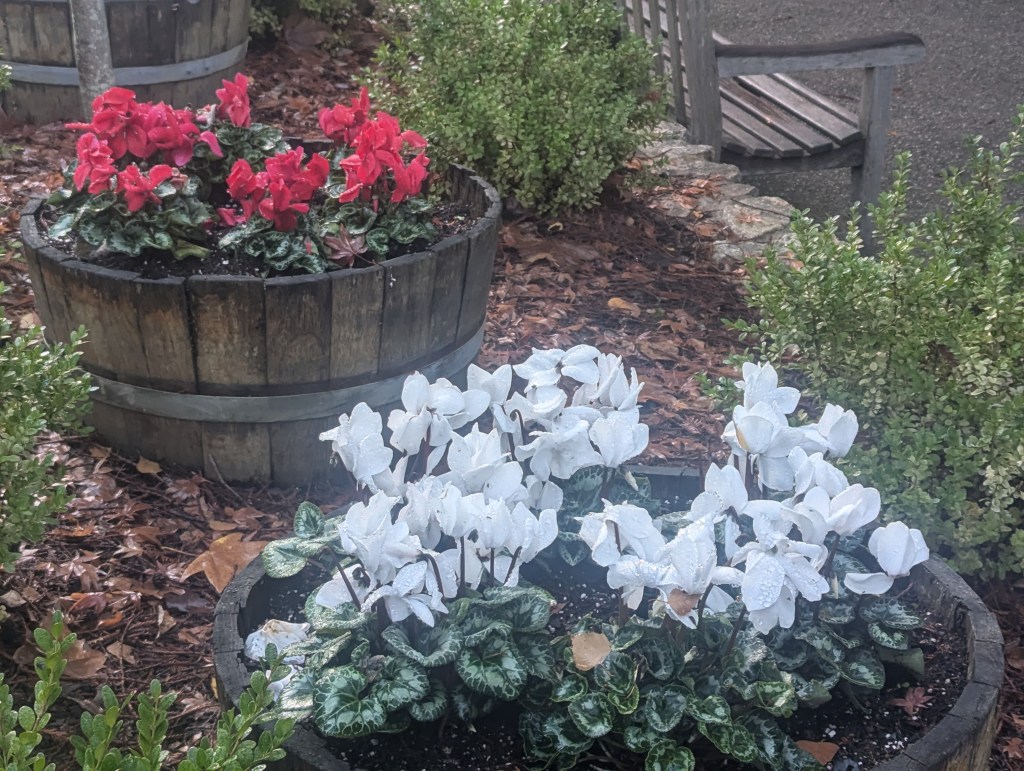
1. Cyclamen persicum, Persian cyclamen is now a Ghost of Christmas Past that will stay as long as it performs. If it does not mold by the end of the rainy season, it will hibernate by the warmly dry season. It is sadly exploited as an expensively cheap annual perennial.
2. Lobularia maritima, alyssum remains from last summer as a genuinely cheap annual that wants to be a perennial. Although it has potential to perform as a perennial, salvage after winter is less practical than replacement, especially since alyssum is not expensive.
3. Rosmarinus officinalis ‘Prostratus’ creeping rosemary is neither annual nor perennial like the others. It is instead a very prostrate shrub that sprawls as a ground cover. Bloom seems to be continuous, although not as impressive as bloom of annuals and perennials.
4. Viola X wittrockiana, pansy is probably the most popular cool season annual here. It has potential to be perennial, but like alyssum, it is easier to replace when it is in season than salvage after it was not in season. It gets thrashed through the warmth of summer.
5. Osteospermum ecklonis, African daisy tries to bloom as continuously as rosemary. Its flowers do not last for long while the weather is cool and damp, though, and might mold before they unfurl. Several cultivars with distinct floral colors bloom in the same garden.
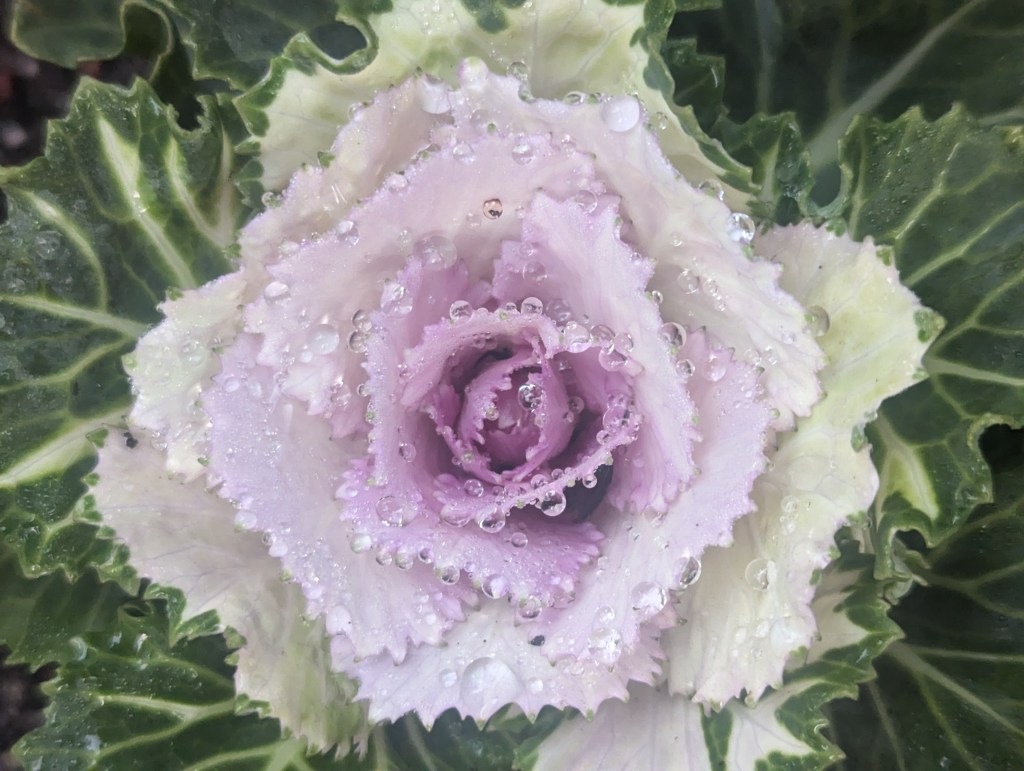
6. Brassica oleracea var. acephala, ornamental cabbage is the only one of these six that is foliar rather than floral. Actually, it deteriorates as it eventually blooms with warming summer weather. Yet, it is the biggest and boldest of these six even without floral bloom.
From spring until autumn, semperflorens begonia, which is also known as fibrous, bedding or wax, begonia, is a warm season annual. They actually start to deteriorate as the weather gets cool this time of year. However, they do not necessarily need to be pulled out as their season ends. In sheltered locations or with protection from frost, they actually survive through winter as perennials. They are so easy to propagate by cuttings or division of overgrown plants that tired older plants can replace themselves with their own babies before they get too ugly.
The small flowers of semperflorens begonia can be white, red, or various shades of pink in between. Foliage is more often green or bronze, but can be reddish or variegated. The largest plants get only a foot tall. Denser dwarf types are half as tall. Semperflorens begonia likes rich soil and regular watering (when it is not raining). They prefer partial shade, but will take full sun if mixed with other plants that keep things cool and humid.
Because they do not like warm weather through summer much, sweet William, Dianthus barbatus, is appreciated more as a cool season annual from autumn into winter and even into spring. They can also be planted early in spring for color before summer warmth. They can sometimes survive as perennials in sheltered areas, particularly if mixed and hidden amongst other perennials and annuals. Deadheading (removal of deteriorating flowers) prolongs bloom.
New plants are easy to propagate from division, cuttings or layering of tired older plants. (Layering involves rooting prostrate stems by burying them slightly and them separating them when they have developed roots.) By the time the old plants become too deteriorated to salvage, the new cuttings or layers should be ready to replace them. New plants like to start out in rich and well drained soil, but not watered too much since they can be susceptible to rust and fusarium wilt.
The white, pink, rosy pink, red, somewhat purplish or bicolored half inch wide flowers form rather flat dense trusses on top of short stems. Minute but abundant green bracts fill the spaces between the individual flowers. The rich green leaves below are about an inch to two and a half inches long. Mature plants of the more common varieties are typically less than a foot tall and wide. More compact and larger varieties are available as seed.
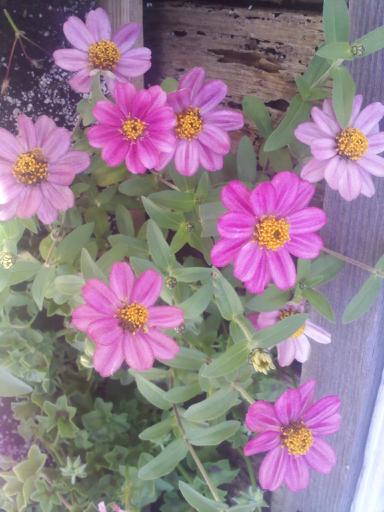
The longer and cooler nights of autumn will soon finish the season for zinnias. (Most, but not all of the common zinnias are of the species Zinnia elegans.) They are really at their best while the weather is warm through summer and the beginning of autumn. As the garden warms up at the end of next spring, new seedlings can be planted, or zinnia seed can be sown. They like rich soil and regular watering, but are susceptible to mildew in humid spots. Sunny areas with good air circulation are best.
Like related chrysanthemums, zinnias are quite variable. Although the simpler forms remain more popular; double, cactus flowered and crested forms are also available. Flowers can be less than an inch wide to more than five inches wide. Their color range includes white, yellow, orange, salmon, pink, red, rose, purple, lavender and even green. The narrowly oval leaves can get to about four inches long. Compact types stay about a foot tall and wide. Large types get twice as wide and more than three times as tall.
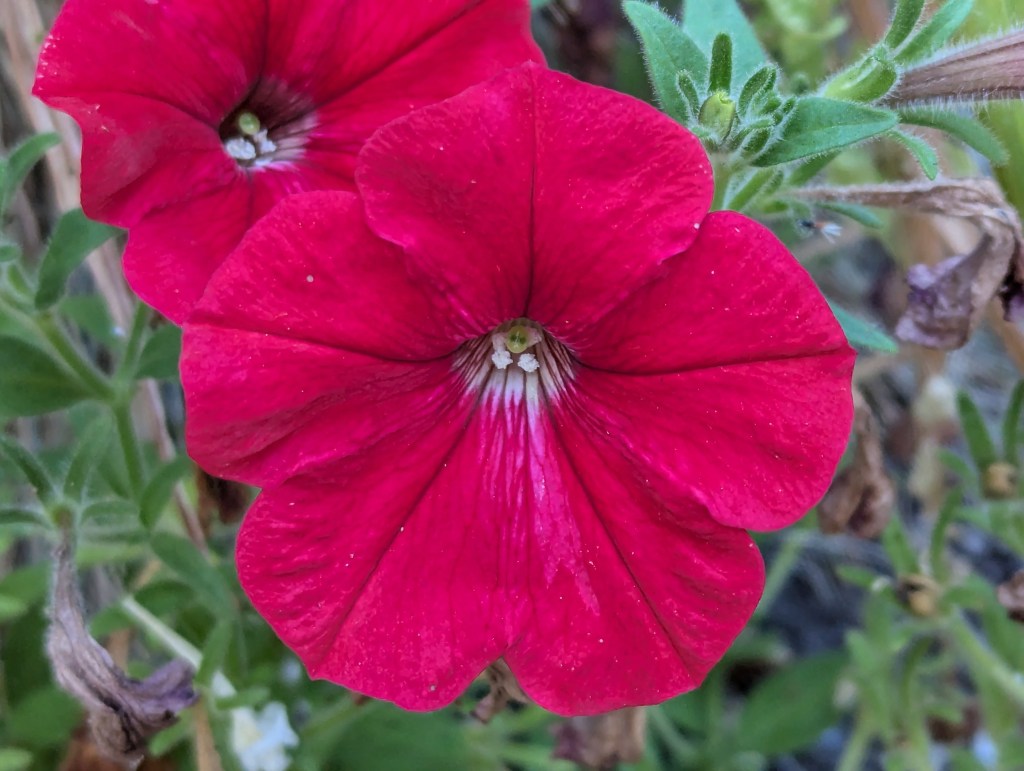
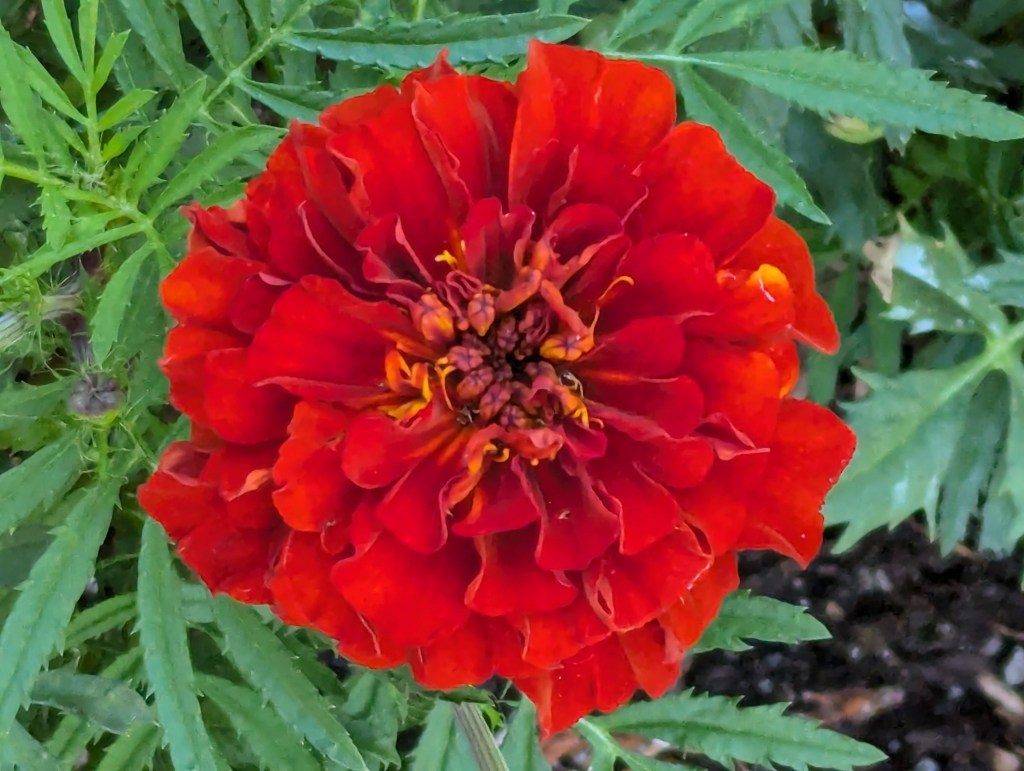
Cool season annuals are beginning to replace warm season annuals not because weather is beginning to cool for late summer, but because warm season annuals are beginning to deteriorate after their long and warm summer. Deterioration of remaining petunias was accelerated by warm weather today. It was warmer than a hundred degrees. Fortunately, marigolds are the first and only cool season annuals that were added into the landscapes already and they tolerate such warmth. I believe that they are varieties of ‘Durango’. I do not know what the petunias that they are replacing are, but they resemble old fashioned red, white and blue varieties of ‘Madness’ that were too popular during the Bicentennial Summer of 1976, although a comparable white variety is notably lacking.
1. ‘Madness – Blue Vein’, if I remember accurately, looks something like this. Its name is not as appealing as its color, and might have been less appealing in the summer of 1976.
2. ‘Madness – Blue’, which looks like this, was one of the three most popular varieties for the summer of 1976, with ‘Madness – Red’ and ‘Madness – White’, but is almost purplish.
3. ‘Madness – Red’ is more convincingly red, very much like this, and just like ‘Madness – Blue’ and ‘Madness – White’, was very popular in profusion through the summer of 1976.
4. ‘Durango – Gold’ is not very different from marigolds that were overly popular during the 1970s, when ‘Madness’ petunias were popular. I do not know when it was developed.
5. ‘Durango – Orange’ is just as familiar as ‘Durango – Gold’ because of its similarity with old fashioned varieties. Only a few specimens of ‘Durango – Flame’ are blooming nearby.
6. ‘Durango – Red’ is the only of these Six that, to me, does not seem to resemble the sort of varieties that were popular in the 1970s likely because red bloom was developed later.
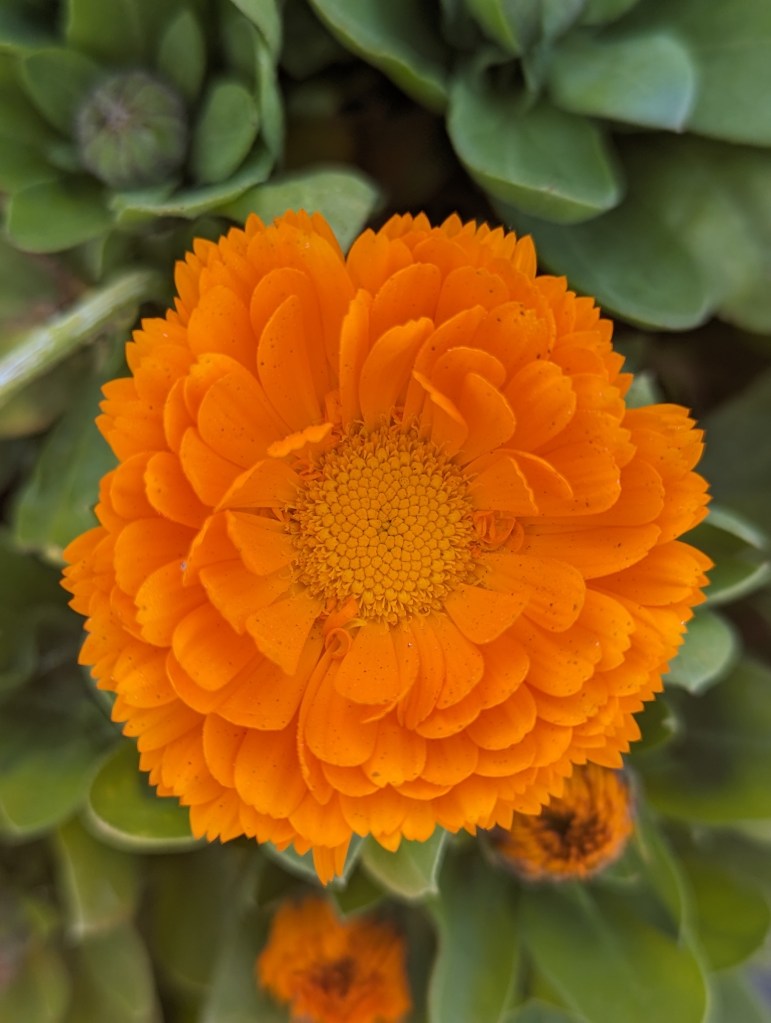
French marigold is one of the most popular annuals of autumn. Pot marigold, Calendula officinalis, provides similar color with daisy like flowers. Most are bright orange or yellow. They lack only the warm burnished red of French marigold. They compensate with more variety of their pastel ranges. Their single or double blooms are two to three inches wide.
Within cooler climates, pot marigold blooms between spring and late autumn frost. Here, it blooms better through mild winters, with only minor pauses for any mild frost. It is more likely to dislike summer warmth. Like many seasonal annuals, it can technically grow as a short term perennial. However, also like others, it performs best for a particular season.
During their season, taller varieties may grow a bit higher than two feet. Most are shorter. Their oblong and slightly fuzzy leaves are mostly between two to five inches long. Some develop wavy margins. Mildew is sometimes a problem. Deadheading promotes bloom. However, a few deteriorating flowers can remain to provide seed for another generation. Subsequent generations eventually revert to simple and single yellow or orange bloom.
There is no rush yet. Some cool season bedding plants can go into their gardens as late as autumn. Ornamental kale and cyclamen can be as late as winter if necessary. Locally, autumn and winter can be a bit later than elsewhere. Also, different cool season bedding plants rely on different schedules. Ornamental kale and cyclamen actually prefer to wait.
Cool season bedding plants are the same as winter bedding plants. They also qualify as cool season annuals and winter annuals. However, most have potential to be perennial, and some can perform after winter. Some are warm season bedding plants within cooler climates. Locally warm summers and mild winters limit their performance very differently.
All bedding plants provide a profusion of temporary floral color for their assigned season. Cool season bedding plants replace deteriorating warm season bedding plants. Within a few months, warm season bedding plants will become seasonal again. Most that can be perennials are disposable for simplicity. Replacement is generally simpler than salvage.
Installation of bedding plants is often contingent on performance of their predecessors. If petunias of last summer still bloom nicely, pansies for autumn may need to wait. Pansies might need to be early though, if petunias are already shabby. Most cool season bedding plants are fortunately adaptable in that regard. Merely a few must wait for cooler weather.
Scheduling for seeding of cool season bedding plants is not as adaptable. Seed can not germinate and grow faster if late. Actually, seedlings grow slower as weather gets cooler. Seedlings for some species should be growing already. Others should start about now or rather soon. Some should start in cell packs or flats. Several others prefer direct sowing.
Pansy and viola are probably the most familiar and reliable cool season bedding plants. Marigold and perhaps snapdragon are popular now, but may not perform through winter. They become seasonal again as winter ends. Sweet William and a few sorts of primrose are potentially perennial. Any that survive through summer could resume blooming soon.
Dahlias are as variable as related chrysanthemums. Rare tree dahlias can grow ten feet tall from the ground annually. Most popular dahlias grow less than half as high with more lavish bloom. Bedding dahlias are less than a foot and a half tall with smaller but profuse flowers. They are popular as warm season annuals, but can be perennial like the others.
Bedding dahlias are neither as ornate nor as diverse as those that are better cut flowers. They compensate with foliar density and floral profusion. Their flowers are less than five inches wide, and could be about half as wide. Their floral color range is limited to yellow, orange, red, pink and white. Floral variegation can add another color of the same range.
Bloom continues through summer and autumn, until frost. Deadheading promotes better bloom. Dormant tubers may remain in their gardens through winters here. They could rot, though, while their soil remains cool and damp. If dug and stored for winter, they prefer to return to their gardens prior to spring warmth. Dormant tubers propagate well by division.
Garden verbena sort of resembles lantana, with more variety of color.
When I first saw ‘Peaches ‘N Cream’ garden verbena, Verbena X hybrida, that was trendy in the early 1990’s, I thought that the variable shades of pale pink and nearly white of its flowers were too dull. Then I saw the flashy bright red, purple, blue and fluorescent pink of other modern varieties at the time, and gained a new appreciation for the more subdued color range, including white and more ‘normal’ pink. The flower color range may not be very extensive, but it is diverse.
Even though it is commonly grown as an annual, garden verbena is actually a short term perennial. It is a traditional component of mixed flower urns and planter boxes, but does not necessarily need to be replaced along with other annuals. Like English ivy and ferns that are so often planted with annuals, garden verbena can be salvaged, at least for a few seasons, as annuals come and go. It looks good in hanging pots or large urns where its slightly cascading form can be appreciated. In good soil, garden verbena can become a colorful small scale ground cover.
Mature plants do not get much more than six inches deep or two feet wide. Their coarsely dentate leaves are about two inches long. Their flat, two inch wide trusses of small flowers bloom mostly in summer. Hard pruning at the end of winter helps restore plants in spring, and keeps plants healthy longer. Mildew can become a problem in humid areas, particularly if air circulation is inhibited by crowded foliage.