Nasturtium

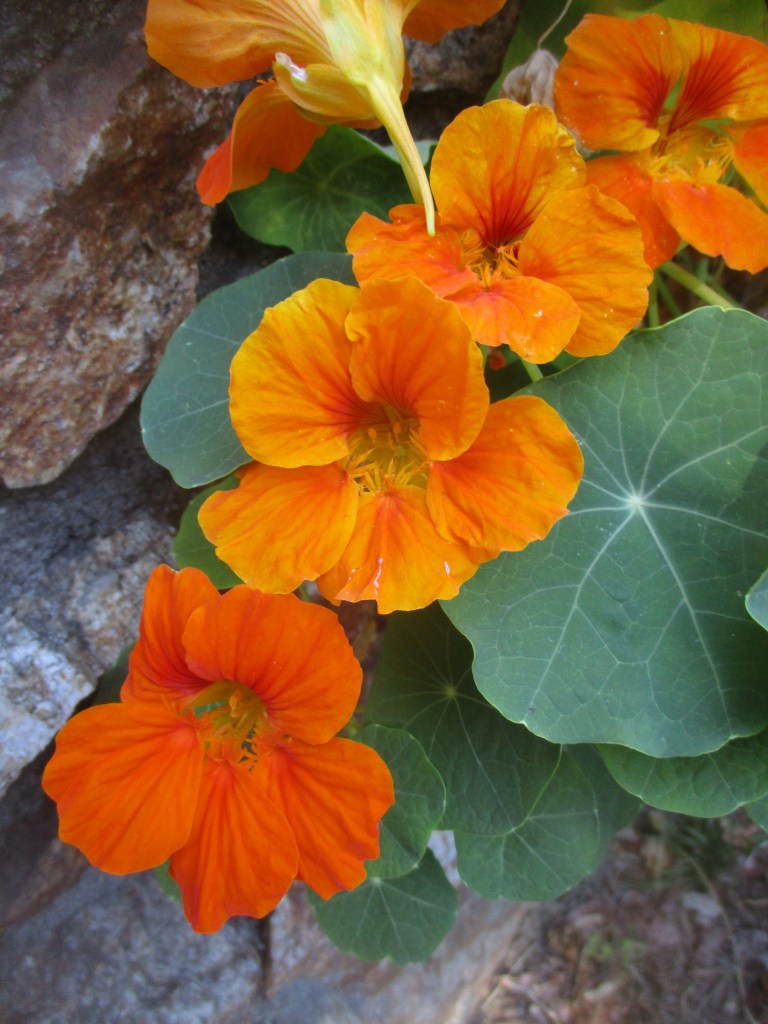
Nasturtium bloom is sensitive to aridity.

Whether feral or planted intentionally, nasturtium, Trapaeolum majus (which is actually a hybrid with two other species) is a delightful flower that just about everyone appreciates. Its eagerness to self sow and possibly naturalize in riparian situations attest to how easy it is to grow. Seed for many varieties is readily available. Feral plants provide feral seed.

Bloom of domestic nasturtium can be various shades, tints and hues of yellow, orange or red. Flowers can be striped or blotched with colors of the same range. Some are double. The palest yellow is almost creamy white. The darkest red is almost brown. Feral plants, after a few generations, generally revert to blooming with simple bright orange or yellow.

Plants are more or less annual, but can replace themselves almost as readily as they die out. Those that perform through spring and summer succumb to cooling autumn weather, as their (feral) seedlings begin to replace them for autumn and winter. Those that perform through winter may succumb to frost where winters get cool, but also self sow feral seed for next spring.

The Spring Rush Is On

Pittosporum can be pruned aggressively now.

It is safe to say that any remaining frost damage can be pruned away. Frosted foliage and stems were only left through winter to help insulate inner stems from more damage by subsequent frost, and to avoid stimulating new growth that would be even more sensitive to frost. Now that there is no threat of subsequent frost, and surviving but damaged plants are growing anyway, there is no reason to retain unsightly frosted foliage. The few plants that do not regenerate probably did not survive.

Spring is the busiest time of year for most plants. By now, most have either bloomed or will be blooming soon. Early spring bulbs have already finished. Later bulbs will be blooming soon enough. Deciduous plants that were bare through winter are developing new foliage. Evergreen plants are likewise growing new foliage to replace older foliage that will get shed later in the year.

If necessary, flowering cherry, flowering crabapple, lilac, forsythia and mock orange (Philadelphus) can be pruned as they finish bloom. Flowering cherry should not need much; but flowering crabapple might be in need of aggressive structural pruning. Some of the older canes of lilac, forsythia and mock orange can be pruned to the ground, where their replacement canes are probably already emerging.

Overgrown or disfigured oleander, photinia, bottlebrush, privet, pittosporum and juniper that need restorative pruning can be pruned now. They recover most efficiently in early spring, and have plenty of time to develop plenty of new growth before they slow down again next autumn. If pruned much earlier, they would have stayed bare longer, since they would not have grown much through winter. Besides, almost all pittosporum are susceptible to disease if fresh pruning wounds are exposed to rainy weather.

Seed can be sown for any of the warm season vegetables and flowering annuals, such as zucchini, corn, okra, nasturtium, lupine and sunflower. Tomato, pepper, eggplant, petunia, marigold and busy Lizzie (Impatiens) can likewise be grown from seed, but are easier to grow from small cell pack plants. Cuttings of jade plant, iceplant, sedum and all sorts of succulents, as well as divided pups of aloe, agave and yucca, really get going well this time of year.

Columbine

Colorado has an elegant state flower.

Colorado must really like blue. Not only is the state tree the Colorado blue spruce, but the state flower is the Colorado blue columbine, Aquilegia caerulea. However, the flowers are not always blue, and in fact, are often white or various shades of pink or soft yellow, or a combination of two colors. The many other specie and hybrids of columbine add even more shades and combinations of richer shades of blue, red, yellow, orange and purple. The distinctively lacy foliage is somewhat bluish. A few varieties have chartreuse foliage.

Although potentially perennial, most columbine do not reliable regenerate after winter dormancy, so are instead grown as spring and summer annuals. Flowers are not as abundant as those of other annuals, but are interesting close up, and very attractive to hummingbirds. Mature plants stand about a foot tall, so work nicely in pots surrounded by lower and more colorful annuals like lobelia and alyssum. Columbine prefers partial shade and rich soil. Plants in full sun tend to be more compact and seem to be a bit faded. Incidentally, some parts of the plants are toxic.

Potted Plants Need Work Too

Potted plants do not have much soil volume to work with.

Potted plants can be a problem any time of the year. Some want more water than get. Most get too much water or do not drain adequately. Large plants get constricted roots if pots are too small. The roots of some plants get cooked in exposed pots that collect too much heat from sunlight. Besides, too many pots just seem to be in the way in otherwise useful spaces on decks, patios and anywhere else trendsetting landscape designers want to put them.

Now that the weather is getting cool and rainy, potted plants are not as active as they were during warm weather. Many are dormant. Although few demand the attention that they got during warmer weather, plants still need to be tended to appropriately through autumn and winter.

Cool season annuals, which are also known as ‘winter’ annuals, should get groomed as long as they are performing in the garden, just like warm season annuals get groomed through summer. Deteriorating flowers should be plucked from pansy, viola, primrose, Iceland poppy, calendula, dianthus, stock, chrysanthemum and cyclamen because they can mildew and spread mildew to developing flowers and foliage. Unplucked cyclamen and calendula can develop seed which diverts resources from bloom.

Pots that are out in exposed areas will not need to be watered while they get enough water from rain. The problem is that many that do not drain adequately can get too much water from rain and stay saturated. Dormant and defoliated plants do not need much moisture at all. Even evergreen plants do not need as much as they do while active during warm weather, because cool and humid weather inhibits evapotranspiration (evaporation from foliar surfaces).

Potted plants under eaves also need less water while the weather is cool and humid, but need to be watered nonetheless because they are sheltered from rain. Plants in hanging pots typically drain and dry more efficiently, so probably want a bit more water. Even a few sheltered small plants in the ground may occasionally want to be watered during rainy weather if they do not extend enough roots where they can get moisture from rain beyond the sheltered area. Sheltered plants are actually the most likely to be neglected because watering does not seem so important when it is raining.

Statice

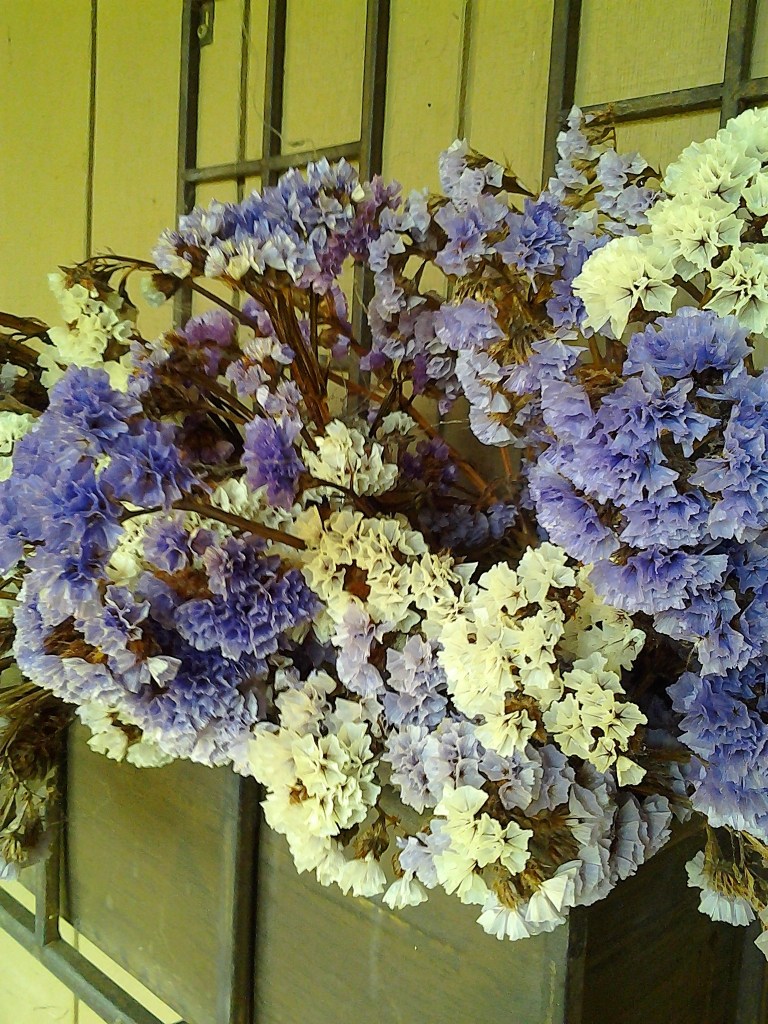
Statice is so popular as a cut flower that it should be more popular than it is in home gardens.

The papery flowers of annual statice, Limonium sinuatum, are so popular as seemingly synthetic dried flowers that many garden enthusiasts are surprised to find that they are happy to bloom naturally in home gardens. The clear shades of blue, purple, pink, orange, yellow and white seem to be dyed. The one or two foot tall flower stems are outfitted with odd papery ‘wings’ that make the stems seem wider than they actually are. Deeply lobed basal foliage forms shallow rosettes. Mature plants are about one or two feet tall, and a foot or so wide. Bloom begins late in summer, and continues into autumn. Good sun exposure and good drainage are preferred. Seed can be sown directly, or young plants can be added to the garden early in spring.

Color Is Not Black And White

Annuls must change with the seasons.

Several months ago, warm season vegetable plants replaced cool season vegetable plants. More recently, new cool season vegetable plants began to grow from seed, to replace warm season vegetable plants. Annual vegetables grow only within specific seasons. As they finish, they relinquish their space to those that grow in the next season. Annual color operates in the same manner.

‘Color’ is another word for ‘annuals’ or bedding plants that provide colorful bloom. Those that grew earlier were warm season annuals or summer annuals. Those that replace them through autumn are cool season annuals or winter annuals. Of course, there is nothing black and white about color. Some color from last summer can linger late. Some for next winter prefers an early or late start.

Furthermore, much of the color that cycles through gardens as annuals actually has potential to perform as perennials. If cut back and obscured by more seasonable color through their dormancy, some types can regenerate when it is again their season to perform. For example, cut back busy Lizzie that bloomed last summer can overwinter underneath primrose, and start over next spring.

Marigold and chrysanthemum can start bloom early, before summer ends, but may not perform for long. Some chrysanthemum bloom only once, before vacating their space for other cool season color that does not mind starting later. Cyclamen and ornamental cabbage happen to prefer late planting, to avoid Indian summer. Warmth causes cabbage to bolt, and promotes rot of cyclamen.

Pansy, viola and various primrose have always been popular. Sweet William, Iceland poppy and stock are not as common. Stock should be, since it is so delightfully fragrant. Both nasturtium and alyssum bloom nicely through either summer or winter, depending on when they started to grow from directly sown seed. Some fibrous begonia can perform through winter if sheltered from frost.

Most color does well from cell packs. Nasturtium should only grow from seed. Chrysanthemum and cabbage might be better from four inch pots. Cyclamen may only be available in four inch pots.

Moss Rose

Moss rose can bloom until frost.

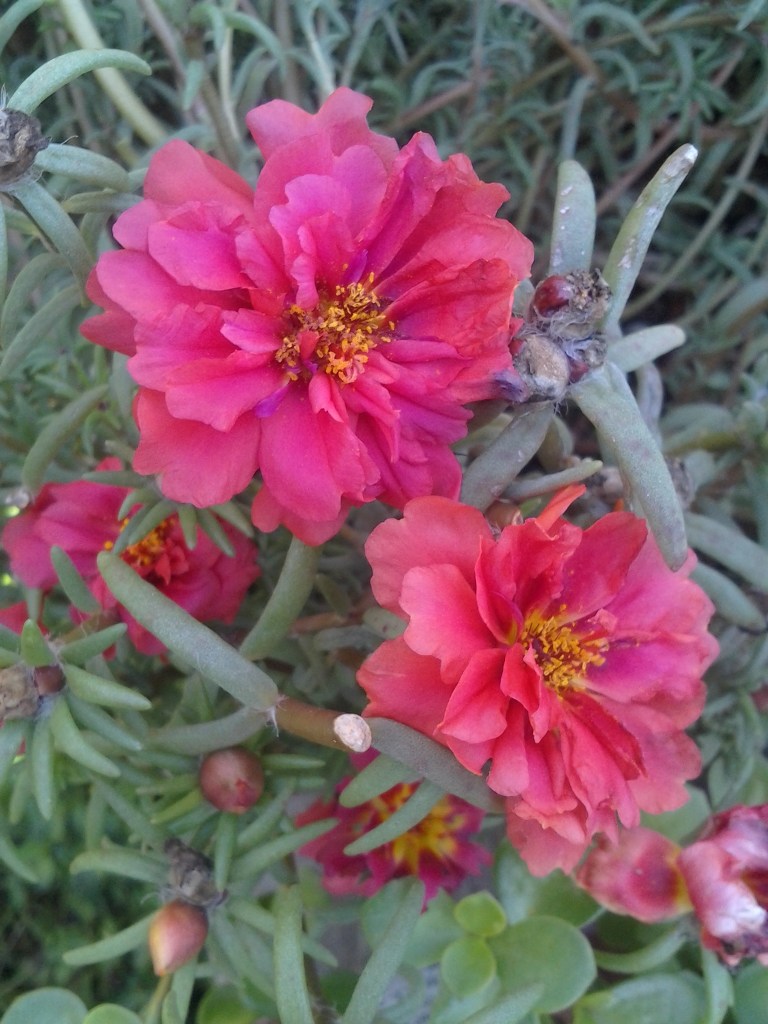
The recent unseasonably warm weather was no problem for any remaining moss rose, Portulaca grandiflora. They usually start to look rather tired as the weather gets cooler this time of year, and eventually succumb to the first frost. Where allowed to do so, they can regenerate next year from seed. I like to collect their seed during the summer or autumn so that I can sow them after the last frost of the following winter. Through spring and summer, I find that additional plants are easy to grow from cuttings.

The inch wide flowers are white, pink, red, orange or yellow, with only a few ruffled petals. Modern varieties that have rufflier ‘double’ flowers and richer colors still seem to be less popular than the more delicate traditional types. The cylindrical and succulent leaves are only about an inch long. The small plants can get more than six inches deep where they are happy or crowded. Moss rose likes good exposure and decent soil, but does not need the rich soil that most other annuals demand. Nor does it necessarily need such regular watering.

Angelonia

This annual can actually be perennial.

Angelonia is one of those warm season annuals that can actually survive through winter as a pernnial to bloom again next spring. It may even want to continue to bloom untill frost. The flowers can be blue, purple, red, pink or white, and look something like small snapdragon flowers. Most have spots or stripes of an alternate color or two in their throats. Some modern varieties have fragrant flowers. Plants can get a foot or two tall, and almost as wide. In sheltered spots, angelonia can be cut back as soon as it starts to look tired in autumn. Exposed plants might be happier if cut back significantly later, as winter ends. Old growth may be unsightly for a while, but can protect interior stems and roots from frost. Besides, pruning stimulates new growth that will be more susceptible to subsequent frost.

October Brings Cool Season Annuals

Warm season annuals are now passe.

As the name implies, ‘annuals’ need to be replaced ‘annually’. What is worse is that they do not even function for an entire year, but only for a specific season. Cool season annuals mostly work from autumn to spring. Warm season annuals mostly work from spring to autumn. Calendula is a popular cool season annual that may not last even that long, since it can mildew half way through winter.

Now that it is time for cool season annuals, it can be unpleasant to remove warm season annuals that are still performing well. In mixed plantings, new annuals can be phased in through autumn as older annuals deteriorate. Busy Lizzie (impatiens), wax begonia and other warm season annuals that are actually perennials can get cut back and overplanted with cool season annuals. The cool season annuals that temporarily overwhelm them can provide shelter from frost. As the cool season annuals finish next spring, the warm season ‘annuals’ can regenerate

However, not all cool season annuals need to finish next spring. Sweet William, cyclamen, chrysanthemum and the various primroses are popular cool season annals that are actually perennials. When the time comes, they can be overplanted with warm season annuals, so that they can regenerate the following autumn. In cool spots, sweet William and some primroses can actually perform all year. (Some people are allergic to primroses like poison oak.)

Alyssum and nasturtium really are annuals, but can function both as warm season and cool season annuals. They sow their own seeds so that new plants can reliably replace old plants without being noticed. The old plants only need to be pulled as they deteriorate. Alyssum is white, or pastel hues of pink or purple. Nasturtium is just the opposite, with bright hues of yellow, orange and red, with only a few pastel options.

Pansies and smaller violas are the two most popular of cool season annuals, since they function like petunias for cool weather. They lack few colors. Most have two or three colors. Ornamental cabbage and kale produce big and bold rosettes of pink, white or pink and white foliage. Kale has weirdly distinctive foliar texture. White, lavender, pink, purple and rose stock is the most fragrant of cool season annuals, and taller varieties are great for cutting. Iceland poppy has delicately nodding flowers on wiry stems. They can be pastel hues of white, pink, yellow, orange or soft red.

Million Bells

50708-c
Million Bells look like small petunias.

Its name may be something of an exaggeration, but million bells, or Calibrachoa, certainly is profuse. However, although it is potentially perennial, it is usually grown as a warm season annual, so it  only has a few months from spring to autumn in which to bloom with a million flowers. Many plants combined might be up to the task.

The tiny flowers resemble petunias more than bells. Actually, the entire plant grows something like very compact petunias, which they are obviously closely related to. The stems are too limber to stand half a foot tall as they spread to about a foot wide. The small and unremarkably hazy green leaves are adequate backdrop for bloom.

The bloom is the remarkable part, displaying all sorts of shades and hues of red, yellow, blue, purple, orange, pink and white. There are not many colors left out. Just like petunia, million bells cascades nicely from pots. Unlike petunia, it does not benefit from deadheading (removal of deteriorating flowers). What is good for petunia is generally good for million bells, although a slight bit of shade is somewhat more tolerable. They want rich soil, regular watering and regular application of fertilizer. (Monthly application of common slow release fertilizer is probably as good as anything fancy.)