Duckweed

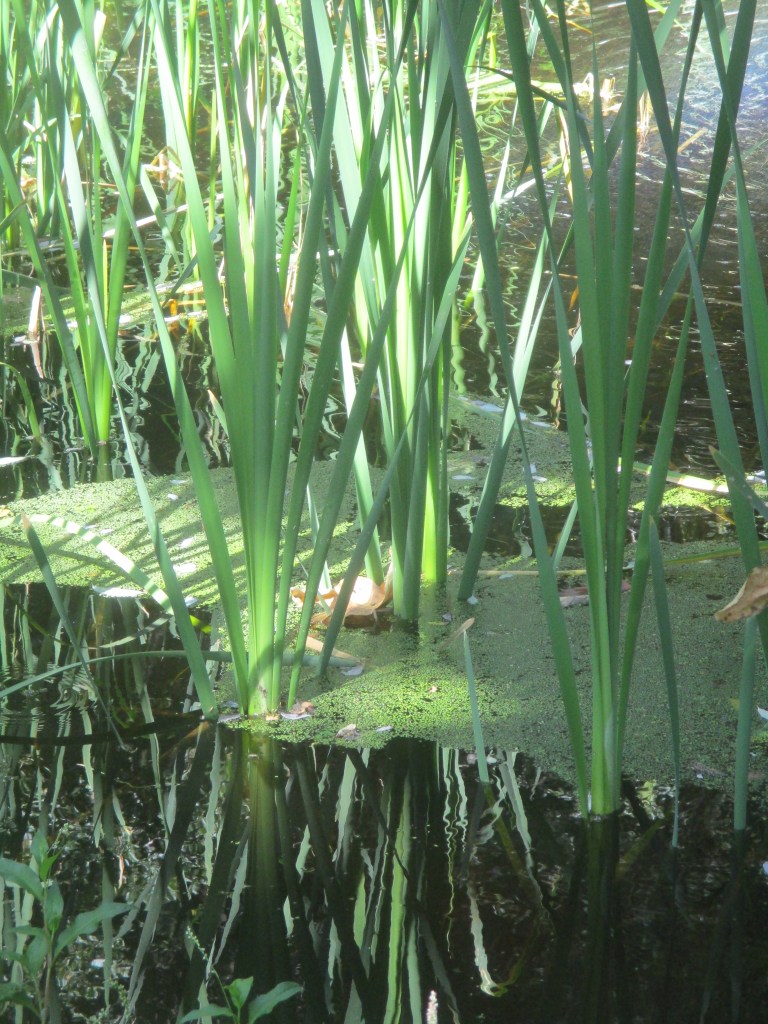
Lemna minor is the common duckweed that infests the drainage pond. It is SO extremely prolific that I doubt that a huge herd of koi could eat it all. It appeared within the pond about as soon as the pond started to fill with water. It was undoubtedly brought by the first ducks to arrive while the pond was no bigger than a large puddle. It was no surprise, since duckweed inhabits most ponds. However, its profusion exceeds expectations. It can get so dense that it spreads into the area of the fountain. The turbulence of the dispersed water mixes some of the duckweed below the surface, but it does not stay there for long. If it does, its absence makes no noticeable difference to the density of what floats on the surface. It looks like a very tightly mown lawn. It is not so dense now that it has been frosted through winter, but is nonetheless more dense than expected. It typically disappears after the first few minor frosts, but has not done so yet, even after more minor frosts than typical. It lingers like some sort of unnatural pollution on the surface of the pond. YUCK! At this rate, it may not completely disappear before it is time for it to reappear during warming weather of late winter and early spring. It supposedly makes superb compost, but no one has time to scoop it off the surface of the pond. Besides, I doubt that it would not more than replace whatever we scoop, particularly since it already did so when we tried scooping in in the past. It seems like a harmless weed that is confined to the pond, but is so obnoxiously prolific and persistent within a pond that would likely be more visually appealing without it.
Coy Koi

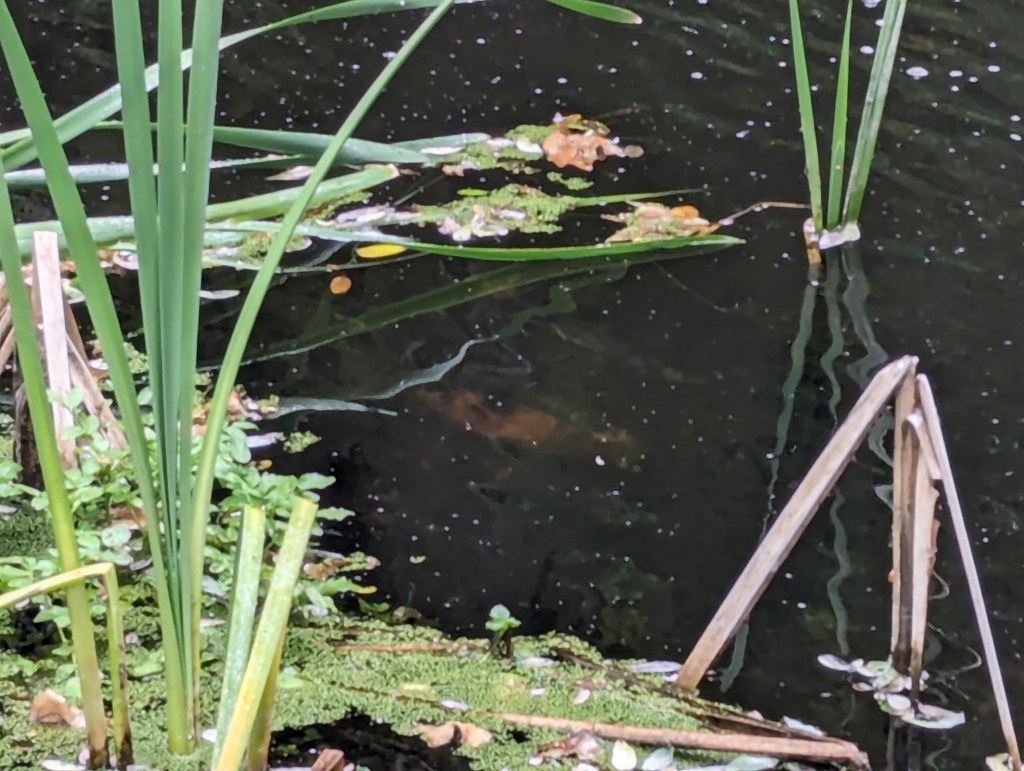
The larger of two koi is difficult to see at the center of this picture. The other is rarely seen.

Attempts to tame the recently discovered but still unidentified pair of koi within the drainage pond have been futile so far. Both remain elusive. Although the larger of the two is almost as big as Rhody, we still are not certain if they are actually a koi. We just do not know what else they could be. I try to get them to accept koi food, but the food floats on the surface of the water until a pair of ducks eats it. I should try to feed them some sort of food that sinks, at least until they respond to food, if they ever respond.

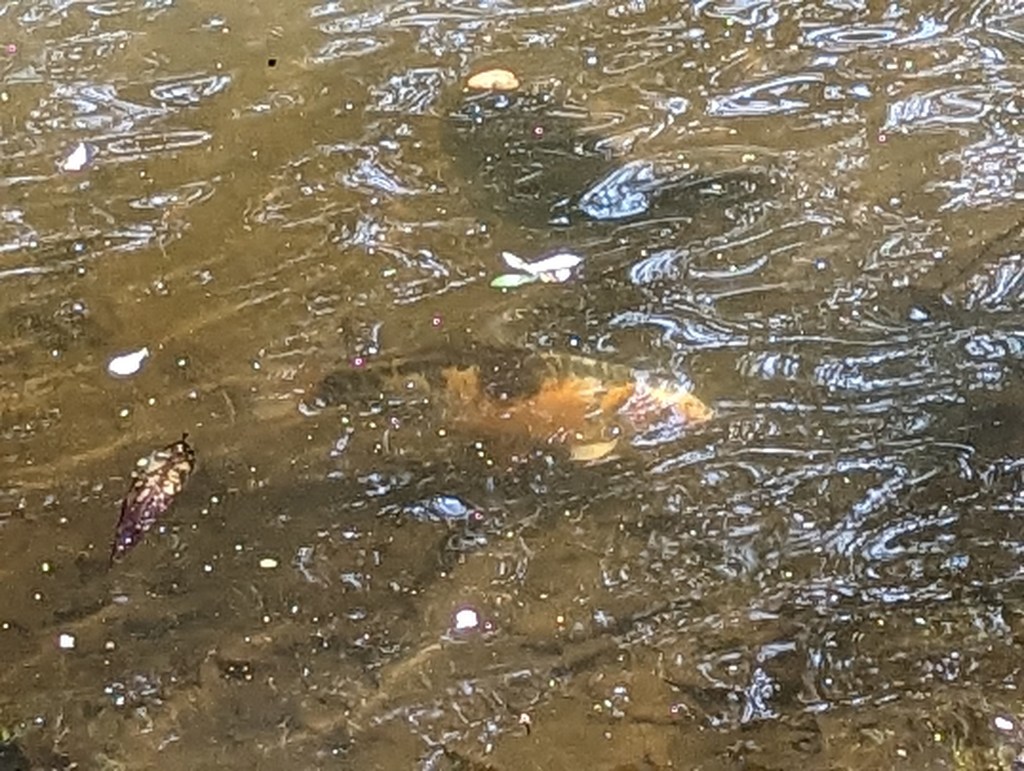
The larger and more visible of the pair is typically referred to as “Cheeto”, although not yet formally named. Cheeto happens to resemble, and could potentially be, one of the original koi who was also known as such. Its associate is known merely as its “Associate”. Even well trained koi do not respond to names. Nonetheless, we should probably assign them names, just in case they ever become tame. These are some of the options, besides Cheeto, for either of them.

Jaws

Nemo

Kraken

Moby

Sashimi

Gill

Charlie (Tuna)

Nessie (because of their elusiveness)

Roy (don’t need to be koi)

Blinky (of the Simpsons)

Wanda (a fish called Wanda)

I hope that whomever they are, they help to limit the proliferation of aquatic vegetation, particularly duckweed, within the pond, although I doubt that they can consume enough to make a noticeable difference. Also, I hope that they become friendly enough to amuse visitors. Neither are brightly colorful enough to be prominent if they remain elusive at a distance. We intend to add a bit more vegetation to somewhat mitigate erosion on the edge of the pond, as well as to displace other shabbier vegetation.

This is an older but better picture.

Aquatic Plants Are All Wet

Both cattail and duckweed are native.

Home gardens and landscapes should be compatible with their respective climates. For local chaparral climates, plants that do not need much watering through the long and dry summers are appropriate. Aquatic plants are the extreme opposite. They require regular replenishment of the ponds that they inhabit. Arid warmth increases their need for water.

Aquatic plant can not be ‘drought tolerant’. Several, such as duckweed, water lettuce and water hyacinth, float over the surface of water. Water lily and lotus inhabit the mud below the water, and extend their foliage to float over the surface of the water. Waterweeds stay completely submerged, with or without roots. Aquatic plants need water for their survival.

Marginally aquatic plants are somewhat less dependent on water. Cattail and yellow flag iris inhabit shallow ponds and saturated soil, but can survive if their situations drain for a while. If they stay too dry for too long, they can initiate dormancy, and then recover when saturation resumes. Canna inhabits either shores of shallow ponds, or evenly moist soil.

Regardless, all aquatic plants require maintenance that is completely different from what terrestrial plants require. Even those that need only minimal maintenance will eventually necessitate muddy and messy interaction. Much of such interaction is under water that is difficult to see through while murky. Aquatic plants are innately heavy and totally sloppy.

Moreover, some common aquatic plants grow like weeds. Water hyacinth and giant reed are two of the most invasive exotic species in California. So, not only are they sloppy, but they are also voluminous! Because they are very invasive, they should not inhabit ponds that they could escape. Besides, giant reed is too overwhelming for most home gardens.

Few home gardens include natural ponds or water sources to contain as ponds. Garden ponds are therefore mostly contained within some sort of sealed infrastructure, and need replenishment to compensate for evaporation. Fountains aerate the water for a healthier ecosystem, but also increase evaporation. Some tall aquatic plants also consume water, as the foliage that extends above water transpires.

Water Lily

50715+
Water lily bloom emerges from the depths.

The fragrant flowers of water lily are unreal! They either float on the surface of the water, or hover just above. Abundant pointed petals radiate outward from central tufts of pronounced stamens. Most flowers are soft hues of yellow, pink, blue, lavender, peachy orange or white. Some are brighter yellow or pink, or richer shades of red or purple. Some open in the morning. Others open in the evening.

The rubbery leaves that float on the surface of the water are nearly circular. Some are symmetrically cleft to the center, like Pac-Man or a pizza with a slice taken out. The thick rhizomes that the foliage and flowers emerge from stay buried in pots or mud under the ponds that they live in. Rhizomes can be divided to propagate, but take a year or so to recover and bloom.