Horridculture – Aquatic Vegetation

Watercress, Nasturtium officinale

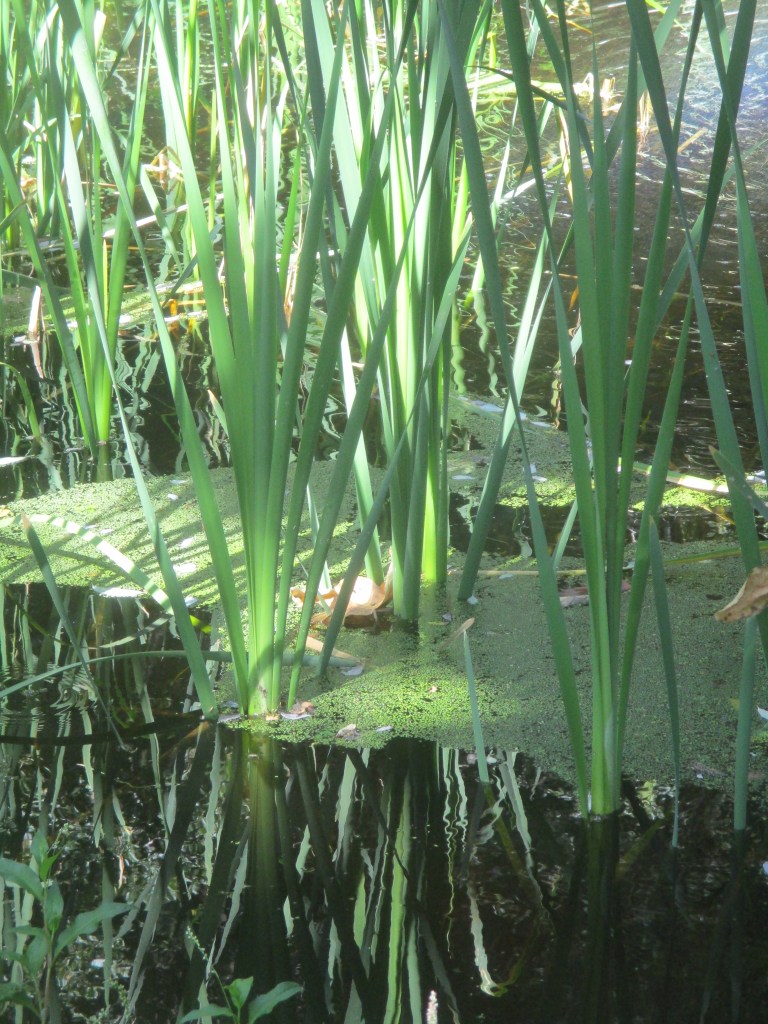
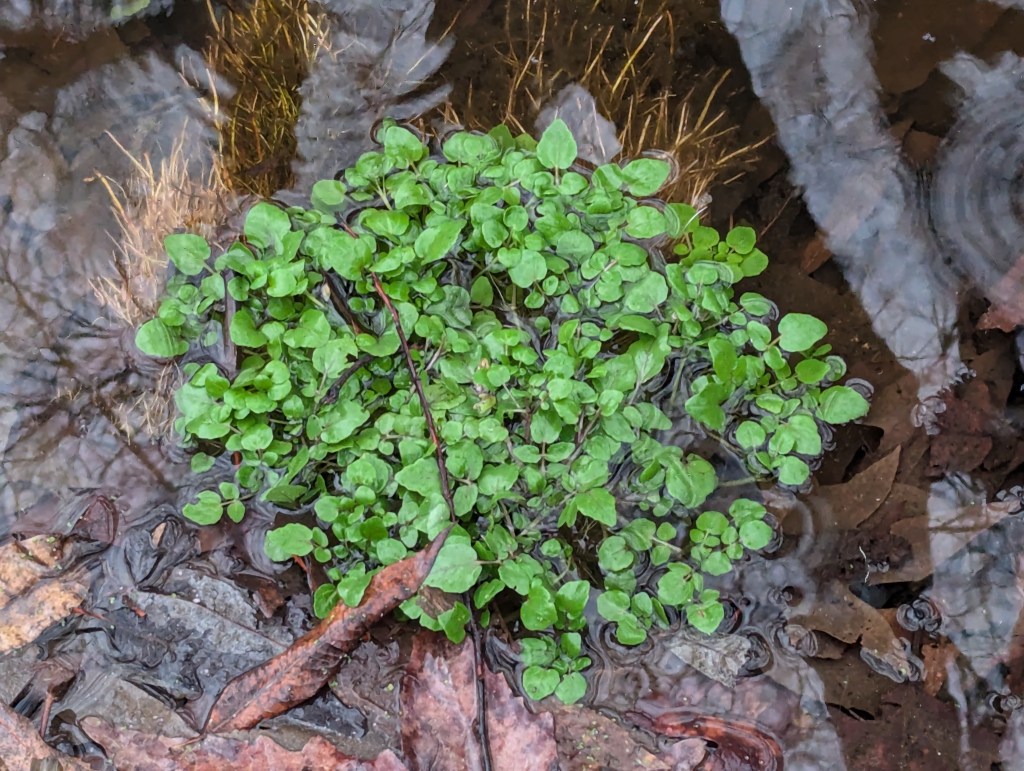
Watercress, Nasturtium officinale, seems to be proliferating a bit more in the drainage pond than it did last year. It is difficult to compare, since I was not concerned about it enough to monitor it last year. I am likely noticing it more now because the duckweed, Lemna minor, deteriorated slower than it did last year, which maintained my interest in such infesting aquatic vegetation. I have been monitoring the cattail, Typha latifolia, also. Although none of these species are exotic, I do not want any of them to proliferate so much that they obscure the pond that they inhabit. That has been a problem with duckweed as long as the pond has contained water. I am aware that cattail also has potential to proliferate aggressively, although I believe that such proliferation would be easier to mitigate. I really do not know how watercress behaves, though. I can not remember ever seeing a pond anywhere completely overwhelmed by it. I doubt that, even if it does proliferate aggressively, that it would be as difficult to contend with as duckweed is. Perhaps it would compete with duckweed! Goodness; I never intended to get so involved with aquatic vegetation. It is not exactly the sort of vegetation that inhabits ‘land’scapes. Yet, the drainage pond is a feature of the landscapes here. We maintain the willows, cottonwoods, sycamores, oaks and Landon’s tree around it, so obviously, must maintain the aquatic vegetation within it as well. In that regard, I would prefer to grow a few more ornamental but less aggressive aquatic species, such as water lilies. Unfortunately, the few water lilies that we tried were tropical species that seemed to succumb to cool winter weather and overwhelming duckweed. I should try some native water lilies, but they might be a bit too prolific.

Duckweed

Lemna minor is the common duckweed that infests the drainage pond. It is SO extremely prolific that I doubt that a huge herd of koi could eat it all. It appeared within the pond about as soon as the pond started to fill with water. It was undoubtedly brought by the first ducks to arrive while the pond was no bigger than a large puddle. It was no surprise, since duckweed inhabits most ponds. However, its profusion exceeds expectations. It can get so dense that it spreads into the area of the fountain. The turbulence of the dispersed water mixes some of the duckweed below the surface, but it does not stay there for long. If it does, its absence makes no noticeable difference to the density of what floats on the surface. It looks like a very tightly mown lawn. It is not so dense now that it has been frosted through winter, but is nonetheless more dense than expected. It typically disappears after the first few minor frosts, but has not done so yet, even after more minor frosts than typical. It lingers like some sort of unnatural pollution on the surface of the pond. YUCK! At this rate, it may not completely disappear before it is time for it to reappear during warming weather of late winter and early spring. It supposedly makes superb compost, but no one has time to scoop it off the surface of the pond. Besides, I doubt that it would not more than replace whatever we scoop, particularly since it already did so when we tried scooping in in the past. It seems like a harmless weed that is confined to the pond, but is so obnoxiously prolific and persistent within a pond that would likely be more visually appealing without it.

WWF

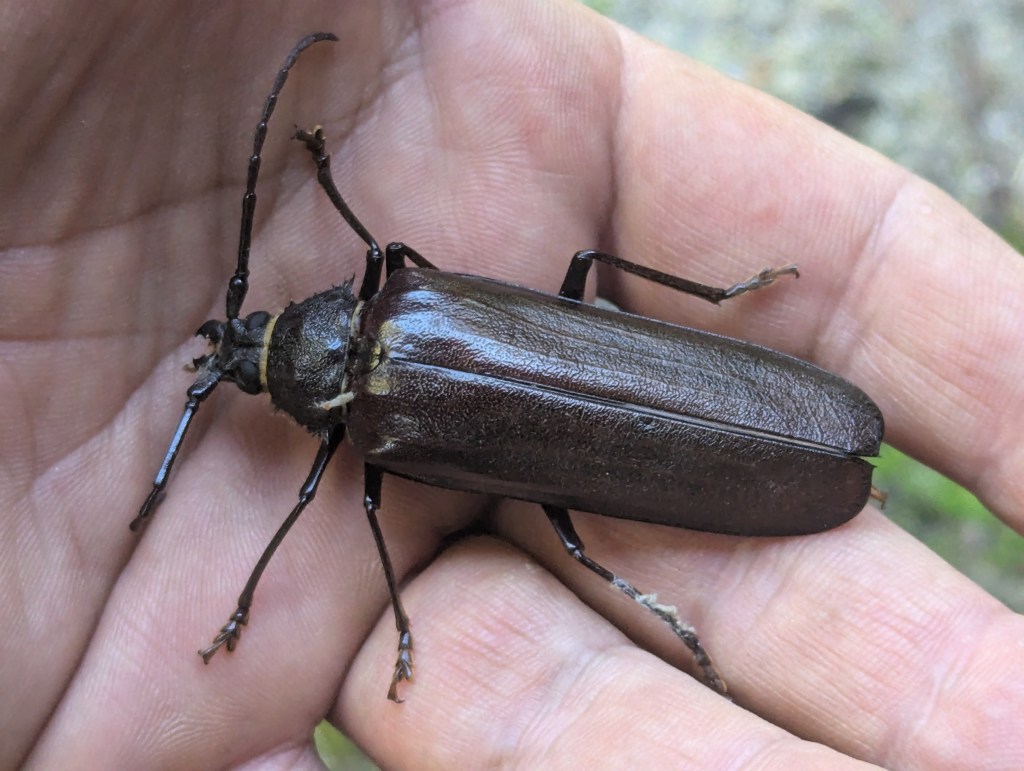
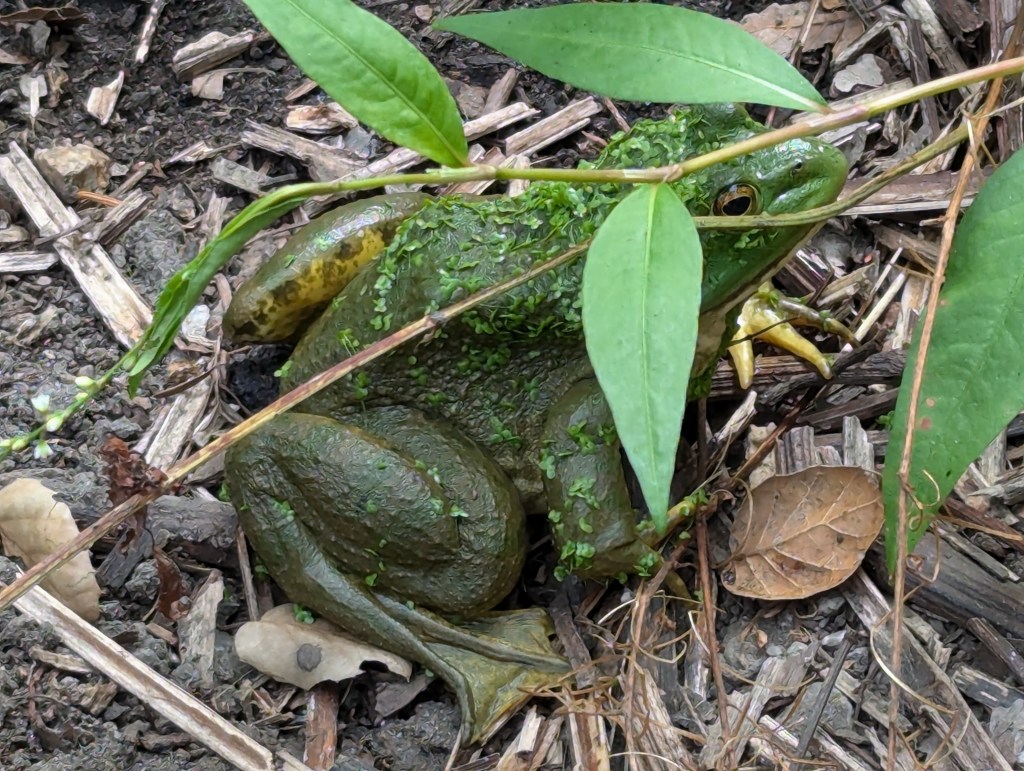
The World Wrestling Federation is now known as World Wrestling Entertainment because the World Wildlife Fund was already known as the WWF. The dude in the picture above could go either way. Apparently, he, or she, is some sort of aggressively invasive exotic bullfrog. Nonetheless, he or she still qualifies as wildlife, and now inhabits the drainage pond that is within a cultivated landscape that is adjacent to natural forest ecosystems. I mentioned his or her presence to a biologist who then informed me of how much damage this particular species can do to any natural ecosystem that it infests. I then realized that the tree frogs that had been so loud through spring had been silent all summer. Although they naturally get quiet by summer, they are not normally so completely silent. I am now concerned that the bullfrog might eat small fish who might inhabit the pond. Duckweed obscures activity below most of the surface of the pond. I would not mind if the bullfrog ate the duckweed. He or she probably does, but there is just too much of it. This species of bullfrog is omnivorous, so will eat anything that it can get its big mouth around, including mollusks and insects. That could be beneficial, but might also include beneficial insects. Actually though, I am more concerned about any baby fish than insects. Besides, when I met the insect in the picture below, I was actually somewhat concerned about the unwelcome bullfrog. I do not want his or her demise to be as violent as the appearance of this insect suggests it could be. I have no idea what this insect is, but it looks like it should have a Volkswagen hood ornament. Getting it together with the bullfrog could be an event for the WWF!

Coy Koi

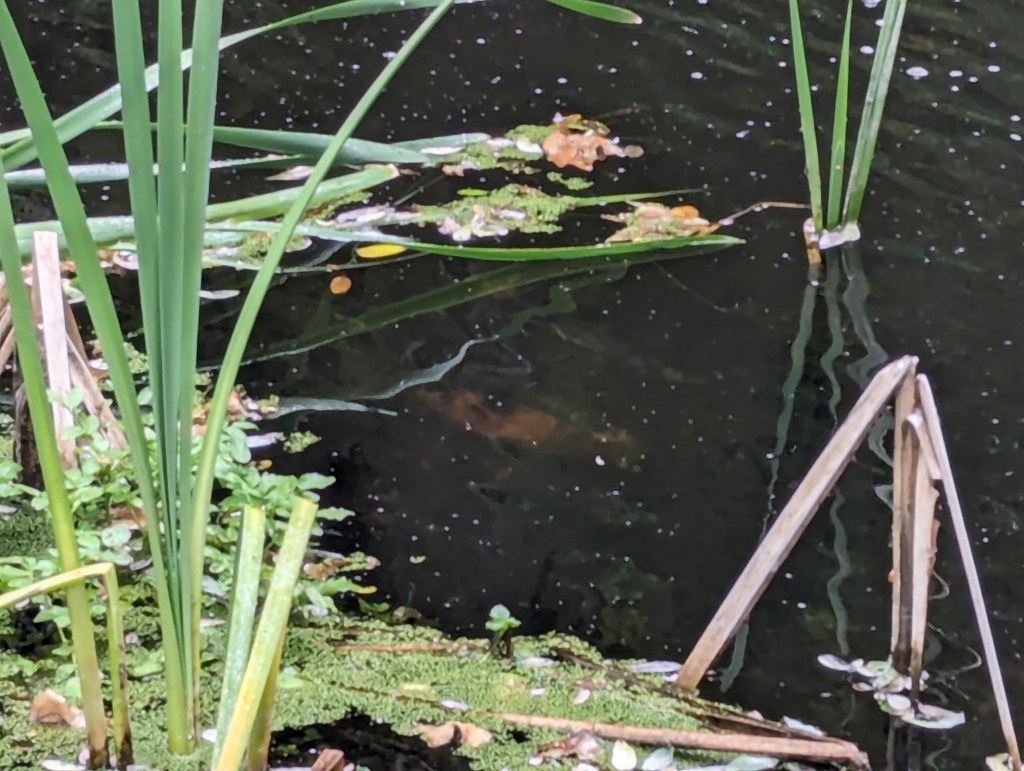
The larger of two koi is difficult to see at the center of this picture. The other is rarely seen.

Attempts to tame the recently discovered but still unidentified pair of koi within the drainage pond have been futile so far. Both remain elusive. Although the larger of the two is almost as big as Rhody, we still are not certain if they are actually a koi. We just do not know what else they could be. I try to get them to accept koi food, but the food floats on the surface of the water until a pair of ducks eats it. I should try to feed them some sort of food that sinks, at least until they respond to food, if they ever respond.

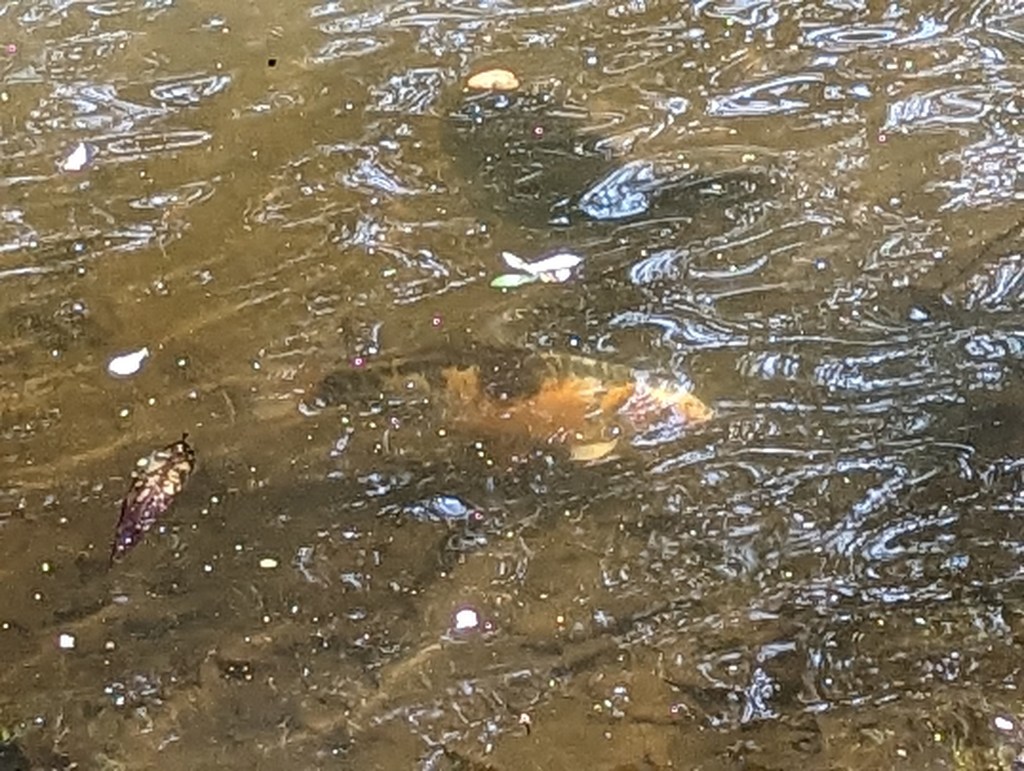
The larger and more visible of the pair is typically referred to as “Cheeto”, although not yet formally named. Cheeto happens to resemble, and could potentially be, one of the original koi who was also known as such. Its associate is known merely as its “Associate”. Even well trained koi do not respond to names. Nonetheless, we should probably assign them names, just in case they ever become tame. These are some of the options, besides Cheeto, for either of them.

Jaws

Nemo

Kraken

Moby

Sashimi

Gill

Charlie (Tuna)

Nessie (because of their elusiveness)

Roy (don’t need to be koi)

Blinky (of the Simpsons)

Wanda (a fish called Wanda)

I hope that whomever they are, they help to limit the proliferation of aquatic vegetation, particularly duckweed, within the pond, although I doubt that they can consume enough to make a noticeable difference. Also, I hope that they become friendly enough to amuse visitors. Neither are brightly colorful enough to be prominent if they remain elusive at a distance. We intend to add a bit more vegetation to somewhat mitigate erosion on the edge of the pond, as well as to displace other shabbier vegetation.

This is an older but better picture.

Sweet Flag

Sweet flag might enjoy wasteful watering.

If unpaved drainage ditches and collection ponds were more common locally, sweet flag, Acorus gramineus, might be also. It can provide a nicely neat border for such waterways, where the ground is too steep and damp for mowing. It can migrate into muddy situations and even into shallow water. Its dense network of fibrosus rhizomes helps to retain mud.

‘Variegatus’, with elegantly elongated and variegated leaves, is the most popular cultivar locally. It is rare in nurseries, but occasionally shared by friends and neighbors who grow it. Propagation by division is very easy. Single shoots or clumps of shoots grow if merely plugged into damp soil or mud. ‘Pusillus’ lacks variegation, and develops stouter leaves.

Sweet flag aggressively excludes other herbaceous vegetation, but does not migrate too rapidly. Plucking shoots and plugging them elsewhere accelerates migration. The dense foliage might get a foot deep. Individual leaves are very narrow, like grass. The mundane bloom is easy to ignore and is uncommon where the soil is not often saturated or muddy.

Duckweed

Duckweed can thoroughly obscure a pond.

Ducks somehow find water. They eventually visit most home garden ponds that they can fit into. Duckweed, Lemna minor, is likely to come with them. It adheres to waterfowl and other wildlife for that purpose. It proliferates very efficiently, and almost typically becomes a nuisance. Eventually, proliferation in a healthy pond should stabilize to a tolerable rate.

Individual duckweed plants are tiny. Their oval leaves are typically less than a quarter of an inch long. Each floating leaf extends its single root less than three quarters of an inch into the water below. Plants produce no more than four rooted leaves before dividing into a few smaller plants to repeat the process. Bloom and subsequent seed are uncommon.

As a floating aquatic plant, prolific duckweed might obscure koi and submergent aquatic plants within garden ponds. However, it also helps stabilize healthy aquatic ecosystems. In fact, it is useful for bioremediation of agricultural and industrial applications. It absorbs detrimental substances from water, while producing fodder and biomass for composting.

Aquatic Plants Are All Wet

Both cattail and duckweed are native.

Home gardens and landscapes should be compatible with their respective climates. For local chaparral climates, plants that do not need much watering through the long and dry summers are appropriate. Aquatic plants are the extreme opposite. They require regular replenishment of the ponds that they inhabit. Arid warmth increases their need for water.

Aquatic plant can not be ‘drought tolerant’. Several, such as duckweed, water lettuce and water hyacinth, float over the surface of water. Water lily and lotus inhabit the mud below the water, and extend their foliage to float over the surface of the water. Waterweeds stay completely submerged, with or without roots. Aquatic plants need water for their survival.

Marginally aquatic plants are somewhat less dependent on water. Cattail and yellow flag iris inhabit shallow ponds and saturated soil, but can survive if their situations drain for a while. If they stay too dry for too long, they can initiate dormancy, and then recover when saturation resumes. Canna inhabits either shores of shallow ponds, or evenly moist soil.

Regardless, all aquatic plants require maintenance that is completely different from what terrestrial plants require. Even those that need only minimal maintenance will eventually necessitate muddy and messy interaction. Much of such interaction is under water that is difficult to see through while murky. Aquatic plants are innately heavy and totally sloppy.

Moreover, some common aquatic plants grow like weeds. Water hyacinth and giant reed are two of the most invasive exotic species in California. So, not only are they sloppy, but they are also voluminous! Because they are very invasive, they should not inhabit ponds that they could escape. Besides, giant reed is too overwhelming for most home gardens.

Few home gardens include natural ponds or water sources to contain as ponds. Garden ponds are therefore mostly contained within some sort of sealed infrastructure, and need replenishment to compensate for evaporation. Fountains aerate the water for a healthier ecosystem, but also increase evaporation. Some tall aquatic plants also consume water, as the foliage that extends above water transpires.

Canna

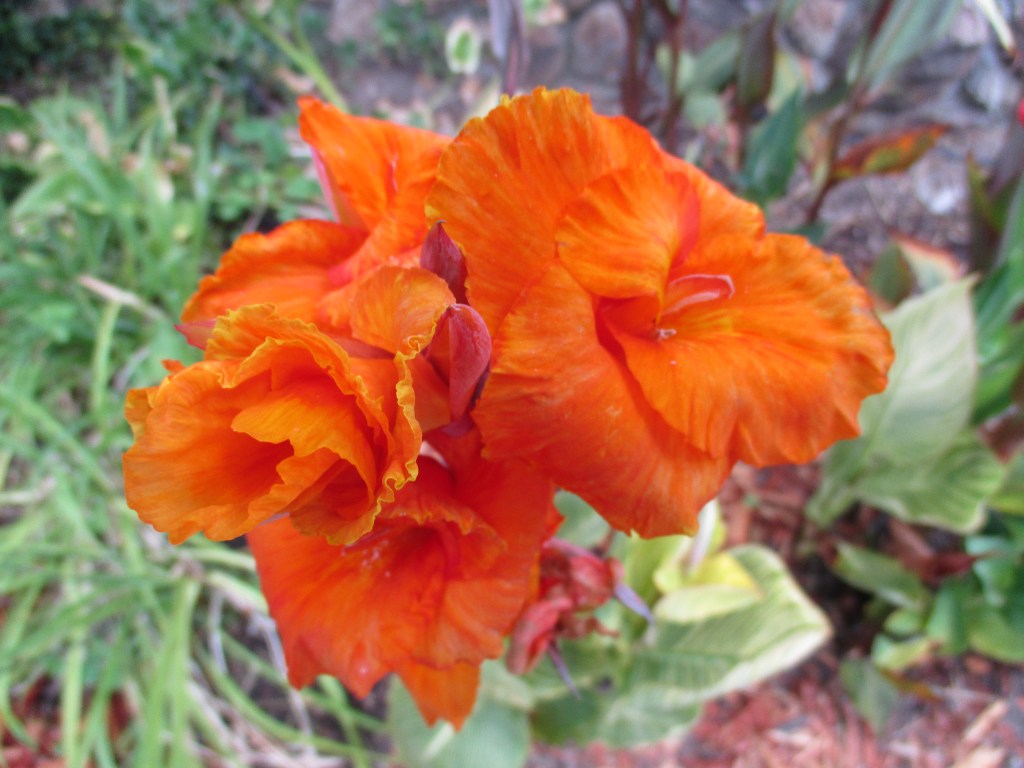
Canna excels at orange.

Although not directly toxic, canna has a unique reputation of lethality. Its spherical seeds are so hard that they were historically used as shot. Many victims are now pushing up daisies. Those who survived were pulling out cannas.

Old fashioned varieties that get up to six feet tall seem to be at least as popular as shorter modern varieties that get less than half as tall, probably because their bold foliage is as appealing as their colorful but awkwardly structured flowers. The big leaves can be cool green, rich reddish bronze or variegated. Red, orange, yellow, pink or rarely white flowers that bloom from summer to autumn are striking amongst the lush foliage, but are too perishable to be good cut flowers.

Stems that have finished blooming should be cut to the ground to promote more colorful new foliage and bloom. Mature colonies (of rhizomes) can be divided while dormant through winter if they get crowded enough to inhibit bloom every few years.

Canna bloom as well as foliage seem to be so tropical.

Elephant Ears

50722-c
The origin of taro is vague.

Taro was grown as a vegetable in ancient Egypt. It was grown in India before that. A few hundred varieties were cultivated in precolonial Hawaii. Taro was likely native to southeast Asia, but has been in cultivation for so long that it is difficult to know where it originated from. In modern American gardens, it is known as elephant ears, Calocasia esculenta, and grown for its striking foliage.

The big and broad leaves are held as high as six feet on long petioles (leaf stalks), and flare out as broadly as three feet, although many varieties get half as tall and broad. Some varieties have weirdly dark foliage. Others have green leaves with colorful veins. A few are simply jade green. Any of the deciduous foliage that lingers into winter should be cut back before spring.

Since they are naturally bog plants, elephant ears likes very rich potting soil and plenty of water. Muddy clay soil that will not float away works fine for pots submerged in ponds. (Ick!) Partial shade is important. Leaves can get roasted if too exposed. To propagate, corms can be divided while dormant in winter. All parts of elephant ears are toxic until cooked.

Water Lily

50715+
Water lily bloom emerges from the depths.

The fragrant flowers of water lily are unreal! They either float on the surface of the water, or hover just above. Abundant pointed petals radiate outward from central tufts of pronounced stamens. Most flowers are soft hues of yellow, pink, blue, lavender, peachy orange or white. Some are brighter yellow or pink, or richer shades of red or purple. Some open in the morning. Others open in the evening.

The rubbery leaves that float on the surface of the water are nearly circular. Some are symmetrically cleft to the center, like Pac-Man or a pizza with a slice taken out. The thick rhizomes that the foliage and flowers emerge from stay buried in pots or mud under the ponds that they live in. Rhizomes can be divided to propagate, but take a year or so to recover and bloom.