The Importance of Proper Arboriculture

Arboriculture is horticulture of trees.

Pasadena sustained the worst of the damage caused by the strongest Santa Ana Winds in three decades. Huge piles of debris from broken trees are much more than can be removed any time soon. Falling debris and trees damaged many roofs, cars and anything else that happened to get in the way.

Other towns and neighborhoods throughout the area, particularly those at the base of mountains, also sustained major damage. At the same time, severe winds ravaged the San Francisco and Monterey Bay Areas as well, particularly in the Santa Cruz Mountains and the hills of the East Bay.

Some of the damage caused by wind in urban areas might have been less disastrous if trees had gotten the respect and attention that they deserve. Some trees develop structural deficiencies that need to be corrected by pruning, either to eliminate the problems, or at least to decrease the strain exerted onto the structurally deficient parts. A few trees that become unstable as they mature may likewise need to be pruned or even removed.

It is not always possible to prune trees to remove all structural deficiencies without damaging the affected trees more, or causing more structural problems to develop. For example, major pruning to remove all parts that may get blown down by wind, such as pollarding or ‘topping’, may seem to be effective for the short term, but actually stimulates the development of vigorous secondary growth or watersprouts that are disproportionately heavy and even more likely to tear off from the older limbs.

Structural pruning more often involves thorough reduction of weight and wind resistance. Weight of foliage and stems directly applies leverage against unions where smaller stems are attached to the larger stems from which they originate. Wind resistance adds more leverage as foliage gets blown about by wind. Thinning obviously removes significant weight, and also decreases wind resistance to allow wind to blow though the affected canopies.

Besides helping to compensate for structural deficiency, structural pruning is also beneficial to potentially unstable trees for the same reasons. However, unstable trees typically need even more reduction of weight and wind resistance. Some of the most unstable trees and those that are deteriorating need to be removed because their instability cannot be accommodated.

During winter, while deciduous trees are bare, evergreen trees are more susceptible to wind damage, obviously because they retain their weight and wind resistance through winter while the weather is the most severe. Unstable trees become even more destabilized as rain softens the soil. Regardless of the potential for susceptibility to wind damage, this would be a good time of year to get any needed tree maintenance done, prior to any more windy and rainy winter weather.

Arborists certified by the International Society of Arboriculture are the most qualified to identify potential structural problems or instability, and to prescribe corrective procedures. A list of certified arborists can be found at the website of the International Society of Arboriculture at http://www.isaarbor.com.

Trees May Benefit From Winterization

Many trees need no winterization pruning.

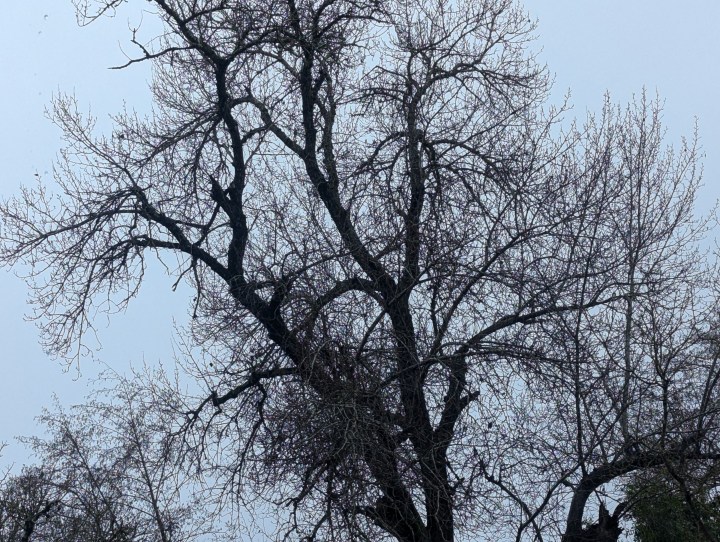
Arboriculture becomes more of a concern at this time of year. Although winter is a month away, the weather is becoming increasingly stormy. Wind and rain can dislodge limbs or destabilize entire trees. Some trees may benefit from winterization prior to even stormier weather in the future. Some may need the specialized services of professional arborists.

Dormant pruning of deciduous fruit trees is, incidentally, not the same as winterization. It happens later in winter, after the subjects have been dormant for a while longer. Besides, after proper dormant pruning last year, they should not need winterization now. However, if subjects are defoliated, they should not mind early pruning. They are already dormant.

Ironically, the trees that are more likely to require winterization are evergreen. Deciduous species perform almost all of their own winterization naturally. They defoliate to eliminate most of their resistance to wintry winds. In other words, they become more aerodynamic. Defoliation also eliminates most of the surface area to accumulate heavy water from rain.

Evergreen species are generally more resilient to wind than foliated deciduous species. However, as deciduous species defoliate, evergreen species can not. Evergreen foliage therefore becomes less aerodynamic and more vulnerable to wind. Also, it absorbs more heavy rainwater. The added weight of rainwater causes limbs to sag and perhaps break.

Rain does more than cause foliage to become heavier. It also saturates soils, which can potentially compromise root stability. The timing could not be worse, since wind typically accompanies rain. This is also more of a problem for evergreen species than deciduous species. However, some storms arrive early, and some deciduous species defoliate late.

Winterization pruning is as variable as the trees that benefit from it. Large trees will likely need specialized services that only arborists can provide. Japanese maples may require only minor clipping of stems that have extended too far. Many trees require nothing at all. Ultimately, such techniques should help limbs and trees survive eventual wintry weather.

KPCR Garden Report

Nothing is official yet. I am hopeful, though. I am currently in training to establish a new Garden Report on Pirate Cat Radio KPCR-LP 92.9 FM in Los Gatos, KMRT-LP 101.9 FM in Santa Cruz, KVBE-LP 91.1 in Portland, and online at KPCR.org. For me, it is daunting. However, those training me are confident of my ability. I have no problem talking about horticulture for an hour. My difficulty is operating the necessary electronics. It is not much, and actually looks quite simple. I am just not comfortable with it. I am intent on doing what I must, though. I miss my former Garden Report gardening shows on KSCO 1080 AM in Santa Cruz and KBCZ 89.3 FM in Boulder Creek. Ultimately, I would like to post recordings of the new Garden Report here on the blog, or at least post links to such recordings. I am told that is not difficult to do, if I record the shows, which is apparently standard procedure. I still need to find “intro” music for the beginning and end of each show, but I believe that I have a source for that. Goodness, although I know this should be easy, I am nervous!
Sun Scald

Vegetation needs sunlight, but sunlight can be excessive.

It was sad to see the removal of a rather mature but unstable Italian stone pine from the neighborhood. Fortunately, the arborist who removed it was careful to avoid damaging the garden below. Yet, after all the effort, the garden did not remain undamaged for long. The healthy bear’s breech (acanthus) and young Australian tree ferns that had been shaded by the dense canopy of the pine got roasted by the first warm weather.

These perennials got roasted because they were adapted to shade, but could not adapt soon enough to exposure to direct sunlight. This illustrates one of the main problems of topping trees and exposing the interiors of formerly shaded canopies. (‘Topping’ is the disfiguring removal of major portions of the upper canopies of trees.) Like perennials on the ground, foliage as well as stems and main limbs within the canopies of topped trees gets damaged by increased exposure. Although most perennials eventually adapt and recover, topped trees are often damaged too severely to recover.

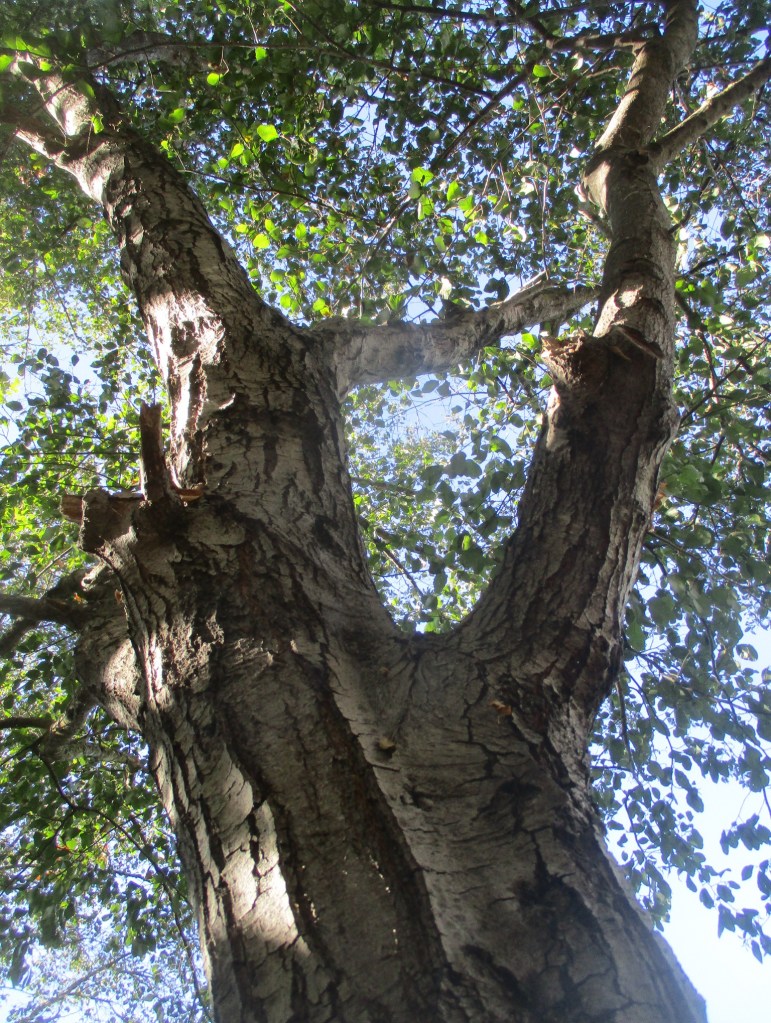
Foliage can be replaced, but stems and limbs are not so expendable. Deciduous trees and most evergreen trees will replace damaged foliage within the first year. Deciduous trees that get topped while dormant in winter actually do not exhibit foliar damage, since foliage that emerges in spring will be adapted to the exposure that they grow into. However, formerly shaded stems that suddenly become exposed by topping are easily damaged by sun scald, which is like sunburn of the bark.

Sun scald deteriorates into open wounds which leave inner wood susceptible to decay. Minor sun scald of small limbs can eventually be compartmentalized (healed over) before it becomes too much of a problem. Major sun scald can destroy main limbs and even trunks, causing additional disfigurement to trees that were already disfigured by topping! Even if sun scald does not develop, the open wounds left from topping are often too large to be compartmentalized, so remain open to decay.

Regardless of sun scald, topping is more directly disfiguring, by removing well structured limbs and trunks, and causing the development of disfigured and structurally unsound limbs. Secondary growth that emerges in response to topping or severe pruning is weakly attached to the mature limbs that it emerges from because it did not grow together with the mature limbs. It breaks away easily in wind, or simply because it grows too vigorously and soon gets too heavy for weak unions.

Topping actually causes more problems than it is thought to remedy. In some situations, it is actually more practical to remove potentially hazardous trees than to make them more hazardous by topping them.

Why Hire An Arborist?

Arborists work with the big trees.

Like the many different kinds of physicians who work in a hospital, there are many different kinds of horticultural professionals who specialize in particular disciplines. Although too commonly considered to be ‘landscapers’, and even though many do not work directly with landscapes, there are nurserymen, gardeners, landscape architects, horticulturists and arborists, to name a few.

Arborists specialize in the horticulture of trees. Only a few decades ago, arborists were known as tree surgeons, since they perform surgery on trees. Of all the horticultural physicians that attend to concerns in the landscape, arborists and their associated technicians are the most qualified to properly maintain trees.

Expecting a gardener to maintain large mature trees is like expecting a pediatrician to perform major surgery. Even the most proficient and educated gardeners are too specialized with maintaining other plant material in the garden to also be specialized with arboriculture, or the horticulture of trees.

Arborists who are certified by the International Society of Arboriculture, or ISA, have successfully passed and examination of their arboricultural aptitude. Certification must be maintained by attendance to educational seminars, workshops and other relevant events approved by the ISA.

The website of the International Society of Arboriculture, or ISA, at www.isaarbor.com, is the best resource for finding certified arborists and the tree service establishments that they are affiliated with. Arborists can be found within particular regions by city or ZIP code, or identified directly by name or certification number.

The ‘Public Outreach’ category at the ISA website features links to www.TreesAreGood.org, and ‘Why hire an arborist?’, as well as a few other links for consumers. After all, the website exists not only for professionals, but also to help consumers find professionals and to make responsible decisions about their trees, from the time they get planted, throughout their lifetime, and until they get old and eventually need to be removed.

The www.TreesAreGood.org link has all sorts of information about trees and their maintenance. There are many and various articles about the benefits of trees, the value of trees, tree selection, planting new trees, proper pruning techniques, insects and diseases, tree hazards, why topping hurts trees, and even an article about palms. Incidentally, the Fun Facts link mentions that the tallest tree is the coastal redwood, the biggest tree is the giant redwood, and oldest tree is the bristlecone pine, all of which are native to California.

Trees are of course the most substantial components of a landscape. Some will be around for years. Some will be around for more than a century!

Tree Selection

Some trees grow too large for urban situations.

Trees are the most significant components of the landscapes that they inhabit. They get larger than all other plants, and live for decades or centuries. Because inappropriate trees have such potential to cause such serious problems, and can be so difficult and expensive to remove, it is important to select trees that are appropriate to each particular application.

Size and form of trees when they mature are important considerations. Crape myrtles are small to midsized trees that fit nicely into tight spots, but are too dinky to be good street trees. London plane trees are more proportionate as street trees, but eventually displace sidewalks and curbs with their aggressive buttressed roots. Chinese elms can be good street trees, but need to be pruned regularly to maintain clearance. Red maples are a better choice because they get large enough without getting too big, have complaisant roots, and are easily pruned for adequate clearance.

Other features in the area can limit tree selection. Poplars and willows have aggressive roots that invade septic systems or old unsealed iron or terra cotta sewer pipes. Queen palms eventually reach utility cables, but can not be pruned to go around them. Any good shade tree can provide too much shade over solar panels. Partial shade from large trees or structures is a problem for most other trees, but is actually preferred by a few ‘understory’ trees like vine maples, Japanese maples and dogwoods.

Trees that are expected to provide shade through summer should probably be deciduous, like red oaks or silk trees, to allow warming sunlight through during winter, particularly close to the home. However, trees that should obscure unwanted views should be evergreen, like Southern magnolias or arborvitaes.

Some trees that need more attention than others are only appropriate where they will get the attention they need. Mexican fan palms are easy to care for while young, but eventually grow out of reach and need to be groomed by professional arborists. Of course, every tree is limited to particular climates. Various ficus trees that are common in nurseries in San Diego will not survive even a mild frost, which is why they are not available in San Jose.

Horridculture – Bad Pollarding

Actually, this does not even qualify as pollarding. It looks as if this tree, which was one of a few similarly damaged Acacia melanoxylon, black acacia trees, was in the process of being removed when the crew who was removing it left for the day. It would not have been so bad if they had returned to remove it and the others completely. They did not. This was the finished product. It and the others were almost twenty feet tall in this condition. They were about twice as tall prior. This sort of hack job is what gives pollarding a very bad reputation. It also demonstrates why proper pollarding should not be so vilified that arborists do not learn how to do it. Very obviously, this is not proper. Because they could not be salvaged, all of these trees were cut down a few days after I got this picture.

Pollarding can be done for a variety of reasons, and has been done for centuries in various cultures. It is still respected technique in many or most cultures. It stimulates vigorous growth that can be fodder for some types of livestock, including silkworms who consume the vigorous foliage of pollarded white mulberry trees. It can prevent some trees from producing troublesome pollen or fruit, such as old orchard olive trees that were retained as homes and their respective gardens were constructed around them. It can enhance autumn foliar color for some types of deciduous trees, such as the old Schwedler maples that were formerly common as street trees in San Jose. It stimulates growth of vigorous cane stems that are useful for basketry, fences, trellises or kindling. Locally though, it is considered to be as egregious as the technique pictured above, which is why no one here learns about it.

Arboriculture Is Very Specialized Horticulture

Arborists specialize in the big trees.

Horticulture is as diversified as horticultural professionals. Nurserymen grow horticultural commodities. Landscape designers plan installation of the commodities into landscapes. Landscapers construct the landscapes. Gardeners maintain them afterward. Florists use floral commodities. Arborists specialize in arboriculture, which is the horticulture of trees.

Arboriculture is necessary because trees are so substantial. Although most arborists can work with smaller trees, larger trees are their priority. Other horticultural professionals are neither qualified nor able to work with such trees. Similarly, arborists are too specialized to engage with landscape design or floristry. Arboriculture is truly an intensive discipline.

Many garden enthusiasts maintain their own trees while such trees are somewhat small. Some trees, such as dwarf citrus and Japanese maples, stay small. However, most trees eventually grow beyond reach from the ground. Even within gardens that lack gardeners, arborists might become necessary. This is certainly not something to be negligent about.

When pansies get tired in spring, gardeners can replace them with petunias for summer. Trees are completely different. They are the most substantial and persistent vegetation in their respective landscapes. Some can survive for a few centuries. The consequences of their neglect can be disastrous. Arboriculture is crucial to the safety of their environment.

The importance of arboriculture typically becomes more apparent during wintry weather. Rain destabilizes roots. Wind weakens the integrity of limbs and trunks. Generally, trees become messier and more hazardous than at other times of year. However, arboriculture is a concern throughout the year. Spontaneous limb failure is more likely during summer.

Besides, several procedures for certain trees are more appropriate during other seasons. Furthermore, mitigation of potential problems is easier before they become emergencies. Information about arboriculture is available from the International Society of Arboriculture or ISA. Their website, which also provides a list of certified arborists, is at isa-arbor.com.

Horridculture – Aberraculture

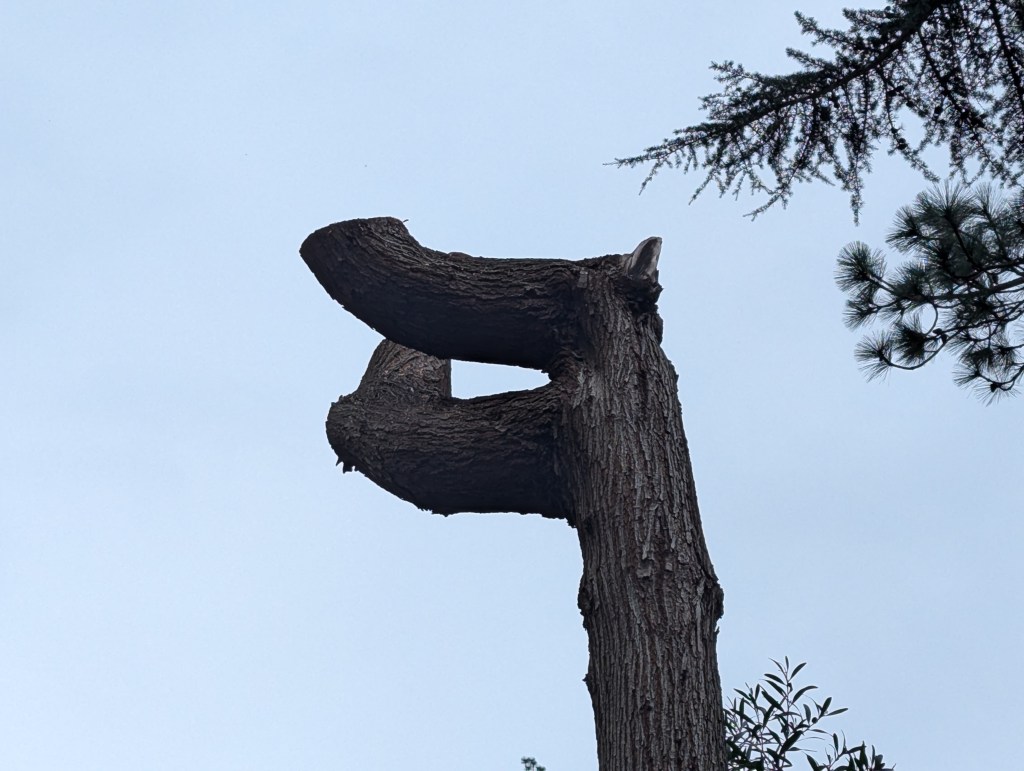
Totem of aberrative arboriculture

“Aberraculture” is no more a real word than “horridculture” is. Just as “horridculture” is like a contraction of “horrid” and “culture” that seems to describe horrid horticulture without actually doing so, “Aberraculture” is like a contraction of “aberrative” and “culture” that seems to describe aberrative arboriculture without actually doing so. Perhaps the illustration above provides a better explanation. I suspect this happened because the entire canopy of this particular Quercus agrifolia, coast live oak, extended over the fence and the driveway within the fence from which it needed to be pruned for clearance. However, because of the fence at the edge of the driveway, the trunk could not be cut completely to the ground. Whoever did this lacked access through a nearby gate. The dinky limb and stubbed limb at the top of this severed trunk seem to be a pathetic attempt to cut back to a lateral limb, as if it somehow makes this a proper cut. If this trunk had remained, it would have generated rampant growth that would extend in all directions, including back over the driveway that necessitated this procedure. It is gone now, and the stump should be dead. Because this was on a property where I work, I did not want anyone to see it there. I have no idea who did it, since it was done for an adjacent property, and whoever made arrangements for it did not want to trouble us with it. I only noticed because the adjacent property happens to be a bank that I do business with. I probably should occasionally inspect such fenclines for potential problems before something like this happens again. They are easy to neglect because, although close to some landscapes outside, they are so far from the trees and refined landscapes that we maintain within.

Does cutting back to a lateral limb somehow make this a proper cut?!

Horridculture – Deferred Road Maintenance

It is not on the road yet, but will be soon. This box elder has been deteriorating for several years. Only a few viable watersprouts remain within about ten feet of the ground. All limbs above are gone, leaving only this decomposing trunk. Several more similarly deteriorating trunks, with more or even less of their associated canopies remaining, are barely standing nearby. Most succumbed to an unidentified pathogen a few years ago. Some were dead prior to that. This one is special because such a significant portion of its upper trunk has broken off, and now remains suspended by the unbroken portion of the same trunk and the collective canopy of adjacent bay trees. This would not be such a concern if this broken portion of the trunk was not suspended so closely to the busy road below. (The picture above shows where the trunk broke. The picture below shows its proximity to the road below.) I suspect that when the broken portion of trunk eventually falls through the canopy of bay trees, the heavier basal end will fall first, and guide the lighter upper portion to land closer to the base of the remaining trunk, and safely away from the road, but I can not be certain until it actually happens. Those who maintain the road will not remove the broken portion of trunk until this does not actually happen, and the debris instead falls into the road. I can do nothing about it because I can not direct how the broken portion of trunk will fall once it is dislodged, and the traffic on the road is nearly constant during the day. It would be safer with a crew to stop traffic while the trunk is removed, and even better if they remove all of the several decaying trunks.