Horridculture – Deferred Road Maintenance

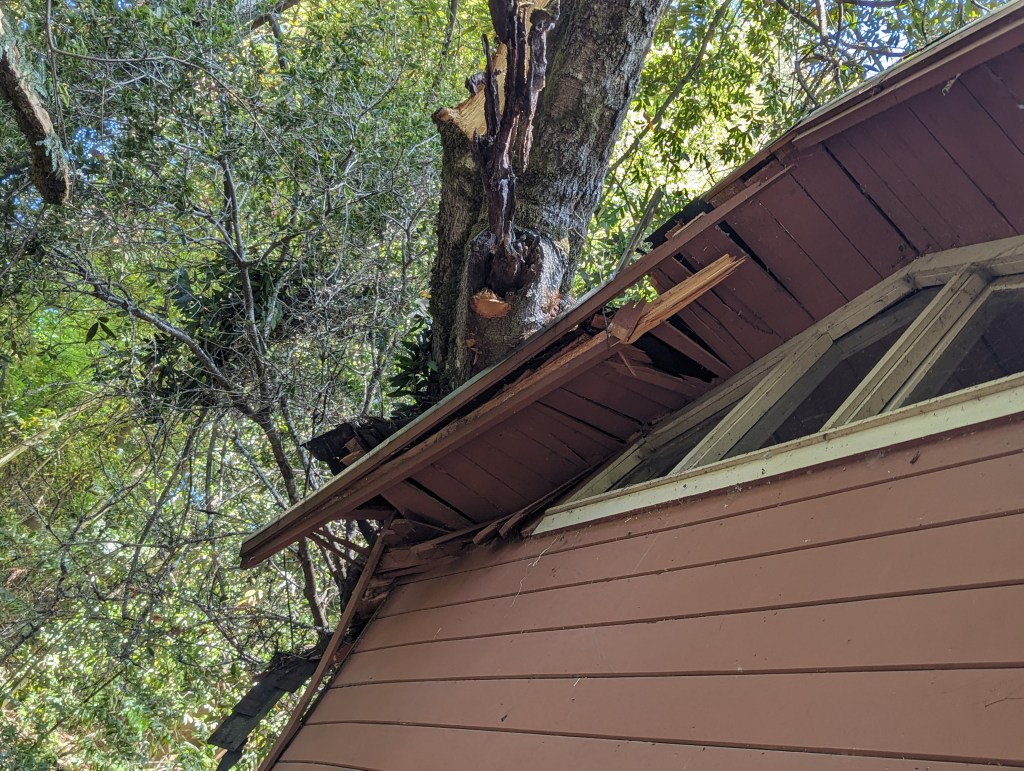
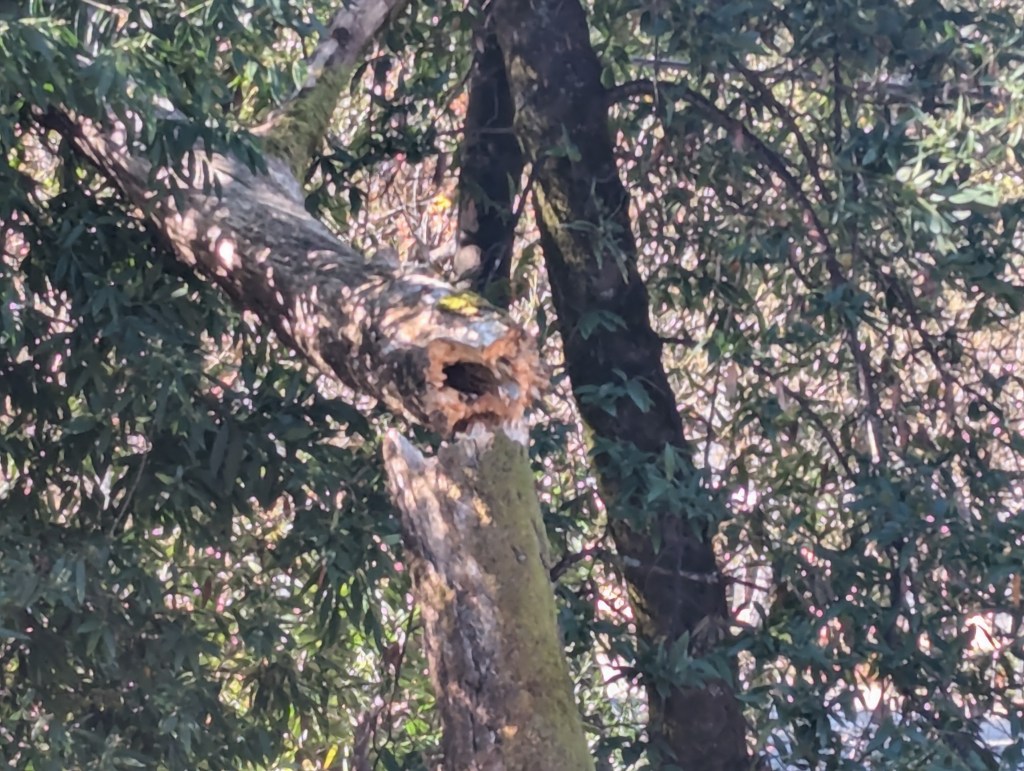
It is not on the road yet, but will be soon. This box elder has been deteriorating for several years. Only a few viable watersprouts remain within about ten feet of the ground. All limbs above are gone, leaving only this decomposing trunk. Several more similarly deteriorating trunks, with more or even less of their associated canopies remaining, are barely standing nearby. Most succumbed to an unidentified pathogen a few years ago. Some were dead prior to that. This one is special because such a significant portion of its upper trunk has broken off, and now remains suspended by the unbroken portion of the same trunk and the collective canopy of adjacent bay trees. This would not be such a concern if this broken portion of the trunk was not suspended so closely to the busy road below. (The picture above shows where the trunk broke. The picture below shows its proximity to the road below.) I suspect that when the broken portion of trunk eventually falls through the canopy of bay trees, the heavier basal end will fall first, and guide the lighter upper portion to land closer to the base of the remaining trunk, and safely away from the road, but I can not be certain until it actually happens. Those who maintain the road will not remove the broken portion of trunk until this does not actually happen, and the debris instead falls into the road. I can do nothing about it because I can not direct how the broken portion of trunk will fall once it is dislodged, and the traffic on the road is nearly constant during the day. It would be safer with a crew to stop traffic while the trunk is removed, and even better if they remove all of the several decaying trunks.

Horridculture – Headless

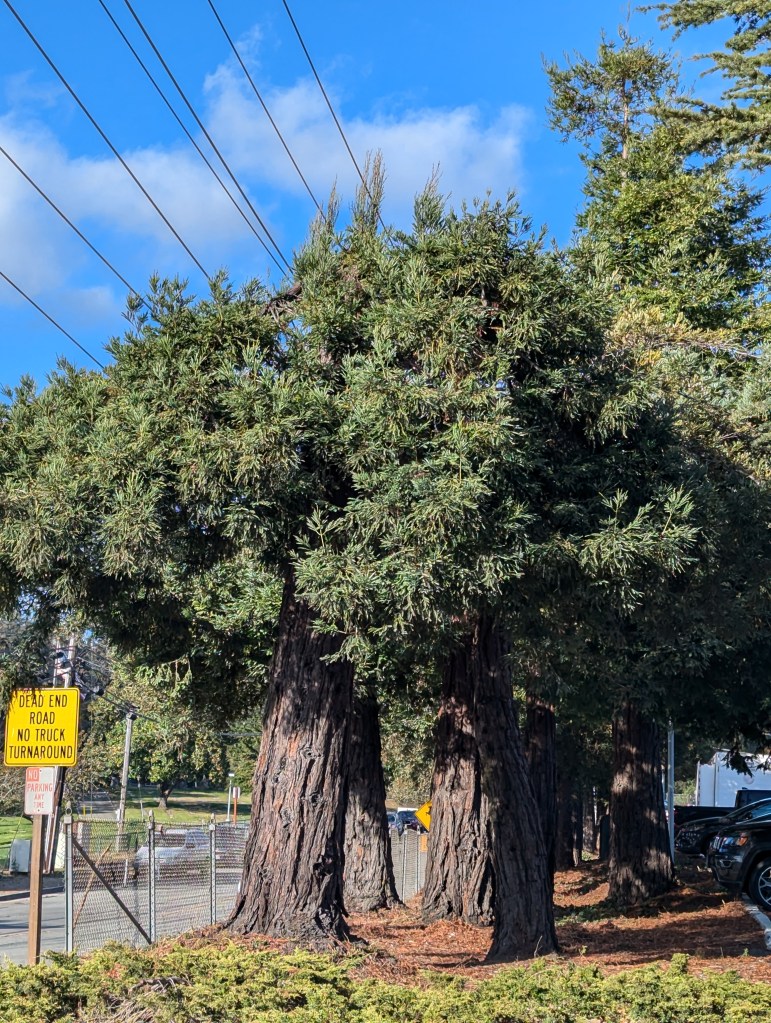
Appropriately, this picture was taken on Halloween. The ‘DEAD END’ sign and cemetery beyond, which are visible to the lower left of the picture, were also coincidental. The several headless redwood trees are the primary topic. Obviously, they were decapitated because of the electrical cables above. Otherwise, redwoods with such healthily plump trunks would be rather tall by now. After all, coastal redwoods are the tallest trees in the World. Unfortunately for them and those who are now appalled by their disfigurement, reliable and safe electrical service is more of a priority than poorly situated trees. It is no fault of the trees. Nor should this atrocity be blamed on those who executed it. Their only better option would be complete removal of the subjects, and perhaps replacement with smaller trees that will not grow tall enough to get too close to the electrical cables above. Maintenance of clearance of the vigorously upright redwoods from the cables above is a chronic problem that must be morally challenging for the arborist who must perform the necessary procedures. However, removal of several such significant trees would be very objectionable to the Community, which is very likely why these trees remain, regardless of their severe and irreparable disfigurement. Application for permits for their removal requires posting of such intentions on the trunks of the subject trees, to which neighbors would very likely protest. None of this would be such a problem now if only trees that are more appropriate to this particular situation were installed instead! Did the landscape designer who designed this landscape even visit the site during the design process, or was it all done on paper in a remote studio? Why did those who installed these trees not foresee this problem and modify the landscape plan and species selection accordingly?

Firewood Still Warms Some Homes

Firewood is a byproduct of arboriculture.

Firewood was much more popular only a few decades ago. It was readily available from displaced orchards and nearby forests. Fireplaces and even a few woodstoves were not yet so uncommon. People were more motivated to cut and split firewood. More than now purchased it already cut and split. For heating, gas and electricity were more expensive.

Firewood is not so readily available nowadays. Forests are not so nearby. Orchards that were subject to displacement in the past are now completely gone. Most firewood that is available for purchase is a byproduct of arboriculture. Yet, it may not be much less costly than gas or electricity for warmth. Gas or electricity are more convenient and less messy.

Fireplaces and woodstoves are not so common nowadays either. Modern building codes prohibit them from new construction. Repair is rarely justifiable for any that incur damage from earthquakes. Because most are very rarely if ever in use, their removal is generally more practical. The many more households that are here now utilize much less firewood.

However, firewood is not obsolete. It is a renewable resource that very literally grows on trees. Some households consume only very minor volumes from their home landscapes. Some households purchase more significant volumes of it from tree service businesses. In some communities, it is available from woodcutters who harvest it from private forests.

Regardless of its source, firewood for this autumn and winter must be seasoned by now. In other words, after cutting and splitting, it needed time to dry thoroughly. Otherwise, it is difficult to ignite, produces excessive smoke, and burns inefficiently. Palm, cordyline and yucca trunks are not suitable for firewood. They burn fast, but do not produce much heat.

Average home gardens do not produce much firewood. However, removal of a single big tree can instantly provide an abundance. Tree services prefer to leave such wood where it falls. They usually cut it to fit fireplaces but do not split it. Those with an abundance are often happy to share, especially if they use none. It occupies space, and eventually rots.

Taking Sides

This is what taking sides looks like. The right side was taken completely off, leaving only the left. The view from the other side would show that the left side was taken completely off, leaving only the right. It is not such a good picture because it is difficult to distinguish the extent of the damage from what is going on in the background. Realistically though, a better picture would be even worse, since the extent of the damage would be more obvious. The justification for such damage here is more obvious, since, obviously, this is a bad situation, with no room for balanced growth. Although survival is possible, this is not what nature intended. Natural growth should be an asset, and efficiently directed to where it can be useful, which would most likely be much more balanced than this. Incidentally, this is a coastal redwood, which is the Official State Tree of California. This sort of pruning would be just as damaging to Western hemlock, Douglas fir or blue spruce. For that matter, it would be just as damaging to longleaf pine, Western white pine or Ponderosa pine. Ultimately, it is bad technique for any tree in any situation.

Tree Work Will Be Less Stressful During Dormancy.

Only arborists can work on the big trees.

The taller trees are typically the first to admit that summer is finished and that it is now autumn. Perhaps because they are higher up and into the changing weather more than smaller plants that are sheltered and closer to the ground. Some trees are changing color nicely. Others are thinking about it. Evergreens are, . . . well, evergreen; so they may not seem to change so much. Nonetheless, autumn is here, and most plants will consequently be going dormant for the winter, or at least slowing down a bit.

For many trees and other plants that need to be pruned, the next few months will be the best time for it. Because they are more or less dormant, they are not very aware of whatever procedures they are subjected to. When they wake up in spring, they simply adapt to the earlier pruning and start growing as if not much happened to them. Dormancy is like a natural anesthesia for trees and plants.

Conversely, the end of winter and beginning of spring is the worst time to prune many trees and plants because they are just emerging from dormancy, so are wide awake! If necessary, minor pruning done properly is generally tolerable, but should realistically be done either before or after that time. Maples, birches, mulberries and figs express their disapproval of late pruning by bleeding profusely, and sometimes for a long time.

Deciduous trees are most dormant by winter when their leaves have fallen off. Pruning them a bit earlier would probably be harmless, but deprives them of their colorful foliage. Maples, gingkoes, poplars and mulberries typically defoliate earliest. Oaks, elms and sweetgums (liquidambars) take their time, holding onto their leaves until they get knocked out by wind and rain. Oaks and elms are not very colorful anyway. Sweetgums though can look too good to get pruned late into winter!  

Arborists are physicians of trees, so can prescribe recommended pruning and maintenance procedures. Many trees, like Chinese elms, fruitless mulberries and willows, need more attention than others. Austrian black pines and Eastern redbuds are not so needy. Blue spruces that are allowed to remain branched to the ground and have enough space around them may never need a visit by an arborist.

Regardless of how much attention any particular tree needs, when it develops a problem that is out of reach, it should be assessed by an arborist, and hopefully pruned accordingly. Because trees are the most substantial features of the landscape, and can develop worse problems if not maintained properly, it is imperative to procure the services of qualified arborists; and not trust such important tasks to a gardener or anyone who can find a chain saw and pick up. Fortunately, certified arborists can be found at the website of the International Society of Arboriculture (ISA), at www.isaarbor.com.

Electrical Cables Necessitate Arboricultural Atrocities

Trees can not mix with electricity.

Electrical cables are hazardous! There is no need to elaborate. That is why high voltage electrical cables are either subterranean or aerial. Subterranean electrical cables remain safely out of reach underground. Aerial electrical cables remain safely out of reach about thirty feet above ground. However, electricity is always dangerous regardless of location.

Excavation can inadvertently expose subterranean electrical cables. Pruning large trees can similarly involve minimal proximity to aerial electrical cables. Home gardening rarely involves such deep excavation. However, it commonly involves arboriculture, or pruning, of big trees. When it does, the most eager of garden enthusiasts must know their limits.

Clearance pruning eliminates obstructive vegetation. Ideally, it prevents it from becoming obstructive before it does so. It is useful for roadways, walkways and chimneys, and also protects roofs from damage. Yet, it sometimes necessitates the service of professionals. For example, pruning trees over major roadways is likely too hazardous for anyone else.

Pruning trees over high voltage electrical cables is even more hazardous. However, it is also necessary. That is why electrical service providers employ professionals to perform such tasks. Unfortunately, proper arboricultural technique is not a priority. Reliability and safety of electrical service are. It is efficient, but can severely damage any involved trees.

What is worse is that such damage is also dangerously close to utility cables. Corrective procedures also require the services of specialized arborists. Utility service providers do not assume any associated expenses. Removal might be more practical than salvage for the most severely mutilated trees. Salvage of decapitated palm tree trunks is impossible.

Selection of appropriate trees can limit such problems in the future. With few exceptions, palms are inappropriate within aerial utility easements. Almost all grow only upward with solitary terminal buds. Conversely, some large shrubbery is conducive to pruning to stay lower than cables. So are a few compact trees. Several stay lower than cables naturally.

Victim of Gravity

Nature is messy.

What goes up must come down. This elderly and deteriorated Shreve oak may have taken more than a century to go up, and then suddenly came down within only a few seconds. Unfortunately, it was not at all graceful about doing so, as it landed on this unoccupied cabin and a nearby bay tree. The cabin can be repaired. The bay tree needed to be removed with the fallen Shreve oak. Nature is messy like that. Some might say that it is also inconsiderate. Regardless, it can be difficult to live and work with. Most of our landscapes are adjacent to natural ecosystems. All are dominated by big natural trees, including coastal redwood, which is the tallest species of tree in the World. Even if none of the big trees are directly within some of the landscapes, some of such trees are big enough to drop debris or limbs within landscapes that are significant distances away; or worse, they can fall into the landscapes. As much as we try to limit such risks, nature, besides being messy and potentially inconsiderate, is also generally unpredictable. However, one of only a few aspects of nature that is always reliably predictable is gravity.

Horridculture – Thorough Hacking

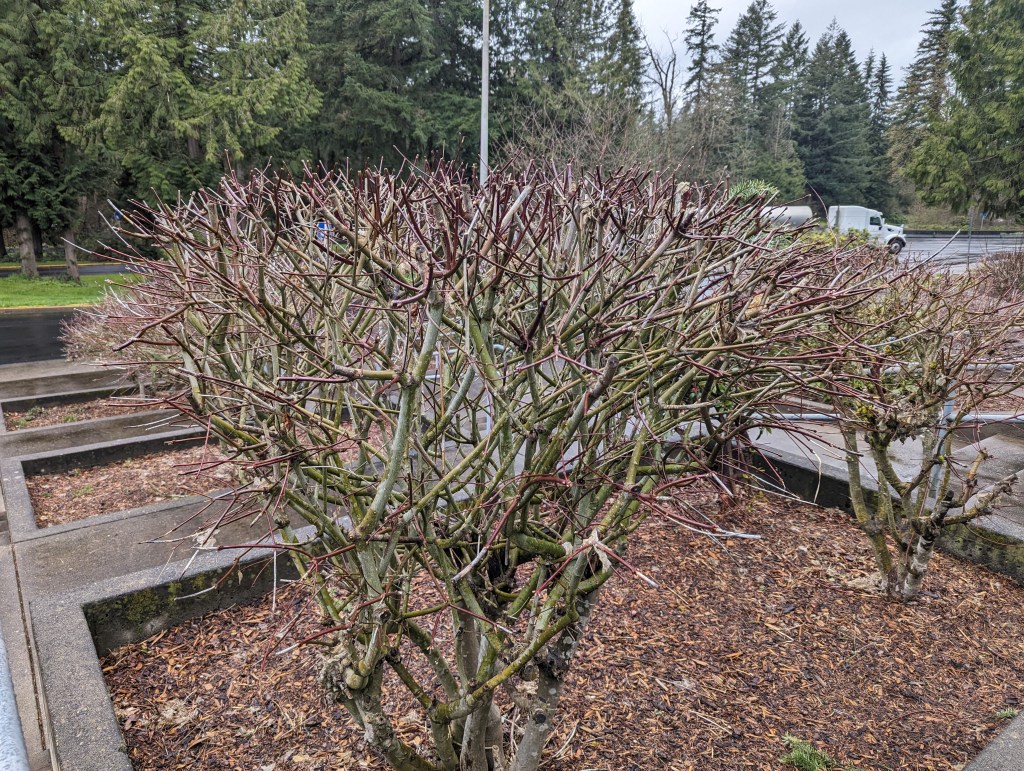
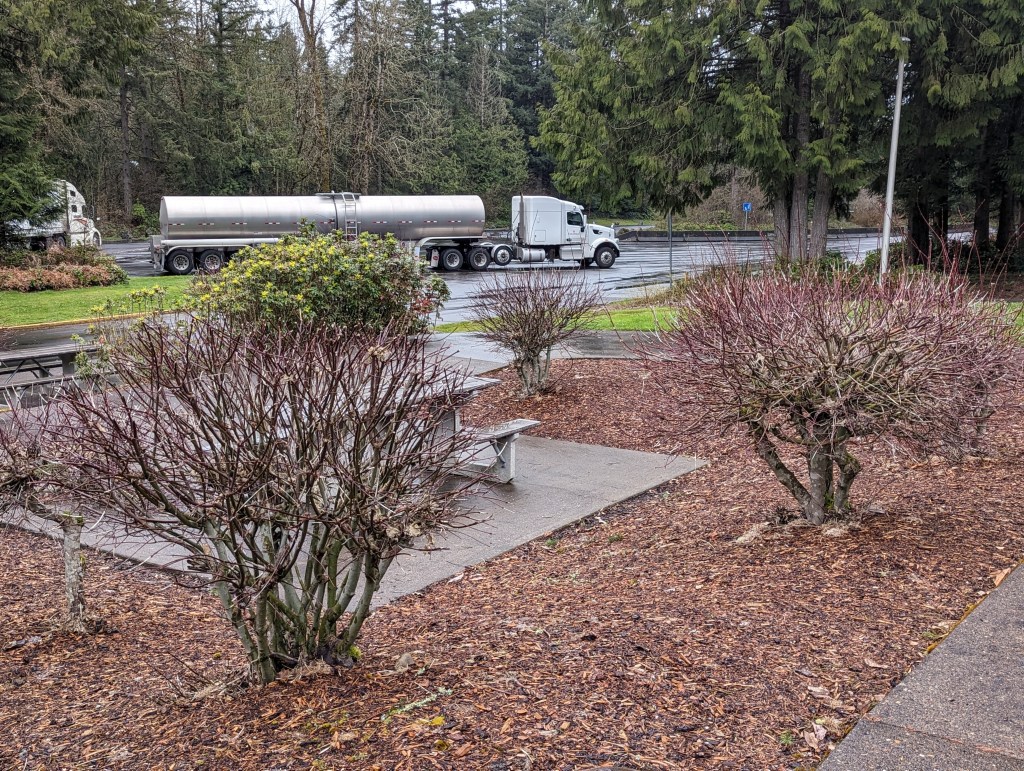
This is no simple hack job. Someone or a few someones put a great deal of effort into this very thorough hack job. This took significantly more effort than would have been needed to do it properly. Seriously, proper pruning would have been much easier, and much healthier to this victimized vegetation. In the future, this vegetation would have needed much less maintenance. Furthermore, this is more than visually unappealing. It is downright unsightly. Removal of such disfigured shrubbery would be an improvement, even without replacement. As the illustration below demonstrates, this is not merely a single specimen. It is an entire herd of brutally disfigured shrubs. How did someone determine that this was the right thing to do?!

This mangled shrubbery is vine maple, Acer circinatum, which is native to the Pacific Northwest where I got these pictures. I actually like this particular species because it can perform similarly to Japanese maple, but is not Japanese maple, which I am not at all keen on. Part of my dislike of Japanese maple is the result of working with so many that were ruined like these vine maples were. Vine maple is more tolerable to me because it is too rare here at home for me to encounter any that are ruined like these. This is a first for me. Perhaps that is why it was more difficult to ignore than the countless similarly ruined Japanese maples that I do not need to work with, but see around town.

I can not help but wonder what these vine maples would look like if they had developed somewhat natural form with only significant pruning for clearance above the adjacent pavement, perhaps with minor pruning to limit congestion within their canopies.. Would they resemble mature Japanese maples with extra trunks by now?

Hard Hat

This is a harsh reminder.

This is why arborists wear hard hats. It is more than eight feet tall. I do not know how much of it extends into the wet sand. Nor do I know how much it weighs. It might have fallen from about twenty-five feet up. I do not know how far the pole saw that it was plucked down with was extended. Even with a hard hat, this would have been potentially very dangerous. I am glad that it is now on the ground, or will be when it falls over.

Nature is naturally hazardous. We try to make some of it safer. We can not eliminate all hazards though. Some, like this one before it fell, are not obviously hazardous. Some are not visible from the ground. As frequently as some hazards are eliminated, others are developing. Trees are always growing and shedding limbs that get shaded out. Old trees are always dying and deteriorating. It never ends.

The alder that dropped this necrotic limb took quite a beating when the creek flooded last winter. Water was higher than this broken limb now stands. Massive trunks of trees that fell upstream floated through here, battering any tree trunks that they encountered, including the trunk of the tree that dropped this limb, which is now at the edge of the water at its current depth. Such pummelling should have dislodged such decayed limbs. Perhaps this limb was not so decayed last winter, and therefore more firmly attached.

The intention of the minor tree work that was done in this area was merely to neaten the scenery a bit. Hazards such as this were not a consideration, since the trees appeared to be reasonably safe, and because they are located on the bank of a creek where no one else goes.

Horridculture – Hackers

How could anyone believe that this was appropriate?!

Of the many different types of horticultural professionals, the two most professional and educated are nurserymen and arborists. The two least professional and downright idiotic are maintenance gardeners and arborists. That means that some of the most professional and some of the least professional of horticultural professionals are arborists.

I have been very fortunate to have worded for some of the most professional, most educated and best arborists. However, much of my work as a consulting horticulturist and arborists involved damage that was caused by some of the least professional, least educated and worst of so-called arborists. They ruin the trees that their clients pay them to maintain or repair. It is infuriating.

Someone put a great deal of effort into destroying this formerly healthy tree.

This tree was formerly a nearly exemplary specimen of big cone pine, Pinus coulteri. It was impressively healthy and exhibited no indication of instability. Its only obvious problem was that it developed so many trunks that it would eventually develop structural deficiency. That will not likely be a problem now, since it will not likely survive long enough for such deficiency to develop. Even if it remains healthy enough to grow significantly, it will become too structurally deficient as a result of this recent damage to survive for long.

I can not imagine how anyone, arborist or not, could believe that this was a proper pruning technique. Nor can I imagine how anyone could have put so much effort into so blatantly destroying this formerly healthy tree. Seriously, this involved a lot of work! Every trunk, every major limb, and many minor limbs were cut. Some cuts were made at lateral branches, but many were not. It is not possible for the tree to compartmentalize all of the resulting pruning wounds, which will remain exposed to the weather until the tree succumbs to the resulting decay.

Recovery from such severe damage is impossible.