Arboriculture Is Horticulture Of Trees

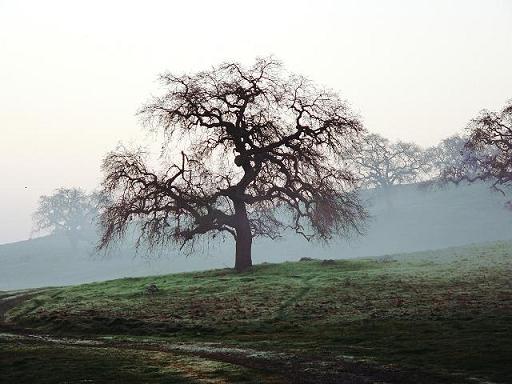
Many trees grow out of reach.

Recently wintry weather is a reminder that large trees require maintenance. Otherwise, some are likely to eventually drop limbs or blow over. Even some of the most stable and structurally sound trees benefit from maintenance. Otherwise, they can become shabby, overgrown or obtrusive. Such maintenance is what constitutes the basis of arboriculture.

Arboriculture is, most simply, the specialized horticulture of trees. Of course, it is not as simple as its definition. It is as complex as the diversity of the countless species of trees that it involves. In some gardens, particularly within rural regions, it may involve forestry. For small trees, such as citrus or Japanese maples, it may be comparable to gardening.

Garden enthusiasts are likely to maintain small trees within their gardens. Those who do not enjoy gardening may rely on maintenance gardeners to do so. Unfortunately though, very few maintenance gardeners are qualified for arboriculture. Many commonly damage or ruin trees by attempting to maintain them improperly. Arboriculture is very specialized!

Arborists are specialized horticulturists of trees who perform arboriculture. Most prefer to work with large trees that are beyond reach of garden enthusiasts. Many also work with small trees for those who do not enjoy gardening. Information about arborists is available at isa-arbor.com. This is the website of the International Society of Arboriculture, or ISA.

Garden enthusiasts who maintain their small trees may not be able to do so forever. Only a few of the smallest sorts of trees will never grow beyond their reach. Most trees that are manageable while young eventually mature. Taller types of palms grow too tall to groom within only a few years. It becomes more practical and much safer to rely on arborists.

Trees are the most substantial and permanent of vegetation within home gardens. They are not as temporary or disposable as annual bedding and vegetable plants. Some can survive for centuries. Within most municipalities nowadays, mature trees are protected by ordinance. Trees are commitments, which are certainly worthy of proper arboriculture.

A Good Arborist Can Be Difficult To Find.

Some of the most avid garden enthusiasts need help with big trees.

            It was probably best that I was not here when it happened. Although, coming home to it was horrible nonetheless. This is the second major tragedy in my garden in only a few months. Last autumn, just before it could defoliate to be less susceptible to the wind, the most magnificent black oak in my garden was blown down. Now I find that the weather has again flaunted its ominous power by claiming the innocent life of the most glorious Douglas fir, and desecrating the shattered remains in the cold mud.

            How can this be?! I am an arborist! I am supposed to protect trees from such demise! Sadly, the truth is that the fir has been deteriorating for a long time before we became acquainted. There was nothing that I could have done for it. If the tree had been located where it could have been hazardous to anyone in the area, it would have needed to be removed.

            Hazardous trees innately become much more hazardous in stormy weather. Rain loosens their anchorage by softening the soil. Wind can either destabilize trees, or break their limbs away. Ideally, it is best to give trees the attention they need before the weather gets unpleasant. Realistically though, we do not often think about it while the weather is not so threatening.

            Now that the weather is reminding us of how important it is to take care of our trees, we should be certain to do so properly. Large trees may require procedures that we are unable to perform. When it becomes necessary to procure the services of tree maintenance professionals, it is imperative to find qualified arborists. (Arborists are horticulturists of trees.)

            Unfortunately, the arboricultural (tree maintenance) industries are infested with unqualified ‘hackers’ who can inflict serious damage. Real arborists are about as specialized as physicians are. Getting anyone else to assess trees is about a sensible as getting a cardiologist to do brain surgery. 

            Arborists inspect trees to identify hazards such as instability and structural deficiency, and then prescribe corrective procedures. Not everyone involved with the crew that performs any necessary procedures is a ‘certified’ arborist. The crew should though be directed by what an arborist prescribes. Sometimes, trees are found to be too hazardous to be salvaged, and will need to be removed.

            The website of the International Society of Arboriculture (ISA) at www.isaarbor.com is an excellent resource for finding local certified arborists. This site also features articles that explain in more detail than I did why it is so important to ‘hire an arborist’, as well as many other relevant topics. Perhaps just as importantly, it demonstrates how serious arborists are about arboriculture.

Horridculture – Rainy Days and Mondays (deferred from Wednesday)

Deferred maintenance has consequences.

Karen Carpenter famously said, “Rainy days and Mondays always get me down.”

Several old and deteriorating box elders on the roadside outside the gate at work have survived many rainy days and many Mondays during the past many years that they have grown there. Earlier this week though, a rainy Monday brought one down.

It was no surprise. All of the several box elders there are in very bad condition. Most are completely dead and collapsing. However, I can do nothing about them because they extend over the roadway. They must be removed by a County Crew who can remove them safely. Unfortunately, they are unable to do so in a timely manner while so much similar work is needed throughout the County.

The problem with the demise of this particular tree is that it fell onto the hood of a Ford F150 that was travelling toward town. The Ford swerved and collided with a Subaru station wagon of some sort that swerved off the other side of the road, where it seemed to stop just inches from a utility pole. The tree or portion of the tree that fell was not very big, but indirectly caused extensive damage to both vehicles, and necessitated lane closures while the vehicles were removed.

In the picture, which was taken as I opened the gate for the crew, the Subaru is still visible on the opposite side of the road, at the center of the picture. The Ford has already been removed to the side of another road that extends to the right in the distance, beyond the bridge, where the traffic signals are. The taillights belong to one of the responding Sheriff’s cars. Most of the debris from the fallen box elder has already been pushed into the ditch to the right.

Wintry Weather Can Damage Trees

(This posted in 2011.)

Wind brings out the worst in trees.

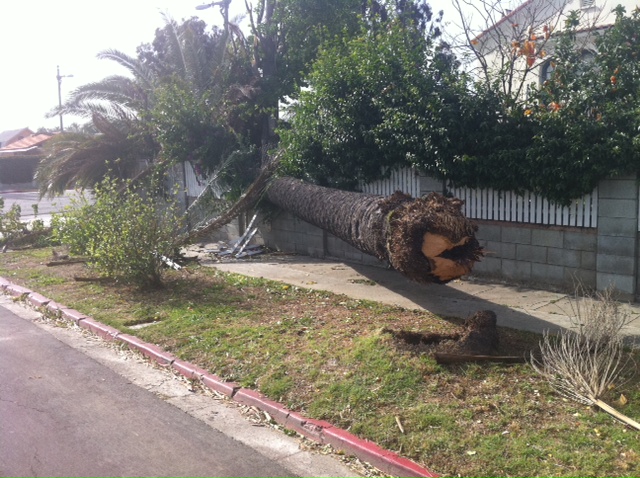
Pasadena sustained the worst of the damage caused by the strongest Santa Ana Winds in three decades. Huge piles of debris from broken trees are much more than can be removed any time soon. Falling debris and trees damaged many roofs, cars and anything else that happened to get in the way.

Other towns and neighborhoods throughout the area, particularly those at the base of mountains, also sustained major damage. At the same time, severe winds ravaged the San Francisco and Monterey Bay Areas as well, particularly in the Santa Cruz Mountains and the hills of the East Bay.

Some of the damage caused by wind in urban areas might have been less disastrous if trees had gotten the respect and attention that they deserve. Some trees develop structural deficiencies that need to be corrected by pruning, either to eliminate the problems, or at least to decrease the strain exerted onto the structurally deficient parts. A few trees that become unstable as they mature may likewise need to be pruned or even removed.

It is not always possible to prune trees to remove all structural deficiencies without damaging the affected trees more, or causing more structural problems to develop. For example, major pruning to remove all parts that may get blown down by wind, such as pollarding or ‘topping’, may seem to be effective for the short term, but actually stimulates the development of vigorous secondary growth or watersprouts that are disproportionately heavy and even more likely to tear off from the older limbs.

Structural pruning more often involves thorough reduction of weight and wind resistance. Weight of foliage and stems directly applies leverage against unions where smaller stems are attached to the larger stems from which they originate. Wind resistance adds more leverage as foliage gets blown about by wind. Thinning obviously removes significant weight, and also decreases wind resistance to allow wind to blow though the affected canopies.

Besides helping to compensate for structural deficiency, structural pruning is also beneficial to potentially unstable trees for the same reasons. However, unstable trees typically need even more reduction of weight and wind resistance. Some of the most unstable trees and those that are deteriorating need to be removed because their instability cannot be accommodated.

During winter, while deciduous trees are bare, evergreen trees are more susceptible to wind damage, obviously because they retain their weight and wind resistance through winter while the weather is the most severe. Unstable trees become even more destabilized as rain softens the soil. Regardless of the potential for susceptibility to wind damage, this would be a good time of year to get any needed tree maintenance done, prior to any more windy and rainy winter weather.

Arborists certified by the International Society of Arboriculture are the most qualified to identify potential structural problems or instability, and to prescribe corrective procedures. A list of certified arborists can be found at the website of the International Society of Arboriculture at http://www.isaarbor.com.

V8

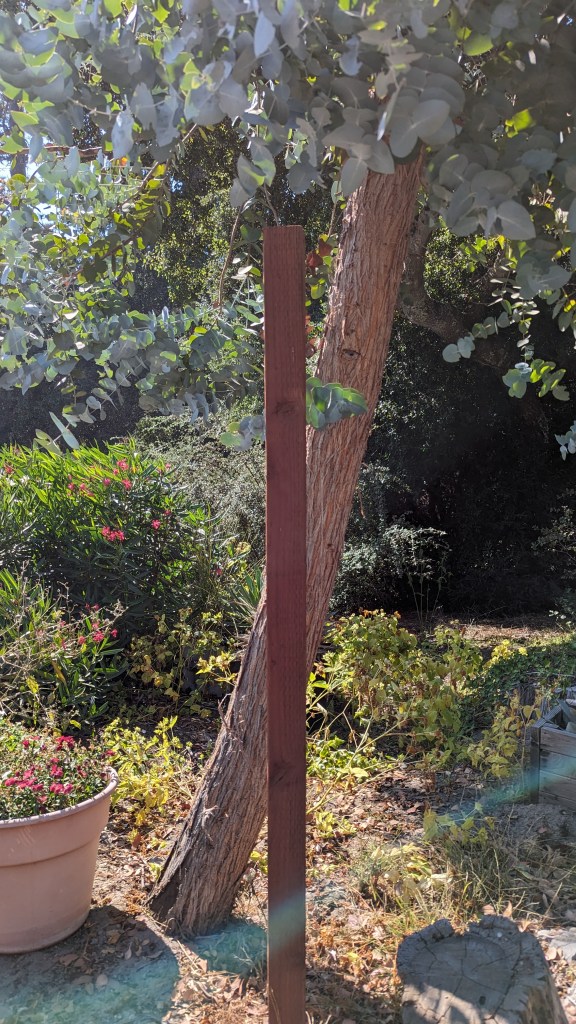
The vertical post demonstrates how much the tree trunk leans.

A few tree species should’ve had a V8. That includes more than a few individual trees. It applies to enough individuals of a species to indicate that the need is almost typical of the particular species.

The need for a V8 is derived from old advertisements for the V8 beverage that depicted those who were deficient in adequate consumption of V8 as leaning prominently. V8 is a juice beverage that is composed of juices of eight vegetables; tomatoes, carrots, celery, beets, parsley, lettuce, watercress and spinach. Hence, V8. It balances a diet so that those who consume it stand upright rather than lean.

In horticultural slang, the need for a V8 refers to a leaning trunk.

Any tree of any species has potential to develop a leaning trunk, and consequently appear to be in need of a V8. Some species innately develop leaning trunks though. No one seems to know why, but specimens of such species with vertical trunks are oddly uncommon or perhaps rare.

For example, so many ginkgo trees lean at such similar angles that, among some groups, their distinctive lean seems to be a normal characteristic of the species. It is variable though. Many individual trees that are isolated from others are quite vertical. So are some groups of street trees. However, many or most specimens of other groups of street trees lean at very similar angles, although in random directions.

Italian stone pines are more likely to lean, also at relatively similar angles, and also in random directions. Locally, vertical trunks are rare among this species. However, within their native range, vertical trunks are typical.

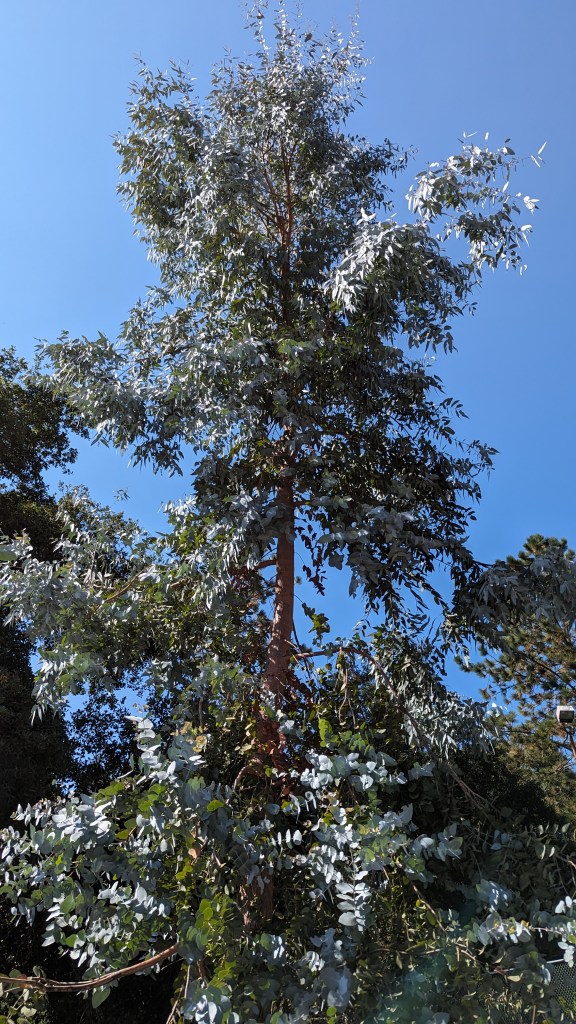
Argyle apple (eucalyptus) is almost comparable to Italian stone pine in regard to its typical need for a v8. I have seen a few with vertical trunks. I was determined for ours to be among them. I bound the trunk to keep it straight as it grew. I installed it with the trunk as vertical as the sign post next to it. When wind caused it to lean slightly while it was smaller than it is now, I pushed it back into position. Actually, I might have done that a few time. However, as it matured, it became more difficult to push back into position. Eventually, it refused to budge from its leaning position. Now, like most of the species, this specimen also seems to be in need of a V8.

After the base of the trunk insisted on leaning, the upper portion of the trunk assumed vertical posture.

Horridculture – Deadhead (from last Wednesday)

At least the new growth is healthy.

Property management pays landscape service companies to maintain their landscapes for them. It is expensive. It is certainly fiscally adequate to justify the expectation that this sort of damage would not occur within the landscapes that property management pays landscape service companies to maintain. Now that it did occur, it should be remedied as efficiently as possible by the landscape service company that is justifiably expected to both prevent such damage, and remedy such damage if it occurs. This should not be a complicated concept.

Realistically, this is likely not as egregious as it seems to be. Automated irrigation was likely disabled through the rainy season last winter. It might have been enabled a bit too late into the dry season that began last spring. Hey, it happens. The upper stems of the subject succumbed to desiccation, likely as a result of warm and arid weather. Now that the automated irrigation has been restored, the subject is now attempting to recover from the damage by generating healthy and vigorous new growth relatively low within its canopy. Upper necrosis might remain only because the gardeners are prohibited by their insurance to perform any tasks above a particular height, even with a pole pruner instead of a ladder, and the necrosis is simply too high for them to engage. That task must instead, and perhaps more appropriately, be performed by an arborist. However, the arborist who typically maintains the trees at this particular property would need to charge an expensive minimal fee for this relatively minimal task. It would be more feasible to postpone the task until there is a need for more substantial arboricultural work. The arborist could remove necrosis from this subject within a few minutes, and without charging extra, while at the site to maintain many other larger trees.

Tree Stumps May Put Up A Fight

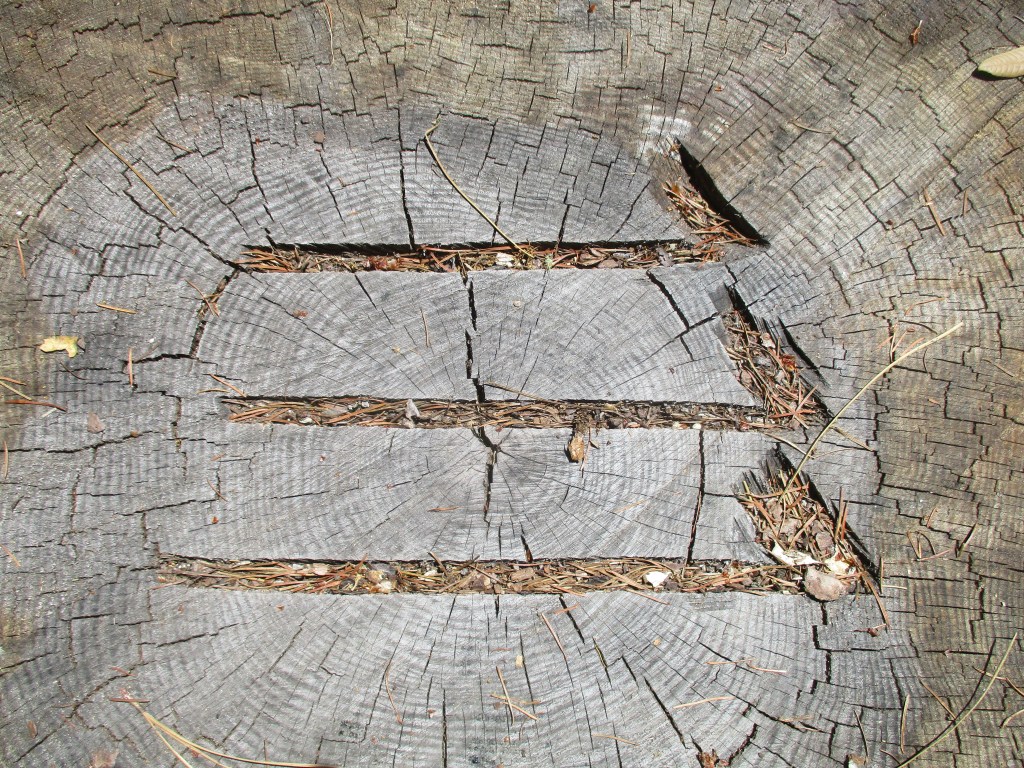
Some stumps die immediately. Some do not.

Trees of all sorts are among the most important features of most gardens, and are also the most substantial. Yet, in the end, whether they get too big, too crowded, too hazardous or simply succumb to old age, they eventually need to be removed.

Getting rid of the brush (foliage and smaller limbs) of smaller trees is generally not much of a problem, especially where greenwaste can be left at the curb for recycling. Larger limbs and trunks can be cut and split into firewood. The brush and wood of trees that are so large that they need to be removed by professionals typically gets taken away be the same professionals. The most difficult parts to remove though, are the stumps.

Professional tree services typically offer the option of stump grinding. This works well for the most obtrusive stumps that are accessible. Other stumps get left either because they are inaccessible, or because of the expense of grinding.

Stumps that are within ground cover or shrubbery often get obscured by the surrounding vegetation, and are never seen again. Others are not so easy to hide. Many refuse to die for several years, and may even try to grow back as new trees.

Coastal redwoods (but not giant redwoods), poplars, willows, privets, sycamores and camphors are notoriously difficult to kill. Their stumps can continue to sprout for years. Shoots that emerge away from the stump can certainly be left to grow into new trees if they happen to be where they will not soon become problematic. (Shoots that emerge directly from cut stumps will likely lack structural integrity.)

To kill stubborn stumps, shoots must be removed as they appear. Eventually, the stumps and roots below the ground exhaust all resources and die. Of course this sounds simple, but may take years to kill redwood stumps. Leaving shoots to grow prolongs the process by allowing replenishment of resources. A stump from a camphor tree that I cut down in about 1988 but did not regularly remove the shoots from lingered for about twenty years before finally succumbing in about 2008!

Once stumps die, they rot faster if buried or at least covered with other plant material. Less stubborn stumps that are not likely to sprout again, like those of pines, cypresses, cedars, birches and (solitary trunked) palms, can be buried or concealed immediately. Stumps that are not cut low to the ground are not so easy to conceal, but should still rot faster if covered with ivy. I prefer to plant either freshly divided lily-of-the-Nile shoots or geranium cuttings around the bases of stumps, because they obscure the stumps and also promote rot as they get watered and disperse roots into the decaying wood. They can be removed, if desired, as the stumps deteriorate.

Horridculture – Post Office

Posted!

The Post Office in town is where I go to post or collect mail. For the past few years, this small coast live oak has been getting so low that I must duck under it to get onto the sidewalk from the parking spaces, or even to get past it on the sidewalk. It is particularly annoying because it is in such a prominent location where many other people park and enter the Post Office. I have sometimes considered bringing my pole saw and other pruning tools to prune it for clearance, but because I have not driven the pickup into town for a very long time, and do not intend to do so anytime soon, I would have no means with which to dispose of the debris.

Well, someone else pruned it. Well, sort of pruned it. Well, let us just say that I no longer need to duck under it. What a hot mess of stubs, or should I say, ‘posts’. This is after all, the Post Office. How could anyone think that this was acceptable?! How difficult would it have been to cut these lower limbs properly, without leaving these horrid posts?! Even someone who is not at all concerned about the tree or proper arboriculture can see how hideous this is. Seriously, this goes beyond negligence. Someone put considerable effort into doing this so extremely improperly!

I brought my pole saw the following week to remove these posts without doing any more pruning. I figured that without all the foliage, I could fit them into the trunk of the Roadmaster. However, by the time I go there, someone, likely from the Department of Public Works, had already repaired the damage. The tree could be pruned a bit more, but at least it is not so mutilated.

Arborists Are Horticulturists Of Trees

Arborists work with the big trees.

Landscapers and gardeners are only the two most familiar of horticultural professionals. There are also landscape designers, horticulturists, greenskeepers and various nurserymen, just to name a few. Each of the many distinct horticultural professionals works within a specific horticultural industry; like each of the many different types of physicians works within a specific medical industry, even though many might work together in the same hospital.

Arborists are the horticultural professionals, or even horticultural ‘physicians’, who work specifically with trees. In fact, they had historically been known as ‘tree surgeons’  because they perform what might be considered to be surgery on trees. After nurserymen grow trees in nurseries, and landscapers install trees in landscapes, arborists take over to care for the same trees like gardeners take care of landscapes below the trees.

Arboriculture, or the horticulture of trees practiced by arborists, is important because trees are so different from other plants in the landscape. Obviously, trees are larger than anything else. Structural problems or instability can have devastating consequences, not only to the affected trees, but also to anything around them that might be damaged by falling limbs or even entire trees. Some trees are large enough, or even have limbs that are large enough to crush an entire home.

Arborists who are certified by the International Society of Arboriculture, or ISA, have passed an examination of their arboricultural expertise, and maintain their certification by attendance to educational seminars, workshops and other relevant ISA approved events. Certified arborists are the most qualified to assess the health, stability and structural integrity of trees, and prescribe any necessary arboricultural procedures. Such matters should not be trusted to other horticultural professionals who specialize in other aspects of horticulture.

The website of the ISA at www.isaarbor.com is the best resource for finding certified arborists and the tree service businesses that they are affiliated with. Arborists can be found within particular regions by city or ZIP code, or directly by name. The website also features all sorts of information about trees that is useful to anyone who lives with them or wants to add more to the landscape.

Of course, there is more to gardening than trees. For those who missed reading about it already, it is nearly time for the most locally grown of horticultural events. Spring in Guadalupe Gardens will be April 28, from 10:00 a.m. to 3:30 p.m., in the Guadalupe River Park and Gardens between Taylor Street and Coleman Avenue in San Jose. More information can be found online at www.grpg.org or by telephoning 298 7657.

Utility Clearance Can Disfigure Trees

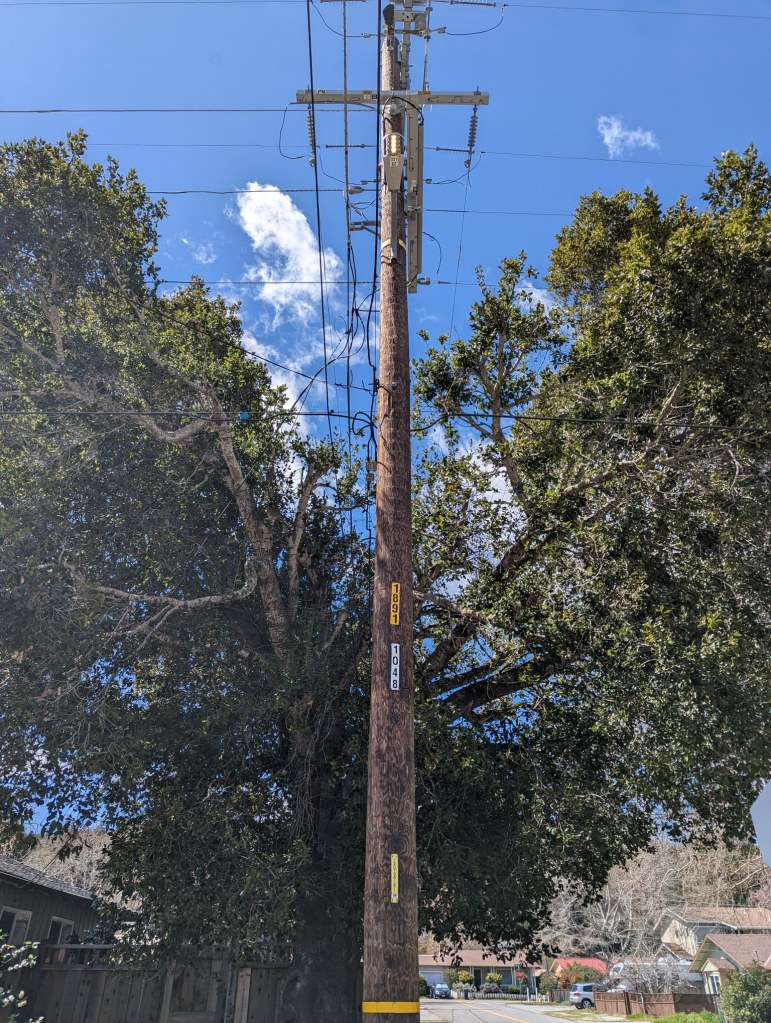
Utility cables need clearance from trees.

Last winter was a doozy! It involved historic frost, snow, rain, wind, floods and mudslides. A few roads remain closed in some regions. Major electrical outages were too numerous for prompt repair. Weather alone did not cause such outages though. It merely dislodged vegetation that did so. This demonstrates the necessity for utility clearance maintenance.

Utility pruning is a specialized but very often unpleasant sort of arboriculture. It maintains necessary clearance between vegetation and utility cables. Its unpleasantry derives from its harsh efficiency. Clearance is the priority. Proper arboricultural technique is not. There is no compromise. Trees that encroach too closely to cables are likely to regret doing so.

Proper arboricultural procedures are too expensive to justify for utility clearance pruning. Otherwise, electricity and other utilities that utilize cable would be much more expensive. Besides, for many trees within utility easements, proper arboriculture is impossible. They can not accommodate necessary pruning without disfigurement. Several can not survive such disfigurement.

Palms, for example, can not survive without their single terminal buds. They lack limbs to divert growth to. Removal of a terminal bud that encroaches too closely to utility cables is lethal. Palms generally grow only upward. Those that grow tall rapidly can not live below utility cables for long. Very few palms remain low enough to maintain minimal clearance.

Excurrent trees are generally more vulnerable to disfigurement than decurrent trees. The single central trunks of excurrent redwoods and spruces do not adapt to redirection. The several main limbs of decurrent oaks and elms are more cooperative. Compact trees that are unlikely to reach cables are least problematic. Of course, many trees are unplanned.

Arborists can repair some minor clearance pruning damage or disfigurement. They might prevent some damage by timely pruning for containment. Unfortunately, some damage is neither repairable nor preventable. Also, such procedures are too dangerous for anyone who lacks qualification for them. Typical garden enthusiasts must avoid electrical cables!