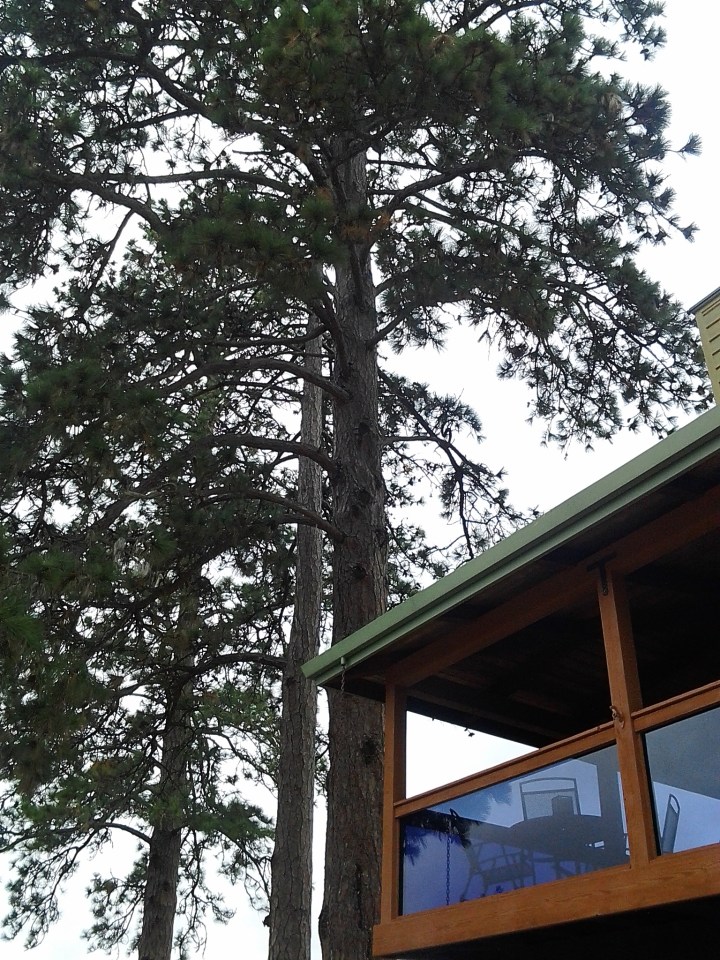
Mature Trees Need Professional Help

50902thumb
Arboriculture is specialized horticulture of trees.

Arborists are horticulturists who are specialized with the horticulture of trees, which is known as arboriculture. In urban gardening, they are not as familiar as gardeners who mow lawns and tend to the annuals, perennials and shrubbery that are close to the ground; but they should be. The trees that arborists maintain are the most significant features in most landscapes.

Bad annuals or poorly tended lawns can get unsightly, but are not too hazardous. However, a tree can be extremely hazardous if it becomes unstable or develops structural deficiency. Falling trees or limbs are very dangerous, and can cause all sorts of damage to anything within reach. Arboriculture is therefore the most important horticulture in home gardens with trees.

Sadly, many trees are severely damaged by improper pruning, which is often performed by those hired to prune them. Some get pruned too severely, or get pruned in the wrong season. Others do not get pruned aggressively enough. Either way, many get structurally compromised so that they drop limbs as they mature. Some trees get damaged too severely to salvage.

This is precisely why arboriculture should be done by qualified arborists. Unfortunately, finding such an arborist may not be as easy as it would seem to be. The industry is notoriously overrun with ‘hackers’, who are unfamiliar (and often unconcerned) with what trees need, and how trees respond to improper pruning.

The International Society of Arboriculture, or ISA, certifies arborists who pass an exam of arboricultural expertise. ISA certified arborists maintain their certification with regular involvement with the ISA, which involves arboricutural seminars and classes, as well as networking with other professional arborists. Certified arborists can be found at the website of the ISA at isa-arbor.com.
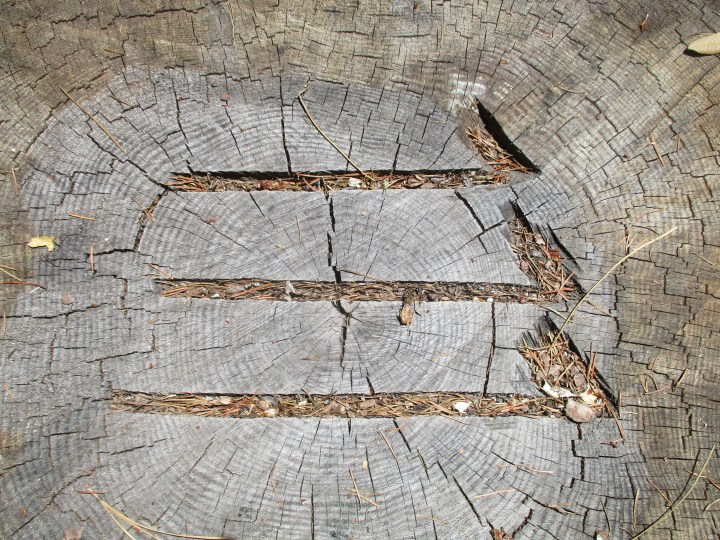
Hieroglyphs

P00606K
“111”? . . . “777”? . . . “TTT”? . . . “LLL”?

What does this mean? Is it ‘111’ deprived of the lower serifs? Is it ‘777’ with abbreviated arms? . . . ‘TTT’ lacking right arms? . . . ‘LLL’ with abbreviated legs? Is it pointing toward something important? Is a hieroglyph from an ancient language . . . or a language that has yet to be invented?! Is it like a miniature crop circle pattern cut into wood by Sasquatch or extraterrestrials?!

The arborist who left it here after cutting down the deceased ponderosa pine that formerly stood where this large stump remains might be amused to read that I contemplated it so intently. Actually, I did not really contemplate it so much. I only wrote about it as if I did because it is amusing to do so. I have no idea what this hieroglyph represents. I know that it is not important.

I have worked with enough respectable arborists to know that some of them prefer to leave their distinctive marks on the stumps of some of the impressively large trees that they cut down. In many of the suburban regions in which I work, most of such stumps get ground out shortly afterward. In the forested rural area here, such stumps remain until they rot and disintegrate.

On rare occasion, I encounter a familiar hieroglyph or the initials of a respected colleague. Now that we are as old as we are, familiar hieroglyphs are increasingly rare. Arboriculture is for the young. I sometime wonder about those who leave unfamiliar hieroglyphs. To me, the continuation of the tradition seems to indicate that they enjoy their work as much as my colleagues did.

That is important in horticultural industries. There are few in society who understand the appeal. We do what we do because it is what we enjoy.

Arborists Specialize In Tree Horticulture

0

Why is it so difficult to believe that there are so many different kinds of horticultural professionals? No one is ever surprised that surgeons, cardiologists, dermatologists, ophthalmologists and pulmonologists are all physicians. Yet, those who do not know better consider all horticultural professionals to be ‘gardeners’. This is actually more insulting to real professionals than outsiders can imagine, because the gardening industry is more dominated by non-professionals than any other horticultural industry.

Nurserymen, landscapers and florists are also horticultural professionals. Each of these basic categories can be divided into more specialized professions. For example, production nurserymen grow nursery stock or other horticultural commodities, while retail nurserymen maintain plant material only long enough to sell it. Maintenance gardeners are probably the most familiar of horticultural professionals because so many of us use their services around our home gardens.

Arborists are the horticulturists who specialize in trees, and really should be more familiar than they are. The only landscapes that have no possible use for their services are those that are devoid of trees. Even the most proficient of maintenance gardeners should not be expected to maintain large trees or diagnose potential arboricultural problems, not only because arboriculture is so specialized, but also because maintenance gardeners have their own specialties to be concerned with.

Because trees are the most substantial features of a landscape, and they have the potential to cause proportionate problems if not maintained properly, it is very important to have them maintained by qualified arborists. Those who are certified by the International Society of Arboriculture, or ISA, have passed an exam of their expertise, and maintain their certification with regular involvement with the ISA. Such involvement includes attendance to arboricultural seminars and classes.

It is ironic that some of the least familiar of horticultural professionals need to stay so dedicated to the maintenance of their credentials. Certified arborists can be found at the website of the ISA at isa-arbor.com.