Hard Hat

This is a harsh reminder.

This is why arborists wear hard hats. It is more than eight feet tall. I do not know how much of it extends into the wet sand. Nor do I know how much it weighs. It might have fallen from about twenty-five feet up. I do not know how far the pole saw that it was plucked down with was extended. Even with a hard hat, this would have been potentially very dangerous. I am glad that it is now on the ground, or will be when it falls over.

Nature is naturally hazardous. We try to make some of it safer. We can not eliminate all hazards though. Some, like this one before it fell, are not obviously hazardous. Some are not visible from the ground. As frequently as some hazards are eliminated, others are developing. Trees are always growing and shedding limbs that get shaded out. Old trees are always dying and deteriorating. It never ends.

The alder that dropped this necrotic limb took quite a beating when the creek flooded last winter. Water was higher than this broken limb now stands. Massive trunks of trees that fell upstream floated through here, battering any tree trunks that they encountered, including the trunk of the tree that dropped this limb, which is now at the edge of the water at its current depth. Such pummelling should have dislodged such decayed limbs. Perhaps this limb was not so decayed last winter, and therefore more firmly attached.

The intention of the minor tree work that was done in this area was merely to neaten the scenery a bit. Hazards such as this were not a consideration, since the trees appeared to be reasonably safe, and because they are located on the bank of a creek where no one else goes.

Horridculture – Hackers

How could anyone believe that this was appropriate?!

Of the many different types of horticultural professionals, the two most professional and educated are nurserymen and arborists. The two least professional and downright idiotic are maintenance gardeners and arborists. That means that some of the most professional and some of the least professional of horticultural professionals are arborists.

I have been very fortunate to have worded for some of the most professional, most educated and best arborists. However, much of my work as a consulting horticulturist and arborists involved damage that was caused by some of the least professional, least educated and worst of so-called arborists. They ruin the trees that their clients pay them to maintain or repair. It is infuriating.

Someone put a great deal of effort into destroying this formerly healthy tree.

This tree was formerly a nearly exemplary specimen of big cone pine, Pinus coulteri. It was impressively healthy and exhibited no indication of instability. Its only obvious problem was that it developed so many trunks that it would eventually develop structural deficiency. That will not likely be a problem now, since it will not likely survive long enough for such deficiency to develop. Even if it remains healthy enough to grow significantly, it will become too structurally deficient as a result of this recent damage to survive for long.

I can not imagine how anyone, arborist or not, could believe that this was a proper pruning technique. Nor can I imagine how anyone could have put so much effort into so blatantly destroying this formerly healthy tree. Seriously, this involved a lot of work! Every trunk, every major limb, and many minor limbs were cut. Some cuts were made at lateral branches, but many were not. It is not possible for the tree to compartmentalize all of the resulting pruning wounds, which will remain exposed to the weather until the tree succumbs to the resulting decay.

Recovery from such severe damage is impossible.

Arboriculture Is Horticulture Of Trees

Many trees grow out of reach.

Recently wintry weather is a reminder that large trees require maintenance. Otherwise, some are likely to eventually drop limbs or blow over. Even some of the most stable and structurally sound trees benefit from maintenance. Otherwise, they can become shabby, overgrown or obtrusive. Such maintenance is what constitutes the basis of arboriculture.

Arboriculture is, most simply, the specialized horticulture of trees. Of course, it is not as simple as its definition. It is as complex as the diversity of the countless species of trees that it involves. In some gardens, particularly within rural regions, it may involve forestry. For small trees, such as citrus or Japanese maples, it may be comparable to gardening.

Garden enthusiasts are likely to maintain small trees within their gardens. Those who do not enjoy gardening may rely on maintenance gardeners to do so. Unfortunately though, very few maintenance gardeners are qualified for arboriculture. Many commonly damage or ruin trees by attempting to maintain them improperly. Arboriculture is very specialized!

Arborists are specialized horticulturists of trees who perform arboriculture. Most prefer to work with large trees that are beyond reach of garden enthusiasts. Many also work with small trees for those who do not enjoy gardening. Information about arborists is available at isa-arbor.com. This is the website of the International Society of Arboriculture, or ISA.

Garden enthusiasts who maintain their small trees may not be able to do so forever. Only a few of the smallest sorts of trees will never grow beyond their reach. Most trees that are manageable while young eventually mature. Taller types of palms grow too tall to groom within only a few years. It becomes more practical and much safer to rely on arborists.

Trees are the most substantial and permanent of vegetation within home gardens. They are not as temporary or disposable as annual bedding and vegetable plants. Some can survive for centuries. Within most municipalities nowadays, mature trees are protected by ordinance. Trees are commitments, which are certainly worthy of proper arboriculture.

A Good Arborist Can Be Difficult To Find.

Some of the most avid garden enthusiasts need help with big trees.

            It was probably best that I was not here when it happened. Although, coming home to it was horrible nonetheless. This is the second major tragedy in my garden in only a few months. Last autumn, just before it could defoliate to be less susceptible to the wind, the most magnificent black oak in my garden was blown down. Now I find that the weather has again flaunted its ominous power by claiming the innocent life of the most glorious Douglas fir, and desecrating the shattered remains in the cold mud.

            How can this be?! I am an arborist! I am supposed to protect trees from such demise! Sadly, the truth is that the fir has been deteriorating for a long time before we became acquainted. There was nothing that I could have done for it. If the tree had been located where it could have been hazardous to anyone in the area, it would have needed to be removed.

            Hazardous trees innately become much more hazardous in stormy weather. Rain loosens their anchorage by softening the soil. Wind can either destabilize trees, or break their limbs away. Ideally, it is best to give trees the attention they need before the weather gets unpleasant. Realistically though, we do not often think about it while the weather is not so threatening.

            Now that the weather is reminding us of how important it is to take care of our trees, we should be certain to do so properly. Large trees may require procedures that we are unable to perform. When it becomes necessary to procure the services of tree maintenance professionals, it is imperative to find qualified arborists. (Arborists are horticulturists of trees.)

            Unfortunately, the arboricultural (tree maintenance) industries are infested with unqualified ‘hackers’ who can inflict serious damage. Real arborists are about as specialized as physicians are. Getting anyone else to assess trees is about a sensible as getting a cardiologist to do brain surgery. 

            Arborists inspect trees to identify hazards such as instability and structural deficiency, and then prescribe corrective procedures. Not everyone involved with the crew that performs any necessary procedures is a ‘certified’ arborist. The crew should though be directed by what an arborist prescribes. Sometimes, trees are found to be too hazardous to be salvaged, and will need to be removed.

            The website of the International Society of Arboriculture (ISA) at www.isaarbor.com is an excellent resource for finding local certified arborists. This site also features articles that explain in more detail than I did why it is so important to ‘hire an arborist’, as well as many other relevant topics. Perhaps just as importantly, it demonstrates how serious arborists are about arboriculture.

Do Not Try This At Home

Before and After pollarding

Pollarding and coppicing are very unfortunately vilified here. I just wrote an article about these topics for the gardening column. Arborists are taught that they are comparable to topping, and that they cause irreparable disfigurement.

It is unfortunate because both procedures have very practical application. Both are still commonly practiced in other regions. If performed properly, both are quite sustainable, and can actually maintain some specimens of a few species longer than they typically live naturally. I use both techniques to a minor degree at work, and will likely do more of both within my home garden.

However, I almost never recommend either technique. Because they are so vilified, arborists do not learn about them. Consequently, it is nearly impossible to find an arborist who can perform either technique properly. Trees and shrubbery can very easily be ruined by either technique if performed improperly.

In fact, I am hesitant to allow reliance on pollarding and coppicing by trees and shrubbery at work because I am concerned that no one else will want to repeat the processes after my retirement or resignation, which could be at any time. Coppicing carpet roses should be no problem for whomever performs it in the future, but I can not be certain. Pollarding is a bit more specialized, so concerns me more.

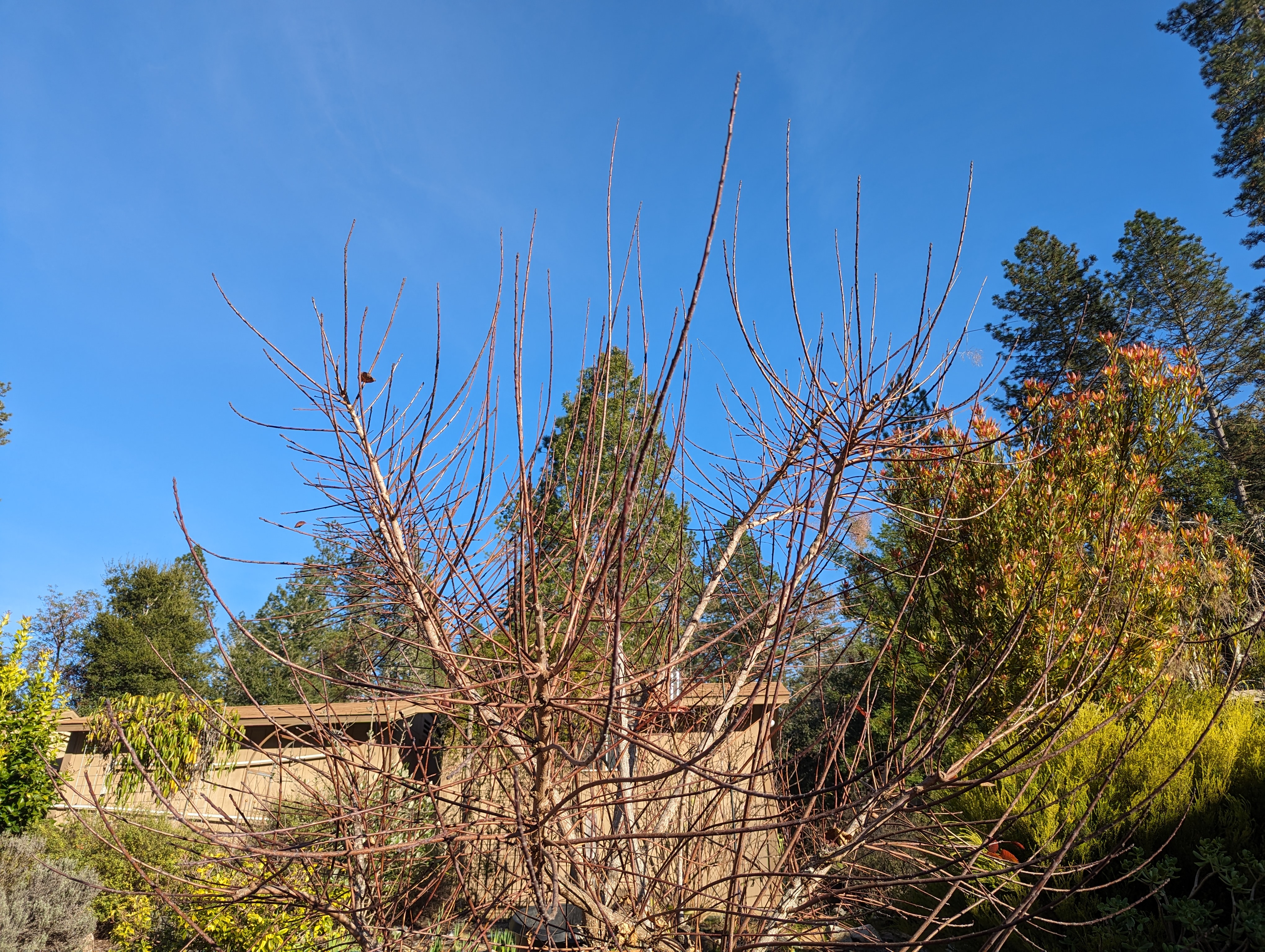
This smoke tree was initially pollarded for renovation. It was previously distressed and weak, but is now quite vigorous. Its purple foliar color is more vibrant through summer. So is its autumn foliar color. I previously believed that it bloomed only on year old stems, so would be unable to bloom on exclusively new canes after being pollarded. Instead, it blooms better on vigorous new stems that it on distressed year old stems.

It is not forming knuckles though. New stems emerge from all over the permanent stems, so leave pruning wounds that do not compartmentalize as efficiently as they would on knuckles. Also, without terminal knuckles, some permanent stems die back an inch or two annually. Although pollarding successfully renovated this smoke tree, it is not as sustainable as I would like it to be.

So, because the procedure is not sustainable for this particular specimen for very long, and I suspect that no one will want to repeat the process annually in the future, I will likely encourage more natural form. I left a few extra new canes for this year. For next year, the twiggy interior growth may be thinned, while upper and outer growth is allowed to develop into a more permanent canopy.

Wintry Weather Can Damage Trees

(This posted in 2011.)

Wind brings out the worst in trees.

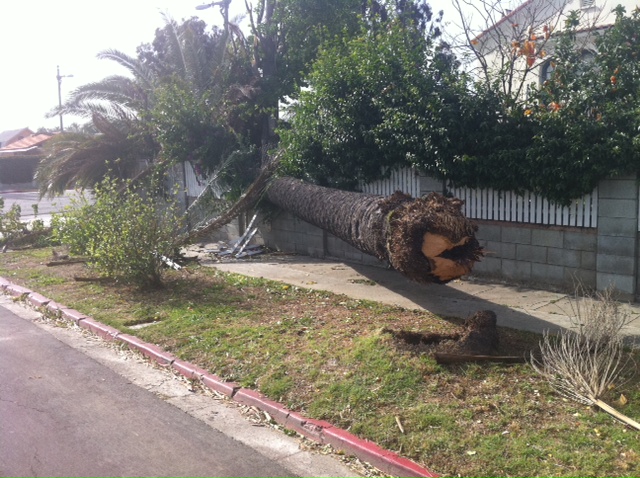
Pasadena sustained the worst of the damage caused by the strongest Santa Ana Winds in three decades. Huge piles of debris from broken trees are much more than can be removed any time soon. Falling debris and trees damaged many roofs, cars and anything else that happened to get in the way.

Other towns and neighborhoods throughout the area, particularly those at the base of mountains, also sustained major damage. At the same time, severe winds ravaged the San Francisco and Monterey Bay Areas as well, particularly in the Santa Cruz Mountains and the hills of the East Bay.

Some of the damage caused by wind in urban areas might have been less disastrous if trees had gotten the respect and attention that they deserve. Some trees develop structural deficiencies that need to be corrected by pruning, either to eliminate the problems, or at least to decrease the strain exerted onto the structurally deficient parts. A few trees that become unstable as they mature may likewise need to be pruned or even removed.

It is not always possible to prune trees to remove all structural deficiencies without damaging the affected trees more, or causing more structural problems to develop. For example, major pruning to remove all parts that may get blown down by wind, such as pollarding or ‘topping’, may seem to be effective for the short term, but actually stimulates the development of vigorous secondary growth or watersprouts that are disproportionately heavy and even more likely to tear off from the older limbs.

Structural pruning more often involves thorough reduction of weight and wind resistance. Weight of foliage and stems directly applies leverage against unions where smaller stems are attached to the larger stems from which they originate. Wind resistance adds more leverage as foliage gets blown about by wind. Thinning obviously removes significant weight, and also decreases wind resistance to allow wind to blow though the affected canopies.

Besides helping to compensate for structural deficiency, structural pruning is also beneficial to potentially unstable trees for the same reasons. However, unstable trees typically need even more reduction of weight and wind resistance. Some of the most unstable trees and those that are deteriorating need to be removed because their instability cannot be accommodated.

During winter, while deciduous trees are bare, evergreen trees are more susceptible to wind damage, obviously because they retain their weight and wind resistance through winter while the weather is the most severe. Unstable trees become even more destabilized as rain softens the soil. Regardless of the potential for susceptibility to wind damage, this would be a good time of year to get any needed tree maintenance done, prior to any more windy and rainy winter weather.

Arborists certified by the International Society of Arboriculture are the most qualified to identify potential structural problems or instability, and to prescribe corrective procedures. A list of certified arborists can be found at the website of the International Society of Arboriculture at http://www.isaarbor.com.

Horridculture – Sniveling

My colleagues are as totally excellent as my career is!

Horridculture is a collection of rants about horrid horticulture. Almost all of such rants are from my own experience and observation within the various horticultural industries. There are more than I can write about. I have been involved with so much more than just production of horticultural commodities on the farm. Horridculture is a bunch of sniveling about the worst of it.

Perhaps I should occasionally say a bit more about the best of it. If I thought it would be more interesting, I could write much more about the best than the worst. Except for the few experiences that I so frequently snivel about, my career has been awesomely RAD!

Therefore, for this week, I will briefly deviate from the typical Horridculture theme.

While we were in school, the professor who taught ‘Orientation to Horticulture’ told us, “If you want to make a lot of money in your career, change your major NOW!”. Of course, we did not. Brent and I both were naturally horticulturists, even if we were not good students. We studied exactly what we wanted to study. We made our careers of what we do naturally. Brent became one of the most renowned landscape designers of the Los Angeles region. I became a nurseryman.

Not only did I work for two legendary nurserymen within my primary career, but I also worked for at least four legendary arborists. I worked with the production of both citrus and rhododendrons with their companion crops. My gardening column was not planned, but has continued for a quarter of a century. Although not as well distributed locally as it had been, it is presently shared with a few publications between San Francisco and Beverly Hills in the Los Angeles region. These few publications sometimes share it with a few others elsewhere.

So, besides all the sniveling, I have been very pleased with my career. The worst of it may not have been as difficult as retirement might be. Fortunately, I do not necessarily need to retire completely, although I should quit sniveling.

Horridculture – Deadhead (from last Wednesday)

At least the new growth is healthy.

Property management pays landscape service companies to maintain their landscapes for them. It is expensive. It is certainly fiscally adequate to justify the expectation that this sort of damage would not occur within the landscapes that property management pays landscape service companies to maintain. Now that it did occur, it should be remedied as efficiently as possible by the landscape service company that is justifiably expected to both prevent such damage, and remedy such damage if it occurs. This should not be a complicated concept.

Realistically, this is likely not as egregious as it seems to be. Automated irrigation was likely disabled through the rainy season last winter. It might have been enabled a bit too late into the dry season that began last spring. Hey, it happens. The upper stems of the subject succumbed to desiccation, likely as a result of warm and arid weather. Now that the automated irrigation has been restored, the subject is now attempting to recover from the damage by generating healthy and vigorous new growth relatively low within its canopy. Upper necrosis might remain only because the gardeners are prohibited by their insurance to perform any tasks above a particular height, even with a pole pruner instead of a ladder, and the necrosis is simply too high for them to engage. That task must instead, and perhaps more appropriately, be performed by an arborist. However, the arborist who typically maintains the trees at this particular property would need to charge an expensive minimal fee for this relatively minimal task. It would be more feasible to postpone the task until there is a need for more substantial arboricultural work. The arborist could remove necrosis from this subject within a few minutes, and without charging extra, while at the site to maintain many other larger trees.

Tree Stumps May Put Up A Fight

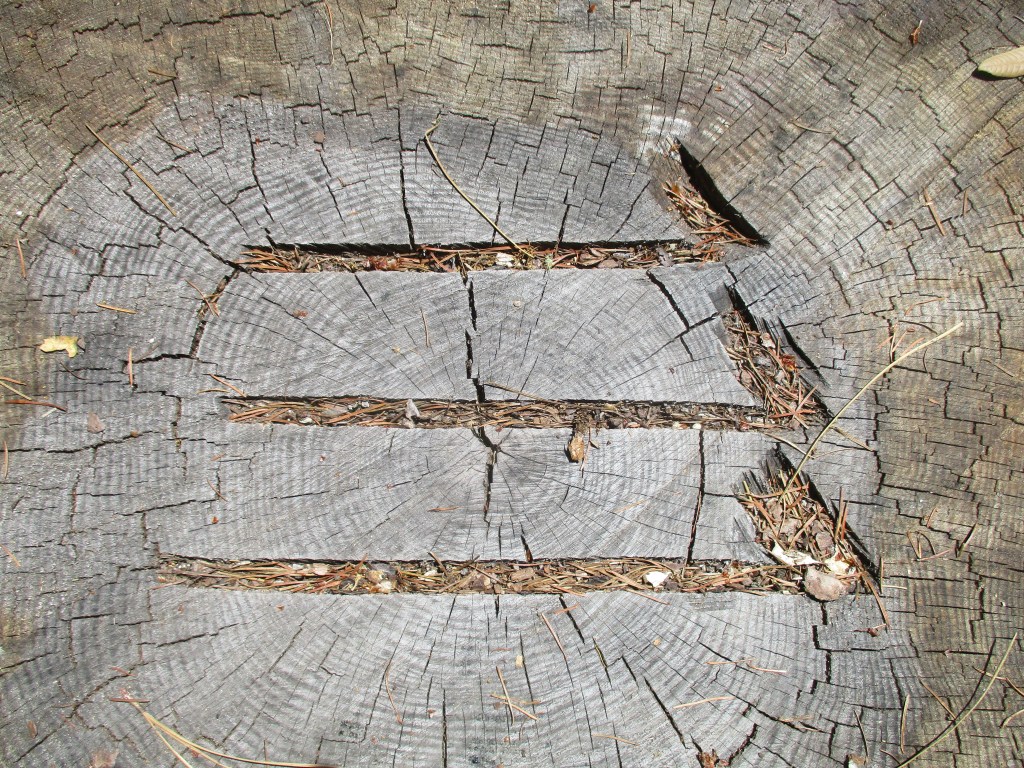
Some stumps die immediately. Some do not.

Trees of all sorts are among the most important features of most gardens, and are also the most substantial. Yet, in the end, whether they get too big, too crowded, too hazardous or simply succumb to old age, they eventually need to be removed.

Getting rid of the brush (foliage and smaller limbs) of smaller trees is generally not much of a problem, especially where greenwaste can be left at the curb for recycling. Larger limbs and trunks can be cut and split into firewood. The brush and wood of trees that are so large that they need to be removed by professionals typically gets taken away be the same professionals. The most difficult parts to remove though, are the stumps.

Professional tree services typically offer the option of stump grinding. This works well for the most obtrusive stumps that are accessible. Other stumps get left either because they are inaccessible, or because of the expense of grinding.

Stumps that are within ground cover or shrubbery often get obscured by the surrounding vegetation, and are never seen again. Others are not so easy to hide. Many refuse to die for several years, and may even try to grow back as new trees.

Coastal redwoods (but not giant redwoods), poplars, willows, privets, sycamores and camphors are notoriously difficult to kill. Their stumps can continue to sprout for years. Shoots that emerge away from the stump can certainly be left to grow into new trees if they happen to be where they will not soon become problematic. (Shoots that emerge directly from cut stumps will likely lack structural integrity.)

To kill stubborn stumps, shoots must be removed as they appear. Eventually, the stumps and roots below the ground exhaust all resources and die. Of course this sounds simple, but may take years to kill redwood stumps. Leaving shoots to grow prolongs the process by allowing replenishment of resources. A stump from a camphor tree that I cut down in about 1988 but did not regularly remove the shoots from lingered for about twenty years before finally succumbing in about 2008!

Once stumps die, they rot faster if buried or at least covered with other plant material. Less stubborn stumps that are not likely to sprout again, like those of pines, cypresses, cedars, birches and (solitary trunked) palms, can be buried or concealed immediately. Stumps that are not cut low to the ground are not so easy to conceal, but should still rot faster if covered with ivy. I prefer to plant either freshly divided lily-of-the-Nile shoots or geranium cuttings around the bases of stumps, because they obscure the stumps and also promote rot as they get watered and disperse roots into the decaying wood. They can be removed, if desired, as the stumps deteriorate.

Horridculture – Post Office

Posted!

The Post Office in town is where I go to post or collect mail. For the past few years, this small coast live oak has been getting so low that I must duck under it to get onto the sidewalk from the parking spaces, or even to get past it on the sidewalk. It is particularly annoying because it is in such a prominent location where many other people park and enter the Post Office. I have sometimes considered bringing my pole saw and other pruning tools to prune it for clearance, but because I have not driven the pickup into town for a very long time, and do not intend to do so anytime soon, I would have no means with which to dispose of the debris.

Well, someone else pruned it. Well, sort of pruned it. Well, let us just say that I no longer need to duck under it. What a hot mess of stubs, or should I say, ‘posts’. This is after all, the Post Office. How could anyone think that this was acceptable?! How difficult would it have been to cut these lower limbs properly, without leaving these horrid posts?! Even someone who is not at all concerned about the tree or proper arboriculture can see how hideous this is. Seriously, this goes beyond negligence. Someone put considerable effort into doing this so extremely improperly!

I brought my pole saw the following week to remove these posts without doing any more pruning. I figured that without all the foliage, I could fit them into the trunk of the Roadmaster. However, by the time I go there, someone, likely from the Department of Public Works, had already repaired the damage. The tree could be pruned a bit more, but at least it is not so mutilated.