Fragrant Bloom Appeals To Pollinators

Fragrant bloom needs no bright color.

Aroma and fragrance in a garden have two very different natural purposes. Aroma, which is foliar, repels insects or animals who may otherwise eat such foliage. Fragrance, which is floral, attracts insects and animals to pollinate such flowers. Aromatic foliage ironically appeals to people, particularly as herbs. The appeal of fragrant bloom is not so contrary.

With few exceptions, fragrant bloom is an asset to a garden. Although its primary function is to attract pollinators, people enjoy it also. The few exceptions are flowers that produce fragrances that are unappealing to people. For example, several species of Arum attract flies for pollination. Therefore, they exude foul fragrances that appeal specifically to flies.

Fortunately, most pollinators prefer fragrances that people also enjoy. Many of the richest and strongest fragrances appeal to a broad range of pollinators. Some more refined and distinctive fragrances attract specific pollinators. Fragrant bloom is most fragrant when its preferable pollinators are most active. A few bloom at night for their nocturnal pollinators.

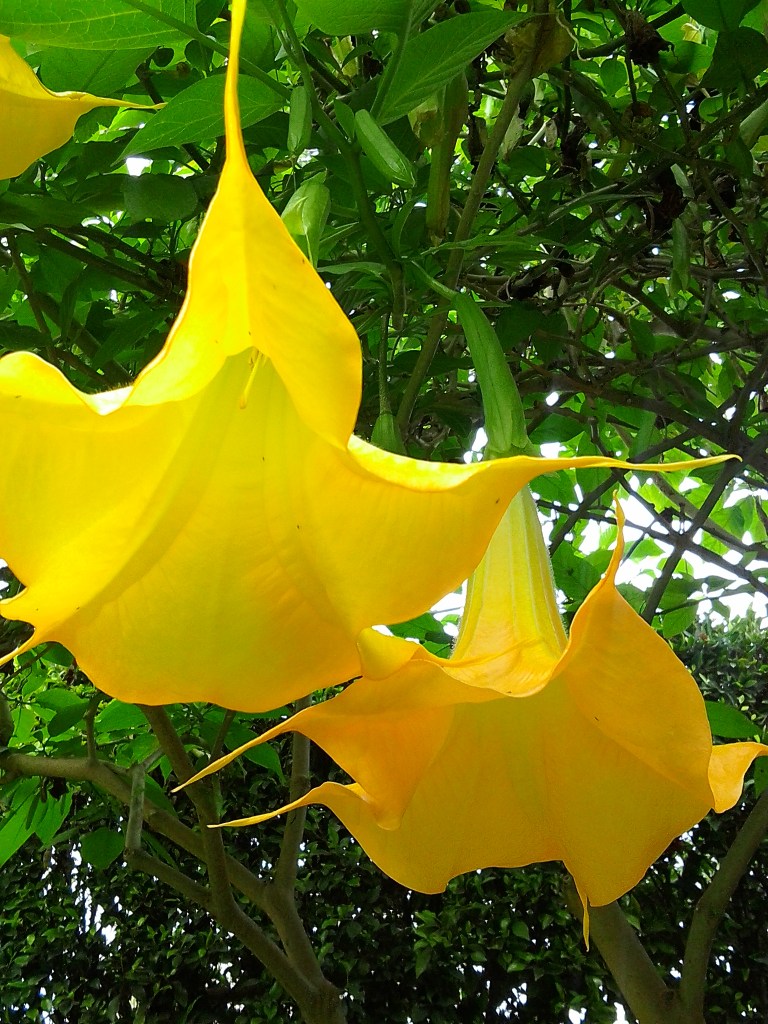
Fragrant bloom is generally not as colorful as bloom that is less fragrant. It does not need to be. Color is merely another visual means with which to attract pollinators. Flowers that are both fragrant and colorful are mostly from competitive ecosystems. Angel’s trumpet is both spectacular in bloom and splendidly fragrant. Yet, its floral color is limited to pastels.

Some of the most fragrant bloom is that of bulbs that bloomed early last spring. Hyacinth, narcissus, freesia, lily and some bearded iris are both fragrant and colorful. Wisteria and pink jasmine are vines that were also fragrant and colorful last spring. Star jasmine is not quite as colorful, but is as fragrant, and still continues to bloom. So does angel’s trumpet.

Warming summer weather will now promote more fragrant bloom, even if it is not colorful. Pittosporum undulatum exudes an almost citrusy fragrance. Pittosporum tobira is slightly buttery. Sweet osmanthus and sweet box are proportionately more fragrant while young. Night blooming jasmine might be the sweetest of all, but more so during warm evenings.

Aromatic Foliage Has Ulterior Motives

Several Salvia species are splendidly aromatic.

Floral fragrance attracts insect pollinators. Foliar aroma repels insect pathogens. It might repel other herbivores also. For organisms that lack olfactory perception, plants certainly make productive use of it. Fragrant flowers are as attractive in home gardens as they are to pollinators in the wild. However, aromatic foliage has the opposite of intended effects.

In other words, aromatic foliage is popular within home gardens because of its aroma. Its effort to be repulsive to some insects and herbivores makes it attractive to people. Some aromatic foliage has culinary or herbal application. Actually, almost all herbs are notably aromatic, with corresponding flavors. Mint, chive, thyme and sage are popular examples.

Window boxes became popular in ancient European towns because of aromatic foliage. Where garden space was scarce, they were convenient planter boxes for growing herbs. Also, prior to window screens, they sustained aromatic foliage that repelled mosquitoes. Trailing rosemary, ivy geranium and nasturtium are still very traditional accompaniments.

Rosemary has both culinary and aesthetic application. Culinary cultivars exhibit the best flavor. Landscape cultivars are either trailing or more densely shrubby. Some cultivars of fennel are similarly better for either culinary or landscape application. Bronze fennel has become popular for both. Varied lavenders are more popular as home garden shrubbery.

Native bay is very aromatic when its foliage is disturbed, but is not culinary bay. It is a big and obtrusive tree that is proportionate only to large landscapes. Culinary bay is another smaller species that is more proportionate to home gardens. Also, it has a distinct aroma. Incense cedar is another very aromatic native tree, but is quite rare within home gardens.

Most aromatic foliage can not exude its aroma like fragrant flowers exude their fragrance. Most does so only when disturbed. Some, such as that of many conifers and eucalypti, is beyond reach. It is therefore easy to dismiss within some landscapes. Lavender, lantana, diosma, rockrose and salvia stay within reach. Warmth and humidity amplify their aroma.

White Sage

White sage is so aromatic that it may be be objectionable to some.

‘White’ is not often associated with ‘sage’, since so many sages are known for the rich shades of purple, blue and red of their flowers. Others have lavender, pale blue, pink, yellow or ‘almost’ orange flowers. Compared to these, the whorls of small, slightly blushed white flowers of white sage, Salvia apiana, are relatively unremarkable, even though they are held as high as a foot and a half above the shrubby foliage on elegantly slender flower spikes.

However, the evergreen silvery foliage of white sage is quite remarkable both visually and aromatically. It is so aromatic that some people may actually find it to be objectionable. Those who initially grow white sage as an herb or for use as incense later realize that it also becomes a prominent ornamental, particularly with dark green foliage, like junipers or arborvitaes, to contrast with its strikingly silvery color. Mature plants get taller and wider than three feet, with simple three inch long leaves. After spring bloom, flower spikes can be shorn off to promote fuller foliar density. I prefer to prune stems back more aggressively to promote more aromatic vigorous vegetative (non-blooming) growth. These vegetative stems become less aromatic as they too eventually bloom.  

Aromatic Foliage Is An Acquired Taste

Foliar aromas and flavors that are useful for culinary application deters many grazing animals.

The infinite variety of colors, fragrances, flavors and even textures that plants use to solicit the help of wildlife is amazing. Flower color, fragrance and sometimes texture are customized to attract very specific pollinators, and guide them to where they are needed. Many flowers direct and reward their pollinators with flavorful nectar. Fruit color, flavor and aroma attract specific animals to take the fruit, and disperse the seeds within. There is no end to what plants will do for their friends. We are merely secondary beneficiaries.

It is ironic that we also enjoy aromas and flavors that are instead designed to be objectionable to plundering herbivores. For example, the appealingly pungent foliage of most herbs is actually intended to repel grazing animals or feeding insects. We not only exploit these herbs for culinary purposes, but also to add their aromas to our gardens.

Lavender, mint, rosemary and the various thymes and sages are the most popular herbs that are attractive both aromatically and visually, whether or not we actually use them in the kitchen. Rosemary is actually a common and practical ground cover for large areas. Thyme is a good ground cover for smaller areas, and stays low enough to be grown around stepping stones where it becomes even more aromatic if stepped on.

Grecian or sweet bay is another herb that actually grows into a sizeable but practical evergreen tree. The native bay laurel is a bit too large to be as practical where space is limited, but is even more pungent. Although generally not useful as herbs, the various cypresses, pines, cedars and eucalypti are appreciated for their aromatic foliage as well. Incense cedar is particularly pungent.

Two of my favorite types of plants, junipers and geraniums, are among the more common aromatic shrubbery. Although actually considered to be perennials, zonal, ivy and of course, scented geraniums, can be used as small shrubbery or small scale ground cover. Junipers of course, range from ground covers to shrubbery to small trees.

Rockrose, breath of Heaven (Coleonema spp.) and myrtle are all quite aromatic. The old fashioned myrtle that gets considerably larger than the modern compact variety is even more aromatic. Lantana is an aromatic ground cover or low mounding shrubbery.

The aromas of aromatic foliage are strongest as fresh new foliage emerges in spring, and particularly after spring rain. Some people like to put aromatic plants where they will be slightly in the way, since foliage relinquishes its aroma more readily when slapped with a gate, bumped, or otherwise disturbed. 

Aromatic Foliage Attracts And Repels

Scented geranium supposedly repels some insects.

After their invention in ancient Rome, window boxes became overly prevalent in Venice. They contained herbs and vegetables where space was limited within such urban areas. Their produce was close to kitchens, and more visually appealing than nearby buildings. Several window box herbs produced aromatic foliage for more than culinary application.

The popularity of window boxes preceded the availability of affordable window screens. Mosquitoes were a nuisance within the swampy ecosystems around Venice prior to that. Therefore, besides their obvious usages, window boxes also sustained aromatic foliage. Such foliage, which was mostly also culinary herbs, repelled some troublesome insects.

Just as flowers attract pollinators with fragrance, some foliage repels insects with aroma. Some aromatic foliage intends to repel other large consumers, such as rodents and deer. Any potential consumers know that flavor is likely as objectionable as associated aroma. Ironically, some flavors or aromas that are unappealing to them are appealing to people.

Culinary herbs are perfect examples. Their strongly flavorful and aromatic foliage is quite repellent to insects and wildlife. However, it is an asset both for culinary and horticultural application. Some such herbs have cultivars for either culinary or landscape application. Trailing rosemary is a groundcover that has slightly milder flavor than culinary rosemary.

Several cultivars of lavender are popular for home gardens even if not for home kitchens. Their aromatic foliage is as delightful as their foliar color and bloom. The foliar texture of fennel is as striking as its foliar aroma. Thyme is both an herb and an aromatic, although irregular, ground cover. Mint and oregano are a bit more casual, but likely more aromatic.

Some of the most popular aromatic foliage has no culinary application, though. Its aroma more than justifies its cultivation. Scented geraniums and sages are remarkably diverse. Although most are quite pretty, a few are simply very aromatic. Most aromatic foliage can not disperse its aroma like floral fragrances. It requires some sort of disturbance to do so. Warmth with humidity enhance typical foliar aroma.

FLORAL FRAGRANCE IN THE GARDEN

The most fragrant flowers are generally smaller and less colorful than less fragrant flowers. This angel’s trumpet is an exception.

Attracting pollinators is serious business for flowers that do not rely exclusively on wind for dispersion of their pollen. Many flowers attract pollinators with flashy color. Some reward their pollinators with sweet nectar. Many prefer to use fragrance. Most flowers use a combination of two or more of these tactics.

Fragrances are designed by the flowers that use them to appeal to the discriminating taste of specific pollinators. Most are sweet. Some are more perfumed. A few are even quite objectionable to people because they are tailored to flies. Fortunately, flowers with foul fragrances are rare in gardening.

The most fragrant flowers are often less abundant than flowers that rely on wind for dispersion of their pollen, or less colorful than flowers that rely on visual appeal to attract pollinators. Yet, the fragrant flowers of wisteria vines and lilacs are both profuse and colorful. The surprisingly big and fragrant flowers of ‘Charles Grimaldi’ angel’s trumpet are bright yellow.

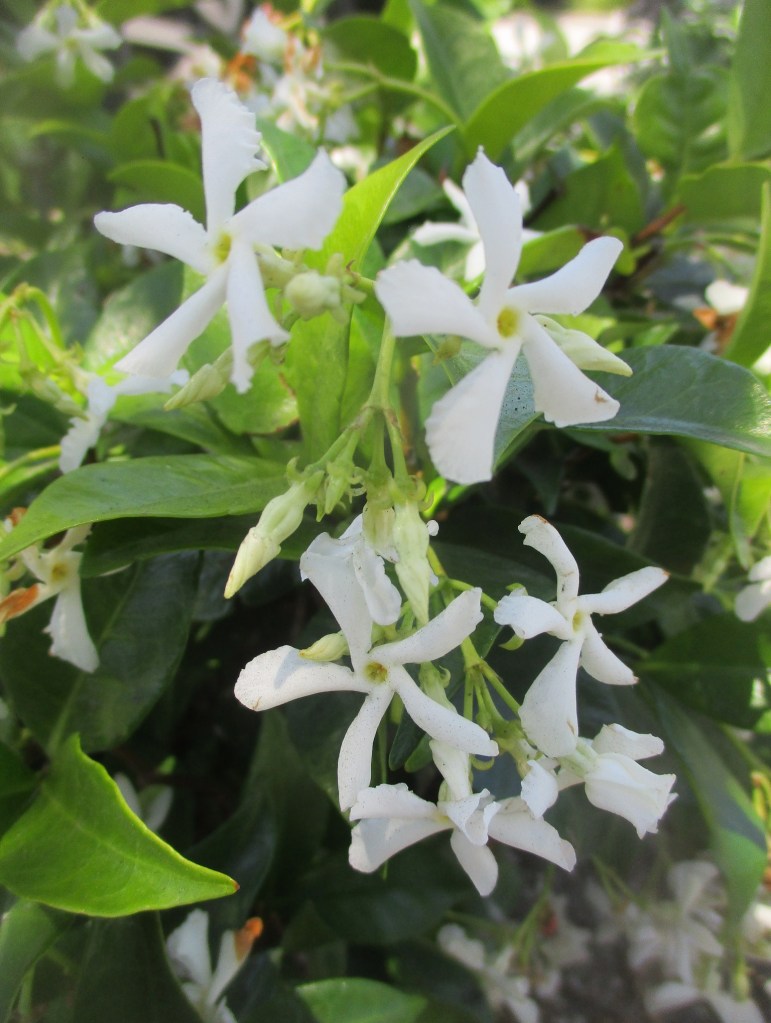
Mock orange (Philadelphus spp.) conforms to the stereotype of fragrant flowers a little bit better, with somewhat small white flowers that are incredibly fragrant. The small pale pink flowers of daphne are even less impressive and nearly hidden among their foliage, even though their fragrance can not be ignored. The sweetly fragrant flowers of Japanese honeysuckle vines are abundant but not too colorful. Star jasmine vines likewise bloom fragrantly and abundantly, and their bright white flowers contrast better against their glossy green foliage.

Night blooming jasmine is not appealing enough for prominent placement, and is not even fragrant during the day, but will be unbelievably fragrant on warm summer nights. Just as fragrances appeal to specific pollinators, nocturnally fragrant flowers specifically appeal to insects or bats who are active at night.

Freesia, hyacinth, lily,narcissus and some types of iris are very fragrant as well as colorful now that they are blooming for early spring. It is unfortunate that their flowers do not last long, and that there are not any comparable flowers later in the year. The same annual sweet peas and stock that bloom about now can be planted again later for autumn bloom. Sweet peas are easiest to grow from seed. Stock is easiest to grow from cell packs, and since it is actually perennial, sheltered plants can survives through warm summer weather to bloom again in autumn. Annual sweet alyssum can bloom anytime while the weather is warm.

Fragrant Flowers Often Lack Color

Unremarkable flowers can be remarkably fragrant.

It is presumptuous to believe that all the fancy breeding that is done to enhance the characteristics of flowers necessarily ‘improves’ them. Breeding only makes flowers more appealing to those who enjoy them in their gardens. Most flowers were already quite efficient for their intended function in their respective natural habitats long before humans started tampering with them. As far as flowers are concerned, they only need to get pollinated.

Some flowers use flashy color or patterns to be visually attractive to pollinators. Others use fragrance to be olfactorily appealing. Small but profuse flowers that are neither colorful nor fragrant have given up on insect or animal pollinators, so instead rely on the wind to disperse their pollen.

Not many flowers are both remarkably colorful and remarkably fragrant like freesia, lilac and wisteria were earlier in spring. Lily and bearded iris are of course very colorful, but not all types are fragrant. The big and bold flowers of cereus cactus, moon flower and angel’s trumpet are only fragrant because they bloom at night, and rely on nocturnal  pollinators who benefit from a bit more guidance in the dark.

Many fragrant flowers are somewhat showy, like gardenia, star jasmine, pink jasmine and honeysuckle. (However, gardenia are almost never healthy and showy locally.) Many of the most reliably fragrant flowers are really not much to brag about. Pittosporum tobira, Pittosporum undulatum and sweet osmanthus are known more for the appealing evergreen foliage than for their small and nondescript flowers. The flowers of sweet osmanthus may actually be difficult to find amongst the obscuring foliage. Night blooming jasmine is sometimes planted around corners or in the background because even the foliage is not too appealing, although the powerful candy-like fragrance is a favorite for warm evenings.

Fragrant flowers can be annuals like sweet alyssum, bulbs like hyacinth, or perennials like tuberose. Woody plants with fragrant flowers can be vines like stephanotis, shrubs like mock orange (Philadelphus spp.), or trees like Southern magnolia. Some have brief bloom seasons, while others bloom for quite a while.

Fragrant Flowers Have Ulterior Motives

00311
Demure daphne bloom is richly fragrant.

Many who enjoy gardening appreciate fragrant flowers. Many grow particular flowers specifically for their fragrance. Yet, not many consider why so many flowers are fragrant. Plants can not enjoy their own alluring floral fragrances any more than they can enjoy their own delightful floral colors and forms. They do not expect people to enjoy their bloom either. Human appreciation is incidental.

Floral fragrance is merely intended to attract pollinators. Flowers are inanimate, so rely on either wind or animate pollinators to exchange their pollen among other flowers. Animate pollinators are mostly insects, but may be birds, bats or other animals. Flowers do what they must to attract their preferred pollinators. Many use color and floral form. Many use fragrance. Some use both tactics.

Flowers that use both color and fragrance to attract pollinators are mostly endemic to densely forested ecosystems. There is more competition for pollinators within such ecosystems than there is within ecosystems of sparser vegetation. Otherwise, fragrant flowers are generally not as colorful as those that are not as fragrant. Likewise, the most colorful flowers are generally not so fragrant.

Angel’s trumpet is striking in bloom because the flowers are so large. Wisteria and lilac that bloomed last spring were spectacular because they were so profuse. The pastel hues of their blooms are no problem that their fragrance does not compensate for. Pink jasmine and mock orange are about as fragrant, even if their color range is more limited. Star jasmine is not always so profuse.

Pittosporum tobira and Pittosporum undulatum are even less visually impressive in bloom, but can be surprisingly fragrant. The tiny but richly fragrant flowers of sweet osmanthus, sweet box and night blooming jasmine are so obscure that other bloom is often credited with their fragrance. As the name implies, night blooming jasmine is powerfully fragrant after sunset during warm weather.

Freesia, hyacinth, narcissus, lily and some bearded iris are both colorful and very fragrant.

Horridculture – Stinky Flowers

P00527-1
Rhody was not impressed, and he is an expert on fragrance.

Dracunculus vulgaris – dragon lily. It was featured in the gardening column for next week, both as an illustration for the main topic, and as the ‘highlight’ species. It is as unappealing as the name and the pictures suggest, but it sure is interesting. It has several more equally unappealing common names. We know it as ‘death arum’ because that is the first name we came up with.

Besides, it smells like death. Yes, it stinks. It does so to attract flies for pollination. Actually, it attracts quite a few annoying insects. I can not explain why, but insects who congregate around stinky flowers are as unappealing as the fragrance that draws them. They are certainly very different from the appealing bees and butterflies who pollinate flowers with appealing fragrance.

The first of these death arums mysteriously appeared in the garden of a colleague several years ago, and promptly multiplied by both seed and disbursement of tubers. There are now a few expansive colonies that continue to expand. Cutting down the foliage does not slow them down much. The fragrance, which is not too bad individually, is getting to be bothersome collectively.

My colleague brought me one of the tubers to confirm the identity. I got a picture of it since it was here, but then did not know what to do with it. I did not want to toss it aside into the forest like I do with so much other greenwaste. It could have grown into a problem. I did not want to discard it either, since it was viable and healthy. So, I canned it and put it aside in the nursery.

This is the result. It is not as stinky as I expected it to be. I still do not know what to do with it.

P00527-2
These unidentified beetles that I had never noticed here before arrived promptly for the stinky bloom.


Sweet Box

50325
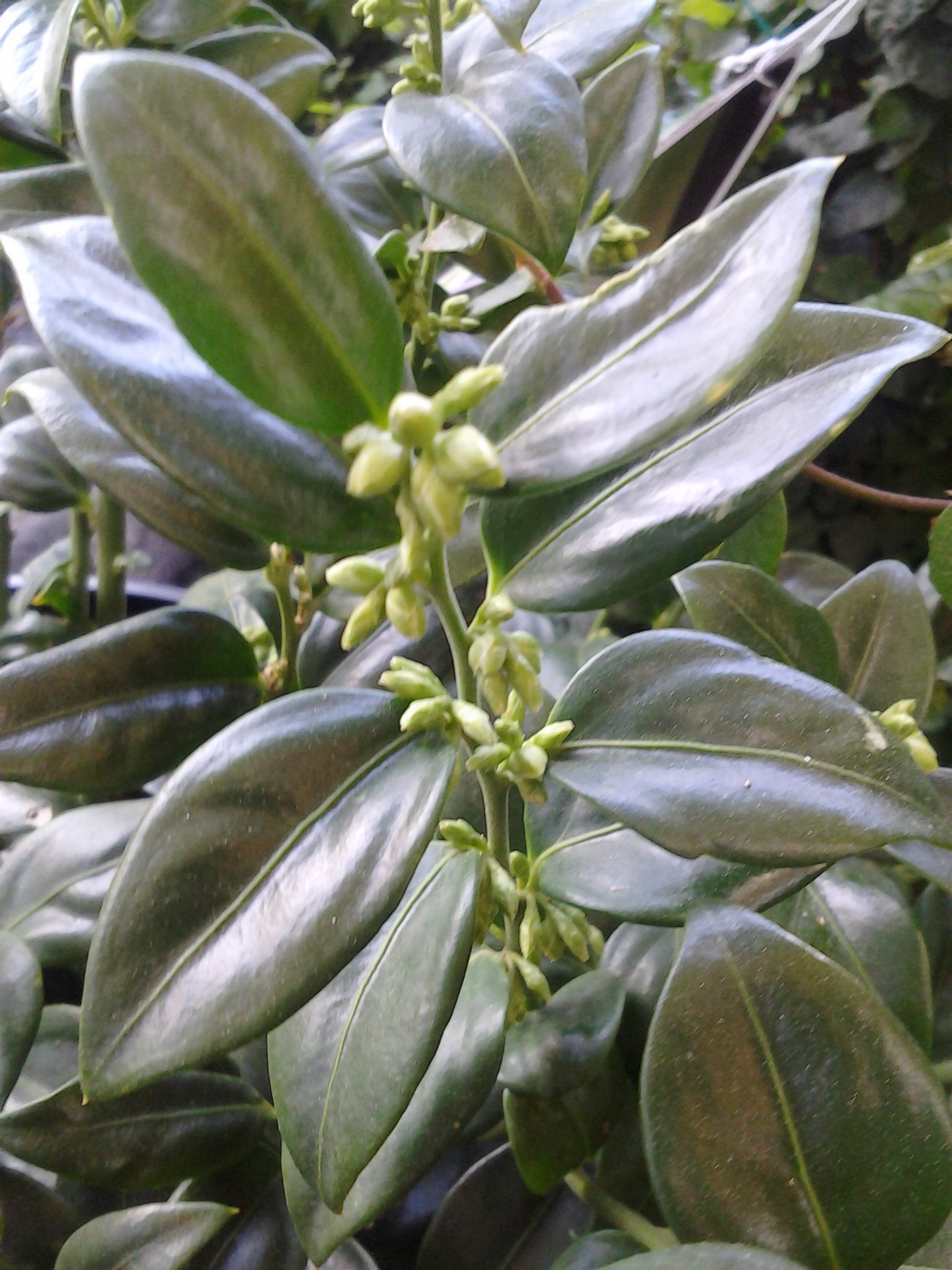
Foliage of sweet box outdoes flowers.

While bloom cycles of most plants are accelerated by the unusually warm winter, sweet box, Sarcococca ruscifolia, seems to be blooming a bit late. It should have bloomed sometime in winter, and finished a month ago. The tiny pale greenish white flowers are certainly nothing to look at, but they produce a remarkably rich fragrance that seems like it would be delicious with coffee.

The foliage is very glossy and dark green, like that of English holly, but the leaves are small and lack spines. Red berries sometimes develop, but are only abundant enough to be notably colorful on plants that are distressed. Sweet box may take a few years to get established and grow to only about three feet high and wide, although it can slowly get a bit larger.

Since it is naturally an understory plant, sweet box prefers at least a bit of shade. Harsh exposure fades foliage. Because of its tolerance of partial shade, as well as its low and dense growth, sweet box is ideal for obscuring foundations. After the first few years, it does not need too much water. It gets established more efficiently in rich soil.