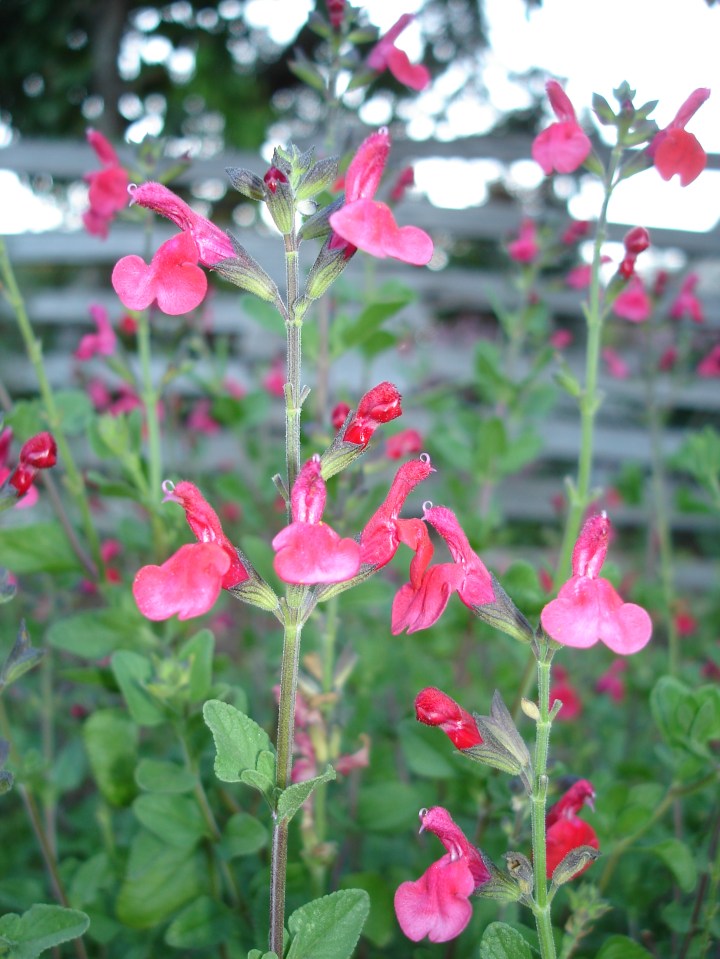
 Perhaps in the wild, it blooms in autumn. Where it gets watered in home gardens, even if watered only occasionally, autumn sage, Salvia greggii, blooms all through summer as well. If pruned back severely over winter, it starts to bloom even sooner in spring. The tiny flowers are red, rose, pink, peach, very pale yellow, lavender or white. Some poplar cultivars have bi-colored flowers.
Compact autumn sage that does not get much more than a foot tall is uncommon. Larger cultivars get four feet tall and broad, with more open growth. Most get about three feet high and a bit wider. Without severe winter pruning, stems can eventually get twiggy, with sparse foliage on the exterior. The tiny aromatic leaves are less than an inch long, and visually resemble oregano.
Even though it is not native to California, autumn sage is popular for native landscaping because it does not need much water. Just like native sages, it attracts butterflies and hummingbirds.
 Here on the West Coast of California, most of us know goldenrod only as a color of crayon. In most other parts of America though, it is a common wildflower that is colorful enough to be popular in home gardens. Yet, with more than a hundred specie, it is hard to say exactly which goldenrod, (Solidago spp.) the crayon color corresponds to. All are some shade of gold or yellow, but some are a bit more orange than others.
 Tony Tomeo