Six on Saturday: Fake Autumn

Daylight does not last quite as long as it had earlier in summer. Shadows stay noticeably longer. Summer actually ended about two weeks ago. For now it is early Indian summer.

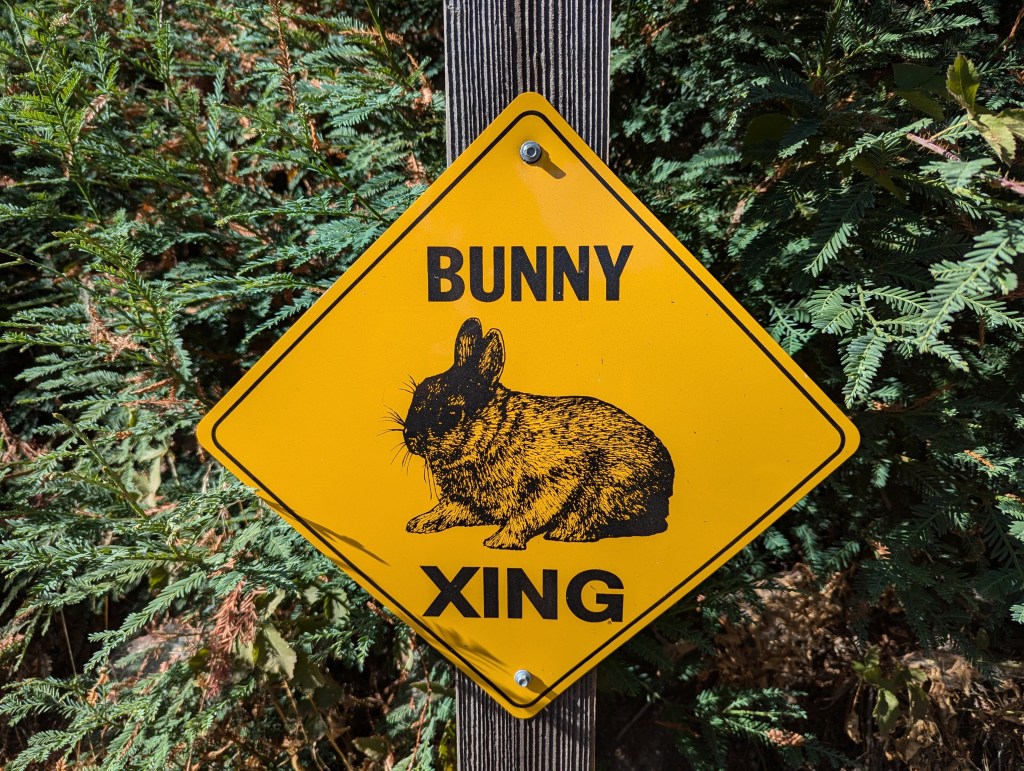
1. “Bunny Xing” is as irrelevant to autumn as it is to Charing Cross Road in Los Angeles. I just found it to be amusingly odd that a neighbor seems to be protective of wildlife that can be so detrimental to some gardens here. Bunnies fortunately do not bother us much.
2. Juglans nigra, Eastern black walnut or Juglans nigra X hindsii, royal walnut, yellows early, more likely because it is tired of summer heat than because it anticipates autumn. Both walnut tree types naturalized from understock that sustained old walnut orchards.

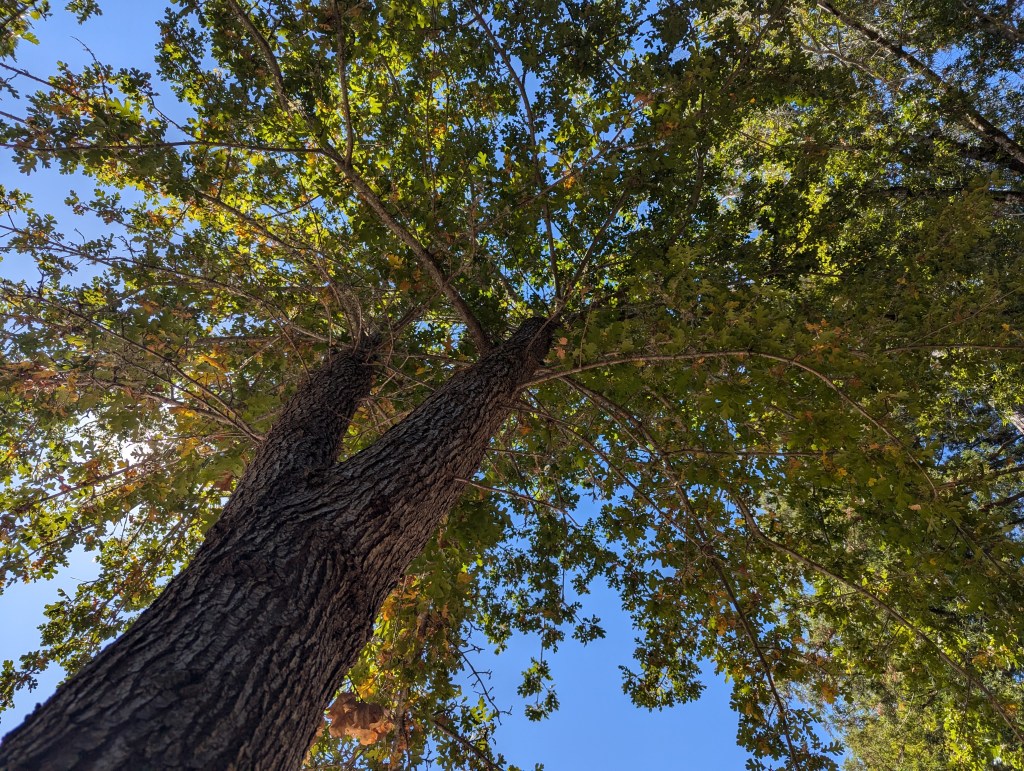
3. Quercus lobata, valley oak typically but not always begins to brown after walnut trees yellow. This yellowish color is likely a result of the weather cooling a bit before warming again. This species is native nearby, but may have naturalized here after getting planted.
4. Acer rubrum, red maple is likely only coloring because it is distressed by confinement of its roots within its big clay pot. Recent and suddenly warmer weather after seasonably cooler weather may have accelerated the process. I really want these trees in the ground!

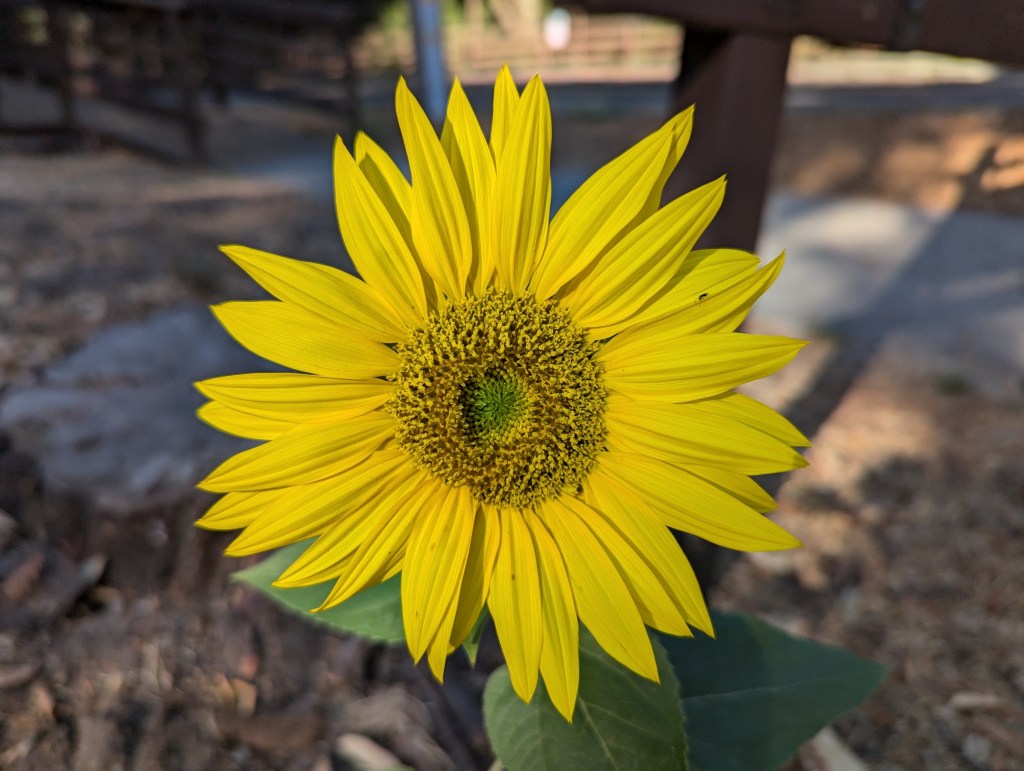
5. Helianthus annuus, sunflower mysteriously appeared precisely where we should have but neglected to grow sunflowers this year. This is the only one, but it is enough to show us what we are missing because of our lack of diligence. It is only a bit early for autumn.
6. Rhody is ready for autumn. More specifically, he is ready for cooler weather. Although it was scarcely more than ninety degrees yesterday, and only for a few hours after noon, it seemed to be unseasonably warm, after earlier weather was already beginning to cool.

This is the link for Six on Saturday, for anyone else who would like to participate: https://thepropagatorblog.wordpress.com/2017/09/18/six-on-saturday-a-participant-guide/
Colorful Autumn Fruit Is For The Birds

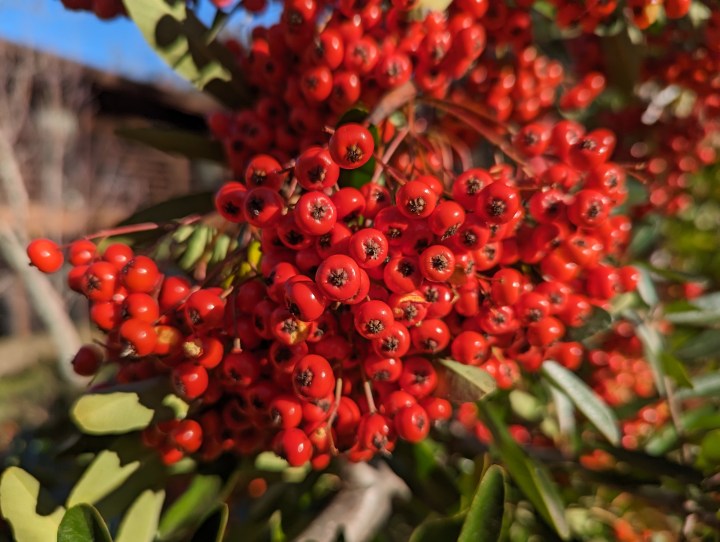
Firethorn is typically the most colorful of autumn berries.

It is hard to ignore the slight bronzing of flowering pear trees in the neighborhood. The recent warm weather after such a mild summer may detrimentally accelerate the development of autumn foliar color, as well as the ripening of some of the colorful fruit that adorns gardens through autumn and winter. Sadly, there have been reports of scorched persimmons as well.

Despite their deviation from a more typical schedule, many of the plants that provide the most colorful fruit start to do so about now, just as birds want to fatten up for winter. My favorites of these provide fruit that I like to get before the birds do. I have already harvested gooseberries, currants and grapes, and am in the process of getting to the elderberries and black chokeberries. Pomegranates will ripen later in autumn. Citrus and persimmon will be ready later in winter, followed by loquat. Natal plum produces randomly all year.

Even fruit that I do not want looks good and keeps the birds happy though. Firethorn is probably the showiest and most popular of these, since it produces such abundant bright red berries that linger into winter. Some have orange or even yellowish berries. Cotoneaster and toyon are similar, but not so flashy. English hawthorn makes similar berries, but grows into a larger tree. Fruiting crabapples were harvested in early summer; but the ornamental, albeit sparse fruit of the flowering crabapples will linger after the leaves fall. Plants that provide abundant fruit that is popular with birds may not be so desirable near where cars are parked outside though, since well fed birds can be rather messy.

I am particularly fond of persimmon, pomegranate, English hawthorn and crabapple trees for other reasons as well. Persimmon trees will provide some of the best orange and red autumn foliar color. By the time it falls, there is plenty of comparably bright orange fruit to replace it! Pomegranate blooms with few but bright reddish orange flowers in summer. English hawthorn and crabapple trees are among the most abundant of spring blooming trees. Some of the flowering crabapple trees bloom with unique shades of bright pink and nearly red. 

Heavenly bamboo, Oregon grape (Mahonia) and California pepper tree are not often grown for their colorful fruit, but sometimes like to show it off. Oregon grape is striking because the fruit is so dark purplish black. California pepper tree makes pendulous trusses of small pink berries. Snowberry is an uncommon native that makes few but striking white berries. 

Dormancy Facilitates Survival Through WInter

Deciduous vegetation defoliates for winter dormancy.

Dormancy is not exclusive to vegetation. Many animals are dormant while they hibernate through cold winter weather. Some animals are dormant while they aestivate through hot and dry weather. Fungi and bacteria can maintain dormancy for many years or centuries. Dormancy is a technique for avoiding unpleasant situations, such as cold or hot weather.

Like some animals, fungi and bacteria, some vegetation is dormant through dry weather. This is evident within local chaparral climates and nearby desert climates. Even within a few coastal forests, buckeye defoliates during summer. Such vegetation resumes activity in response to late autumn rain. However, most vegetation here prefers winter dormancy.

Such winter dormancy is especially evident among deciduous species. Many evergreen species merely halt or decelerate their growth, but without defoliation. Several evergreen species defoliate only partially. A few only shed their old foliage as new foliage replaces it during the following spring. Few species prefer to grow most vigorously through winter.

There are a few advantages to defoliation for winter. Wintry wind blows much more freely through defoliated canopies. Evergreen canopies are therefore more vulnerable to wind. In other harsher climates, defoliated canopies do not accumulate much snow. Evergreen canopies might accumulate more snow than they can support. Some get heavy with rain.

Foliage is not as useful through winter as it is through summer anyway. The sun is lower to the south. Consequently, less sunlight gets through more of the atmosphere. Days are shorter while nights are longer. Furthermore, cooling autumn and winter weather inhibits photosynthesis. For deciduous species, foliage becomes less of an asset than a liability.

Dormancy, whether it involves defoliation or not, facilitates a few horticultural techniques. Bare root stock becomes available at the beginning of winter. Transition from its farms to home gardens is much less stressful during dormancy. So is the aggressive pruning that roses and deciduous fruit trees require. Most pollarding is safest during winter dormancy.

Defoliation Is A Messy Process

Defoliating deciduous foliage must go somewhere.

Autumn foliar color eventually gets messy. Actually, any deciduous foliage can become messy during its autumn defoliation. Color is not a prerequisite. Some deciduous foliage remains green through the process. Furthermore, some evergreen foliage contributes to the mess. A few evergreen species shed a bit more as the weather becomes more wintry.

Contrary to popular belief, deciduous vegetation is neater than evergreen vegetation. It only seems to be messier because it defoliates completely at once. Also, such complete defoliation exposes bare stems. Evergreen vegetation sheds slower throughout the year. As it replaces old foliage with new, it sheds more in seasonal phases, but incompletely.

Deciduous leaves also seem to be messier because they are generally bigger. They do not disintegrate into landscapes as efficiently as tiny evergreen leaves do. They require raking from lawns, as well as groundcover that can absorb smaller leaves. So, they fall most abundantly, and dissipate least efficiently. That is why defoliation is so very messy.

Defoliation of deciduous foliage occurs at both the best and worst time of year. It allows more warming sunlight into homes and gardens while the weather is cooling. It leaves deciduous trees more resilient to eventual windy wintry weather. However, it gets messy while the weather begins to get less conducive to gardening. Summer is about finished.

It truly is ironic. Rain and wind will eventually dislodge the last deciduous foliage during winter. Rain is also why this same foliar debris must not clog eavestroughs and gutters. Yet, it is why removal of such debris can be such an unpleasant chore. Removal of foliar debris from hardscapes is also important. It stains and gets slippery if dampened by rain.

While defoliation decreases shade above, it can increase shade below. Accumulation of foliar debris can detrimentally overwhelm turf and groundcover. Some large leaves can do the same on top of dense shrubbery. Fungal pathogens proliferate within the dark and stagnant dampness below such debris. Shade from such debris inhibits photosynthesis.

Autumn Foliar Color Appreciates Chill

Maples perform better in cooler climates.

Indian Summer complicates autumn. It is an imposition of pleasant weather that delays inevitable chill. Gardening is a bit more enjoyable while the weather remains summery. However, late warmth confuses a few species that should decelerate growth for autumn. Deciduous species delay dormancy. This delays the development of autumn foliar color.

Consequently, autumn foliar color is somewhat late this autumn. It is only beginning to develop. Some species that eventually become spectacularly colorful remain very green. Only the most sensitive species, such as Boston ivy, are beginning to exhibit their color. Unfortunately, because of this delay, some may defoliate unusually soon after coloring.

Autumn foliar color is underrated here, for various reasons. It is less common in the wild than in other regions. The color range of native deciduous species is almost exclusively simple yellow. Orange or red are uncommon. This is not much incentive for incorporation of such species within home gardens. Nor does it promote more colorful exotic species.

Besides, deciduous trees are innately less popular here than within other regions. Local culture seems to promote a preponderance of broadleaf evergreen species. Penetration of warming sunlight through defoliated trees is not such a priority. Winter weather does not get very cold here. Concealment of undesirable suburban scenery is more important.

Also, the misbelief that chill is inadequate here for much autumn foliar color is common. Technically, many of the most colorful species of cooler climates lack such color locally. This unfortunately includes famously colorful North American maples. Several species, however, do not need much chill for spectacular color. They compensate for what lacks.

Sweetgum develops the most vivid autumn foliar color, including yellow, orange and red. It defoliates slowly to retain its color until winter. PIstache is about as colorful, although it defoliates a bit earlier. Flowering pear provides more orange, red and dark burgundy red. Crape myrtle is a smaller tree with comparable foliar color. Ginkgo becomes vivid yellow. Of course, physical traits of each species are also important.

Out of Tune Trumpet

Brugmansia X cubensis ‘Charles Grimaldi’

Summer was mild. Vegetation that enjoys warmth grew relatively slowly through much of it. Then, toward late summer, and without increased warmth, some vegetation seemed to accelerate growth unexpectedly. Banana and heliconia pups grew like they should have earlier in summer. Angel’s trumpet cuttings began to get somewhat weedy. Some that did not bloom earlier began to bloom now!

Brugmansia X cubensis ‘Charles Grimaldi’ is likely the most popular angel’s trumpet. It is the most vigorous, and may be the most fragrant. One cutting that survived the unusually cool frost last winter grew from its roots to more than six feet tall since then. Now that it is time for it to decelerate growth, it is blooming! Such performance is impressive, but not in tune with the seasons. It can not continue for long, before disruption by increasingly cool autumn weather. Unusually vigorous growth that continues to bloom unusually late could be unusually vulnerable to frost next winter.

This is not the only angel’s trumpet that is out of tune with its seasons. A similarly mature specimen of an unidentified cultivar with single white flowers is about to bloom also. Two older specimens of other unidentified cultivars are growing about as vigorously, although without bloom. One blooms with double white flowers. The other blooms with single pale orange flowers.

About nine copies of each of both cultivars that bloom with white flowers are growing like weeds in #1 cans, with more than a dozen more small cuttings of the cultivar that blooms with double flowers in cells. Only the original matured specimen that blooms with double white flowers actually inhabits a landscape, and is incidentally about to bloom, but is not here with these in the nursery. More will go to landscapes after winter, where their bloom can be enjoyed.

Six on Saturday: Autumn in the Redwoods

Autumn is not much to brag about here. Not only is the change of the weather mild, but foliar color is limited beyond synthetic landscapes. Redwoods are only a bit messier now because they did not shed as much as typical while summer weather remained atypically mild. Fireplaces at work get a bit more use, but only for ambience. A few autumn flowers bloom between summer flowers and winter flowers.

1. Sequoia sempervirens, coastal redwood is evergreen. Its foliage does not turn colorful for autumn. It certainly sheds though. It sheds mostly while the weather is warmest and driest through summer. However, without such weather, it sheds more as summer ends.

2. Firewood is too mixed for identification of all species that might be involved with this picture. It comes from the various trees that must be removed and pruned here. Because fires at work are more for ambience than heat, the quality of such wood is unimportant.

3. Anemone hupehensis var. japonica, Japanese anemone exhibits why I find ‘Honorine Jobert’ to be so appealing. This is the only anemone here, and it is ghastly pallid, neither pure white nor pinkish. It actually seems to be slightly grayish. Ick! I learned this species as simply Anemone japonica, but now learn that it is supposedly Eriocapitella japonica.

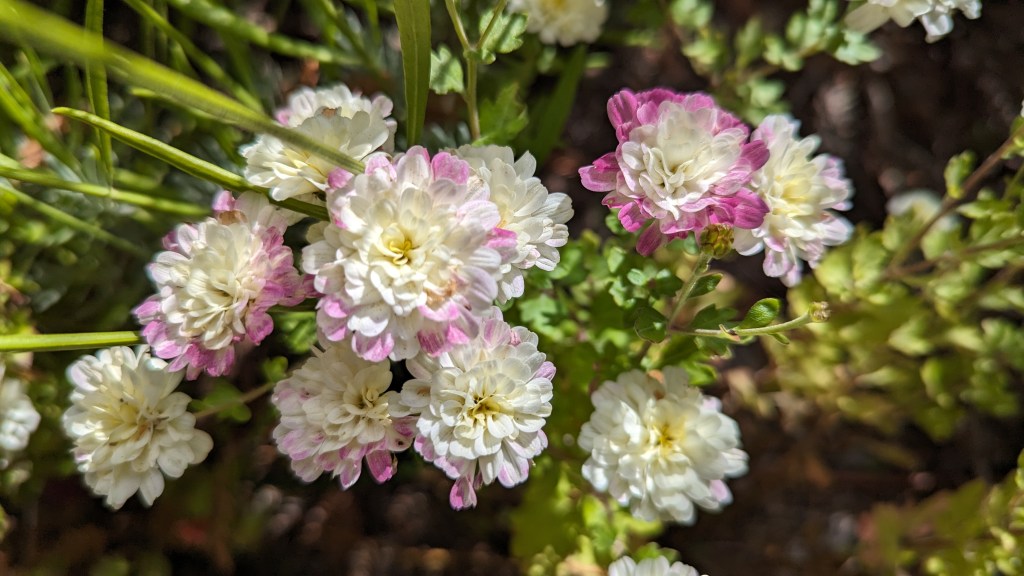
4. Chrysanthemum X morifolium, is more discolored than anemone, but is instead quite pretty. It was likely white when left here after a wedding. It now lives in a garden nearby.

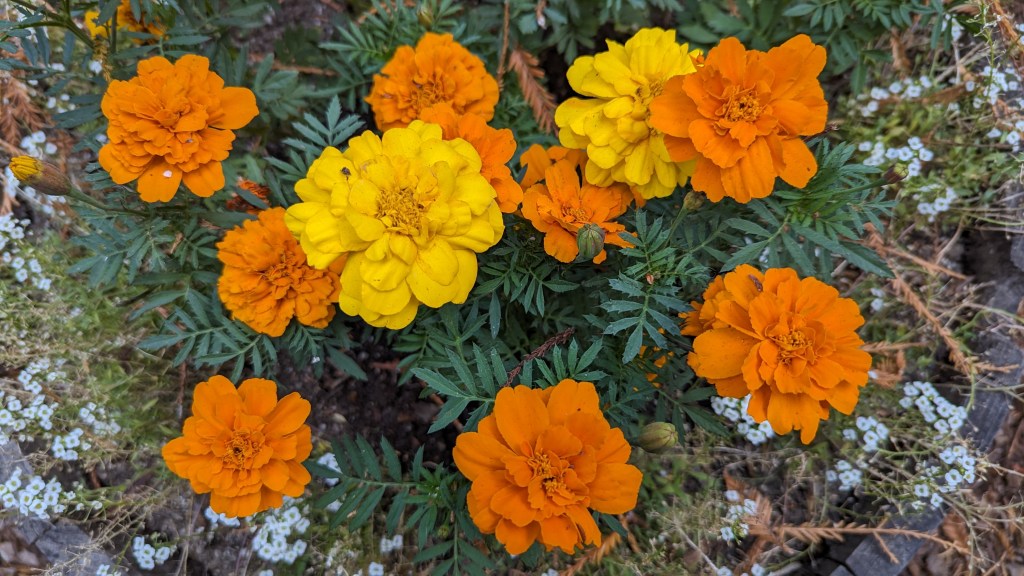
5. Tagetes patula, marigold is as customary for autumn as chrysanthemum is. Its bright yellow and orange are splendid. This one though looks too much like Ronald McDonald.

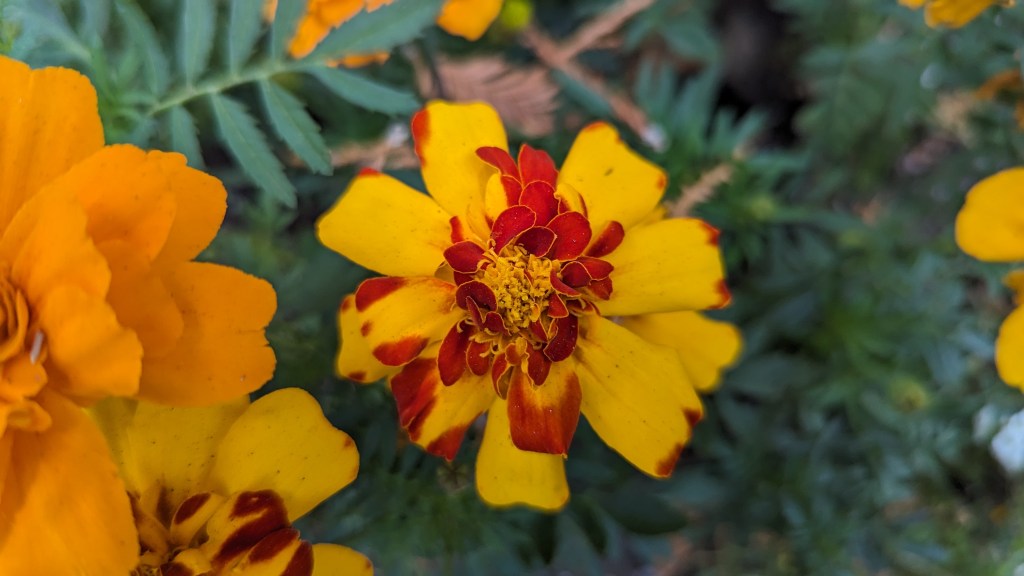
6. Tagetes patula, marigold should look more like these. Brownish red is traditional too. Marigold is the official flower of Dia de los Muertos of the first and second of November.

This is the link for Six on Saturday, for anyone else who would like to participate: https://thepropagatorblog.wordpress.com/2017/09/18/six-on-saturday-a-participant-guide/

Autumn Bloom Is Remarkably Natural

Some bloom adapts to regional climate.

Most flowers bloom during spring. That seems to be most practical. It maximizes the time for their seed to develop prior to the following winter. It conforms to the schedules of their naturally preferred pollinators. Bloom is less likely to succumb to weather through spring. Deviancy is natural though. Many functional flowers quite naturally prefer autumn bloom.

Deviancy, of course, is as complicated as it is natural. Autumn bloom occurs for a variety of reasons among a variety of species. Many can be delightful assets for home gardens. They provide more options for floral color than the most popular of cool season annuals. Some autumn bloom continues as autumn foliar color develops, and perhaps into winter.

Many flowers bloom randomly as warm weather allows them to do so. They may seem to bloom almost continually here. Cool weather may disrupt their bloom only during winter. As weather fluctuates, bloom might resume before a previously disrupted bloom finishes. African daisies provide autumn bloom because autumn is too mild to disrupt their bloom.

Technically, such flowers do not necessarily prefer to bloom during autumn. They merely bloom whenever they can. Most actually bloom most profusely during spring or summer. Canna produces summer and autumn bloom, as it regenerates from its winter dormancy. Otherwise, within frostless tropical climates, it blooms continuously. It is quite adaptable.

Some flowers that are actually more responsive to seasons simply prefer autumn bloom. Joe Pye weed and goldenrod grow only vegetatively through spring and earlier summer. They only begin to bloom about now. Perhaps their seed prefer to grow through cool and damp winter weather. Their seedlings may be vulnerable to desiccating summer warmth.

Naked lady is more extreme. It maintains dormancy through most of summer to bloom as summer ends. Then it grows through winter until spring warmth initiates dormancy again. It seems to believe that it still inhabits its native range within South Africa. Summer there is winter here. Actually, summer weather there is more severe than winter weather there.

Early Rain

This could be a sequel to ‘Late Summer’ from yesterday. It happened shortly afterward. It certainly adds another interesting component to this already odd year of weather. Although not impossible, rain at this time of year is rare. Almost all of the rain here occurs between late autumn and early spring.

Weirdly, if rain does occur during summer, it typically does so around the fifteenth of August. Seriously, it is very prompt about that schedule. It typically either begins or ends on that same date.

The first flash of lightning of the storm that started the CZU Fire occurred at 11:59 p.m. on the night of the fifteenth of August of 2020, less than a minute prior to midnight. So, although the storm occurred during the early morning of the sixteenth, it technically began on the night of the fifteenth.

This brief rain shower was minimal, but by local standards, it was surprising. I sort of wanted it to continue long enough to dampen and contain the dust of summer. It might have done so briefly, but could not prevent the dust from becoming dusty again shortly afterward. The aroma of damp asphalt dissipated even before that happened. It was fun while it lasted.

Perhaps this rain shower will be the last of this unusually autumnish weather. Warm and dry summery weather typically resumes immediately after brief rain showers that happen during the middle of August. Technically, for a summer rain shower, it is only half a month late. So far, the forecast does not suggest that pattern, but it has been wrong before, even here. I doubt that there will be any more rain prior to autumn, even if cool autumnish weather resumes until then. But of course, I have been wrong more often than weather forecasts.

Six on Saturday: Before Winter

Autumn is the season for planting. For portions of the landscapes that lack irrigation, we must wait until the beginning of the rainy season. By the time the rainy season ends next spring, new plants should be outfitted with irrigation, or sufficiently established to need none. Now that the weather got rainy, as well as windy and messy, planting is facilitated by a sale at one of our suppliers. We normally do not purchase much, but the prices were too good to ignore. I did not get enough pictures, so added random pictures, such as the shabby bearded iris foliage. The important details of #5 are difficult to distinguish.

1. Scout at least tried to cooperate for a picture, which is more than Rhody does. He just does not know how to cooperate. He was too wiggly to get a picture that was not blurred.

2. Cedrus atlantica ‘Glauca Pendula’, weeping blue Atlas cedar is an oddly limber trophy tree that my colleague here had wanted for a while, but could not justify procurement of.

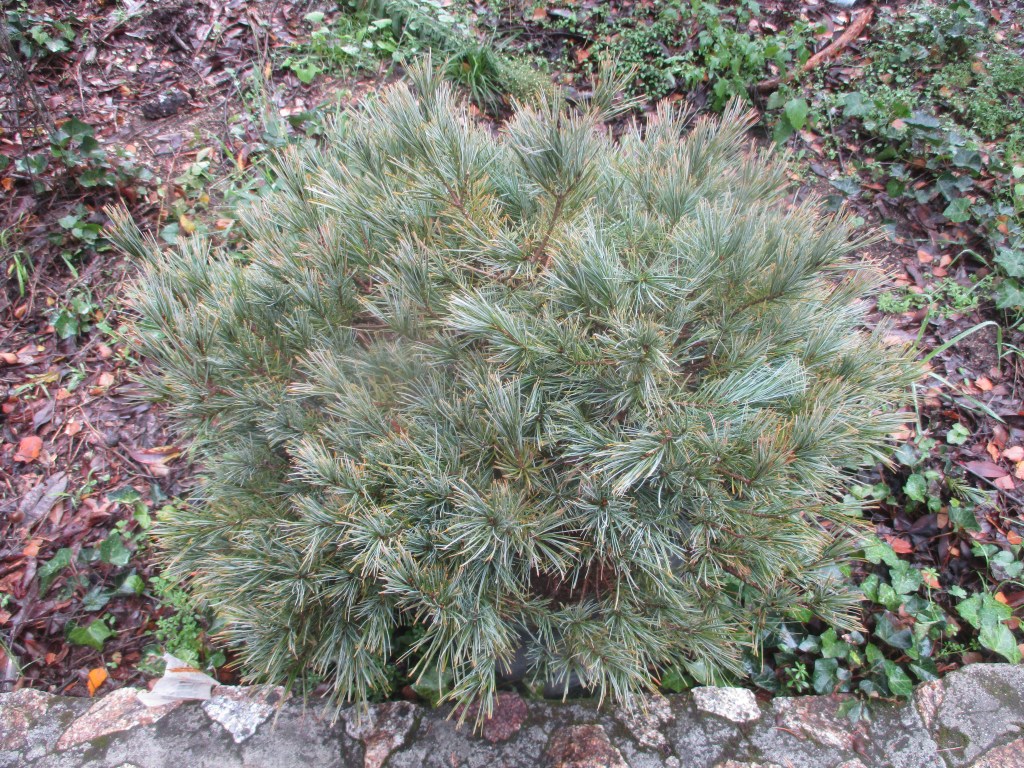
3. Pinus strobus ‘Nana’, dwarf Eastern white pine was not planned, but like the weeping blue Atlas cedar, was unusually affordable. There are eight in a row. Mugo pine are next.

4. Iris X germanica, bearded iris start growing prior to shedding old foliage of last year, so now look shabby. This is the pallid white and potentially feral iris in the new iris bed.

5. Wind is messy! Those two diagonal trunks just above and to the right of the middle of this picture were not diagonal earlier. Those headlights to the lower left are on a bridge.

6. Rain is messy also! This is a spillway of a drainage pond at work. While the sycamores and other deciduous trees continue to defoliate, it can get partially clogged and flooded.

This is the link for Six on Saturday, for anyone else who would like to participate: https://thepropagatorblog.wordpress.com/2017/09/18/six-on-saturday-a-participant-guide/

These four pictures below are not affiliated with the Six on Saturday above, but at the request of one of his most enthusiastic fans, were added to compensate for the lack of a picture of Rhody, the star of my blog. I had assumed that he was being uncooperative with my attempts to get a good picture, but he reminded me of what his fans really want to see. Can you guess what the last picture shows?