Warming spring weather is stimulating new growth among vegetation that was dormant or shabby through this winter.
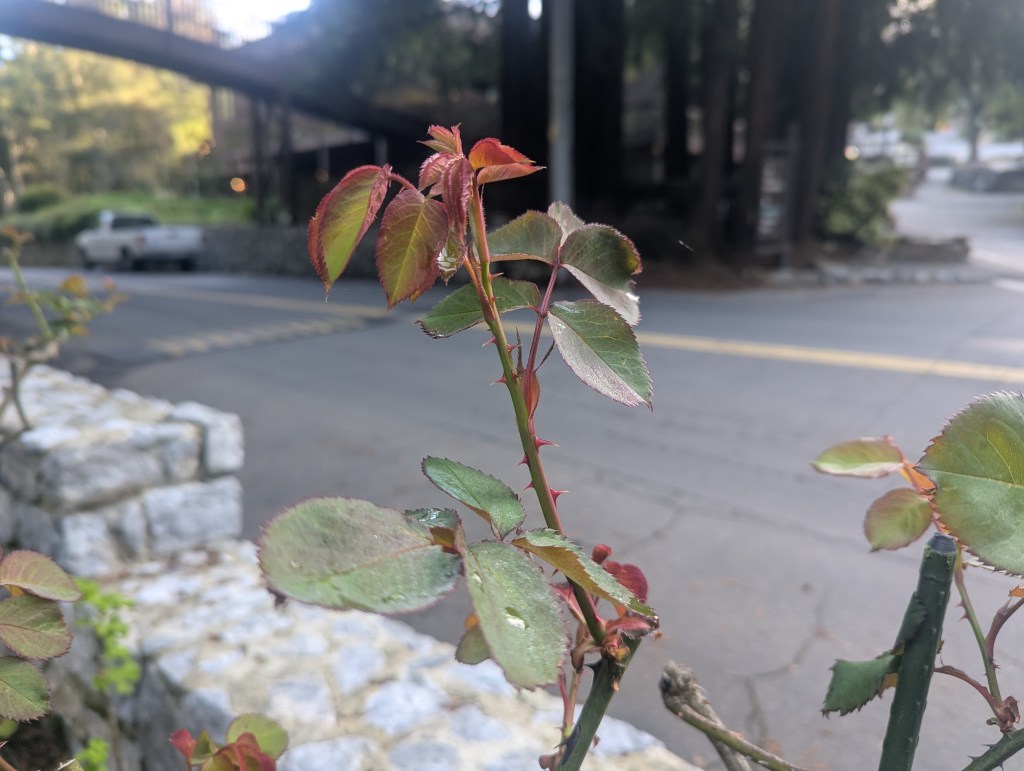
1. Rosa spp., rose started growing even before the weather became warmer. It is good to see that squirrels are not eating the new growth. I do not know what cultivar this one is.
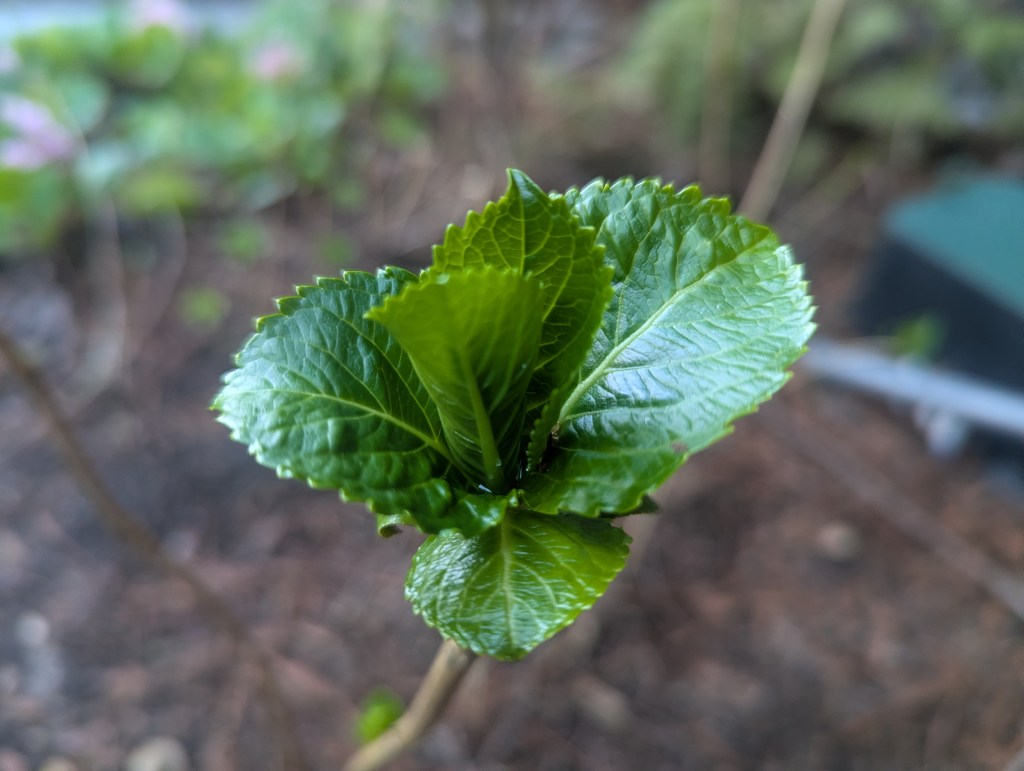
2. Hydrangea macrophylla, hydrangea, which is also unidentified, also started growing while the weather was still cool and rainy. It is now settling in after bare root relocation.
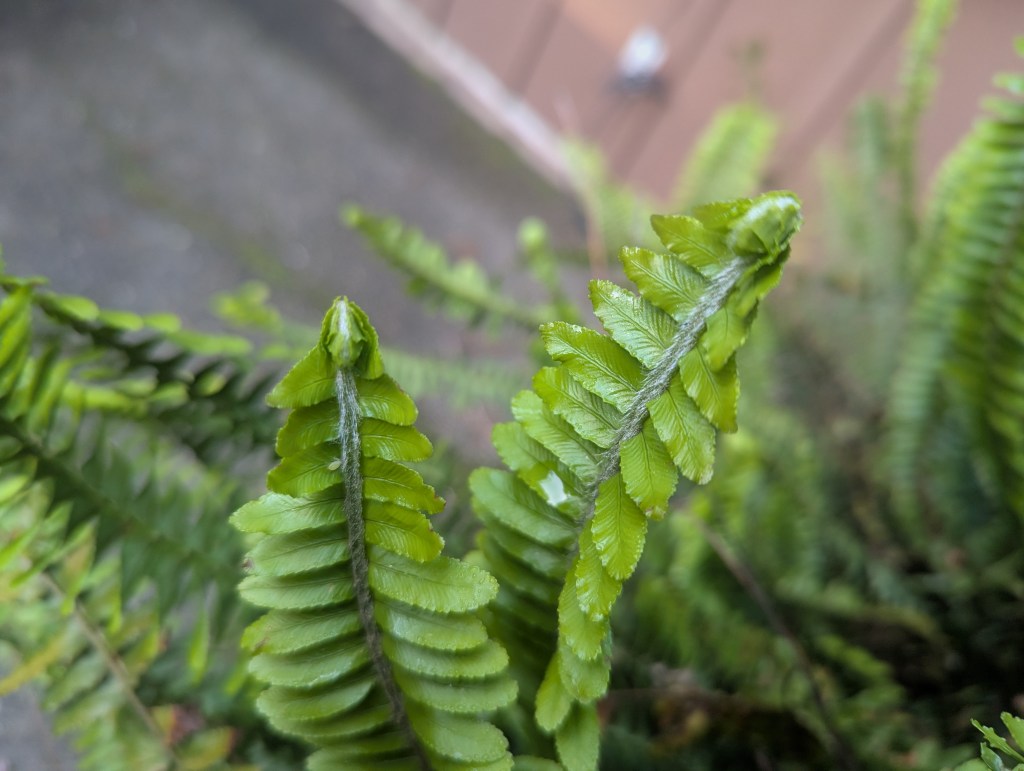
3. Nephrolepis cordifolia, sword fern, like many ferns, is beginning to replace old foliage with new foliage. It grew too large for its pot years ago, but somehow continues to grow.
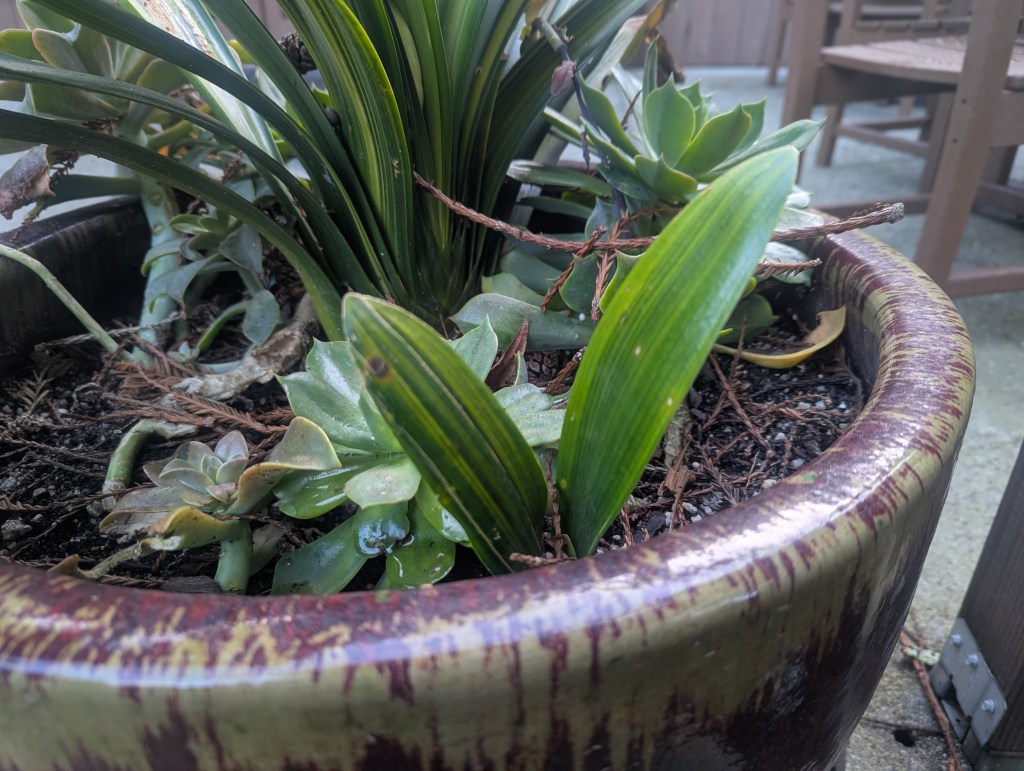
4. Clivia miniata, Kaffir lily has been maturing slowly for more than a year, but is finally providing a pup. It is variegated with yellow stripes, but I do not know what cultivar it is.
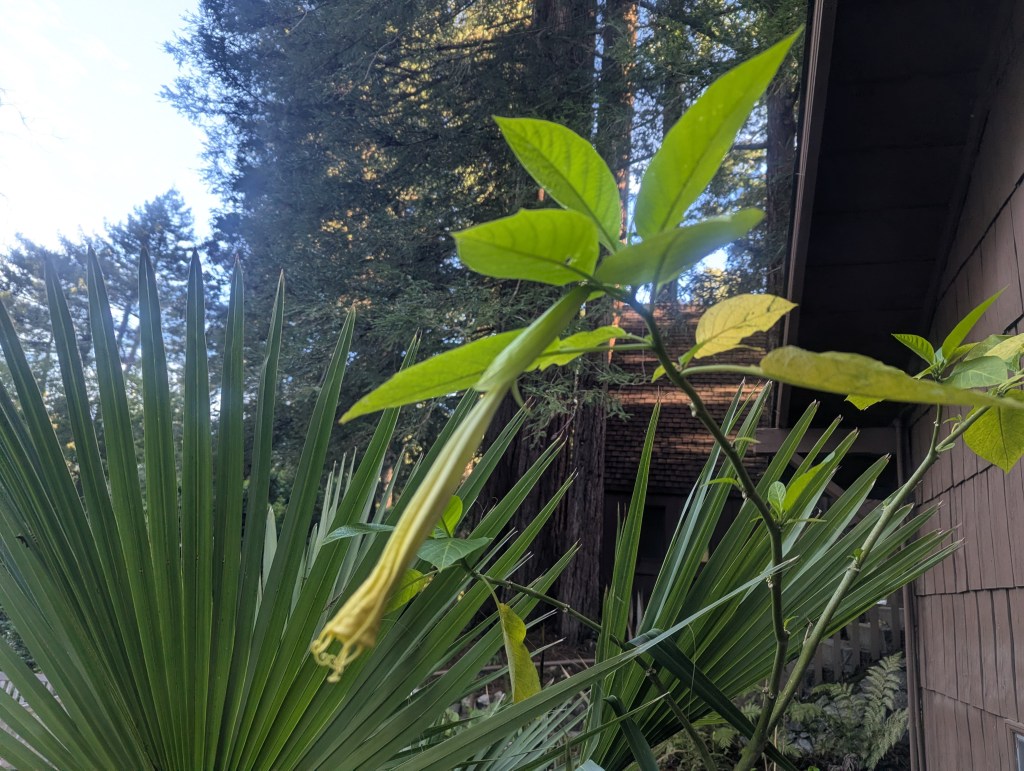
5. Brugmansia X cubensis ‘Charles Grimaldi’ angel’s trumpet is producing a new flower as readily as it produces new foliage. It should be no surprise. it is rarely without bloom.
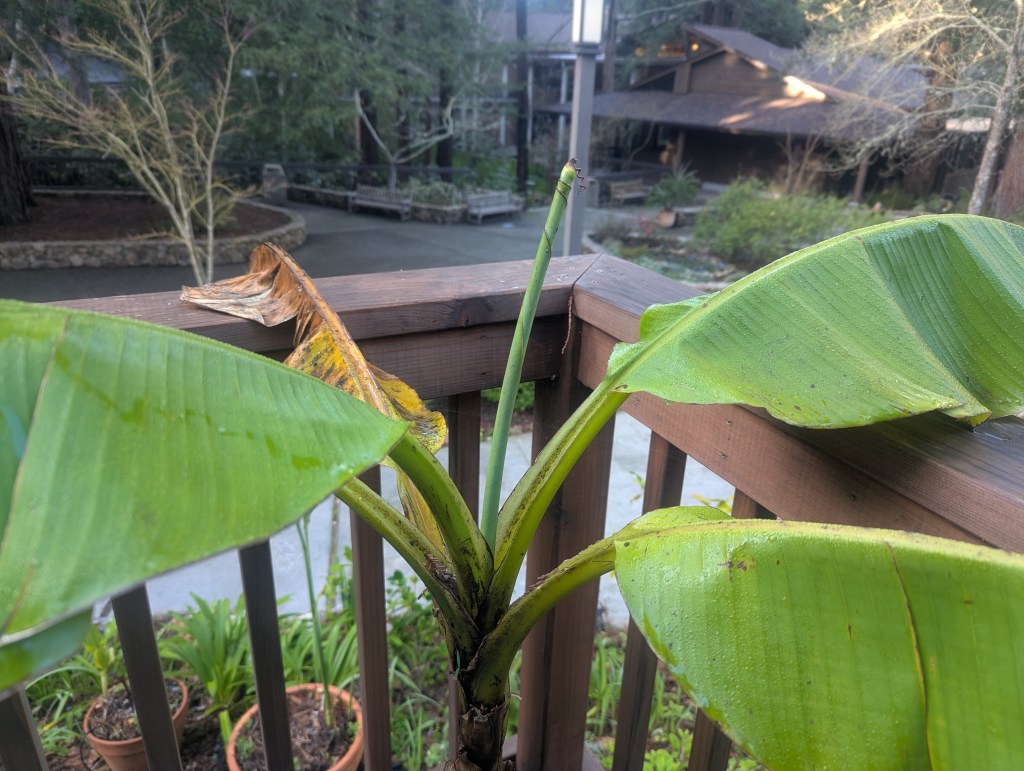
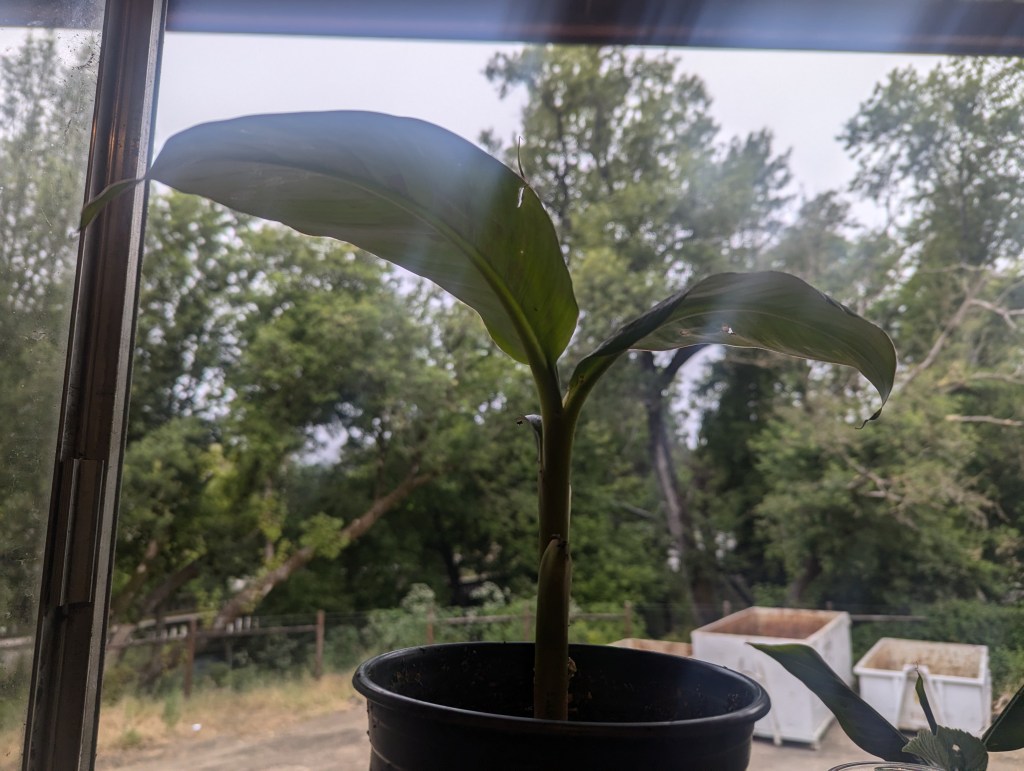
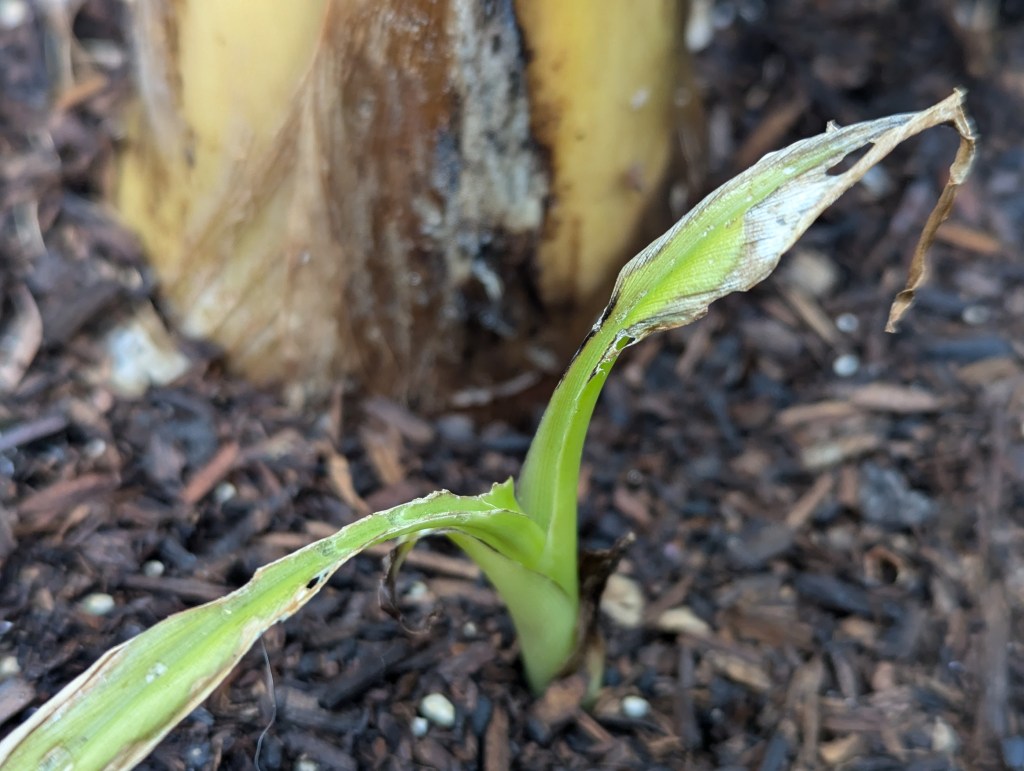
6. Musa acuminata X balbisiana ‘Golden Rhino Horn’ banana starts to produce its new foliage about the time we consider taking it out of the landscape because it is so shabby.
Squirrels have been chewing some of our foliar plants since spring. Now that they found our banana trees, I am more concerned. Their damage is more severe and impossible to ignore.
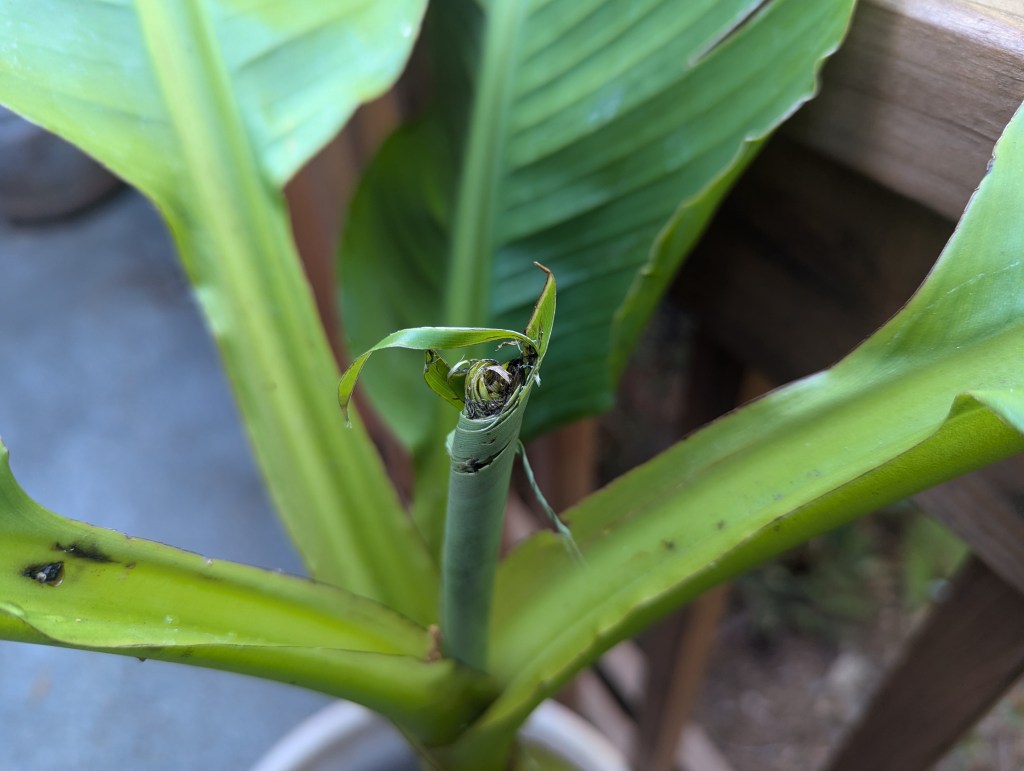
1. Musa acuminata ‘Golden Rhino Horn’ banana got chomped by a squirrel, right where its new leaf is unfurling. A Musa acuminata ‘Ever Red’ banana got chomped at its base! Squirrels are also chomping other cultivars of banana and two species of Chamaedorea.
2. Musa ingens, oem, or giant highland banana demonstrates what a young banana tree should look like without squirrels chomping on them like little arboreal demon beavers. I will be furious if I see any more damage on any of these more prominent banana trees.
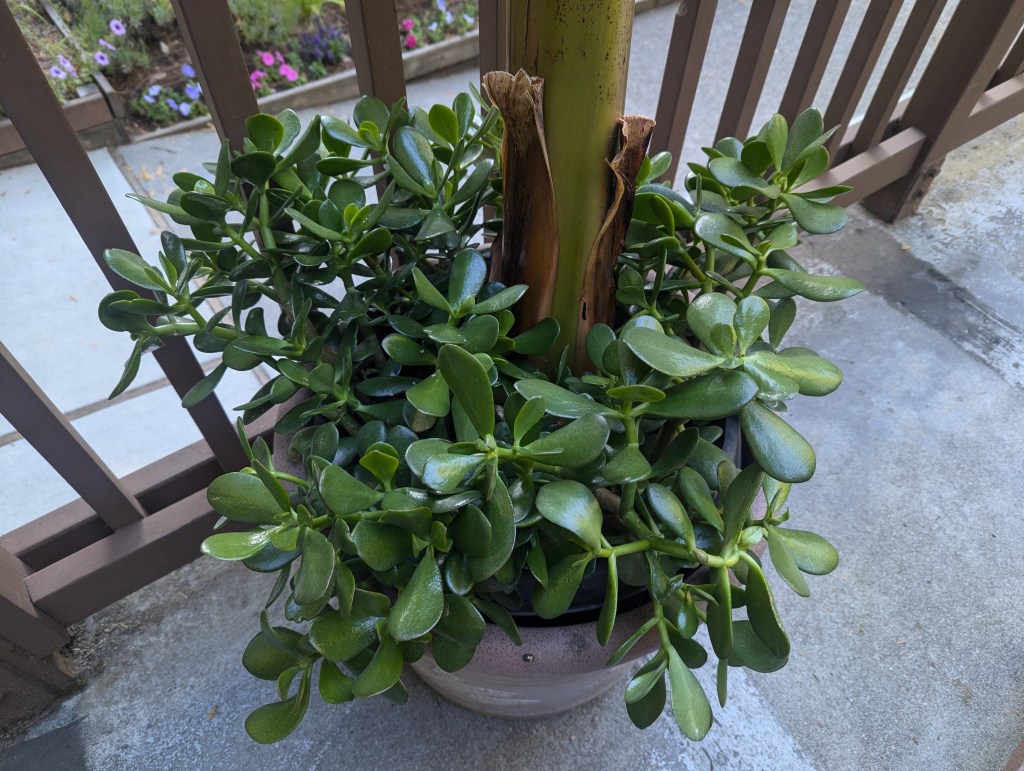
3. Crassula ovata, jade plant is not often considered to be a ‘foliar’ plant, but happens to function splendidly as such by obscuring the otherwise bare bases of several of the small banana trees. It all grew from pruning scraps from one big, old and sculptural specimen.
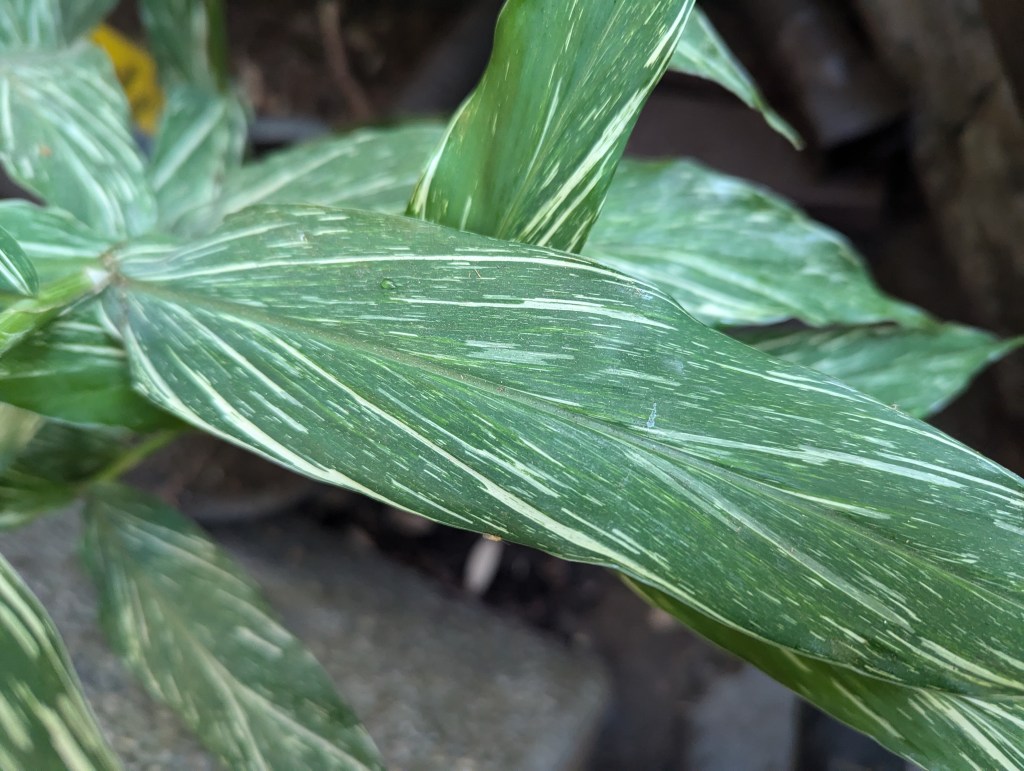
4. Hedychium coronarium ‘Vanilla Ice’ ginger was chomped by squirrels as soon as new growth began to develop last spring. Fortunately, it recovered. Although it appears to be ‘Vanilla Ice’, and likely is, I was told that its flowers are white rather than vanilla yellow.
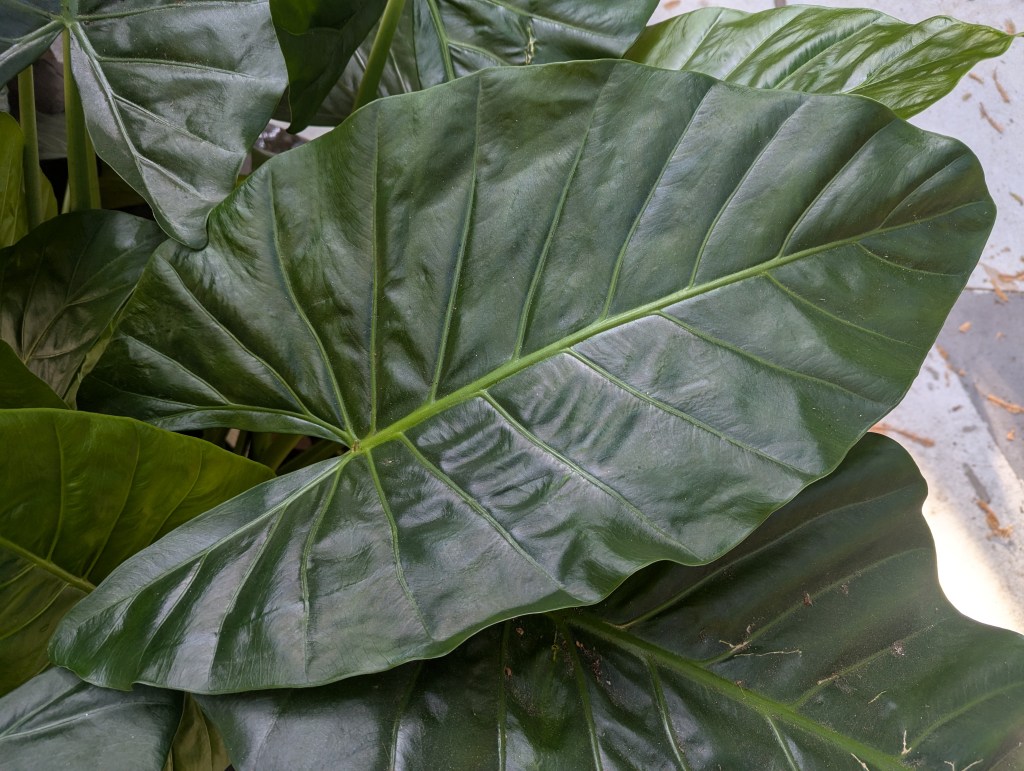
5. Alocasia gigantea, elephant ear was also chomped by squirrels as soon as it started to regenerate foliage last spring, and also recovered. It is quite large now. If its foliage were not so simple, it would be as striking as that of the old fashioned Philodendron selloum.
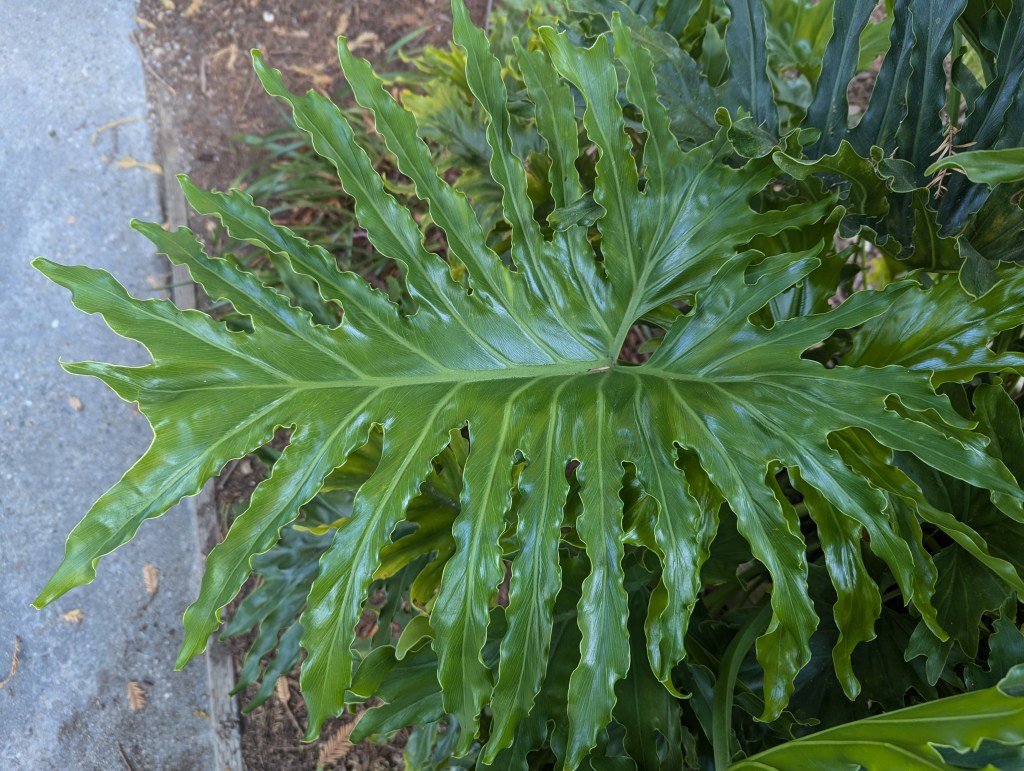
6. Philodendron selloum ‘Lickety Split’ philodendron produces the striking foliage of the species, but not the form. Its multiple trunks are so stout that I have not seen them yet. I suspect that individual leaves do not get very big either. Squirrels have ignored it so far.
Several of these Six were featured here before, and some only recently. They continue to surprise.
1. Musa ingens, oem, or giant highland banana, produced two pups. This is the larger of the two. Although I was told that this is oem, I am not certain. It behaves like the species in some ways, but not others. For example, oem should only occasionally produce pups.
2. Heuchera sanguinea, coral bells does not look coral to me. This looks like simple red. I think of coral as more orangish pink. Is that correct? I can not complain, since I prefer this color. Some of the fancy foliar cultivars here bloom with colors other than coral too.
3. Canna X generalis ‘Cannova Mango’ canna and feral Antirrhinum majus, snapdragon that I posted pictures of two weeks ago are blooming even better together now. Why are some of the best flowers as unplanned as these were? Perhaps I should unplan for more.
4. Helenium autumnale, tickseed was yellow last week. This is literally the same flower. Is this new color orange or red? Was it supposed to be this color, or is this what happens to yellow flowers as they fade? I will need to see how the other two varieties bloom later.
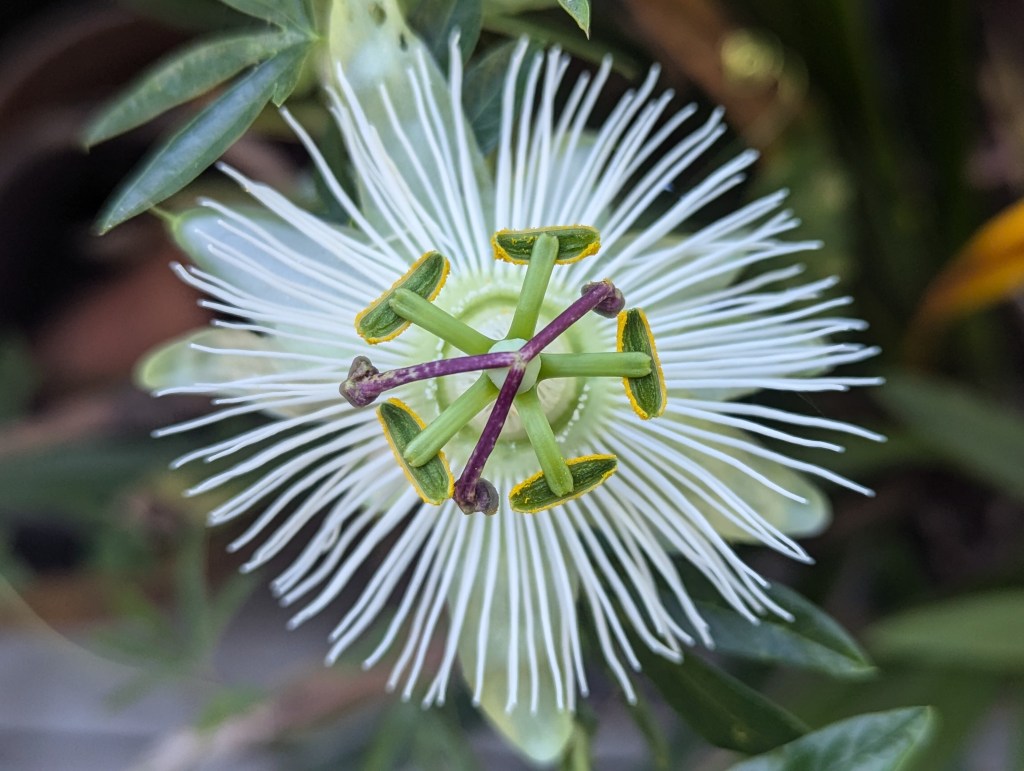
5. Passiflora caerulea ‘Constance Elliott’ passion flower smells like pineapple guava, but only briefly. Its fragrance is gone before I can get someone else to confirm the similarity. The garishness of this bloom does not last very long either. This flower is wilted by now.
6. Rhody rarely cooperates for pictures. He should though, since he is who we all want to see here for Six on Saturday. I would post six pictures of him weekly if he would allow it. Perhaps I should have gotten a picture of Heather too. She cooperates more for pictures.
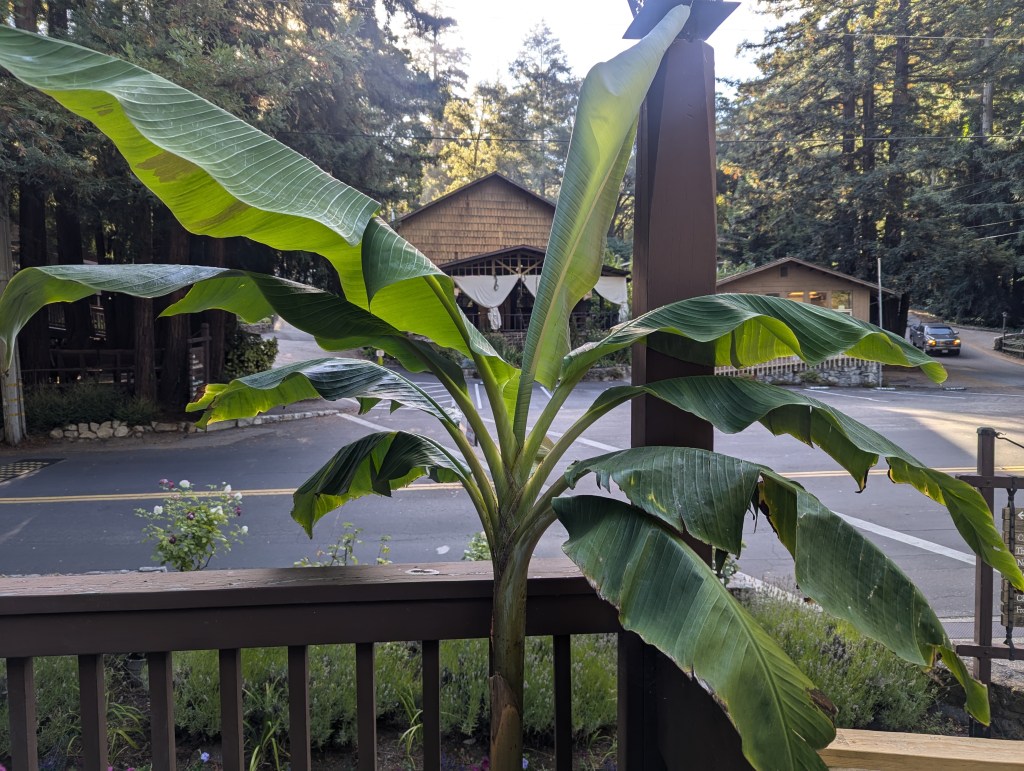
Banana trees have grown slowly through the oddly cool weather of spring. They are only now beginning to slowly recover from last winter.
1. Ariolimax columbinanus, banana slug is obviously unrelated to bananas, but seems as if it should not be. It is about as big as a small banana, but fortunately does not consume much viable vegetation. It prefers redwood detritus. It is rarely out during arid weather.
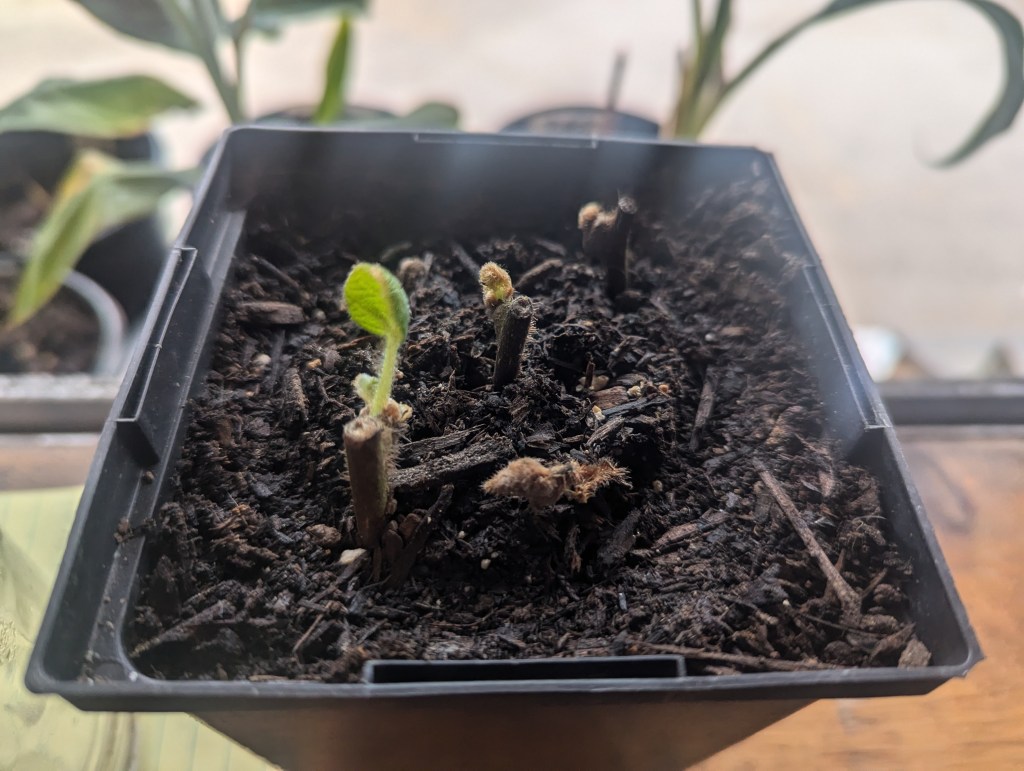
2. Actinidia deliciosa, kiwi vine is obviously as unrelated to bananas as a mollusk, but is something that I want to show off. These remaining three of five original cuttings are my second attempt to grow a male pollinator for a female vine that grew here two years ago.
3. Musa ingens, oem or giant highland banana produced a pup that grew big enough for separation. A smaller secondary pup remains attached as a potential replacement for the primary trunk when it finishes, but additional pups will likely develop through summer.
4. Musa itinerans var. xishuangbannaensis ‘Mekong giant’ banana also produced a pup. It is still dinky and now seems to be blinding out without a new leaf within its latest leaf. Another pup is only beginning to appear. I hope that more pups will eventually develop.
5. Musa, banana of an unidentified species and cultivar is recovering slowly from winter. It was here through last summer, so, unless it is a dwarf, it should be bigger by now. The shabbier specimen to its far left is Musa X balbisiana ‘Blue Java’ or ‘Ice Cream’ banana.
6. Rhody is who everyone who reads my Six on Saturday really wants to see. I have been negligent in posting pictures of him. He is not exactly easy to get a good picture of. Even this picture should have been centered better. Obviously, he knows his fans do not mind.
Oem is beginning its third spring here. Fortunately, it has not yet grown too big to stay. That could change soon now that the weather is warming. I still do not know what to do with it as it grows. It is the largest species of banana in the World, Musa ingens. The foliage of the original pseudostem was frosted enough last winter to get trimmed away, leaving only an unsightly bare trunk. It is only beginning to replace its foliage for this season. Just as readily though, it produced two pups, which will likely grow faster than the original pseudostem did during the last two seasons. They are growing from a larger rootbase. Meanwhile, there are several other cultivars of banana growing here also. There were about fourteen last year. There are about two dozen this year! Only a few will remain compact enough to inhabit the landscapes at work, but even fewer will be appropriate there. Banana trees are not exactly comparable with the style of a redwood forest. Most, including the oem, will likely inhabit a riparian area of my home garden, which is also in a redwood forest. Goodness! I really should have planned this better.
‘Siam Ruby’ banana started to display bronze foliar color before it seemed to revert to chartreuse.
Of the two dozen or so cultivars of banana here, ‘Siam Ruby’ is one of only two that are merely ornamental. It and ‘Zebrina’ produce fruit that is too seedy to be reasonably palatable. Both are instead grown more for their colorful foliage. ‘Siam Ruby’ develops bronze foliage with yellowish green spots. ‘Zebrina’ develops darker bronze or brown color mixed with more but darker green. Since their distinct foliar colors are their primary attributes, I was initially disappointed when ‘Siam Ruby’ seemed to revert to chartreuse green without any bronze foliar color. I was informed that it is typically chartreuse while very young or if shaded, but develops bronze foliar color as it matures with adequate sun exposure. However, I still suspect reversion because it started to display broad bands of bronze foliar color earlier, but became exclusively chartreuse green afterward. While inquiring about the potential for reversion with this particular cultivar, I learned that ‘Margarita’ originated as a reverted sport of ‘Siam Ruby’ with exclusively bright chartreuse foliage, just like the specimen of ‘Siam Ruby’ here that I suspect reverted. So, I may have indirectly acquired a fake copy of ‘Margarita’, which should contrast splendidly with the bronze foliage of both ‘Siam Ruby’ and ‘Zebrina’! The grower who sent the original pup of ‘Siam Ruby’ already sent a replacement. Now I want to see what the original pup does. If it recovers its bronze foliar color, there will be two copies of ‘Siam Ruby’ here. If it does not, I will consider it to be ‘Margarita’, which is still a rare cultivar. In a way, I sort of hope that it does not recover. A glitch such as this is a good excuse to try something that I would not try otherwise. Actually, we already have plans for it.
New foliage of ‘Siam Ruby’ banana is exclusively chartreuse green, without any bronze.
The Hedge on the Ledge continues to develop. Nothing has been added or subtracted from it since its previous update late last July. The vegetation has only grown and been moved about a bit. Perhaps that is an understatement. It has grown more substantially than it should have been allowed to within a situation that it should not actually be in. The only other change is that the pair of parakeet flower pups and the pair of banana pups switched places. It is so overgrown that it obstructs sunlight that would otherwise brighten the associated window. That was not so bad during warm weather of summer. It might not be so desirable as weather cools for autumn. Besides, all of this overgrown vegetation should relinquish its space to smaller vegetation that can benefit from the sheltered position and associated but presently unused heating mat through winter. After all, shelter from minor frost and access to electricity for a heating mat were the original justifications for the installation of this silly shelf below only the half of its window that opens. If I had known that it would still be here, I might have constructed it as a window box instead of an exposed shelf, so that the black vinyl cans and their faded old labels would not be so prominently visible. Eight #1 cans fit neatly onto the shelf, with three 4″ pots nestled into the spaces between them. An elastic strap holds them firmly in place so that they do not get blown off. The vegetation includes:
4 – #1 Solandra maxima ‘Variegata’ cup of gold vine – back row closest to window
2 – #1 Musa acuminata ‘Golden Rhino Horn’ banana – left and right corners of front row
2 – #1 Heliconia psittacorum (unidentified) parakeet flower – middle of front row
2 – 4″ Cucurma longa (unidentified) turmeric – left and right between rows
1 – 4″ Agapanthus africanus ‘Peter Pan’ lily of the Nile – middle between rows
Banana trees, much like palms, arboriform yuccas and cordylines, are herbaceous trees. They develop no secondary xylem, or wood. What seems to be trunks are pseudostems, which are just leaves in very tight bundles. These pseudostems grow from subterranean corms, which can grow rather big. Each pseudostem is monocarpic, so dies after bloom.
Although they are very easy to grow, banana trees are not very popular. They can be too easy to grow, and become overwhelming. In some climates, frost can ruin their foliage for part of the year. In some exposures, their foliage can get shabby from wind. Some expect generous and frequent applications of fertilizer. All want generous and frequent irrigation.
These characteristics are contrary to growing banana trees merely for appealing foliage. Realistically, that is what most are for. Those of the Ensente genus are fortunately easier to maintain, but fruitless. Their lushly huge leaves are spectacular, relatively durable and generate much less debris. However, after a few years, they die without generating pups.
Banana trees of the Musa genus generate fruit, although some are primarily ornamental. A few produce delightfully colorful fruit that is too small, seedy or starchy to be palatable. Musa are more pervasive although less popular than Ensente. While Ensente come and go, Musa are reliably perennial. Several produce enough pups to potentially be invasive.
Musa, unlike Ensente, therefore develops colonies of a few to many pseudostem trunks. A few new trunks can replace each old trunk faster than they can deteriorate after bloom. Removal of deteriorating old trunks promotes growth and fruiting of new trunks. So does culling of congested new trunks. They propagate very easily by division with intact roots.
Because banana trees are tropical, they are unfamiliar with the seasons here. They grow fast with warmth but very slowly without it. They bloom randomly though. Flowers that try to bloom during autumn may stagnate long enough to rot through winter. Late fruit can do the same. Fruit that begins to develop early is much more likely to finish prior to autumn. Some cultivars develop faster.
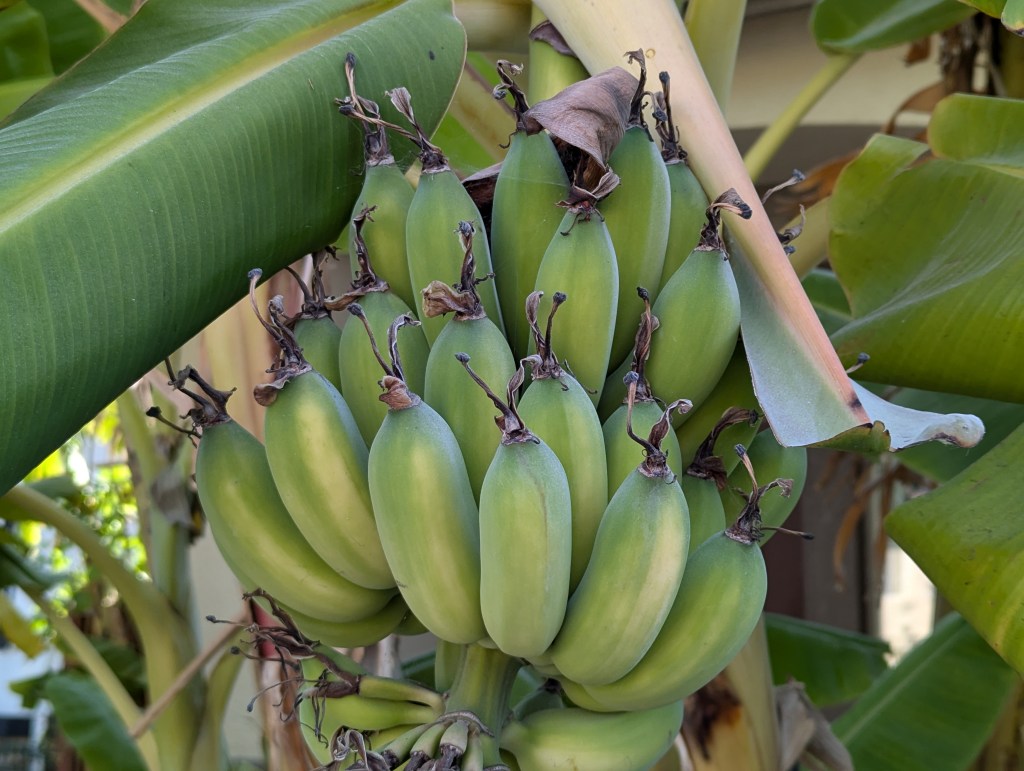
Karpooravalli bananas after removal of their edible male flowers below.
Pronunciation is only slightly easier than when I first tried to read it. Spelling still necessitates cheating, which I do not feel at all guilty about. Karpooravalli is a big name! I must get acquainted with it though, since it will likely be with me for the rest of my life.
Yes, it is another cultivar of banana, which is something else that I do not feel at all guilty about. I have no intention of retaining all of the other twenty or so cultivars that are already here. In the future, I will likely give away most of them to colleagues, without retaining pups. I actually already have plans to install at work the two that are least likely to produce edible fruit, and never grow either in my own garden again.
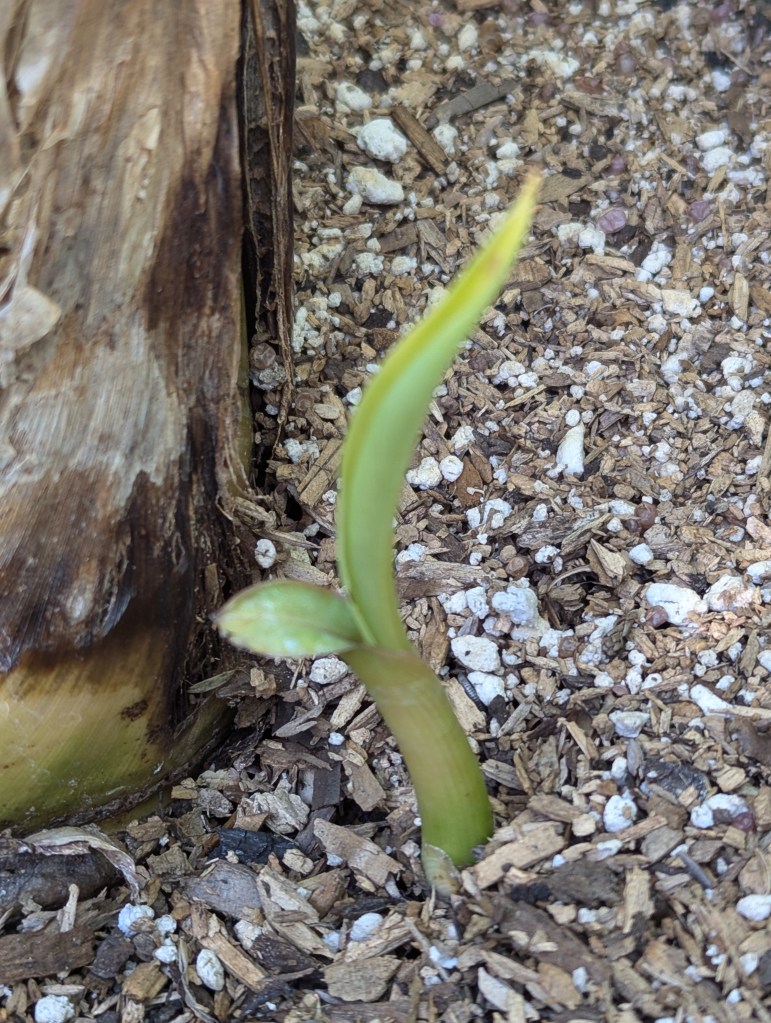
Karpooravalli banana pups
These four new pups of Karpooravalli arrived last Monday, just two days after eight unidentified pupping pups and a single pup of ‘Blue Java’ which is also known as the ‘Ice Cream’ banana. Like these previously most recent acquisitions, as well as another ‘Blue Java’ pup and another unidentified pup that were acquired together last year, these four pups of Karpooravalli are from a private garden. All of the other cultivars here are from nurseries, and most were tissue culture plugs that never actually grew in soil.
That is the dilemma. Cultivars from nurseries are expendable. I can give them away without retaining any copies and not miss them. However, cultivars from private gardens have history, even if I am unaware of it. They are important to someone.
I can give away the recently acquired pup of ‘Blue Java’ only because another pup of it from another important source is already established here, and I knew when I took it that it would not be staying. Also, I can give away almost all of the other unidentified pups that came with it because there are already too many to retain. However, I will retain at least one of them because I know that the cultivar was important to the person who shared it. Likewise, I will retain my first copy of ‘Blue Java’ and the unidentified pup that came with it because they are important to the person who shared them.
Karpooravalli is fortunately one of the more reliably productive cultivars here, and provides sweet fruit with remarkably rich flavor. It is gratifying to know this now because I will grow it for as long as I can tend the garden. This particular Karpooravalli is very important to the person who grew it in her garden for a few decades before sharing it with me, so it is important to me now. I know that I will eventually need to share it with others as it multiplies in the future, but I will prefer to share it with those who respect its importance.
Before I was in kindergarten, I acquired my rhubarb from my paternal paternal great grandfather, and my Dalmatian iris from my maternal maternal great grandmother. Both are growing well in my garden now, and always will. I acquired my common lily of the Nile and the first of my common zonal geranium a few years later. Much of what inhabits my garden now has been with me for many years. Yet, I acquired my first Japanese iris, persicaria and goldenrod as recently as late last winter from Tangly Cottage Gardening. Perhaps it is never too late to start another important tradition.
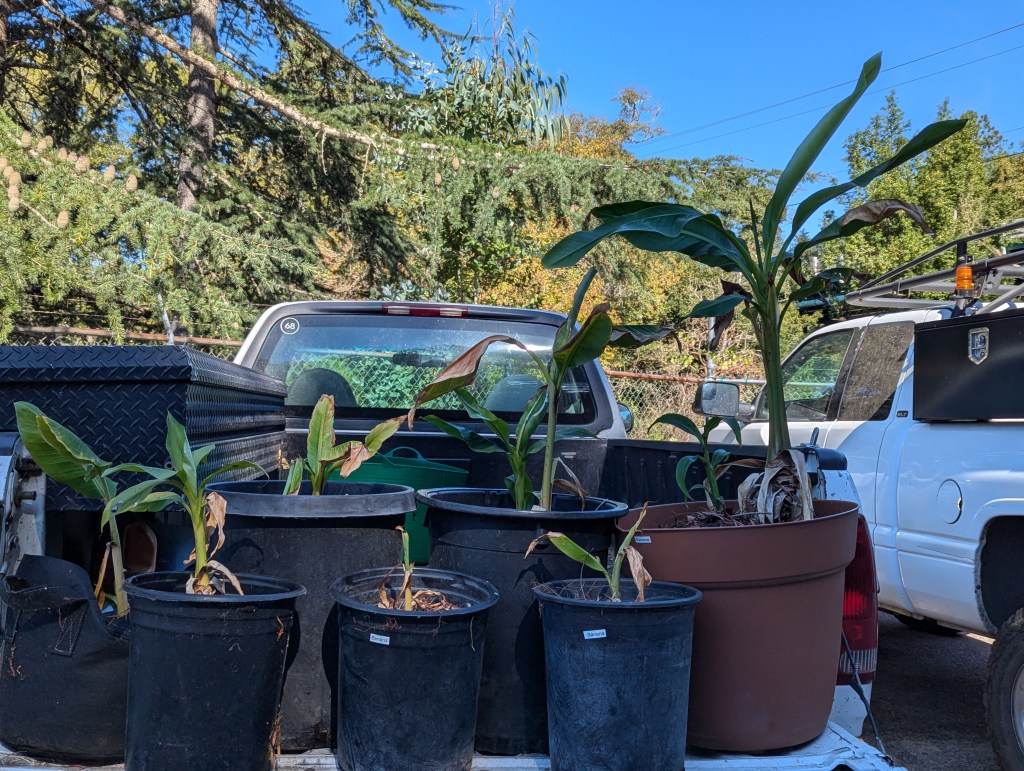
Yes! We have more bananas! I can explain. Although there are as many as twenty cultivars of banana here, almost all are individual pups or tissue culture plugs. (Of these twenty, three are unidentified. Of these three, one is likely a redundant copy of one of the other cultivars, one seems to be completely necrotic without possibility of recovery, and only one is notably distinct.) All but a few arrived earlier this year, so have not yet generated pups. ‘Double Mahoi’ has doubled by generating a single pup. ‘Golden Rhino Horn’ arrived as a pair, and one of the pair is only now beginning to generate another pair of pups. Otherwise, there are no spare pups to share. The only spare pups of ‘Double Mahoi’ and ‘Golden Rhino Horn’ (the one which lacks new pups) may be leaving in the next few days. Whatever remains of these two will most certainly go to another colleague at the end of winter. Another colleague would like to add any spares, regardless of cultivar, to his garden. However, until just now, I could not help in that endeavor. The few in the picture above just arrived from Gilroy because they were in need of a new home. The pup to the far left is ‘Blue Java’, which is also known as ‘Ice Cream’, is redundant to a copy that is already here, so can be shared with a colleague. The others, which are sufficiently numerous for all of us to get copies, are unidentified, which merely means that if they produce fruit, it will be a surprise. Even if their fruit is not palatable, their foliage is good for forage and compost. For the colleague who would like to add any spares regardless of cultivar, they can live in a riparian area of his garden that is too steep, damp and shady for gardening. These pups may not look like much in the picture, but their corms are quite plump, so will provide an abundance of foliage after they get into the ground and the weather warms after winter. Soon afterward, they will generate more pups, but we can worry about that later.








 Tony Tomeo