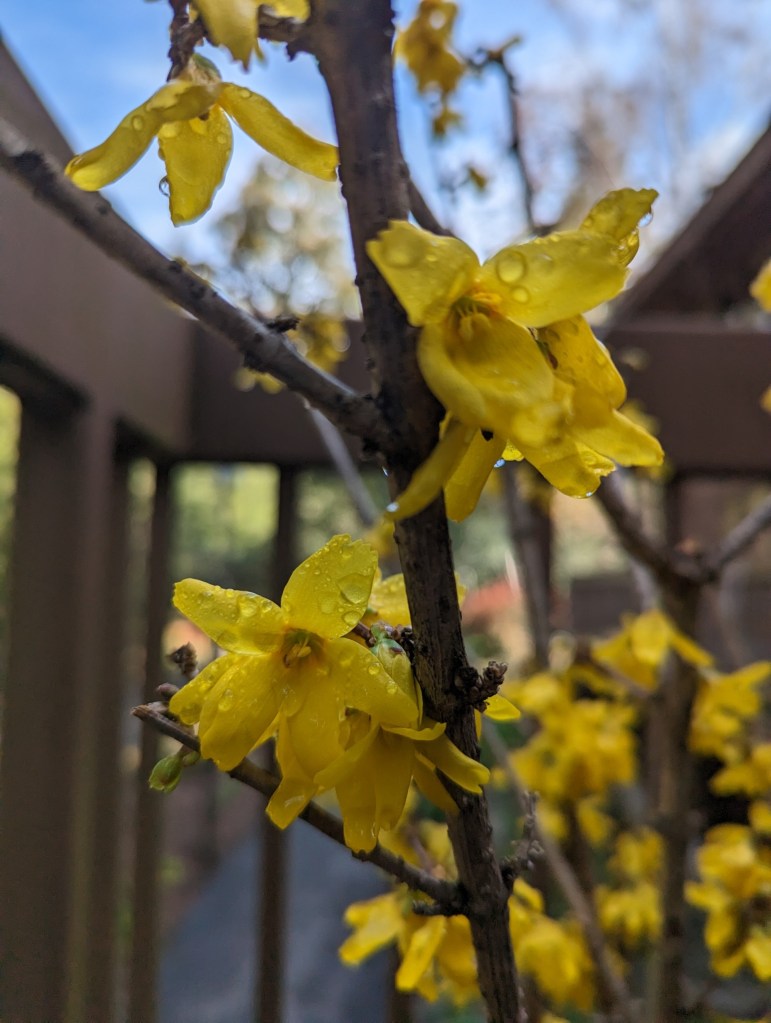
This may seem to be unseasonable for now. Forsythia, Forsythia X intermedia, does not bloom until early spring. However, this is the time to plant it as bare root stock. It is one of only a few fruitless ornamental species that is available as such. New specimens will not bloom much for spring. They grow through summer, though, to bloom for the next spring.
The famously bright yellow flowers of forsythia are small but very abundant. They bloom on bare stems before their deciduous foliage regenerates. The simple paired leaves are about two or three inches long. Mature specimens mostly do not grow more than ten feet tall unless partly shaded. Most branches arch upward and outward from their root bases.
Pruning should involve the removal of deteriorating older canes, to favor younger canes. Complete removal at their base promotes more vigorous new basal growth. Pruning can happen after bloom rather than before. Pruning of the exterior compromises the naturally outwardly flaring form. Complete coppicing eliminates all bloom for the following season.
Wintry weather, although unpleasant at times, has certain advantages. Most importantly, it provides rain here, and snow in the mountains for water reserves. Gardening would be very different with any less. Also, cool weather initiates dormancy for most plant species, giving them a time for rest prior to spring. This is what makes bare root season possible.
Bare root stock is exactly what it sounds like. It is available for sale without the soil that it grew in. Some comes with an individual bag of moist sawdust around its otherwise bare roots. Most merely rests with its otherwise exposed roots in damp sand at nurseries until purchase. Because it is so portable, much is available by mail order, or online purchase.
Bare root stock becomes available now because this is when it is dormant. It comes into nurseries as readily as Christmas trees relinquish their space. Because it is dormant, it is unaware of what is happening to it. Dormancy works like an anesthetic for major surgery. Ideally, bare root stock awakens in its new gardens without any idea how it arrived there.
There are several advantages to bare root stock. It is much less expensive than canned, or potted, nursery stock. It is less cumbersome to bring home from nurseries. Because its roots were never confined, they disperse readily into surrounding soil. For some types of plants, more varieties are available bare root. Several plants are only available as such.
Roses and fruit trees are the most popular of bare root plants. More cultivars of roses are available now than at any other time of year. Fruit trees include primarily stone fruits and pome fruits. Stone fruits include apricot, cherry, plum, prune, nectarine and peach as well as almond. Pome fruits include apple, pear, crabapple and Asian pear as well as quince.
Cane berries, including blackberry and raspberry, are also available with bare root stock. So are perennial fruit and vegetables like strawberry, rhubarb, artichoke and asparagus. A few deciduous but fruitless shrubs, trees, vines or perennials are sometimes available. These might include lilac, forsythia, clematis, wisteria, astilbe and deciduous magnolias. Grapevines and nut trees are also available.
Now that nurseries and garden centers are no longer selling Christmas trees, they have plenty of room for bare root stock. All sorts of deciduous fruit trees, a few deciduous shade trees, shrubs and vines, and even a few perennials can now be purchased while dormant and without the cumbersome media (soil) that the roots need at all other times of the year. Not only is bare root stock easier to handle and transport in small cars, but it is also much less expensive than canned stock (that has roots contained in media, which is contained in nursery cans). Bare root stock typically costs about a third of what canned stock costs.
Bare root stock also has the advantage of adapting to new garden easier, since it does not need to leave the comfort zone of the media that it would have grown into (within a can) in order to venture out into unfamiliar soil. Instead, it starts to disperse roots into the new home soil immediately as it emerges from dormancy in late winter. Without cans, bare root stock can not get root bound. Instead of developing branch structure that is appealing to nursery marketing, bare root stock can get an early start on developing branch structure that is most practical and efficient for the gardens that it gets installed into.
It seems that all of the ´stone’ fruit can be found as bare root stock. These include apricot, cherry, plum, prune, peach, nectarine, almond (which is the seed, or ´stone’, of a peach like fruit) and the odd hybrids of these. The pomme fruits, apple, pear and quince, are perhaps the second most popular of bare root stock, although quince is still rather rare. Ornamental trees, shrubs and vines include flowering crabapple, flowering cherry, flowering quince, alder, poplar, willow, lilac, forsythia, wisteria and clematis. Perennials include rhubarb and artichoke.
Bare root stock can be purchased as soon as it becomes available, but does not do much until it starts to grow in spring. It should get planted quickly and soaked in, but will get more water than it needs from rain afterward. It should not need water again until after it blooms or gets new leaves in late winter or early spring. Despite guarantees of fruit in the first year, none should be expected. The few fruit trees that might set fruit will probably produce only useless underdeveloped fruit because new plants are busy producing new roots and growing. Actually though, this apples to canned stock as well, except only for citrus, olives and other evergreen fruit trees.
Blackberry canes are not at all “low maintenance”!
The fruits of summer are still a few month away. The work necessary to produce them needs to get done now though. Just like bare root trees, bare root raspberry canes get planted while dormant in winter, and later require intensive specialized pruning to keep them in control and to promote abundant production. Canes that are already established need to get pruned now and every winter.
New plants should be planted about two or three feet apart, and then cut back so that only a single bud is visible above ground. Root barriers should keep them from venturing under fences and into neighbor’s gardens, particularly since south or west facing fences are ideal spots to grow raspberries. Alternatively, raspberries can be planted in sunken #15 cans (15 gallon nursery pots), with or without the bottoms cut off. Cans should be buried up to their rims because any exposed black vinyl collects warmth from the sun, which is uncomfortable for the roots within. Mulch should insulate the soil until new foliage provides shade.
The few new canes that should develop during the next few months should be able to support their own weight, but may be easier to work with if tied to a fence or trellis. The popular everbearing types, like ‘September’, ‘Heritage’, ‘Summit’, ‘Golden Summit’ and ‘Fallgold’ may produce fruit on top of their new canes by autumn. The tops of these canes should get cut down as low as fruit developed during the following winter. The remaining lower portions of canes that did not produce fruit in the first year should produce fruit by the second summer, and should be pruned to the ground as the fruit finishes.
As the spent canes get removed, about five to ten of the best new canes should be selected and tied in place if desired. All other canes should be cut to the ground. Like the canes of the previous year, the selected canes should develop fruit on top in autumn and get pruned as they finish in winter, and then develop more fruit down low before getting pruned out during the following summer. This process should be repeated annually.
‘Willamette’, ‘Tulameen’ and ‘Canby’ are traditional summer bearing raspberries. They do not produce in their first year, and will need to be pruned to about five feet tall during the following winter. As these canes develop fruit, many new canes emerge below. Every winter afterward, about five to ten of the new canes should be selected and pruned to about five feet as spent canes and unneeded canes get cut to the ground.
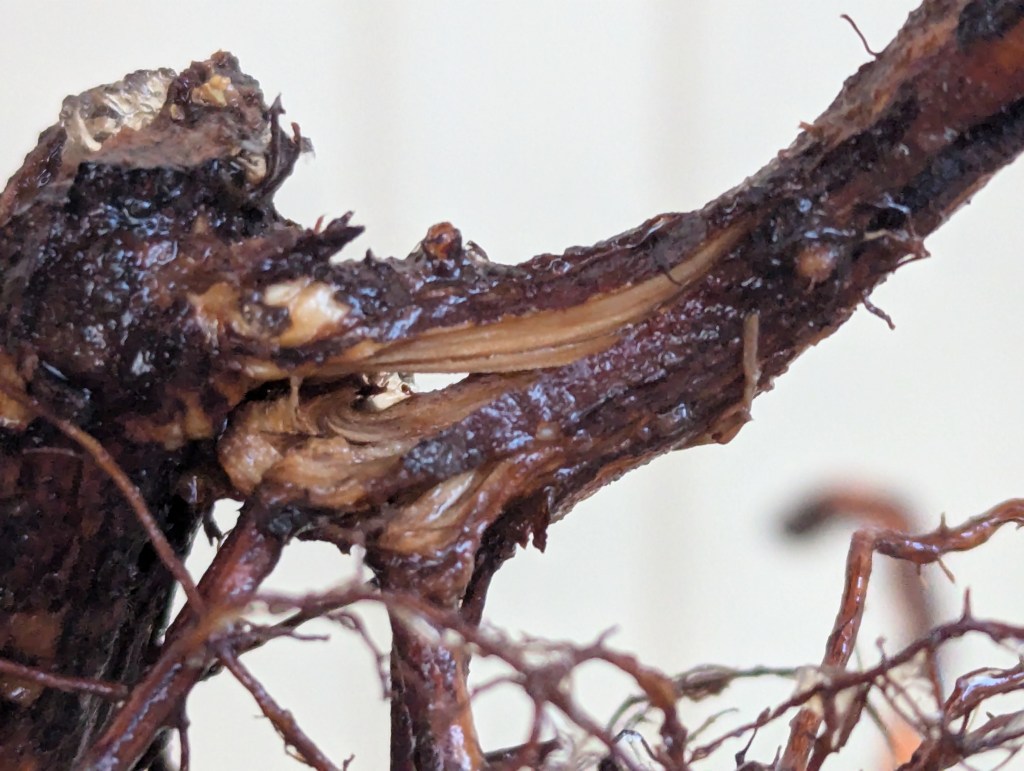
Of a dozen or so items of a mail order purchase that included various cane berries, mulberries, grapes and mayhaws, only a ‘Cumberland Black’ raspberry was less than exemplary. Unfortunately, it was majorly less than exemplary. It was broken at the base of its newest cane, just above where it extended from the older cane that the cutting was made from. If only it had not been broken, it would have been an excellent bare root specimen, with more roots than typical, and a substantial cane with several plump and turgid buds. I realize that it could either extend new canes from latent buds just below where it broke, or extend new roots from the base of the younger cane just above where it broke; so I should simply wait to see what it does. It could even do both, to provide me with two specimens for the price of one. However, I also realize that it could potentially do neither, but instead succumb to its damage. Regardless, its recovery from such damage should not be my concern. It is not in a condition that I intended to purchase it as. The provider should either provide a replacement, or refund what was paid for this particular item. Instead, I was instructed to wait to see if this damaged raspberry cane recovers. Well, at least I got a response. Perhaps that is all that is necessary. I am now more intent on keeping this raspberry cane alive, partly because I doubt that its purchase would be refunded if it succumbs to its damage, and partly because I would likely be to embarrassed to request such a refund if it becomes justifiable. Besides, as I mentioned, all other items of the purchase are of exemplary quality. I should be satisfied with that.
As soon as any unsold Christmas trees move out of nurseries, bare root plants move in. Like Christmas trees, bare root plants are available within a limited season, while they are dormant through winter. They will all be gone by the time they start blooming and producing new foliage at the end of winter.
Bare root plants of course have ‘bare roots’, without typical media (potting soil) contained within cans or pots. Some get their roots wrapped in lightweight coarse sawdust to keep them moist without too much bulk. Others get their roots heeled into moist sand in nurseries, so that they can simply be dug when purchased.
Because bare root plants need much less space than canned (potted) plants, many more different kinds of deciduous fruit trees, roses, grapes, berries and even a few ornamentals are available. Bare root plants also cost about half as much as typical canned plants.
Since no nursery can stock all of what is available, more varieties are available from mail order catalogues and online. Most of what is available in local nurseries is selected for local climates. Plants purchased from catalogues or online need to be selected accordingly.
A main advantage of bare root plants is that they get established in the garden more efficiently than typical canned (potted) plants do. They get dug, transported and replanted into the garden all while dormant. By the time they wake up in spring, they are already in their new home, where they immediately adapt and start to disperse their roots into relatively uniform soil. Canned plants have confined roots that must disperse into unfamiliar garden soil
Bare root plants should get into the garden as soon as possible. If they do not get planted immediately, plants that were pulled from sand in nurseries should get heeled into damp soil or mulch, and watered to settle the fill. Alternatively, they can wait with their roots in buckets of water for a day to two. Bare root plants that are wrapped in bags of sawdust should be safe for more than a week in the shade outside.
Planting holes should be just large enough to accommodate the roots. If too deep, the loosened soil below is likely to settle and sink. Soil can be mounded into a small cone (known as a ‘volcano’) in the middle of each hole to spread roots over. Graft unions (seen as kinks low on trunks of fruit trees or where rose plants branch) of grafted plants should stand above the surface of the soil. Backfill soil should only be amended lightly, if at all.
Even though dormant plants get more moisture than they need from rain through winter, freshly planted bare root plants should get soaked twice immediately after planting to settle the soil around their roots. Lastly, damaged or superfluous stems can be pruned off. Most bare root fruit trees have much more stems than they should for padding in transportation and to allow more options for pruning.
Gardening is dynamic. It must adapt as each season becomes the next. Autumn became winter. Then, suddenly, the Christmas Season became bare root season. Cut Christmas trees that did not sell became green waste. Formerly expensive live Christmas trees that did not sell became bargains. They must relinquish their spaces for fresh bare root stock.
The chronology could not be better. Christmas trees are seasonable while not much else is. Their season abruptly ends precisely as bare root season begins. Bare root season is contingent on the winter dormancy of all associated bare root stock. While dormant, such stock is unaware of what is happening. Otherwise, it would not survive such techniques.
Bare root stock grows in the ground on farms. The roots become bare by separation from their soil during winter dormancy. They should be comfortable within the soil of their new gardens before dormancy ends. They disperse new roots into their new gardens as they resume growth after dormancy. Therefore, transition from farm to garden should be quick.
Some bare root stock arrives by parcel delivery with damply wrapped and bagged roots. More is available from nurseries, with its roots relaxing within damp sand until purchase. Some is available within individual bags of damp sawdust. Most bare root stock benefits from generally minor trimming or grooming. All benefits from prompt and proper planting.
Bare root season is the best time to procure and install several types of plants. Bare root stock is significantly less expensive than canned stock. It is also much less cumbersome to bring home from nurseries. Because bare roots were never confined within cans, they disperse more efficiently. Formerly canned root systems must recover from confinement.
Deciduous fruit trees and roses are the most popular bare root plants. More cultivars are available during bare root season than as canned nursery stock later. Several deciduous but fruitless trees, vines and shrubs are also available. So are a few types of berries and perennials, like rhubarb, asparagus and artichoke. Bare root season finishes with winter.
Like these dormant fruit trees, raspberry canes should go into the garden during bare root season.
My grandmother would have gotten better results by sending me out to the garden for zucchini. She should have known better than to send me out for raspberries. I could have brought in as many zucchini as she wanted in a short while. With raspberries though, I was gone too long, and returned with meager spoils and diminished appetite.
Neither raspberries nor zucchini will be exploitable for a few more months. Raspberries though, can get planted about now. Also, established raspberry canes should be pruned about now to promote abundant production later. Just like most deciduous fruit trees and blackberries, raspberries are not ‘low maintenance’, and require intensive specialized pruning.
New bare root plants should be spaced about two to three feet apart and mulched to insulate the soil until they develop enough foliage to shade their own roots. Their canes can then be cut back so that only a single bud is visible above ground. Because raspberries spread, root barriers are sometimes useful to keep them out of neighbors’ gardens.
Through summer, new plants should produce three or more new canes. These canes should be able to support themselves, but are less rampant if tied to a trellis or wire. I like to train them onto a fence like grapevines, because there are not many other uses for a fence.
The more popular everbearing cultivars like Heritage, September, Summit, Golden Summit and Fallgold may develop fruit on the tops of their new canes during their first autumn. During the following winter, the tops of the canes should be cut back as far down as fruit developed. The remaining lower portions of their canes that did not develop fruit in the first year will do so during their second summer, and should get pruned out as they finish producing.
At about the same time, about five to ten of the best new canes should be selected, and trained if desired. Superfluous canes should be cut to the ground. Like their predecessors, the remaining selected canes should fruit on top during autumn, get pruned in winter, and fruit again during the following summer before getting pruned out. This process should be repeated annually.
Summer bearing cultivars like Willamette, Canby and Tulameen should not fruit in their first year, and should be pruned to about five feet tall during the following winter. Every subsequent summer, many new canes emerge as the older canes bloom and fruit. Every subsequent winter, about five to ten of these new canes should be selected, tied to support if desired, and pruned to about five feet tall, as all spent canes and superfluous new canes get cut to the ground.
Black and purple raspberries are shrubbier, so get pruned differently than the more traditional red and yellow raspberries do. During their first summer, canes should be pruned back to about two feet to promote branching. All except about six or seven of the best of these canes should be removed over winter. The side branches of the selected canes of black raspberries should then get pruned to about half a foot long. Side branches of purple raspberries can be twice as long. After these canes finish fruiting during the following summer, they should be cut to the ground. New canes can then be pruned like during the first summer so that the process can be repeated annually.
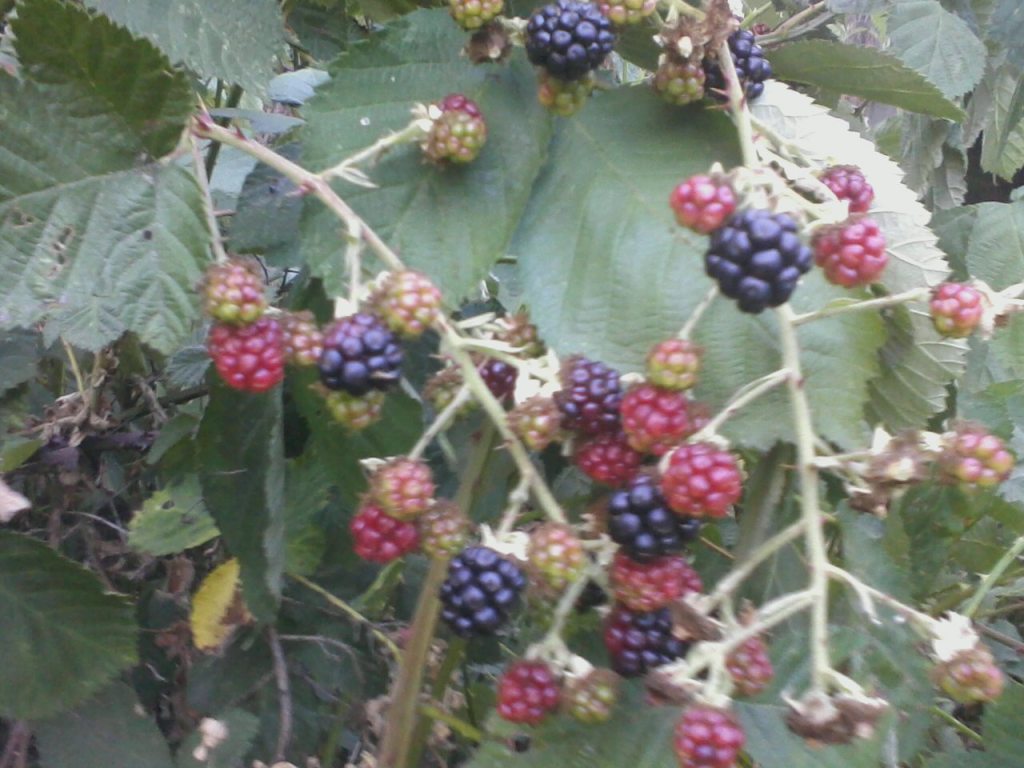
Dormant blackberry canes are now available with other bare root stock.
One of my favorite modern California impressionistic paintings depicts suburban gardening of the post agricultural period in the Santa Clara Valley. It is a finger painting that I made in kindergarten at Bucknall School in about 1972 or 3, to illustrate some of my favorite features of my grandparents’ garden in Santa Clara. To the left is a vertical brown stripe below green squiggles with black spots; the avocado tree. To the right is a similar image with red instead of black spots; the cherry tree. Between and below these, and lacking a vertical stripe, is a flurry of green squiggles with more black spots. These are blackberry canes.
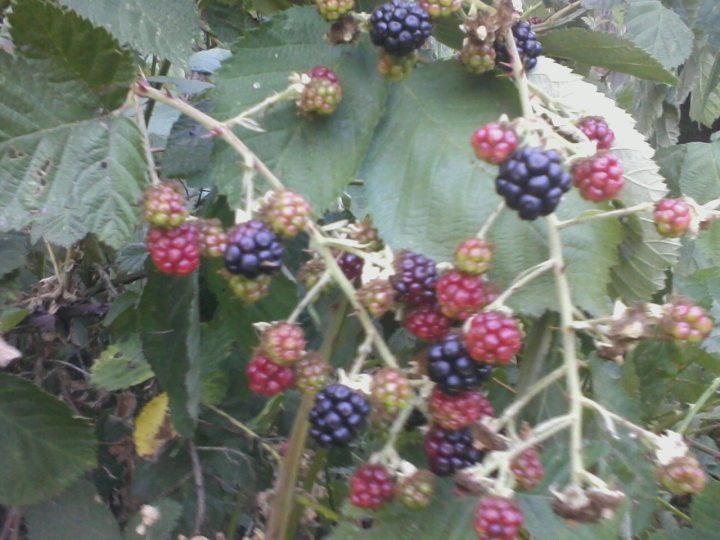
Blackberries are not at all ‘low maintenance’ since they require rather intensive specialized pruning. Most of the work that they need gets done during summer; but bare-root blackberry plants become available and get planted this time of year with other bare-root plants. Blackberries produce fruit on biennial canes which grow during their first year, and then bloom and fruit during their second year before dieing out.
Once the tough roots are established, there is no shortage of fresh new canes to replace the old canes. In fact, surplus young canes can be dug and divided with roots to propagate new plants during winter. Because they have a way of spreading outward, blackberries should not be planted too near to neighbors’ fences without root barriers to keep them contained.
The most popular blackberries locally are ‘trailing’ types such as ‘Boysen’, ‘Marion’ and ‘Olallie’, which are also known as ‘Boysenberry’, ‘Marionberry’ and ‘Olallieberry’. Less common ‘erect’ types, such as ‘Arapaho’, ‘Chickasaw’, ‘Choctaw’ and ‘Navaho’, are more tolerant to cold winter weather, so are more popular where winters are more severe. Hybrids of trailing and erect blackberries are ‘semierect’, and are generally treated like trailing types.
After they get planted in winter, trailing and semierect blackberry canes can do whatever they want to through their first year. In their second year, canes should be trained onto trellises or wires until they have finished fruiting in summer. When the fruit is finished, these canes should be cut to the ground.
Some of the canes that were growing on the ground below the trellises while all this was going on should now be trained like the canes that were just removed. For trailing types, about ten to fifteen of the best canes should be selected, trained and pruned to about six or seven feet long. About half as many canes of semierect types should be selected and pruned about a foot shorter. All remaining canes should be cut to the ground. (A few of the smallest remaining canes may be left intact through summer to be divided for propagation in winter.)
Side branches grow from the pruned canes through late summer and early autumn. At the end of the following winter, these side branches should be pruned to about a foot long. New growth from these stems blooms and fruits during the following summer. Again, when fruit is gone, the spent canes get cut to the ground so that the process can be repeated.
Erect blackberries do not need to be trained onto support. Canes that develop during their first year can be cut to about two and a half feet tall in the middle of summer. Resulting branches should be cut about a foot long in winter. During the following summer, these fruiting canes should be cut to the ground as fruit is depleted. New canes can then be pruned like the previous canes were.
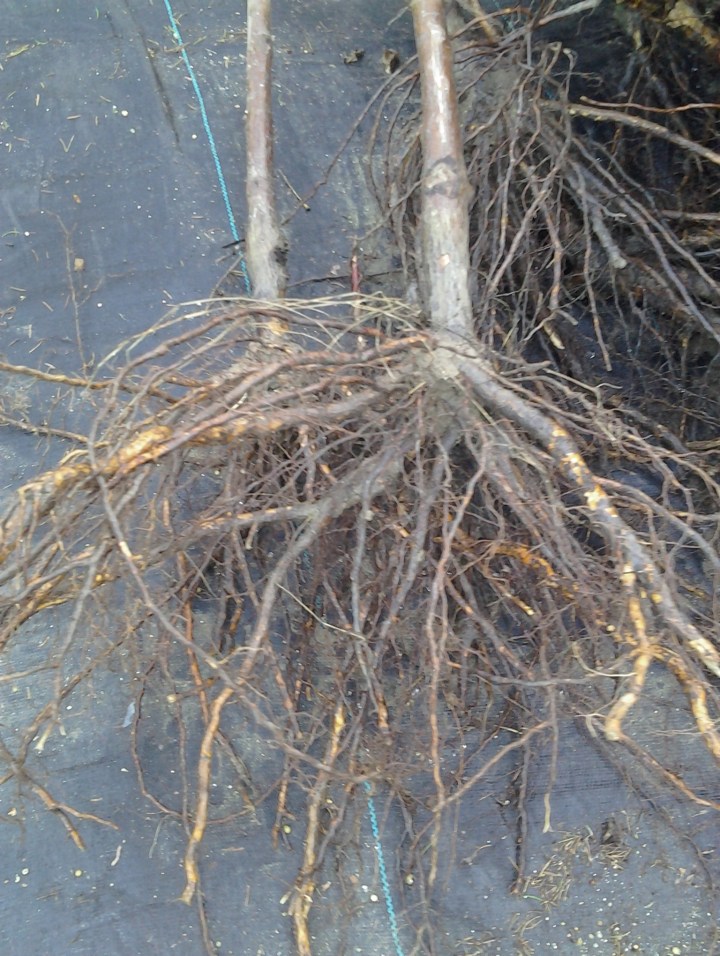
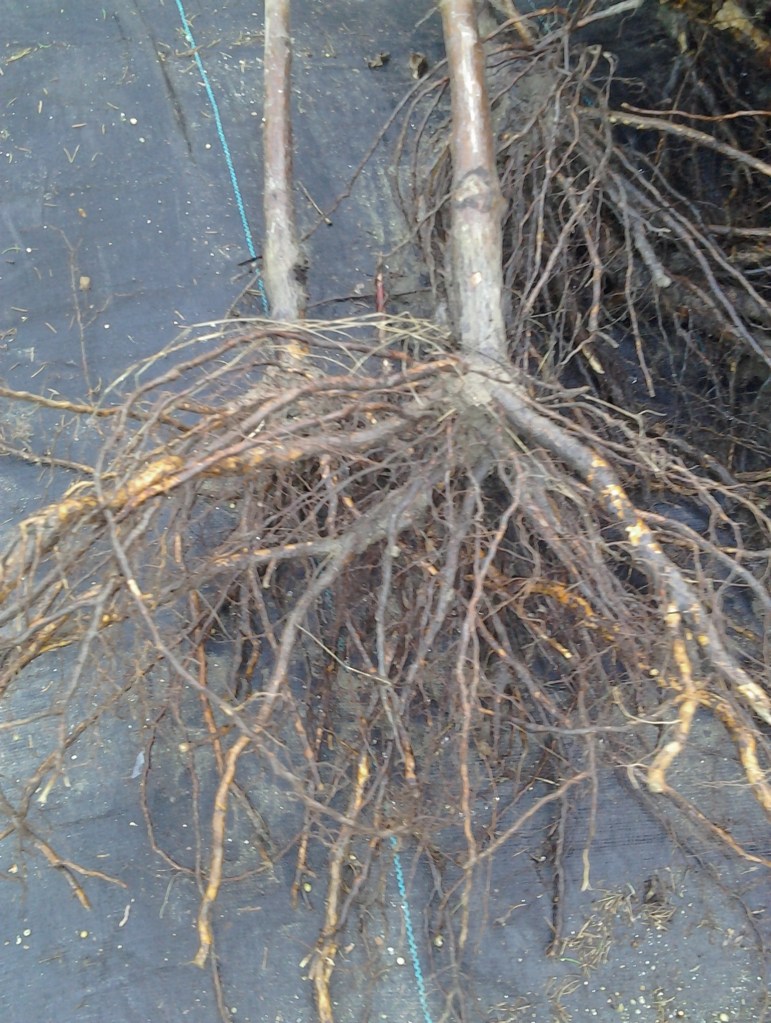
Bare root stock is none too pretty in the beginning.
Now that Christmas trees have been moved out of the nurseries, it is time for bare root plants to move in! As the term implies, bare root plants have ‘bare roots’, lacking typical media (such as potting soil) which is typically contained in cans or pots. All sorts of deciduous fruit trees, roses, grapes and berries can be purchased bare root, either bagged with moist wood shavings, or out of the ‘sand boxes’ that they are heeled into in the nurseries. Even more are available from mail order catalogues. (Just check climate zone ratings for mail order stock.)
I purchased all of my deciduous fruit trees bare root mainly to save money. Bare root stock typically costs about half of what canned stock (grown in a nursery can or pot) does. Also, because bare root stock does not take up as much space as canned stock does, more varieties can be brought in and made available during bare root season.
Bare root stock gets established into the garden more efficiently than canned stock does. It gets dug, transported and planted while dormant; and can disperse roots into relatively uniform soil immediately after dormancy. However, stock that gets canned wakes up in spring in uncomfortably warm and confining nursery cans. After adapting to nursery conditions, it must then adapt to new garden environments, and disperse roots into soil that is very different from what it already rooted into.
Bare root stock should be planted as soon as possible after it leaves the nursery so that roots do not get too dry. If they can not get planted immediately, plants that were pulled from sand boxes in nurseries should get their roots heeled into (covered with) damp soil. Bagged stock in original packaging is safe for a few days in the shade.
Roots should be soaked a few hours before planting. I prefer to instead keep roots well watered for a day after planting. Broken or damaged roots should be pruned away before planting. Damaged and superfluous stems should be pruned away after planting.
Planting holes for bare root stock can be wide enough to loosen surrounding soil, but should be no deeper than necessary. Plants are likely to settle too deeply if the soil below is too loose. All roots should be buried while graft unions (the odd ‘kinks’ low on the trunks of grafted trees) remain exposed. Soil can be mounded firmly into a ‘volcano’ in the middle of each hole to spread roots over. Backfill soil can be amended lightly; not so much that it is too different from surrounding soil.
A basin should be formed around each new bare root plant so that roots can be soaked and settled in by filling the basins with water twice. Bare root plants are initially dormant and lack foliage, so do not need water again until they develop foliage, and the soil gets dry in spring. Besides, rain and cool weather will keep the soil wet through winter.


 Tony Tomeo