Contractions are awkward for me. I certainly could use them if I want to, I just prefer not to. It is a pointless habit that I should be more comfortable with breaking sometimes.
Another habit that I should indulge in less is the use of six different cultivars of the same species for my ‘Six on Saturday’ posts. I have done it for camellias, rhododendrons, roses, flowering cherries, bearded iris, African daisies and a few other species, including various annuals. I refrained from featuring six azaleas simultaneously for yesterday morning, although I did feature three bearded iris, which comprised half of the ‘Six on Saturday’. I should remember to limit azaleas to three pictures, or preferably two or one, if I feature them on ‘Six on Saturday’ later, as they continue to bloom.
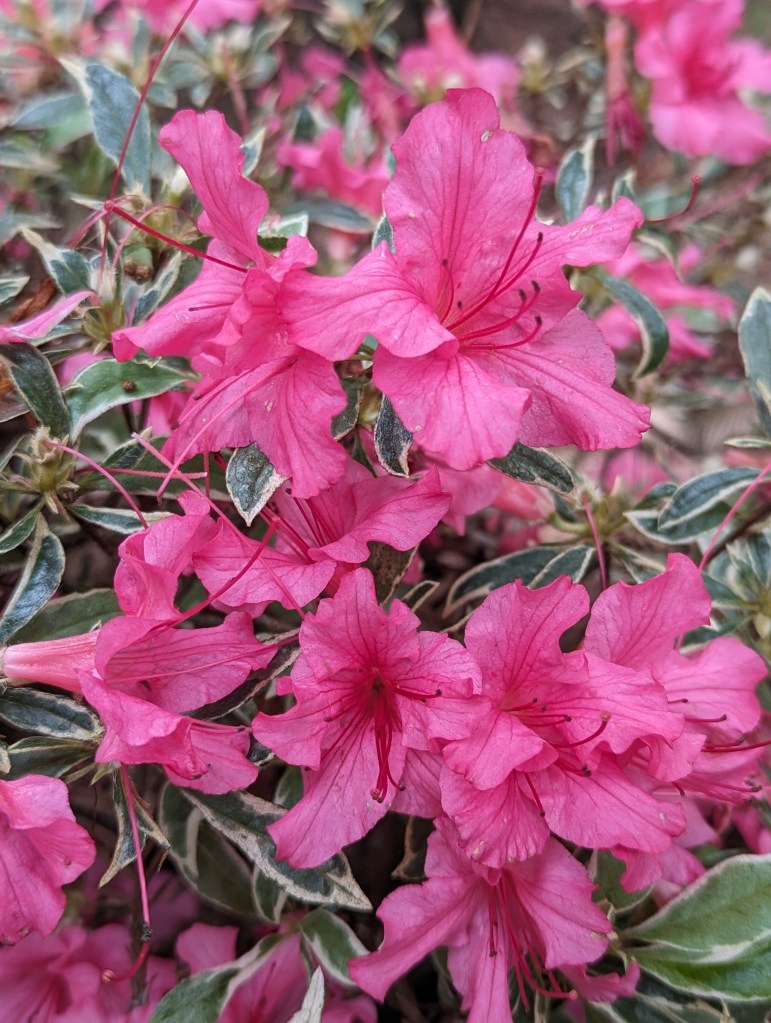
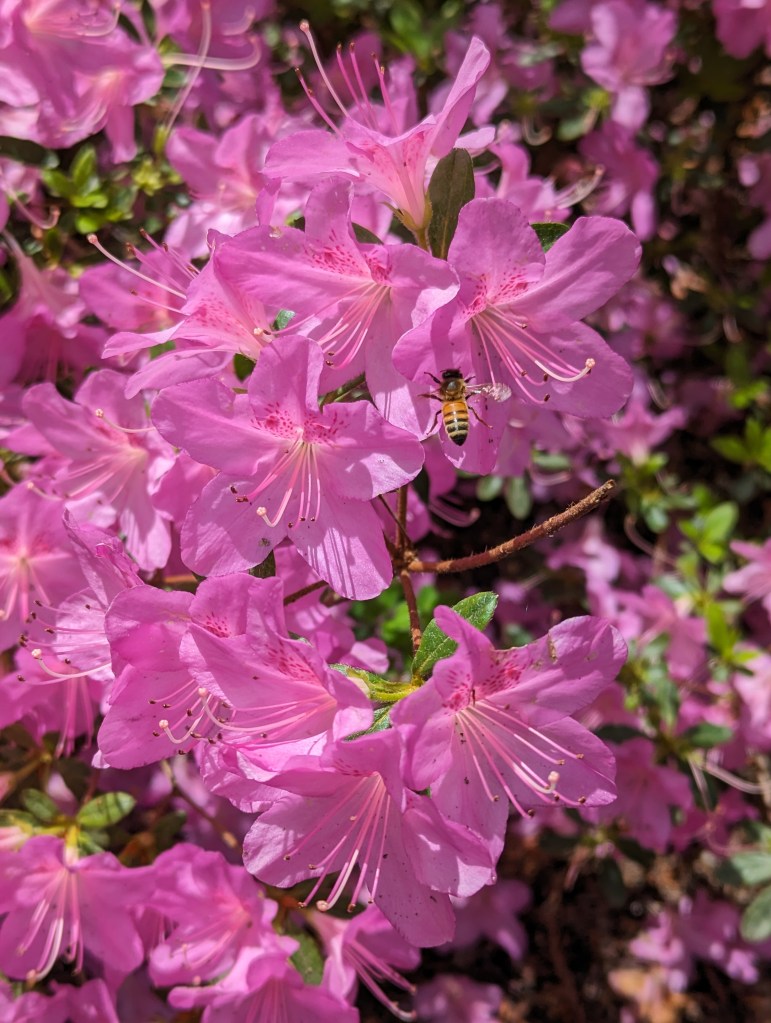
These two pictures of azaleas were omitted from my ‘Six on Saturday’ post yesterday because, as the theme implies, such posts are limited to six pictures. Perhaps I should have used one or both of these pictures instead of one or two pictures of bearded iris. It is too late now.
The first azalea above is variegated. Its leaves resemble those of variegated andromeda. I do not remember what cultivar it is, although the label remains attached to at least one specimen. At least three specimens inhabit the same landscape together. They are blooming better this spring than they have in the past, perhaps because, annually, they are bigger and more established than they were for their previous season.
Relative to the many azaleas here, the second azalea below is nothing special. I like this particular picture because it happens to show a bee visiting the bloom. My pictures tend to be more technical than artistic. Perhaps I should try to include a bit of wildlife sometimes.
 They were impossible to miss. They came at a weird time too.
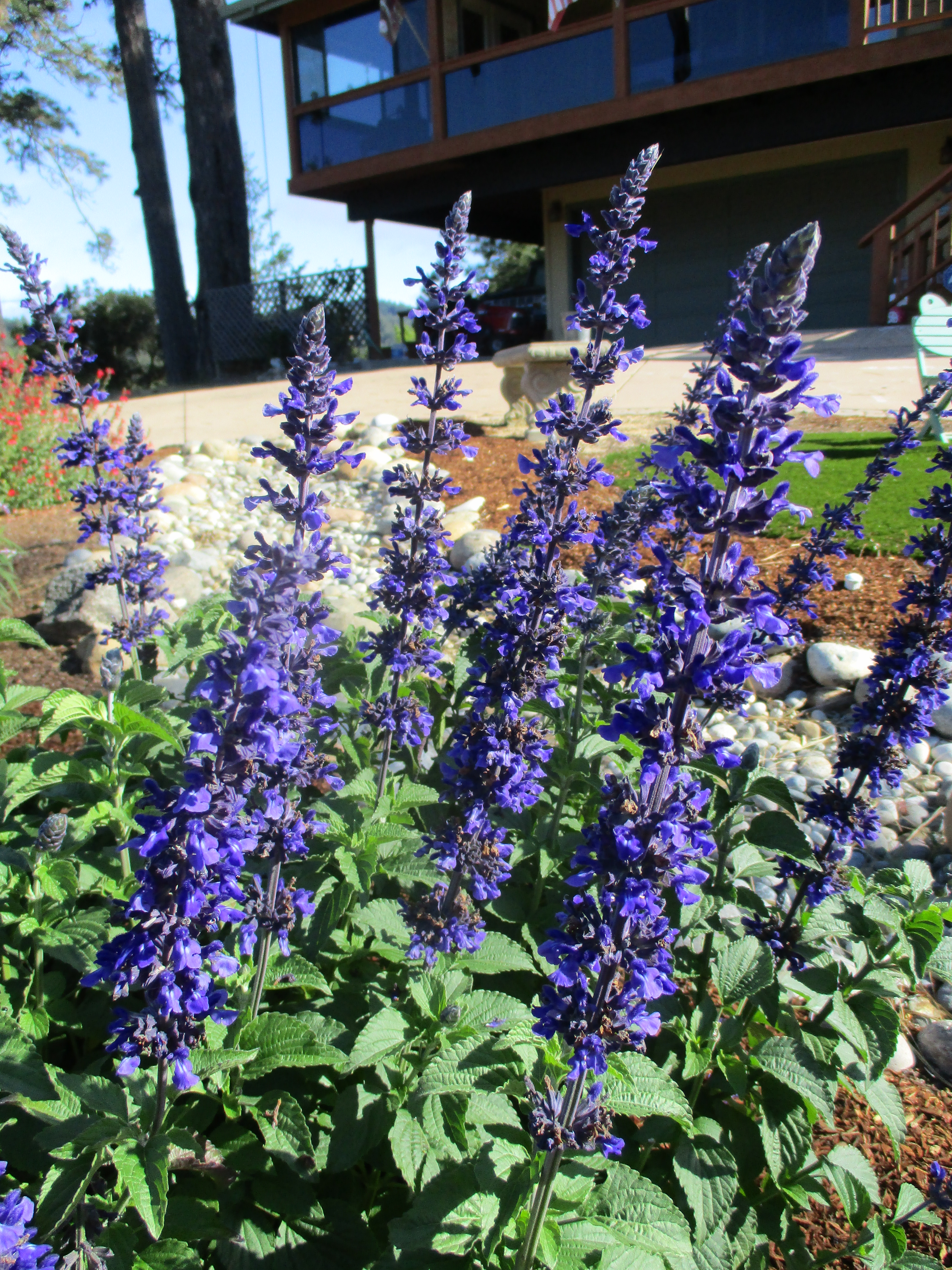 Once it gets started in late spring, ‘Mystic Spires Blue’ salvia has potential to bloom until autumn. It only needs older floral spikes pruned away as they fade (deadheading) to stimulate new bloom. If it gets overworked and lanky without deadheading, it can be cut back in the middle of summer to start a new bloom cycle all over. It can get more than three feet tall and almost three feet broad.
 There is so much more to gardening than mere horticulture. There is so much more to horticulture than mere plant life. Plants get eaten by insects and animals, and also take advantage of insects and animals for pollination and dispersion of seed. Some of us who enjoy gardening also like to attract some types of animals and insects to our gardens because they are nice to have around.
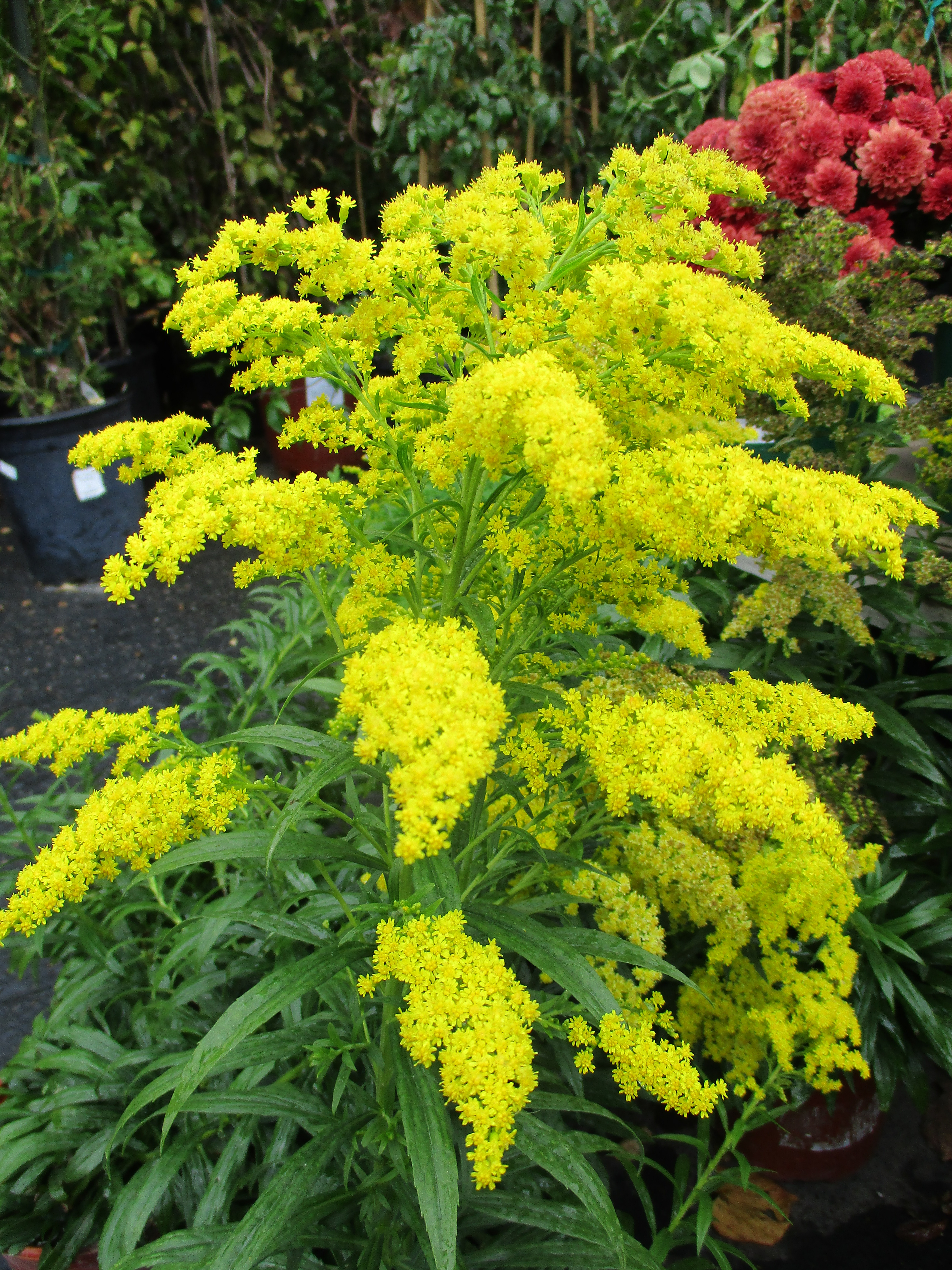 Here on the West Coast of California, most of us know goldenrod only as a color of crayon. In most other parts of America though, it is a common wildflower that is colorful enough to be popular in home gardens. Yet, with more than a hundred specie, it is hard to say exactly which goldenrod, (Solidago spp.) the crayon color corresponds to. All are some shade of gold or yellow, but some are a bit more orange than others.
 Tony Tomeo