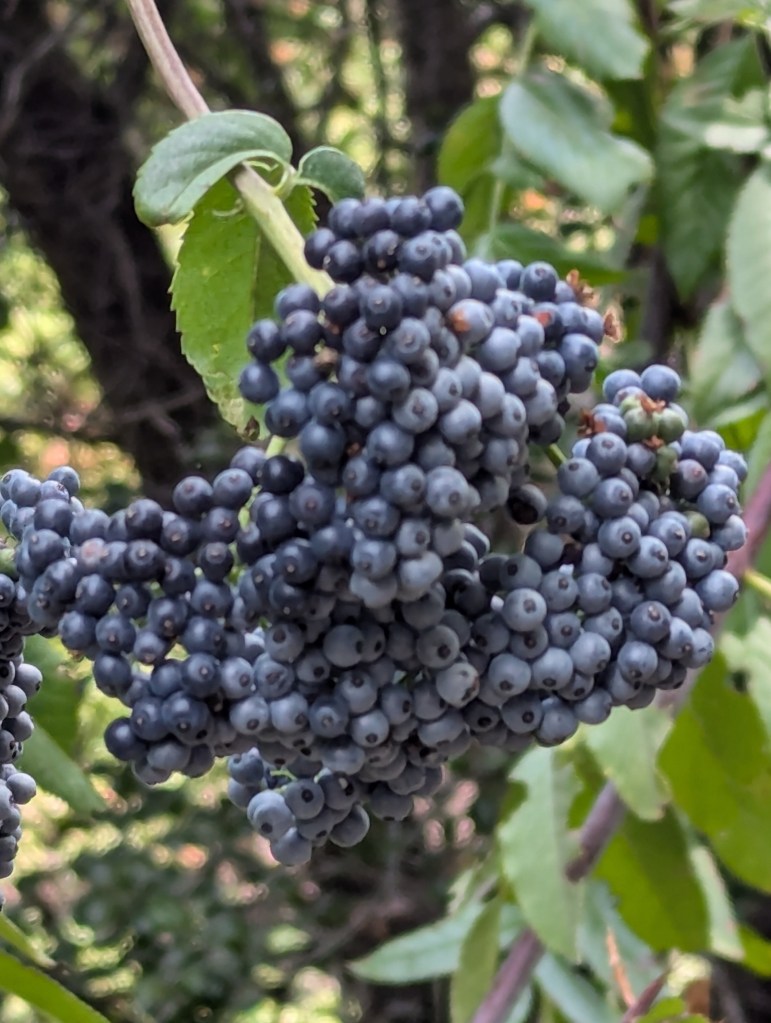
Native blue elderberry, Sambucus cerulea, can grow twenty feet tall and wide in the wild. It is rare among compact home gardens. Domestic specimens are fortunately conducive to various pruning techniques, though. They regenerate very efficiently from coppicing or pollarding. Alternating canes pruning involves more effort but promotes berry production.
Blue elderberries are toxic while fresh, but make good jelly or syrup when cooked. They are also edible dried. Although quite tiny, they grow in large clusters that are three or four inches wide or wider. They ripen through late summer. Flowers, which bloom during late spring, are useful for teas or cordials. Some find their floral fragrance to be unappealing.
Because it grows so large, blue elderberry can be a large shrub or a small tree. It usually develops several trunks. Aggressive dormant pruning enhances foliar lushness. Without much pruning, old trees can develop dense thicket growth with sparse foliage. Individual leaves are pinnately compound, with five to nine leaflets. They are as long as six inches.
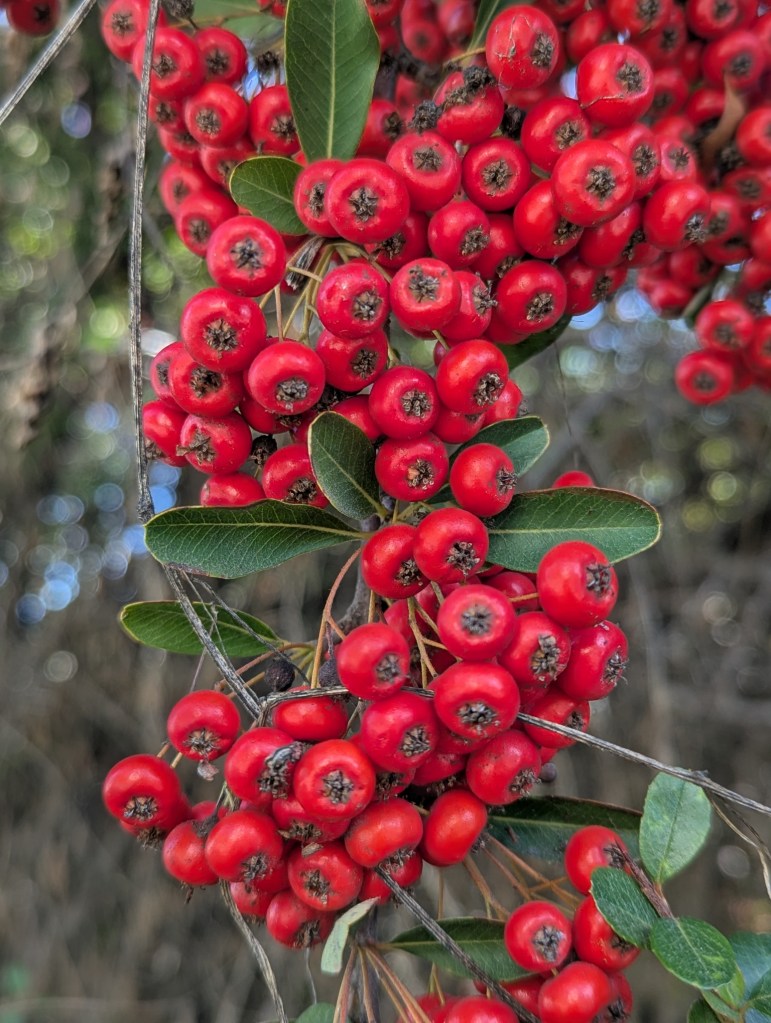
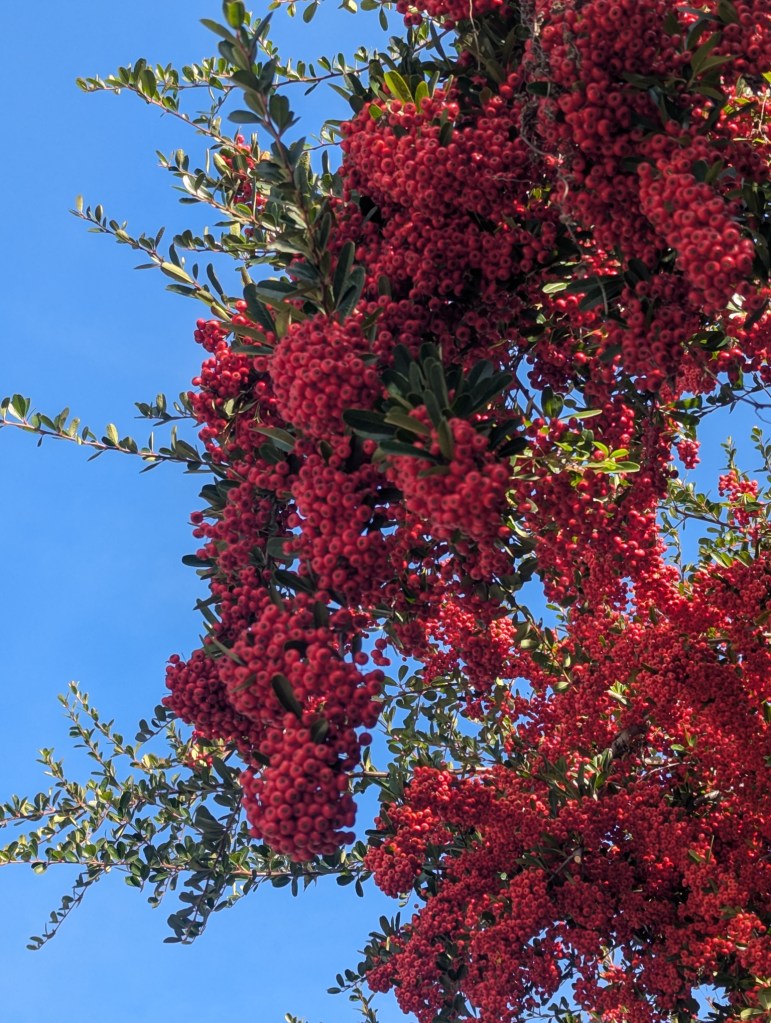
Nothing is lost in translation. The botanical name of Pyracantha coccinea literally means “Firethorn red”. Firethorn is its common name. It produces bright red berries on wickedly thorny stems. Some old-fashioned cultivars produce bright orange berries. Cultivars that produce bright yellow berries are now rare. Fruit ripens for migrating birds about autumn.
The thorns of firethorn are difficult to work with. However, they make a hedge of firethorn impenetrable. Frequent shearing deprives hedges of their natural form and some of their fruit. Selective pruning is tedious and likely painful, but retains more berries. Pyracantha needs sunny exposure, but is otherwise quite undemanding. It is susceptible to fireblight.
The most popular cultivars of firethorn can grow taller than eight feet. Taller cultivars that can grow twice as tall are uncommon. Sprawling types initially stay quite low, but without adequate pruning, form thickets. These same sprawling types are conducive to espaliers on fences and walls. Because pyracantha is difficult to work with, it should not be left to get unruly.
Cool season annuals are less diverse than warm season annuals for one simple reason. Flowers prefer to bloom while their favorite pollinators are most active. Most of the better pollinators are insects that are most active during warm weather. Therefore, most flowers want to bloom while the weather is warm. Many colorful berries are similarly exploitative.
For dispersion of their seed, colorful berries rely on birds. Therefore, many ripen and are most colorful as many birds migrate during autumn. Birds consume the berries but do not digest their seed. Instead, as they migrate, they disperse the viable seed. It is a mutually beneficial arrangement. Birds eat all they want. Seed benefits from thorough dispersion.
As they ripen, autumn and winter berries develop bright colors that attract birds. Most are bright red. Some are bright orange. A few are bright yellow. They are substantial enough to satisfy the birds that eat them. Yet, they are compact enough for such birds to eat them whole. Some are impressively abundant, at least until any birds that they feed find them.
That can be a dilemma for home gardening. Many garden enthusiasts grow autumn and winter berries for the color. Many grow them to attract birds, though. More grow them both for their color and to attract birds. The latter is least disappointing. Typically, such berries ripen to display their color faster than birds can eat all of them. Every season is different.
Unfortunately, there are not many options for colorful autumn and winter berries. Some of the species that produce the most colorful fruit are unfortunately thorny. Firethorn notably produces the most abundant, most colorful and most familiar berries. It is horridly thorny, though. So is English hawthorn, which is deciduous and defoliates to expose its red fruit.
Toyon and various cotoneasters are thornless alternatives for colorful berries. Toyon is a native species that grows rather large. Although cotoneasters are not as prolific, cultivars stay proportionate to home gardens. Hollies are dioecious, so female specimens need a male nearby for pollination. Because males are rare, females produce only a few berries.
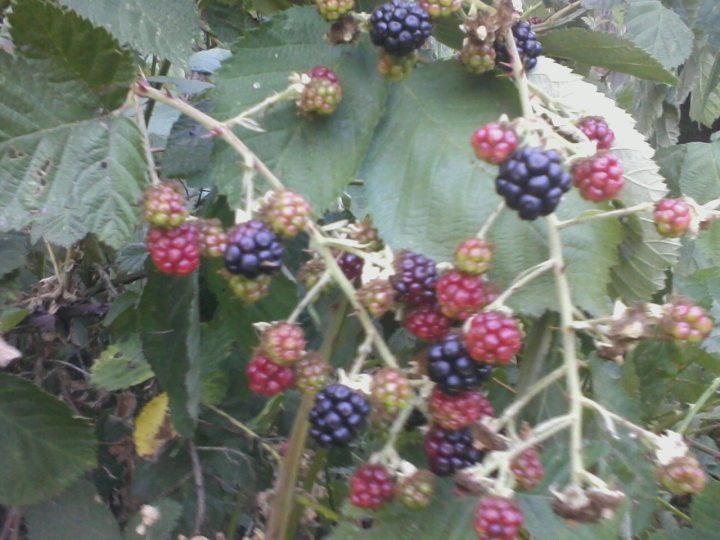
Given the opportunity, blackberry and raspberry canes become rampant thickets. The trick is to keep them contained and controlled so that they can produce berries without conquering the garden. Besides, proper pruning promotes production. Properly maintained canes are therefore both better behaved and more productive.
Berry canes are certainly not low maintenance, and should be selectively pruned a few times through the year. The type of pruning needed is determined by the type of growth that the canes exhibit in particular seasons. Spent canes or upper portions of everbearing raspberry canes that produced berries through summer and early autumn will need to be removed by the end of winter while new canes that grew through this year get trained to replace them.
Pruning and thinning of new canes should be delayed until the end of winter; but removal or pruning of spent canes can begin as soon as their fruit gets depleted. Spent canes of traditional summer bearing raspberries like ‘Willamette’, ‘Tulameen’ and ‘Canby’ can be pruned to the ground. ‘September’, ‘Heritage’, ‘Summit’, ‘Fallgold’ and other everbearing raspberry canes should be pruned only as low as their fruit was produced. Lower portions that did not produce fruit should be left to bloom and produce berries next spring.
Just like raspberry canes, new blackberry canes that grew this year do not need to be pruned until late winter. However, the canes that grew last year and are finishing berry production this year can be pruned to the ground as their last berries get taken. There is no rush for this procedure, but getting it done early makes later pruning of new canes for next year a bit easier.
Of course, every different cultivar (cultivated variety) of raspberry and blackberry behaves differently. Some finish producing and are ready to be pruned sooner than others. Their behavior is also affected by climate and environmental conditions, so that the same variety may be earlier or later in different areas, or even different parts of the same garden.
Favorite berry canes are very easy to propagate by division of superfluous new shoots during winter. Alternatively, spent canes that should be removed can be ‘layered’ instead. They simply need to be bent down and partially buried, and can be dug and separated as they develop roots.
The top few inches of cane should extend above the soil. At least a few inches of cane below the top should be buried a few inches below the surface of the soil. The length of cane between the buried portion and the base of the parent plant can remain exposed.
Layering can be done at any time of year if the layer (buried section of cane) gets watered while developing roots. Layering this time of year is easiest though, because layers get plenty of water from rain through winter, and develop roots most efficiently as they come out of dormancy late in winter or early in spring. If layers are buried where new plants are desired, they do not need to be dug and moved next year.
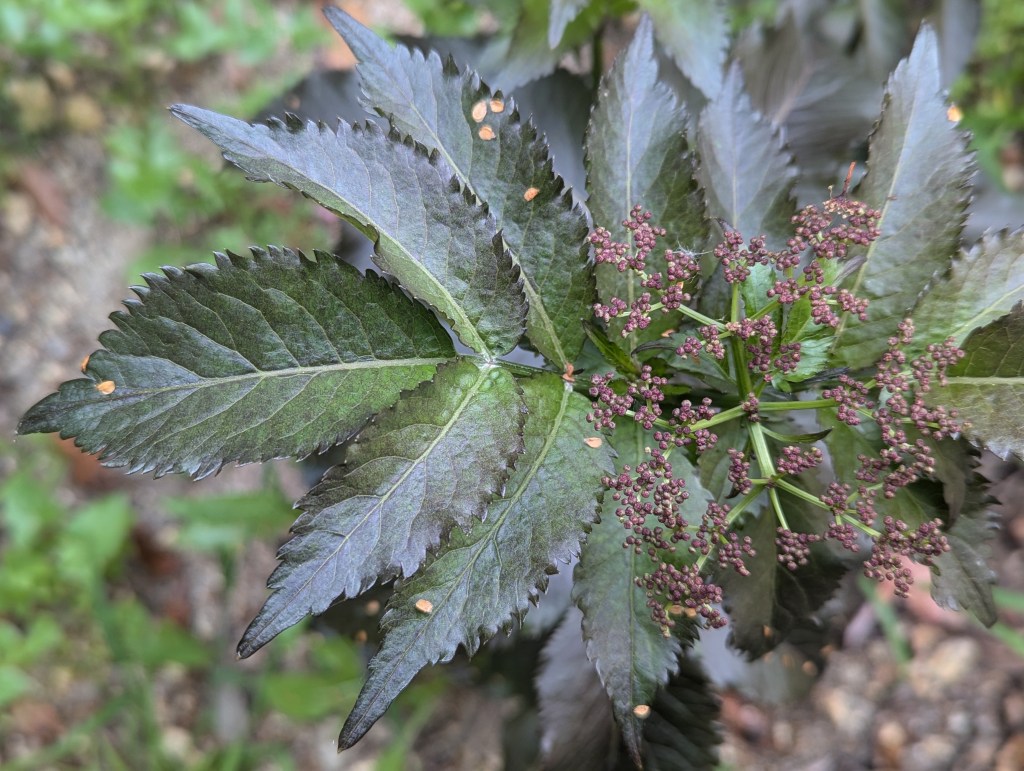
‘Black Tower’ European black elderberry is not very black yet.
Perhaps my explanation of the elderberry glut here was a bit brief last Saturday. Allow me to explain.
Sambucus caerulea, blue elderberry is native and grows wild here, so was innately the first on the scene.
Sambucus nigra ‘Black Lace’ European black elderberry arrived next. I do not know who procured it or why, but it was left here in a can before my time. I put it into a landscape just to get it out of the storage nursery. In other words, I was none too keen on it, so I just wanted to make it go away. Instead, because it was so popular with those who saw it in the landscape, I learned to appreciate it. Then, I figured that it would be even more appealing if it produces berries for birds, so I sought a mate for it.
Sambucus nigra ‘Madonna’ European black elderberry was almost the perfect mate. I would have preferred ‘Albomarginata’, but did not want to pay for it. ‘Madonna’ in a #1 can was available for only a few dollars because it looked so shabby two winters ago.
Sambucus racemosa, red elderberry was a gift from Tangly Cottage Gardening shortly afterward. They were a group of four seedlings, so needed no mate for pollination. Although they are supposedly native here, I had never seen them before, but want to grow them.
Sambucus nigra ‘Albomarginata’, ‘Atropurpurea’ and ‘Black Tower’ European black elderberry, and Sambucus racemosa ‘Lemony Lace’ red elderberry unexpectedly became available for a few dollars each just last winter because, like ‘Madonna’ European black elderberry two years prior, they were shabby while dormant. Without a plan, I procured all of them. ‘Lemony Lace’ red elderberry, the only red elderberry of the four, could be pollinated by the red elderberries that already came from Tangly Cottage Gardening. As I mentioned, ‘Albomarginata’ was the cultivar that I would have preferred to ‘Madonna’ that I procured earlier.
Sambucus canadensis ‘Nova’ and ‘York’ American black elderberry were the last acquisitions at the end of bare root season last winter. They are for fruit production in my home garden.
I would have been pleased with only ‘Black Lace’ and one other pollinator cultivar for it within the landscapes at work. For my home garden, I wanted only blue elderberry, red elderberry and American black elderberry. I would have preferred wild American black elderberry, but can not complain about the cultivars that I got. Collectively, we got much more than we bargained for.
Their habit of overwhelming untended gardens gives blackberry canes a bad reputation. Their thicket like growth in their native habitats does not help. They are certainly not ‘low maintenance’ and need intensive specialized pruning later in the year. Yet, they become available with other bare-root plants this time of year for a reason. They make great blackberries!
New bare-root blackberry plants do not look like much when they are first planted, and do not produce berries in their first year. They will instead be busy dispersing roots and producing biennial canes that will produce berries the following year. Root barriers can prevent their aggressive roots from getting into neighbors’ gardens, particularly since south or west facing fences are just as practical for supporting trailing canes as trellises are.
‘Trailing’ types like ‘Marion’, ‘Boysen’ and ‘Olallie’ blackberries, which are also known as ‘boysenberry’, ‘marionberry’ and ‘olallieberry, are the most popular locally. ‘Erect’ types, like ‘Arapaho’, ‘Choctaw’ and ‘Navaho’ are more tolerant to frost, so are more popular where winters are colder. ‘Semierect’ types are hybrids of trailing and erect blackberries.
In their second year, trailing and semierect canes that grew during the first year should be trained onto trellises, fences or wires. As their fruit gets depleted later in summer, these canes can be cut to the ground. Some of the new canes that developed through the season need to be trained onto the same supports to replace the older canes as they get removed.
There should be more than enough new canes. About ten to fifteen of the best canes of trailing types should be selected and pruned to about six or seven feet long. Semierect types need about half as many canes, and can be pruned about a foot shorter. Extra canes should be cut to the ground. A few of the smaller extra canes can be left through summer to be separated with roots as new plants during the following winter.
Side branches that grow from the pruned canes through late summer and early autumn should get pruned to about a foot long at the end of the following winter. New growth from these stubs will produce fruit during the following summer. The process of replacing the old canes with new canes can be repeated as the fruit gets depleted. The process is similar for erect blackberries, but no support is needed. During the second year, canes should be cut to about two and a half feet tall in the middle of summer. Secondary branches from these canes should be cut to about a foot long in winter. As fruit gets depleted and replacement canes develop during the following summer, these mature canes can get cut to the ground. New canes then get pruned just like the older canes were.
The fruits of summer are still a few month away. The work necessary to produce them needs to get done now though. Just like bare root trees, bare root raspberry canes get planted while dormant in winter, and later require intensive specialized pruning to keep them in control and to promote abundant production. Canes that are already established need to get pruned now and every winter.
New plants should be planted about two or three feet apart, and then cut back so that only a single bud is visible above ground. Root barriers should keep them from venturing under fences and into neighbor’s gardens, particularly since south or west facing fences are ideal spots to grow raspberries. Alternatively, raspberries can be planted in sunken #15 cans (15 gallon nursery pots), with or without the bottoms cut off. Cans should be buried up to their rims because any exposed black vinyl collects warmth from the sun, which is uncomfortable for the roots within. Mulch should insulate the soil until new foliage provides shade.
The few new canes that should develop during the next few months should be able to support their own weight, but may be easier to work with if tied to a fence or trellis. The popular everbearing types, like ‘September’, ‘Heritage’, ‘Summit’, ‘Golden Summit’ and ‘Fallgold’ may produce fruit on top of their new canes by autumn. The tops of these canes should get cut down as low as fruit developed during the following winter. The remaining lower portions of canes that did not produce fruit in the first year should produce fruit by the second summer, and should be pruned to the ground as the fruit finishes.
As the spent canes get removed, about five to ten of the best new canes should be selected and tied in place if desired. All other canes should be cut to the ground. Like the canes of the previous year, the selected canes should develop fruit on top in autumn and get pruned as they finish in winter, and then develop more fruit down low before getting pruned out during the following summer. This process should be repeated annually.
‘Willamette’, ‘Tulameen’ and ‘Canby’ are traditional summer bearing raspberries. They do not produce in their first year, and will need to be pruned to about five feet tall during the following winter. As these canes develop fruit, many new canes emerge below. Every winter afterward, about five to ten of the new canes should be selected and pruned to about five feet as spent canes and unneeded canes get cut to the ground.
Blackberry canes are not at all “low maintenance”!
The fruits of summer are still a few month away. The work necessary to produce them needs to get done now though. Just like bare root trees, bare root raspberry canes get planted while dormant in winter, and later require intensive specialized pruning to keep them in control and to promote abundant production. Canes that are already established need to get pruned now and every winter.
New plants should be planted about two or three feet apart, and then cut back so that only a single bud is visible above ground. Root barriers should keep them from venturing under fences and into neighbor’s gardens, particularly since south or west facing fences are ideal spots to grow raspberries. Alternatively, raspberries can be planted in sunken #15 cans (15 gallon nursery pots), with or without the bottoms cut off. Cans should be buried up to their rims because any exposed black vinyl collects warmth from the sun, which is uncomfortable for the roots within. Mulch should insulate the soil until new foliage provides shade.
The few new canes that should develop during the next few months should be able to support their own weight, but may be easier to work with if tied to a fence or trellis. The popular everbearing types, like ‘September’, ‘Heritage’, ‘Summit’, ‘Golden Summit’ and ‘Fallgold’ may produce fruit on top of their new canes by autumn. The tops of these canes should get cut down as low as fruit developed during the following winter. The remaining lower portions of canes that did not produce fruit in the first year should produce fruit by the second summer, and should be pruned to the ground as the fruit finishes.
As the spent canes get removed, about five to ten of the best new canes should be selected and tied in place if desired. All other canes should be cut to the ground. Like the canes of the previous year, the selected canes should develop fruit on top in autumn and get pruned as they finish in winter, and then develop more fruit down low before getting pruned out during the following summer. This process should be repeated annually.
‘Willamette’, ‘Tulameen’ and ‘Canby’ are traditional summer bearing raspberries. They do not produce in their first year, and will need to be pruned to about five feet tall during the following winter. As these canes develop fruit, many new canes emerge below. Every winter afterward, about five to ten of the new canes should be selected and pruned to about five feet as spent canes and unneeded canes get cut to the ground.
Hollies produced more bright red berries while they were more popular many years ago. Formal and perhaps lengthy hedges of exclusively female cultivars were common. A few or solitary male pollinators grew nearby, often as obscure small trees. Nowadays, males are oddly rare. Not many horticultural professionals are aware that hollies are dioecious.
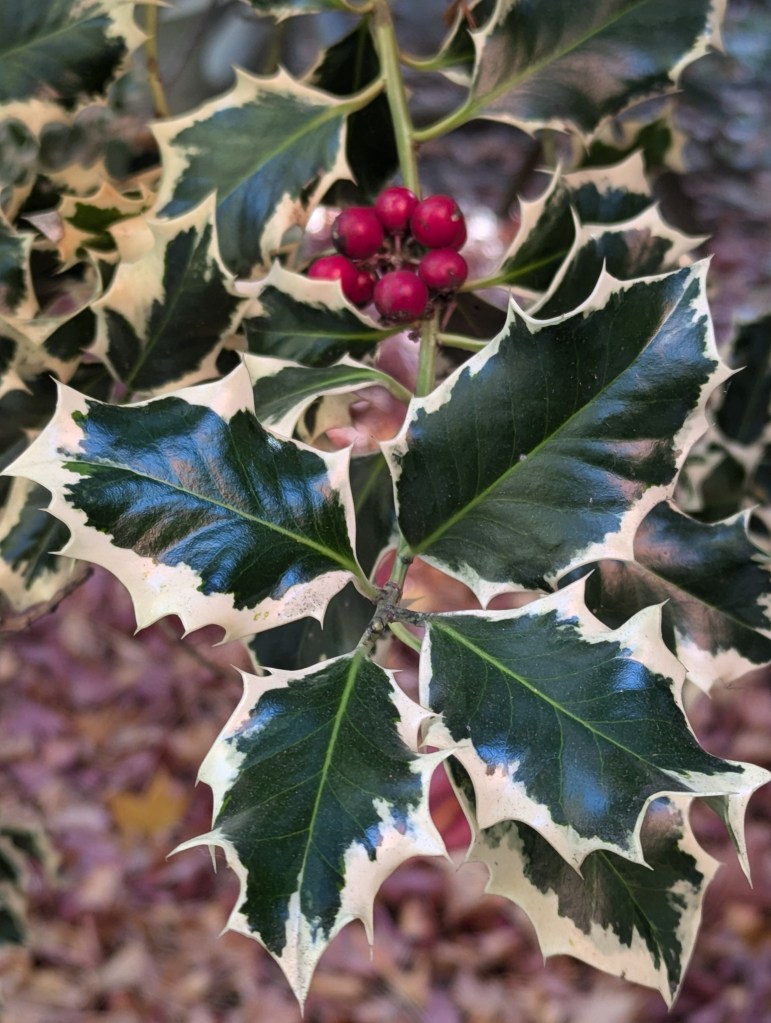
English holly, Ilex aquifolium, is both the most and least favorite holly. Some who grow it appreciate its distinctively intricate foliar texture. Others detest the unpleasant prickliness of the same foliar texture. No other holly is as spiny, although most are somewhat prickly. All hollies exhibit dark green foliar color, remarkably glossy foliar sheen and rigid foliage.
English holly can grow as a small tree with a dense canopy. With pruning, most stay less than ten feet tall. Cultivars with white or yellow variegation grow slower and stay smaller. Berries are common amongst naturalized colonies which naturally include both genders. Nurseries occasionally sell cultivars of both genders, potted together to mature together.
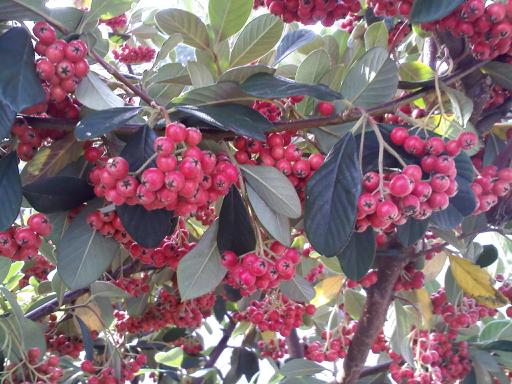
Cotoneaster berries can be as colorful as hawthorn berries, but with evergreen foliage.
Unlike the more popular low growing cotoneasters that are grown as groundcover, the large Cotoneaster lacteus can be grown as large informal hedges or small sculptural trees with multiple trunks. Their limber arching branches can get more than eight feet high and broad. Cotoneaster lacteus are at their best where they have space to grow wild and unshorn, since indiscriminate pruning deprives them of their naturally graceful form; although selective pruning of lower growth exposes trunks and enhances the forms of those grown as small trees. Once established, they do not need much attention or watering anyway.
Abundant two inch wide clusters of small white flowers in spring are not remarkably showy, but develop into comparably abundant clusters of bright red berries in autumn and winter, much to the delight of overwintering birds. The simple two inch long leaves of Cotoneaster lacteus have pale green and slightly tomentose (fuzzy) undersides.
 Tony Tomeo