There are actually a few different flowers known as Queen Anne’s lace. The most common species, Daucus carota, that has naturalized and even become somewhat of a weed in some areas, has two and a half inch broad, flat-topped trusses of delicately minute but abundant flowers, with a single red flower at the center of each truss. Apparently, Queen Anne pricked a finger with a needle while making the lace, leaving a drop of blood. Modern varieties have broader and fluffier trusses, often lacking central red flowers. They are a popular ingredient or fill for mixed bouquets with more colorful flowers.
The biennial foliage of Queen Anne’s lace grows to about three feet tall in the first year, with weedy but intricately lacy leaves. It blooms in summer of the second year. It is very similar to poison hemlock, which is poisonous enough to kill Nero, so should not be allowed to grow in vegetable gardens or where toxicity might be a problem; just in case.
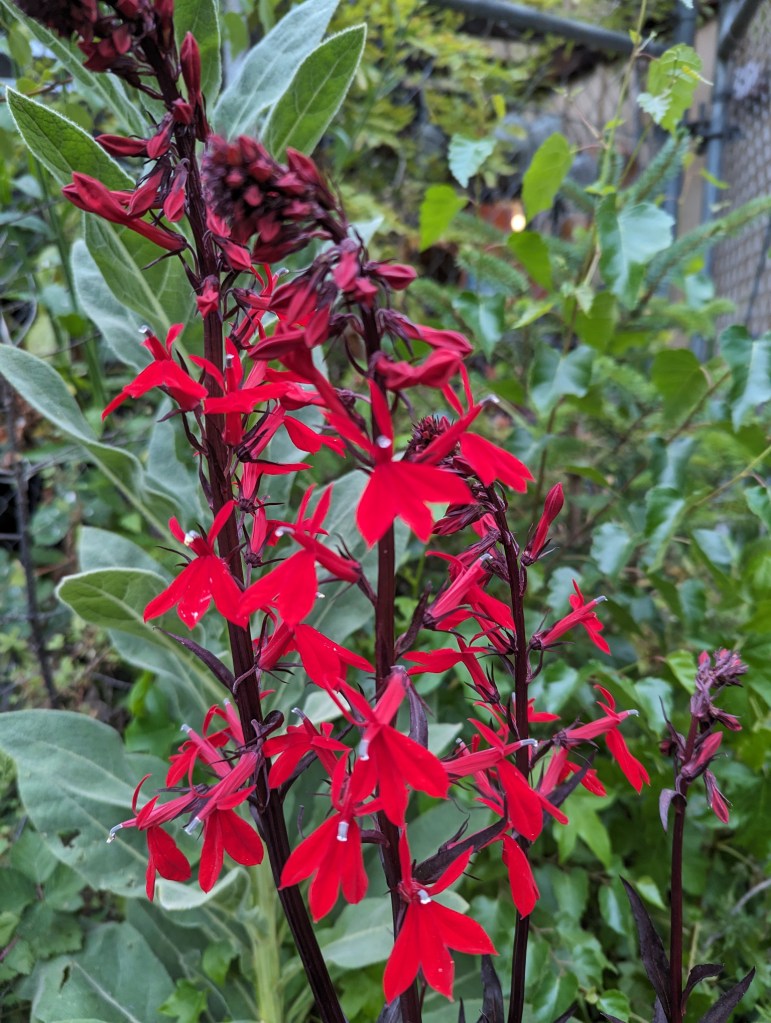
This warm season annual is actually a biennial. Cardinal flower, Lobelia cardinalis, may stay relatively short for its first summer. It might bloom four feet high for its second or third summer. By then, pups are easy to divide as new plants to replace the old. Most cardinal flower plants from nurseries are rather mature. They might grow tall for their first summer.
Common cardinal flower has rich cardinal red bloom and bright green foliage. ‘Alba’ has white bloom. ‘Rosea’ has pink bloom. ‘Queen Victoria’ has familiar rich red bloom above deeply bronzed foliage. Individual flowers are only an inch and a half from top to bottom, but are numerous. Basal leaves can be almost six inches long. Upper leaves are shorter.
Cardinal flower enjoys richly organic soil with regular irrigation. It dislikes getting too dry. It appreciates a bit of partial shade as the weather gets warmest after noon. Seed is easy to collect. However, seed from fancy cultivars is not necessarily true to type. Subsequent generations eventually revert to familiar rich cardinal red bloom and bright green foliage.
Perennial pea is similar to sweet pea, but as the name implies, it is perennial.
‘Perennial’ is a simple adjective that describes something that last for more than a single year. Horticulturally, it is not this simple. After all, every plant that is not an ‘annual’, which completes its entire life cycle within only one year, is technically a ‘perennial’. Those that develop lignified (woody) parts instead conform to such categories as tree, shrub or vine.
Even these categories are not as simple as they seem to be. Palms are trees, but without woody stems. Technically, they are merely very large perennials. Some consider them to be ‘herbaceous trees’. Yucca trees conform to the same category; while terrestrial yuccas are usual perennials. Sweet peas are annual vines. Perennial peas are perennial vines.
Many annual bedding plants, such as begonia, chrysanthemum, primrose, cyclamen and even busy Lizzie, are technically perennial. They could survive for a few or several years if they get such a chance. All ferns, including tree ferns, are perennials. So are bamboos, ornamental grasses, and many succulents. ‘Biennials’ are perennials that live two years.
Many of the most popular perennial plants have an indefinite life span. It is impossible to know how long they can survive. They are constantly replacing themselves with new but genetically identical parts. For example, bearded iris migrate and propagate by rhizomes that could have been propagating for centuries. New plants are identical to their original.
However, many perennial plants with potential to propagate indefinitely might eventually get shabby. New Zealand flax, after many years, may slowly migrate outward from where it started growing, leaving a bald spot in the middle. Outer shoots relocate easily to patch such bald spots, or unite as a fresh clump. Crowded lily of the Nile benefit from thinning.
Bulbs and bulb like plants are generally perennial, even if unreliable as such in the mild local climate. (Many bulbs and bulb like plants prefer more chill through winter than they get here.) Most of these sorts of perennials are dormant for part of the year, so die back to the ground. Hostas are bare through winter. Florists’ cyclamen are bare through summer.


 Tony Tomeo