Norfolk Island Pine

Norfolk Island pine seems to have been built rather than grown.

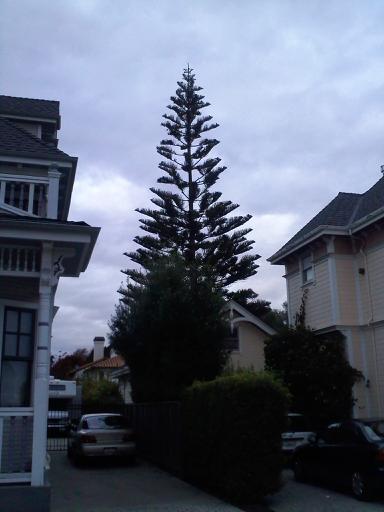
            In coastal areas of Southern California, the Norfolk Island pines, Araucaria heterophylla, are among the most distinctive large trees. Perhaps they are better described as ‘unusual’ . . . , or even ‘strange’. They are so symmetrical that they seem to have been assembled from prefabricated kits than to have grown as natural trees. Their strictly organized conical branch structures and remarkably straight central trunks are always visible through their uniformly open canopies. In such mild climates, they can get nearly a hundred feet tall and half as wide, so are not easy to hide. In Hawaii, their symmetry has actually made them popular as Christmas trees. Their finely textured juvenile foliage is comprised of narrow, half inch long pine-needle like leaves, which are wider among adult growth.

            Locally though, Norfolk Island pines are primarily enjoyed as houseplants, particularly since they can grow slowly and live in pots for many years. The climate is just a bit too cool in winter for them to be very happy in the garden. However, as they eventually get too large for their homes, many end up in the garden anyway. They stay much smaller and are not nearly as symmetrical as they are in milder climates, and may be damaged by the more severe frosts every few years, but they have a certain appeal and distinction regardless. Those that get planted in the garden while young seem to be more symmetrical than those that get disfigured by living as houseplants longer. For some reason, trees that develop weak or curved trunks as houseplants tend to continue to grow with interestingly irregular trunks and branch structure.
Valley Oak

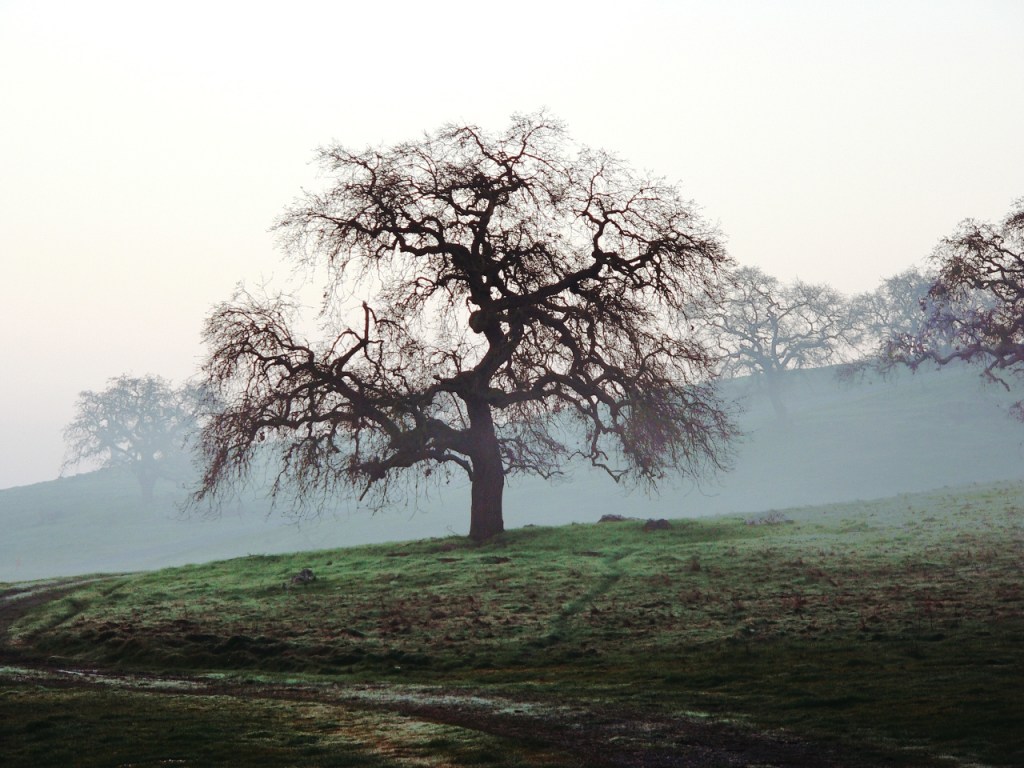
Foggy Oak Morning

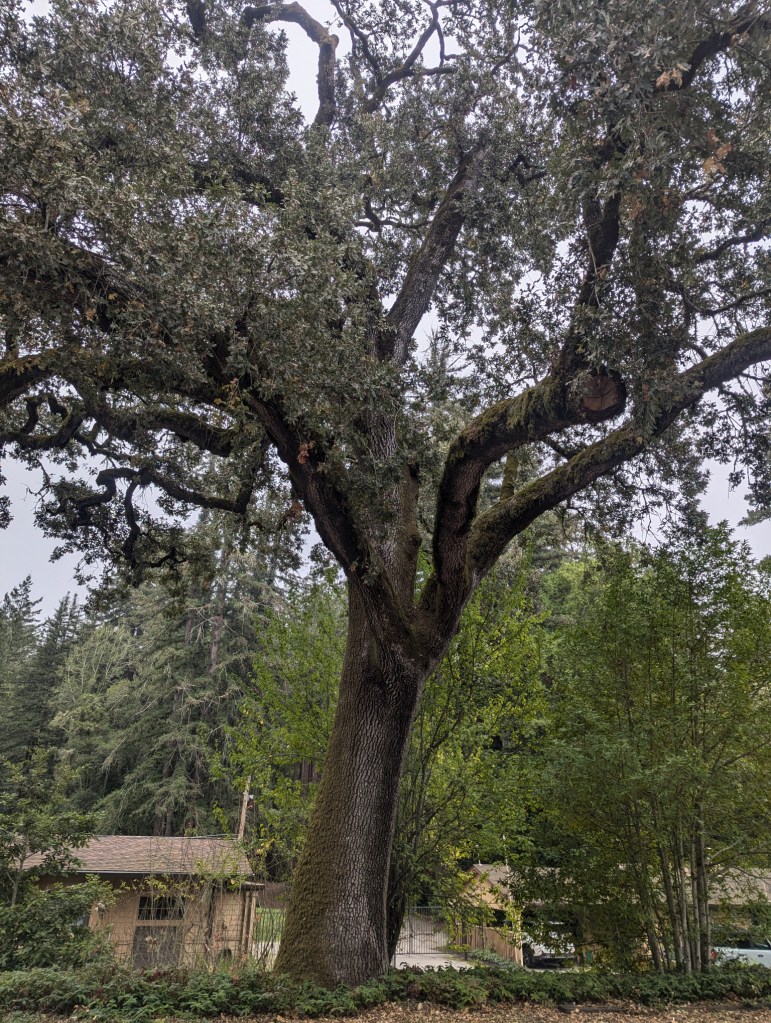
‘Foggy Oak Morning’ by Karen Asherah, is another example of the local scenery that I miss while not taking a bus or walking. I drove past this scene for years on my way to work outside of San Martin without ever bothering to take a look at it. This happy tree is a native valley oak, Quercus lobata, like those that had been common throughout the Santa Clara Valley until only about two centuries ago. It is not exactly the sort of shade tree that everyone wants in a compact suburban garden, but is grand enough for large spaces like parks.

Mature specimens may not seem to get as tall as oaks in the Appalachian Mountains, but are actually the largest oaks in North America, and live more than five centuries. The tallest trees are mostly less than seventy feet tall, but can get taller. Trunks of the oldest trees are commonly six feet wide or wider. The distinctively and uniformly furrowed bark is as classically ‘oakish’ as the rounded prominent lobes of the deciduous leaves, and the sculpturally irregular branch structure. Odd stem galls, commonly known as ‘oak apples’, are home to the larvae of tiny wasps that rely on valley oaks for everything they need. Incidentally, Paso Robles, or ‘El Paso de los Robles’ is named for the valley oaks in the area, which Spanish immigrants thought resembled the ‘robles’, the European oaks that inhabit Spain.

More information about ‘Foggy Oak Morning’ can be found at the website of Karen Asherah at karenasherah.com.

The Importance of Proper Arboriculture

Arboriculture is horticulture of trees.

Pasadena sustained the worst of the damage caused by the strongest Santa Ana Winds in three decades. Huge piles of debris from broken trees are much more than can be removed any time soon. Falling debris and trees damaged many roofs, cars and anything else that happened to get in the way.

Other towns and neighborhoods throughout the area, particularly those at the base of mountains, also sustained major damage. At the same time, severe winds ravaged the San Francisco and Monterey Bay Areas as well, particularly in the Santa Cruz Mountains and the hills of the East Bay.

Some of the damage caused by wind in urban areas might have been less disastrous if trees had gotten the respect and attention that they deserve. Some trees develop structural deficiencies that need to be corrected by pruning, either to eliminate the problems, or at least to decrease the strain exerted onto the structurally deficient parts. A few trees that become unstable as they mature may likewise need to be pruned or even removed.

It is not always possible to prune trees to remove all structural deficiencies without damaging the affected trees more, or causing more structural problems to develop. For example, major pruning to remove all parts that may get blown down by wind, such as pollarding or ‘topping’, may seem to be effective for the short term, but actually stimulates the development of vigorous secondary growth or watersprouts that are disproportionately heavy and even more likely to tear off from the older limbs.

Structural pruning more often involves thorough reduction of weight and wind resistance. Weight of foliage and stems directly applies leverage against unions where smaller stems are attached to the larger stems from which they originate. Wind resistance adds more leverage as foliage gets blown about by wind. Thinning obviously removes significant weight, and also decreases wind resistance to allow wind to blow though the affected canopies.

Besides helping to compensate for structural deficiency, structural pruning is also beneficial to potentially unstable trees for the same reasons. However, unstable trees typically need even more reduction of weight and wind resistance. Some of the most unstable trees and those that are deteriorating need to be removed because their instability cannot be accommodated.

During winter, while deciduous trees are bare, evergreen trees are more susceptible to wind damage, obviously because they retain their weight and wind resistance through winter while the weather is the most severe. Unstable trees become even more destabilized as rain softens the soil. Regardless of the potential for susceptibility to wind damage, this would be a good time of year to get any needed tree maintenance done, prior to any more windy and rainy winter weather.

Arborists certified by the International Society of Arboriculture are the most qualified to identify potential structural problems or instability, and to prescribe corrective procedures. A list of certified arborists can be found at the website of the International Society of Arboriculture at http://www.isaarbor.com.

Valley Oak

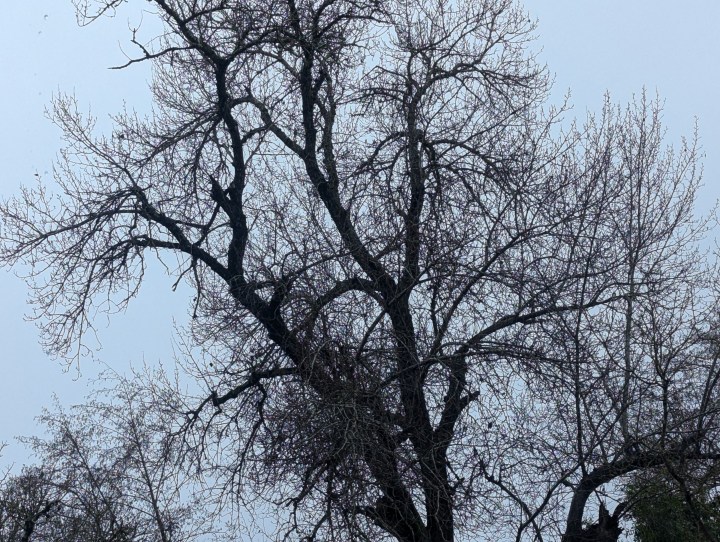
Valley oak is a stately tree.

Native trees are not necessarily the best options for home gardens. Valley oak, Quercus lobata, for example, grows much too large. Old trees can grow more than a hundred feet tall. Although unpopular for new plantings, it sometimes self sows. Also, new landscapes sometimes develop around old trees. Formerly rural trees therefore become urban trees.

Old trees are unfortunately very sensitive to disruption of their surroundings. Grading can severely damage their shallow feeder roots. Irrigation to sustain new landscapes is likely to promote rot of older and larger roots. Trees that should live for centuries can succumb to such damage within decades. Younger trees are fortunately adaptable to landscapes.

Nonetheless, young valley oaks are trees for future generations. Also, they require plenty of space. Although it may take a few centuries, trunks can eventually grow ten feet wide. As they mature, such big trees can make a big mess. The deciduous foliage can shed for weeks instead of days. The pale yellowish brown autumn foliar color is rather mundane. Without excessive irrigation, roots are remarkably complaisant.

Canary Island Date Palm

Canary Island date palm is the biggest and boldest.

The biggest and boldest of the common palms is the Canary Island date palm, Phoenix canariensis, which can get more than sixty feet tall and nearly forty feet wide, with a full canopy of gracefully arching deep green fronds. A young tree actually spends the first many years as a shrubby plant while the base of the trunk develops. Fronds get longer and spread broader every year until the trunk gets big enough to elongate. Vertical growth then accelerates somewhat, but the canopy gets no broader.

Most trees are female, eventually producing ornately orange but messy clusters of inedible dates. Male trees eventually get a bit taller, but are not quite as graceful and bloom with unimpressive dusty tan flowers.

Old deteriorating fronds need to be pruned away close to the trunk. Petiole bases of the most recently removed fronds are often carved into ‘pineapples’ to leave a bit of support directly below the canopy. Removed fronds leave a distinctive pattern on the trunk.

Palms

Mexican fan palm is the most prominent palm.

Only a few of the  many different palms that can be grown locally are actually common. The Canary island date palm and the Mexican fan palm, which had historically been the most common palms, have unfortunately given palms a bad reputation. Both get too large for small gardens, and need costly maintenance when they grow out of reach.

Since the late 1980s, the formerly uncommon queen palm has become the most common palm. Although it too eventually grows beyond reach, it is still more proportionate to home gardens while young. It has a relatively narrow trunk that is partially ‘self-cleaning’ (which means that old fronds, or leaves, often fall off or can be easily peeled off).

The windmill palm and the Mediterranean fan palm, although no more common now than a century ago, are two of the better palms for home gardens, since they do not get too large, and are somewhat easy to maintain. The Mediterranean fan palm has several sculptural trunks that curve out randomly from the base. Sharp teeth on their petioles make pruning a challenge, but not impossible.

The windmill palm has a straight solitary trunk that is distinctively hairy where old fronds get pruned away. It eventually grows out of reach, but takes many years to do so. By that time, many people allow beards of old fronds to accumulate on the trunks overhead instead of bothering to keep them pruned.

The desert fan palm, which is the only palm that is native to California, is very similar to the Mexican fan palm, but is about twice as stout and half as tall, with a fluffier canopy. Because it grows slower and stays smaller, it would be a better palm for urban gardens, except that it does not like to be watered regularly when mature. It really prefers warmer and drier climates.

Pindo palm and Mexican blue palm would also be great palms for urban gardens, but grow rather slowly before getting big enough to get noticed. In some climates, pindo palm produces strange and messy, but sweet and tasty fruit. Mexican blue palm is one of the most resilient palms, and blooms with really cool long floral tassels that a can drag on the ground from short trees.

‘Feather’ palms, like Canary Island date palm, queen palm and pindo palm, have pinnate (and generally compound) leaves, with small leaflets arranged on solitary midribs. Their fronds must be removed as they deteriorate.

‘Fan’ palms, like Mexican fan palm, Desert fan palm and windmill palm, have palmate leaves, centered around the distal termini of solitary petioles. These are most often pruned away, leaving distinctive patterns of petiole bases, but can alternatively be left to accumulate into thick beards of thatch.

Mexican fan palms are sometimes ‘shaven’ of their petiole bases to expose elegant lean trunks, although the procedure is intensive and expensive. Desert fan palms and some Mexican fan palms drop their own beards naturally.

Mexican Fan Palm

Mexican fan palm is also known as the skyduster palm.

It does not take long for Mexican fan palm, Washingtonia robusta, to get too big for most of the spaces it so often self sows its abundant seed into. The attractive lush foliage looks innocent enough, although the long petioles (leaf stalks) have nasty teeth. As trees get tall enough to get out of the way, they also get too big to manage, eventually reaching a hundred feet tall on elegantly curving trunks. No matter how tall they get though, their canopies always stay about eight feet wide. The problem is that the maintenance of such tall and aggressive trees can be costly.

Beards of old leaves can be allowed to accumulate on the trunks, but are combustible and can get infested with rats. Old leaves are more often pruned off, leaving a distinctive pattern of petiole bases. Old leaves can alternatively be ‘shaven’ to expose elegant bare trunks.

Redgum Eucalyptus

Redgum eucalyptus is famously adaptable and resilient.

Although not quite as aggressive, sloppy, big or structurally deficient as the notorious blue-gum eucalyptus, the red-gum eucalyptus, Eucalyptus camadulensis, is one of the ‘other’ eucalyptus that give eucalyptus a bad reputation. It is realistically too big and messy for refined urban gardens, and can be combustible if overgrown or too abundant. It is consequently probably not available in nurseries, despite being one of the most common species of eucalyptus (second only to blue-gum) in California. Red-gum eucalyptus has the advantage of being one of the most resilient large scale trees for unrefined or semi-wild landscapes, and works well where it has space to grow in many of the local county parks.

Douglas Fir

Douglas fir is rare within landscapes.

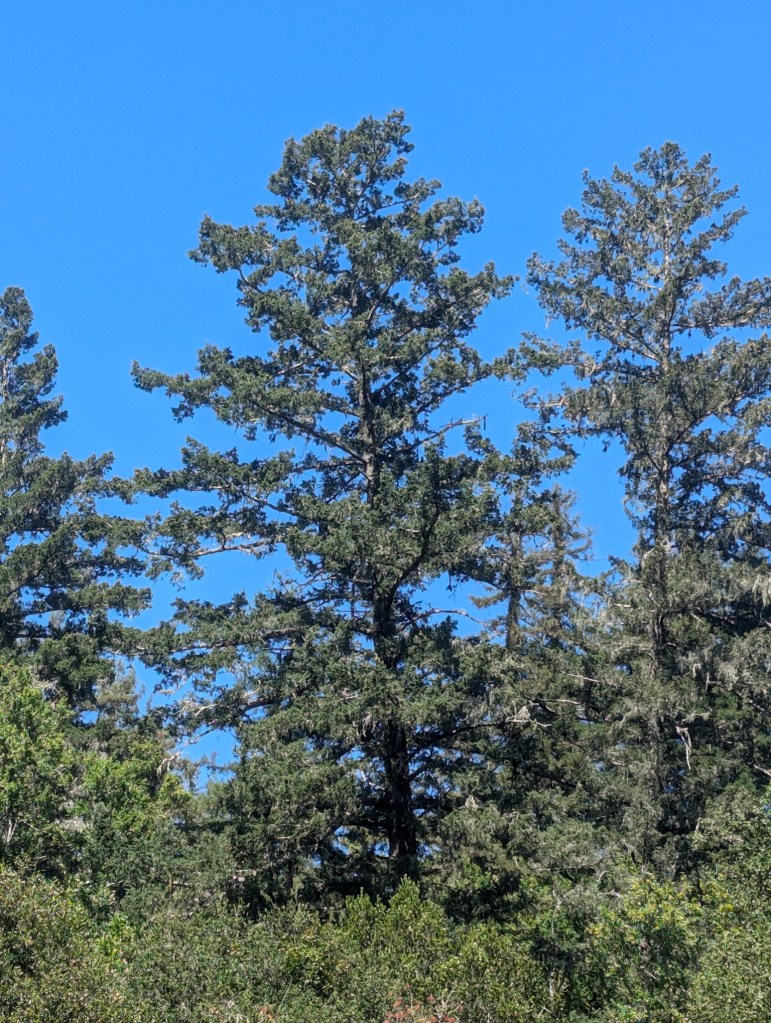
Within home gardens, Douglas fir, Pseudotsuga menziesii is very rare. So is the bigcone Douglas fir, Pseudotsuga macrocarpa of Southern California. However, they are not rare in the wild. Sometimes, suburban or rural home gardens develop around them. They can be awkward to accommodate. They are magnificent trees, but simply grow much too big.

Contrary to its rarity among home gardens, Douglas fir is actually common within homes. after all, most houses are constructed mostly of Douglas fir lumber. Most Christmas trees here are plantation grown Douglas fir. It is a major lumber plantation commodity in Chile, Argentina, New Zealand and Europe. Douglas fir is the Official State Tree of Oregon too.

Douglas fir is a grand tree in the wild. Old trees can grow more than two hundred feet tall with trunks eight feet wide! Their limbs may extend more than thirty feet from their trunks. It is obviously disproportionate for home gardens. Its soft evergreen foliage is delightfully aromatic, though. Its flattened, two-ranked needles are less than an inch and a half long. The female cones exhibit uniquely lacy scales.

Catalpa

Catalpa bloom may be too high to see.

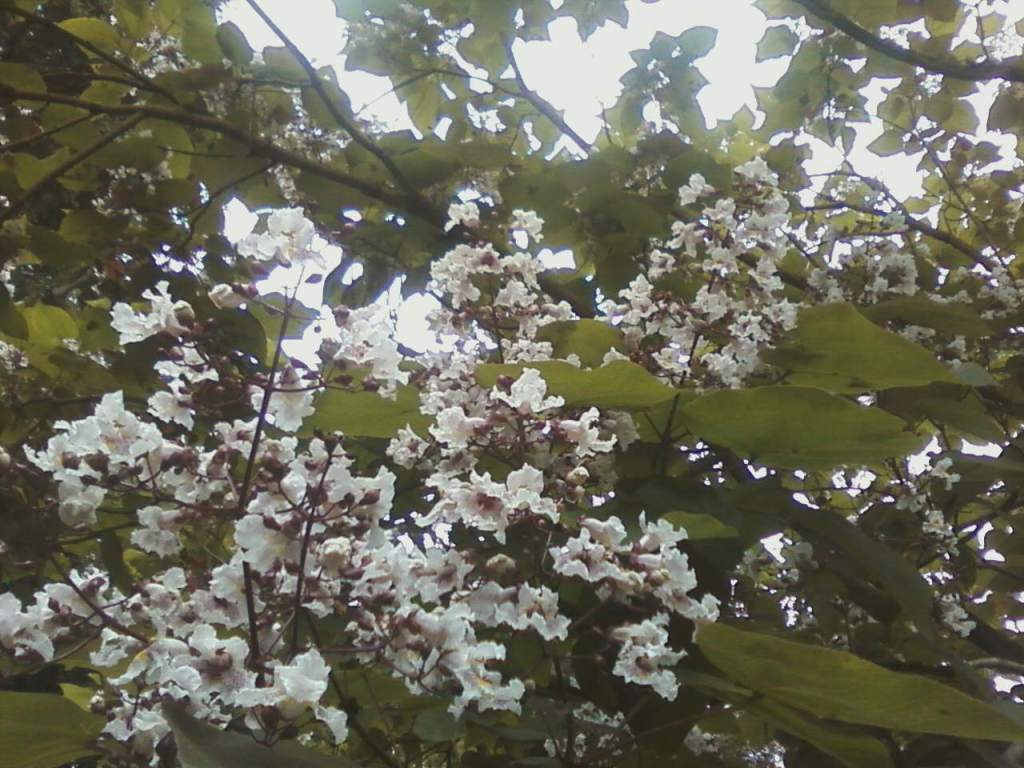
Those who know trees mostly agree that the more traditional catalpa, Catalpa speciosa, from the Midwest is the best catalpa, with soft leaves between half and a full foot long. In late spring or early summer, impressive upright trusses suspend an abundance of bright white, tubular flowers with yellow or tan stripes and spots at their centers. Individual flowers are as wide as two inches. Mature trees can be taller than forty feet and nearly as broad.

From the Southeast, Catalpa bignonioides, is a bit more proportionate to urban gardens though, since it only gets about seventy five percent as large, with leaves that are not much more than half as long. The flowers are also smaller, and not quite as bright white, but are more abundant than those of Catalpa speciosa are. The stripes and spots at their centers are slightly more colorful purplish brown and darker yellow.

Both catalpas can be messy as their flowers fall after bloom.  Fortunately, the big leaves are easy to rake when they fall in autumn. Long seed capsules that look like big beans linger on bare trees through winter.

Catalpa speciosa is almost never seen in modern landscapes, and not exactly common even in older Victorian landscapes around downtown San Jose. A few remarkable specimens remain as street trees in older neighborhoods of Oakland, Burlingame and Palo Alto. Most young trees were not planted, but instead grew from seed from older trees that are now gone.

Catalpa bignonioides is actually quite rare locally. A few old but healthy specimens can be seen around downtown Felton, with a few younger trees that grew from seed around the edges of town. Trees in Golden Gate Park in San Francisco are not as happy because of cool and breezy summers and mild winters.