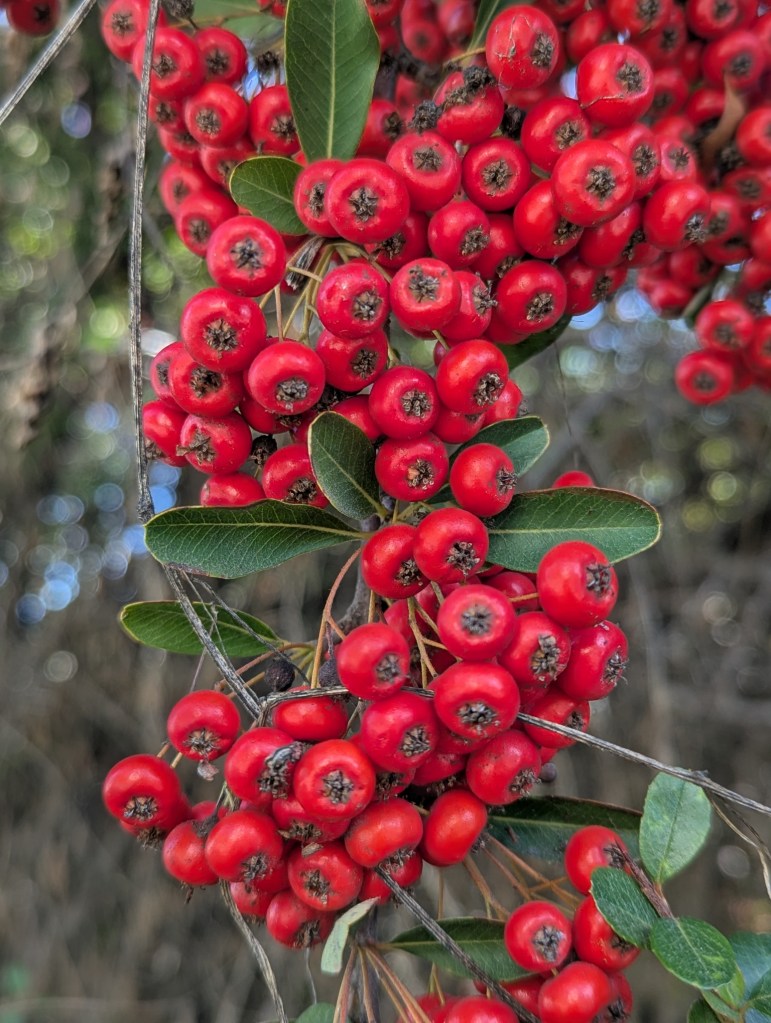
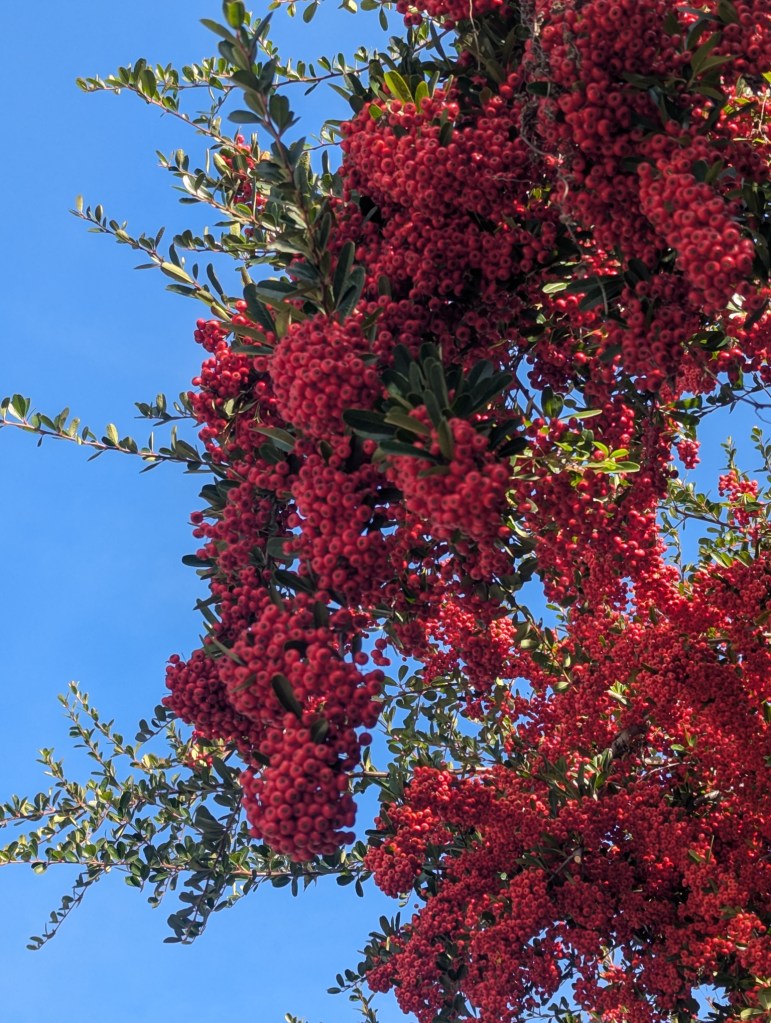
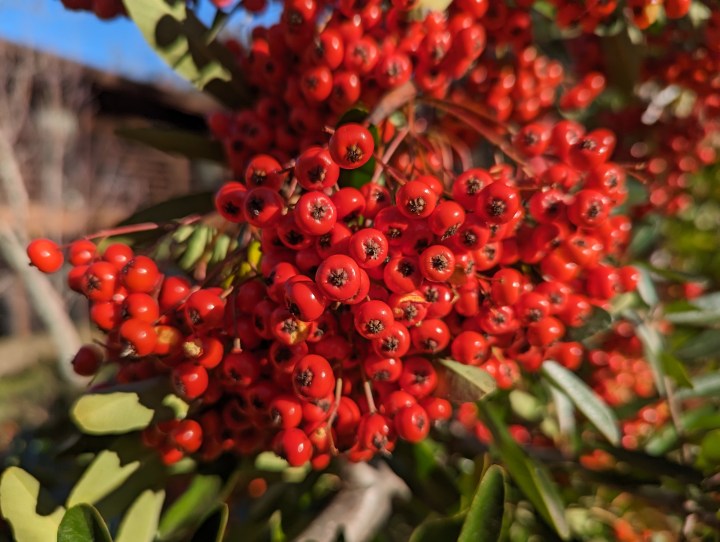
Nothing is lost in translation. The botanical name of Pyracantha coccinea literally means “Firethorn red”. Firethorn is its common name. It produces bright red berries on wickedly thorny stems. Some old-fashioned cultivars produce bright orange berries. Cultivars that produce bright yellow berries are now rare. Fruit ripens for migrating birds about autumn.
The thorns of firethorn are difficult to work with. However, they make a hedge of firethorn impenetrable. Frequent shearing deprives hedges of their natural form and some of their fruit. Selective pruning is tedious and likely painful, but retains more berries. Pyracantha needs sunny exposure, but is otherwise quite undemanding. It is susceptible to fireblight.
The most popular cultivars of firethorn can grow taller than eight feet. Taller cultivars that can grow twice as tall are uncommon. Sprawling types initially stay quite low, but without adequate pruning, form thickets. These same sprawling types are conducive to espaliers on fences and walls. Because pyracantha is difficult to work with, it should not be left to get unruly.
Cool season annuals are less diverse than warm season annuals for one simple reason. Flowers prefer to bloom while their favorite pollinators are most active. Most of the better pollinators are insects that are most active during warm weather. Therefore, most flowers want to bloom while the weather is warm. Many colorful berries are similarly exploitative.
For dispersion of their seed, colorful berries rely on birds. Therefore, many ripen and are most colorful as many birds migrate during autumn. Birds consume the berries but do not digest their seed. Instead, as they migrate, they disperse the viable seed. It is a mutually beneficial arrangement. Birds eat all they want. Seed benefits from thorough dispersion.
As they ripen, autumn and winter berries develop bright colors that attract birds. Most are bright red. Some are bright orange. A few are bright yellow. They are substantial enough to satisfy the birds that eat them. Yet, they are compact enough for such birds to eat them whole. Some are impressively abundant, at least until any birds that they feed find them.
That can be a dilemma for home gardening. Many garden enthusiasts grow autumn and winter berries for the color. Many grow them to attract birds, though. More grow them both for their color and to attract birds. The latter is least disappointing. Typically, such berries ripen to display their color faster than birds can eat all of them. Every season is different.
Unfortunately, there are not many options for colorful autumn and winter berries. Some of the species that produce the most colorful fruit are unfortunately thorny. Firethorn notably produces the most abundant, most colorful and most familiar berries. It is horridly thorny, though. So is English hawthorn, which is deciduous and defoliates to expose its red fruit.
Toyon and various cotoneasters are thornless alternatives for colorful berries. Toyon is a native species that grows rather large. Although cotoneasters are not as prolific, cultivars stay proportionate to home gardens. Hollies are dioecious, so female specimens need a male nearby for pollination. Because males are rare, females produce only a few berries.
Ecological balance should be an asset to the garden. Good insects eat bad insects. Certain birds eat more bad insects. The problem is that some visitors to the garden are not so beneficial.
Besides the bad insects that can damage various plants in the garden, there are several types of birds and squirrels that compete for nuts and fruit. Birds and squirrels are much more aggressive in their tactics than insects are, and are often more difficult to control.
Some people like to provide alternate sources of food for hungry birds. However, birds that crave fresh berries are not so likely to be distracted by dry birdseed in a bird feeder.
Flash tape (which is strips of silver Mylar) or unwanted CDs hung prominently in fruit trees repels birds for a while, but eventually fail to impress. Such bling should be put out in the garden only as fruit starts to become attractive to birds. If hung out too early, birds become accustomed to them and will not be deterred by the time the fruit ripens.
Flash tape or CDs should be placed where they will flutter in the breeze and can be seen from most perspectives, and may be more effective if moved every few days. Scarecrows are much more work to move about, but are no more effective. Besides, they can be unpopular with neighbors.
Bird netting is more effective to keep birds away. It can be installed over fruit trees a week or more before the fruit ripens. It should be tied around the trunk below lower branches or extend to the ground if birds are persistent enough to look for access through it. Netting should be removed when the fruit is harvested, so that stems to not grow through it.
Squirrels are more of a challenge. They have no problem getting through netting, and do not mind flashy bling. Squirrels may temporarily avoid dummy owls that repel pigeons and rats, but eventually realize that they are not a threat. Poison baits are dangerous to cats or dogs or anyone else that may be interested in poisoned squirrels, particularly since squirrels are so easy to catch as they succumb to poison!
Plastic rodent guards (or even sheet metal) wrapped around the trunks of fruit trees block access to squirrels because they are too smooth for rodents to get a grip into. Some types flare out too far for rodents to reach around. Others are too wide (from top to bottom) for squirrels to reach over. They should be located at least six feet above the ground so that squirrels do not simply jump past them from the ground.
However, rodent guards are only effective if all other access is also blocked. Lower limbs should be pruned about six feet above the ground, as well as six feet from roofs, fences, other trees or anything else that squirrels can jump from. This can be somewhat of a hassle when it is time to harvest ripe fruit that is out of reach.
Dormant pruning of deciduous fruit trees last winter should finally be proving its benefits. Such pruning enhances tree vigor and resilience to disease. As importantly, it enhances fruit and nut quality. Birds, squirrels and perhaps other wildlife are unfortunately noticing. Protecting fruit as it ripens may seem to be impossible. Sharing might not be acceptable.
The problem with sharing is that most wildlife is greedy. Wildlife that is not greedy can be too generous by inviting their friends over to indulge. They may not consume everything, but might damage all that they can not consume. Protecting fruit does not deprive wildlife of sustenance that they require for survival. It merely diverts their exploitation elsewhere.
The problem with protecting fruit is that it can seem futile. Even if wildlife could read, they would not comply with signs telling them to keep out. Cats and dogs can not chase them all away, and can not be there to try all the time. Techniques that are somewhat effective for some wildlife are not effective for all wildlife. However, some techniques are effective.
Protecting fruit requires some degree of familiarity with whomever wants to exploit it. Not many deterrents are effective for all of them. Netting is only effective for marauding birds, but not rodents, who can chew through it. Because it is so difficult to install, and worse to remove, other options are better anyway. Flash tape repels some birds rather effectively.
Protecting fruit from squirrels is more challenging. Tree trunk baffles can only be effective if there is no other access to the subject trees. They are useless if squirrels can jump into low limbs from the ground or adjacent trees. Growing rosemary, lavender or mint around fruit trees is supposedly a mild deterrent. However, it obstructs maintenance of the trees.
Plastic snakes or owls might be effective for protecting fruit from both squirrels and birds. Plush toys might be as effective since squirrels and birds do not recognize them as safe. However, such effigies eventually become uselessly familiar without frequent relocation. Squirrels and birds may not seem to be very intelligent, but they are not too stupid either.
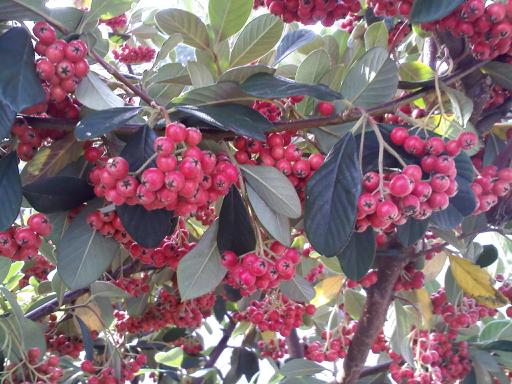
Cotoneaster berries can be as colorful as hawthorn berries, but with evergreen foliage.
Unlike the more popular low growing cotoneasters that are grown as groundcover, the large Cotoneaster lacteus can be grown as large informal hedges or small sculptural trees with multiple trunks. Their limber arching branches can get more than eight feet high and broad. Cotoneaster lacteus are at their best where they have space to grow wild and unshorn, since indiscriminate pruning deprives them of their naturally graceful form; although selective pruning of lower growth exposes trunks and enhances the forms of those grown as small trees. Once established, they do not need much attention or watering anyway.
Abundant two inch wide clusters of small white flowers in spring are not remarkably showy, but develop into comparably abundant clusters of bright red berries in autumn and winter, much to the delight of overwintering birds. The simple two inch long leaves of Cotoneaster lacteus have pale green and slightly tomentose (fuzzy) undersides.
Seed of most vegetation here finishes developing by late autumn to be ready for winter. It wants to germinate while soil is damp, and before it gets dry after spring. Some needs to vernalize with a bit of chill to be ready to germinate prior to spring. Some offers incentive to birds or other wildlife to disperse it. It develops within colorful fruits and wintry berries.
Both migrating and overwintering birds enjoy wintry berries while other food gets scarce. Squirrels and other wildlife are likely to indulge as well. Seed within such fruit is resilient to digestion. In fact, many of such seed germinate better after digestion softens their hard exteriors. For them, digestion by their vectors is comparable to vernalization by weather.
This is why wintry berries are so colorful. They want to be visually appealing to birds and other vectors who disperse their seed. Their vectors need no more persuasion than that. They instinctively recognize a free meal when they see it. While they eat well, vegetation which feeds them benefits from dispersion of its seed. It is a mutually beneficial situation.
Birds and wildlife are not exclusive beneficiaries of ripe wintry berries. Many people who enjoy gardening appreciate their vibrant color. Such color is particularly appealing where floral color is deficient during winter. Many who enjoy gardening instead prefer any birds who eat such berries. Unfortunately, wintry berries will not last long after birds find them.
Wintry berries are already developing color, a month or so before the beginning of winter. Some may become more prominent as autumn foliar color eventually diminishes. Almost all wintry berries are bright red, but some are rusty red, orange or even golden. Greenish pittosporum berries are not so prominent. Elderberries are uncommon in home gardens.
Firethorn is the most prominent of wintry berries here. Various cotoneasters are likely the second most prominent, with rustier red color. Toyon berries are more colorful than those of cotoneaster, but are less common. English hawthorn can retain its berries longer than its deciduous foliage, but is rare. Because they lack pollination, most hollies are fruitless.
Brightly colored berries are an incentive for birds to disperse the seed within.
Colorful fruit and berries that ripen in autumn and winter bring more than their own color to the garden. They also attract all sorts of birds. Some birds want to fatten up on the earlier and typically more abundant and colorful fruit before migrating south for the winter. Other birds that stay through winter eat fruit and berries that develop over a longer season, after the migratory birds are gone.
The most abundant and brightly colored red fruit of pyracantha (or firethorn) appeals to the early migratory birds that want to fatten up fast and get south. Cotoneaster, toyon and English hawthorn are not quite as flashy, but appeal to the same crowd of migratory birds. These sorts of plants get their colorful fruit early on in the season, but are then stripped of it rather efficiently.
The fruit of pyracantha, cotoneaster and toyon is not often very messy since almost all of it gets consumed; but the birds that eat it can be remarkably messy before they fly south. Coincidentally, these three plants are often grown as informal hedges and screens around the perimeters of large parking lots, so the mess is a traditional nuisance for many parked cars this time of year.
Chokeberry and elderberry ripen early enough for the migratory birds, but do not get devoured so efficiently because they are not so brightly colored. Migratory birds seem to prefer bright red or orange berries, so are likely to leave black chokeberries and blue elderberries for overwintering birds, which stay through winter. Strawberry tree, although not very productive, appeals to both crowds, and anyone else who might be interested in their fruit, by producing bright red berries throughout the year.
Persimmon, holly, loquat, some mahonia and some crabapple are even a bit more selective, by ripening their fruit later in autumn and winter after the migratory birds are gone. Pomegranate fruit splits open in the middle of winter, exposing a buffet of juicy red berries with meaty seeds for anyone who hasn’t gone south for the winter. Many pittosporums do the same, but without the colorful advertisement. Of course, most of us want to get our persimmons, loquats and pomegranates before the birds do!
Citrus such as lemons, oranges, grapefruits and mandarins that ripen later in winter do not attract birds, so we only need to share these fruits with our friends and neighbors. Citrus are colorful enough on their own anyway.
Firethorn is typically the most colorful of autumn berries.
It is hard to ignore the slight bronzing of flowering pear trees in the neighborhood. The recent warm weather after such a mild summer may detrimentally accelerate the development of autumn foliar color, as well as the ripening of some of the colorful fruit that adorns gardens through autumn and winter. Sadly, there have been reports of scorched persimmons as well.
Despite their deviation from a more typical schedule, many of the plants that provide the most colorful fruit start to do so about now, just as birds want to fatten up for winter. My favorites of these provide fruit that I like to get before the birds do. I have already harvested gooseberries, currants and grapes, and am in the process of getting to the elderberries and black chokeberries. Pomegranates will ripen later in autumn. Citrus and persimmon will be ready later in winter, followed by loquat. Natal plum produces randomly all year.
Even fruit that I do not want looks good and keeps the birds happy though. Firethorn is probably the showiest and most popular of these, since it produces such abundant bright red berries that linger into winter. Some have orange or even yellowish berries. Cotoneaster and toyon are similar, but not so flashy. English hawthorn makes similar berries, but grows into a larger tree. Fruiting crabapples were harvested in early summer; but the ornamental, albeit sparse fruit of the flowering crabapples will linger after the leaves fall. Plants that provide abundant fruit that is popular with birds may not be so desirable near where cars are parked outside though, since well fed birds can be rather messy.
I am particularly fond of persimmon, pomegranate, English hawthorn and crabapple trees for other reasons as well. Persimmon trees will provide some of the best orange and red autumn foliar color. By the time it falls, there is plenty of comparably bright orange fruit to replace it! Pomegranate blooms with few but bright reddish orange flowers in summer. English hawthorn and crabapple trees are among the most abundant of spring blooming trees. Some of the flowering crabapple trees bloom with unique shades of bright pink and nearly red.
Heavenly bamboo, Oregon grape (Mahonia) and California pepper tree are not often grown for their colorful fruit, but sometimes like to show it off. Oregon grape is striking because the fruit is so dark purplish black. California pepper tree makes pendulous trusses of small pink berries. Snowberry is an uncommon native that makes few but striking white berries.
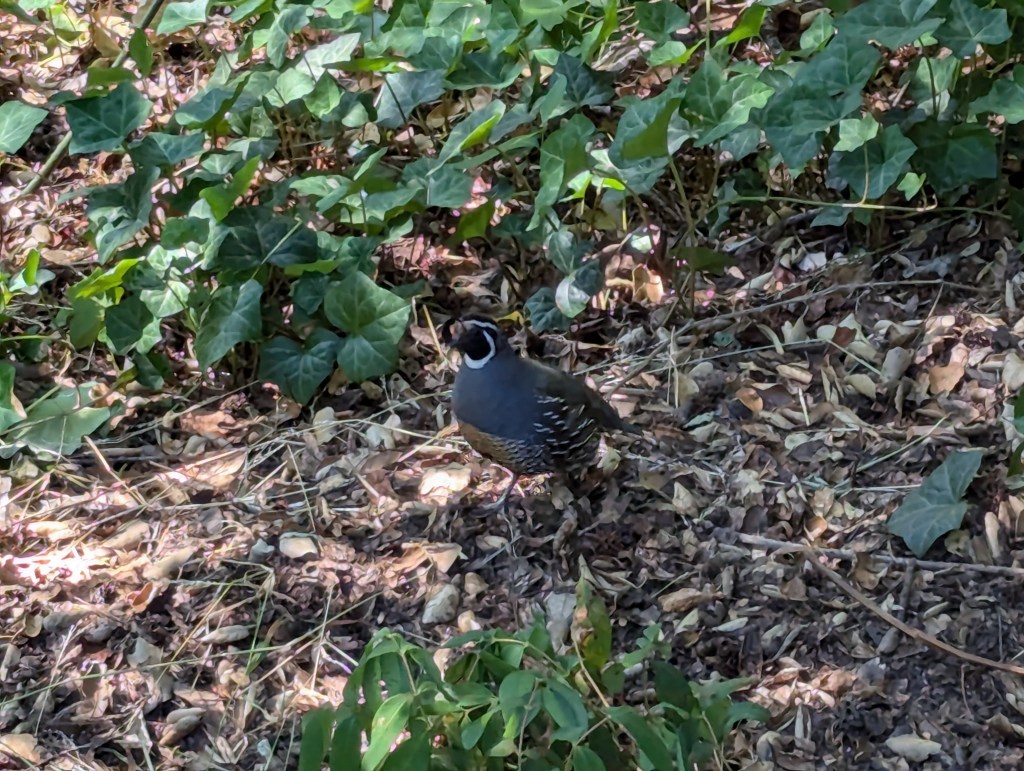
California quail are the Official State Bird of, as one might guess, California. They are delightfully plump but small game birds that are on the ground more than anywhere else. They fly only when necessary, and seem to avoid landing in trees or shrubbery. They effectively avoid predators by running into thickets of vegetation that their predators can not follow them into. Some believe that they sound like they say “Chicago” when they talk to each other. Actually though, they say “Hey Paco!”, in a politely mellow tone. They are a chaparral species that venture into adjacent forests such as the redwood forests here. Relatively colorful males, such as this, are typically followed by their visually subdued female mates after spring, and by now are likely to be followed by a herd of tiny and fuzzy chicks. Their motion on the ground is fluid, although most of a small herd can angularly and suddenly change direction, as if the Papa quail follows his silly apostrophe shaped topknot to the left or right, and the rest follow. They run about pecking at exposed soil, and often stop to scratch at forest debris where soil is not so exposed. Not only do they eat insects and mollusks, but most of their diet is seeds. Since only a negligible minority of seeds within our landscapes of desirable vegetation, such as naturalized wildflowers, almost all of the seeds that California quail eat here are those of weeds. They proactively eat weeds before they happen.
Eight columns arranged in a semicircle behind the High Place garden at Filoli were found by excavation for the foundation of a skyscraper in San Francisco. The stone from which they were carved is European, but no one knows how or why they were buried under San Francisco. They could have been recycled into one of many buildings that were destroyed by the Great Earthquake and associated fire of 1906, and subsequently buried within landfill with tons of other debis. They were more likely recycled as ballast for a European ship that, as it deteriorated or became obsolete, was dismantled and buried within landfill in San Francisco. It is a mystery. They are in a formal landscape at Filoli now, and will likely remain there for a very long time.
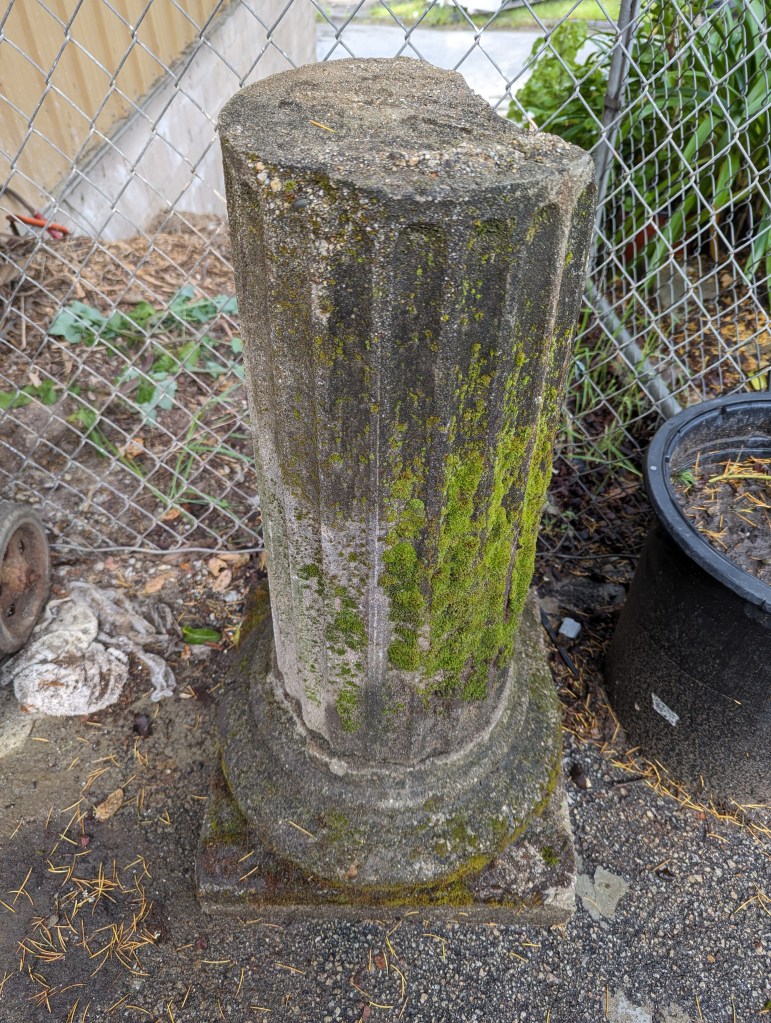
Within a dumpster of recyclable broken concrete, I noticed this old concrete column. With a bit of investigation, I also found the base. Each component is very heavy. I have no idea what they were, but I suspect that they were the base of an elaborate birdbath. I did not find any associate basin within the dumpster. In order to identify their origin, I inquired about these items with those who disposed of them. At the location, I found a small portion of the column that fits between the base and the larger portion of the column, as well as another column that is identical to the original with the smaller portion attached, but no other base. Nor did I find any basin or other features that might have been supported by the columns. They are either already disposed of, or buried by earlier excavation. It is such a waste. Regardless, these items are here now, and will hopefully be incorporated into the landscapes, although I have no idea how.

 Tony Tomeo