Six on Saturday: Firsts & Lasts

Angel’s trumpet should be finishing bloom by now. Instead, and even while their foliage is fading with cooler weather, their bloom continues. Only the unidentified cultivar with single pink flowers currently lacks open flowers, but even it is budded for potential later bloom. (I neglected to get a picture of a flower of ‘Charles Grimaldi’ angel’s trumpet only because two pictures of angel’s trumpet is sufficient.) While angel’s trumpet is finishing, Algerian iris and ‘Peach Delight’ ginger lily are blooming for their first time here and red butterfly ginger is generating bulbils for its first time here. I was not aware that this sort of ginger generates bulbils. Otherwise, I could have allowed the other gingers do so also.

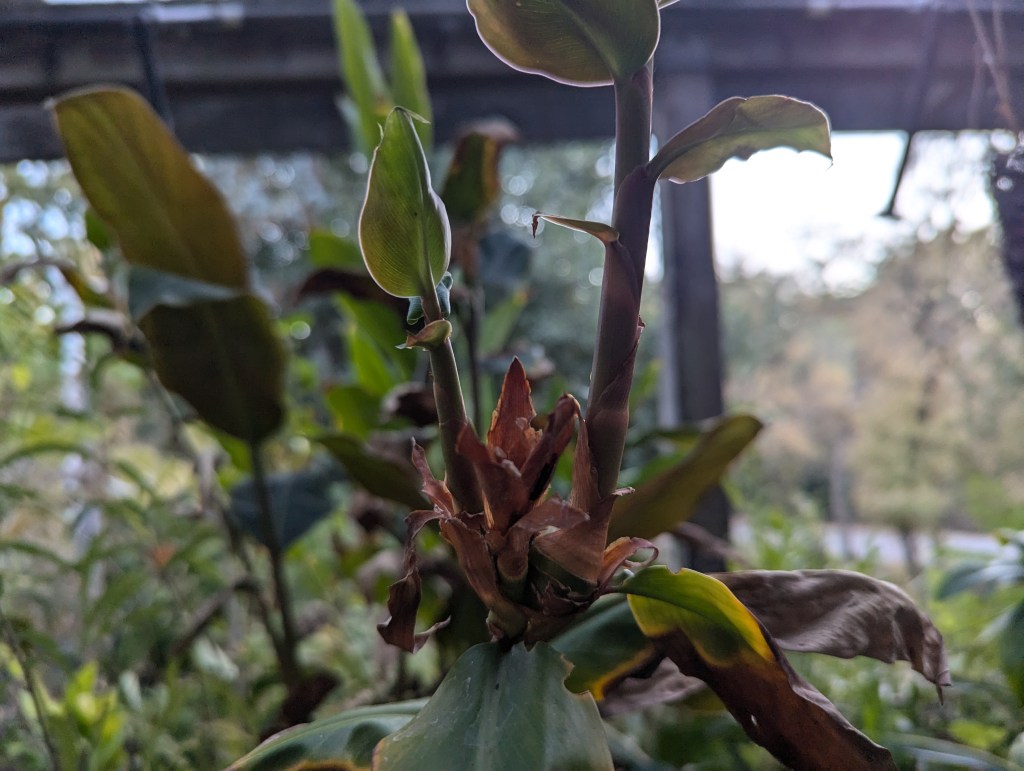
1. Hedychium greenii, red butterfly ginger is making bulbils! I did not know that it knew how to do so. I am now glad that I refrained from pruning the bloomed canes out earlier.
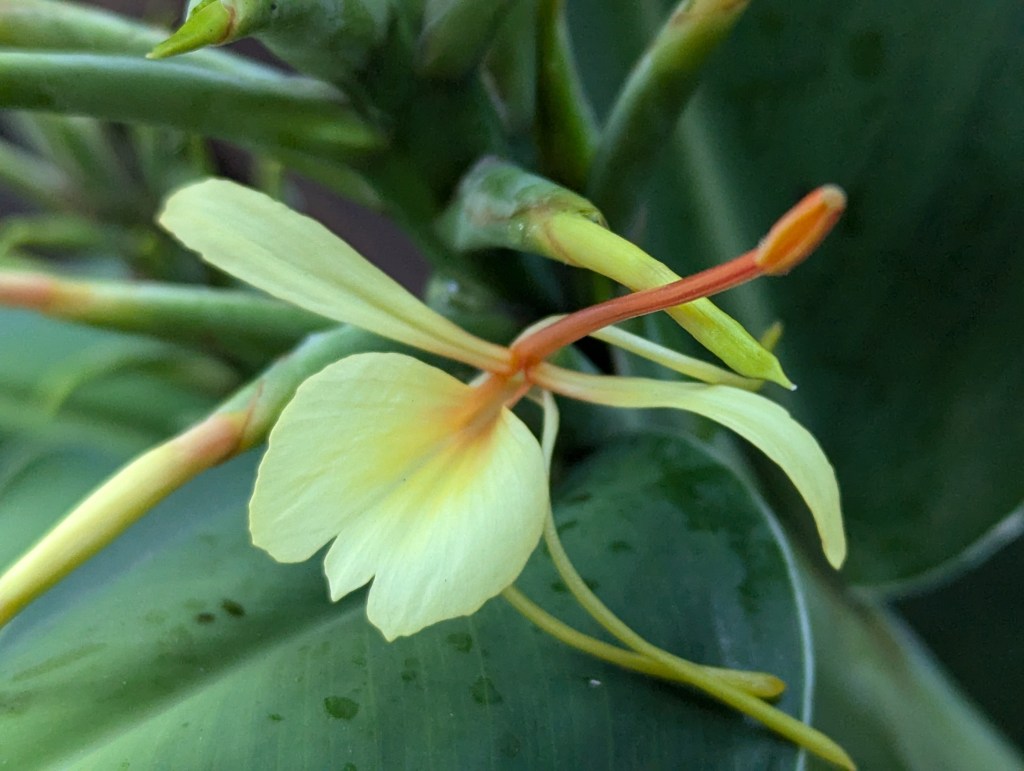
2. Hedychium coccineum X cornonarium ‘Peach Delight’ ginger lily started to bloom so late that I did not expect for it to actually show this much color and confirm its identity.

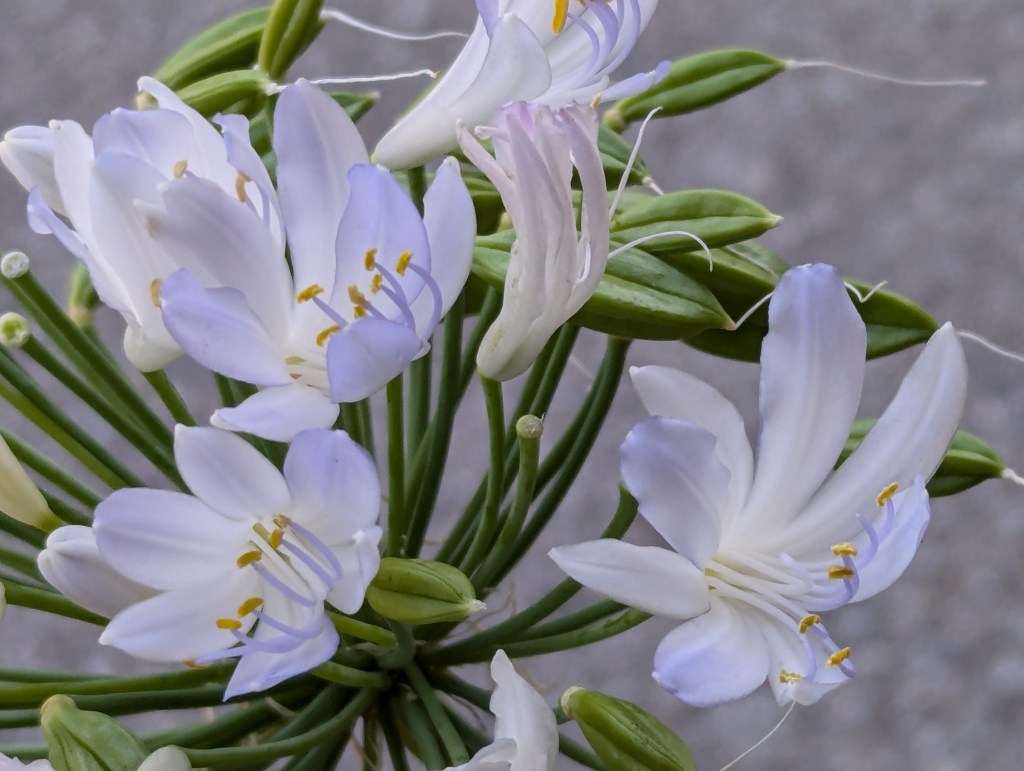
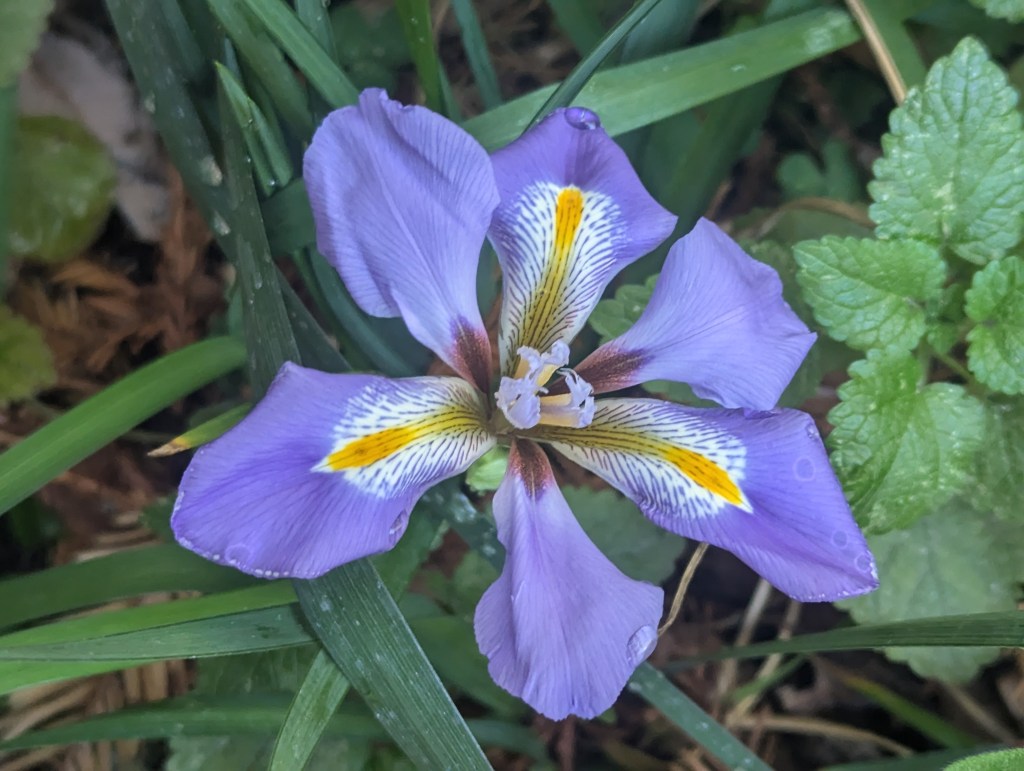
3. Iris unguicularis, Algerian iris is also blooming for the first time here, since its arrival from Tangly Cottage Gardening. It should bloom more for winter. Is it blue or purplish?
4. Brugmansia, angel’s trumpet of an unidentified cultivar, species or perhaps hybrid, is trying to bloom with its last big single pink flowers of the season, and it just might do so.
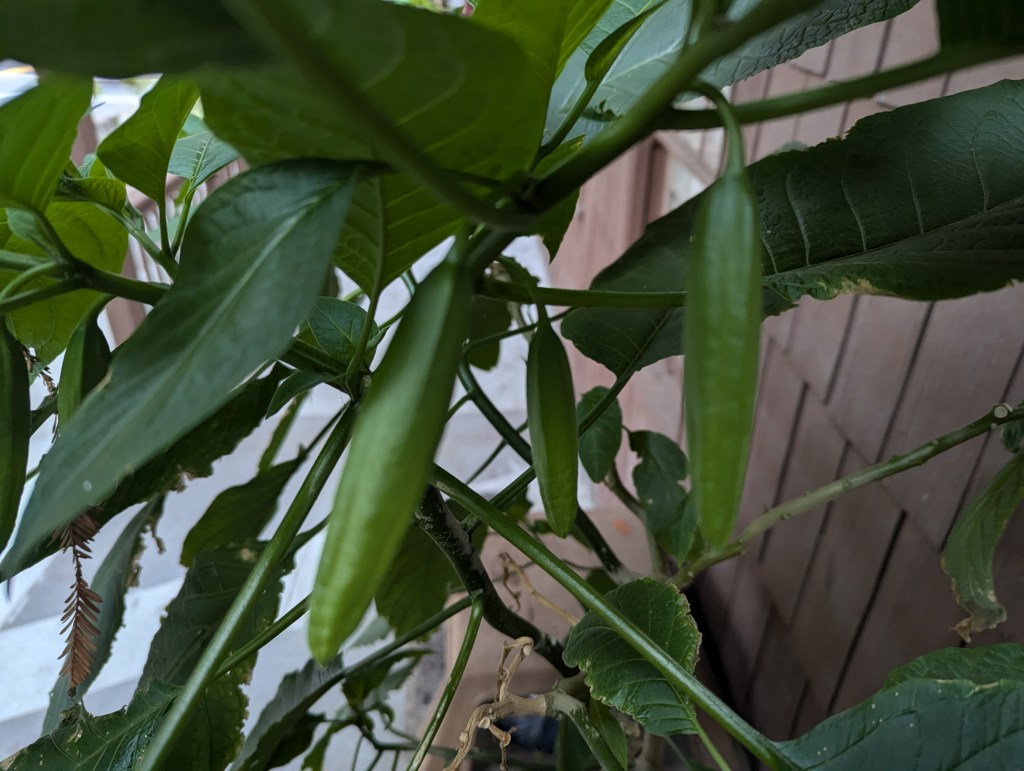
5. Brugmansia insignis ‘Single White’ angel’s trumpet is my favorite in regard to bloom, but not one that I recommend. It is blooming nicely though, now that its season is done.
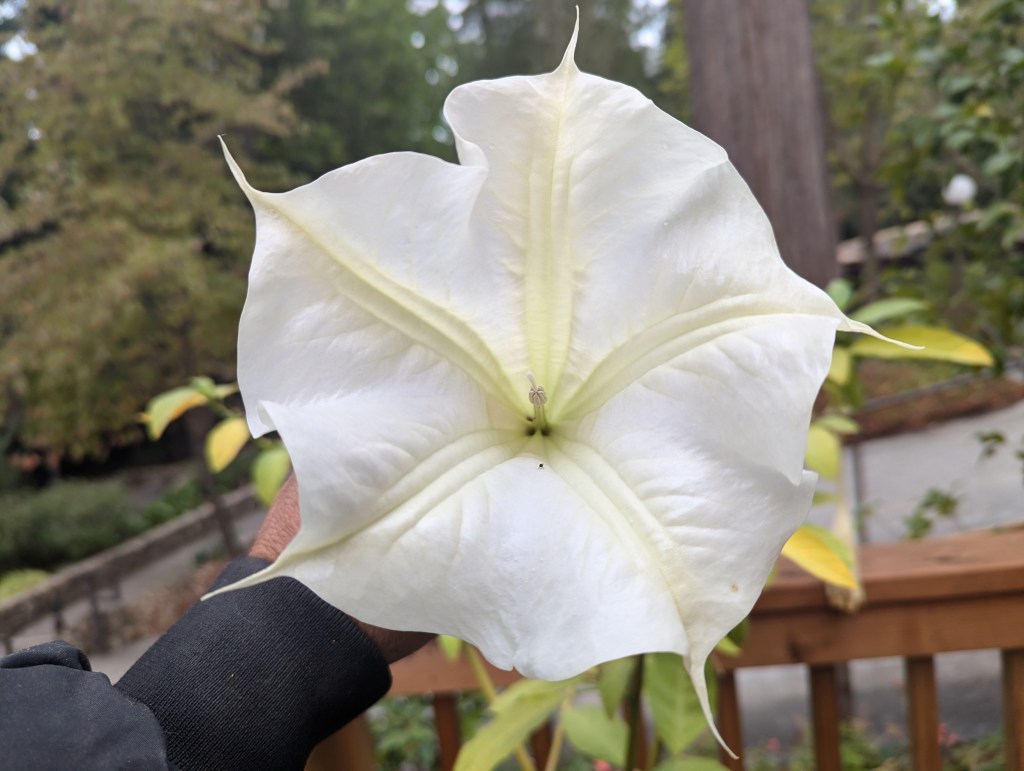
6. Brugmansia candida ‘Double White’ angel’s trumpet also intends to bloom until it no longer can. It bloomed only sporadically since spring, but better than the ‘Single White’.

This is the link for Six on Saturday, for anyone else who would like to participate: https://thepropagatorblog.wordpress.com/2017/09/18/six-on-saturday-a-participant-guide/
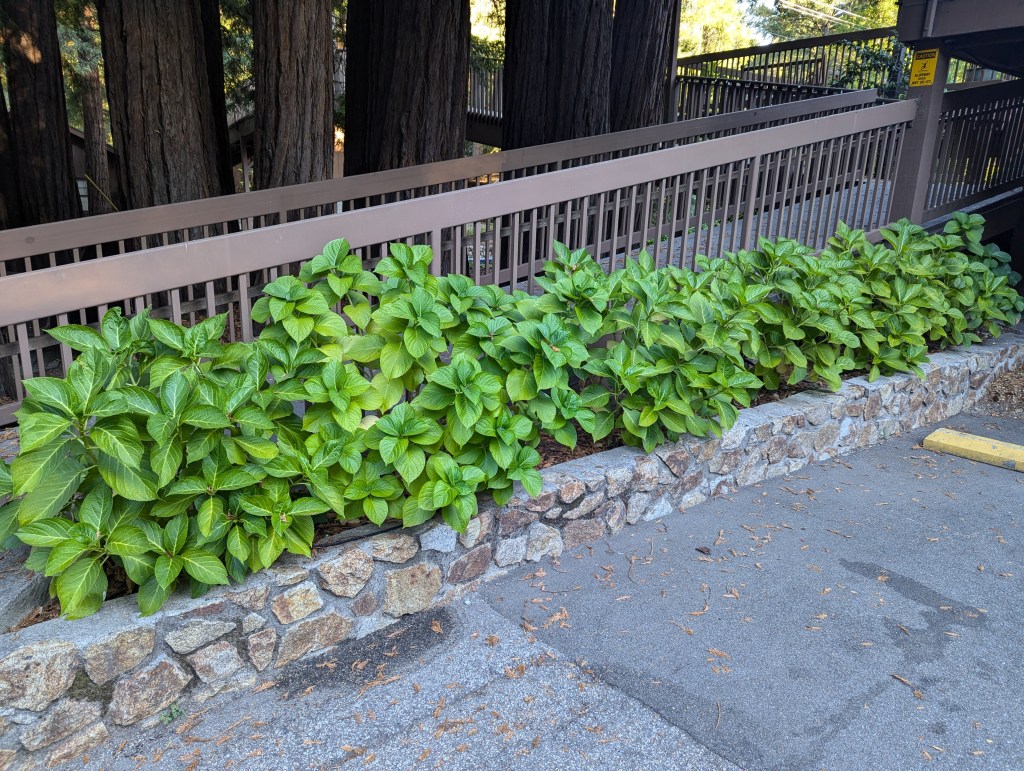
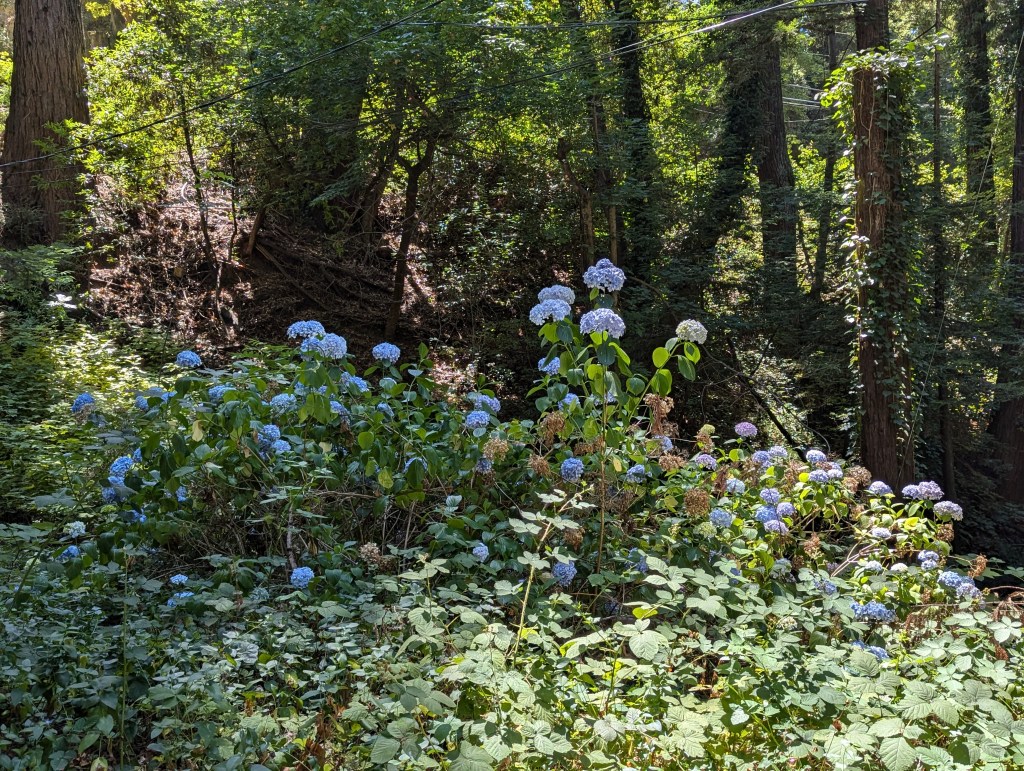
Bloomless Hydrangea

This hedge of modern Hydrangea is completely devoid of bloom.

Modern cultivars of Hydrangea were not easy to adapt to. I learned how to prune old fashioned cultivars during their winter dormancy. I knew to retain the terminal buds of their retained canes to bloom for their following season. Pruning canes of modern cultivars back shorter and depriving them of their terminal buds in order to promote shrubbier growth seemed to be more like pruning roses. I did not trust them to bloom without their terminal buds. Not only do they bloom, but they do so a bit more abundantly, and with sturdier floral trusses that last and retain their floral color somewhat longer than those of old fashioned cultivars. Old fashioned cultivars have bloomed so reliably for the past few years that I am not so hesitant about pruning them back. However, this year, they inexplicably did not bloom. I do not mean that they bloomed sparsely, or that a few of the total did not bloom. I mean that none of the modern hydrangeas bloomed at all. The only hydrangeas that bloomed within the landscapes at work this year are the few remaining old fashioned sorts. All of the hydrangeas are healthy with vibrantly green foliage. Neither disease nor insect pathogens have been problematic. I can not explain this odd lack of bloom. With such vigorous canes, pruning should be easy this winter. However, I am more likely to leave awkwardly long canes in order to retain their terminal buds. Even if they are not necessary, terminal buds might provide an earlier prebloom prior to the bloom of stems that grow from lateral buds. I can not help but wonder why, while modern cultivars did not bloom, old fashioned cultivars did. A colony of unpruned feral Hydrangea near the bank of Zayante Creek was unusually prolific in bloom.

Unpruned feral Hydrangea bloomed unusually prolifically.

Tabasco

Dahlia ‘Tabasco’

Annuals, as their designation implies, complete their respective life cycles within one year. Perennials, as their designation implies, can survive perennially, for more than one year. However, some bedding plants that are enjoyed as annuals actually have potential to be perennials. They are only as disposable as annuals because they are less appealing during dormancy or whatever season in which they do not perform so exemplarily. Most who enjoy gardening do not mind. Perennials that are designated as perennials but do not perform for more than a year are more disappointing. Of a few dahlias that the other horticulturist here purchased a few years ago, four were two pairs of bedding dahlias, which typically function as annuals, and one was a rather expensive perennial ‘Cafe au Lait’ dahlia. ‘Cafe au Lait’ rotted within its first season of minimal bloom. I was not at all keen on it anyway, and was even less keen on its lack of perennial performance. One pair of bedding dahlia, which I do not remember the name of, bloomed for two years, with bright yellow flowers against light green foliage. They would have bloomed again this year if I had stored them better and put them back into the landscape sooner. I forget about the stored dahlia tubers because we typically do not dig and store them here. The other pair of bedding dahlia was ‘Tabasco’. It originally bloomed with red flowers striped with orange, against dark green foliage. For the following year, it blooms with yellow flowers blotched with orange, against simpler green foliage. Now, for its third year, it blooms more like it appears in pictures, with simpler red flowers against bronzed foliage. I do not mind its variability, and actually find it to be interesting. I am more impressed by its perennial performance.

Exposure

Sunshine promoted bloom to the left. Shade inhabited bloom to the right.

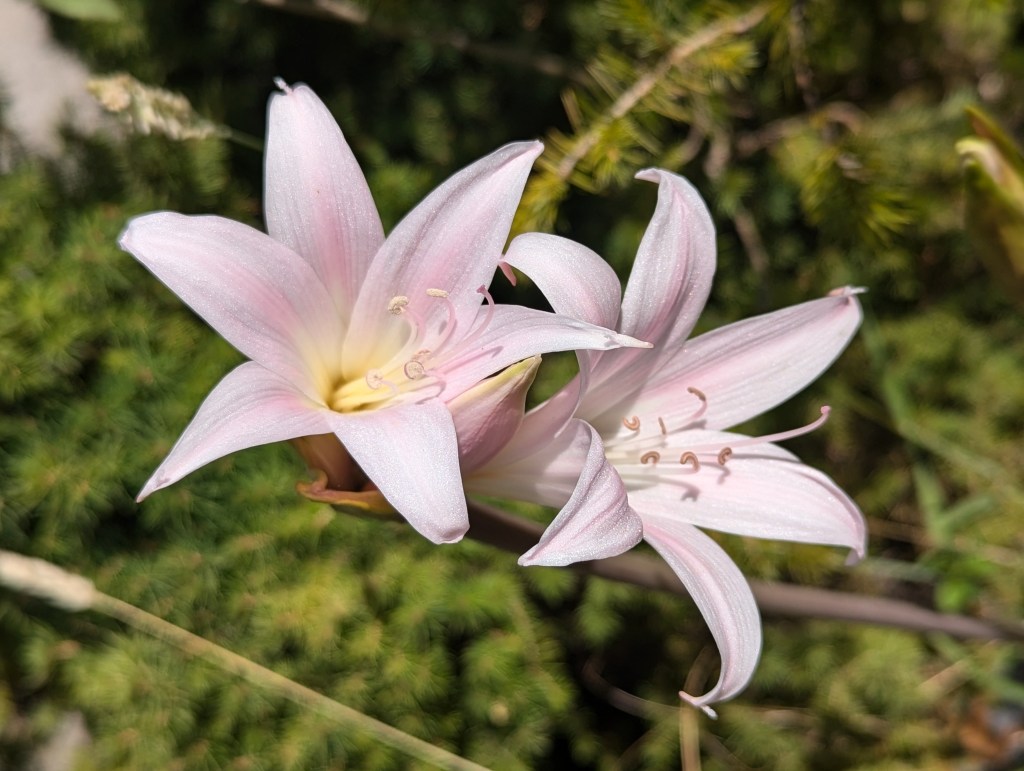
Naked ladies like exposure. Amaryllis belladonna can certainly survive and actually develop lushly healthy foliage in partial shade. However, it needs sunshine to bloom. This picture above, which was recycled from yesterday when I mentioned that I might elaborate on it later, demonstrates how discriminating this species is. As mentioned yesterday, a row of naked lady bulbs extends completely across the picture from left to right. It does not extend only from the left to the middle of the picture, as the bloom might imply. Now that bloom is finishing, foliage will develop throughout the entire row, including the portion of the row that currently lacks bloom, so that the extent of their herd will be more apparent. The lack of bloom to the right is the result of the shade of a densely foliated coast live oak above. Because coast live oak is evergreen, it shades the area below its canopy through winter, when naked lady is also foliated and storing resources for subsequent late summer bloom. Those that do not get sufficient sunshine to initiate bloom within any particular season will be unable to bloom for the beginning of their subsequent season. When we installed these recycled bulbs here, we considered that bloom would likely be inhibited below the coast live oak, and that we would relocate bulbs that were too shaded to bloom, but we expected more of a transition between the shaded area and the sunnier area. This is so blunt, with bloom to the left, but none to the right. At least we now know precisely which bulbs to relocate while they are dormant next summer. Although there is technically no need to relocate them, and they can be adequately healthy here, they would be more appealing within a sunnier situation that would promote bloom.

Six on Saturday: Firsts

The first and last may potentially suggest that this is an episode of the Red Green Show.

1. Hedychium greenii, red butterfly ginger, which I accidentally took from Brent Green’s garden with a bunch of crowded out Heliconia psittacorum, is now about to bloom here. I was totally unaware that it was here until Brent mentioned that it was no longer there.

2. Hedychium gardnerianum, kahili ginger bloomed during the pandemic, while no one was here to see it. Then, gophers ate it. I canned the remnants, which are blooming now. This is the first of several florets to bloom on the first tall floral spike. It smells like 1986.

3. Agapanthus orientalis, lily of the Nile suddenly bloomed with this single white umbel within an exclusively blue colony. I removed the offending shoot as bloom began to fade, but found that it is not completely white. I canned it to observe how it blooms next year.

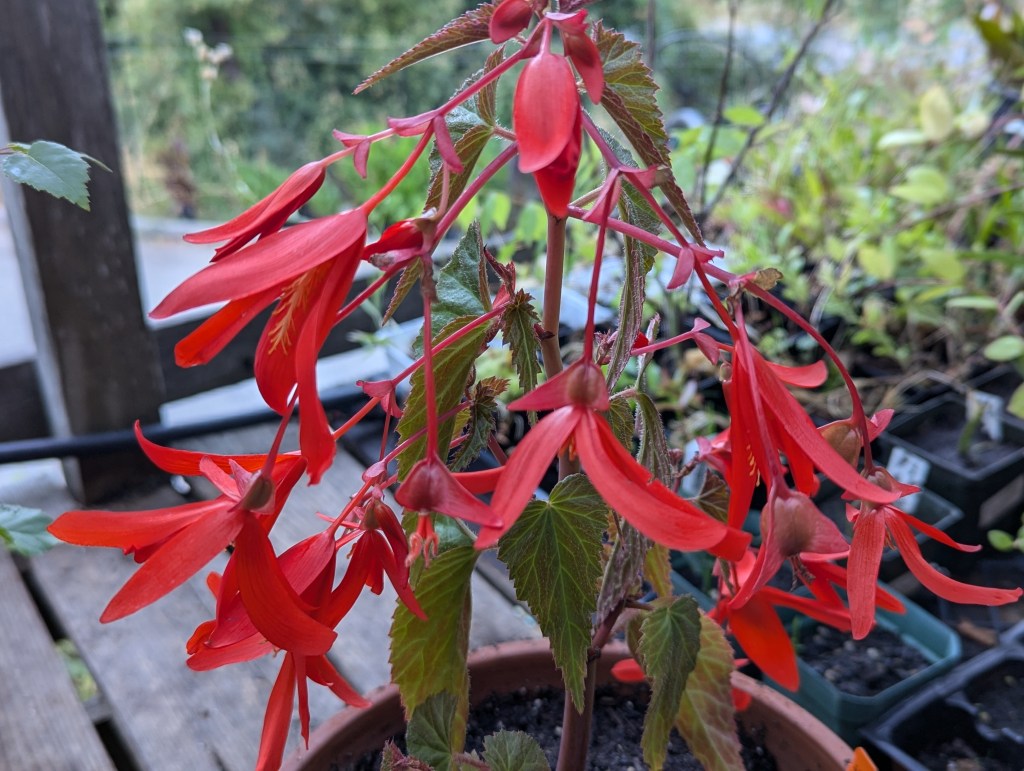
4. Begonia boliviensis ‘Santa Cruz’ begonia was not my idea. Another horticulturist here just procured it from a nursery in Santa Cruz, a few miles away. It is quite happy here in Santa Cruz County. It deserves a more appealing name, such as ‘Los Gatos’ or ‘San Jose’.

5. Canna ‘Cannova Mango’ canna was not my idea either. Brent sent it to me. I am not at all keen on modern cultivars, particularly this color. I nonetheless divided it too much to bloom well. This is its first opportunity to demonstrate how profuse its bloom should be.

6. Canna that was a gift from friends of a friend last winter is now blooming here. I have no idea what cultivar it is, and I do not care. Gifts are always better than nursery surplus from Brent’s projects. It is elegantly tall with simple red bloom and simple green foliage.

This is the link for Six on Saturday, for anyone else who would like to participate: https://thepropagatorblog.wordpress.com/2017/09/18/six-on-saturday-a-participant-guide/

Six on Saturday: Early or Late

Some of these six are early. Some are late. Some merely seem to be one or the other, but are actually right on schedule. Only the banana pup, which is the only of these six that is not blooming, was influenced intentionally.

1. Hymenocallis latifolia, Peruvian daffodil is actually right on schedule. I expected it to remain dormant through summer to bloom for autumn, after naked lady. It may still do so if it foliates first. Otherwise, it should naturally bloom for summer. These are my first.

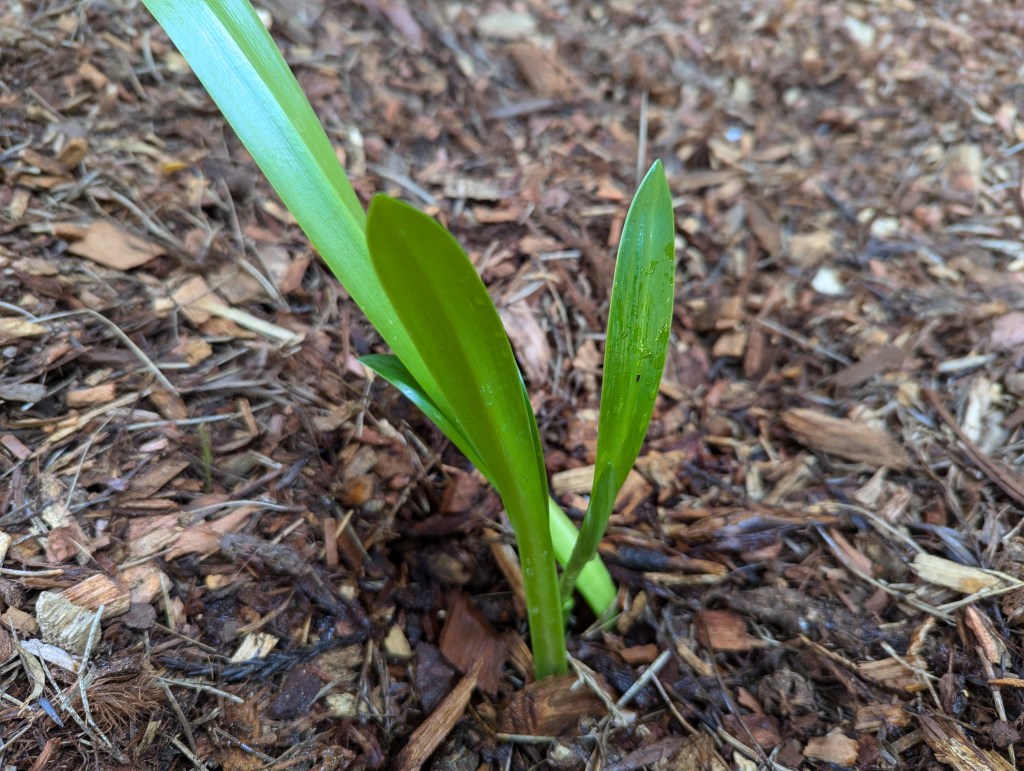
2. Musa acuminata ‘Cavendish’ banana was divided earlier and allowed to grow for two months, but then lopped and sent by mail. It must now grow new foliage before autumn. It is actually less likely to rot with this technique. I am quite pleased to have procured it.

3. Hedychium gardnerianum, kahili ginger surprised me with what initially seemed like early floral trusses. However, they have since grown so slowly that they might bloom for later summer or autumn, which is when I previously thought that they normally bloom.

4. Gladiolus hybridus, gladiola has been unexpectedly reliably perennial, and is actually slowly multiplying. A sport of an orange and yellow variety now blooms yellow. Another blooms red. This one seems to be trying to extend its bloom season by blooming so late.

5. Amaryllis belladonna, naked lady is doing the opposite. It should not bloom for about another month. This bulb might be blooming early as a result of distress associated with crowded confinement with too many other bulbs within a big pot. It is pretty regardless.

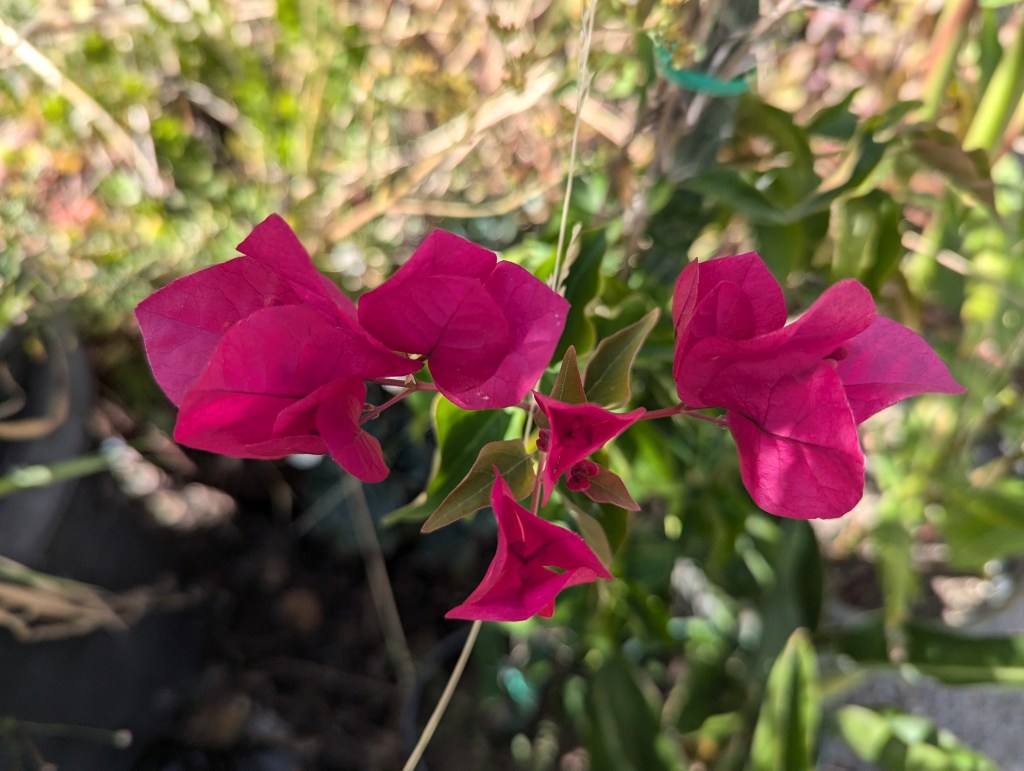
6. Bougainvillea, which lacks a common name that is actually common, could have been blooming since the weather began warming at the end of last winter. It recovered slowly from minor frost damage, though. It still seems to be rather lean, but at least it is trying.

This is the link for Six on Saturday, for anyone else who would like to participate: https://thepropagatorblog.wordpress.com/2017/09/18/six-on-saturday-a-participant-guide/

Smokebush

Smokebush bloom is not particularly flowery.

Mundane floral color and a lack of floral fragrance are no problems. Smokebush, Cotinus coggygria, compensates. Its uninteresting bloom reveals strikingly fluffy floral trusses for summer. These trusses eventually deteriorate to reveal exquisitely vibrant foliar color for autumn. This foliar color eventually deteriorates to reveal sculptural trunk form for winter.

Foliar color through spring and summer is likely the most striking attribute of smokebush. Most are boldly rich purplish bronze. Some are strikingly vivid yellowish chartreuse. The two extremes contrast splendidly. Old fashioned olive drab is now rare. Foliar color does not fade much. However, it suddenly transitions to fiery orange and red color for autumn.

Old fashioned olive drab smokebush can grow a bit more than fifteen feet high and wide. Because it does not grow fast, only old specimens are so large. Most bronze cultivars do not get much higher than first floor eaves here. Chartreuse cultivars are likely to stay a bit shorter. Healthy young specimens might get wobbly if their canopies outgrow their roots. Aggressive pruning improves form and stability, and can also enhance foliar color.

Second White

How did this get in here?!

Lily of the Nile had previously been exclusively blue at work. Many from undoubtedly several different sources had been added to the landscapes for the past century or so, but, until recently, none were white. Even within a large and likely original colony, where genetic variability is evident among specimens that were added from different sources, or that grew from seed over the years, all bloomed monochromatically blue. I added the first white lily of the Nile only a few years ago. They are a significant herd of the same cultivar that I grew from only seven original pups that I acquired in the early 1990s. They are separate from the other lily of the Nile, in a neat row in front of the White Garden of el Catedral de Santa Clara de Los Gatos. They are not as fancy as they sound of course, and bloom with only a few flowers in the partial shade there, but they were supposedly the only white lily of the Nile. However, I recently found this other white lily of the Nile within the large and very established colony that provided many lily of the Nile for other landscapes. It could have grown from seed, and finally matured enough to bloom. I suspect that it merely reverted, as lily of the Nile sometimes does. I suppose that I should be pleased with it, but I am not so certain. It is almost intrusive, both to the exclusivity of the single white cultivar, and also to the exclusivity of the monochromatically blue colony. I have noticed within other old landscapes that, once one pup blooms white, others can follow its example. The same applies to a pup that blooms blue within a white colony. I may tag this particular pup for removal after bloom.

Reveille

Angel’s trumpet, Brugmansia X cubensis ‘Charles Grimaldi’

Summer has been slow to arrive. Now, some flowers that have been waiting for a bit of warmth to bloom are ready to make up for lost time.

These angel’s trumpets are fortunately silent. Even prior to full bloom, so much bloom looks silly with such minimal foliage.This picture is a few days old; so they are in full bloom by now. More foliage will develop as the summer progresses.

This particular cultivar is the common ‘Charles Grimaldi’, with splendidly fragrant single yellow flowers. Two other cultivars are blooming nearby. One is somewhat less vigorous, with single white but perhaps less fragrant flowers. The other is more compact than ‘Charles Grimaldi’, with double white and comparably fragrant flowers.

All were grown from cuttings, and have potential to grow like weeds. Six more of the cultivar with double white flowers were added to another landscape nearby. Several of both cultivars with white flowers are developing in the nursery, and will need homes either in the landscapes or neighbors’ gardens by next year. Another cultivar in the nursery may bloom with mildly fragrant single pastel orange flowers in the next few days, but we will not know until it actually does so. We have not seen it bloom yet. It could actually be another copy of ‘Charles Grimaldi’.

Daylilies are beginning to bloom now also. Like angel’s trumpet, they seem to have been waiting a bit longer than they wanted to, so are ready to bloom simultaneously in atypical profusion. I hope that such profusion does not compromise subsequent bloom, since they continue to bloom throughout summer and until frost. Also like angel’s trumpet, daylilies are so easy to grow and propagate that there has been no incentive to acquire more cultivars than the three or so that are already here.

Volunteering at the San Jose Heritage Rose Garden

The San Jose Heritage Rose Garden is the most complete collection of ancestral roses in the World!

(This article is recycled from several years ago, so information about events is now outdated.)

            No matter how careful I am to avoid spending any money at Spring in Guadalupe Gardens, I have never escaped without purchasing something, or a few or even several somethings that I did not need but really wanted for my garden. My plunder was relatively meager this year, but did include three climbing roses from Liggett’s Rose Nursery.

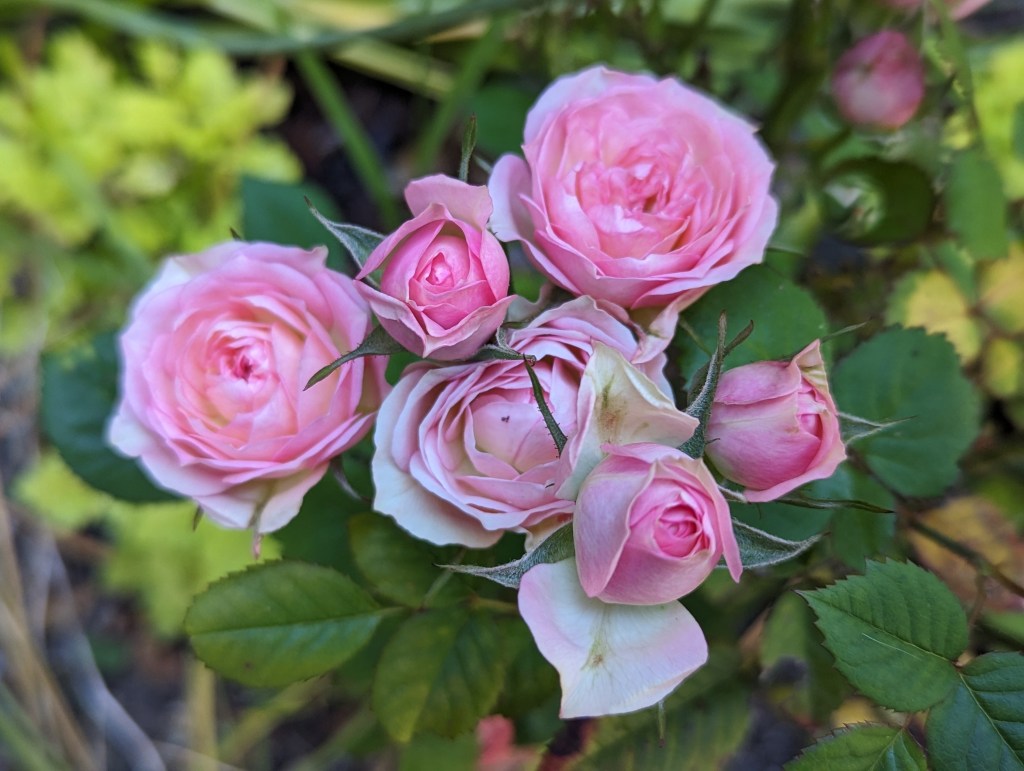
            One is a ‘Renae’ rose that blooms all summer with remarkably fragrant pale pink blooms. Its fragrance is so obnoxiously strong though; that I gave the plant to my neighbor, and told him that it ‘smells good’. It really does smell good, albeit from a distance, such as in my garden.

            The other two roses are ‘Lamarque’, with abundant fluffy white blossoms all summer. The robust fragrance is fortunately more tolerable. I really like the monstrous canes that are already reaching out to cover a bare embankment.

            The two ‘Lamarque’ roses are manageable so far. I really do not know how manageable they will be next year though. It would be nice if they could go wild, and only get pruned as they encroach into trees and the driveway. However, roses perform best if properly maintained. I will want to be able to prune off deteriorating flowers to promote subsequent bloom. This process of ‘dead heading’ will not be so easy if I can not reach all the canes.

            The Heritage Rose Garden has a similar challenge. Although most of the plants are within reach of anyone wanting to prune them, there are simply too many plants for a herd of goats to remove all the spent blooms from. Since goats are not such a feasible option in a rose garden, volunteers are invited to attend a Rose Deadheading Blitz from 5:00 to 7:30 p.m. every second Tuesday of each month, beginning June 8 and continuing until September 7.  

            No experience is needed, either for deadheading the roses or for swilling the ice cream served afterward. Volunteers should bring shears and gloves, and wear closed-toe shoes. Shears are available from the staff if necessary. 

            The Heritage Rose Garden is located on Taylor Street at Spring Street, just east of Coleman Avenue in San Jose. Volunteers can get more information or sign up by contacting Volunteer Coordinator, Lucy Perez by telephone at 298 7657 or by email at lperez@grpg.org

            My bounty from Spring in Guadalupe Gardens of past years includes many succulents, particularly a few specie of Crassula that were frozen by frost early last winter. Their recovery has been delayed by the lingering cool and rainy weather through spring. Now that I am removing the last of the sludge that remains from the previously frozen leaves and stems, I am finding where snails have been hiding and breeding. Even though the sludge is harmless, the snails within are not. I probably should have cleaned it out earlier.

            Foliage of fruit trees, roses or other plants that has been infected with peach leaf curl, powdery mildew or any other disease should likewise be removed and disposed of. Either next spring or later this year, secondary infection is much more likely without sanitation.