White Perennial Pea

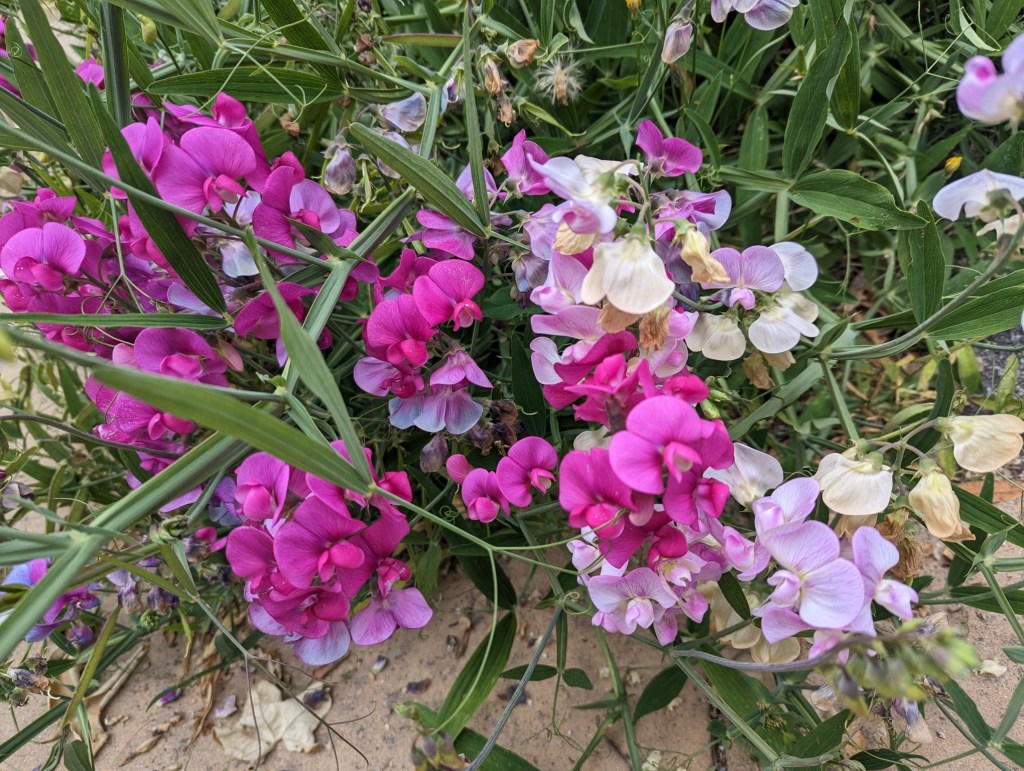
Bright pink, light pink, but no white here.

Perennial pea is a somewhat naturalized exotic species here. It may not be aggressively invasive enough to be classified as a weed though. However, I would classify some of it that I can not exterminate from at least one of our landscapes as weeds. Once it gets established, it is very persistent.

It seems to prefer to grow on roadsides or fences. It is not so common in flat open spaces. It rarely gets big enough to overwhelm or otherwise damage other vegetation. It dies back when the weather gets too inhospitable for it. It regenerates when the weather is more comfortable.

Perennial pea certainly is pretty. Almost all of it blooms with typical bright purplish pink flowers. A few uncommon specimens bloom with variations of lighter pink. White is even more rare. Only red is more rare than white. I have never seen it growing wild. Although seed for red perennial pea is available, I know of no one who has actually grown it.

Therefore, until someone can prove that red actually exists amongst naturalized perennial pea, white is the rarest color. It might also be my favorite. I can not decide. White is my favorite color. Also, perennial pea happens to look great in white. Yet, the familiar obnoxiously bright pink is so typical of the species. It is the color that everyone expects to see growing wild on local roadsides.

I was fortunate to find a specimen at work that blooms white. I grew a few copies of it, but kept them canned. I shared some with colleagues in other regions until only two remained here. I was not too alarmed when these last two were overwhelmed by other vegetation and died, since I thought I could grow more copies from the original specimen. That was until I found that the original was destroyed by excavation to mitigate erosion from last winter!

I believe that another specimen that blooms white lives nearby. Its particular colony has already finished bloom for the season. I must therefore wait for it to resume bloom, or look for errant bloom through winter. After getting so involved with it, perhaps it really will be my favorite.

Muskogee?

This is not a color I had expected.

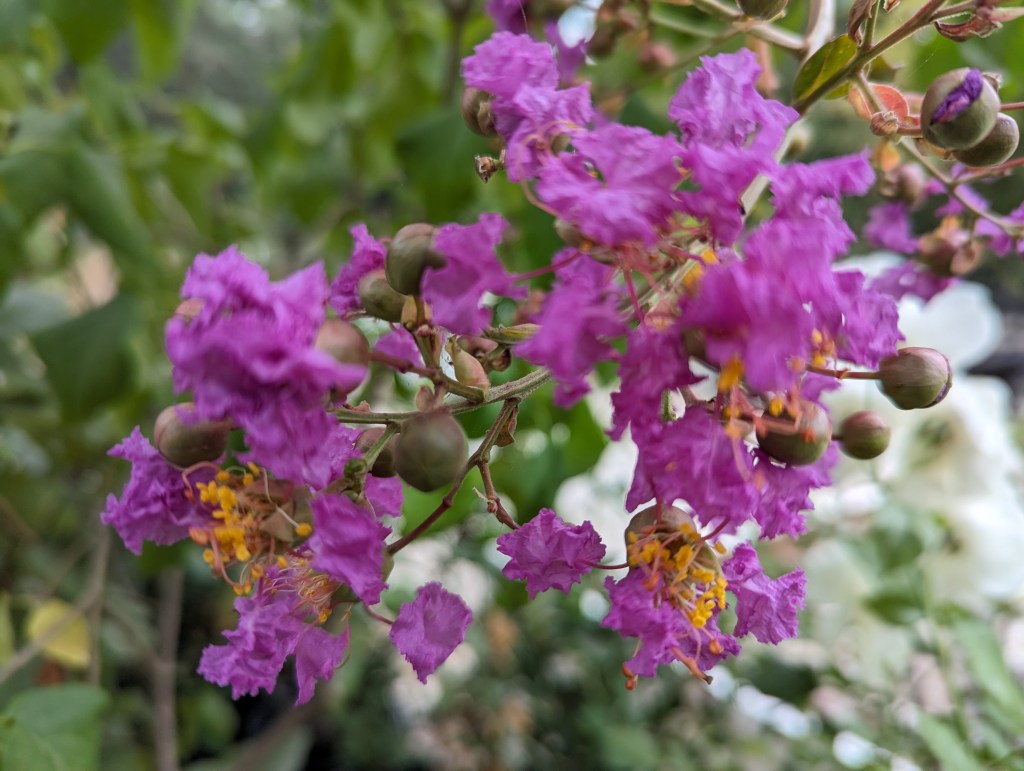
What cultivar of crape myrtle is this?! I realize that this picture is blurred, which is why it was not included within my ‘Six on Saturday’ post this morning, but it is the floral color that is important. Is it purplish pink, or just bright pink? What cultivar does it look like?

I expected this crape myrtle to be one of the old reliable cultivars because it was a gift from the Arbor Day Foundation. The primary old reliable cultivar that blooms with similar floral color is ‘Muskogee’. Yet, even with my limited ability to discern color quality, this floral color seems to be a bit too rich. I sort of expect a milder and scarcely purplish pink from ‘Muskogee’. I suppose that the Arbor Day Foundation can also grow modern cultivars like the rest of us.

Regardless of its identity, it is certainly pretty. The foliar color during autumn is comparable to that of old reliable cultivars. Because neighbors like it, I grew a few copies for them. We would like to incorporate more crape myrtles into the landscapes at work. The abundance of spring color from other species there mostly finishes prior to the summer bloom of crape myrtle. Summer is the busiest season, so justifies flashy color.

Embarrassingly though, I am still none too keen on crape myrtle. If I did not typically spell ‘crape’ as ‘crepe’, I would prefer to spell it without the ‘e’ at the end. I was impressed with it when I first started to notice it through the 1980s, but then realized that it was becoming too common through the 1990s. That was long after Brent told me that it had become too common throughout the Los Angeles region significantly earlier. Decades later, it is still too much of a good thing.

Hydrangeas Perform Better With Proper Pruning

Pruning of one season affects bloom of another.

After decades of breeding, most modern cultivars of hydrangea are much more compact and a bit stockier than old fashioned hydrangeas that had long, limber stems that could bend downward from the weight of their own blooms. They stand up to proudly display their modern, vibrant color, even when their billowy blooms get heavy with rain. Yet, even with all their genetic improvements, they should still be pruned properly and annually to promote continued bloom. Without pruning, even modern cultivars can get floppy and lanky.

Because most hydrangeas bloom on stems that developed during the previous year, they should not be pruned too much while dormant through winter. Instead, solitary (generally unbranched) stems that grew from the base last year and bloomed this year should be pruned back to a pair of buds about a foot high as their blooms deteriorate. Even though some blooms continue to develop late into autumn, most are finishing about now. Therefore, pruning stems back while also removing spent blooms gets the pruning done early enough for the side buds to start to grow into secondary stems.

These secondary stems should not get pruned again, even when they go dormant through winter. They do not grow much before winter, but should be mature enough to bloom during the following spring. Thinning these branched stems through winter by cutting some of the smaller stems to the ground should produce fewer but significantly larger blooms, as well as prolong the blooming season. (However, many modern cultivars naturally bloom sporadically after their primary bloom phase until autumn anyway.)

New canes that develop from the ground to replace older branched stems may not bloom their first year, but can be left unpruned through winter to bloom early the next spring, which starts the process over again. Old stems should be cut to the ground after their third year (second bloom season). Leaving a few spent blooms on the plants long enough to dry (as dried flowers) should not interfere too much with proper pruning.

Wind Pollinated Flowers Are Worse For Allergies

Have you ever wondered why it is sometimes difficult to know which flowers cause the worst allergies at any particular time? It is for the same reason that it can be difficult to find the flowers that produce the most fragrance. They simply do not need flashy colors to attract pollinators. Fragrant flowers instead use fragrance to attract pollinators. Flowers that are the worst for allergies simply put less effort into attracting pollinators, since they prefer to get their pollen delivered by wind. Yes, wind; it is one hundred percent natural and absolutely free.

Pollen than is designed to be dispersed by wind seems to perform just as well without it, by floating through the air, which is like ‘diet wind’. Unlike the pollen of big colorful flowers that is heavy and sticky in order to adhere to pollinators, pollen that is designed to be dispersed by wind (or diet wind) is extremely finely textured and abundant. Since it is not so directly and efficiently delivered between flowers, it gets everywhere and into everything, with the hopes that some of it, if even just a few particles, will reach the flowers that it wants to pollinate.

Pollen that primarily relies on wind for dispersion is like all those millions of bulk mailing fliers that get mailed out to everyone so that one or two or perhaps a few might reach someone who might actually be interested in getting one. Pollen from big flashy flowers are more like fancy Christmas cards that we send directly to friends, family and neighbors, but would be too expensive to send to millions of uninterested people. The problem is that like so much junk mail that clogs mailboxes, wind dispersed pollen is too abundant, which makes it a serious problem for those who are allergic to it. There is no escape when it fills the air.

The many wind pollinated plants that bloom in secret are the worst for pollen production. Unremarkable flowers of pines, cypress and cedars are among the worst. Acacias and eucalyptus are nearly as bad; but at least some have colorful bloom. Although hedged privets are not often able to bloom (because their flower structures get shorn off), privets that are allowed to grow into trees produce wicked pollen, even at a young age. Wild grasses may not seem like they would be much of a threat in urban landscapes, but their pollen travels for many miles to find victims.

Unfortunately, there is no way to control all the plants that produce objectionable pollen. We can only contend with those in our own gardens and be aware of what else is out there in the neighborhood.

Fragrance Lacks Color

Mock orange compensates for its lack of flashy color with alluring fragrance.

Remember the smell of the neighbor’s kitchen that met you on the sidewalk as you occasionally walked by when you were young? Whether it was Momma Tomeo’s gnocchi, Mrs. Panagakos’ fresh bread or Mrs. Adam’s black eyed peas, it was so alluring, even from considerable distance. Fragrant flowers may not compare to black eyed peas (mmm), but they certainly can be alluring even without being seen.

Because flowers prefer to be efficient at their work of attracting pollinators, they tend to be either colorful or fragrant, but not both. Those that attract pollinators with color do not need to also use fragrance. Conversely, those that use fragrance to impress pollinators do not need flashy colors. Most fragrant flowers are pale shades of white, and bloom for a short time. However, there happen to a few flowers that are both fragrant and colorful.

Black locust is one of the most fragrant of trees, despite its many other problems. (It is invasive and weedy.) The flowers are bright white, and abundant enough to be quite impressive. Southern magnolia has a distinctive but more subdued fragrance. The flowers are impressively large and bloom randomly through the year, but pale and not very showy among the bold evergreen foliage.

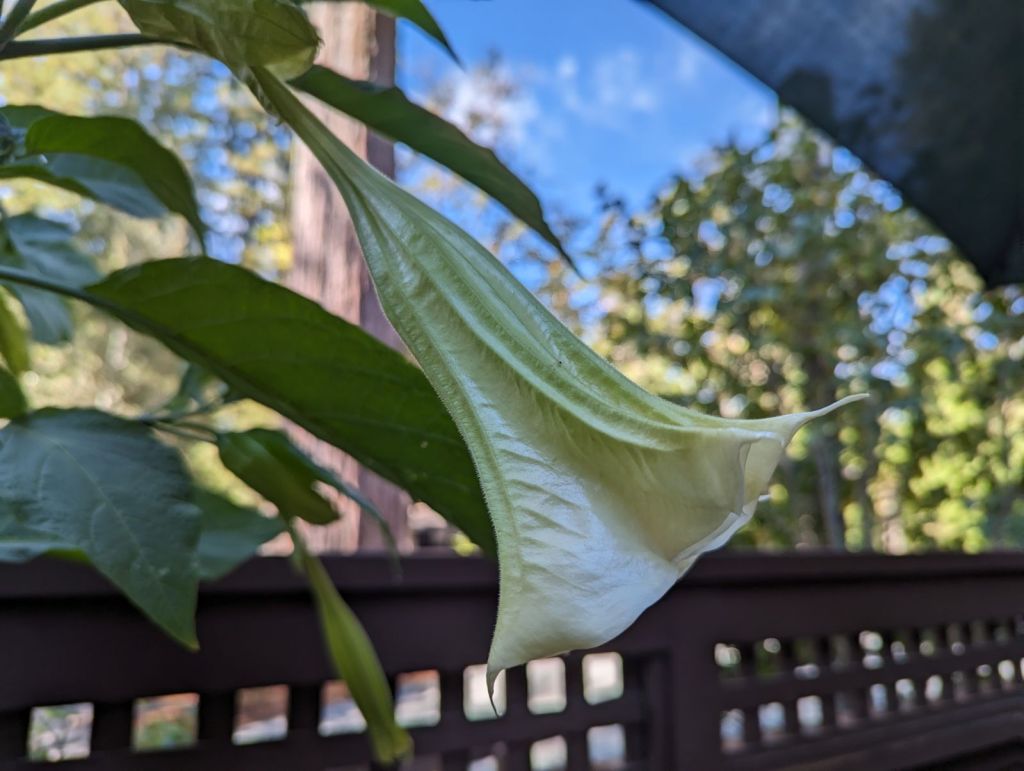
Of the many shrubs with fragrant flowers, mock orange (Philadelphus spp.) has rampant growth with a good display of elegant and remarkably fragrant white flowers. Daphne produces a strongly sweet fragrance with clusters of small pale pink flowers. Both lilac and angel’s trumpet, although very different from each other, have the advantage of impressively fragrant flowers that are quite colorful. Roses offer a better variety of color, but not many are as fragrant.

Wisteria is an aggressive vine with flowers and fragrance like those of the black locust, with all the colors of lilac. Despite the advantage of a longer bloom season, fragrant honeysuckle lacks impressive color.

Earlier in spring, bulbs like freesia, hyacinth, lily, narcissus and some iris bloomed with some of the most fragrant flowers available, in all sorts of colors. Alyssum and flowering tobacco are nice fragrant annuals that bloom longer than most others. Sweet pea may not last as long as weather gets warmer, but compensates with richer and more varied fragrances.

Bloom Is Bountiful For Spring

Many flowers bloom only for spring.

Bloom that was delayed by the unusually wintry winter is making up for lost time. Spring bulbs, flowering cherries and deciduous magnolias were amazing. Wisterias and lilacs continue their pastel display within some climates. More flowers bloom during springtime than at any other time of year. Even roses of summer will begin their performance soon.

Pollination is the priority of all flowers. The majority of flowers exploit wind for pollination. Because they need not attract pollinators, they are neither very colorful nor very fragrant. Colorful and fragrant flowers are the minority that compete for the attention of pollinators. This includes the same colorful and fragrant flowers that are desirable for home gardens.

Whether reliant on wind or pollinators for pollination, flowers adhere to a strict schedule. Some colorful and fragrant flowers want to be receptive while their pollinators are active. However, pollinators are more likely to adjust their schedules to exploit favorite flowers. After all, there is another major incentive for spring bloom. Seed needs time to develop.

Pollination is the priority of all flowers because it is how they generate seed. Some seed develops fast enough to grow into new plants within the same year. Some annuals can actually procreate for a few fast generations annually. Most seed develop slower though. They mature during summer, overwinter, and ultimately grow during the following spring.

For now, garden enthusiasts should enjoy the most abundant bloom of the year. That will not require too much exertion. Fresh fruit of summer will develop later. Some flowers that deteriorate without producing fruit may justify deadheading. This redirects resources for vegetative growth, and eliminates any unwanted seed. Besides, it might be a bit neater.

The most profuse spring flowers generally bloom only once annually. They will not do so again until next spring. Some less profuse bloomers may repeat with later bloom phases through summer. Of course, some flowers bloom within other seasons between summer and even winter. Their individual schedules are appropriate to the climates that they are originally native to.

Forcing Early Bloom Even Earlier

Home interior warmth accelerates early bloom.

Some of the earliest of spring flowers are done blooming. More are just beginning. Then, a few early spring flowers barely qualify as early. Their fresh color is especially pleasing after such an atypically wintry winter. Many are delightful cut flowers. A few that bloom on bare deciduous stems are conducive to forcing. Even the earliest bloom could be earlier.

Bare stems are simpler and less wasteful to force to bloom than bulbs and potted plants. Most bulbs and some potted plants do not survive long after forcing. Dormant deciduous plants easily replace a few forceable stems. Forcing such stems is as simple as bringing cut flowers into a home. The difference is that it is premature, immediately prior to bloom.

Flower buds on dormant deciduous stems begin to swell during warming spring weather. Such stems are ready for forcing when these floral buds are about to pop open. Ideally, a bit of floral color should be visible through some of the bud scales. A few flowers may be blooming. Collective bloom accelerates within the warmth of a home interior after cutting.

Flowering but fruitless counterparts of popular fruit trees are some of the best for forcing. These include but are not limited to flowering cherry, plum, apricot and other stone fruits. Flowering pomme fruit trees, such as quince, crabapple and pear are almost as popular. Related fruiting stone and pome fruit trees are as conducive to forcing, but not as garish.

Of course, there is nothing wrong with simpler bloom. Some fancy flowering cherry trees bloom with single white flowers like fruiting cherries. However, cutting stems from fruiting trees decreases fruit production. With a bit of planning, dormant pruning can allow a few undesirable stems to remain. These stems are then available for cutting and forcing later.

Witch hazel cultivars are exemplary for forcing, but are done blooming. Flowering quince and forsythia are now finishing within most climates. Redbud, lilac, wisteria and perhaps weigela are still conducive to forcing. Dogwood and deciduous magnolia can perform as well if humidity is not too minimal. So should some acacias, although their fragrance and pollen may be distasteful.

Six on Saturday: Lenten Rose?!

Lenten rose does not perform well here. Perhaps it prefers more of a chill during winter. Perhaps it prefers more humidity. I do not know. Some were added to the landscapes at work sometime in the past, and naturalized. Because no one knows when this happened, it is impossible to know which if any are original, and which are naturalized feral plants. Until recently, only one specimen bloomed unexplainably well annually. Now, after very unusually wintry weather, Lenten rose is performing unusually well. Although not quite as impressive as it is in other climates, we are impressed locally. These pictures are more than a week old, but are still relevant, since the Lenten rose continues to bloom. I do not know what to expect. They never performed like this before.

1. Helleborus argutifolius, Corsican hellebore is the only simple species of Helleborus in the landscapes here. All the others are simple Lenten rose hybrids or their feral progeny.

2. Helleborus X hybridus, Lenten rose typically does not perform well here. The climate is likely too mild. This specimen, which is likely feral, performs unusually well annually.

3. Grayish lavender seems to be the most common color here. Lenten rose is performing unusually well this season. Perhaps they appreciated the unusually cool wintry weather.

4. Darker grayish purple is not as common here. Regardless of this unusually impressive bloom, hellebore are still prettier in pictures from other climates of more wintry winters.

5. White, of course, is my favorite. Only two bloom convincingly white, but the other is a bit spotty and blushed. I might have split a few copies if they typically bloomed this well.

6. Rhody does not cooperate for pictures. If I remember correctly, this picture was taken immediately prior to the picture from last week with his tongue out. It could be cropped.

This is the link for Six on Saturday, for anyone else who would like to participate: https://thepropagatorblog.wordpress.com/2017/09/18/six-on-saturday-a-participant-guide/

Rain Can Ruin Bloom And Developing Fruit

Bloom is not really early. Frost and unusually torrential rain just happen to be late.

Again this year, the excellent weather that makes gardening so much fun even through winter has the potential to become a problem. Winters are innately mild here, and like this year, are sometimes mild and warm enough to prompt many plants to bloom much too early. Many of the fruit trees and their ‘flowering’ (non-fruiting) counterparts are already finishing bloom as if it is the middle of spring, even though the equinox is about two weeks away. This should not be a problem for the flowering cherries, plums, pears and apples (flowering crabapples), but is risky for the many trees that should produce fruit.

The problem is that, despite the weather, it really is winter and early spring, so could potentially rain while fruit trees are blooming. The rain can batter the blooms, or cause them to rot before they set fruit, compromising or even eliminating the fruit production for the following summer. Trees that are not blooming, or just barely showing ‘color’ of the first few blossoms, should be safe. Also, the trees that bloomed earliest and have already set fruit should likewise be safe, as long as the weather does not stay rainy too long, which it almost never does here. Trees that are in full bloom when it rains are the most sensitive to damage.

It is impractical to cover mature trees with plastic sheeting to protect them from rain. Even if it is possible to get the sheeting over the trees, it knocks much of the bloom or developing fruit off anyway. Also, if the sheeting is not removed when the rain stops, it can trap humidity, which can rot the blooms that were so carefully protected from the rain. (Although, high trees hold the plastic high enough from the ground to allow for good air circulation.)

Small trees are easier to cover, but do not produce enough fruit to worry about. In other words, it would be easier to buy fruit at a market, or to get it from friends and neighbors with different varieties (that bloom at different times) than to put too much effort into protecting trees from the rain. In most situations, it is best to just accept that fruit trees will sometimes have ‘off’ years when they either do not produce, or produce only minimal quantities of fruit. The good news is that trees that lose some but not all of their fruit often produce best.

Plum bloom is not resilient to late frost or rain.

Six on Saturday: Narcissism

That is such an objectionable word. Perhaps that is why so many of us prefer to describe narcissus as daffodils or paperwhites. Both bloom at work, and as much as I prefer white bloom, I do not maintain favorites in this regard. I enjoy paperwhites for their whiteness as well as their fragrance. However, I enjoy classic yellow daffodils, such as ‘King Alfred’, because they are so traditional. All are blooming late this year. So is winter daphne. The weather has been cooler than it typically is, but only for the past month or so. It seems to me that if chill were to enhance bloom, it would have needed to begin somewhat earlier. Also, it seems to me that narcissus do as they please.

1. Frost is generally minor and uncommon here. However, a wet jersey that was hung to drain overnight froze solid enough to lean against this pickup. Its hanger is not hanging.

2. Cupressus macrocarpa, Monterey cypress is nothing special, but I happen to be fond of its foliage and bark. This is a hedge that never got hedged, but grew as crowded trees.

3. Daphne odora ‘Marginata’, winter daphne is still blooming! It blooms slowly through winter, but should be finished by now. Furthermore, it blooms remarkably well for here.

4. Narcissus grows wild in soil that was dumped on the perimeter of our industrial yard over the years. No one sees them there, so I collect some to bring into our meeting room.

5. Narcissus are much more abundant within the landscapes where they belong. Several sporadic colonies are sparsely naturalized. However, several new bulbs bloom only once.

6. Narcissus are even prettier close up. I consider these to be daffodil, although I do not know what the distinction is. They are blooming late, and more are beginning to bloom.

This is the link for Six on Saturday, for anyone else who would like to participate: https://thepropagatorblog.wordpress.com/2017/09/18/six-on-saturday-a-participant-guide/