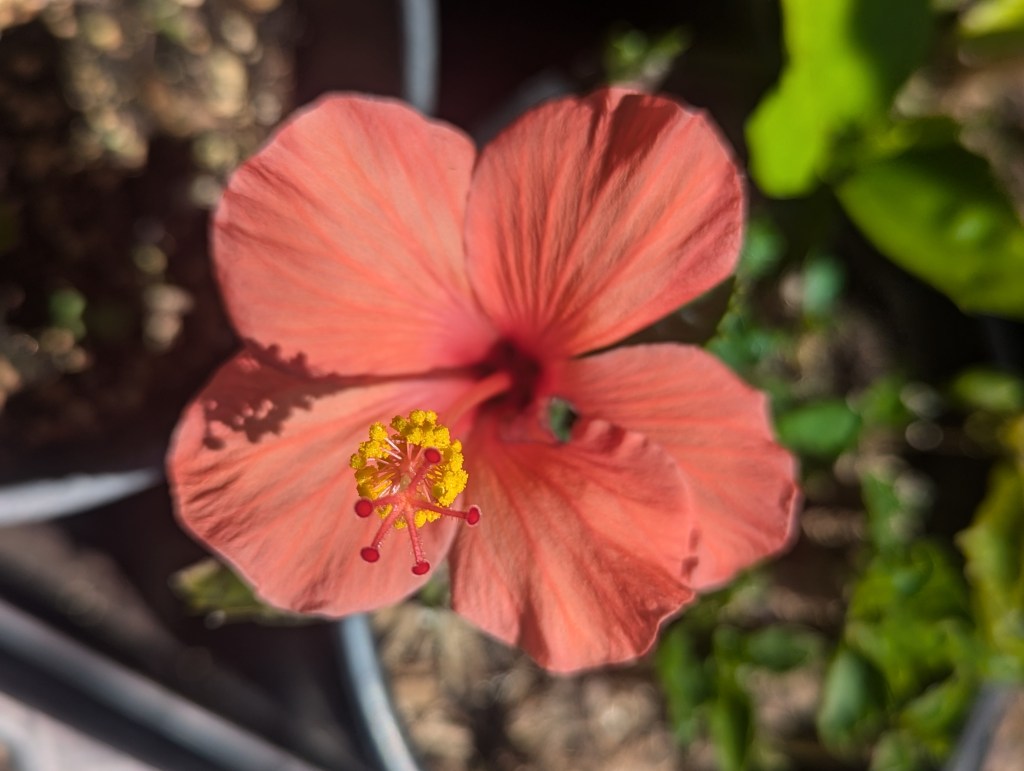
What a pathetic tropical hibiscus flower! It is only about two inches wide. It should be bright red instead of this faded terracotta pink. It even lacks foliage in the background. So, why did I take a picture of it? I was impressed by this flower because it bloomed on a cutting that is still in the process of rooting. I should have removed the bud when it appeared, to conserve resources for root growth. Instead, I let it bloom to see what would happen. This is the result. Knowing all that I know about it, I am somewhat impressed. Of course, I plucked the flower off after taking its picture. After all, I am a nurseryman, not a gardener. I want the cuttings to root as efficiently as possible. Actually, more of them than I expected seem to be rooting, so there may be a surplus of these particular hibiscus in the future. Cuttings of another cultivar that blooms yellow did not perform so well. Only three survived so far, and they are rather wimpy. I may need to go back to collect more cuttings for that one. I also would like cuttings from a cultivar that blooms orange.
Purple is not as easy as white. White is either white or not white. Purple can be bluish or reddish. I am not totally certain if all Six of these are purple or lavender, which is merely pastel purple.
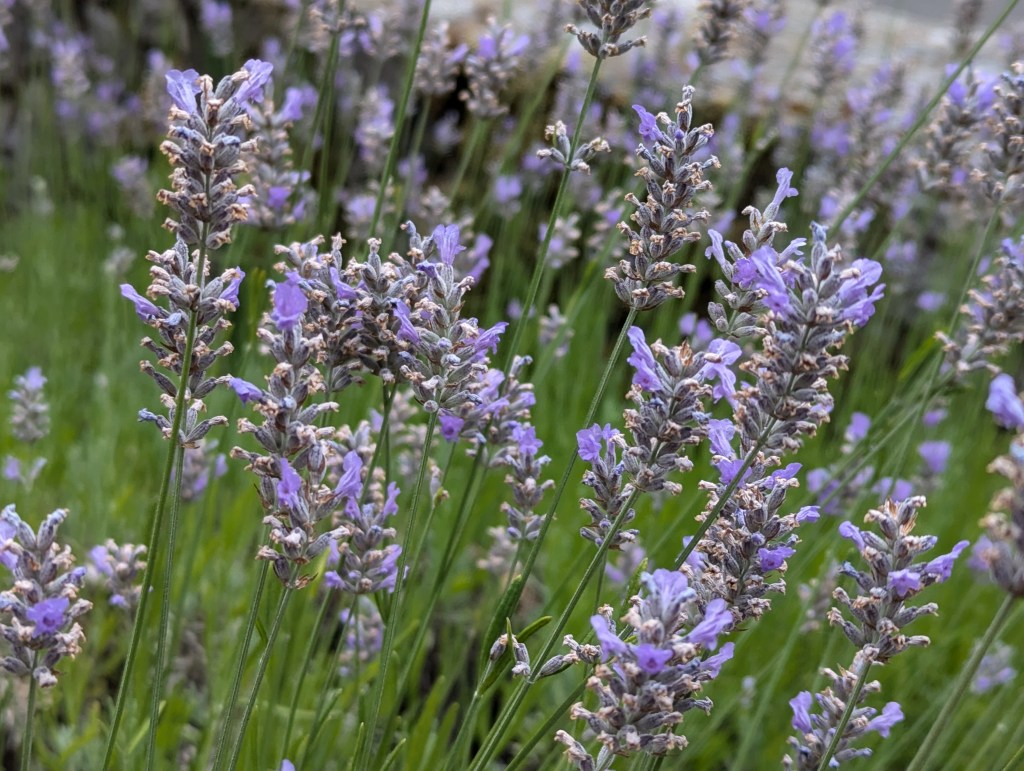
1. Lavandula angustifolia, English lavender blooms, as its name suggests, with lavender floral color, which is really just pastel purple. It looks blue to me, though. I do not know what cultivar this is, but it has survived here longer than lavender should be expected to.
2. Phlox paniculata, garden phlox also blooms lavender, although it looks pink to me. It is a feral progeny of the already feral garden phox with pure white bloom that I posted a picture of last Saturday. Although white is my favorite, I find this odd variant appealing.
3. Lobularia maritima, sweet alyssum also resembles its white counterpart that I posted a picture of last week, but is not a progeny of it. It is a common garden variety, although I do not remember its name. It survived through last winter for another summer season.
4. Lantana montevidensis, trailing lantana survives within a badly neglected landscape. It really is worthy of consideration for other sunny and warm landscapes here. Lantana camara also performs well in an adjacent landscape, and was recently added to another.
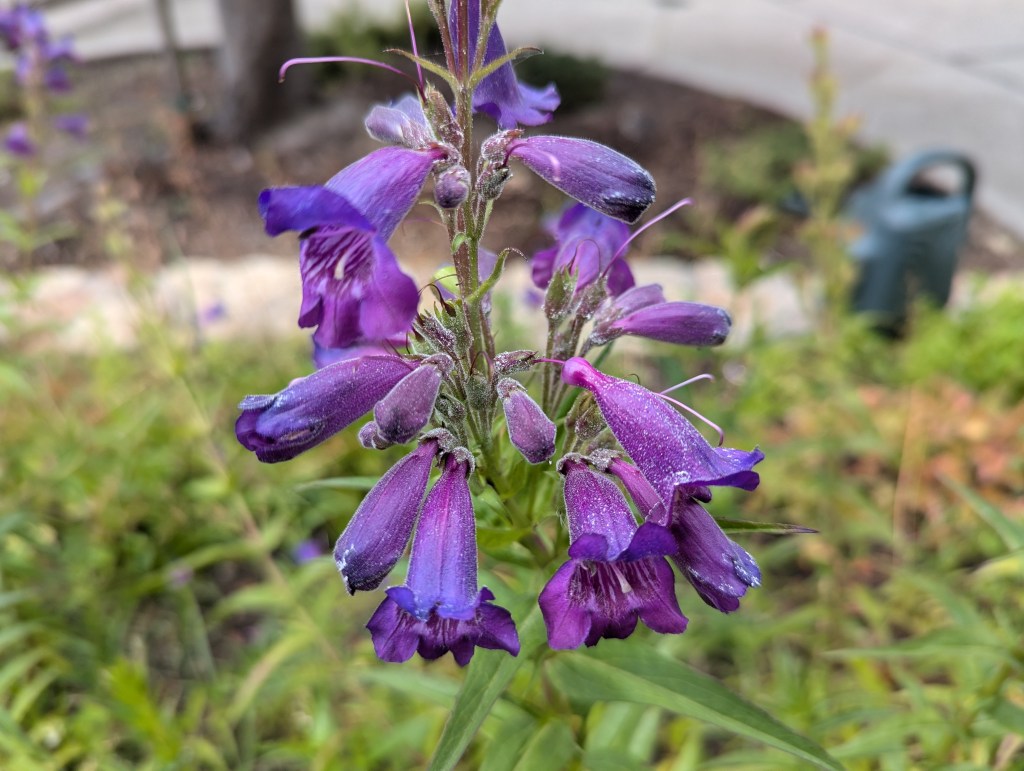
5. Penstemon gloxinioides, beard tongue blooms sparsely for now only because it is new in this particular situation. It grew from several rooted bits that were separated from old specimens as they were cut back last winter. These might produce similar bits next year.
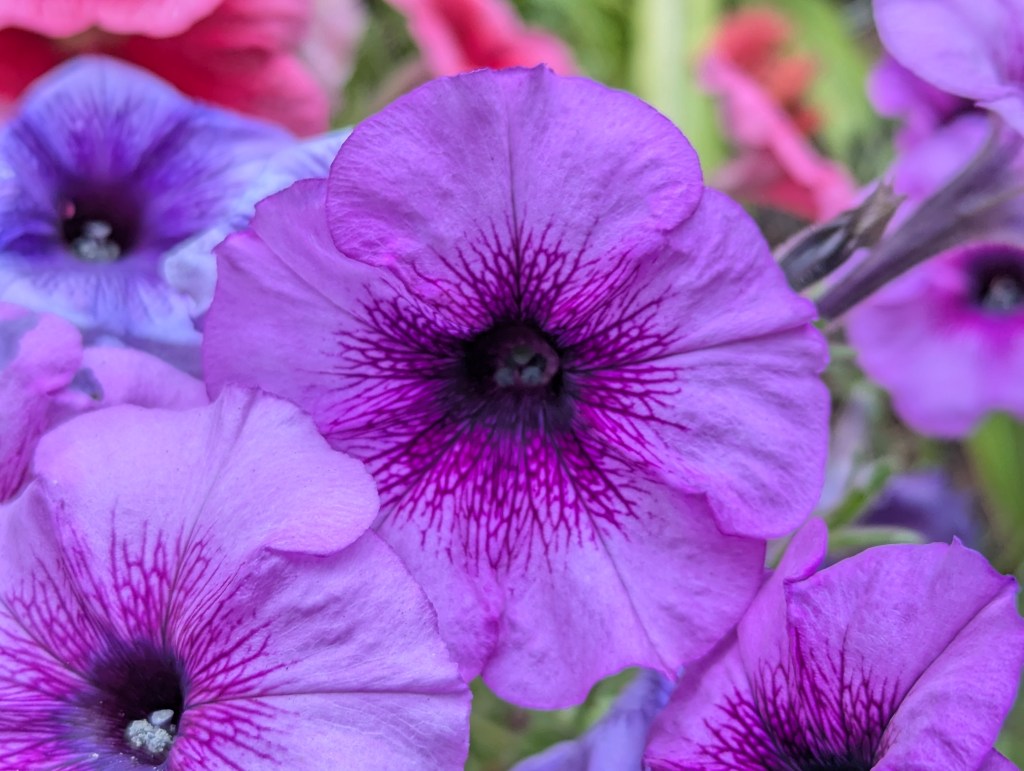
6. Petunia X hybrida, petunia is always reliable for bright color through summer. These have been growing somewhat slowly this year only because the weather has been so mild and even weirdly cool sometimes. Gophers consumed quite a few in a landscape nearby.
There are not many colors that bearded iris can not provide.
If I could select my favorite color for the flowers in the garden, they would all bloom white. There is no more perfect color. White may be bright or pale, but lacks the many shades that other colors have. There is no need to select between deep blue or sky blue, bright yellow or pastel yellow, purple or lavender. White is simply white.
The main problem with white, or any other color, is that no color is the right color for every situation. Also, some flowers are simply not at their best in white. Camellias, oleanders and fruit trees look great in white. However, nearly white marigolds, sunflowers and nasturtiums are interesting oddities that are excellent in the right spot, but are not nearly as flashy as the more traditional bright yellow and orange shades are.
My two favorite geraniums are actually reddish orange and fuchsia pink, and really look horrid in bloom together. They are my favorites nonetheless, because I have been growing them since my sophomore year at Prospect High School! I have taken cuttings with me whenever I relocated since then. I enjoy the garden too much to grow things that I do not enjoy.
Flower colors probably should be compatible with the colors and architecture of associated residences and other buildings, as well as the neighborhood. Yet, we all have different tastes. It is more important to grow flowers with the colors that we enjoy, even if they are not exactly perfect for their particular situations. Fortunately, compatible colors are more likely to also be enjoyable.
White happens to be useful in shaded areas, or with an abundance of deep green, such as wax privet hedges. White brightens an area, even in conjunction with other colors. It also softens richer colors like purple or red.
Darker shades of purple, red and blue should be out in the open, since they can make shaded areas seem even darker. Lighter shades, including lavender and pink, can work almost anywhere. True blue happens to be uncommon among flowers, even though the very common lily of the Nile is typically blue.
Yellow and orange seem at home in sunny spots, and also brighten shaded spots if not overdone. Yellow contrasts with purple. Orange contrasts with blue. Orange marigolds and cobalt blue lobelia might look odd in abundance, but can be striking as a border to a perennial or annual bed. Many of us like a random mix of any color; but too much mix over a large area can look like a garage sale of colors. Black, gray and brown flowers are rare and mostly grown by those of us who really appreciate them; since they look quite odd in the wrong situations. Black hollyhock, pansy and bearded iris are perhaps the best blacks, while other black flowers are not so convincing. Gray iris are still quite rare. Brown sunflowers are becoming more popular.
Aroma and fragrance in a garden have two very different natural purposes. Aroma, which is foliar, repels insects or animals who may otherwise eat such foliage. Fragrance, which is floral, attracts insects and animals to pollinate such flowers. Aromatic foliage ironically appeals to people, particularly as herbs. The appeal of fragrant bloom is not so contrary.
With few exceptions, fragrant bloom is an asset to a garden. Although its primary function is to attract pollinators, people enjoy it also. The few exceptions are flowers that produce fragrances that are unappealing to people. For example, several species of Arum attract flies for pollination. Therefore, they exude foul fragrances that appeal specifically to flies.
Fortunately, most pollinators prefer fragrances that people also enjoy. Many of the richest and strongest fragrances appeal to a broad range of pollinators. Some more refined and distinctive fragrances attract specific pollinators. Fragrant bloom is most fragrant when its preferable pollinators are most active. A few bloom at night for their nocturnal pollinators.
Fragrant bloom is generally not as colorful as bloom that is less fragrant. It does not need to be. Color is merely another visual means with which to attract pollinators. Flowers that are both fragrant and colorful are mostly from competitive ecosystems. Angel’s trumpet is both spectacular in bloom and splendidly fragrant. Yet, its floral color is limited to pastels.
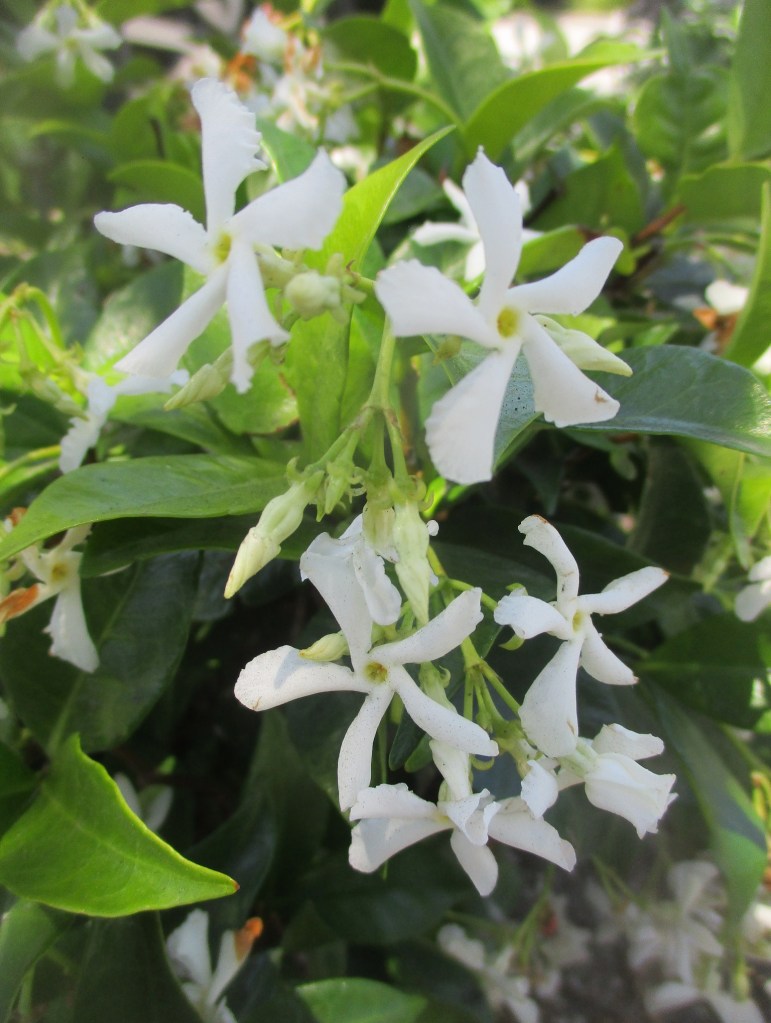
Some of the most fragrant bloom is that of bulbs that bloomed early last spring. Hyacinth, narcissus, freesia, lily and some bearded iris are both fragrant and colorful. Wisteria and pink jasmine are vines that were also fragrant and colorful last spring. Star jasmine is not quite as colorful, but is as fragrant, and still continues to bloom. So does angel’s trumpet.
Warming summer weather will now promote more fragrant bloom, even if it is not colorful. Pittosporum undulatum exudes an almost citrusy fragrance. Pittosporum tobira is slightly buttery. Sweet osmanthus and sweet box are proportionately more fragrant while young. Night blooming jasmine might be the sweetest of all, but more so during warm evenings.
Horticultural dysfunction can be, from one to six, annoying, frustrating, very infuriating, entertaining, confusing and pleasantly surprising. Much of this is more natural than it is dysfunctional.
1. Arundo donax, giant reed is not as giant as expected. Four potted specimens look like big grassy weeds amongst these lily of the Nile. They will be removed if they do not grow as fast as they famously should. They are here only temporarily for this summer anyway.
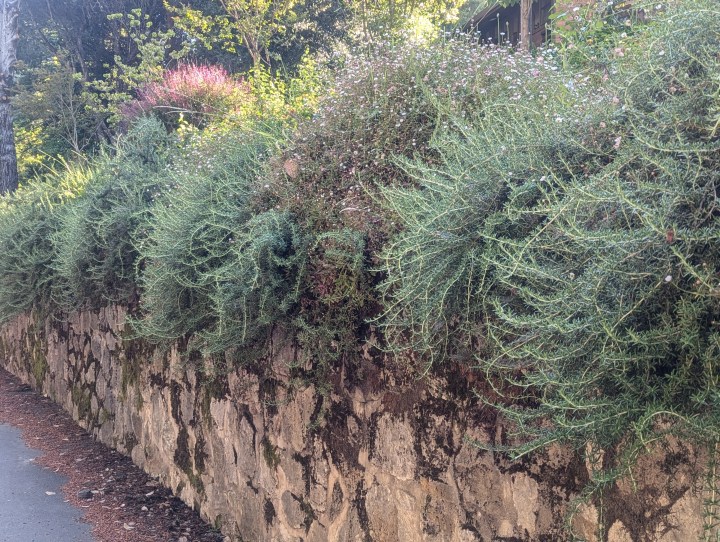
2. Rosmarinus officinalis ‘Prostratus’ creeping rosemary is not as prostrate as expected. I thought that it would cascade more limbry from the top of the wall rather than become fluffy but barely pendulous shrubs on top of the wall. In a row, they look like Soul Train.
3. Agapanthus orientalis, lily of the Nile are expected to bloom for summer. Here on the edge of a trafficked walkway, they are too tempting to kids with sticks. Fortunately, their evergreen foliage is a nice border even without bloom. We try not to be too discouraged.
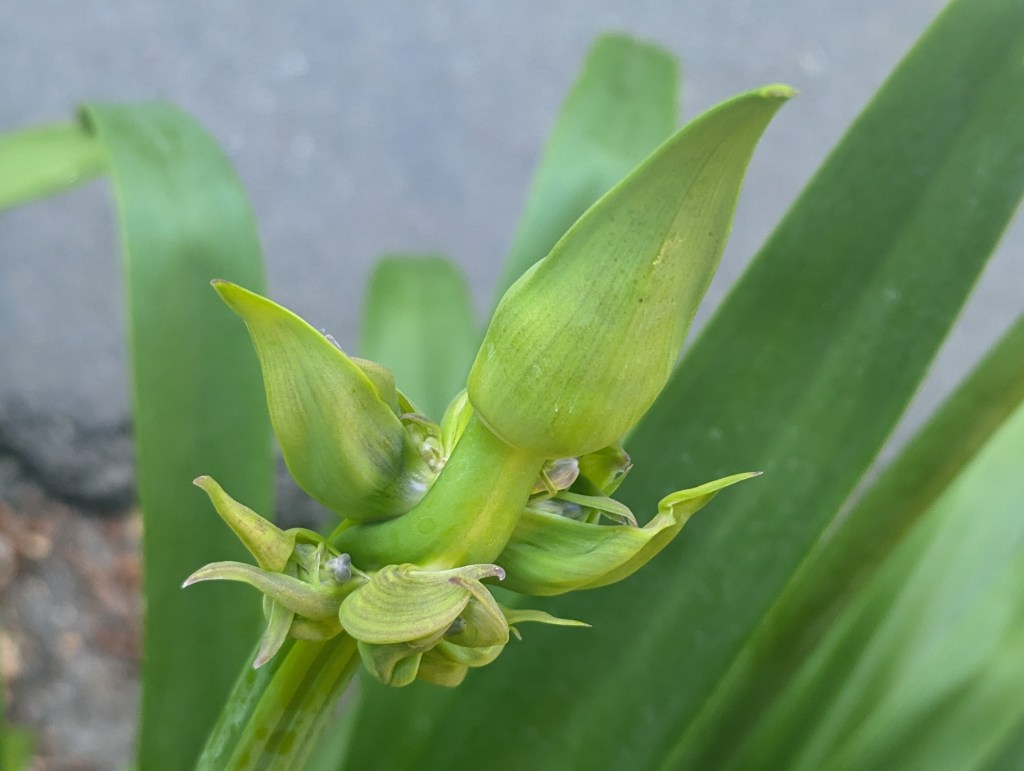
4. Agapanthus orientalis, lily of the Nile is trying to bloom a bit more than expected, by fasciation. Perhaps it is trying to compensate for the destruction of so much other bloom nearby. Ultimately, a fascinated bloom will be no more substantial than a normal bloom.
5. Echinops sphaerocephalus, globe thistle is unexpectedly solitary. This is the first that I have grown since my second summer after high school, so I do not remember how they typically bloom. Yet, I expected a branched bloom stem. Maybe that is what it does next.
6. Helenium autumnale, sneezeweed was expected to bloom later in summer. This is the first for me, so I can neither complain nor question its timing. Two other varieties bloom red and orange. They, the globe thistle and others came from Tangly Cottage Gardening.
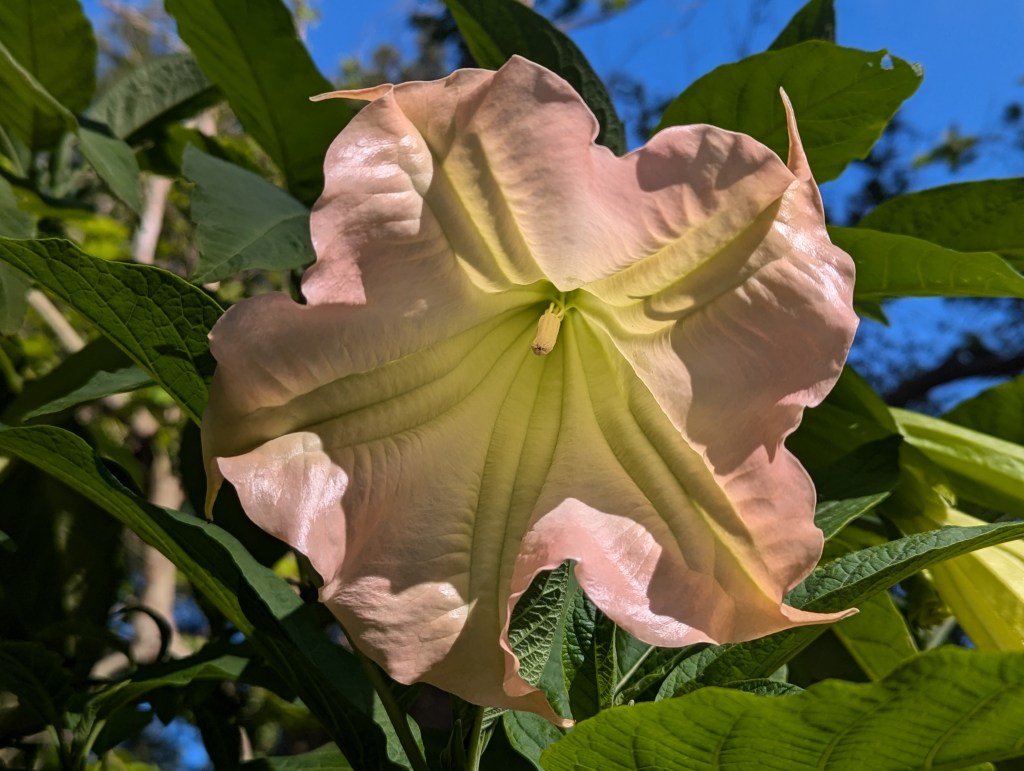
What color is this? It looks pink to me. A day earlier, though, it looked peachy orange. At various times last year and the year earlier, this same angel’s trumped bloomed more orangish orange, yellow and even white. I can not remember its schedule now, but I know that it has been weirdly variable. It is one of four cultivars of angel’s trumpet here, but the only one that will not decide on a color for its bloom.
One of the other four angel’s trumpets here blooms with double white flowers. My favorite, although relatively diminutive, blooms with single white flowers. The most vigorous is ‘Charles Grimaldi’, which blooms with single yellow flowers. A formerly fifth cultivar with big single pink flowers unfortunately rotted without replacements over winter a few years ago.
This particular angel’s trumpet grew from scrap that I took from a green waste pile at the curb of a job site in eastern San Jose several years ago. I took it because I found the pastel orange foliar color of the specimen that it was likely pruned from to be appealing. I had no idea that it would bloom with so many other comparably appealing floral colors.
Too much is blooming now for pictures of foliage, bark, trees, vines, shrubs or any other horticultural subject matter. I got these pictures before yesterday, so they are technically still spring bloom.
1. Gladiolus X hortulanus, gladiolus looks silly alone. It was the first to bloom. All others are in small colonies that developed from reliably perennial bulbs, which were originally components of a mixed batch. I would not have expected any to be so reliably perennial.
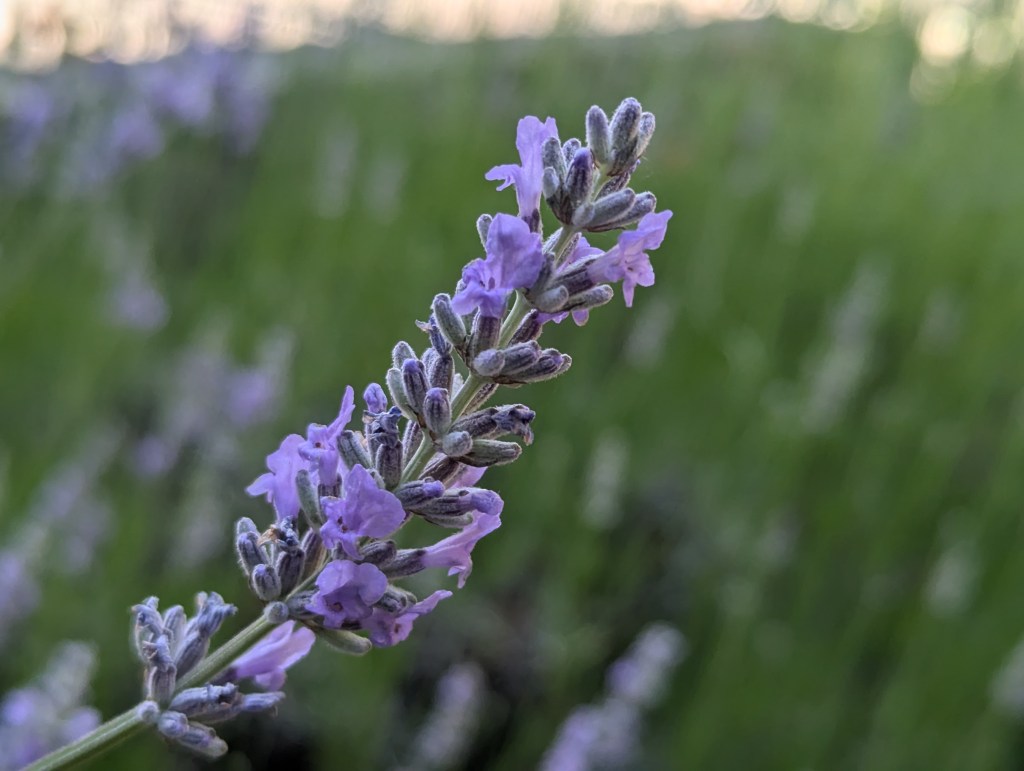
2. Lavandula angustifolia, English lavender has similarly lasted longer than expected. It was already a few years old several years ago, when I predicted its natural demise within two years. A feral specimen of Spanish lavender coincidentally grew from a seed nearby.
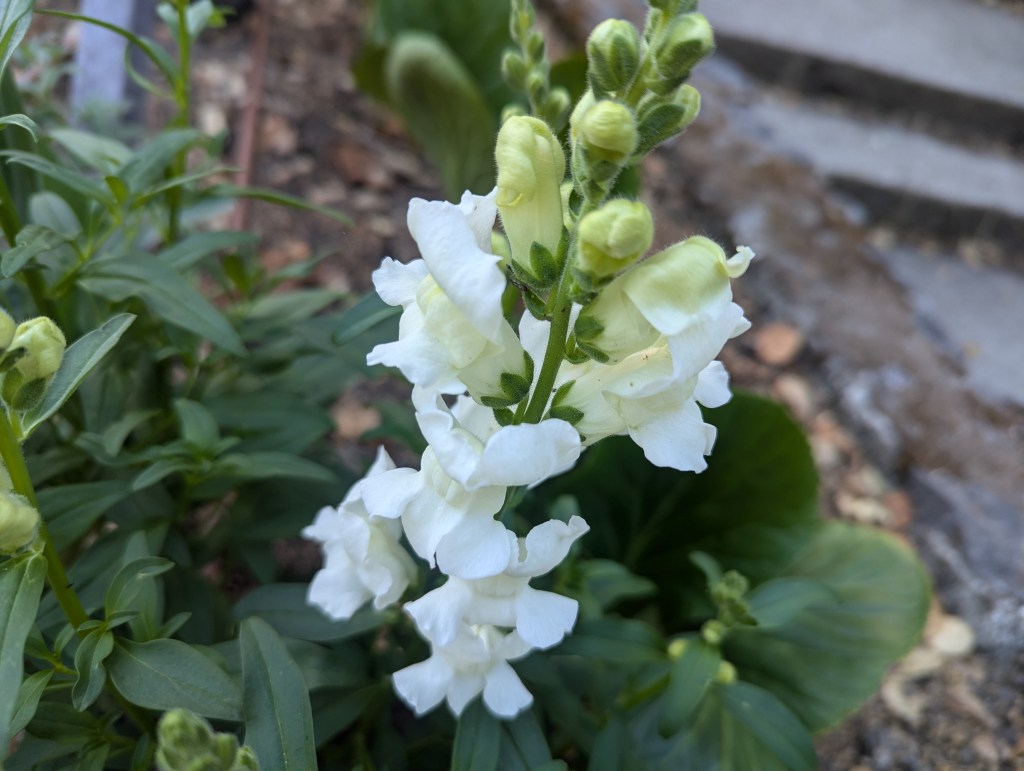
3. Antirrhinum majus, snapdragon is also feral. All within its colony bloom white. Those of another feral colony all bloom yellow. However, the parents of both colonies bloomed with mixed colors of the same variety. I can not complain, but I wonder what happened.
4. Celosia argentea, plumed cockscomb blooms with these red, orange or yellow flames. The chartreuse foliage in the background is coleus. They are a good example of why I do not procure annuals at work. I have difficulty with such striking color, texture and form.
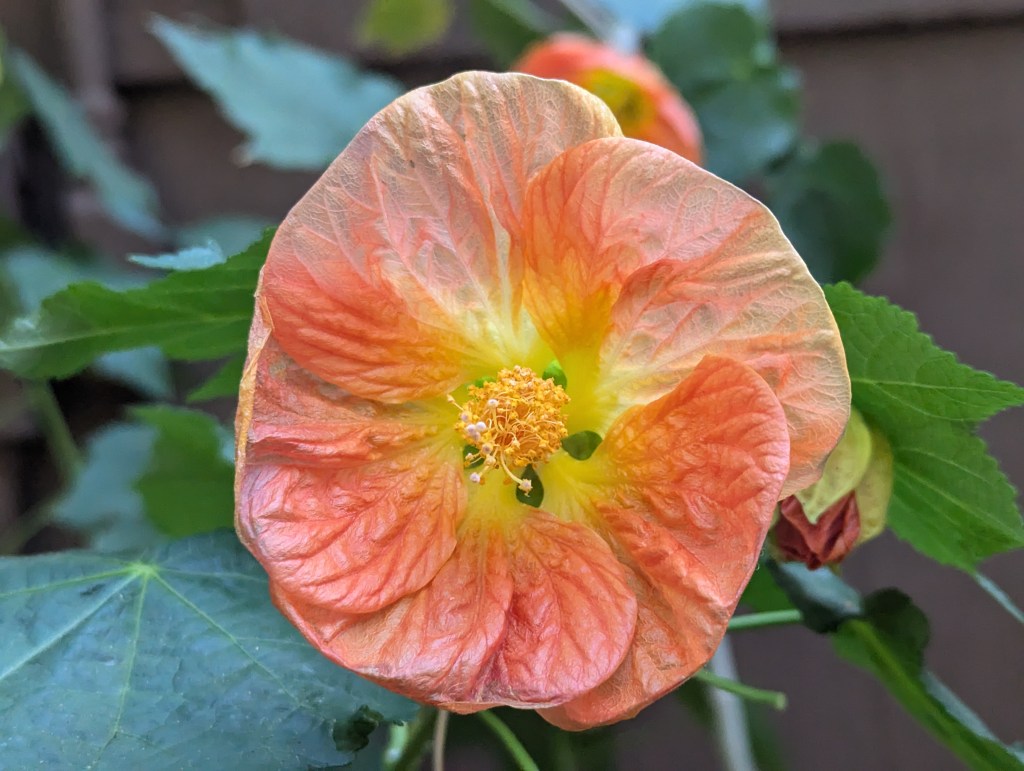
5. Abutilon X hybridum, Chinese lantern is an awkwardly lanky shrub that will not stop blooming. I would like to prune it down to perhaps improve its density, but do not want to interfere with its bloom schedule. It has been here for many years, and might be feral.
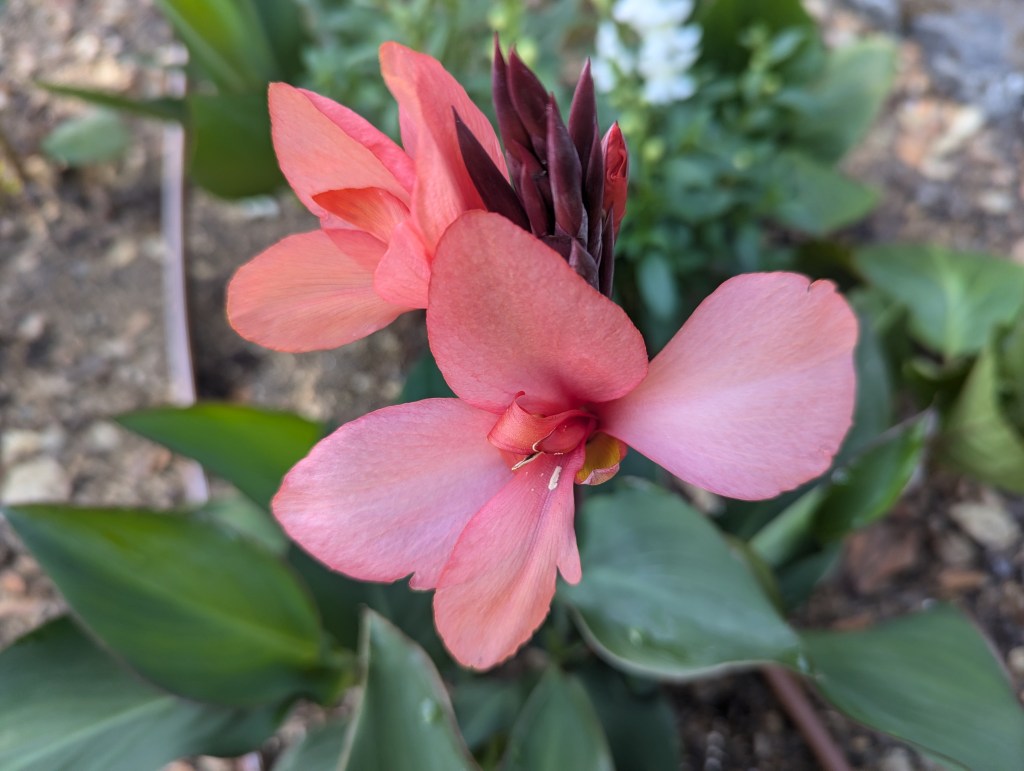
6. Canna ‘Cannova Mango’ canna is not my favorite cultivar, but has too many attributes to discredit. It begins blooming before any other canna here. It blooms more abundantly than any other canna here. I know of no one else who dislikes this color as much as I do.










 Tony Tomeo