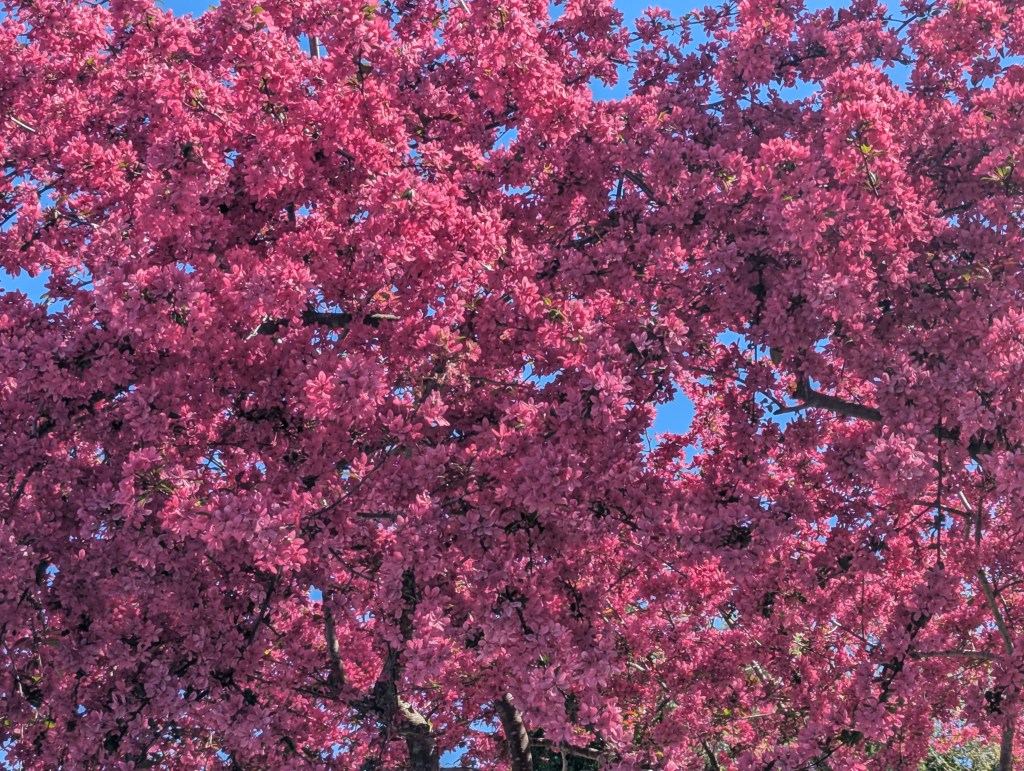
Sunday Best – ‘Prairie Fire’ Flowering Crabapple

Borago officinalis, borage, as I mentioned last October, blooms almost exclusively with blue flowers. At the time though, a few maturing seedlings were blooming with a few pink flowers that eventually were replaced with blue flowers. Now that more are blooming, a few are doing so like this, with white flowers. Also last October, I mentioned that, although white is my favorite color, I expect borage to bloom blue. Not only does blue seem like a more natural color for it, but is also prettier. White borage seems rather mundane. Fortunately, most bloom blue, with enough that bloom white for my own garden, where I am less concerned with how pretty they are. I now wonder if they will be true to type. In other words, I wonder if those that bloom white will produce seed for more that bloom white, or if they will revert to bloom mostly blue. I will take what I get, I suppose. I have not yet found one that I do not like. I would be impressed, or perhaps concerned, by orange bloom, but I seriously doubt that will happen. I should be more concerned with what to do with all these borage seedlings than with their bloom color. I will plant only a few at work, which leaves more than a few for my home garden. Although supposedly not invasive, they are also supposedly proficient with self seeding. Once they get established within my garden, they will likely always be there. I suppose that I should learn to exploit their culinary applications, particularly for those that bloom blue where I do not want them, but perhaps less so for those that bloom white where I do want them. Now I am getting ahead of the situation. After all, they are still just seedlings.
Skyler and Allan, the people who live with Skooter of Tangly Cottage Gardening, invited Rhody and me to tour their home gardens while vacationing in the Pacific Northwest. It has become an annual event. I always leave with a trunk load of interesting and unusual species. I will post pictures of some of such acquisitions from this tour next week. These six pictures are from the home gardens of Tangly Cottage Gardening, although I did take rooted bits and a potted specimen of two of them. After taking these pictures, Rhody and I stayed for lunch and a visit, but did not leave too late to avoid driving in the dark. More pictures of our tour can be seen at Tangly Cottage Gardening.
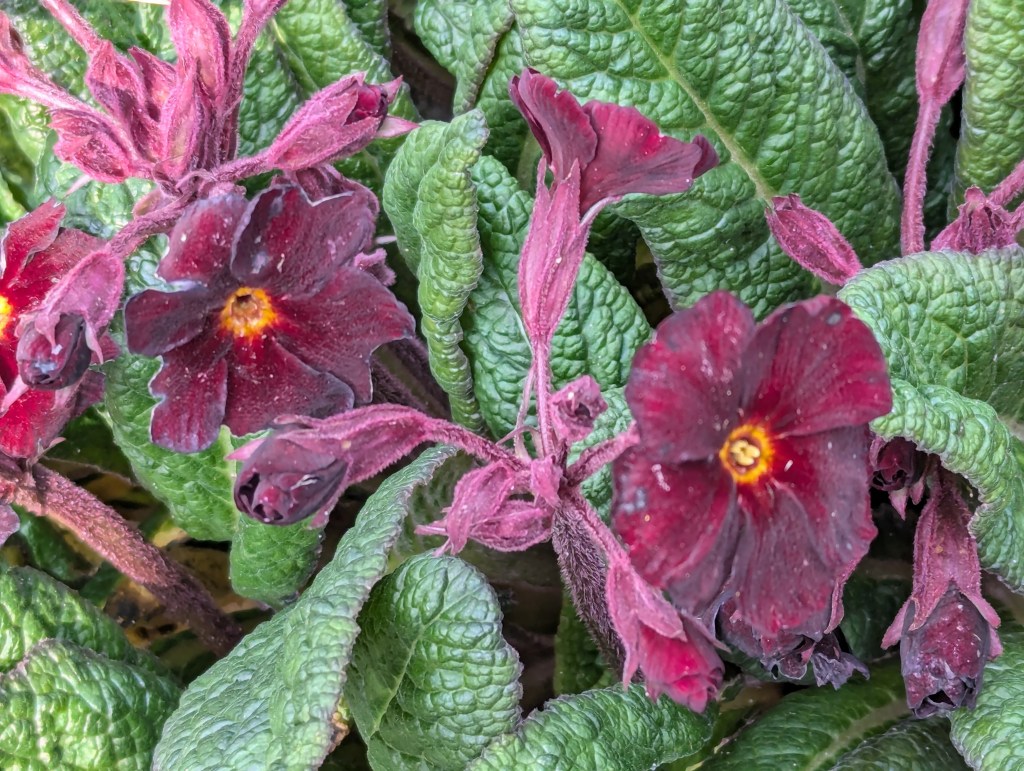
1. Primula X pruhonicensis ‘Old Port’ primrose exhibits luxuriantly rich burgundy floral color. This name is merely a guess, since I actually have no idea what cultivar this one is.
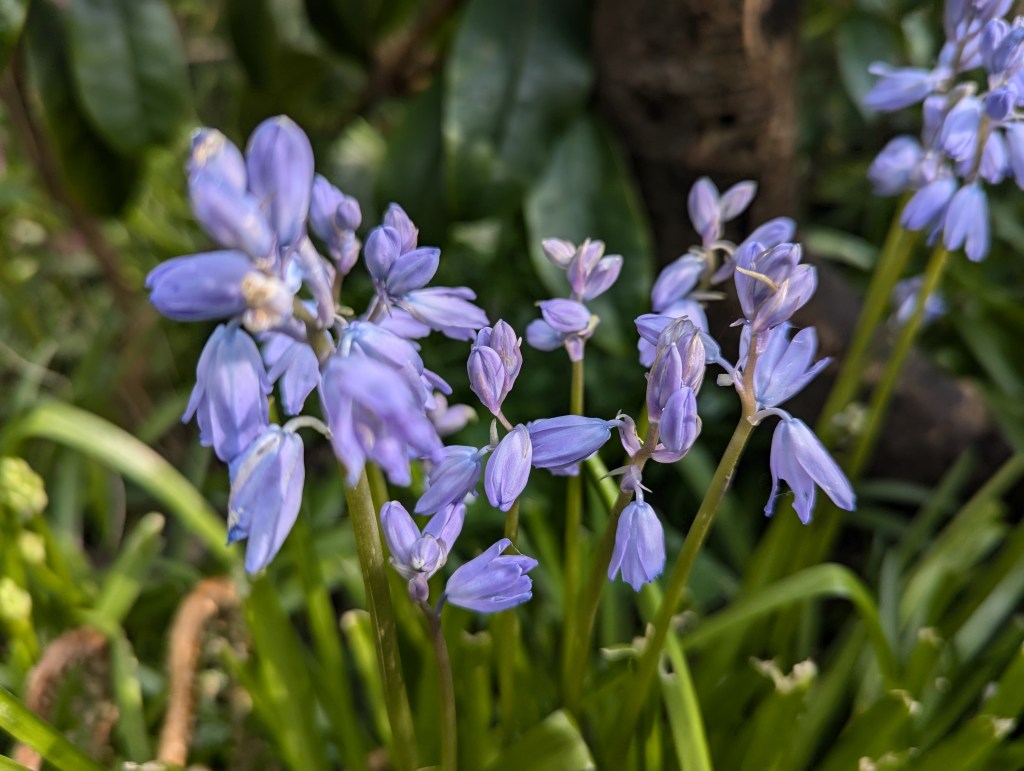
2. Hyacinthoides hispanica, Spanish bluebells is unfortunately a bit too aggressive here, which is why I have not tried it at home. It could be docile in a chaparral climate though.
3. Rubus spectabilis, salmonberry is native and grows wild in Ilwaco. I would have asked for cuttings if I had not already acquired it. I will compare its fruit to other cane berries.

4. Vinca minor ‘Alba Variegata’ periwinkle is not as invasive at home as it is elsewhere. I procured a few bits because I like its white flowers, and may learn to like its variegation.

5. Pulmonaria officinalis ‘Bowles’ Blue’ lungwort, along with cultivars that bloom white, pink and purple, were excellent acquisitions also! Its cultivar name is merely conjecture.

6. Skooter approved of my acquisitions from his Tangly Cottage Garden, which includes quite a bit more than periwinkle and lungwort. I will get pictures of them for next week.

This is the link for Six on Saturday, for anyone else who would like to participate: https://thepropagatorblog.wordpress.com/2017/09/18/six-on-saturday-a-participant-guide/

Spring bulbs are now blooming, and some are already done. Summer bulbs will bloom a bit later, and some will continue until autumn. Annuals, perennials, shrubbery, vines and all sorts of other vegetation also bloom. Most simply shed their deteriorating flowers after bloom. Some may benefit from grooming to remove such flowers before they go to seed.
Grooming to remove lingering deteriorated flowers, or deadheading, is obviously neater. Flowers that continue to bloom are more prominent without their decaying predecessors. Camellias may not need such grooming, since their flowers fall away as they deteriorate. However, removal of fading flowers, before or after they fall, eliminates their mess below.
Perhaps more importantly, grooming to remove fading flowers conserves vital resources. Although most bulbs are sterile hybrids, some try to generate fruiting structures for seed. This consumes substantial resources. Removal of fruiting structures before they develop diverts resources to other growth. Canna diverts such resources into subsequent bloom.
For some species, grooming to remove fruiting structures stimulates subsequent blooms. After all, seed production is their priority, and the objective of bloom. If they perceive any deprivation of seed, they are compelled to produce more. Several dahlias bloom initially with single flowers. After grooming, the stems below branch for a few secondary flowers.
For a few potentially invasive species, grooming eliminates unwanted seed. Montbretia, which is famously invasive, is less so if deprived of its seed. African iris might disperse a few unwanted seed and get shabby without grooming. Summer snowflake and common grape hyacinth often disperse their seed. Both are too small and numerous for grooming.
Fortunately, summer snowflake and common grape hyacinth are true to type. Freesia are not. Without grooming, they can produce feral progeny that are similar to their ancestors. Such feral progeny are more prolific with seed for more of the same. Eventually, they can displace the desirable original varieties. Although more fragrant, they are not as colorful.
Spring bulbs, with prechilling, were conducive to the technique of forcing bloom earlier. A few summer bulbs might still be responsive to it, although it is getting late for most. Now, it is about time for forcing bloom with certain dormant deciduous stems. Most are already beginning to bloom. Forcing bloom merely accelerates this process for cut flower stems.
Forcing bloom for dormant deciduous stems is actually simpler than for bulbs. It involves merely cutting stems that are about to bloom and bringing them indoors. The warmth of a home interior is what accelerates profuse bloom. Aridity of home interiors may accelerate the deterioration of this bloom. However, homes also provide shelter from wind and rain.
Witch hazel, flowering quince and forsythia are mostly done blooming locally. Otherwise, they are conducive to forcing bloom, and will be available next winter. Several flowering cherries and flowering plums are now about ready for forcing bloom. Redbuds are ready also, though some will be later. Flowering crabapples should bloom later in their season.
Several fruit trees are as conducive to forcing bloom as their fruitless flowering relatives. Their floral color and profusion are less extravagant only because of their breeding. Fruit is, after all, the priority. With planning, dormant pruning can involve leaving a few surplus stems to cut later. Then, cutting them about now should not compromise fruit production.
With precise timing, wisteria and lilac are conducive to forcing bloom. Technically, so are dogwood and several deciduous magnolias. They bloom relatively slowly though. A few flowers should therefore be blooming before collection of their stems. Evergreen species are less striking in bloom. Fringe flower and Oregon grape can perform elegantly though.
Forcing bloom is more popular where winters are cooler. This is partly because gardens lack floral color for so long through winter. Those who enjoy flowers are in more of a rush to bring some into their homes. Also, dormant vegetation is more reactive to warmth after colder winters. Warmth might not stimulate bloom as effectively after locally mild winters.
Flowers in the gardens of others remind me that I should be more adventurous in regard to trying new things. These six are not completely unfamiliar, but happen to be different from the cultivars that inhabit our landscapes. All are Not In My Back Yard.
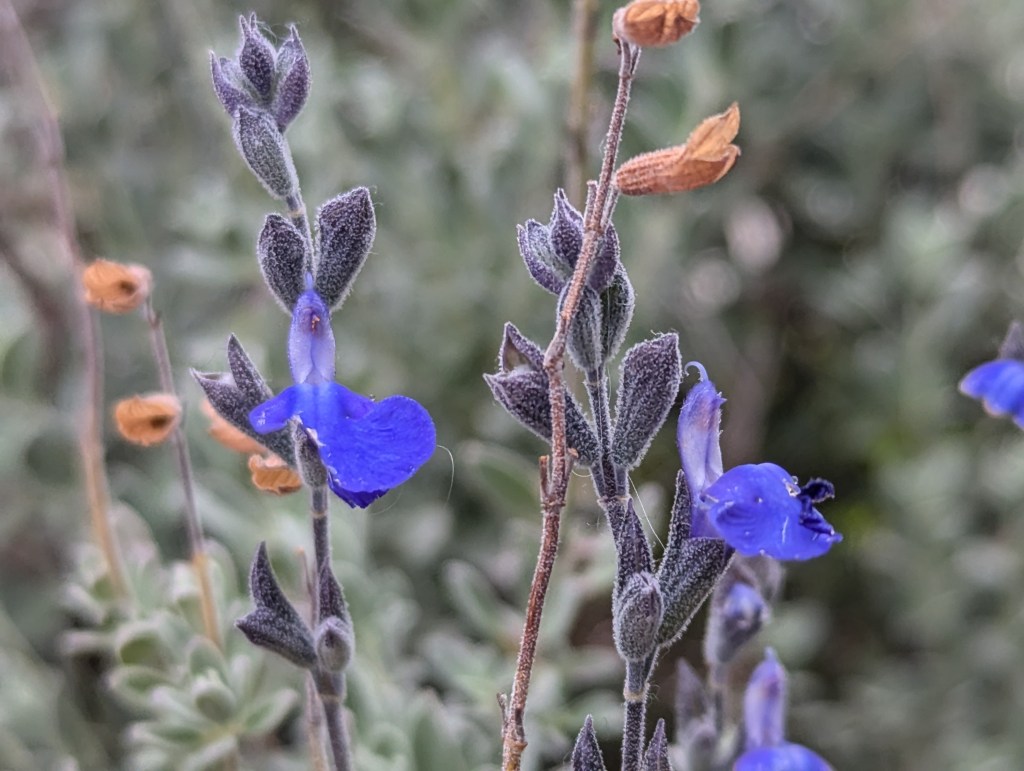
1. Salvia chamaedryoides ‘Marine Blue’ sage, like other species here that are more often grown as common annuals, has performed reliably as a perennial for at least a few years. Like other sages, it is very popular with hummingbirds. It stays small, but gets attention.
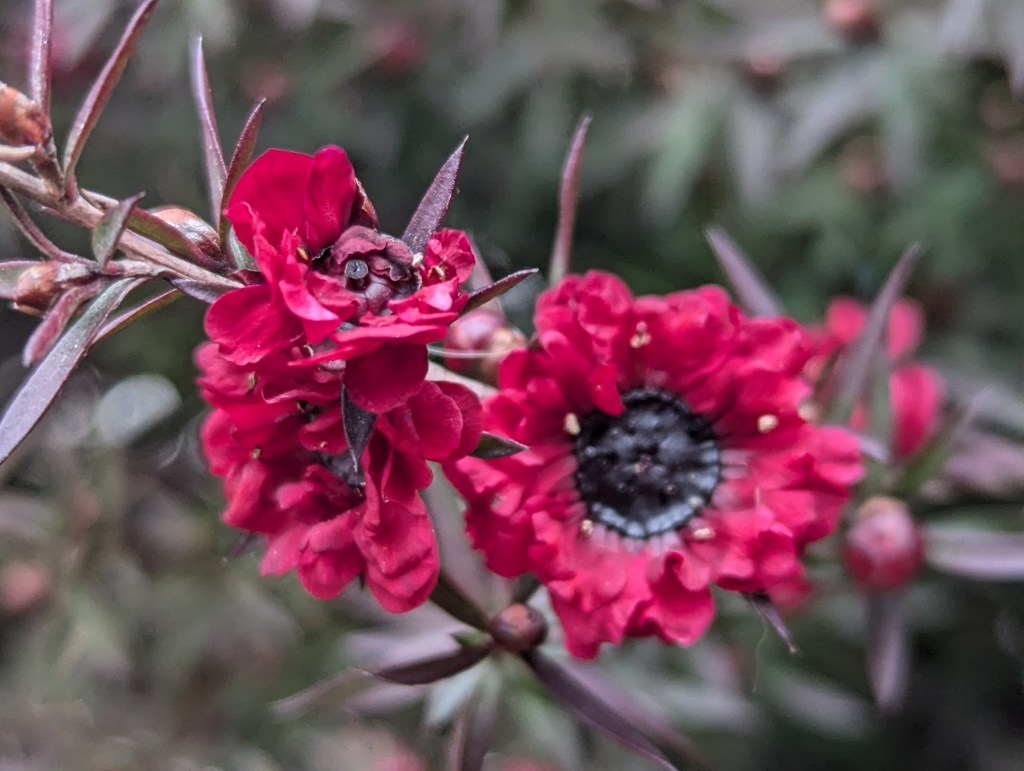
2. Leptospermum scoparium ‘Ruby Glow’ New Zealand tea tree is deprived of its natural form by frequent shearing, but somehow manages to bloom with a few sporadic flowers. Bees are grateful. Its tiny leaves are very dark green, but perhaps technically not bronze.
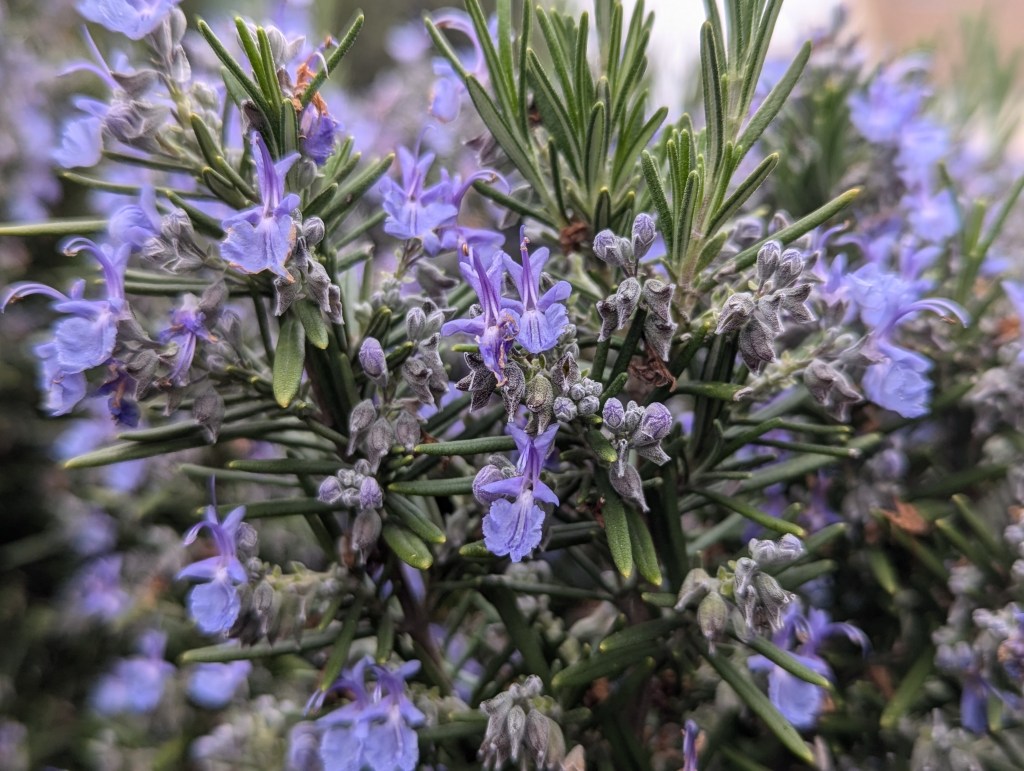
3. Rosmarinus officinalis ‘Tuscan Blue’ rosemary is shrubbier with more upright growth than the sprawling ground cover cultivars that I am more familiar with. I still remember this cultivar as ‘Tucson Blue’ because that is how we said it in school prior to about 1990.
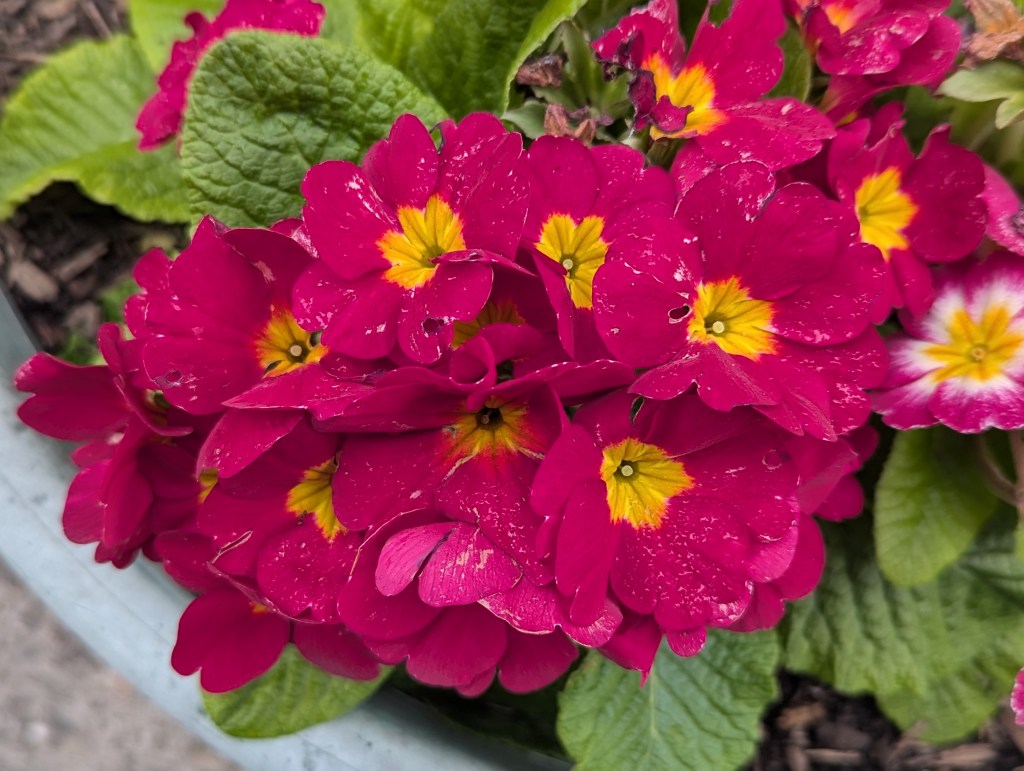
4. Primula X elatior ‘Pacific Hybrids’ English primrose can bloom yellow, white, purple, lavender, blue, maroon, red, orange, or, like this specimen, pink; all with yellow centers. They look like the flowers that Mickey Mouse picked for Minnie Mouse, from her porch.
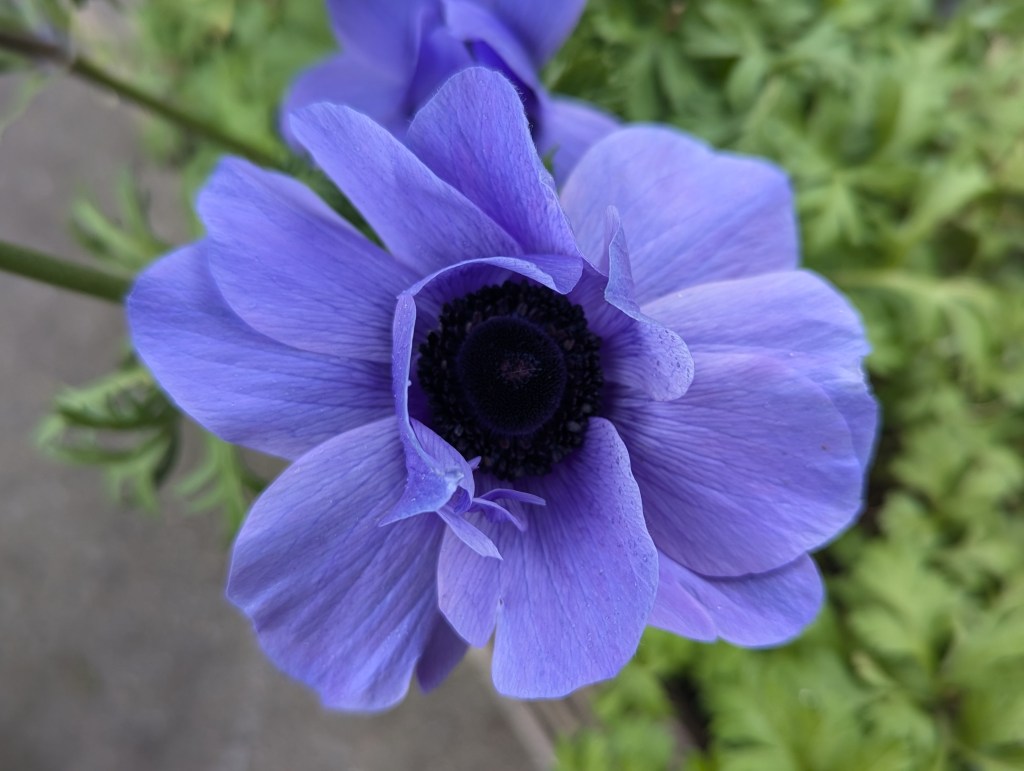
5. Anemone coronaria ‘Mr. Fokker’ windflower has been impressively perennial here for a few years, like the ‘Marine Blue’ sage. Although it technically should be this perennial, it rarely is here. It might prefer cooler winter weather than it typically experiences here.
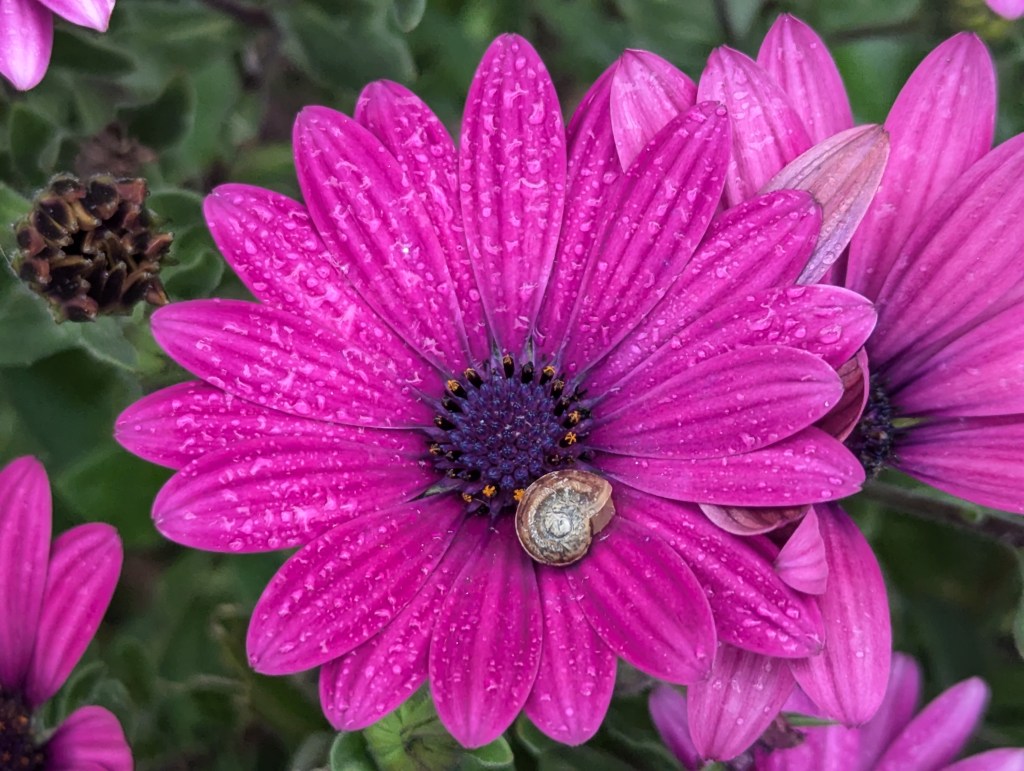
6. Osteospermum ecklonis ‘Flower Power Compact Purple’ African daisy is notably more compact than its extensive name is. Its purple floral color seems to be more purple than any within the landscapes at work. Perhaps I should grow a copy, but without that snail.
This is the link for Six on Saturday, for anyone else who would like to participate: https://thepropagatorblog.wordpress.com/2017/09/18/six-on-saturday-a-participant-guide/

Aspidistra elatior, cast iron plant, is a foliar perennial. In other words, it is grown more for its lush and famously resilient evergreen foliage than for its bloom. The resiliency of its foliage accounts for its common name. Its bloom does not account for much. In fact, it is rarely seen. This is not because it is rare, but because it is not much to see. Such bloom is typically obscured by the lush evergreen foliage. Even if exposed, as in these pictures, it is not prominent. Individual flowers are tiny and dark, and do not extend much above grade. They seem to be designed for pollination by ants or other insects that might walk over them on the ground. In the picture above, one flower is blooming to the far left, another is beginning to bloom to the far right, and a third floral bud seems to be developing below that which is is beginning to bloom to the far right. Even the closeup of the far left bloom below is more weird than visually appealing. The floral form, texture and color suggest that they are intended to attract flies. I did not notice if the floral fragrance was consistent with that assumption, nor do I want to. I know what sort of fragrances flowers disperse to attract flies. However, I suspect that if such floral fragrance were notably objectionable, cast iron plant would be known for sometimes producing it, or not be quite as popular as it is.


Tulip is the only single flower of these Six this Saturday. The other five are dinky flowers that are colorful in their natural profusion. Even tulip is more colorful with at least a few friends, as it bloomed in its landscape. Flowering quince shows only three flowers in this closeup picture, but it actually blooms more comparably to forsythia or spirea.
1. Tulipa X hybrida, tulip is of an assorted batch, but seems to be the same color as all of the others. Such batches typically contain a preponderance of varieties that happen to be overly abundant when they are mixed, but are not likely to be completely homogeneous.

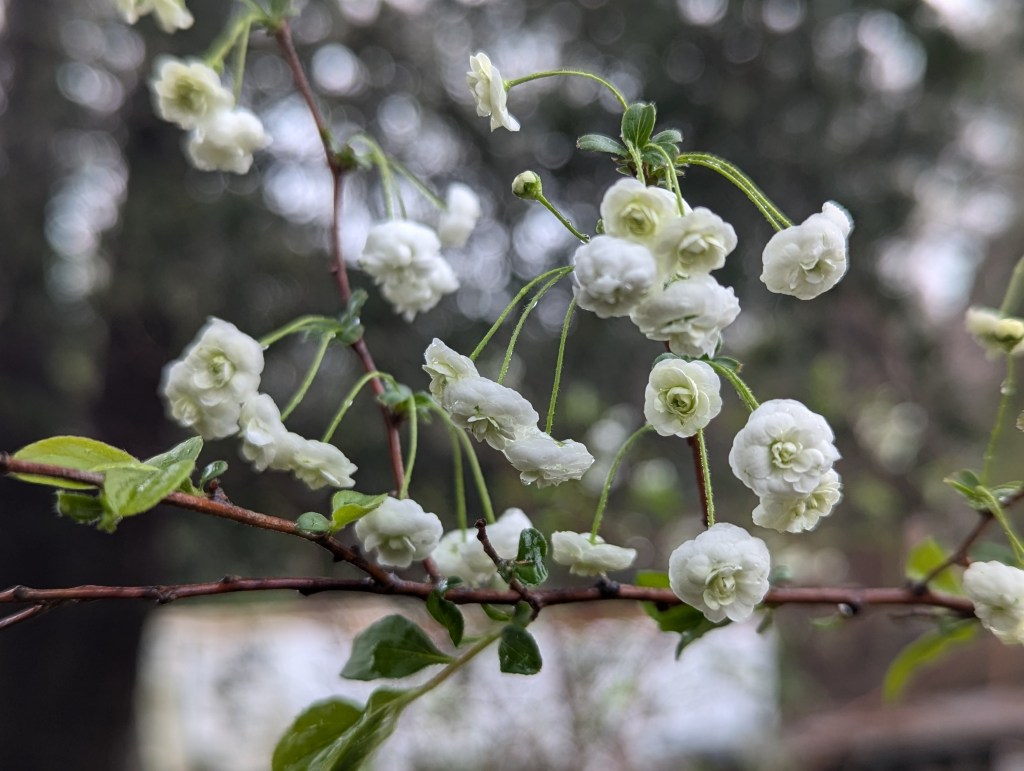
2. Spirea prunifolia, bridal wreath spirea could have bloomed more fluffily if it had been in a sunnier situation. This specimen has been in partial shade in the storage nursery for too long as it waits for reassignment to a real landscape. I remember it only as it blooms.
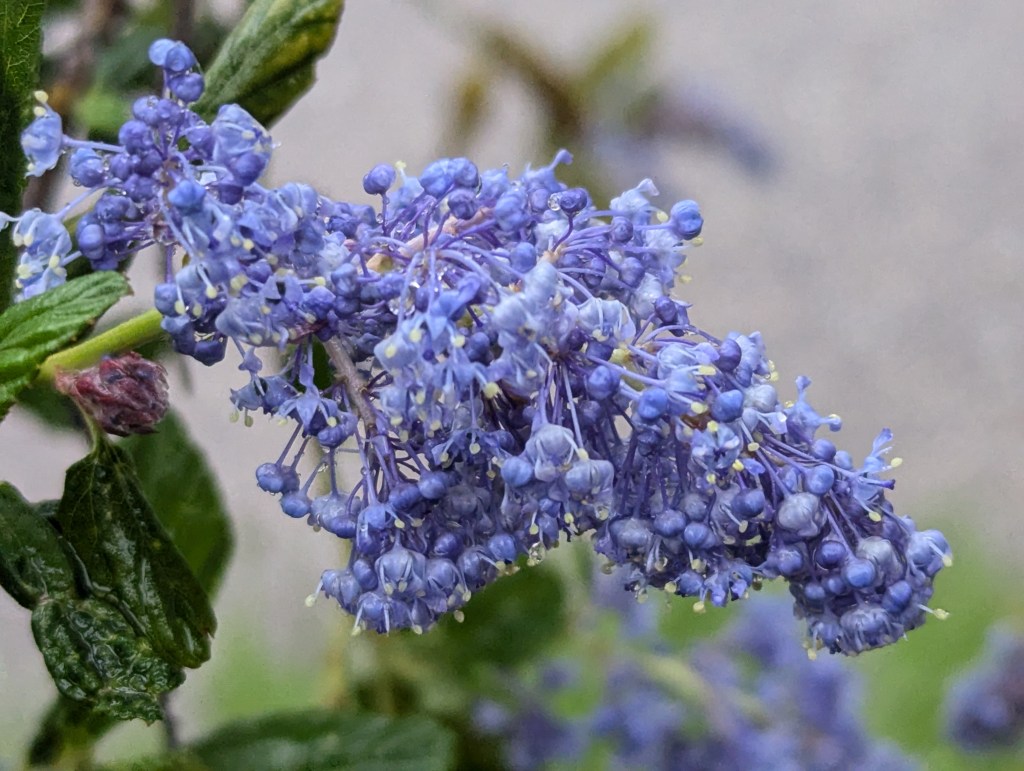
3. Ceanothus thyrsiflorus, California lilac is the same that I posted a picture of here two weeks ago, but neglected to remember until now. It is the only of these six that is native. It could have been installed intentionally into its landscape, but it more likely grew wild.
4. Chaenomeles speciosa ‘Orange Storm’ or ‘Double Take Orange’ flowering quince has a pair of cultivar names, which is two more than I can identify for the other five of my six. I can not determine if one is more correct than the other. It is pretty, but a bit overrated.

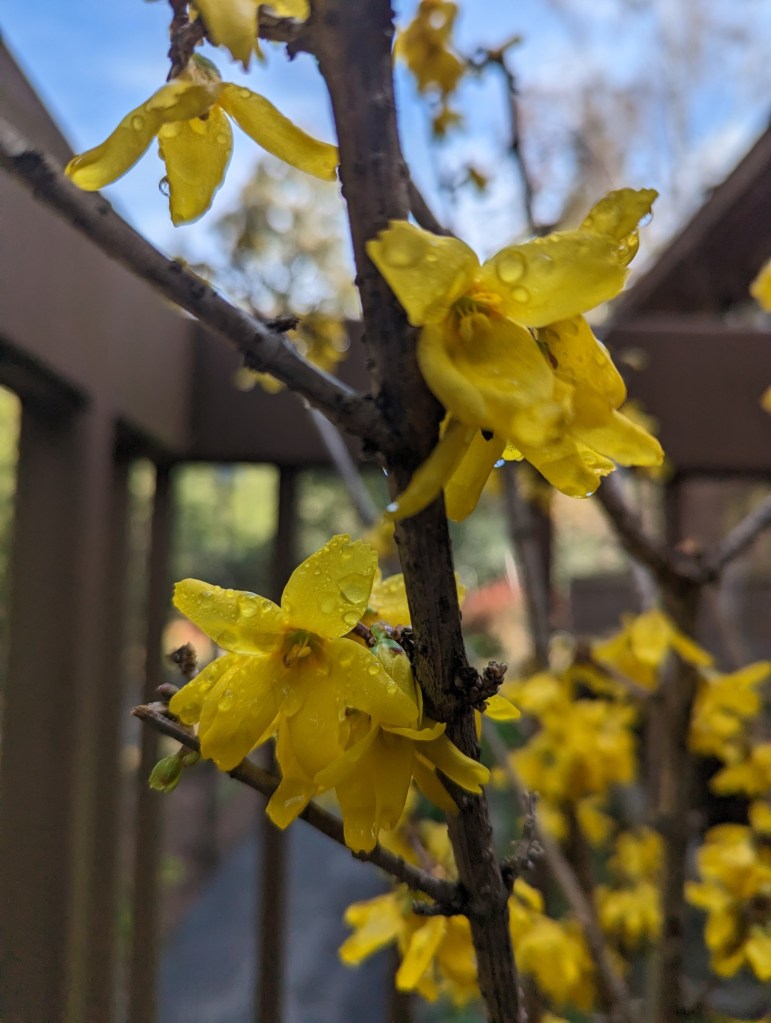
5. Forsythia X intermedia, forsythia was with the bridal wreath spirea and ‘Double Take Orange’ flowering quince in the storage nursery for a long time before assignment to the landscape that it now inhabits only last winter. It has not grown much, but blooms well.

6. Loropetalum chinense, Chinese fringe flower is pretty enough to be an illustration for the gardening column. I may feature it next week or the week after. If I do so, it must be within its bloom season. When it became a fad several years ago, I was not so keen on it.

This is the link for Six on Saturday, for anyone else who would like to participate: https://thepropagatorblog.wordpress.com/2017/09/18/six-on-saturday-a-participant-guide/
k
 Tony Tomeo