Human intervention has sustained the seven species of angel’s trumpet, Brugmansia, since their prehistoric extinction from the wild. They were likely endemic to tropical regions from Venezuela to Chile, and southeastern Brazil. Their extinction was likely a consequence of the natural extinction of animals that dispersed their seed. Most garden varieties are hybrids of the various species.
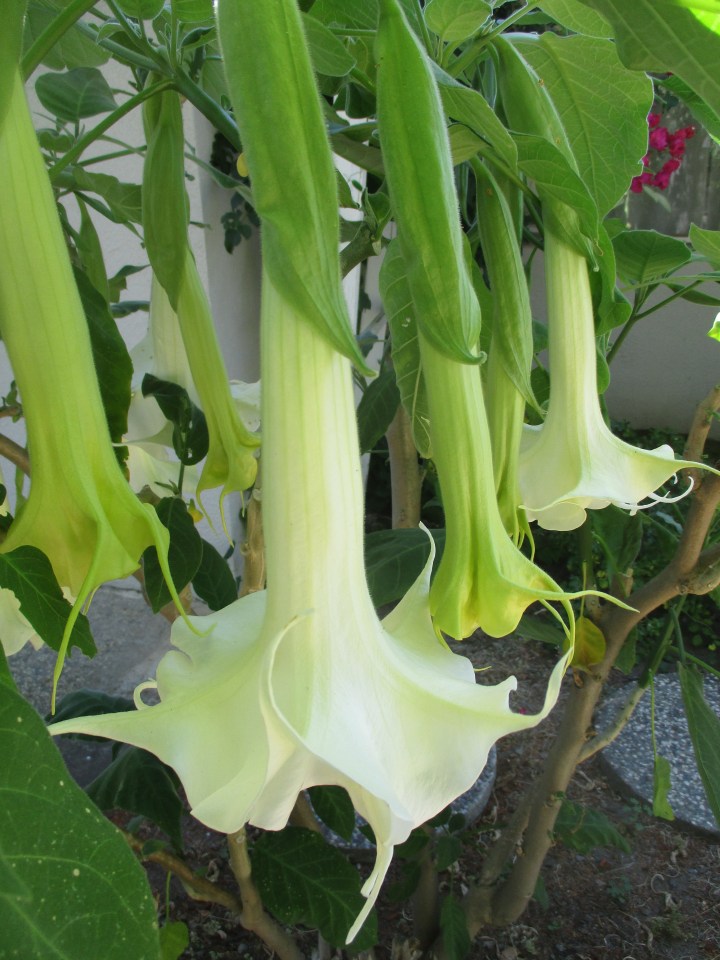
Angel’s trumpet is either a big shrub or small tree, with rather herbaceous stems. The more popular cultivars can get more than eight feet tall. Cultivars that might get twice as tall are rare. The soft leaves get about six inches long and half as wide. Leaves might get almost twice as long on vigorous growth. Some cultivars have slightly tomentous (fuzzy) foliage. A few have variegated foliage.
Although generally sporadic, and pastel hues of pink, orange, yellow or white, bloom is impressive. The pendulous trumpet shaped flowers are commonly longer than six inches, and half as wide. Double flowers are frilly. Several cultivars are delightfully fragrant, particularly in the evening. All plant parts are very toxic. Plants damaged by frost in winter are likely to regenerate from their roots.
Landscaping and growing houseplants really is no way to bring nature closer to home. If it were up to nature, most of our gardens would be relatively bare. Most of the few native trees are less than ideal for home gardens. The few native annuals and perennials with colorful flowers bloom only briefly. Almost all native shrubbery is scrubby and not conducive to pruning. After all, most of us live in what would naturally be coastal chaparral.
This is why home gardens contain so many exotic plants from so many different climates and regions all over the world. These plants get pruned, shorn and mown in all sorts of unnatural ways. Most do better if watered unnaturally through naturally dry summer weather. Many crave unnatural fertilizer. Houseplants and a few others are confined to pots so that roots can not disperse like they want to.
Potted plants that are forced into bloom to decorate home interiors are the most unnatural of all. They are among the most extensively bred of plants. They are grown in contrived environments that coerce them to bloom whenever their blooms are needed. Poinsettias, lilies, azaleas, hydrangeas, kalanchoes, callas, miniature roses, chrysanthemums and some orchids are the more familiar of these sorts of plants.
They are certainly colorful by the time they leave the greenhouses they were grown in. By the time they come home, they are in the middle of full bloom. There is no work to get them to bloom. The work is in keeping blooms as healthy and as colorful as possible, for as long as possible. Most of these plants only want to be watered regularly, and are happy to keep their color for quite a while.
By the time they want fertilizer, blooming potted plants will have finished blooming. Sadly, at that time, most get discarded instead. Realistically though, such systematically abused plants can be rather ugly as they replace their greenhouse foliage with foliage that is better adapted to the garden. The process of forcing them into bloom is just too unnatural and difficult to recover from easily.
Yet, with enough patience and pampering, most blooming potted plants should eventually recover and adapt to a garden lifestyle. Lilies, callas and other bulb-like plants should be put aside in the garden while their foliage fades and eventually separates from the bulbs. The dormant bulbs can then be planted and allowed to grow into their new environments.

 Tony Tomeo