Lemon Bottlebrush

Lemon bottlebrush is popular among hummingbirds.

Like oleander and junipers, lemon bottlebrush, Callistemon citrinus, has become passe. It was a victim of its own practicality. It was so popular that it became overly common. Yet it is just as practical now as it was then. It is resilient enough to survive within medians of freeways with minimal irrigation. In less exposed situations, it might require no irrigation.

As a small tree, lemon bottlebrush can grow more than fifteen feet tall. With pruning from below, some grow about twenty feet tall with sculptural trunks. Their canopies eventually become messy though, and require aggressive pruning. Most lemon bottlebrush grow as big flowering shrubbery or high hedges. Shearing can compromise bloom if too frequent.

Bright red bloom should be most abundant for summer, but may be sporadic at any time. It is very popular with pollinators, including hummingbirds. Many small staminate flowers bloom in compact cylindrical trusses, like bottlebrushes. Each truss is about two or three inches long and nearly as wide. The aromatic and evergreen leaves are almost as long. Dark brown bark is handsomely shaggy and furrowed.

Orchid Rockrose

Orchid rockrose, as well as other rockrose, are remarkably resilient.

Out in the most remote islands in the vast parking lots of Westgate Mall, the three inch wide, bright pink flowers of orchid rockrose, Cistus X purpureus, defy the harsh exposure and sun baked soil. They begin to bloom somewhat abundantly about now after winter rains, and continue until the beginning of summer. Sporadic flowers can occasionally bloom out of season. The center of each flower looks like a starfish wearing a fuzzy sweater, because each of the five petals has a brownish red spot at the base, surrounding the bright yellow stamens.

Mature orchid rockrose plants are typically less than four feet tall and broad, with somewhat grayish green, aromatic foliage. Individual leaves are about one or two inches long. Older stems can be pruned out as they start to deteriorate and drop leaves, in order to promote new growth that lasts longer. Otherwise, plants look tired after a few years, and eventually die out. Orchid rockrose does not want much water once established, and can only tolerate frequent watering with good drainage.

Bridal Wreath Spiraea

Bridal wreath spiraea resembles baby’s breath.

Flowering quince and forsythia set a precedent. Bridal wreath spiraea, Spirea prunifolia, somehow became old fashioned too. All three are only beginning to regain popularity. All are deciduous, so defoliate for autumn and remain bare through winter. They then bloom spectacularly on bare stems for late winter or early spring. Foliage develops after bloom.

Bridal wreath spiraea, like forsythia, develops many upright and arching basal stems. Its stems can grow taller than eight feet, although they are typically a bit shorter. Removal of old stems after bloom promotes growth of new stems, which bloom better. Indiscriminate pruning ruins their naturally upwardly flaring form. A slight bit of partial shade is tolerable.

Almost all bridal wreath spiraea are of the cultivar ‘Plena’. Their double flowers are fluffy but tiny, between just a quarter and a half inch wide. The simple species, and the variety ‘simpliciflora‘ with single flowers, are rare. Regardless of floral form, floral color is limited to white. Foliage might develop yellow color for autumn where autumn weather is cooler.

Chinese Fringe Flower

Fringe flower is an early bloomer.

The simple species is notably distinct from its several popular modern cultivars. Chinese fringe flower, Loropetalum chinense, grows very slowly to about fifteen feet tall. Its simple evergreen foliage is exclusively light green. Its small and ribbony flowers are exclusively creamy white. Limber and arching stems can eventually overwhelm adjacent vegetation.

However, this simple species is now very rare. Popular modern cultivars are much more compact. Although a few can grow taller, most are no more than five feet tall. Most exhibit delightfully purplish or bronzed foliage. Individual leaves grow about an inch or two long. Floral color ranges through white, creamy white, pink, rosy pink, rich red and garnet red.

Chinese fringe flower has a woodsy style. Shearing or aggressive pruning compromises its naturally relaxed form. It is naturally an understory species, so is somewhat tolerant of partial shade. Bloom is most abundant as winter relinquishes to early spring. It continues sporadically throughout most of the year. Blooming stems can be handsome cut flowers, and tolerate forcing bloom.

Andromeda

Andromeda can be somewhat shade tolerant.

Andromeda might be more familiar by its Latin name of Pieris. A few of its seven species, and a few of their hybrids, are popular for home gardens. All are evergreen shrubs. A few do not grow much taller and wider than three feet. Few can grow a bit more than ten feet tall and wide. In the wild, some might grow as small trees that are almost twenty feet tall.

Andromeda has glossy evergreen foliage. Individual leaves are lanceolate, perhaps with serrated margins. They are between one and three inches long, and half to an inch wide. New growth of most cultivars is as rich cinnamony red as that of photinia. A few cultivars have more pinkish or simple green new growth. A few cultivars are variegated with white.

Andromeda blooms with somewhat pendulous racemes of tiny pendulous flowers. Floral racemes are between two and four inches long. Individual flowers are between a quarter and half an inch long. Most are white. Some are pink. Most have green rachi. Some have pink rachi. Bloom is abundant for the middle of spring. Andromeda prefers partial shade.

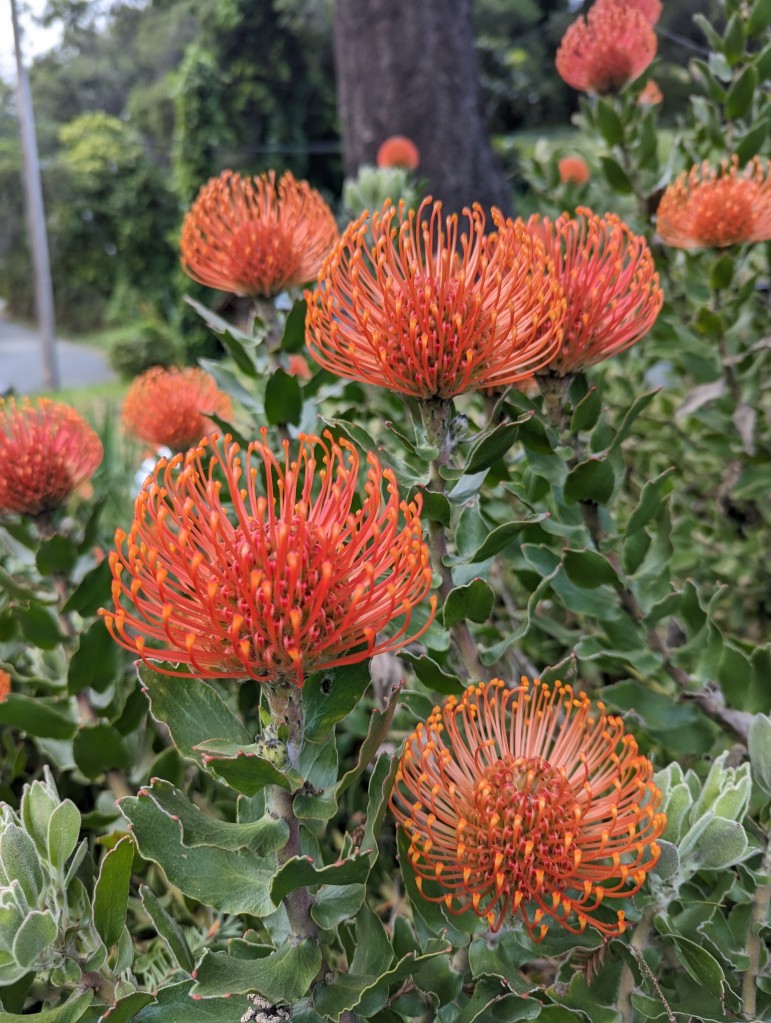
Pincushion Protea

Pincushion protea is most certainly distinctive.

Proteas seem to be as happy locally as they are within their native range in South Africa. The Mediterranean climates there and here must be similar. Like most species from such climates, they are quite undemanding. They enjoy sunny and warm exposure with good drainage. They dislike fertilizer and frequent irrigation. Occasional irrigation is tolerable.

Pincushion protea, Leucospermum cordifolium, is the most popular protea here. Bloom can begin between late winter and early spring, and lasts for weeks. Many are presently blooming. Most are orange. Some are yellow or red. They are excellent cut flowers, both fresh and dried. Each rounded and four inch wide bloom contains many narrow flowers.

Pincushion protea develops stiff branches, but potentially wobbly roots. Sprawling stems that lean onto the ground improve stability. Pruning should remove undesirable stems at their origins, without leaving stubs. Shearing ruins form and texture, and inhibits bloom. Mature specimens can be about five feet tall and somewhat wider. Stiff evergreen leaves are about three inches long and half as wide.

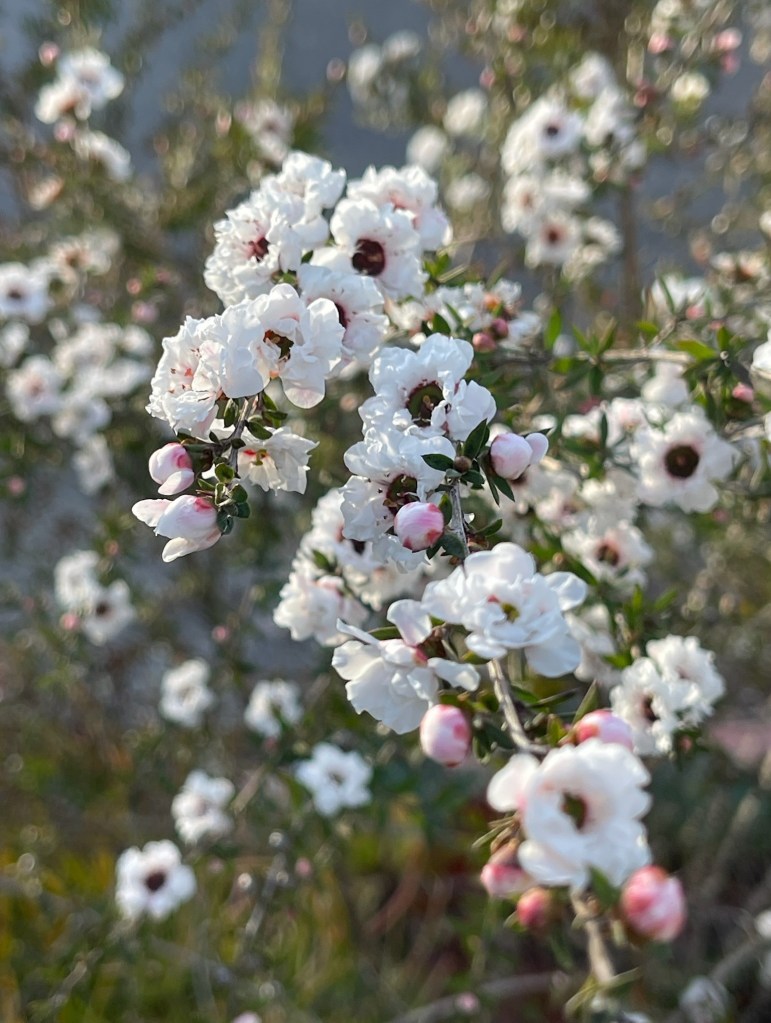
New Zealand Tea Tree

Frequent shearing might interfere with bloom.

Bloom should probably be most profuse for late spring or early summer. In actuality, New Zealand tea tree, Leptospermum scoparium, blooms whenever and however it wants to. Now that it seems to be blooming prematurely, it might continue to bloom in phases until autumn. Minor bloom phases might even continue randomly through autumn and winter.

Floral color is white, pink or red, including deep ruby red. The tiny flowers are sometimes sporadic but sometimes quite profuse. A few cultivars have plump double flowers. Foliar color is olive drab green or bronze green. The finely textured evergreen foliage is slightly scratchy. Its tiny leaves have pointed tips. The fibrous brown bark is handsomely shaggy.

New Zealand tea tree works very well as a blooming informal hedge. Frequent shearing of formal hedges compromises both bloom and natural form. Elimination of lower growth exposes appealingly sculptural trunks supporting little trees. Some modern cultivars will not reach first floor eaves. Some reach second floor eaves. All demand sunny exposure.

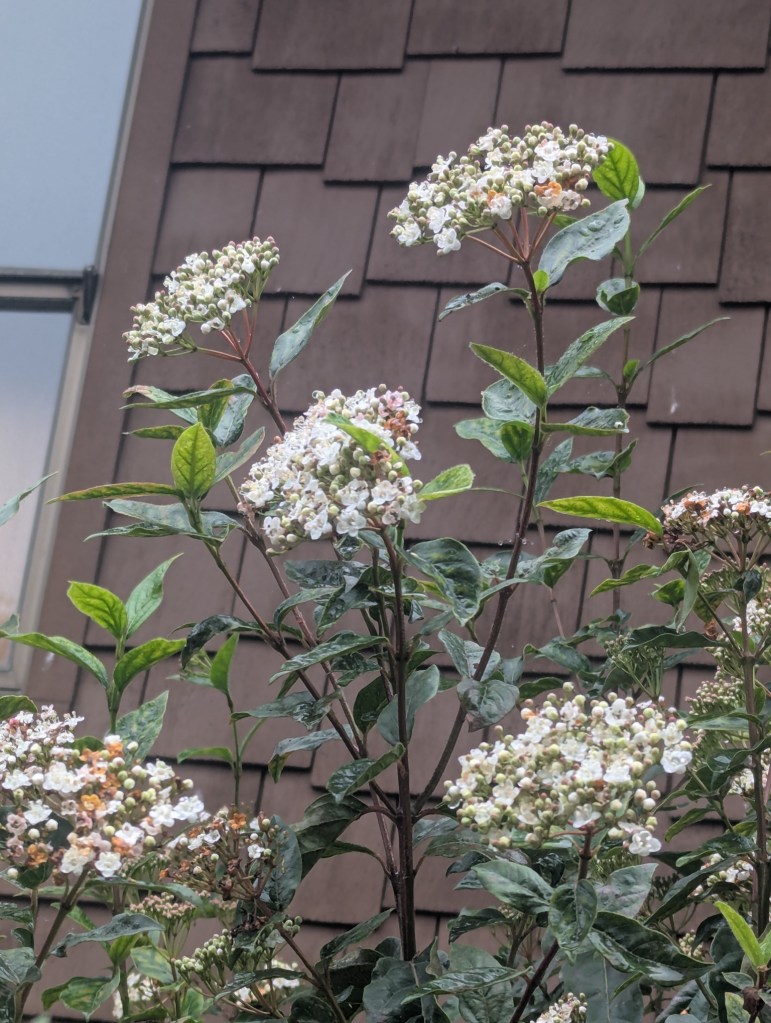
Snowball Bush

Even without the variety of color of hydrangea, these relatively delicate, crisp white flowers of snowball bush are quite elegant.

Like small, clear white hydrangea blooms, the round, three inch wide floral trusses of snowball bush,Viburnum opulus ‘Roseum’, are composed of many smaller flowers. Unlike hydrangeas that bloom after vegetative (stem and foliar) growth, snowball bush blooms early, so that as it finishes, deteriorating blooms will be obscured by soft green foliage before anyone notices. The distinctively lobed, three inch wide leaves get quite colorful in autumn. Snowball bush should not be shorn, but can instead be pruned aggressively while bare in winter. Older or obtrusively tall stems should be pruned to the ground where possible. Good sun exposure without too much reflected glare or heat promotes bloom and autumn foliar color. Mature plants can get ten feet tall and nearly as broad.

Rockrose

Harsh exposure is fine for rockrose.

The few rudimentary rockroses that were available years ago have been bred into too many cultivars to keep up with. Some of the traditional types can get a few feet tall, with delightfully irregular growth, and flowers that are almost three inches wide. Most of the modern types are relatively dense, low and mounding, like a deep ground cover, with smaller but more profuse flowers. Most bloom pink. Some bloom white. After the initial spring bloom phase, a few flowers continue to bloom sporadically through summer. The grayish and aromatic foliage is not as impressive as the bloom. Rockroses want well drained soil and good warm exposure.