Lungwort

Most lungwort blooms blue or purplish.

Its unappealing common name is less common than its more agreeable botanical name. Lungwort does not sound as pretty, or at least as official as Pulmonaria officinalis. It is an evergreen perennial, although its foliage likely desiccates through summer. New foliage replaces it during cooler autumn weather. Lungwort prefers cool and moist partial shade.

Mounds of foliar rosettes grow no deeper than a foot. They often stay only half a foot high as they spread as wide as two feet. Their lowest rhizomes produce adventitious roots so that they can sprawl even farther. Such growth is easy to divide. Foliage of most cultivars exhibits pretty lighter green or silver spots or blotches. Some is almost completely silver.

Lungwort blooms mostly for late winter and early spring. Trusses of daintily small flowers hover barely above their basal foliage. The most popular sort blooms with pinkish purple flowers that mature to blue. Others bloom with purple, pink, purplish red or white flowers. Although foliage is healthier within partial shade, sunshine promotes profusion of bloom.

Wild Lilac

Some wild lilac can grow quite large, but lives only about thirty years.

There are many different forms of wild lilac, Ceanothus spp., ranging from low sprawling ground cover types that get only about two feet deep, to dense shrubs that get a few feet tall and broad, to relatively open and irregular shrubs that are a bit larger. The largest can become a small tree with multiple trunks as tall and broad as twelve feet. Wild lilac flowers can be any shade of blue ranging from deep dark blue to soft pale blue. Only a few have white or pinkish flowers. Some wild lilacs have leaves that are glossy and round like nickels. Others have small but thick and roughly textured leaves, like bacon bits.

However, almost all bloom in early spring, are evergreen, and want well drained soil. Only a few lose their leaves where winters are cold. Most prefer infrequent irrigation or none at all, although some of the ground cover types like to be watered occasionally through summer. Wild lilacs do not like to be pruned, and really do not want to be shorn, so should be planted where they have room to develop their natural forms. Sadly, wild lilacs are not permanent, and typically die within ten years or so.

Six on Saturday: Bluem

Blue is the rarest floral color. Furthermore, many flowers that appear blue are somewhat purplish, or perhaps more purple than blue. These six all look blue to me, although I can not see blue very well.

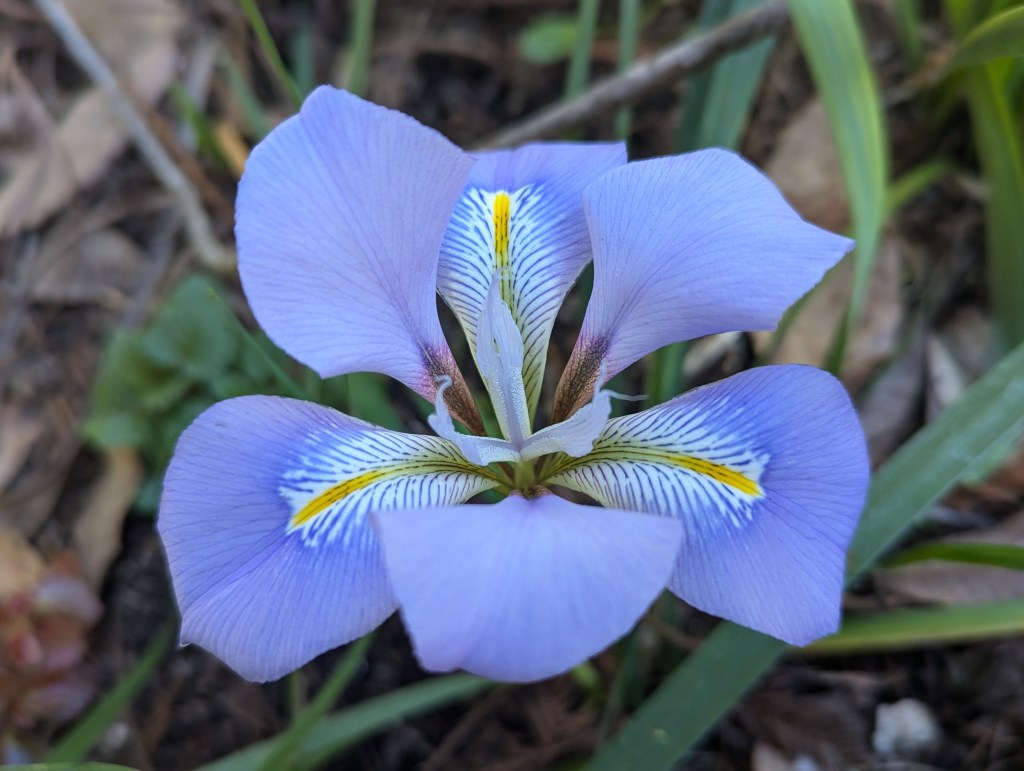
1. Iris unguicularis, Algerian iris has been blooming long enough for a third appearance here in four months. That may seem to be redundant, but it is my favorite for this week. I still do not know when to expect its last blooms. It is from Tangley Cottage Gardening.

2. Viola cornuta, viola exhibits more insect damage than I was aware of when I took this picture. Well, this is embarrassing. I do not select annuals at work, but I do enjoy taking credit for them. These bloom longer here than they would within the Santa Clara Valley.

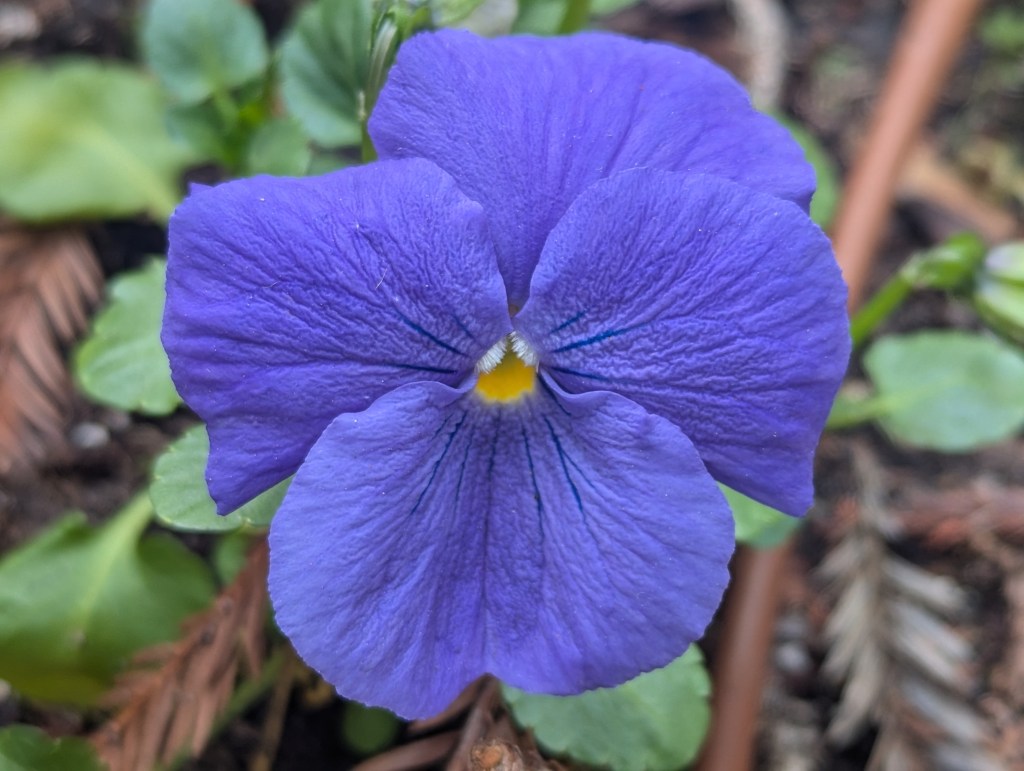
3. Viola X wittrockiana, pansy also performs better here than in the Santa Clara Valley. These blue pansies alternate with white pansies, which I prefer; but I took this picture to conform to the blue theme. We have not yet found any color that is not appropriate here.

4. Hyacinthus orientalis, hyacinth blooms thinly on floppy stems in partial shade, but is impressively reliably perennial. We should probably move the bulbs while dormant, but would prefer to instead remove an unwanted bay laurel tree that shades their landscape.

5. Ceanothus thyrsiflorus, California lilac is both locally native and added to at least one of our landscapes. Unfortunately, it is not easy to accommodate. It grew too large for its particular applications, but is difficult to prune properly without removing its best parts.

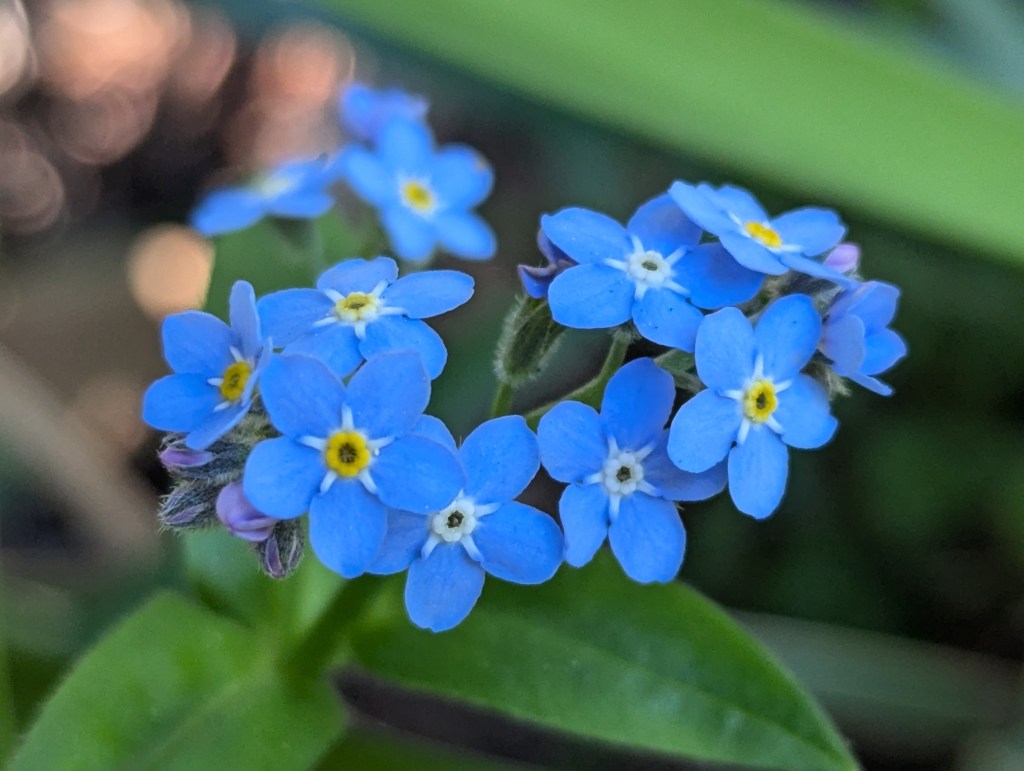
6. Myosotis sylvatica, forget-me-not is naturalized here, but not too aggressively so. It is pretty near but not within cultivated landscapes, where it can benefit from supplemental irrigation without incurring damage from weeding, raking and other gardening activity.

This is the link for Six on Saturday, for anyone else who would like to participate: https://thepropagatorblog.wordpress.com/2017/09/18/six-on-saturday-a-participant-guide/

Periwinkle

Periwinkle is both pretty and a weed.

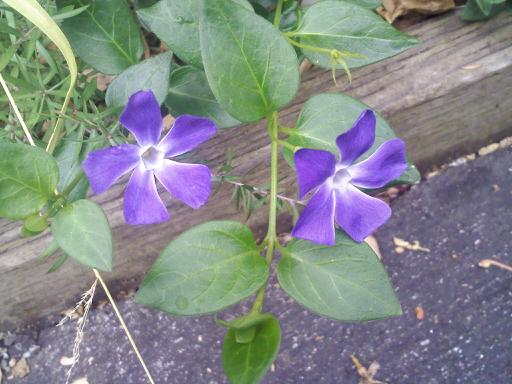
Conflict would likely erupt from any discourse between the city mouse and the country mouse regarding the topic of periwinkle, Vinca major. In rural areas, periwinkle can aggressively invade any area that stays even slightly damp through summer; and it is nearly impossible to eradicate. In urban areas, periwinkle can be a useful and appealing ground cover for difficult situations. It clings to steep embankments, and ventures into shade that is too dark for other ground covers.

Periwinkle can mound up to more than a foot and a half deep with wiry stems and rich green leaves about two and a half inches long. It looks neater and stays lower if shorn or mown down just before new growth develops at the end of winter. Two inch wide sky blue periwinkle flowers bloom mostly as new growth develops through spring, and can bloom sporadically through the end of autumn. ‘Variegata’, with wide white leaf margins, brightens up urns or planters of mixed ferns, and also looks good cascading from planters of mixed annuals or perennials. 

Off Color

Borage can bloom pink, although it should fade to blue.

Borago officinalis, borage blooms almost exclusively with blue flowers. Those that bloom with white flowers are a naturally rare variant, although a slightly less than natural white blooming variety is available. Although white is my favorite color, I wanted to grow the more common sort that blooms with blue flowers merely because, to me, blue seems like the more natural color for the species. Besides, white borage flowers look rather bland. Actually, I am not much more impressed with blue borage flowers, but wanted to grow borage just to see what all the fuss was about. Though they were not expected to be viable, I was pleased that someone shared some expired seed with me. Because I expected none of them to grow, and expected that even less than none would grow if I delayed sowing them until after winter, I tossed the seed into the cans of other plants in the recovery nursery. I figured that if one or a few grew, I could pull them up and can them separately. Only a few days later, they all seemed to be germinated and growing! I extracted and plugged them into one more six-pack than a full flat of cells, which is forty-two seedlings! The problem is that summer is over, and borage does not overwinter well, even here. I am pleased with them nonetheless, and am confident that some can survive with shelter. I figured that with so many seedlings, that one or more might possibly bloom with white flowers. I noticed floral buds a while ago, so was watching for my first borage bloom. I was not expecting this! What is weirder is that all are blooming like this. Apparently, it is normal for borage to bloom with pink flowers that fade to blue during autumn.

Campanula

Many home garden Campanula are easier to identify by cultivar name than by species.

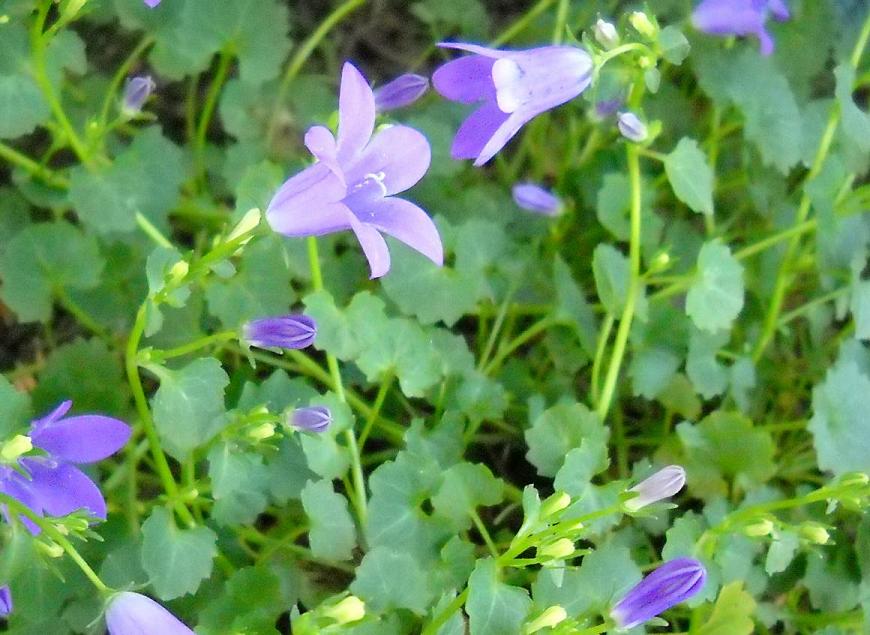
Of the hundreds of varied Campanula (Campanula spp.) that can be found in the wild, almost all of the few grown in gardens are small scale ground covers or creeping perennials, with blue or white bell or star shaped flowers. Most campanula fill in nicely between clumping perennials, and will spread wherever they have other plants or features to shelter them, although they are rarely reliable as ground cover for exposed areas. Campanula can be grown from seed, but is easiest to propagate by division. Pieces trimmed off from around the edges or pulled out of shrubbery also root very easily.

Blue Marguerite

Not many flowers are as blue as blue marguerite is.

            Like all sorts of daisies, gazanias, ice plants and so many of the familiar flowers in the Compositae family, blue marguerite, Felicia amelloides, is endemic to South Africa. Their flowers are the colors of the flag of Sweden though, with clear blue petals around bright yellow centers. These inch wide or slightly wider flowers bloom on well groomed plants most of the time, except during cool weather. Plants that do not get dead headed (groomed of deteriorating flowers) take breaks between bloom phases. The simple inch long leaves seem to be glossy, but almost have the texture of a cat’s tongue.    

            Mature plants may be taller than a foot and broader than four feet. Their somewhat woody stems are not as substantial as they should be, so can break easily, leaving awkward holes in otherwise well rounded shrubs. Unfortunately, the healthiest plants may live for only a few years. Distressed plants actually last a bit longer. Aggressive pruning at the end of summer or just before spring can restore old deteriorating plants for a while.

            Blue marguerite likes well drained soil, good sun exposure and somewhat regular watering. It is most often used as a colorful and shapely perennial, but is colorful enough for pots and urns of mixed perennials or annuals.

Khartoum

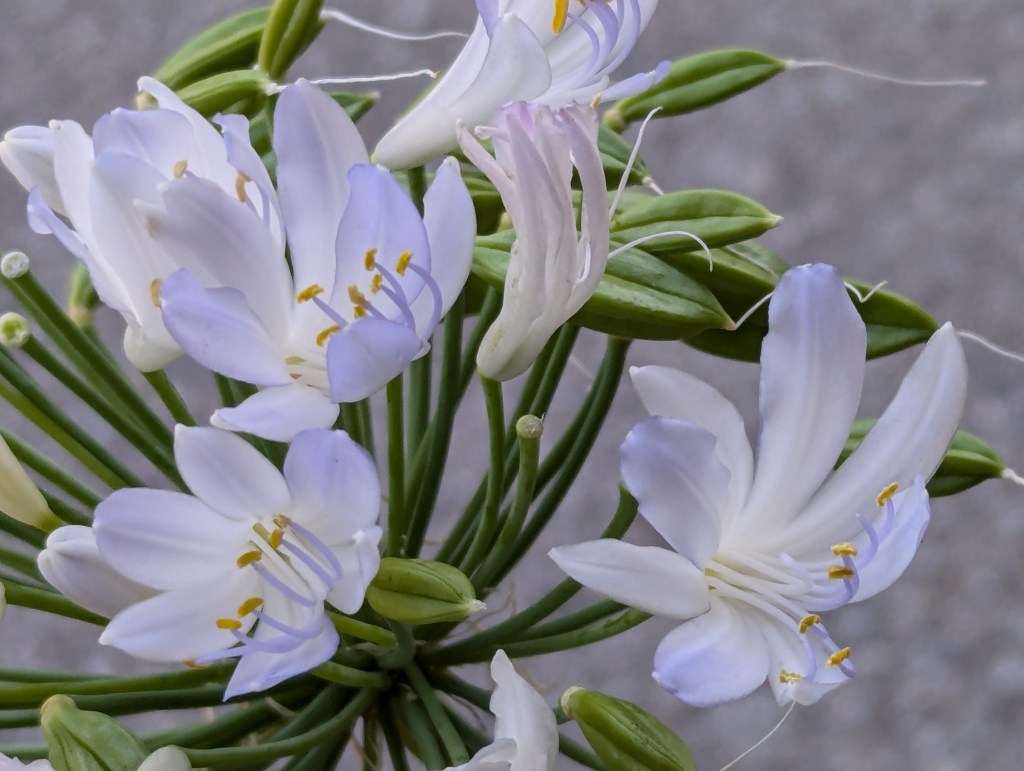
‘Khartoum’ (Agapanthus orientalis ‘Khartoum’) is a blend of Blue Nile and White Nile.

Khartoum is located where the Blue Nile River merges with the White Nile River to become the Nile River. Lily of the Nile, contrary to its name, is neither a lily nor native to any of the three Nile Rivers. It is in the Amaryllidaceae Family, and is native to Southern Africa. Coincidentally though, it naturally blooms either blue or white. It really seems like it should be native to at least two of the Nile Rivers, with those that bloom white inhabiting the floodplains of the White Nile River, and those that bloom blue inhabiting the floodplains of the Blue Nile River. Perhaps both should inhabit the floodplains of the primary Nile River. Like a few other species that bloom exclusively true blue or white, lily of the Nile sometimes exhibits sports, which are mutant growth, that bloom with the other of the two options. In other words, those that bloom blue sometimes produce a shoot that blooms white, and conversely, those that bloom white sometimes produce a shoot that blooms blue. As if genetically unstable, such sports may revert to their original floral color by the following season, and before they divide into several shoots that bloom prominently with aberrative floral color within their otherwise florally monochromatic colonies. When I noticed a single white bloom within an exclusively blue blooming colony, I did not want to wait for the following season to see what its intentions were. Then, as bloom faded and I separated it from the colony, I found that it was blushed with blue, as if already trying to revert. Because it is impossible to confirm its intentions, I canned it and set it aside to see what it does in the future. If blue, it can return to the landscapes with the random mix of blue lily of the Nile that has been accumulating as long as they have inhabited landscapes here. If white, it will be given to neighbors, because I want to maintain the genetic purity of the single white cultivar that is here. If it remains white with pale blue blush, it might get a separate but prominent position within a landscape.

What Is This IV?!

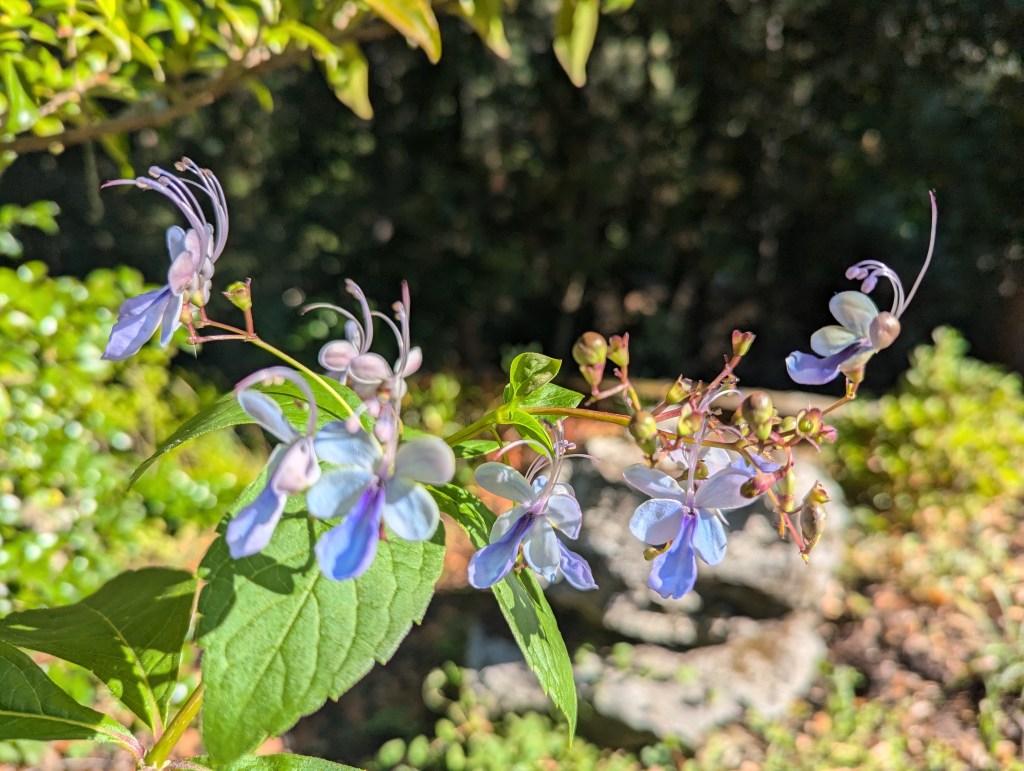
Rotheca myricoides / Clerodendrum myricoides ?

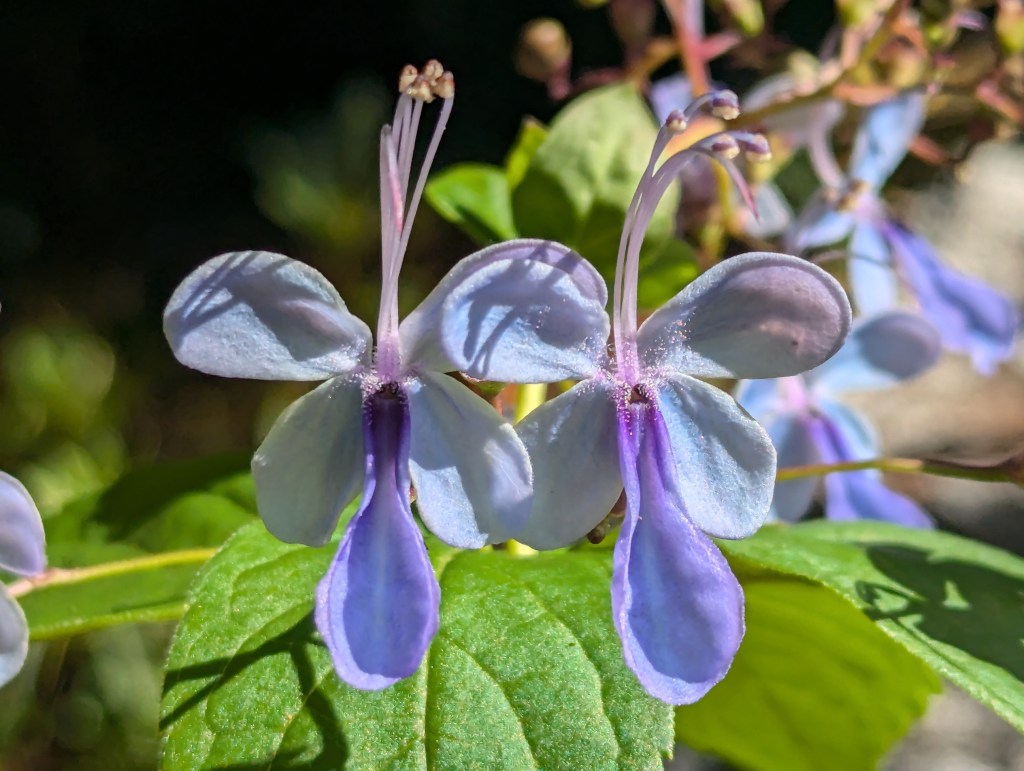
It is not a species of ivy. ‘IV’ is merely its Roman numeric designation as the fourth species that I am unable to identify since I started assigning numeric designations to them. So then, what is it? I suspect that it is likely Rotheca myricoides, which is alternatively known as Clerodendrum myricoides. ‘Ugandense’ is a cultivar name that, in typical modern tradition of botanic nomenclature that violates the simple standards of botanic nomenclature, now seems to be an acceptable species name in conjunction with either genus name. Its common names include butterfly flower, blue butterfly plant and blue butterfly bush, although the latter sounds more like a cultivar of Buddleia. I have not actually confirmed its identity, and I have no idea how it got into one of our landscapes. It grew under the carcass of a Brunfelsia pauciflora, yesterday, today and tomorrow, which did not survive my meager attempt to salvage it from compost. I can only assume that it arrived, most likely as an ungerminated seed, with the now deceased yesterday, today and tomorrow. It initially grew quickly with only two straight canes about four feet tall. I would have pulled it as a weed, but was intrigued by it. It did not grow much this year, but instead took time to branch, and is now taking time to bloom with these few intricate flowers on top. I am now pleased that I did not pull it as a weed. If it really is butterfly flower, it can get a bit taller than it already is. So, because it grew in front of an exemplary sasanqua camellia, I will likely relocate it to a more appropriate situation during its winter dormancy. I am fond enough of its sky blue flowers to propagate a few more copies of it.

The delicate pastel blue flowers are prettier up close.

Second White

How did this get in here?!

Lily of the Nile had previously been exclusively blue at work. Many from undoubtedly several different sources had been added to the landscapes for the past century or so, but, until recently, none were white. Even within a large and likely original colony, where genetic variability is evident among specimens that were added from different sources, or that grew from seed over the years, all bloomed monochromatically blue. I added the first white lily of the Nile only a few years ago. They are a significant herd of the same cultivar that I grew from only seven original pups that I acquired in the early 1990s. They are separate from the other lily of the Nile, in a neat row in front of the White Garden of el Catedral de Santa Clara de Los Gatos. They are not as fancy as they sound of course, and bloom with only a few flowers in the partial shade there, but they were supposedly the only white lily of the Nile. However, I recently found this other white lily of the Nile within the large and very established colony that provided many lily of the Nile for other landscapes. It could have grown from seed, and finally matured enough to bloom. I suspect that it merely reverted, as lily of the Nile sometimes does. I suppose that I should be pleased with it, but I am not so certain. It is almost intrusive, both to the exclusivity of the single white cultivar, and also to the exclusivity of the monochromatically blue colony. I have noticed within other old landscapes that, once one pup blooms white, others can follow its example. The same applies to a pup that blooms blue within a white colony. I may tag this particular pup for removal after bloom.