Something Blue

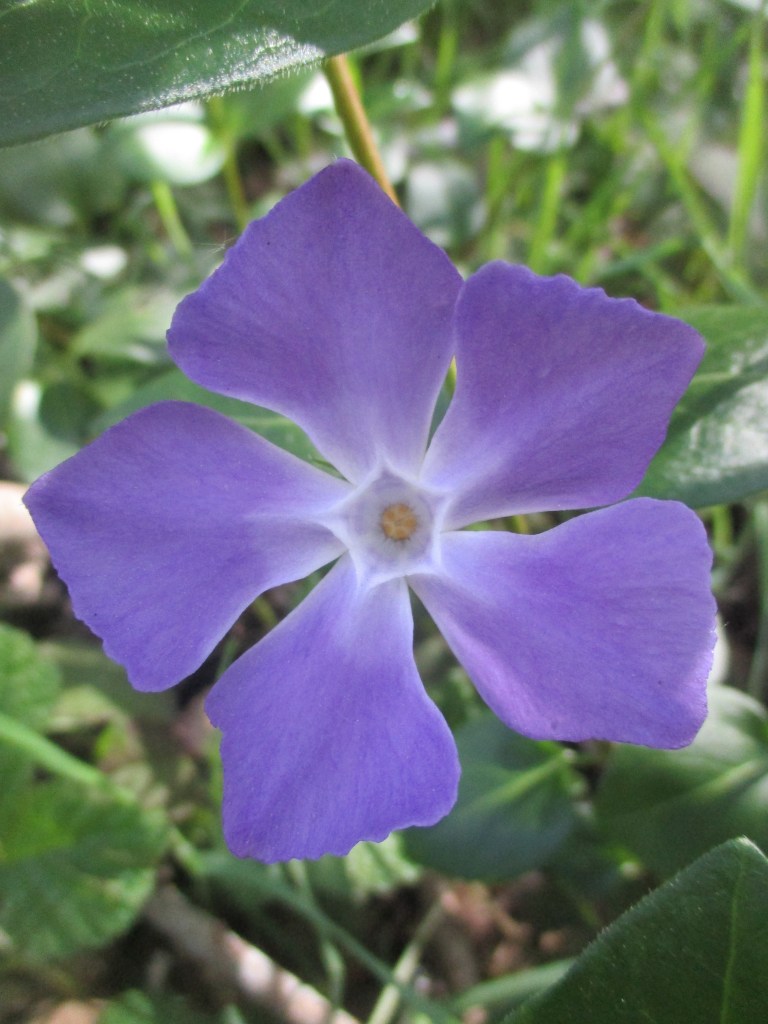
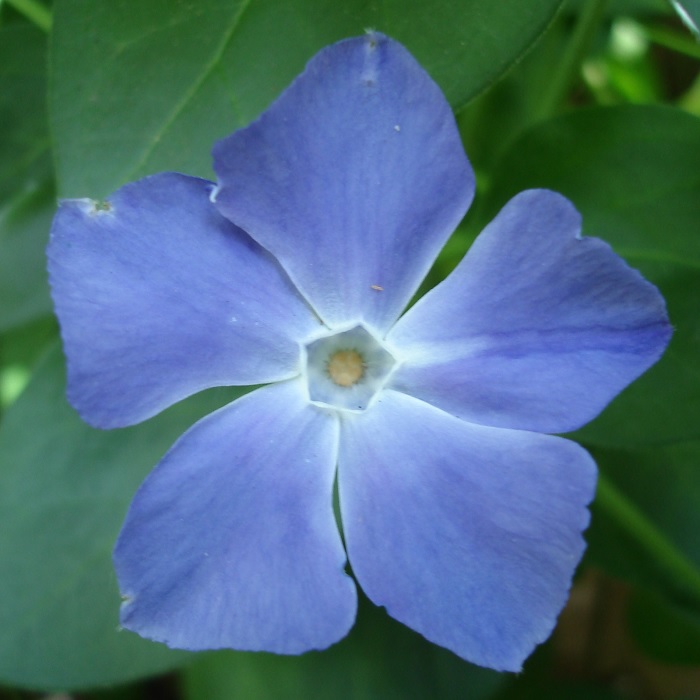
Is periwinkle blue, or slightly purplish?

Blue must be unpopular with the more common of pollinators. After all, colorful flowers are designed to attract some sort of vector to exchange pollen. It seems that most pollinators like yellow. Red and pink (which is actually a tint of red) seem to be more appealing to hummingbirds. Butterflies seem to really like pink and orange. Many flowers that seem to be white actually use infrared to attract bees, or ultraviolet to attract nocturnal moths. Other white flowers rely on wind, which is not discriminating about color.

Of the primary (red, yellow and blue) and secondary (orange, green and purple) colors, the only color that is more uncommon than true blue is green. That is probably only because green flowers do not contrast much against green foliage, so would be harder to find. Many blue flowers, like thyme, lavender, blue potato bush and jacaranda, are closer to purple. Some blue and purple color is probably only incidental, and in conjunction with invisible (to humans) ultraviolet coloration or patterns.

Except for purplish blue jacaranda, there are no substantial trees to bloom blue. Empress tree is flashy, but is even more purplish. However, most ceanothus, including a few that can grow as small trees, are famous for their clear blue bloom. Plumbago, blue hibiscus, echium and rosemary are blue blooming shrubbery. Creeping rosemary is a nice groundcover. Hydrangea has the potential to bloom blue, but often turns purplish or pink because of soil alkalinity. Lilac and wisteria vine can be lavender, pink or white, as well as ice blue.

There are several perennial and annual salvias and lupines that bloom blue. Russian sage, catmint, carpet bugle, campanula, perennial statice and lily-of-the-Nile are some of the other familiar perennials for blue flowers. Delphinium should probably be more familiar. Grape hyacinth and various iris bloom briefly but spectacularly with some of the richest shades of blue. Even though there are not many blue flowers to choose from, there is quite a bit of variety.

Annual statice, aster, zinnia, bachelor button, nierembergia, nigella, pincushion flower, forget-me-not and cineraria are uncommon annuals that are enjoyed by those who crave blue. Petunia happens to be one of the most popular of warm season annuals that also happens to produce some excellent blues. Later, brightly colored pansy and primrose can be just as flashy as popular cool season annuals.
Lily Of The Nile

00805
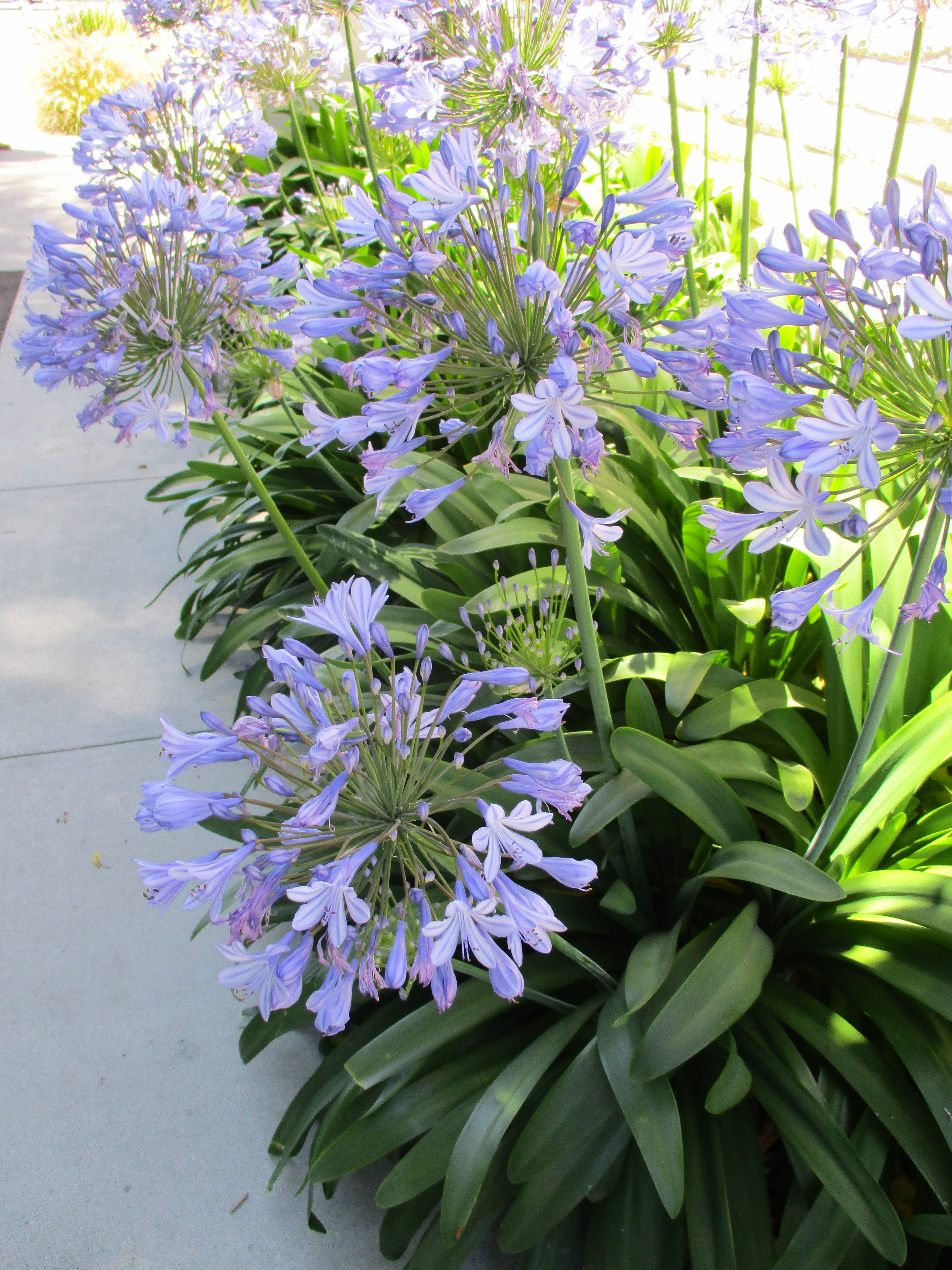
Agapanthus bloom looks like Independence Day.

It is no lily, but it does live on the banks of the Nile River. Lily of the Nile, Agapanthus africanus, endures both long dry summers and winter flooding. While inundated, it clings to the silty soil with a sturdy network of rubbery roots. Densely mounding foliage regenerates as floodwater recedes. If conditions get exceptionally warm and dry, foliage may eventually shrivel after midsummer bloom.

Home gardens are certainly more hospitable than the floodplains of the Nile River. The luxuriant foliage of lily of the Nile is evergreen locally, even if irrigation is minimal. The rubbery leaves get as long as two feet, arching outward from basal rosettes. New foliage obscures deteriorating old foliage. Plants that get too congested to bloom well might benefit from division of individual rosettes.

Lily of the Nile blooms around Independence Day, with round floral trusses that resemble exploding fireworks. Each blue or white bloom stands about two to four feet high, on slim and bare stems. Individual florets are small and tubular. ‘Storm Cloud’ blooms with darker blue or purple. Agapanthus orientalis may exhibit bigger blooms and coarser foliage. ‘Peter Pan’ stays low and compact.

Periwinkle

50701-c
Bloom is sporadic, but the delightful purplish blue color is worth it.

If the Latin name of dwarf periwinkle is Vinca minor, it is logical that large periwinkle should be Vinca major. Large periwinkle is more commonly known simply as periwinkle or common periwinkle, although it is not as common as dwarf periwinkle is, at least in landscapes. In some regions, it has naturalized as an invasive weed.

Some might accurately say that periwinkle is shabbier than the relatively neat and dense dwarf periwinkle. Others might say that it is just rustic or informal. The wiry stems stand less than a foot tall before they bend over from their own weight. Fallen stems can root where they touch the ground, and grow into new plants over winter.

The evergreen foliage is rich green, and a bit darker than the top of a billiard table. The simple paired leaves are about an inch and a half to two inches long. The slightly purplish blue flowers are about an inch and a half wide, with five petals each. Bloom is sporadic, but almost continuous, except for a lapse through winter.

Catmint

50527
Catmint is mellow like old denim.

Not to be confused with closely related catnip, catmint is a resilient perennial for sunny and warm spots. Nepeta faassenii had always been the more familiar catmint. Modern varieties include a few other specie and hybrids. The various catmints work like the various lavenders or trailing rosemary, without getting so shrubby.

Unless they lean on something or climb through shrubbery, stems do not often get any higher than a foot as they spread to two or three feet wide. A few stems around the edges can grow roots through winter, to spread more the following year. New plants are easy to propagate by division of some of the rooted stems before spring.

The diagonal flower spikes that bloom most profusely as weather warms in spring are the color of faded blue denim. Some catmints bloom white or pink. The finely textured foliage is grayish green, although some varieties of catmint have chartreuse or greener foliage. Spent bloom can get shorn off to keep new foliage neat.

Blue Is The Loneliest Color

00506thumb
Colorado has a blue State Flower.

The majority of common pollinators are not impressed with blue. Otherwise, more flowers would be blue. After all, floral color appeals to pollinators. Each type of pollinator prefers specific colors. Plants customize their floral color to their preferred pollinators. If more flowers could attract more pollinators with blue, they would do so. Instead, they rely on colors that have worked well for them.

Green is actually the most common floral color. It is not obviously common because green flowers are generally ignored. They are the sort that rely on wind for pollination, so make little or no effort to draw attention. They are also the sort that produce the most and worst pollen, which gets carried farthest by the wind. Flowers that rely on pollinators produce coarser pollen that clings to things.

Of the many other colors that appeal to pollinators, most are significantly more complex than they appear. For example, what appears to be simple orange may appeal to pollinators that perceive it to be yellow, as well as those that are drawn to red, even if none are interested in orange. Different pollinators perceive different color ranges. Insects do not perceive red; but hummingbirds do.

That certainly could not explain why blue is such an uncommon color for flowers. It surely has more of a following than red, which is more common among flowers. Since most pollinators perceive blue, more flowers should utilize it. They could even add some ultraviolet or infrared to it, if that would make it more appealing. Nonetheless, true blue, without the influence of purple, is quite rare.

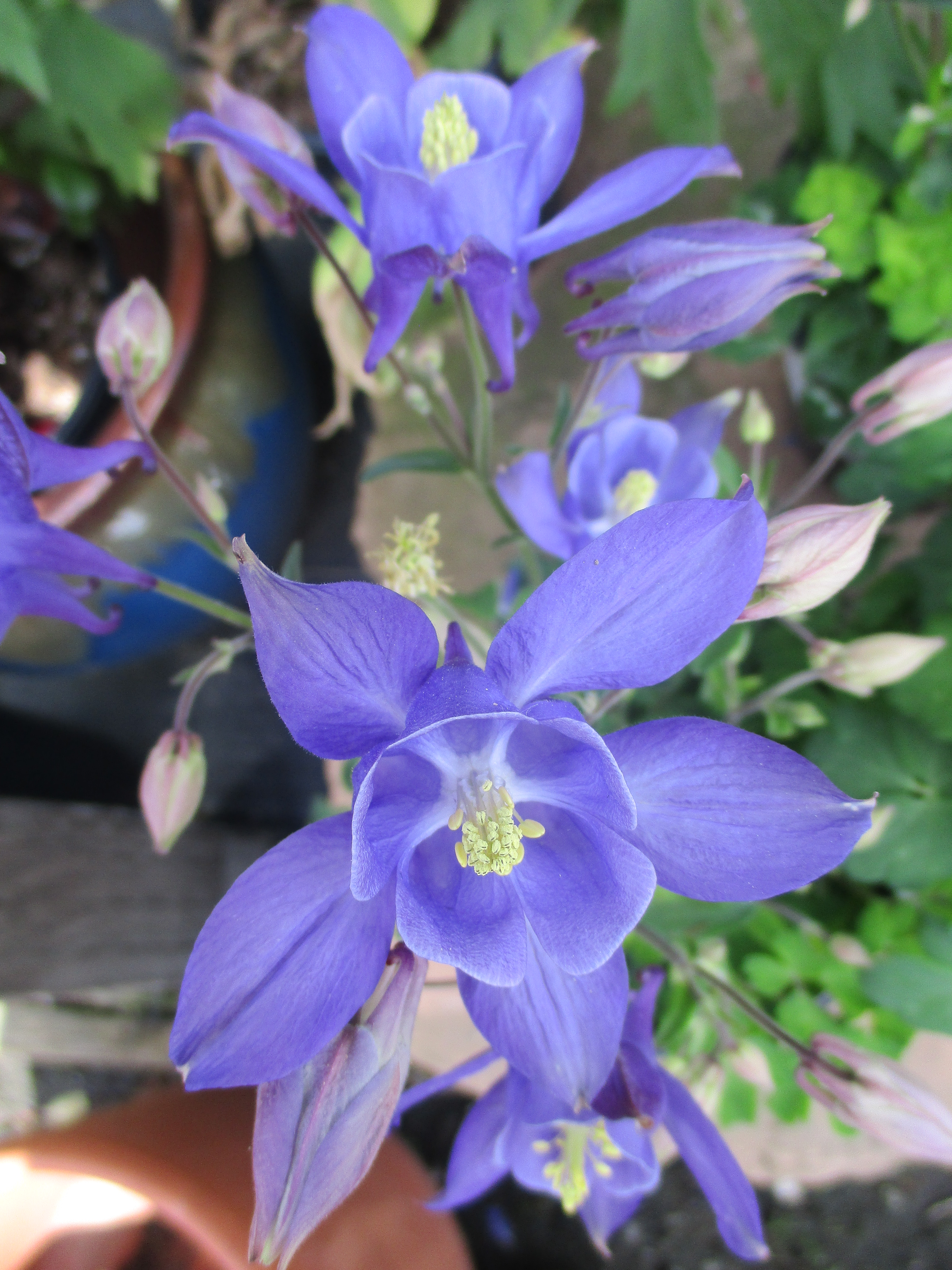
Lily-of-the-Nile and blue dawn flower are some of the more substantial species that provide exquisitely blue bloom. A few cultivars of butterfly bush bloom true blue too, but the color is not so clear and bright. Delphinium, bellflower, squill and grape hyacinth are smaller, but worthy perennials for the richest blues. Petunias, lobelia, nigella, cornflower and columbine are blue blooming annuals.

Many iris, sage and lupine provide exquisitely true blue bloom as well.