Off Color II

Borago officinalis, borage, as I mentioned last October, blooms almost exclusively with blue flowers. At the time though, a few maturing seedlings were blooming with a few pink flowers that eventually were replaced with blue flowers. Now that more are blooming, a few are doing so like this, with white flowers. Also last October, I mentioned that, although white is my favorite color, I expect borage to bloom blue. Not only does blue seem like a more natural color for it, but is also prettier. White borage seems rather mundane. Fortunately, most bloom blue, with enough that bloom white for my own garden, where I am less concerned with how pretty they are. I now wonder if they will be true to type. In other words, I wonder if those that bloom white will produce seed for more that bloom white, or if they will revert to bloom mostly blue. I will take what I get, I suppose. I have not yet found one that I do not like. I would be impressed, or perhaps concerned, by orange bloom, but I seriously doubt that will happen. I should be more concerned with what to do with all these borage seedlings than with their bloom color. I will plant only a few at work, which leaves more than a few for my home garden. Although supposedly not invasive, they are also supposedly proficient with self seeding. Once they get established within my garden, they will likely always be there. I suppose that I should learn to exploit their culinary applications, particularly for those that bloom blue where I do not want them, but perhaps less so for those that bloom white where I do want them. Now I am getting ahead of the situation. After all, they are still just seedlings.

Pacific Hound’s Tongue

Pacific hound’s tongue is reliably perennial.

Cat’s tongue might be a more fitting name. Pacific hound’s tongue, Cynoglossum grande or Adelinia grandis grows where it wants. It can grow from cracks in pavement, and then be difficult to remove. It grows easily through decomposed granite, gravel or wood chips. Yet, it is not readily available from nurseries, or as seed. It is sporadic in its native range.

Pacific hound’s tongue may be uncommon because it takes a few years to bloom well. It does not bloom for its first year from seed and then blooms thinly for its first few years. By its third year though, its resilient perennial taproot should be very established. Its foliage dies back soon after late winter bloom. It stays significantly longer with garden irrigation.

Bloom resembles that of forget-me-not, but relatively sparse and on vertical stems. Floral stems are about a foot tall, or can be two feet tall. They are more numerous in cultivation. The small blue flowers are less than half an inch wide. Foliage develops basal rosettes, which may prefer a bit of partial shade. The biggest leaves are less than six inches long, like a hound’s tongue.

What Is This IV?!

Rotheca myricoides / Clerodendrum myricoides ?

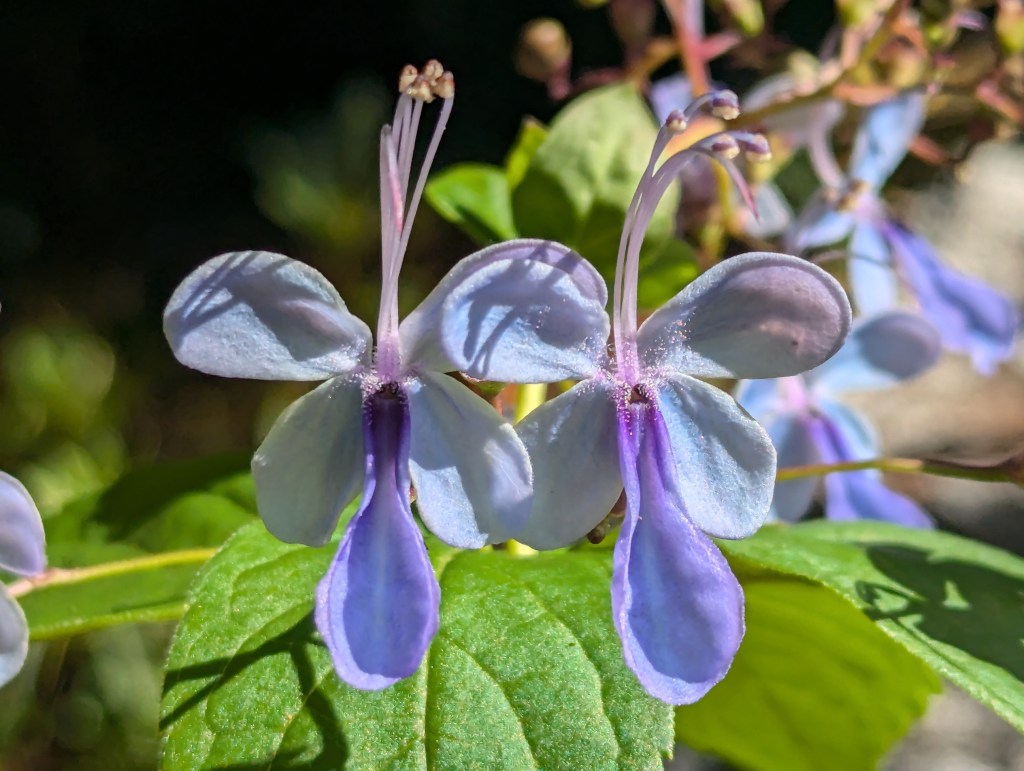
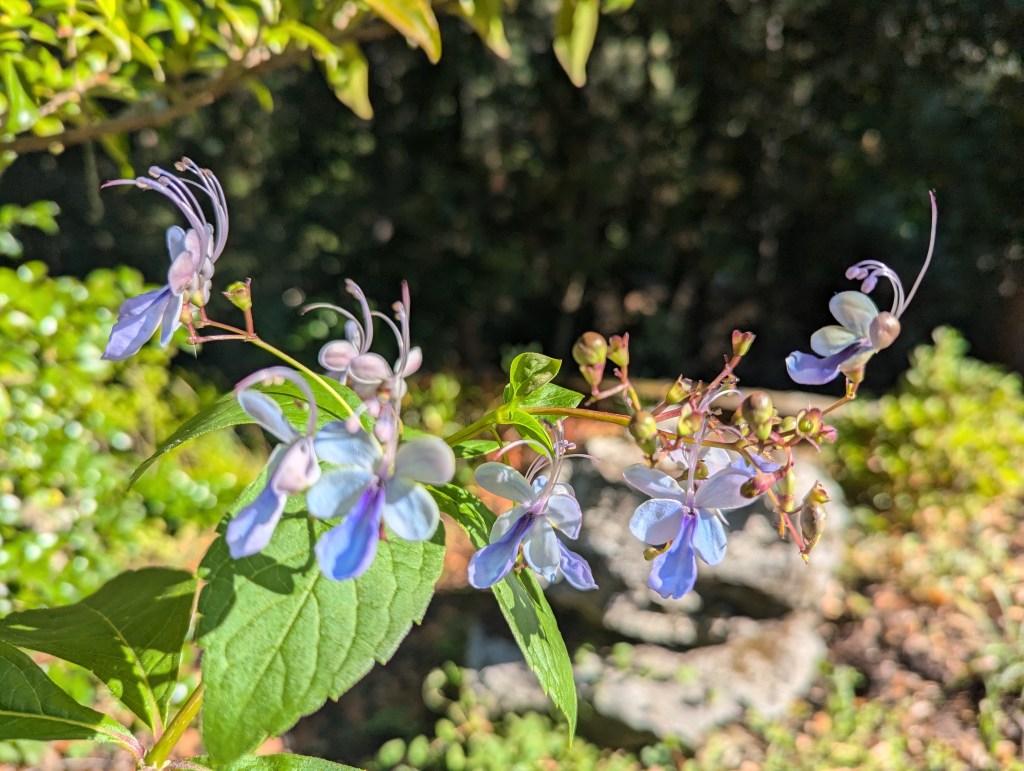
It is not a species of ivy. ‘IV’ is merely its Roman numeric designation as the fourth species that I am unable to identify since I started assigning numeric designations to them. So then, what is it? I suspect that it is likely Rotheca myricoides, which is alternatively known as Clerodendrum myricoides. ‘Ugandense’ is a cultivar name that, in typical modern tradition of botanic nomenclature that violates the simple standards of botanic nomenclature, now seems to be an acceptable species name in conjunction with either genus name. Its common names include butterfly flower, blue butterfly plant and blue butterfly bush, although the latter sounds more like a cultivar of Buddleia. I have not actually confirmed its identity, and I have no idea how it got into one of our landscapes. It grew under the carcass of a Brunfelsia pauciflora, yesterday, today and tomorrow, which did not survive my meager attempt to salvage it from compost. I can only assume that it arrived, most likely as an ungerminated seed, with the now deceased yesterday, today and tomorrow. It initially grew quickly with only two straight canes about four feet tall. I would have pulled it as a weed, but was intrigued by it. It did not grow much this year, but instead took time to branch, and is now taking time to bloom with these few intricate flowers on top. I am now pleased that I did not pull it as a weed. If it really is butterfly flower, it can get a bit taller than it already is. So, because it grew in front of an exemplary sasanqua camellia, I will likely relocate it to a more appropriate situation during its winter dormancy. I am fond enough of its sky blue flowers to propagate a few more copies of it.

The delicate pastel blue flowers are prettier up close.

California Lilac (not a plant profile)

Ceanothus thyrsiflorus

Ceanothus of all sorts are collectively known as California lilac. A few uncommon species are also known by alternate names that might confuse those who are unfamiliar with them. Most species happen to be native to California, although most are not exclusive to California, and a few are not native to California. The species with the most extensive range is native to the eastern half of America, which does not include California. Incidentally, it is known more familiarly as New Jersey tea.

Ceanothus is not actually related to lilac. It merely blooms within the same season, with tiny flowers in floral trusses that are smaller but sort of shaped like those of lilac. The most traditional lilac bloom with lavender floral color, but a few cultivars bloom with pale blue floral color that sort of resembles that of some of the Ceanothus. Most Ceanothus bloom is richer blue, and some is pale white. The most fragrant of Ceanothus bloom is only mildly fragrant, and only in abundance. Most Ceanothus bloom lacks fragrance or smells rather dusty. Lilac, of course, is famously fragrant.

California lilac is therefore neither notably Californian nor a type of lilac. Nonetheless, during spring, we appreciate its bloom, both within refined landscapes and in the wild. It does not last for long, but it can be impressive, particularly among wild specimens that can grow larger than those within confined landscapes. The blue floral color of the majority of wild specimens and perhaps all cultivated specimens is comparable to that of native lupines, and contrasts splendidly with bright orange California poppies that bloom at about the same time. California lilac that grows wild need no maintenance, and although individual specimens do not last long enough to get old, they reliably replace themselves like so many native species do.

Lily Of The Nile

Blue fireworks bloom for Independence Day.

The Nile River Valley is a region of extremes. It floods at times, but is hot and dry at other times. Lily of the Nile, Agapanthus orientalis, naturally survives it all. It can easily survive here. However, it survives arid heat by shedding a bit of foliage. Therefore, it is generally healthier here with at least occasional watering through the warmest weather of summer.

The almost spherical floral umbels of lily of the Nile explode into bloom like blue or white fireworks, just in time for Independence Day. They are about six to eight inches wide, on elegantly bare and slightly leaning stalks that stand about four feet tall. Individual flowers are only about an inch or two long. Flowers bloom only once annually, but last for weeks.

With or without bloom, the dense and evergreen foliage of lily of Nile is always lush. The soft and strap shaped leaves are about a foot and a half long, and flare outward from low basal rosettes. New foliage obscures deteriorated old foliage. Fleshy roots firmly secure plump rhizomes. Division relieves crowded rhizomes, and contains their slow migration.

Catmint

Catmint bloom is like faded denim.

Cats prefer catnip. It makes better tea too. Catmint, Nepeta X faassenii, is prettier though. It sprawls over the ground to get about three feet wide, without getting more than two feet deep. Where well exposed, it may not get much deeper than one foot. The aromatic gray foliage is denser than that of related catnip. Its individual leaves are small and furrowed.

Bloom begins with warming spring weather, and continues until cooling autumn weather. Individual flowers are tiny, and suspended on small floral stems. They just happen to be very abundant. Warmth stimulates phases of exceptionally profuse bloom. Floral color is light or pale blue, like faded denim. Shearing to deadhead enhances profusion of bloom.

Catmint works well as a rustic border or a ground cover for small areas. Alternatively, the blue bloom can be a delightful component of mixed perennials, in beds, planters or pots. Deer generally ignore catmint. Bees most definitely do not. They swarm it! ‘Walker’s Low’ is the most popular cultivar. It may be all that is available in some regions. Catmint is sterile, so generates no seedlings.

Something Blue

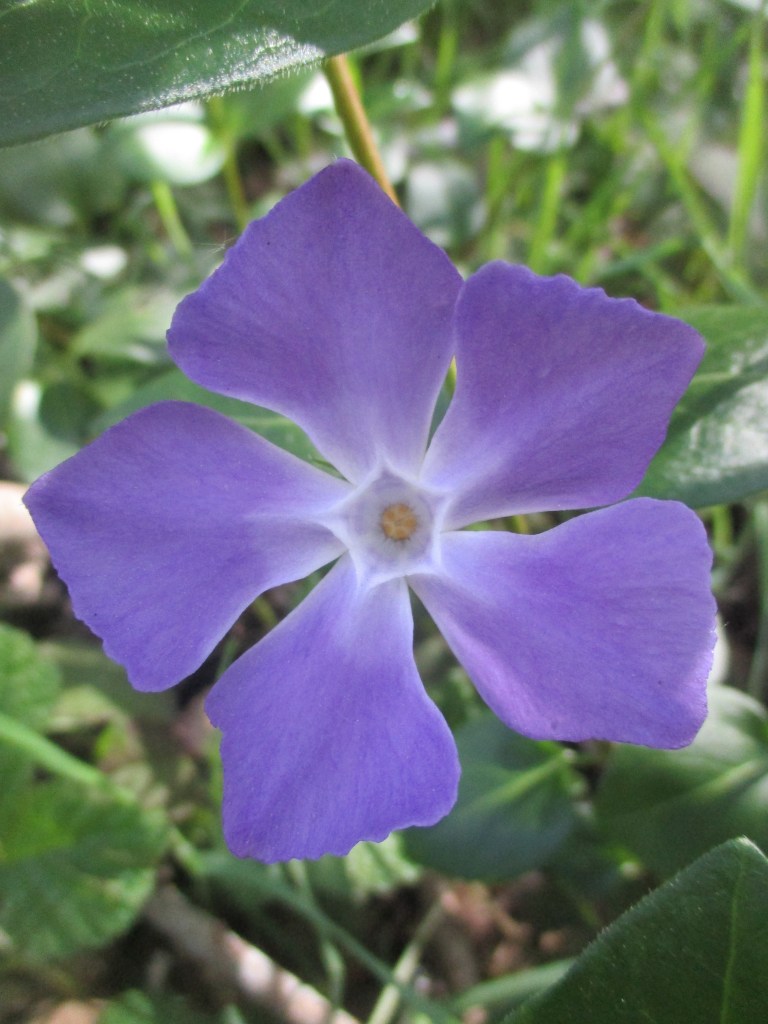
Is periwinkle blue, or slightly purplish?

Blue must be unpopular with the more common of pollinators. After all, colorful flowers are designed to attract some sort of vector to exchange pollen. It seems that most pollinators like yellow. Red and pink (which is actually a tint of red) seem to be more appealing to hummingbirds. Butterflies seem to really like pink and orange. Many flowers that seem to be white actually use infrared to attract bees, or ultraviolet to attract nocturnal moths. Other white flowers rely on wind, which is not discriminating about color.

Of the primary (red, yellow and blue) and secondary (orange, green and purple) colors, the only color that is more uncommon than true blue is green. That is probably only because green flowers do not contrast much against green foliage, so would be harder to find. Many blue flowers, like thyme, lavender, blue potato bush and jacaranda, are closer to purple. Some blue and purple color is probably only incidental, and in conjunction with invisible (to humans) ultraviolet coloration or patterns.

Except for purplish blue jacaranda, there are no substantial trees to bloom blue. Empress tree is flashy, but is even more purplish. However, most ceanothus, including a few that can grow as small trees, are famous for their clear blue bloom. Plumbago, blue hibiscus, echium and rosemary are blue blooming shrubbery. Creeping rosemary is a nice groundcover. Hydrangea has the potential to bloom blue, but often turns purplish or pink because of soil alkalinity. Lilac and wisteria vine can be lavender, pink or white, as well as ice blue.

There are several perennial and annual salvias and lupines that bloom blue. Russian sage, catmint, carpet bugle, campanula, perennial statice and lily-of-the-Nile are some of the other familiar perennials for blue flowers. Delphinium should probably be more familiar. Grape hyacinth and various iris bloom briefly but spectacularly with some of the richest shades of blue. Even though there are not many blue flowers to choose from, there is quite a bit of variety.

Annual statice, aster, zinnia, bachelor button, nierembergia, nigella, pincushion flower, forget-me-not and cineraria are uncommon annuals that are enjoyed by those who crave blue. Petunia happens to be one of the most popular of warm season annuals that also happens to produce some excellent blues. Later, brightly colored pansy and primrose can be just as flashy as popular cool season annuals.

Periwinkle

Periwinkle is pretty for a weed.

Dwarf periwinkle, which is a vigorous but manageable ground-cover here, is an invasive weed in other regions. Locally, common periwinkle, Vinca major, is the more aggressive sort. It naturalizes in riparian situations and damp parts of unrefined landscapes. Stolons can be difficult to pull completely from the soil. Seed disperses secretively but efficiently.

Periwinkle is almost never available in nurseries nowadays. It tends to infest gardens by sneaking in. Then, the foliage and bloom can be too appealing to eradicate. More plants are easy to divide from established colonies. Growth is tidier if mown at the end of winter. As it regenerates, it gets more relaxed, and finally gets floppy. It looks shabby if trampled. 

Periwinkle blooms with sporadic but delightfully clear blue bloom. Individual flowers are about an inch and a half wide. The evergreen leaves are an inch or two long. Wiry stems get a foot or two deep. Cultivars with white or purplish blue bloom were available before  

periwinkle naturalized. Periwinkle with foliar variegation still inhabits some old gardens. It is slightly more complaisant.

‘Carmel Creeper’ Ceanothus

Such true blue color is rare.

Its narrow native range stays near to the North and Central Coast of California, including Carmel. However, its nomenclature is all over the map. The genus is Ceanothus. After that, the species name might be any combination of thyrsiflorus, griseus or horizontalis, or omitted. ‘Carmel Creeper’ is its cultivar name, with or without the species designation.
It is certainly no horror movie starring Clint Eastwood. Carmel Creeper is one of the more practical ceanothus. It spreads out laterally as a deep and densely foliated groundcover. With room to sprawl, it can stay less than three feet tall. Shiny evergreen foliage remains after the fuzzy denim blue bloom of early spring. Individual leaves are distinctly rounded.
Like all native ceanothus, or California lilac, California creeper ceanothus does not want much water once established. It dislikes major pruning too, so prefers areas where it can sprawl freely. Partial shade inhibits bloom and foliar density. Birds enjoy the cover. Bees enjoy the bloom. Unfortunately, even happy plants may not live longer than fifteen years.

Sea Foam Statice

50819+
Statice flowers last fresh or dried.

Many of us who already grow sea lavender, Limonium perezii, might wonder why it is a topic for August. In the mildest spots, it gets more credit for blooming in winter while most other plants are dormant. Yet, it is actually classified as a summer blooming perennial because it blooms more reliably though summer in most places.

Bluish purple blooms stand more than two feet tall, just above coarse mounds of evergreen basal foliage that gets more than two feet wide. Each billowed bloom contains many tiny flowers. Larger blooms are too heavy to stand upright, so they lay down on the foliage. The weirdly wavy leaves are on such long petioles (leaf stalks) that they may lay down too.

Established plants do not need much attention or water. Faded bloom should be pruned away. It is not practical to remove all of the faded foliage. Every few years or so, old plants can be reinvigorated by getting divided. Newly divided rhizomes will need to be watered regularly until they disperse their roots. Sea foam statice likes full sun exposure.