Compositae (Asteraceae)

Feverfew is a member of the Compositae Family.

Kansas may not have the most unusual state flower, but it has the most, in the form of a sunflower. Only black eyed Susan of Maryland, sagebrush of Nevada, and Goldenrod of Kentucky and Nebraska have similar composite flowers, which are actually composed of many minute flowers known as ‘florets’. Yet, none are as large, and therefore not as abundant as the sunflower of Kansas.

Bluebonnet, yucca, lilac and red clover, the state flowers of Texas, New Mexico, New Hampshire and Vermont respectively all bloom with flower trusses that support many individual flowers. Composite flowers of the family Compositae are somewhat more efficient, with their individual florets so tightly arranged that they seem to be individual flowers. Sagebrush and goldenrod actually take this technique a step further, by producing trusses that support many composite flowers; an abundance of abundance!

Composite flowers are so efficient that they actually assign specific tasks to their various members. The outer florets around the margins of larger composite flowers are the ‘ray’ florets that function as petals. They are big, flashy and colorful, to attract bees and other pollinators, but are typically sterile, so can not produce seeds.

The smaller central ‘disc’ florets actually do the work of getting pollinated and producing seed. Because of the efficiency of the ray florets, they do not need to attract attention. They are low and dense, ideal landing pads for bees delivering and collecting pollen. They literally get pollinated as they get trampled.

The showiest composite flowers have disproportionately large ray florets, like chrysanthemums, dahlias, daisies, cosmos, black eyed Susans and  echinacea. Some of the bulkiest and boldest chrysanthemums actually lack disc florets, and produce only colorful but sterile ray florets. The smaller and more colorful sunflowers have more prominent ray florets than the humungous and mostly yellow sunflowers that have more prominent and abundant disc florets.

Other composite flowers impress their pollinators in a more subdued style, by instead producing more appealing disc florets. Lavender cotton and some marigolds actually lack ray florets. Most composite flowers that use this technique are yellow or orange, and quite compact.

There are not many composite flowers that lack aromatic foliage. Daisies and chrysanthemums are actually objectionable to some. It is a wonder than there are insects that eat them! Feverfew and chamomile are instead appreciated for their aroma and flavor.

Horridculture – Common Names

Snowdrop is Galanthus nivalis. Snowflake is Leucojum vernum. Snowdrop is the rarer of the two. I have seen it only in pictures from other regions. The potential for consequences of its misidentification are therefore quite minimal. That is fortunate. I learned Leucojum vernum as snowdrop. Locally, no one ever corrected this transgression, probably because no one here was aware that it was a transgression. Most likely learned it the same as I did. Similarly, we learned heaths as heathers. Since heathers are very rare here, there is not much to compare heaths to. Fortunately, snowdrop, snowflake, heath and heather all have botanical names, which are universally the same everywhere. Well, at least they should be. During the past few years, I have noticed that the tree that I leaned as Eucalyptus pulverulenta is now Eucalyptus cinerea, and what I knew as Eucalyptus cinerea is now Eucalyptus pulverulenta. It is as if the two have simply traded names. Now that more information than ever in history is so readily available online, it is amazing what information is unavailable. I can confirm the identity of neither species of Eucalyptus! Many modern cultivars, particularly hybrids, lack species names between their genus name and cultivar name, as if such designations are no longer important. In that regard, their botanical names are no more defining than their common names. At least some of the common names are entertaining, such as pig face, pig squeak, chicken liver plant, brazen hussy, naked lady, twisty baby, mother-in-law’s tongue, sneezewort, shaggy soldier, corpse flower, sticky monkey flower, bear’s breeches, sticky willy, turkey tangle frog fruit, laurel-leaf snail seed, love in a mist, love in a puff, dead nettle, butter and eggs, teasel, fleabane and yesterday, today and tomorrow. Goodness, that is a big list, and it could go on.

Botanical Names ‘Should’ Be Universal.

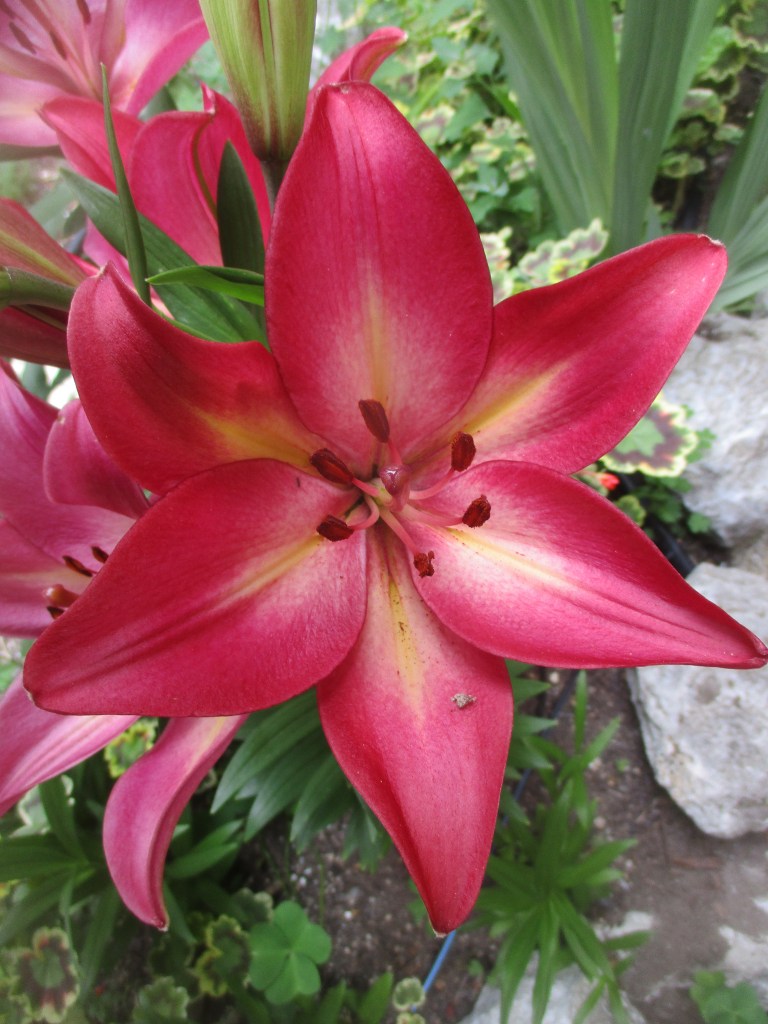
Is it naked lady, amaryllis lily, belladonna lily, Jersey lily, resurrection lily, August lily or March lily?

No horticulturist has yet identified the flowers that Mickey Mouse picked from the porch at the home of Minnie Mouse to give here when she came to the door. Most of us agree that they are a black and white variety of ‘posy’, since they look so similar to those that Popeye picks in the same manner for Olive Oyle, before being smacked aside by Bluto, who then takes the flowers and presents them to Miss Oyle as ‘posies’. However, real posies look nothing like the daisy like flowers of cartoon courtship. Perhaps these flowers will remain as unidentified as the variety of the yellow tulips that the Pink Panther replaces with an also unidentified pink variety of tulips.

Misidentification of plants is probably more common now than ever. Plants are becoming available from other regions, where they may be known by common names that are very different from familiar or local common names. Even Latin or ‘botanical’ names, which should be universal, are not always perfectly reliable, since they are so often based on variable common names. The problem with misidentification is that we sometimes get plants that are very different from what we were expecting.

When purchasing plants or seeds online, it is always best to confirm that the Latin names are what they should be, since they are still more reliable than common names. Misidentification is more likely if the Latin name does not correspond to any of the known common names of the particular plant.

For example, seed that is described as that of ‘swamp maple, Acer saccharinum’ most likely really is Acer saccharinum, even though it is more commonly known locally as ‘silver maple’. The common names, both ‘swamp’ and ‘silver’ maple are regional, but are both correct. However, seed of ‘Norway maple, Acer macrophyllum’ should not be trusted, since the common name does not correspond to any of the several common names associated with the Latin name. It may actually be one or the other, but there is no way of knowing which.

It should not be assumed that plants that are known primarily by their Latin name can not be misidentified; since it actually sometimes happens. Yucca aloifolia that has naturalized on the Gulf Coast of Texas is known to many as Yucca gloriosa!

Seemingly Complicated Latin Names Simplify Nomenclature.

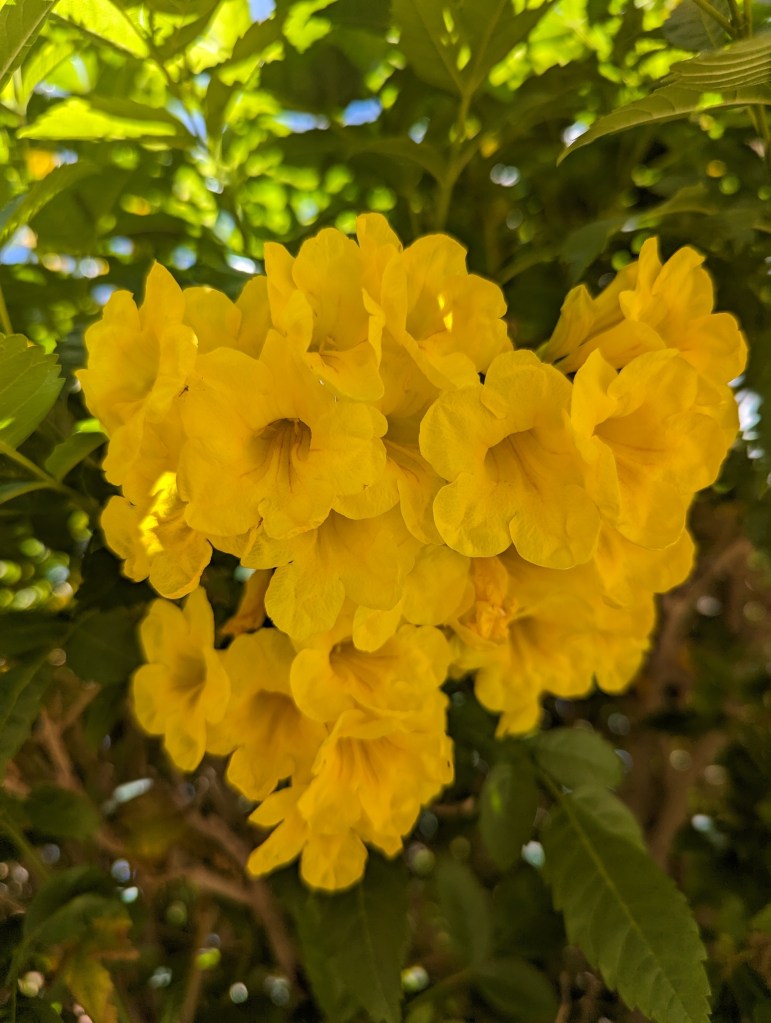
Tecoma stans has only one Latin name, but a few common names; esperanza, yellow bells, yellow elder, yellow bignonia and trumpet bush.

If I remember correctly, it was Wednesday evenings when my three college roommates and I would gather in the parlor of our apartment on Boysen Street in San Luis Obispo to watch Star Trek: the Next Generation. One of my roommates, who has since returned to Cal Poly as a professor of rangeland resource management, traditionally made cornbread for the occasion . . .  with butter and honey . . . mmm. So, for half an hour each week, we learned more about the remotely futuristic cultures of planets many light years away than about our studies.

Thanks to a contraption referred to only on rare occasion as the ‘universal translator’, nearly everyone in this quadrant of the galaxy will be able to understand each other within the next four centuries. No matter what language is spoken, it will all be perceived as the same universal language. Unfortunately, the ‘universal translator’ has not yet been invented. The many languages used on this single planet will consequently continue to interfere with accurate communication.

This is why horticulturists, biologists, and many other professionals who may interact with colleagues who speak other languages or even slightly different regional dialects use Latin to identify, among other things, biological organisms. Latin names may be cumbersome to pronounce and daunting to spell, but are universal to those of us who use them. This is important because the ‘common names’ are so regionally variable. 

For example, some of the European maples that we know as maples here are known as sycamores in England, but are known everywhere by their Latin name of Acer. (Latin is traditionally italicized.) Similarly, North American sycamores that are known as maples, planes or plane trees in various regions are all likewise known everywhere by their Latin name of Platanus. With few exceptions, the universality of Latin names facilitates accurate identification.

Latin names are therefore very helpful when researching plants. A tree known simply as a ‘cedar’ might be a calocedrus, arborvitae, juniper, cypress, chamaecyparis or a true cedar just to name a few. Knowing that this particular tree is more specifically a ‘red cedar’ perhaps limits the possibilities to arborvitae or juniper. (Differentiation between ‘Eastern’ and ‘Western’ red cedars is often neglected in the East and West where the respective cedar is predominant.) Identifying the tree as a Juniperus virginiana will help us find the most accurate information about it, even though it is not really a cedar at all, but a juniper.   

Nomenclature Is Designed For Simplicity.

Automotive and botanical nomenclature are remarkably similar.

As confusing as they seem to be, Latin names of plants are actually intended to simplify things. They work because they are universal, everywhere and in all languages. Common names may seem simpler, but are too variable in different regions and in different languages.

For example, the white pine that is native to Northern California is not the same as the white pine of Maine. However, only the white pine of California is Pinus monticola. Furthermore, it is known as Pinus monticola everywhere and in every language, even though it has different common names in French, Afrikaans and Vietnamese.

The first name of a Latin name, which should be capitalized, is the more general ‘genus’ name. (‘Genera’ is plural, and not coincidentally similar to the word ‘general’.) Pinus is the same genus name for all pines. Acer  is the same genus name for all maples. Quercus is the same genus name for all oaks; and so on.

The second name of a Latin name is the more specific ‘species’ name. (‘Specie’ is plural, and not coincidentally similar to the word ‘specific’.) Monticola specifies the genus of Pinus as Pinus monticola, the white pine of Northern California. Radiata specifies another genus of Pinus as Pinus radiata, the Monterey pine; and so on. The species name is not capitalized. Technically, Latin names, both genera and specie, should be italicized in print or underlined in cursive.

Latin names work like the names of cars. Buick, Chrysler and Mercury are all like genera. Electra, Imperial and Grand Marquis are all like specie, or the specific Buicks, Chryslers and Mercurys. ‘Limited’, ‘Custom’ and ‘Brougham’ are like variety names, like ‘Variegata’, ‘Compacta’, and ‘Schwedleri’. For plants, variety names are capitalized and enclosed in semi-quotes.

As universal as Latin names should be, a few sometimes get changed. This can be confusing, and causes some plants to become known more commonly by either the new or old name as well as the other of the two names as a ‘synonym’. For example, Dietes bicolor and Morea bicolor are the same plant; but not many know for certain which name is more correct. It is like when Datsun became Nissan, but was also known as Datsun for many years afterward.

Common Names Are Potentially Uncommon

Lily is neither calla nor canna.

Nomenclature is simply a structured technique of naming. Botanic nomenclature assigns universally precise general or genus names with specific or species names to all plants. Such botanical names are also scientific and Latin names, but not common names. They are binomial with their uncapitalized species names after their capitalized genus names.

Latin, scientific or botanical names are the same for everyone everywhere, regardless of regional language. They simplify documentation and distribution of botanical information for plants that have different regional common names. Even if all other information needs translation, botanical names do not. They are really more common than common names.

Realistically, common names are no more common than common sense. Many regional names are common only within isolated or contained regions, such as individual islands of Polynesia. Aloalo of Hawaii are simply familiar hibiscus here. Lily of the Nile seems to be the only common name for Agapanthus, but is more familiar as thanh anh in Vietnam.

Acer platanoides is Latin for ‘maple which resembles a sycamore’. Acer pseudoplatanus is Latin for ‘maple which is a false sycamore’. Both are maples here, but also sycamores in England. Conversely, Platanus X acerifolia, which translates to ‘sycamore with maple foliage’ is a sycamore here, but a plane in England. Common names might be confusing.

This is why botanical names are so important. Arborists and horticulturists both here and in England recognize them regardless of possible inconsistencies with common names. Of course, common names are useful regionally. They may be easier to remember, more appealing or merely amusing. Pigsqueak and sticky monkey flower are difficult to forget.

Nonetheless, it might be helpful to be aware that some common names are inaccurate. A rose by any other name would smell as sweet, unless of course, it is a Confederate rose, Lenten rose, rose of Sharon or rock rose. None of such roses are actually roses. Neither calla lily nor canna lily is a real lily. Neither dracaena palm nor sago palm is a real palm.

Gardening Has Something In Common With Automobiles.

Buick is the genus. Electra is the species. Buick Electra is universally the most elegant luxury sedan of all time!

Horticulturists, biologists, and many other professionals who may interact with colleagues who speak other languages or even slightly different regional dialects use Latin to identify, among other things, biological organisms. Latin names may be cumbersome to pronounce and daunting to spell, but are universal to those of us who use them. This is important because common names are so regionally variable.

For example, some of the European maples that we know as maples here are known as sycamores in England, but are known everywhere by their Latin name of Acer. Similarly, North American sycamores that are known as maples or plane trees in various regions are all likewise known everywhere by their Latin name of Platanus. The universality of Latin names therefore facilitates accurate identification.

Latin names are very helpful when researching plants. A tree known simply as a ‘cedar’ might be a calocedrus, arborvitae, juniper, cypress, chamaecyparis or a true cedar, just to name a few. Knowing that the particular tree is more specifically a ‘red cedar’ perhaps limits the possibilities to arborvitae or juniper. Identifying the tree specifically as a Juniperus virginiana will help us find the most accurate information about it, even though it is not really a cedar at all, but a juniper. Juniperus is the general ‘genus’ name of all junipers. Virginiana is the specific ‘species’ name of the particular juniper that is known locally as the Eastern red cedar. (‘Genera’ and ‘specie’ are plural for ‘genus’ and ‘species’.)

Latin names work like the names of cars. Buick, Chrysler and Mercury are all like genus names. Electra, Imperial and Grand Marquis are all like species names of particular Buicks, Chryslers and Mercurys. ‘Limited’, ‘Custom’ and ‘Brougham’ are like variety names, like ‘Variegata’, ‘Compacta’, and ‘Schwedleri’.

As universal as Latin names should be, a few sometimes get changed. This can be confusing, and causes some plants to become known more commonly by either their new or old name, as well as the other name as a ‘synonym’. For example, Dietes bicolor and Morea bicolor are the same plant; but not many know for certain which name is more correct. It is like when Datsun became Nissan, but was also known as Datsun for many years afterward.

Nomenclature Was Designed For Simplicity

Simple standardized nomenclature is getting rusty.

Buick Electra used to mean something. Chrysler Imperial and Lincoln Town Car did also. That was at a time when cars were still distinguishable. Instead of random numbers with a few letters, they had distinctive names. These names, although distinct, conformed to a standardized pattern. This pattern of naming was comparable to botanical nomenclature. 

According to botanical nomenclature, plants are identifiable by genus and species. Their ‘gen’us is a more ‘gen’eral designation than their ‘speci’fic ‘speci’es designation. A family is a larger and more general classification than genus, and in turn, fits into another more general group. Most of us are not concerned with the many classifications beyond family. 

For example, the botanical name of silver maple is Acer saccharinum. Acer is the genus. saccharinum is the species. Acer saccharinum is in the Sapindaceae family. (For botany, genus and species names are italicized, and species names are not capitalized.) Buick Electra is similarly in the General Motors family. Buick is its genus. Electra is its species.

Varieties and cultivars are even more specific designations within species. Some are the products of breeding. Some are naturally occurring. A cultivar is a ‘cultivated variety’ that does not perpetuate naturally like other varieties do. Most cultivars propagate by cloning. (Variety and cultivar names are capitalized and enclosed within single quotation marks.)

For example, Acer rubrum ‘October Glory’ is a cultivar of red maple. It exhibits a distinctly rounded canopy and foliar color in autumn that is superior to that of the simple species in the wild. It might compare to a Buick Skylark Gran Sport, which is essentially a cultivar of Skylark with a stronger engine. Botanical and automotive nomenclature are quite similar. 

Such similarities of nomenclature are no advantage. While cars forfeited their distinctive titles for mundane numeric designations, plants forfeited their species names for cultivar names. Such abbreviation of nomenclature interferes with accurate identification. Those unfamiliar with it may not know if Cercis ‘Forest Pansy’ is an Eastern or Western redbud, or something else.

Nomenclature Is More Than Botanical

90515thumbSimply put, ‘nomenclature’ is how things get named. It is not exactly like naming a child or a dog, or even a new small country in the South Pacific. There is a certain technique to it that is more like naming cars. Well, it ‘was’ like naming cars, a long time ago when cars had simple names rather than numbers and letters. Coincidentally, nomenclature of plants is getting to be just as confusing.

Plants and other biological organisms are assigned Latin names, which for plants, are also known as botanical names. These names are universal, for everyone, everywhere in the World. Almost all plants also have common names that are more or less regional. That is why what is known as Norway maple here is known as sycamore in England, but both are Acer platanoides everywhere.

The first part of a Latin name designates the ‘genus’, which is the more ‘general’ of the two parts of the name. (genus = general) For example, all true maples, including those that are known as sycamores in England, are within the same genus of ‘Acer‘. Genus names are like ‘Buick’, ‘Oldsmobile’ and ‘Pontiac’ for cars. They distinguish a general group, but are no more specific than that.

The second part of a Latin name designates the ‘species’ which is the more ‘specific’ of the two parts of the name (species = specific) For example, within the genus off Acer, the Norway maple is designated as Acer platanoides. Species names are like ‘Electra’, ‘Riviera’ and ‘Skylark’ for cars. They designate specific cars within the big general group that is collectively known as ‘Buick’.

There are of course more general and more specific classifications as well. Just as Buick, Olsmobile and Pontiac are within the group known as General Motors, the genus of Acer is within the family known as Sapindaceae along with Aesculus (horse chestnut) and Litchi (Lychee). ‘Schwedleri’ is a cultivar (cultivated variety) of Acer platanoides, just as some Buick Electra are ‘Limited’.

Incidentally, rules of proper nomenclature dictate that Latin names are italicized, and that the genus name is capitalized, while the species name is not.

Automotive Horticulture

P70929The nomenclature of horticulture, or the ‘naming’ of plants, is very similar to that of automobiles. All those confusing Latin names work just like the names of cars, with species, genus and even family. The Electra is made by Buick, which is a subsidiary of General Motors. I write an article about this every so often. It probably made more sense back many years ago, when both cars and plants were simpler.

Nowadays, it is difficult to distinguish between the different kinds of cars. There are so many different kinds, and they all look so similar. Buicks are not nearly as stylish and distinctive as they once were, and do not look much better than a well outfitted Honda! Cadillac and Lincoln make station wagons, which are now known as SUVs; and they even made pickups! Many cars have one name on the outside, and another, or a few on the inside. A Chrysler might be made by Mercedes Benz, with a Japanese engine! Many cars that had been ‘imports’ are make locally. There are so many different models that some do not even get names. They just get numbers. What is the point of trying to keep track of them all?

Plants have done the same. So many of the reliable and standard specie that had been around until the 80s have been replaced by too many modern cultivars and hybrids to count. Some have been hybridized so extensively between different specie of the same genus that they are not even assigned a specie name! They are merely known by their cultivar name. For example, Grevillea ‘Peaches and Cream’ lacks a species name because no one know who the parents were. (It might be a Grevillea banksii X Greillea bipinnatifida hybrid. See the article about it at https://tonytomeo.wordpress.com/2017/09/30/peaches-and-cream-grevillea/.) What is the point of using standardized nomenclature without the standards? This is not like Madonna or Cher, who do not need last names because they are so unique. Plants need their names more than before because there are so many new ones.

Cars have been improved in the most important ways. They are much safer than older cars. They are also much more efficient and remarkably more durable. The main problem with these improvements is that cars are so difficult to maintain for those who are not professional automotive technicians. Those of us who were inclined to maintain our own vehicles years ago must now take them to mechanics. Although vehicles are designed to need much less maintenance and to last longer, they eventually need to be replaced when maintenance is no longer practical. They are not as sustainable as old cars that can sometimes be repaired with part found in a common hardware store.

Plants have likewise been improved to do what we want them to do better. Foliage is better and more resilient, and in some cases, more colorful. Flowers are more abundant, more colorful, and last longer. Whatever plants were supposed to do before, many do better now. The main problem with all the breeding and hybridizing necessary for these unnatural improvements is that it interferes with what plants need to do naturally. Some are not able to produce viable seed, (although this is an advantage for potentially invasive plants). Others are genetically weak, and therefore more susceptible to disease and insect infestation. Perennials that once perpetuated themselves indefinitely now die out in only a few years. Plants that were once easy to propagate are now not so cooperative. Like modern cars, plants can not be maintained as long as they once were, so need to be replaced instead of sustained.