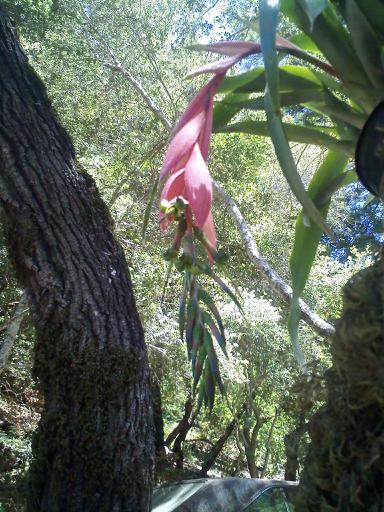
To many of us, Billbergia sanderiana is really just a coarser version of the related and more common queen’s tears bromeliad, Billbergia nutans. The somewhat stiff leaves of the former are substantially wider but are actually shorter than those of the latter, less than a foot long. Billbergia sanderiana foliage has minute teeth for lightly snagging against flannel sleeves, and is sometimes spotted with white. The dense basal rosettes of foliage are always producing pups that can be divided to propagate copies for friends and neighbors.
Their nearly foot long flower spikes look like bunches of perch hanging from jigs on fishing poles. The small weird flowers buds are tipped with almost navy blue, with lime flavored Pez green at the base. These flower buds hang upside down, with their blue tips pointing downward at first. Their petals curl back and upward as they open. The bright pink bracts that wrap the stems that suspend these bunches of flowers puff out as bloom progresses. By the time the lemony yellow pollen laden stamens emerge, the most memorable colors of 1985 are represented.
All specie of Billbergia are naturally epiphytic (grow within the canopies of large trees) so their wiry roots are rather minimal and seem to cling to the inside of their pots while ignoring potting media (potting soil) within. They like to be watered regularly but not excessively while weather is warm, but do not need much at all through the cooler time of year. Their media should be very loose and drain well.
 Many of us already understand that daisies, sunflowers, asters and all related flowers are composite flowers, which bloom as many tiny flowers clustered tightly together to form what appears to be significantly larger single flowers. Distended ‘ray’ florets around the edges imitate petals that other types of flowers are equipped with. It is like one stop shopping for pollinators craving nectar.
 Tony Tomeo