Sticks on Fire

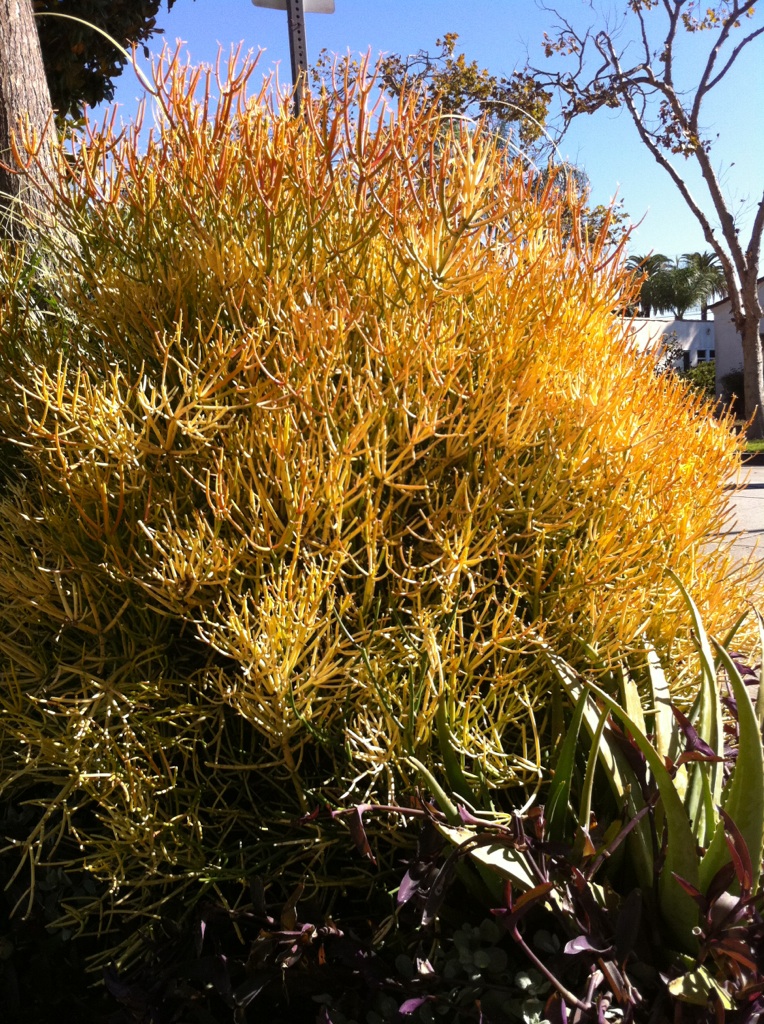
Sticks on fire is a more colorful version of pencil tree.

The old fashioned pencil tree, with leafless, succulent stems is a strikingly strange plant already. In mild climates of coastal Southern California, it can get quite large, nearly ten feet broad and twice as high. Sticks on Fire, Euphorbia tirucalli ‘Sticks on Fire’, stays less than half as large, but is even weirder because the stems are so oddly colored.

The inconspicuous leaves drop almost as soon as they develop, leaving distended fleshy stems that are either reddish or yellowish orange. Stems fade to softer yellow through summer, and then turn red in winter. Size and growth rate are limited by a lack of chlorophyll. Although related to poinsettia, the flowers of sticks on fire are not significant.

Sticks on fire prefers full sun exposure and warmth, but unfortunately needs protection from frost during winter. It can be happy under an eave on a south or west facing wall, or in a large tub that can be moved to shelter during winter. Plants in tubs are a bit more sensitive to rot if watered too frequently. The sap of sticks on fire is very caustic to skin and can be dangerous if it gets in the eyes.

Cork Oak

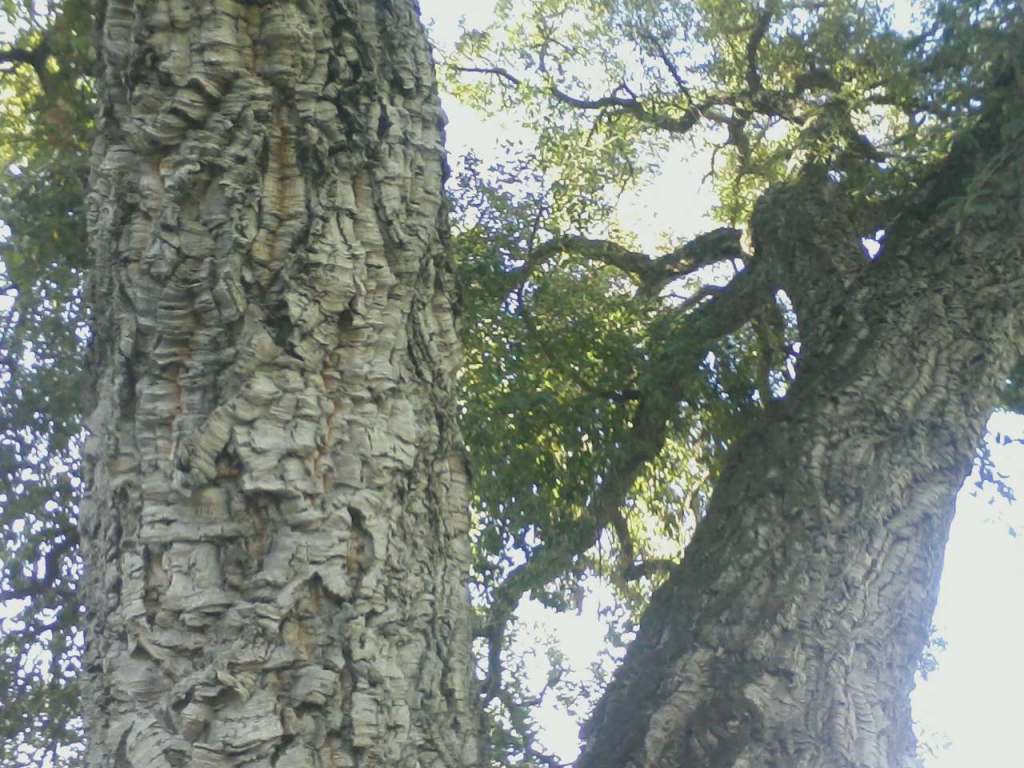
Cork oak develops sculptural trunks and branch structure with striking bark texture.

Portuguese neighborhoods in San Jose and other big cities might be identifiable by the presence of the otherwise rare cork oak, Quercus suber. After all, they are native to Portugal, as well as Spain, Sardinia, Corsica, Sicily and the coast of the Mediterranean Sea as far east as the eastern tip of Italy on the north, and the northwest corner of Libya on the south.

Like redwoods, cork oak is one of the few species of trees that survive forest fires by being less combustible. Their foliage and small twiggy stems may burn, but larger limbs and trunks are insulated by very thick cork cambium (bark). Most other trees that are adapted to burning either disperse their seeds as they burn in order to get a head start at reforestation afterward, or simply resprout from their roots.

 Ironically, this bark that is intended to help the trees survive was actually the reason why trees on the north coast of Algeria were so extensively and detrimentally harvested during French  colonialization. Corks made from the bark were needed for the wind industry in France. Fortunately, cork in Algeria is now harvested like it is in other regions, without harming the trees that produce it.

Compared to other oaks, cork oak is not too large. It can get a bit more than fifty feet tall and nearly as wide, but takes a century or more to do so. It can actually stay proportionate to urban landscapes for a very long time. Roots are mostly complaisant. The main problem with cork oak is that it drops its evergreen foliage constantly, and drops floral debris and acorns for a few months.

Gnarly trunks and limbs with spongy bark are the main appeal. The one and a half or two inch long leaves are not so interesting. They are barely convex, often with a few blunt lobes, and dull grayish green from below.

Giant Yucca

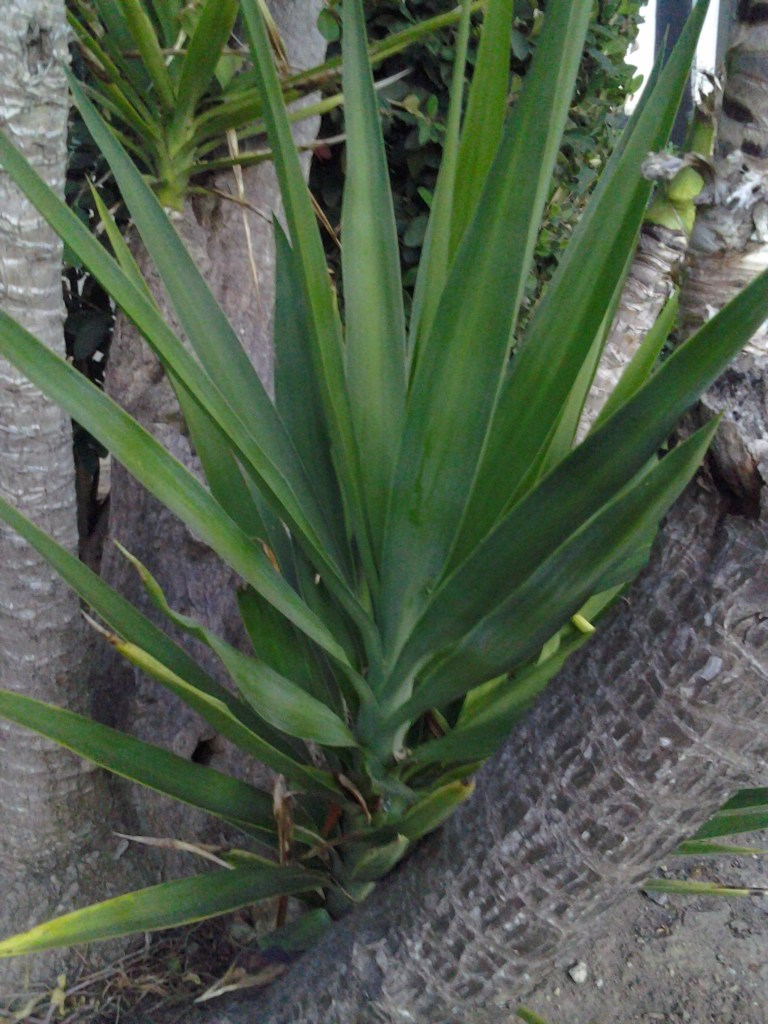
Common giant yucca is uncommonly bold.

Like so many of the plants that became too trendy at one time or another, giant yucca, Yucca elephantipes, had gotten a bad reputation. Some people still consider it to be cheap and common. The real problem though, is that some of the countless giant yuccas planted over the years went into situations that can not accommodate their massively distended trunks. Only a few of the largest specimens are taller than a two story house, and not many get broader than tall. However, their several sculptural trunks are remarkably bulky and flared at the ground.

The somewhat rigid and narrowly pointed leaves can get as long as three feet, and as wide as three inches. Foliage is typically slightly yellowish green, or richer green and a bit floppier in partial shade. Spikes of white flowers that bloom in spring are tall enough to stand just above the foliage, but are usually too high up to be too flashy. Individual flowers are actually only about an inch and a half wide. The bold form and texture of giant yucca work will with other bold plants like giant philodendron, various agaves and various cacti. Shoots and stems of any size that need to be pruned away can be stripped of lower leaves and ‘planted’ wherever new plants are wanted. They only need to be watered regularly until they develop roots like really big cuttings.

Some Trees Are All Bark

P00613-1
California sycamore bark is very distinctive.

Flowers provide color and texture. So does foliage. What is less often considered is that the bark of many trees and large shrubbery can be aesthetically appealing as well. Bark is usually thought of merely as something to cover up the trunks and limbs of the plants that provide all the colorful and textural flowers and foliage.

Coral bark Japanese maple and red twig dogwood (and yellow cultivars, which are  selectively bred varieties) turn color as they defoliate for winter. However, the color is limited to the twigs and smaller stems. Red twig dogwood often gets cut back at the end of winter so that it will produce more twigs for the following winter. Mature stems and trunks are not as interesting.

Palms and yuccas do not actually have bark, but are still texturally interesting. Giant yucca trunks are weirdly sculptural. Mexican fan palm can be  ‘shaven’ to expose lean trunks with a finely textured exterior, but are more often adorned with the intricately patterned thatch of old petiole bases (leaf stalks). Windmill palm is uniquely shaggy with coarse fiber.

Arbutus ‘Marina’ is a madrone that was developed for home gardens. It is compact and symmetrical, with finely textured flaking bark that reveals strikingly smooth cinnamon-colored bark beneath. Larger manzanitas can be pruned up to expose similar bark on a smaller scale. Smooth Arizona cypress looks much like other cypresses, but with strangely  smooth bark on vigorous stems.

The bark of almost all eucalypti is interesting for one reason or another. Even the notorious blue gum, which  gives other eucalypti a bad reputation, peels away in very long strips to reveal smooth bark that fades from green to pink to tan to gray before peeling away to start the process over again. Some eucalypti have blotched bark. Red ironbark has rich brown bark that is uniformly furrowed.

Lemon gum (eucalyptus) and various birches have strikingly white bark. Lemon gum bark is smooth. Birch bark peels away like paper. Because the trees are so slender, they can be planted in groups so that there are more trunks to display the distinctive bark. These are only a few of the many trees that can impress with mere bark.

Self Grafted Redwoods

P91019K

Redwoods are some of the most stable trees in the World. That is partly why they can survive for thousands of years. In my entire career, I have seen very few fall, and only inspected two.

Of those two, one fell because it had co-dominant leaders (double trunks) that fell away from each other, which is more of a structural deficiency than instability. The other, which I suspect was demonically possessed, was a small tree less than thirty feet tall, that literally jumped up out of the ground and onto an Astro van more than ten feet away. A rare ‘updraft’ was blamed.

Almost all of the redwoods here regenerated from the stumps and roots of much older trees that were clear cut harvested a century or so ago. Most of those that grew back with structurally deficient co-dominant leaders are very effectively sheltered from wind by their collective groves. Roots systems are very extensive, very resilient, and too intermeshed to be compromised.

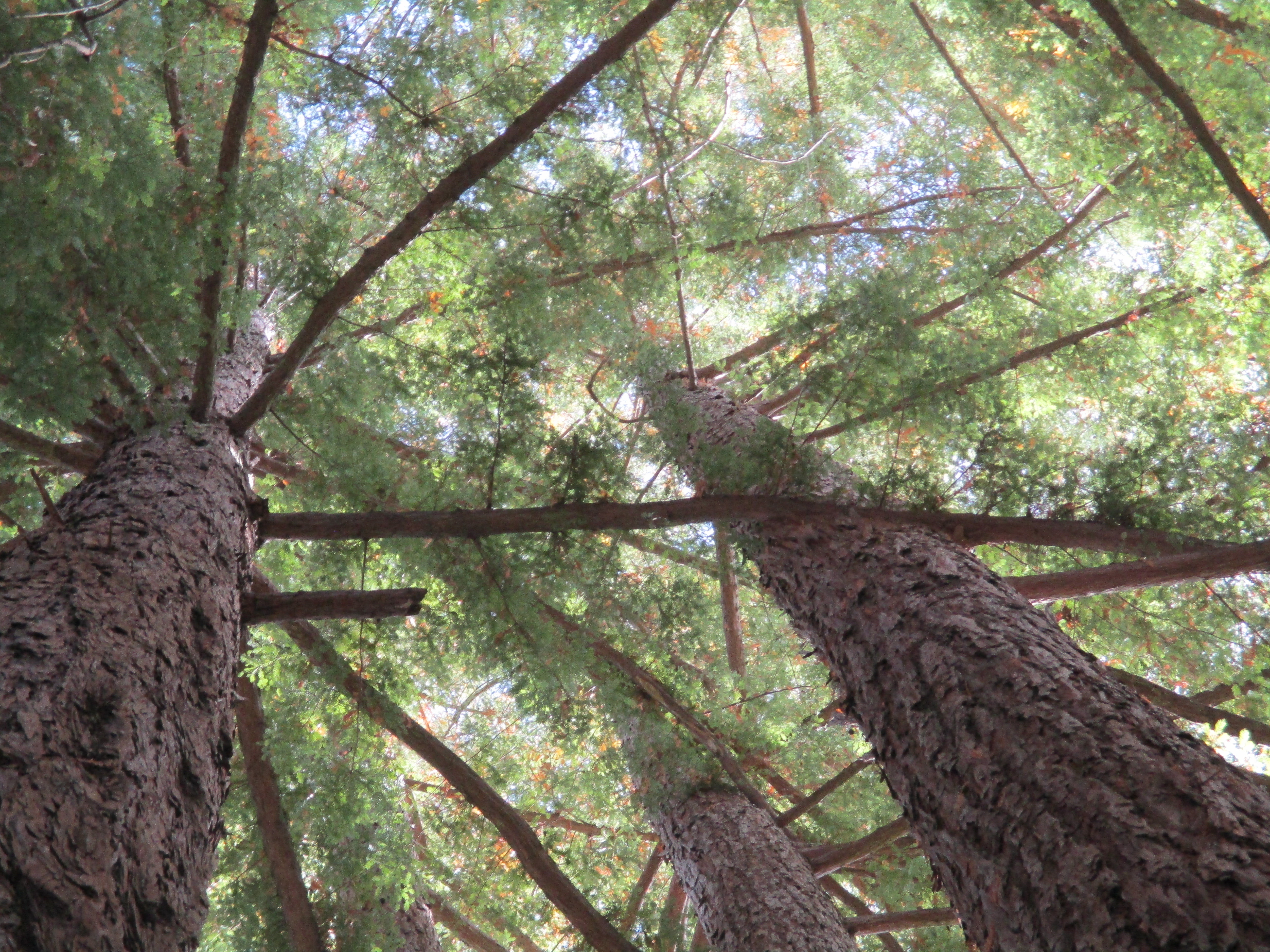
The trunks in the picture above are part of a group of several trunks that grew from roots of the same tree that has been gone for a very long time. All are genetically identical and very close together. They happen to be a focal point of a big patio at a conference center. Although the structural integrity of the limbs within their canopy is a concern, the stability of the trunks is not.

Regardless, I am impressed by their attempt to improve stability. The limb that extends horizontally across the middle of this picture from the trunk to the left grafted to the trunk to the right! It is not uncommon for crossing limbs and trunks to rub through their bark to expose the cambium, but how do they stay still long enough to graft together?!

Some Plants Impress With Bark

P80805Lemon eucalyptus, ‘Marina’ madrone, cork oak and all sorts of melaleuca trees are known more for their interesting bark than for their foliage or flowers. It helps that their distinctive trunks and branch structures are ideal for displaying their unique bark. Color and texture of bark is remarkably variable, and tends to get noticed more in winter while blooms and foliage are lacking.

Bark of sycamores, birches, elms and crape myrtles that had been so handsome throughout the year is more visible now that it is not partially obscured or shaded by the deciduous foliage that is associated with it. Trunks and limbs of European white and Jacquemontii birches are strikingly white. ‘Natchez’ crape myrtle has distinctively blotched bark, (although the white flowers are pale.)

Because of their other assets, English walnuts, figs and saucer magnolias are not often grown for their bark. Nonetheless, their pale gray bark shows off their stocky bare branch structure nicely, especially in front of an evergreen backdrop of redwoods or pines. The smooth metallic gray bark of European beech is much more subdued, but is what makes big old trees so distinguished.

A few deciduous trees and shrubs get more colorful as winter weather gets cooler. Instead of white or pale gray, their bark turns brighter yellow, orange or red. Some plants, like sticks-of-fire, do not need much cool weather to develop good color. Others get more colorful in colder climates, and contrast spectacularly to a snowy landscape. Locally, they should be well exposed to chill.

As the name suggests, the coral bark Japanese maple (‘Sango Kaku’) develops pinkish orange bark. It can get ruddier in colder climates, but may get yellowish here. Unlike other Japanese maples that get pruned to display their delicate foliage and branch structure, the coral bark Japanese maple sometimes gets pruned more aggressively to promote more colorful twiggy growth.

Osier dogwood is a shrubby dogwood that lacks colorful bloom, but compensates with ruddy brown, brownish orange or pale yellow bark in winter. (Dogwood bark . . . There is a pun there somewhere.) Because it lacks colorful bloom, it can be pruned aggressively after winter. Older canes that do not color as well can be pruned to the ground as they get replaced by new canes.