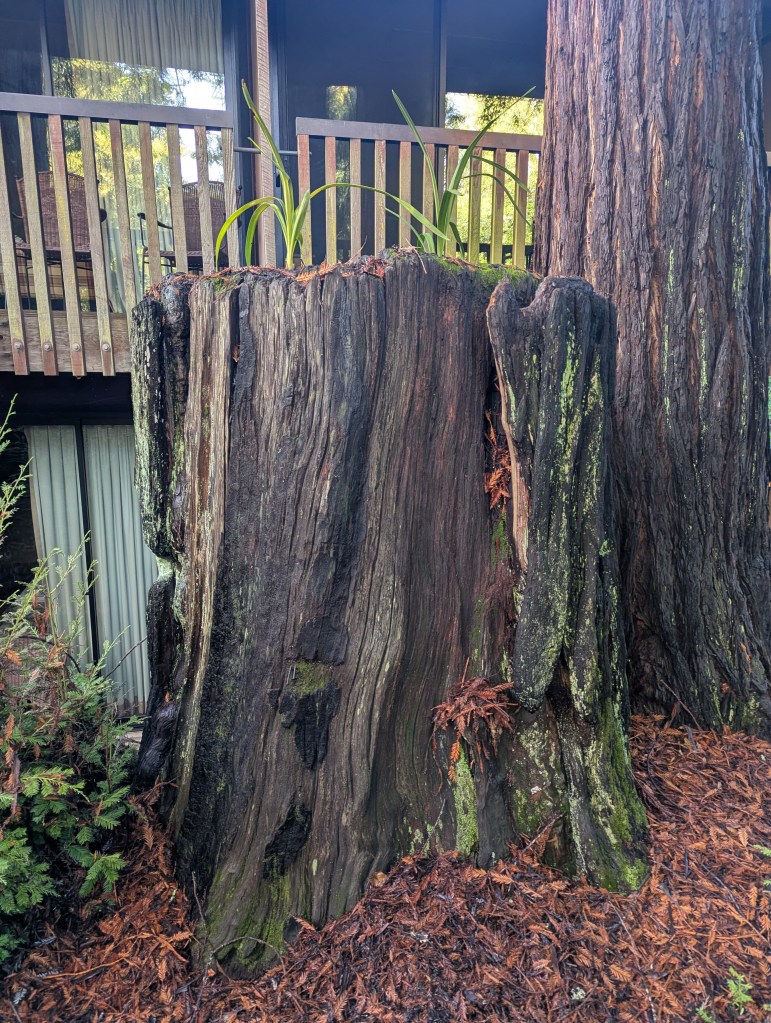
Redwoods give new meaning to stumperies. Their stumps are massive, and remain intact for decades. After all, coastal redwoods are among the largest trees in the world, and their wood is famously resistant to decay. Although redwoods had been harvested here for a very long time, most were harvested soon after 1906 to rebuild San Francisco after the Great San Francisco Earthquake and Fire. The stumps of some of them were subsequently hollowed by forest fire in the 1950s. An outhouse at home was built on top of one such hollow stump. A showers was built within another. A third is big enough to be built into a guest cabin. Stumps at work are not so useful, so remain only as monolithic garden sculpture. One short stump was planted with Billbergias a few years ago. More recently, we installed a few Cymbidium orchids on one short stump and one taller stump. The taller stump is about five feet wide and about eight feet tall, so looks rather silly with a pair of relatively small orchids protruding from the top. The orchids could be happy there, though. They should fill out and become more proportionate to the stump that they inhabit.
Billbergia sanderiana is like a larger version of Billbergia nutans.
To many of us, Billbergia sanderiana is really just a coarser version of the related and more common queen’s tears bromeliad, Billbergia nutans. The somewhat stiff leaves of the former are substantially wider but are actually shorter than those of the latter, less than a foot long. Billbergia sanderiana foliage has minute teeth for lightly snagging against flannel sleeves, and is sometimes spotted with white. The dense basal rosettes of foliage are always producing pups that can be divided to propagate copies for friends and neighbors.
Their nearly foot long flower spikes look like bunches of perch hanging from jigs on fishing poles. The small weird flowers buds are tipped with almost navy blue, with lime flavored Pez green at the base. These flower buds hang upside down, with their blue tips pointing downward at first. Their petals curl back and upward as they open. The bright pink bracts that wrap the stems that suspend these bunches of flowers puff out as bloom progresses. By the time the lemony yellow pollen laden stamens emerge, the most memorable colors of 1985 are represented.
All specie of Billbergia are naturally epiphytic (grow within the canopies of large trees) so their wiry roots are rather minimal and seem to cling to the inside of their pots while ignoring potting media (potting soil) within. They like to be watered regularly but not excessively while weather is warm, but do not need much at all through the cooler time of year. Their media should be very loose and drain well.
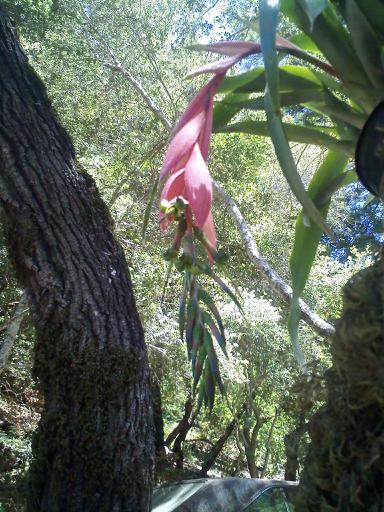
Tillandsias, to the left and right, as well as Spanish moss, which hangs downward throughout, are types of bromeliads.
After certain botany classes, some of my Cal Poly colleagues and I found it difficult to enjoy eating certain fruits and vegetables like we did previously. Simple things like pineapples, figs, potatoes and Brussels’s sprouts were much less appealing, or even unappealing, once we discovered what they really are. Yet, we also gained a bit more respect for these seemingly weird plants. Even though their adaptations do not always make sense to us, and some adaptations are a bit outdated by a few thousand centuries, or much more, many plants are remarkably adapted to their particular situations within their natural environments.
Pineapple is still one of my less favorite ‘fruit’. However, the related bromeliads, of the family Bromeliaceae, are fascinating. Almost all are ‘stemless perennials’ with basal rosettes of foliage. (Their ‘stems’ are actually out of sight below their foliage.) Most are epiphytes that live within the canopies of larger trees or on exposed rock formations, sustained by whatever organic matter that happens to fall onto them from above. They are consequently very well adapted to confinement in pots, so can be quite happy as houseplants. A few bromeliads that live in deserts or other comparably harsh environments actually resemble yuccas.
Some people like to water large bromeliads in the ‘reservoirs’ formed by the densely set leaves at the middles of the foliar rosettes. In the wild, these reservoirs naturally collect rainwater to use during drier weather. Bromeliads can either absorb moisture directly from their reservoirs through their leaves, or they release some of the water between their foliage to their roots below as their leaves lose turgidity (wilt slightly) because of a lack of rainfall or humidity. Either way, bromeliads really know how to conserve and ration water accordingly.
Many bromeliads are appreciated for their unusually colorful and often strangely textured foliage. Many have very interesting or downright strange flowers that mostly stand high above their foliage. The flashiest bromeliads have all of the above ; oddly textured and colorful foliage with interesting flower trusses outfitted with bracts (modified leaves that adorn flowers) that are so colorful that it is difficult to know where the foliage ends and the flowers begin.

 Tony Tomeo