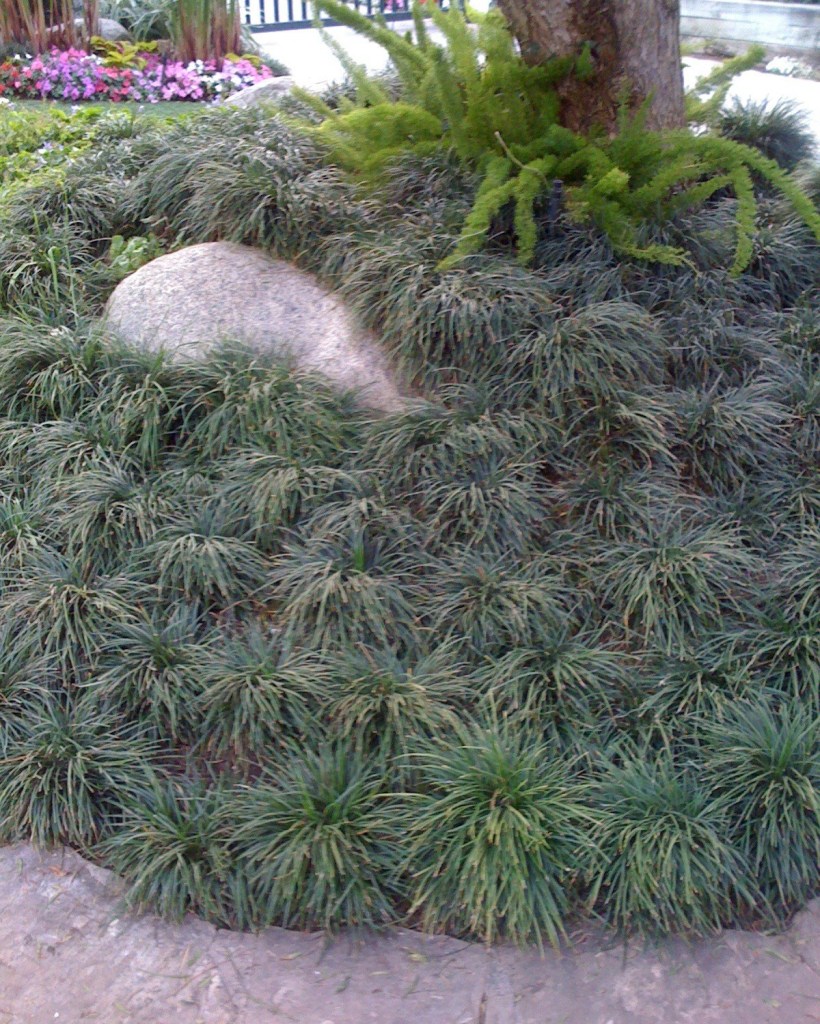
The thick clumps of evergreen grass-like foliage of mondo grass, Ophiopogon japonicas, make a nice lumpy ground cover for small spaces. Because it is rather tolerant of shade, and actually prefers partial shade to full sun, it works nicely under Japanese maples or highly branched overgrown rhododendrons. It gets only about half a foot deep. Narrow stems with small pale purplish blue flowers that bloom in summer are not too abundant, and are generally obscured below the foliage, but can actually get taller. ‘Silver Mist’ is variegated with white.
New plants are easily produced by division of large clumps. Overgrown or tired looking clumps can be shorn down at the end of winter, before new growth begins. Slugs and snails can be problematic.
There are actually several different purple leaf plums, Prunus cerasifera, to provide colorful white or pink bloom sometime between the middle of winter and the middle of spring, followed by colorful bronzy or purplish foliage through summer. Some also provide good fruit, which can unfortunately be messy if it is not harvested. Most stay quite compact, less than twenty feet tall and broad, so are proportionate to small garden spaces. ‘Hollywood’ is the largest, but rarely gets more than thirty feet tall, and not quite as broad. Prunus X cistena does not get much more than six feet tall and broad.
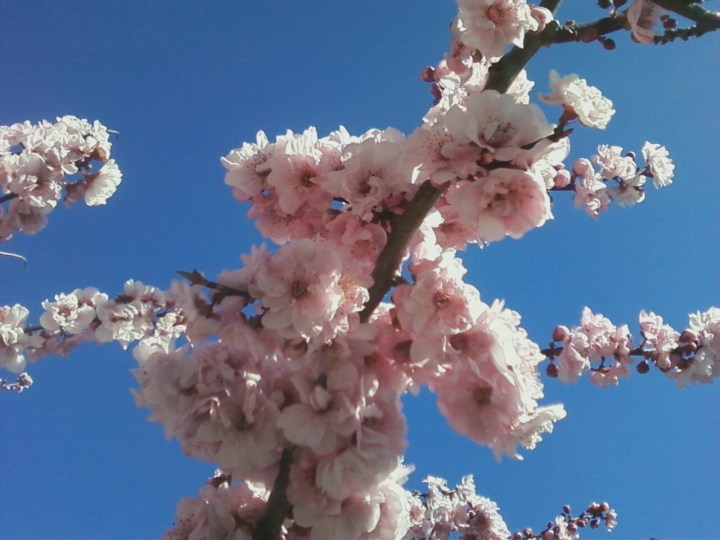
Because each cultivar has a distinct personality, it is important to match trees when adding or replacing trees in a grove. The fruitful ‘Atropurpurea’ has single white flowers in spring, followed by bronzy red new growth that turns purplish in summer and reddish brown in autumn. ‘Krauter Vesuvius’ has single pale pink flowers and the darkest foliage, but lacks fruit. ‘Thundercloud’ has similar or paler flowers, lighter or more bronzy foliage, and sometimes produces tangy red fruit about an inch wide. Prunus X blireiana (illustrated) fades to bronzy green by summer, but has handsome branch structure and double pink flowers that are slightly fragrant. Unlike plums that are grown for larger and more abundant fruit, purple leaf plums do not need much pruning.
‘Siam Ruby’ banana started to display bronze foliar color before it seemed to revert to chartreuse.
Of the two dozen or so cultivars of banana here, ‘Siam Ruby’ is one of only two that are merely ornamental. It and ‘Zebrina’ produce fruit that is too seedy to be reasonably palatable. Both are instead grown more for their colorful foliage. ‘Siam Ruby’ develops bronze foliage with yellowish green spots. ‘Zebrina’ develops darker bronze or brown color mixed with more but darker green. Since their distinct foliar colors are their primary attributes, I was initially disappointed when ‘Siam Ruby’ seemed to revert to chartreuse green without any bronze foliar color. I was informed that it is typically chartreuse while very young or if shaded, but develops bronze foliar color as it matures with adequate sun exposure. However, I still suspect reversion because it started to display broad bands of bronze foliar color earlier, but became exclusively chartreuse green afterward. While inquiring about the potential for reversion with this particular cultivar, I learned that ‘Margarita’ originated as a reverted sport of ‘Siam Ruby’ with exclusively bright chartreuse foliage, just like the specimen of ‘Siam Ruby’ here that I suspect reverted. So, I may have indirectly acquired a fake copy of ‘Margarita’, which should contrast splendidly with the bronze foliage of both ‘Siam Ruby’ and ‘Zebrina’! The grower who sent the original pup of ‘Siam Ruby’ already sent a replacement. Now I want to see what the original pup does. If it recovers its bronze foliar color, there will be two copies of ‘Siam Ruby’ here. If it does not, I will consider it to be ‘Margarita’, which is still a rare cultivar. In a way, I sort of hope that it does not recover. A glitch such as this is a good excuse to try something that I would not try otherwise. Actually, we already have plans for it.
New foliage of ‘Siam Ruby’ banana is exclusively chartreuse green, without any bronze.
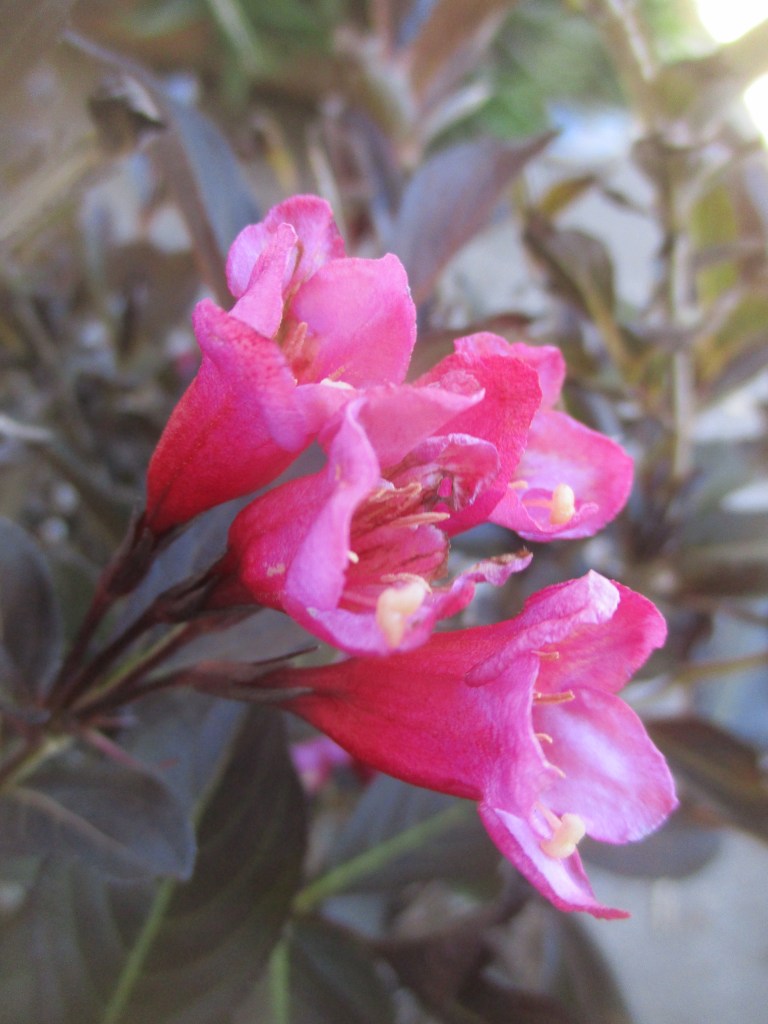
Stylish modern cultivars have been restoring the popularity of formerly common weigela, Weigela florida. Traditional sorts can reach first floor eaves, with delightfully open branch structure and rosy pink spring bloom. The foliage of most is variegated with white. Newer cultivars are more compact, with more variety of form, as well as of foliar and floral color.
Bloom can be pink, red, rosy red, white, white with yellow centers, or the the familiar rosy pink. Foliage can be green, bronze, deep purply bronze, or variegated with white or pale yellow. As it develops in spring, variegated foliage might be blushed with pink. Shrubbier modern cultivars may get no taller than five feet. Some are lower and densely mounding.
Although deciduous, weigela are popular as short informal hedges. Formal or excessive shearing compromises both bloom and form. After primary spring bloom, several modern cultivars bloom sporadically later in summer. Weigela enjoys a bit of winter chill, so may not appreciate the mildest coastal climates. Partial shade is tolerable, but inhibits bloom.
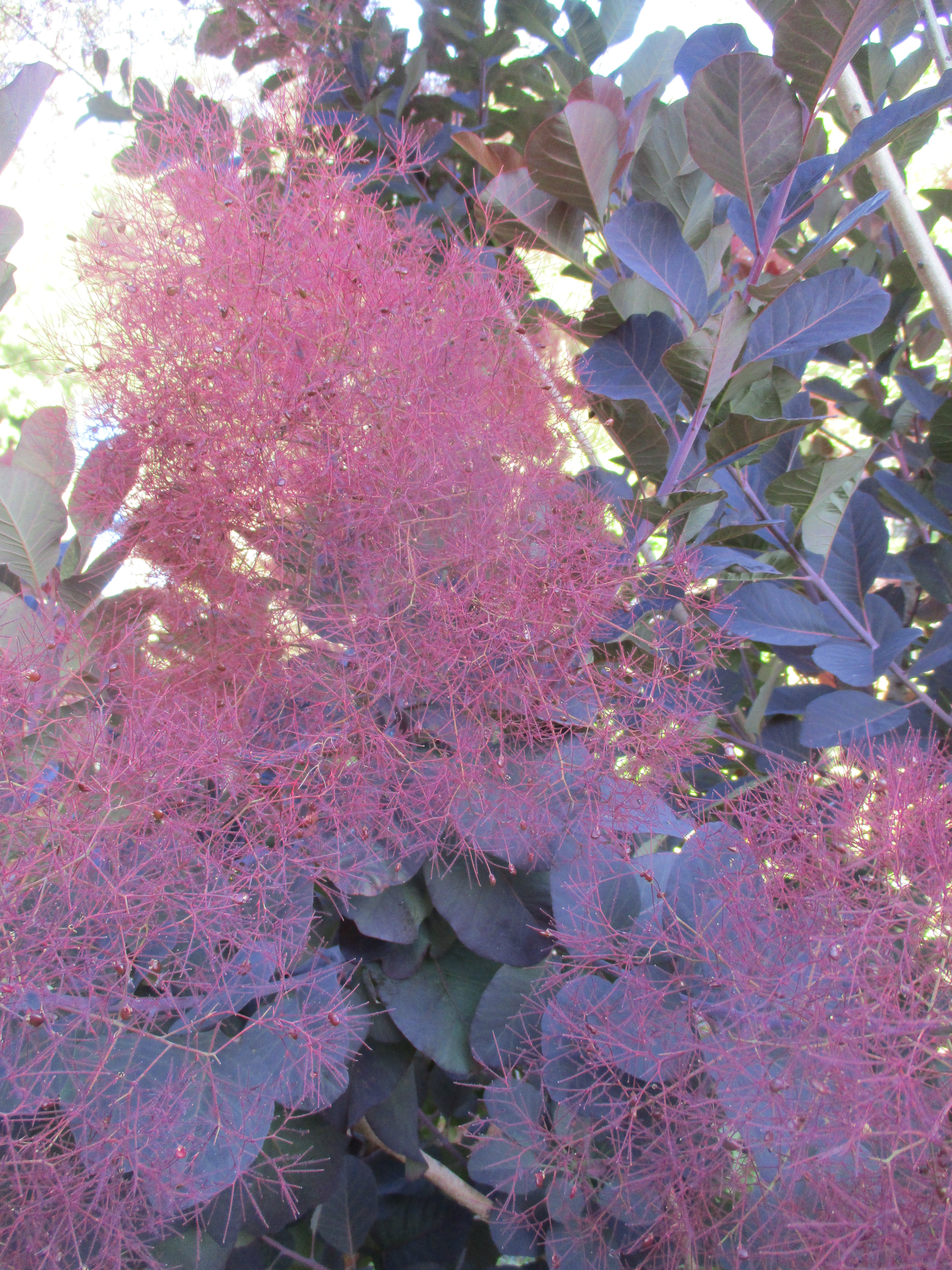
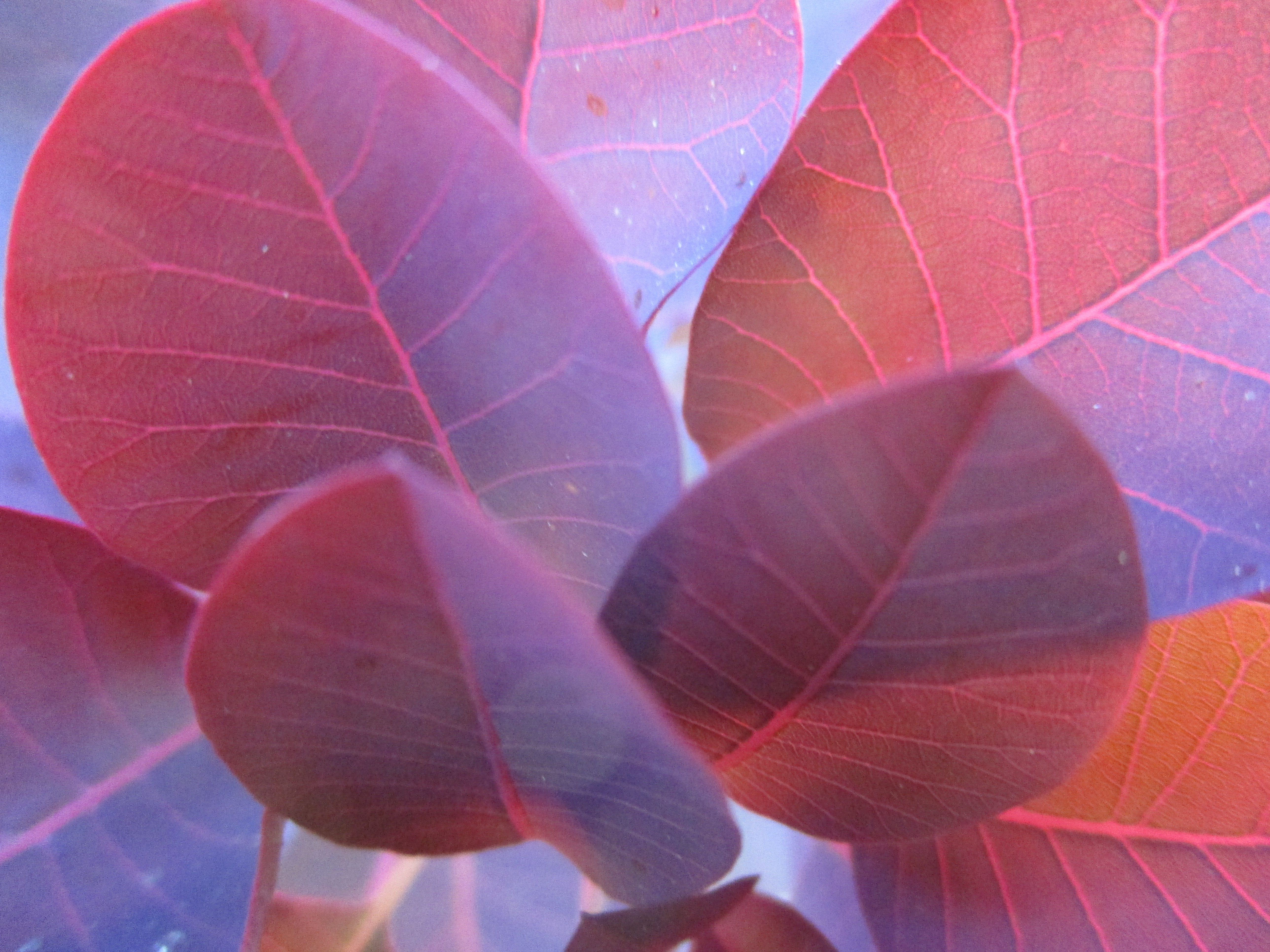
Cliche is barely avoidable regarding smokebush, Cotinus coggygria. It provides rich foliar color from spring until autumn, with uniquely billowy bloom through summer. Then, it provides exquisite fall color until winter. Then, it provides sculptural form of bare stems until spring. Smokebush ‘has it all’. . . almost. All the spectacle distracts from a lack of floral fragrance. Will anyone ever notice?
Foliage is rich purplish bronze, bright greenish yellow or olive green through spring and summer. Formerly common old fashioned cultivars with olive green foliage are now rare. Nowadays, most are rich purplish bronze. Fall color is fiery yellow, orange and red. The round leaves are about one to three inches long. Purplish to pale pinkish plumes of smoke-like bloom are a striking contrast.
The largest of smokebush grow at a moderate rate to more than fifteen feet high and wide. Most cultivars are more compact. They get wobbly in the ground if they grow too vigorously. Aggressive pruning during winter improves stability and enhances foliar color for the next season. However, minimal pruning of stable plants promotes bloom. Smoke tree wants full sun, but is not demanding.
Bronze foliage will never actually replace green foliage. Even if there were enough variety of plants with bronze foliage to do so, too much bronze would look dreary. Bronze is just another option for foliar color in landscapes with significant vegetation. It is distinct from simpler green, and contrasts nicely with gold, blue, gray and variegated foliage. Some bronze foliage is variegated too.
There is all sorts of bronze foliage. Some is brownish bronze. Some is reddish. The most popular bronze foliage is rather purplish. It can be evergreen or deciduous. Annuals, perennials, shrubs, vines, trees and houseplants can provide bronze foliage. Most plants that provide bronze foliage are variants of plants that also provide bloom or fruit. Some are common. Others are rather rare.
Bronze foliage is not an advantage to plants that produce it. The most efficient foliage is green. Gray or bluish foliage has the advantage of reflecting some of the harsh sunlight that could scald it in severe climates. Otherwise, foliage that is a color other than green reflects more of the useful sunlight than it should. Incidentally, dark foliage also absorbs more of the sunlight that can scald it.
This is why many bronze plants are noticeably less vigorous than their greener counterparts. Although it would not be an advantage in the wild, diminished vigor makes some bronze plants more adaptable to compact home gardens. For example, the brownish bronze ‘Summer Chocolate’ silk tree will not get half as high and wide as the common silk tree. It can fit nicely into a cozy atrium.
Cultivars of purple leaf plum, Japanese maple and Eastern redbud are more familiar complaisant bronze trees. ‘Ruby Lace’ honeylocust is still quite rare. Bronze shrubbery includes smokebush, Chinese fringe flower, elderberry, barberry and ninebark. New Zealand flax, canna, houseleek, ajuga, mondo grass and coral bells are popular bronze perennials. Cordyline is a larger perennial.
Bronze foliage adds a bit more color than typical green foliage. In the right situations, it is appealing bold.
Autumn foliar color is not the concern yet. It develops later as deciduous plants defoliate for winter. Purplish, reddish, yellowish, bluish or gray foliar color that can be seen now is provided by plants that are colorful while actively growing. Almost all of this sort of foliage is most colorful when it is young and fresh, early in spring. Then, through summer, some of the best foliar color fades.
This process is perfectly natural. It does not imply that anything was done improperly, or that plants were not given what they need. In fact, most plants with colorful foliage would rather be green. They are mutants that were reproduced specifically for their distinctive color. Some try to revert back to green by producing greener shoots that grow faster because they have more chlorophyll.
Photinia is an odd one. By now, The rich green foliage shows no clue that it was rich reddish bronze when it developed early in spring. The foliage did not really fade. It merely matured. Then there are the newer cultivars of purple leaf plum, which maintain their color from spring to autumn. It is amazing that such darkly colored foliage that seems be devoid of chlorophyll can photosynthesise!
Some plants maintain their color better than others. Gray or bluish foliage is always gray or bluish; but admittedly, blue spruce and blue junipers are not quite as striking now as they were earlier. If red fountain grass and bronze aonium fade, it will be too slight to notice. Stems of bronze, gold or striped cannas that fade after bloom get pruned out in favor of more colorful unbloomed stems.
‘Forest Pansy’ redbud, ‘Summer Chocolate’ silk tree and ‘Sunburst’ honeylocust are notorious for fading. By now, the formerly richly bronzed redbud and silk tree merely seem to be stained with coffee. Golden honeylocust might have been bright yellow in spring, but now just looks sickly. Gold tipped and silver tipped deodar cedars can likewise be a bit pale. Bronze elderberries hold color well, but golden elderberry might now be chartreuse.
As a shorn evergreen hedge or simple shorn shrubbery, photinia, Photinia X fraseri, produces handsomely glossy bronzy red foliage without bloom. It is best if shorn as weather warms at the end of winter, and then allowed to grow out for a while. It can be shorn again through summer as bronzy foliage fades to green, but should not be shorn so often that it is always deprived of red foliage.
Without regular shearing, photinia becomes a small tree or large shrub. Trees can either be staked on single trunks, or allowed to develop multiple trunks. New growth in spring is not as vigorous as it would be in response to shearing, so is not as colorful. Domed trusses of tiny white flowers bloom about as soon as new foliage appears. The floral fragrance can be objectionable to some.
Only the biggest and oldest trees reach high voltage cables. Most stay less than fifteen feet tall and broad. Hedges can be kept less than six feet tall, and ideally, should be kept less than half as deep (from front to back). Photinia can grow rather well while young, but then grows slower as it matures. Partial shade or a lack of water through summer compromise foliar color and density.
Since modern cultivars became trendy several years ago, the old fashioned ‘common’ fringe flower, Loropetalum chinense, has become even more uncommon than it already was. It does not grow fast enough to function as large scale shrubbery, but slowly gets too big to work as small shrubbery. Without pruning, old plants take many years to get to fifteen feet tall.
The gracefully arching stems are outfitted with light green evergreen foliage. The simple leaves are about an inch or two long. The small white blooms have very narrow petals that hang downward like limp bits of ramen. Each bloom is actually a tuft of a few individual flowers. Bloom is most abundant in spring, and then continues sporadically through most of the year.
Modern cultivars of fringe flower are more compact, so rarely get more than five feet tall. Flowers can be white, pink, red or rosy pink. The most popular cultivars have purplish bronze foliage. Fringe flower does well as an understory plant, in the partial shade of trees. It should not be shorn, so should instead be pruned selectively to maintain its natural form.
With indiscriminate pruning, glossy abelia, Abelia X grandiflora, will never develop its natural form, with elegantly long and thin stems that arch gracefully outward. Sadly, almost all get shorn into tight shrubbery or hedges that rarely bloom. If only old stems get selectively pruned out as they get replaced by fresh new stems, mature shrubs can get eight feet tall and twelve feet wide.
Against their bronzy green foliage, the tiny pale pink flowers that bloom all summer have a rustic appeal. In abundance, they can be slightly fragrant. The tiny leaves are not much more than an inch long. Vigorous young canes that shoot nearly straight out from the roots slowly bend from the weight of their bloom and foliage as they mature.
Partial shade is not a problem for glossy abelia, but will inhibit bloom somewhat. Young plants want to be watered regularly. Old plants are not nearly so demanding, and can survive with notably less water. If alternating canes is too much work to restore old and neglected plants, all stems can be cut back to the ground at the end of winter. New growth develops quickly.


 Cliche is barely avoidable regarding smokebush, Cotinus coggygria. It provides rich foliar color from spring until autumn, with uniquely billowy bloom through summer. Then, it provides exquisite fall color until winter. Then, it provides sculptural form of bare stems until spring. Smokebush ‘has it all’. . . almost. All the spectacle distracts from a lack of floral fragrance. Will anyone ever notice?
 Autumn foliar color is not the concern yet. It develops later as deciduous plants defoliate for winter. Purplish, reddish, yellowish, bluish or gray foliar color that can be seen now is provided by plants that are colorful while actively growing. Almost all of this sort of foliage is most colorful when it is young and fresh, early in spring. Then, through summer, some of the best foliar color fades.
 As a shorn evergreen hedge or simple shorn shrubbery, photinia, Photinia X fraseri, produces handsomely glossy bronzy red foliage without bloom. It is best if shorn as weather warms at the end of winter, and then allowed to grow out for a while. It can be shorn again through summer as bronzy foliage fades to green, but should not be shorn so often that it is always deprived of red foliage.
 Since modern cultivars became trendy several years ago, the old fashioned ‘common’ fringe flower, Loropetalum chinense, has become even more uncommon than it already was. It does not grow fast enough to function as large scale shrubbery, but slowly gets too big to work as small shrubbery. Without pruning, old plants take many years to get to fifteen feet tall.
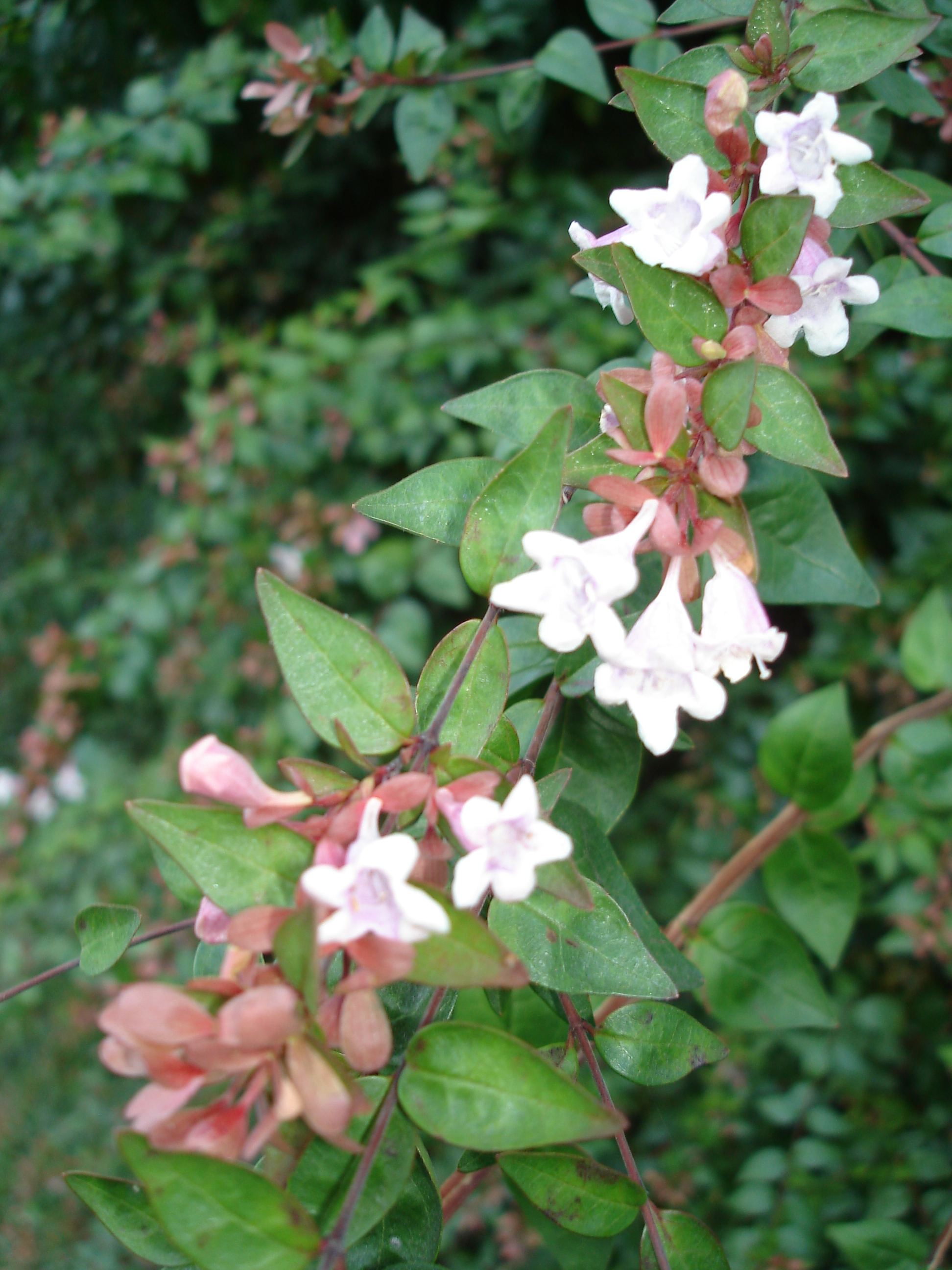 With indiscriminate pruning, glossy abelia, Abelia X grandiflora, will never develop its natural form, with elegantly long and thin stems that arch gracefully outward. Sadly, almost all get shorn into tight shrubbery or hedges that rarely bloom. If only old stems get selectively pruned out as they get replaced by fresh new stems, mature shrubs can get eight feet tall and twelve feet wide.
 Tony Tomeo