Daffodil

Daffodil will bloom months from now.

They may seem to be unseasonable now. Their flowers will not bloom until early spring. It is getting to be about time to install their dormant bulbs, though. Daffodil and all related Narcissus enjoy chilling under damp soil through winter. In fact, established bulbs bloom better after unusually chilly winters. Plump bulbs of some types are conducive to forcing.

The names for daffodil and Narcissus seem to be interchangeable. Narcissus is actually the Latin name of daffodil. It mostly applies to those with smaller but more abundant and fragrant flowers. Most with bigger but fewer and scentless flowers are daffodil. Narcissus are mostly white, but may be yellow. Daffodil are mostly yellow, but may be white or pink.

Some of the fancy varieties of daffodil bloom with billowy double flowers with two colors. Simpler Narcissus are more likely to naturalize though. Taller varieties of both can bloom nearly a foot and a half high. Their narrow and bluish green leaves stay somewhat lower. Foliage deteriorates after bloom, but lingers to sustain new bulbs until summery warmth.

Early Spring Bulbs Start Now

Early spring bulbs appreciate winter chill.

Halloween seems to be an appropriate time to bury early spring bulbs in shallow graves. The season begins about now, and continues until about the end of the year. Installation of new bulbs might initially be ungratifying. There is nothing to show after their interment. Their spectacular bloom during late winter or early spring should more than compensate.

Freesia, narcissus, crocus, hyacinth and tulip are the most popular of early spring bulbs. So are anemone, ranunculus and several iris, although they may also be summer bulbs. Not all of such bulbs are actually bulbs. Several are corms, rhizomes, tubers or tuberous roots. Like bulbs, these store resources through dormancy to grow and bloom in season.

Early spring bulbs, unlike summer bulbs, prefer to be in their garden prior to winter. They enjoy rain and winter chill. Those that originate from nurseries are prechilled so that they bloom well regardless. After their first season though, some might not perform as reliably. Some bulbs can be slightly less than satisfied with winter chill within such mild climates.

However, a few types of early spring bulbs can naturalize. After their primary bloom, they produce new bulbs to replace the originals. Colonies of prolific bulbs eventually become crowded enough to inhibit bloom. Division of superfluous bulbs while dormant alleviates crowding. Also, it relinquishes a few bulbs for relocation. Freesia might be nicely prolific.

Early installation of early spring bulbs promotes early bloom. Obviously, later installation delays bloom. Therefore, installation in phases throughout the planting season prolongs bloom. For example, as one phase of daffodil finishes bloom, the subsequent phase can begin. This is effective only for their first season though. Bloom synchronizes afterwards.

Because winter weather is so mild locally, some early spring bulbs bloom a bit too early. Also because winter weather is so mild, premature bloom may not be a serious problem. Nonetheless, later installation may be preferable for some bulbs. Heavy rain may thrash tulip or freesia. Like phasing though, delaying bloom is only effective for the first season. Naturalized bulbs as they please.

Naked Lady

Naked lady foliage grows after bloom.

They can be quite a surprise when they bloom for late summer. The tops of their dormant bulbs previously seemed to be dead at the surface of the soil. Then, suddenly, their bare floral stems emerge to bloom without foliage. That is why Amaryllis belladonna is naked lady. Foliage grows a bit later in summer or autumn. It shrivels during late spring warmth.

Naked lady flowers stand about two feet tall, on simple green or brown stalks. Their mild fragrance is easy to miss. A profusion of bloom is only slightly fragrant during humid and warm weather. Their vividly pink color more than compensates. Fleshy seed that mature now that flowers are deteriorating are perishable. They prefer almost immediate sowing.

After naked lady flowers imitate lily flowers, their leaves will imitate lily of the Nile leaves. Naked lady and lily of the Nile are related, but neither are related to lily. The strap leaves of naked lady are more fragile than those of lily of the Nile. If damaged, they can lay flatly for quite a while. After defoliation during spring, dormant bulbs are conducive to division. It might delay bloom for that year.

2 / 3

This is the wimpiest of the sixteen survivors.

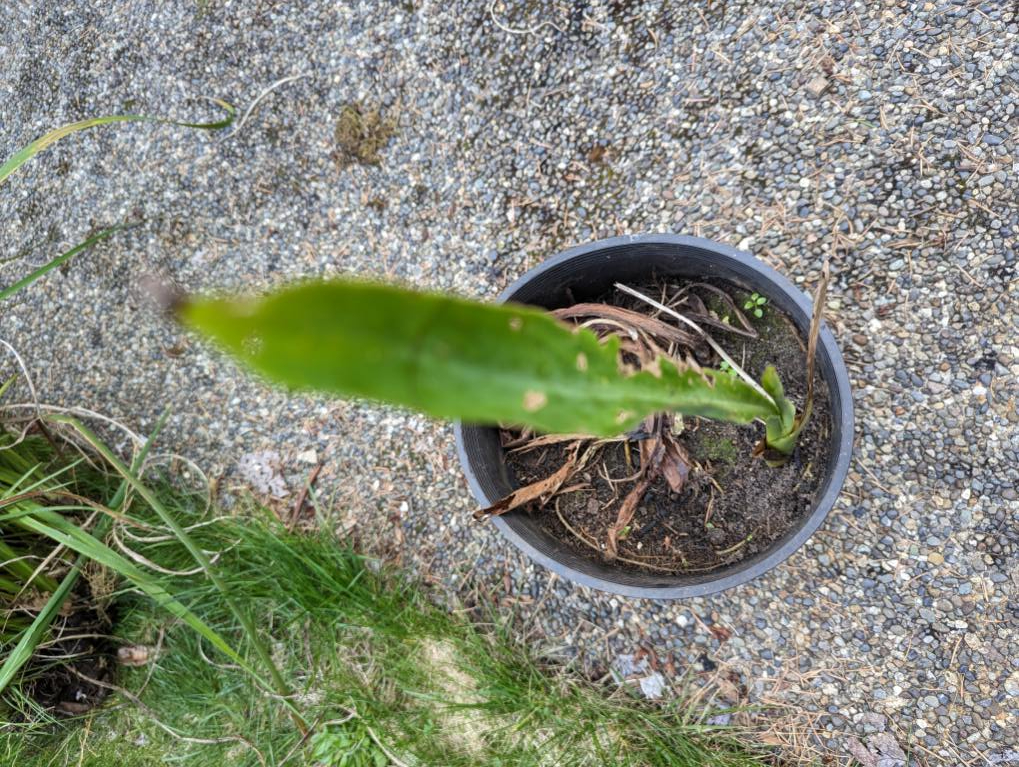
Sixteen of the twenty-four mixed dinnerplate dahlias that I did not expect favorable performance from have survived! Only eight have failed to exhibit any indication of viability. Two thirds are growing. Only one third is not.

I am impressed. I expected less than half to survive. They arrived in embarrassingly shabby condition. I canned all of them regardless, including several that were obviously completely necrotic. I wanted to give all a chance to survive before discarding any. Those that were obviously completely necrotic are among those that have not exhibited any indication of viability. However, I am not ready to discard any yet. Although I still believe that some are completely necrotic, a few others may not be. As I dump any that do not at least try to grow prior to winter, I will inspect their tubers for any indication of viability, no matter how minor.

The survivors will be pampered. I want them to generate as much vegetative growth prior to frost as possible. That should sustain the regeneration of their wimpy tubers so that they will be ready to grow next spring. I am aware that even the healthiest may not survive winter if their tubers are inadequate.

Those that survive through winter are likely to grow and bloom as if they were always healthy. In a few years, they could be ready for division. Perhaps after a few more years, I will regret the procurement of so many.

In this mild climate, it is not necessary to dig dahlia tubers for winter. We only do so because it has become a habit, and perhaps to relocate the dahlias.

Dinnerplate dahlias are certainly not my favorite type, but they are more appropriate to the landscapes that they will inhabit than they types that I would prefer.

This is the most vigorous of the sixteen survivors.

Asiatic Lily

Asiatic lily appreciates pronounced winter chill.

Lily is such a generic classification. Kaffir lily, water lily, calla lily, canna lily and many other lilies are not lilies at all. These examples are not even remote relatives. Real lilies are of the genus Lilium. However, even the most familiar of these are hybrids of various species. Asiatic lilies are a group of such hybrids that classify as Lilium asiaticum.

Asiatic lilies go into the garden as dormant bulbs during late autumn or winter. They grow through spring to bloom for early summer. Bulbs require vernalization to bloom, so may not bloom annually within mild climates. Asiatic lilies that are now popular as spring cut flowers grow in greenhouses. Mature bulbs can grow large enough for propagation by division while dormant. Bulbs like rich and evenly moist soil.

Asiatic lily bloom can be white, yellow, orange, red, reddish purple or pink. Many are delightfully monochromatic. Some display spots, stripes or darker centers. Each bulb extends a single stem with a few flowers on top. Each flower extends six flaring tepals in familiar lily form. Unlike most other lilies, Asiatic lilies do not produce enough pollen to be messy. All lilies are toxic to cats.

Six on Saturday: Skooter Approved

Rhody, Carson and I finally left on vacation. Although this trip was planned a year ago, it was delayed weekly since February. I had intended to leave prior to March. I finally realized that the timing would never be convenient, so left anyway, after midnight on Wednesday morning. We arrived in Ilwaco on Wednesday night, and went to Skooter’s Garden at Tangly Cottage Gardening in the morning. Of course, we stayed later than intended, ate cookies with coffee, and arrived in Silverdale later than we should have on Thursday night. The first four of my Six here are gifts from Tangly Cottage Gardening, so are approved by Skooter. The last two were at the Port of Ilwaco.

1. Canna ‘Stuttgart’ is tall and elegant, with small peachy orange flowers and irregularly white variegated foliage. I requested a copy of it shortly after leaving without it last year.

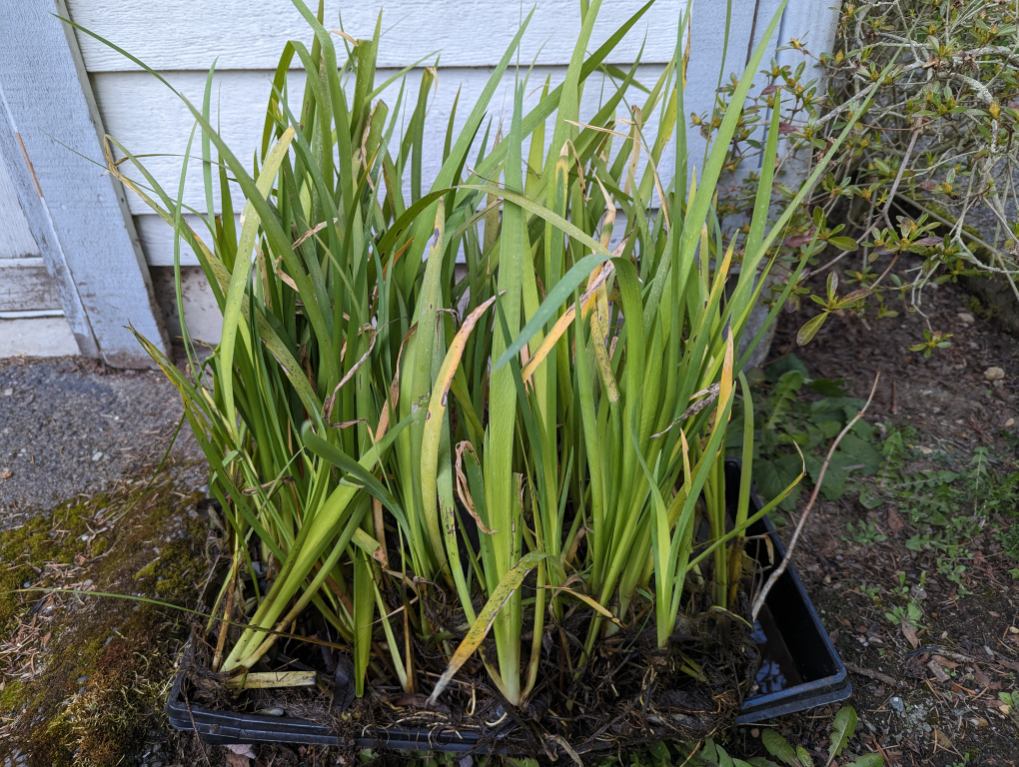
2. Iris X Louisiana ‘Black Gamecock’ is the most popular Louisiana iris, with dark purplish blue bloom. I requested some of it when it was removed from Skooter’s Gaden. This colony will divide into many individual rhizomes. I expect to get significant mileage from them, and I know they will multiply efficiently.

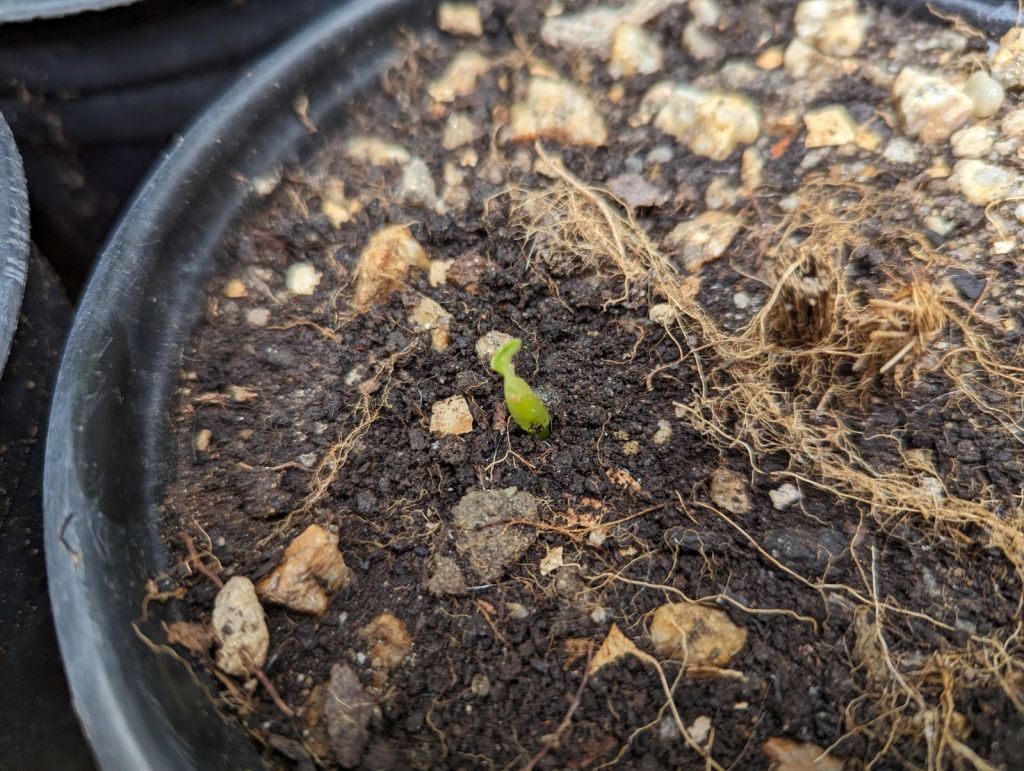
3. Iris unguicularis, Algerian iris was s surprise. It was split after my arrival, directly from a healthy colony within Skooter’s Garden. I had been impressed with the sky blue bloom, but could not justify trying it. Now, no justification is necessary. We will likely put much of it within the Blue Garden. I know that this colony is not very impressive in this picture, but the rhizomes are the important parts.

4. Sambucus racemosa, red elderberry grows wild in Skooter’s Garden. I had been wanting this for a while, but did not think to request it last year. I requested it this year, so got four good wild seedlings.

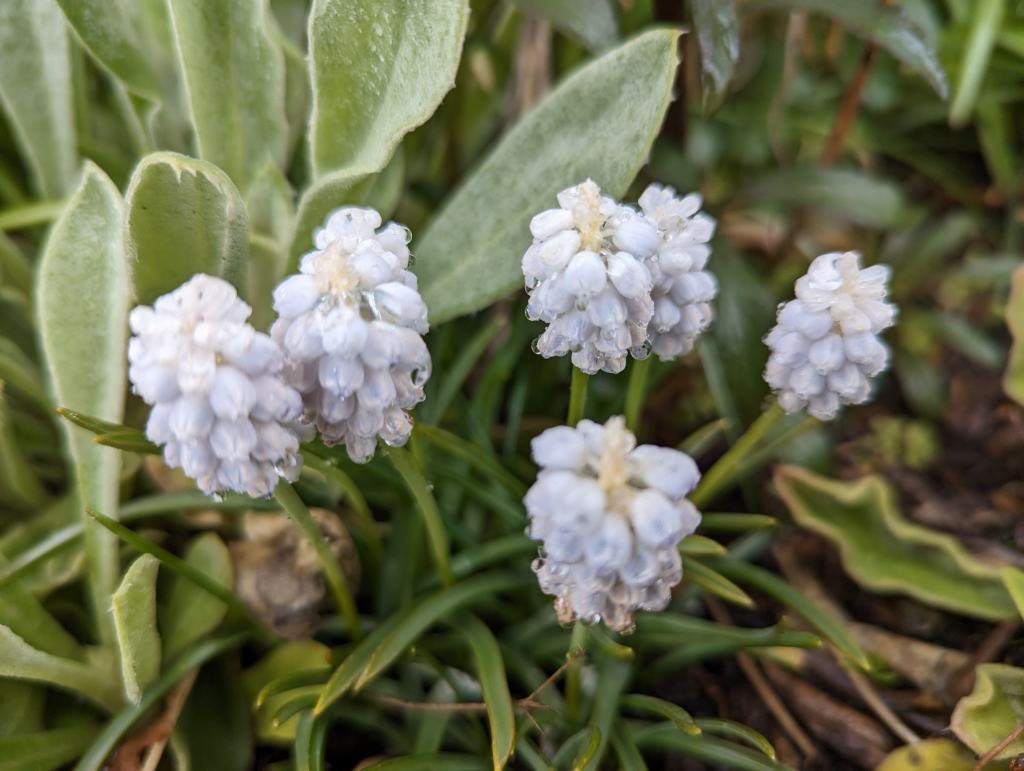
5. Muscari armeniacum ‘Album’, white grape hyacinth inhabits the landscapes at the Port of Ilwaco. I got copies of this last year because I had been wanting it for a while. I know that blue is the most traditional color for grape hyacinth, but white is my favorit color. It may go into the White Garden at work.

6. Muscari armeniacum, grape hyacinth is quite abundant at the Port of Ilwaco. I did not request any of it because I already have a small colony of it for my own garden, and I do not want any others to mingle with them, regardless of how similar they seem to be.

This is the link for Six on Saturday, for anyone else who would like to participate: https://thepropagatorblog.wordpress.com/2017/09/18/six-on-saturday-a-participant-guide/

Spring Bulbs Begin In Autumn

Spring bulbs are dormant through winter.

Crocus, daffodil, hyacinth, tulip, freesia, anemone and ranunculus will not bloom until the end of winter and early spring. They are spring bulbs or early bulbs. Crocus and daffodil, including the various narcissus, will be among the first to bloom. The others as well as a few types of iris will bloom a bit later. After they finish, summer bulbs will begin to bloom.

Although they will not bloom for a few months, spring bulbs go into the garden now while they are dormant. Visually, they are still unimpressive. They are even more uninteresting when hidden from view by interment. Their planting season appropriately begins prior to Halloween, and continues as long as they remain dormant and available from nurseries.

Spring bulbs generally bloom earlier within their bloom season after early planting within their planting season. Similarly, later planting delays bloom. Therefore, periodic planting of groups of the same bulbs throughout their planting seasons prolongs their subsequent bloom season. They begin to disperse roots and grow as soon as they are in the ground.

However, growth through the cool and rainy weather of winter remains subdued. Foliage should remain safely below the surface of the soil until warmer weather during the end of winter or beginning of spring. Like so many other plants in the garden, bulbs rely on chill to adjust their respective schedules after dormancy, but do not want to be vulnerable to it.

Winter is so mild here though that some spring bulbs do not experience sufficient chill to perform reliably as perennials. Daffodil, for example, can naturalize where it experiences more chill. Here, it may bloom best for its first spring, with less bloom annually afterward. Extensive breeding has also compromised the reliability of many perennial spring bulbs.

Some spring bulbs are actually corms, rhizomes, tubers or tuberous roots, which function much like bulbs. All are specialized storage structures that contain all that they require to survive through dormancy and then start growth for another season. They replenish their resources through subsequent active seasons to repeat the process perhaps indefinitely.

Spring Bulbs Begin In Autumn

Daffodil bloom is not in season, but their dormant bulbs will be soon.

Even before winter begins, it is time to plan for it to end. Bulbs (including corms, tubers, rhizomes and tuberous roots) of many of the earliest spring flowers that bloom while the weather is still cool late in winter should begin to get planted about now. They are still dormant and not all that impressive yet, but have already stored everything they need to be ready to bloom as soon as they think it is time. Since the weather will be getting cooler through autumn before it gets warmer at the end of winter, even the earliest blooming of spring bulbs will stay dormant for a while, and have quite a bit of time to slowly disperse roots before their foliage eventually peeks through the soil.

Bulbs planted later will likely bloom later, which is actually an advantage for ‘phasing’ bulbs. Like vegetables, bulbs can be planted in phases every two or three weeks, depending on the duration of the bloom cycle of the particular bulbs involved. As one group finishes blooming, the next group starts blooming. Bulbs become available when it is time for them to be planted, and generally remain available long enough for a few phases to get added later when convenient, although there is always the threat of particular varieties getting sold out later in the season.

Phasing is only effective in the first season, since bulbs get established after their first bloom cycle, and will subsequently be on the same schedule as all their friends of the same variety. Bearded iris, calla, anemone and rananculus are not conducive to phasing, but instead bloom at a particular time, regardless of when they were planted.

Narcissus, daffodil, grape hyacinth, bearded iris and classic white callas are the most reliable of spring bulbs, and the most likely to naturalize, although bearded iris and callas will probably bloom quite late in their first year. Crocus, freesia and harlequin flower are almost as easy to grow. Anemone, rananculus, hyacinth, lily, tulip and the small colorful callas are tempting, but are not as reliable after their first year because the seasons are so mild here.

Naked Lady

These naked ladies are not shy.

While so many flowers are finishing their bloom and leaving their drying foliage behind, naked lady, Amaryllis belladonna, is just beginning to bloom, naked of any foliage. Clusters of a few to several bright pink flowers stand on bare stems about two feet tall. Individual flowers are about two and a half to three and a half inches long, and resemble lily flowers. Foliage only appears after flowers deteriorate, and lasts only until weather gets warm late in spring. The strap shaped leaves are about a foot to a foot and a half long. Through summer, the two or three inch wide bulbs are dormant and bare, and seem to be dead with their tops visible at the soil surface, but retain fleshy roots below. They should therefore only be dug and divided if they get too crowded or need to be moved.

Delay Some Gardening Between Seasons

Plants are still going to seed.

For gardening, this is one of those in between times of year, when summer chores are under control, but it is a bit too early for much of the work that will need to be done in autumn. Automated watering systems have already been adjusted for the longest and warmest days of summer, so will only need to be adjusted the other way as days eventually get cooler and shorter. Growth of most plants slows; and some of the plants that will later be the earliest to show fall color begin to fade from bright green to paler green.

The last of the summer fruits should be gone, leaving the trees that produced them looking somewhat tired. The weight of large fruit, particularly peaches, might have pulled stems downward where they may now be obtrusive. Pruning a few minor stems should not be a problem. However, trees are still too vascularly active for major pruning. That needs to wait for dormant pruning while trees are bare in winter.

A few plants with sensitive bark are susceptible to sun scald if pruned to expose too much bark on interior stems while the sun is still high and warm. This is not so likely to be a problem if pruned during winter because the sun is lower and cooler, and foliage grows back before the following summer. Actually, that is why English walnut and various maples are able to defoliate during winter, even though their smooth bark needs to be shaded.

Pruning of plants that are potentially sensitive to frost should likewise be delayed. Otherwise, pruning is likely to stimulate development of tender new growth that will be even more sensitive to frost during winter. Besides, new growth develops slower this time of year, so plants look freshly pruned for a longer time than if pruned late in winter, just prior to spring.

Some types of pittosporum are more susceptible to disease if pruned in late summer or autumn because their open pruning wounds heal slowly and stay open to infection during rainy winter weather. However, slow recovery from pruning can be an advantage to formally shorn hedges that are not so sensitive to frost or disease, such as the various boxwoods, or glossy or wax privets. If shorn now, they might stay trim until spring.

The dried foliar remains of any summer bulbs that are finished blooming can now be plucked and disposed of. Gladiolus and montbretias that are still green can be deadheaded (pruned to remove deteriorated flower stalks), but should be allowed to turn completely brown before getting plucked. Watsonias are not so easy to pluck without also pulling up the bulbs, so should instead get their dried foliage pruned off.

Weeds outside of landscaped areas may not seem to be a problem, but many are now producing seed that gets blown into the garden. Even if such weeds do not need to be pulled, their flowers and seeding stalks should still be cut off and removed if possible.