Both alocasias and colocasias are striking foliar plants. Alocasias generally develop big leaves that point upward. Colocasias generally develop even bigger leaves that hang downward. Alocasias are generally more colorful, perhaps with striking foliar patterns. Also, most tolerate more shade than colocasias. Of course, these are generalizations.
Asian taro, Alocasia odora, resembles colocasias as much as alocasias. Its big cordate leaves may point only slightly upward, and might sag downward. They can grow two feet long and a foot wide, on petioles as long as three feet. Collectively, foliage can get more than five feet tall. It is bright but monochromatic green, similar to that of Kermit the Frog.
Asian taro is only occasionally available from nurseries. Small plants are too delicate for nurseries to market too many of them for too long. Their dormant bulbs are more likely to become available with summer bulbs. They can be wider than three inches! They grow slowly though, especially while weather is cool. Foliage may not appear for two months.
Spring bulbs begin to go into the garden during autumn to benefit from the chill of winter. Summer bulbs begin to go into the garden during late winter to avoid the chill of winter. Spring bulbs know to remain dormant through winter. Some summer bulbs do not. If they grow prematurely, they can be vulnerable to cool wintry weather. Late is better than early.
Frost is still possible within some climates. However, summer bulbs are now in season. That is because, like spring bulbs, they disperse roots prior to developing foliage. By the time they extend foliage in a month or so, the weather will not be so cool. Later phases of a few sorts bloom later to prolong bloom for the first season. They synchronize afterward.
That is because they establish themselves within the garden. Once they do, some types of summer bulbs become hardy perennials. Some might try to grow prematurely during subsequent winters. If they incur frost damage as established perennials, they can easily replace the damage. Ornamental gingers and cannas do so regularly in inland climates.
Ornamental gingers and cannas may eventually benefit from division. Even if they do not become too crowded, they can migrate where they are not wanted. Their surplus is easy to relocate or share while dormant for winter. Their foliage becomes shabby or dies back during dormancy anyway. Even if mostly green, its removal stimulates healthy refoliation.
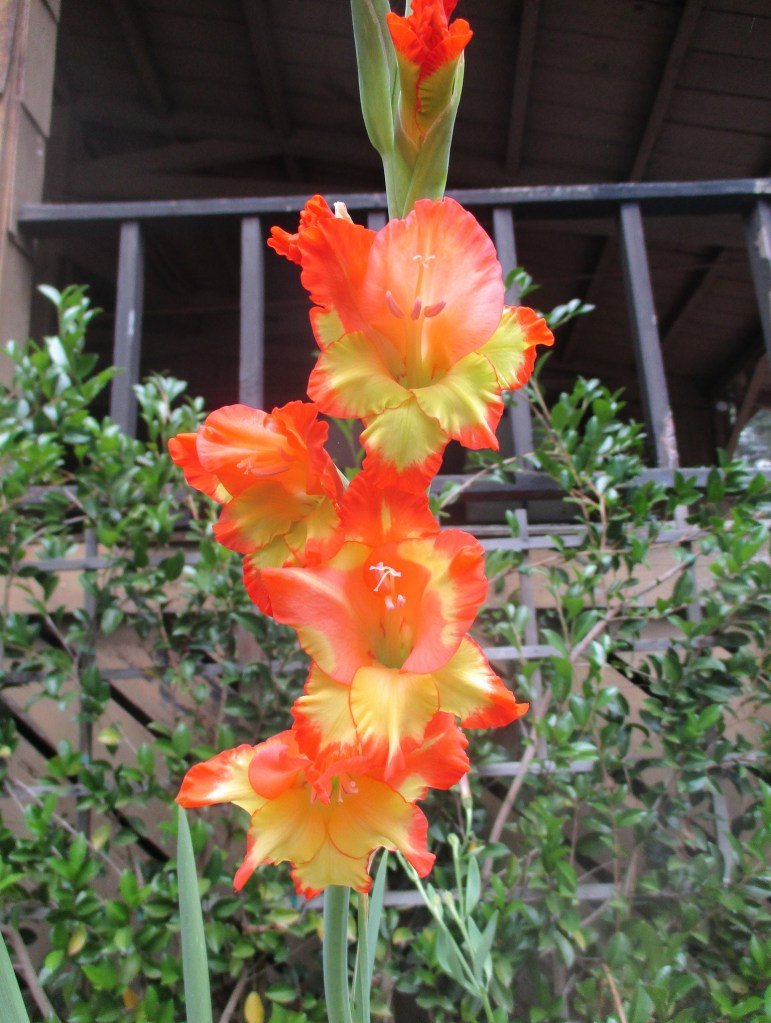
Ornamental gingers and cannas also are oblivious to phasing. Gingers bloom only once for late summer or autumn. Cannas bloom randomly from spring until autumn. Gladiolus bloom only once like gingers, but are more conducive to phasing. Early planting allows early bloom. Late planting delays bloom. Unfortunately, they are much less sustainable.
If summer bulbs do not look like bulbs, it is because few actually are. Most are rhizomes. Dahlias, which, like cannas, bloom from spring until autumn, grow from tuberous roots. As the name implies, tuberous begonias grow from tubers. Crocosmias grow from corms. So do taros, which are large foliar perennials. Gingers and cannas are familiar rhizomes. Although alliums bloom as summer bulbs, they go into the garden along with earlier spring bulbs.
This is no ordinary daffodil. I realize that it looks just like the daffodils that I posted a picture of two Saturdays ago, and it could actually be the same variety, but it is quite distinct. I acquired this particular daffodil in about summer of 1986. It could have been a year or two earlier or later, and might not have been summer. The foliage was not completely shriveled as it should have been during summer, but it lasts longer in the coastal climate that I took it from. I really do not remember when I acquired it, but I know that it was a long time ago, about the summer of 1986.
Although we have not been acquainted for as long as I have been acquainted with my paternal paternal great grandfather’s rhubarb and my maternal maternal great grandmother’s Dalmatian iris, both of which I acquired prior to kindergarten, we have significant mutual history.
I ‘borrowed’ several large clumps of bulbs from an abandoned flower field to the east of my Pa’s home in Montara. The clumps were very overgrown and very crowded, but still in their original rows, as they had been arranged for cut flower production many years prior. Shortly afterward, all of the other bulbs were somehow and seemingly pointlessly removed from the field by an excavator. A monster home was built on the highest part of the field, with a view of the field, which remained completely uncultivated afterward. No one knows how or why all the daffodil bulbs were removed so completely, but none were ever seen again. The naturalized field of daffodils seemed like it would have been an attribute to the home.
Over many years, the bulbs grew at most of the homes that I lived in, until the last few years, after I left the last of them at a former home in town. Then, after bringing a few roses here from my old rose garden at a previous home, I noticed that a few bulbs came with them. I thought that they were fancier daffodils, but now that this one bloomed, it is obvious that they are the familiar daffodils from Montara.
Daffodil bloom here as if they were in the Pacific Northwest.
Narcissus make me wonder. Both paperwhite and common daffodil, as well as a few fancier daffodil, bloom here as if they were in a climate that is more conducive to such performance. The happiest naturalize and slowly multiply. Not many bulbs do so where winter weather is so mild. That is why I do not bother with tulip or hyacinth, although a few hyacinth have also been performing reliably here for many years.
Peony is very marginal here. I know that they perform inexplicably well for some neighbors, but none have ever done well for me. I really do believe that they prefer more chill than they experience here. Realistically, winter weather is relatively mild here.
Yet, I am not convinced that it is as mild as I have always believed it to be. Some who are unfamiliar with California believe that we experience only two seasons, which are summer, and a few days annually that are not summer. I know better. No one argues that the warm and dry summers here last longer than elsewhere. Prior to summer though, spring is likely comparably to spring within other climates. After summer, autumn, although mild, is cool enough to initiate autumn foliar color. Then, winter is cool. Really, it is cool enough for deciduous species to defoliate, and for mild frost. It may not get as cold as it does in other climates, but how cold does it need to be to qualify as winter?
I am satisfied with the winters here. I can grow all of the deciduous fruit trees that I want to grow. This is one of the best climates in the World for roses. These daffodils seem to be quite satisfied as well. In fact, they sometimes stay dormant later here than in climates with cooler winters!
Dinnerplate dahlias should be about ten inches wide.
Mail order scams are a topic that I have been avoiding. I do not want to consider that some of a few items that I purchase by mail order may not be what they were sold as; and, if so, I will not know until they grow, bloom or produce fruit. Furthermore, I want to believe that if such items are not what they were sold as, that the situation is merely accidental.
This was no accident.
It began with the purchase of thirty rhizomes of ‘Red King Humbert’ canna last year. They were the cheap sort that become available after their primary season. I did not expect them to be of exemplary quality. Nor did I expect them to bloom. I only wanted them to grow a bit during the remainder of their season so that their rhizomes could survive winter dormancy to grow and bloom for the following season, which would have been last spring.
They grew as expected, but seemed to be virused. I tried to believe that the supplier would not send me virused stock, and that the striations of their foliage were normal. However, as growth resumed last spring, the foliage was very obviously virused.
Also, as they grew, they were very obviously not ‘Red King Humbert’. They grew only about two feet tall, and bloomed with scrawny orange flowers. ‘Red King Humbert’ gets about six feet tall, with big and billowy orangish red bloom.
The supplier gave me a credit for the expenditure, to spend on more of their products, I should have requested a simple refund. Instead, with the credit and a slight bit more for the difference in price, I purchased two dozen rhizomes of assorted dinnerplate dahlias.
As with the canna, I did not expect exemplary performance from these dahlias so late in the season. I only wanted them to survive and grow enough to store enough resources to survive their winter dormancy, to grow and bloom for the next season.
Most were completely necrotic and mummified upon arrival. Because this was after my experience with the canna, the supplier agreed to refund what I spent, but then only refunded a random amount of a dollar and a few cents. When I asked about the refund, I was informed that it was comparable to the cost of the one rhizome that I sent a picture of, as if I was expected to send a picture of every rhizome that I wanted a refund for. I explained that almost all of the rhizomes were comparable the the one that I sent a picture of, but received no more response.
I still have heard nothing about it. I decided to be satisfied with the few rhizomes that survived, and just accept the loss. The time that I had already wasted on pursuing a refund was worth more than any refund that I would have gotten.
So, . . . a few of the dinnerplate dahlia rhizomes survived and generated a bit of growth to partially recharge their resources prior to their next dormancy. Two actually bloomed. Apparently, these are very special dinnerplate dahlias. Instead of producing blooms that are about ten inches wide, the largest bloom is less than three inches wide. I have never seen such a dinky dinnerplate.
Hyacinth will not bloom for a few months, but goes into the garden about now.
Some of the most familiar flowers to bloom in the earliest of spring get planted now as bulbs. They sit and wait in the garden to finish their dormancy, perhaps get a bit of a chill through winter, and get an early start to their bloom cycles as soon as weather permits. Because winters are so mild here in the Santa Clara Valley, some do not even bother to wait for spring, but are instead happy to start bloom before winter ends.
Bulbs become available in nurseries when they can be planted. Those that are not available yet will become available when it is time to plant them for later spring or summer bloom. The first to become available are generally the first to bloom; although bearded iris seem to know when they want to bloom, regardless of when they get planted.
As long as they do not get stored too long or get planted too late, bulbs do not need to be planted immediately, and actually extend their performance if planted in phases. The earliest phases to get planted will bloom earliest. Phases of the same bulbs planted a few or many days later should bloom about the same amount of time later.
With proper planning, later phases bloom as earlier phases finish. For example, because crocus flowers do not last very long, different phases of bulbs can be planted only a few days or a week apart, so that more flowers start to bloom in time for earlier flowers to fade. Freesia flowers last a bit longer, so different phases can be planted two weeks or so apart.
Narcissus and daffodil bulbs are not so discriminating about how deeply they get planted, so various phases can be put in the same spots. As long as they do not get planted too deep, the earliest phases can be planted deep and covered with only a bit of soil, so that later phases can be planted above. If similarly covered with only a shallow bit of soil, later phases of the same bulbs can be stacked, as long as the last and shallowest phase still gets planted deep enough.
Not many bulbs are actually real bulbs. Most are corms, tubers, rhizomes or tuberous roots. They all do the same thing though; store resources through dormancy to sustain quick bloom as weather allows. Although many bloom reliably only once in their first season, some naturalize to bloom at about the same time each year. Tulips are capable of naturalizing, but rarely get enough chill in winter to bloom after their first season.
Anemone (windflower), hyacinth, lily, rananculus, tulip and small colorful callas are the less reliable of spring bulbs after their first year. Crocus, freesia, hymenocallis and harlequin flower can be more reliable if they get what they want. Grape hyacinth, narcissus, daffodil, watsonia, bearded iris and the old fashioned white callas are the most reliable of bulbs that get planted about now.
They may seem to be unseasonable now. Their flowers will not bloom until early spring. It is getting to be about time to install their dormant bulbs, though. Daffodil and all related Narcissus enjoy chilling under damp soil through winter. In fact, established bulbs bloom better after unusually chilly winters. Plump bulbs of some types are conducive to forcing.
The names for daffodil and Narcissus seem to be interchangeable. Narcissus is actually the Latin name of daffodil. It mostly applies to those with smaller but more abundant and fragrant flowers. Most with bigger but fewer and scentless flowers are daffodil. Narcissus are mostly white, but may be yellow. Daffodil are mostly yellow, but may be white or pink.
Some of the fancy varieties of daffodil bloom with billowy double flowers with two colors. Simpler Narcissus are more likely to naturalize though. Taller varieties of both can bloom nearly a foot and a half high. Their narrow and bluish green leaves stay somewhat lower. Foliage deteriorates after bloom, but lingers to sustain new bulbs until summery warmth.
Halloween seems to be an appropriate time to bury early spring bulbs in shallow graves. The season begins about now, and continues until about the end of the year. Installation of new bulbs might initially be ungratifying. There is nothing to show after their interment. Their spectacular bloom during late winter or early spring should more than compensate.
Freesia, narcissus, crocus, hyacinth and tulip are the most popular of early spring bulbs. So are anemone, ranunculus and several iris, although they may also be summer bulbs. Not all of such bulbs are actually bulbs. Several are corms, rhizomes, tubers or tuberous roots. Like bulbs, these store resources through dormancy to grow and bloom in season.
Early spring bulbs, unlike summer bulbs, prefer to be in their garden prior to winter. They enjoy rain and winter chill. Those that originate from nurseries are prechilled so that they bloom well regardless. After their first season though, some might not perform as reliably. Some bulbs can be slightly less than satisfied with winter chill within such mild climates.
However, a few types of early spring bulbs can naturalize. After their primary bloom, they produce new bulbs to replace the originals. Colonies of prolific bulbs eventually become crowded enough to inhibit bloom. Division of superfluous bulbs while dormant alleviates crowding. Also, it relinquishes a few bulbs for relocation. Freesia might be nicely prolific.
Early installation of early spring bulbs promotes early bloom. Obviously, later installation delays bloom. Therefore, installation in phases throughout the planting season prolongs bloom. For example, as one phase of daffodil finishes bloom, the subsequent phase can begin. This is effective only for their first season though. Bloom synchronizes afterwards.
Because winter weather is so mild locally, some early spring bulbs bloom a bit too early. Also because winter weather is so mild, premature bloom may not be a serious problem. Nonetheless, later installation may be preferable for some bulbs. Heavy rain may thrash tulip or freesia. Like phasing though, delaying bloom is only effective for the first season. Naturalized bulbs as they please.
They can be quite a surprise when they bloom for late summer. The tops of their dormant bulbs previously seemed to be dead at the surface of the soil. Then, suddenly, their bare floral stems emerge to bloom without foliage. That is why Amaryllis belladonna is naked lady. Foliage grows a bit later in summer or autumn. It shrivels during late spring warmth.
Naked lady flowers stand about two feet tall, on simple green or brown stalks. Their mild fragrance is easy to miss. A profusion of bloom is only slightly fragrant during humid and warm weather. Their vividly pink color more than compensates. Fleshy seed that mature now that flowers are deteriorating are perishable. They prefer almost immediate sowing.
After naked lady flowers imitate lily flowers, their leaves will imitate lily of the Nile leaves. Naked lady and lily of the Nile are related, but neither are related to lily. The strap leaves of naked lady are more fragile than those of lily of the Nile. If damaged, they can lay flatly for quite a while. After defoliation during spring, dormant bulbs are conducive to division. It might delay bloom for that year.
Sixteen of the twenty-four mixed dinnerplate dahlias that I did not expect favorable performance from have survived! Only eight have failed to exhibit any indication of viability. Two thirds are growing. Only one third is not.
I am impressed. I expected less than half to survive. They arrived in embarrassingly shabby condition. I canned all of them regardless, including several that were obviously completely necrotic. I wanted to give all a chance to survive before discarding any. Those that were obviously completely necrotic are among those that have not exhibited any indication of viability. However, I am not ready to discard any yet. Although I still believe that some are completely necrotic, a few others may not be. As I dump any that do not at least try to grow prior to winter, I will inspect their tubers for any indication of viability, no matter how minor.
The survivors will be pampered. I want them to generate as much vegetative growth prior to frost as possible. That should sustain the regeneration of their wimpy tubers so that they will be ready to grow next spring. I am aware that even the healthiest may not survive winter if their tubers are inadequate.
Those that survive through winter are likely to grow and bloom as if they were always healthy. In a few years, they could be ready for division. Perhaps after a few more years, I will regret the procurement of so many.
In this mild climate, it is not necessary to dig dahlia tubers for winter. We only do so because it has become a habit, and perhaps to relocate the dahlias.
Dinnerplate dahlias are certainly not my favorite type, but they are more appropriate to the landscapes that they will inhabit than they types that I would prefer.
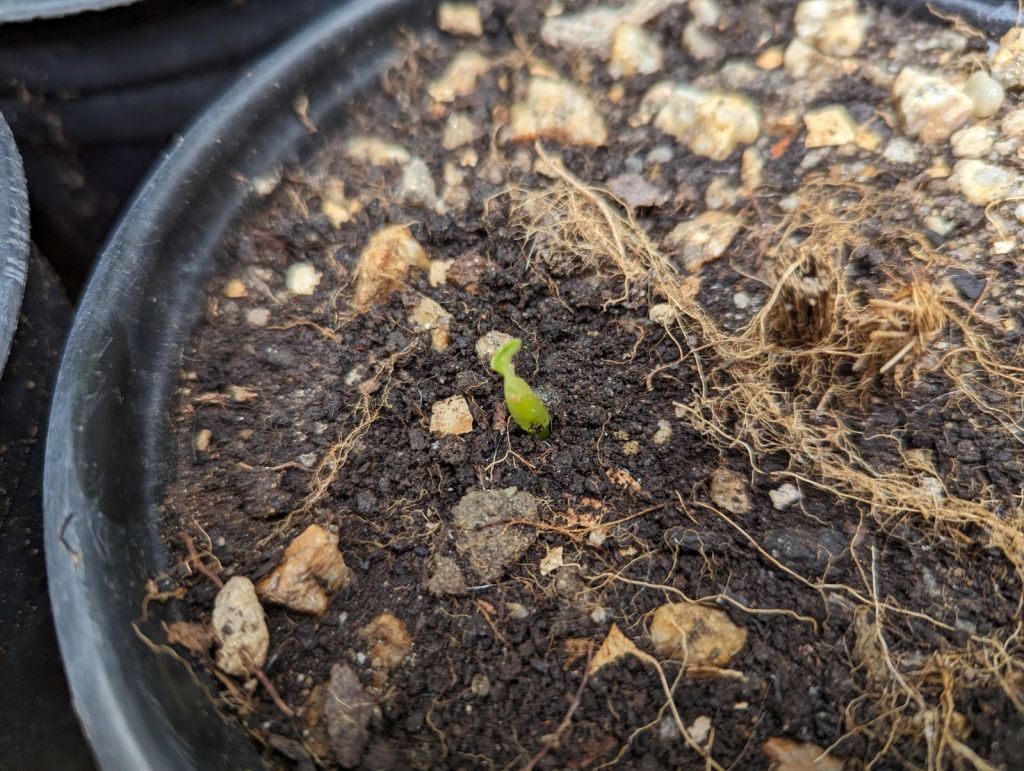
This is the most vigorous of the sixteen survivors.