If their strange tubers got into the garden last autumn, ranunculus should be blooming by now. Although their schedule suggests that they crave winter chill like other spring bulbs, they merely want to disperse their roots early. Then, they can bloom as winter ends, and continue until spring weather gets too warm for them. They mostly finish prior to summer.
If tubers did not get into the garden earlier last autumn, young ranunculus plants become available from nurseries late in winter. Although generally a spring annual, tubers, which go dormant by summer, have potential to regenerate perennially for subsequent springs. Digging and storing tubers through most of their dormancy might improve their potential.
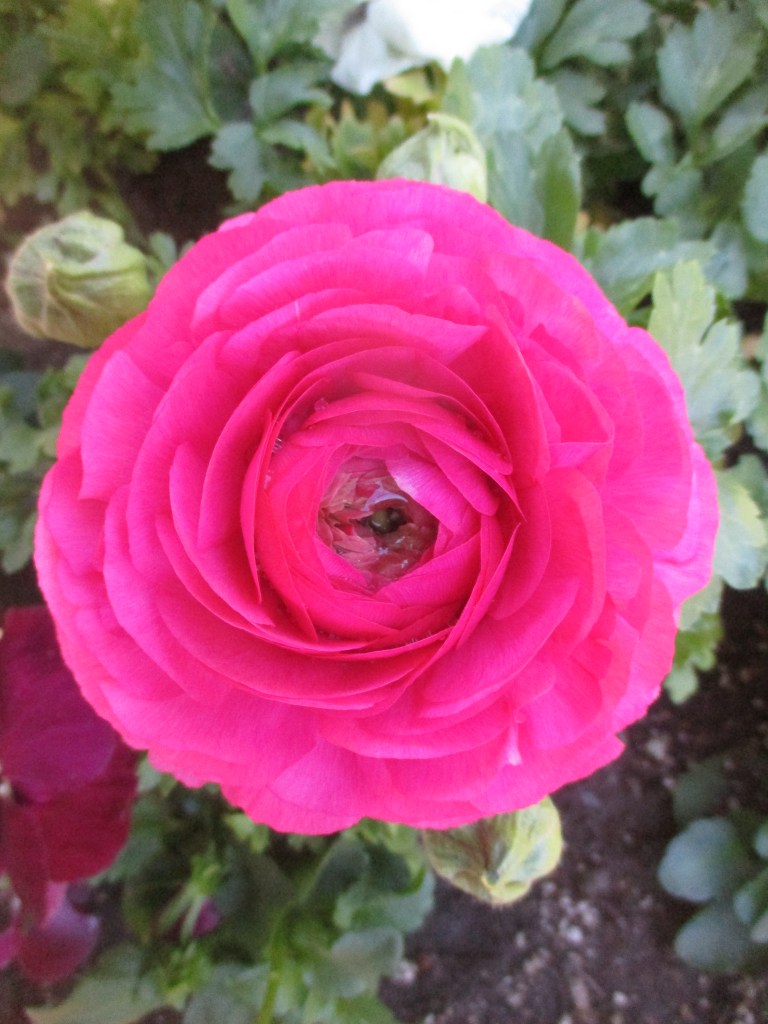
Ranunculus bloom can be pink, red, orange, yellow, purple, cream or white. Flowers are plump and neatly dense with many papery petals, like little peony flowers. They stand on sturdy stems about half a foot to a foot high. Their finely textured basal foliage resembles parsley, but with a lighter color. Dormant tubers are tufts of short, plump and woody roots.
Although they will not bloom until summer or autumn, gladiolus are in season now. Their corms, which are like bulbs, are now available from nurseries, and are ready for planting. Unlike earlier spring bulbs, they need no chill, and should not generate new foliage until warmer spring weather. Corms prefer to be at least four inches deep, in sunny situations.
The most popular and common gladiolus, Gladiolus X hortulanus, are hybrids of several species. They bloom more impressively than their simpler parents, but are not as reliably perennial. Most corms bloom for only a single season, although some within each group may bloom for a second season or more. Blooms can get heavy enough to need staking.
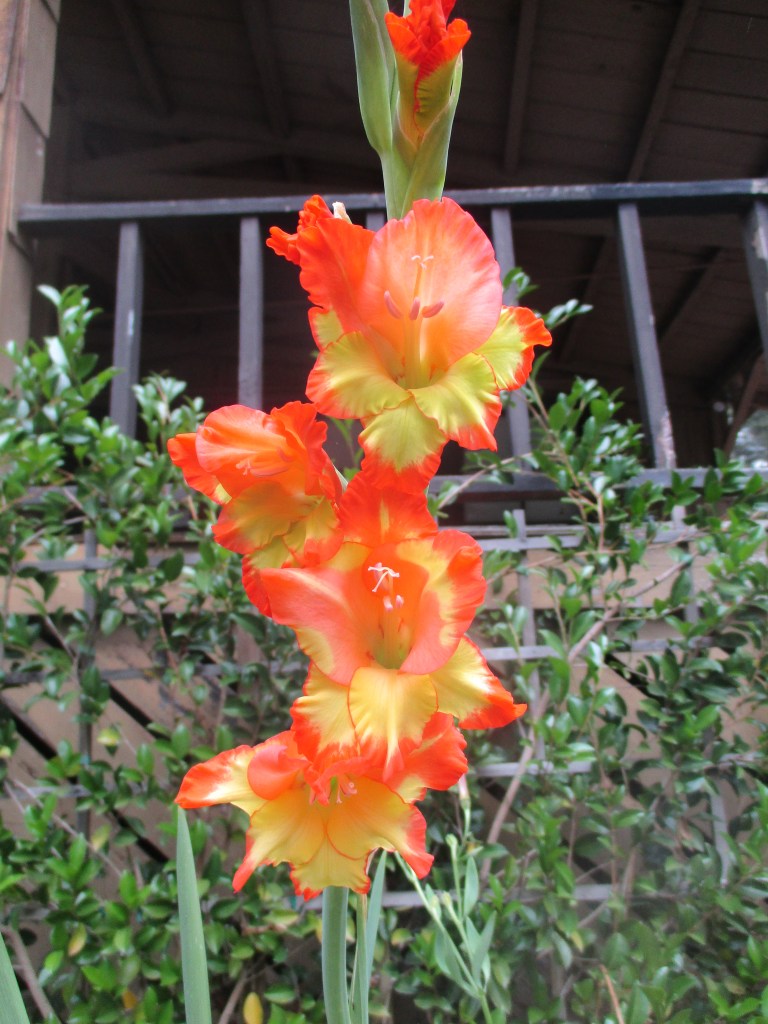
Bloom can be bright or pastel hues of any color except true blue, perhaps combined with another related color. Individual florets are not large, but they share their floral stalks with several similar florets that bloom upward from the bottom. Long and pointed leaves stand upright, flaring only slightly to the left and right. The tallest gladiolus can get six feet high.
Spring bulbs are making a comeback from their unceremonious internments last autumn. Some of the earlier sorts are visibly extending foliage above the surface of the soil. A few narcissus, daffodil and crocus are already blooming! Now it is time to plant late bulbs, or summer bulbs, which start to grow through warm spring weather, and bloom for summer.
Spring bulbs are generally the same as hardy bulbs of climates with cold winter weather. They are hardy to frost while dormant. Since chill is relatively mild locally, their hardiness is irrelevant. Conversely, some prefer more chill than they experience locally. Inadequate chill can compromise performance. Autumn planting maximizes their brief chill exposure.
Late bulbs are completely different from spring bulbs. Not only do they not require chill to perform, but some dislike it. Many of the most popular late bulbs that can naturalize here succumb to frost elsewhere. Instead of early planting for chill, as spring bulbs prefer, late bulbs prefer late planting to avoid chill. Their foliage emerges after the last threat of frost.
However, although they do not need or even appreciate chill, most popular late bulbs are resilient to the minor chill of local climates. Once established, they simply die back to the ground in response to the first frost of autumn. They maintain dormancy through winter to regenerate for spring. Some repeat this process for years, since the soil does not freeze.
Not all late bulbs are actually bulbs. Most are corms, rhizomes, tubers, tuberous roots, or other bulb-like perennials. Some, such as dahlia and canna, bloom through an extensive season. Some, such as lily and gladiolus, bloom only once. Planting in phases for a few weeks prolongs their bloom. Of course, they will synchronize for any subsequent bloom.
Canna and common white calla are two of the most reliable late bulbs. Crocosmia is too reliable, and since it can be invasive, it is rarely available. Common gladioli and various lilies are spectacular in bloom, but not reliably perennial. Dahlia is a very rewarding and reasonably reliably perennial summer bulb. It is spectacularly variable in color, form and texture.
Crocus, daffodil and narcissus are among the earliest of the popular early bulbs to bloom at the end of winter. Hyacinth, tulip, freesia, anemone, ranunculus and some types of iris bloom shortly afterward. That process should begin in February or so, about five months from now. Early bulbs are seasonable now though. This is when they go into the garden.
Early bulbs, or spring bulbs, take commitment. While dormant, they are not much to look at. There is less to look at after their internment into shallow graves, where they disperse their roots secretly through winter. They will not make an appearance until they bloom in spring. Fortunately, their performance is more than adequate compensation for the effort.
Early bulbs go into the garden now because they take time to get ready for spring bloom. While dispersing roots, they also begin to develop foliage and floral stems. Such growth remains safe and invisible below the surface of the soil until the weather is warm enough for it to emerge. Until then, chilly and rainy weather helps bulbs adhere to their schedule.
Whether they are true ‘bulbs’, or they are corms, rhizomes, tubers or tuberous roots, early bulbs are specialized storage structures. They contain what the particular plants need to grow to maturity and bloom within their preferred season. They should resume dormancy afterward, to repeat the process as perennials. However, few modern cultivars will do so.
Realistically, extensive breeding for the development of the more extravagant of modern early bulbs has compromised their vigor. Consequently, some are not reliably perennial. Some simpler crocus, daffodils and narcissus can naturalize as perennial in comfortable situations. Otherwise, more of the later bulbs, like canna, cala and dahlia, are perennial.
Whether they naturalize or not, most early bulbs bloom just once annually. Planting them in phases prolongs bloom. Ideally, a subsequent phase begins to bloom as its preceding phase finishes. The length of bloom determines the frequency of phases. For example, if tulips bloom for a week, phases can be weekly. Winter annuals cover nicely when done.
While so many flowers are finishing their bloom and leaving their drying foliage behind, naked lady, Amaryllis belladonna, is just beginning to bloom, naked of any foliage. Clusters of a few to several bright pink flowers stand on bare stems about two feet tall. Individual flowers are about two and a half to three and a half inches long, and resemble lily flowers. Foliage only appears after flowers deteriorate, and lasts only until weather gets warm late in spring. The strap shaped leaves are about a foot to a foot and a half long. Through summer, the two or three inch wide bulbs are dormant and bare, and seem to be dead with their tops visible at the soil surface, but retain fleshy roots below. They should therefore only be dug and divided if they get too crowded or need to be moved.
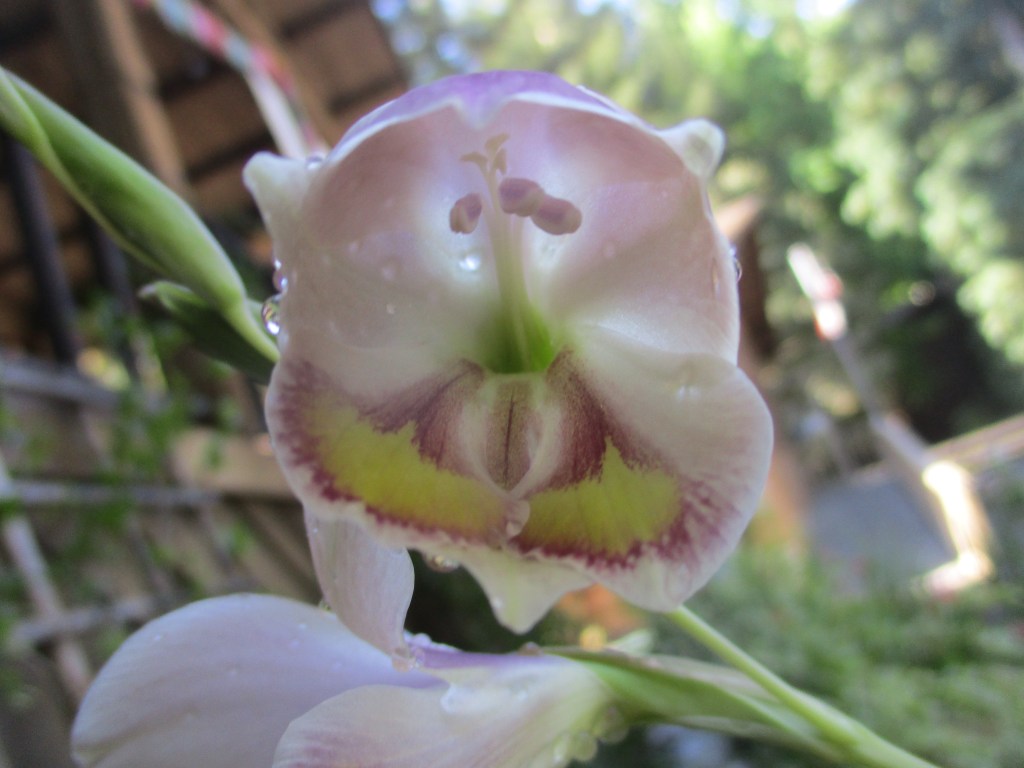
Gladiolus papilio was the topic of my Six on Saturday post for the tenth of November in 2018, when the author of Tangly Cottage Gardening Journal sent me bulbs from one of her landscapes. Embarrassingly, that was almost three years ago. They were properly installed into a landscape here, and grew well for their first season. However, they needed to be relocated as their bed got renovated. They had been in no mood to bloom during recovery. Then, while I was away, a colleague staked a single unfamiliar bloom.
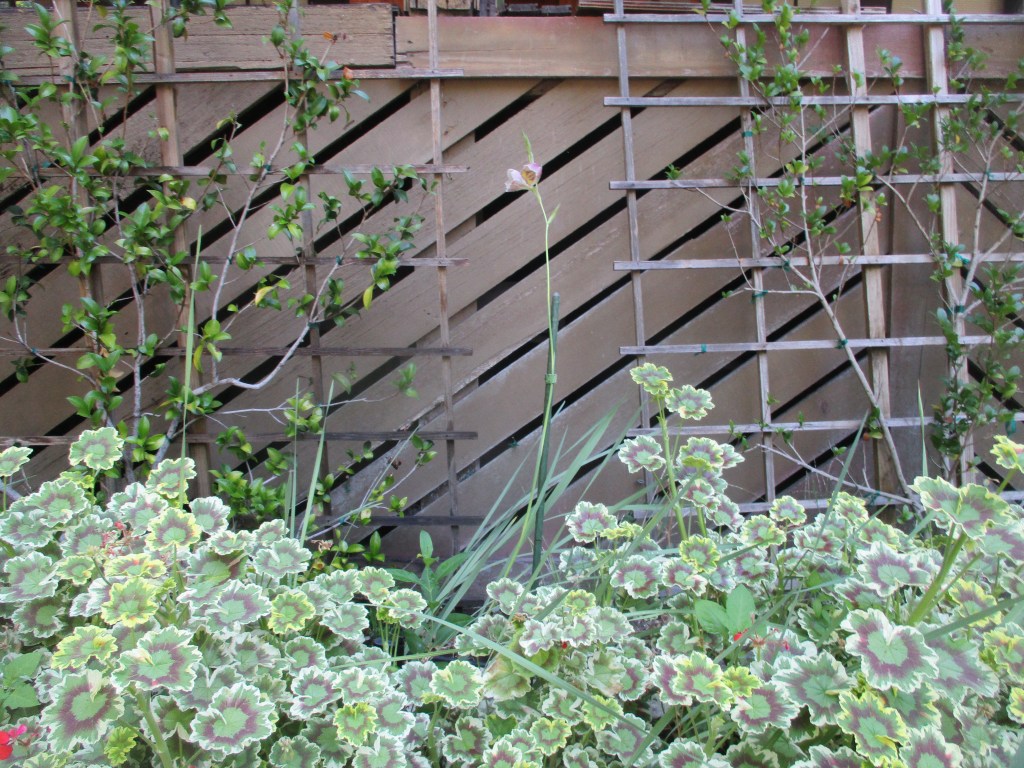
1. Here it is! This is the first bloom of the RAD Gladiolus papilio since it was planted here almost three years ago! I know it looks silly staked like this, but it would not stand upright otherwise.
2. Bloom is exemplary. Well, I believe that it is. I am unfamiliar with this species, so studied it and pictures of it online. It would have been nice to get a picture before the first floret shriveled.
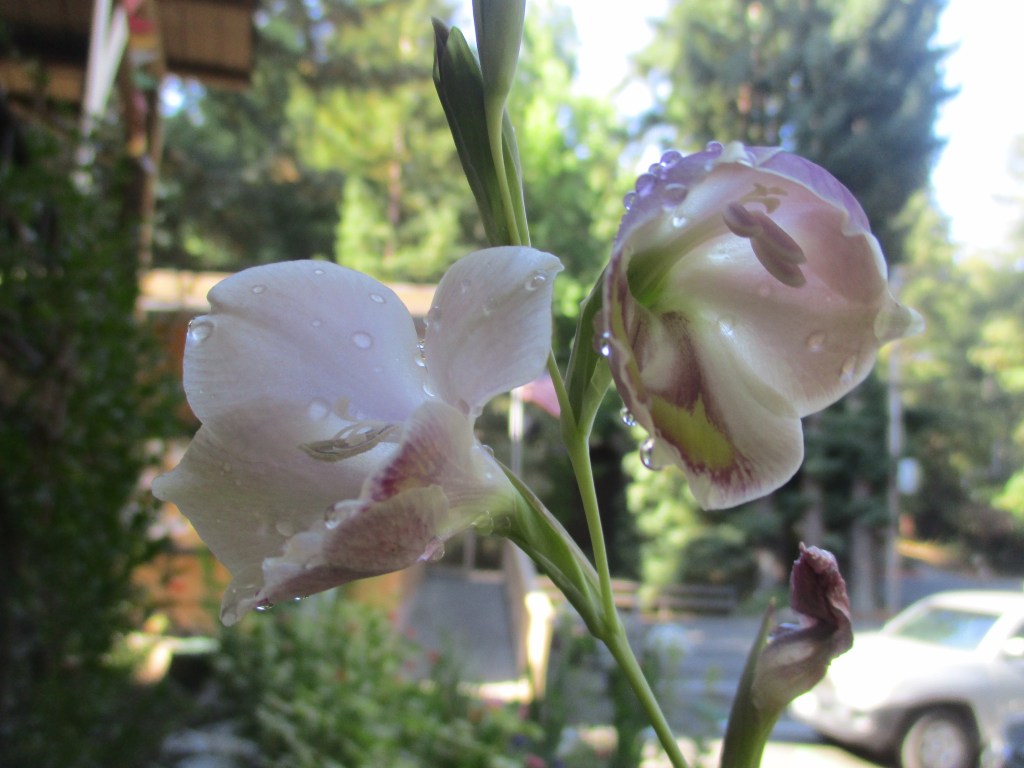
3. The exteriors of the florets seems to be almost light gray blushed with pale purple. Upon closer inspection, they seem to be pale purple with pale white. I am certainly not an expert on color.
4. The interiors exhibit a slightly more distinct pattern with the same colors, as well as a pair of yellow blotches in front where pollinators can see them. I do not know who the pollinators are.
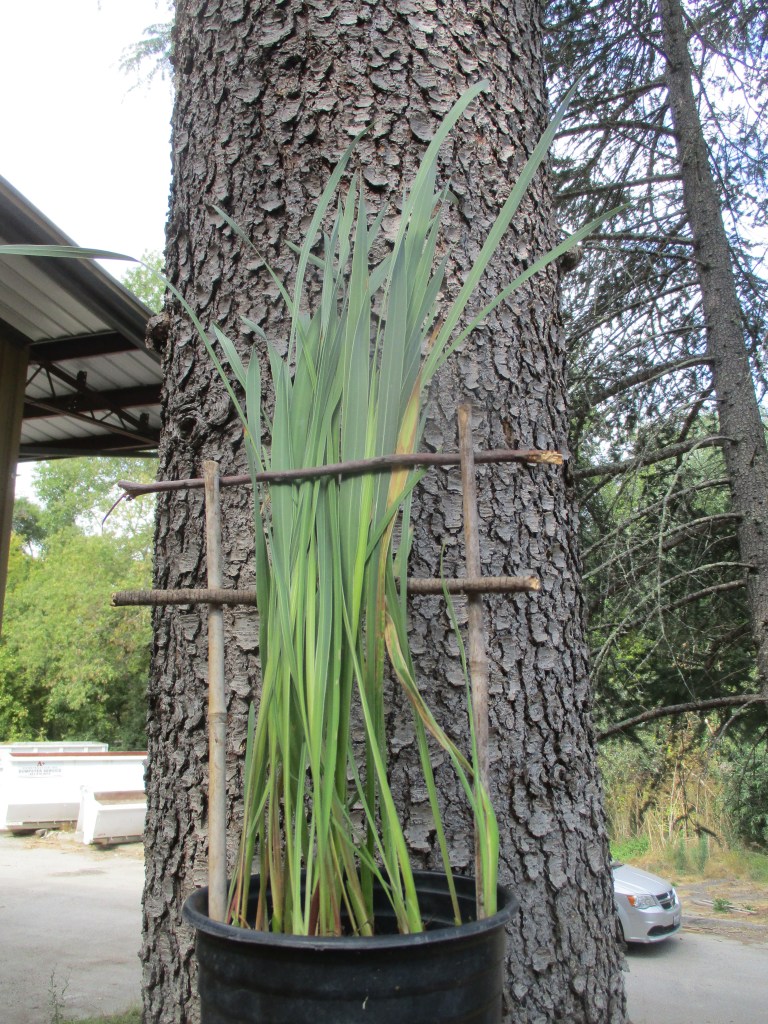
5. A few bulbs got canned so that they can eventually get planted directly into my garden, without getting dug from where the rest of them live. They were staked like this only for this picture.
6. Rhody does not understand what all this fuss is about. He would be more interested to read about the many other dogs, kitties and, of course, Skooter of Tangly Cottage Gardening Journal.
This is the link for Six on Saturday, for anyone else who would like to participate:
Perennial pea is similar to sweet pea, but as the name implies, it is perennial.
‘Perennial’ is a simple adjective that describes something that last for more than a single year. Horticulturally, it is not this simple. After all, every plant that is not an ‘annual’, which completes its entire life cycle within only one year, is technically a ‘perennial’. Those that develop lignified (woody) parts instead conform to such categories as tree, shrub or vine.
Even these categories are not as simple as they seem to be. Palms are trees, but without woody stems. Technically, they are merely very large perennials. Some consider them to be ‘herbaceous trees’. Yucca trees conform to the same category; while terrestrial yuccas are usual perennials. Sweet peas are annual vines. Perennial peas are perennial vines.
Many annual bedding plants, such as begonia, chrysanthemum, primrose, cyclamen and even busy Lizzie, are technically perennial. They could survive for a few or several years if they get such a chance. All ferns, including tree ferns, are perennials. So are bamboos, ornamental grasses, and many succulents. ‘Biennials’ are perennials that live two years.
Many of the most popular perennial plants have an indefinite life span. It is impossible to know how long they can survive. They are constantly replacing themselves with new but genetically identical parts. For example, bearded iris migrate and propagate by rhizomes that could have been propagating for centuries. New plants are identical to their original.
However, many perennial plants with potential to propagate indefinitely might eventually get shabby. New Zealand flax, after many years, may slowly migrate outward from where it started growing, leaving a bald spot in the middle. Outer shoots relocate easily to patch such bald spots, or unite as a fresh clump. Crowded lily of the Nile benefit from thinning.
Bulbs and bulb like plants are generally perennial, even if unreliable as such in the mild local climate. (Many bulbs and bulb like plants prefer more chill through winter than they get here.) Most of these sorts of perennials are dormant for part of the year, so die back to the ground. Hostas are bare through winter. Florists’ cyclamen are bare through summer.
The fact that peonies do not perform well in such mild climates does not dissuade some of us from growing them. After all, they can sometimes be found in local nurseries and even farmers’ markets as if they belong here. Tubers of more of the countless varieties can be purchased online or from mail order catalogs while dormant in autumn. Unfortunately, without much winter chill, few peonies perform as they should.
Peonies can be white or various shades of pink or red, with considerable variation of flower structure. Tree peonies that bloom yellow are the most likely to be wimpy without winter chill. All peonies are good cut flowers. After spring bloom, the distinctively coarse and rich green foliage stays until autumn dormancy. The more popular herbaceous peonies should not get more than three feet tall and broad. Tree peonies do not actually grow into trees, but develop woody stems that can hold flowers nearly six feet high. Larger flowers may need support.
Because plants get established so slowly, they should not be moved or disturbed. Small new plants can be divided from larger plants while dormant, but take a few years to actually bloom. Peonies like rich soil and regular watering, where they do not get crowded or shaded by other plants.
Wildflowers have been quite a fad. Relative to most fads, they are not so impractical. For some situations, they are a good excuse to waste less effort and resources on unrefined parts of the garden. Of course, they all require some degree of effort and resources. Most are neither as wild nor as natural as their marketing suggests them to be. Few are native.
Wildflowers that lived here centuries ago, prior to the introduction of exotic species, were relatively unimpressive. Although some bloomed spectacularly, they did so within a brief season. Winter is too cool for pollinators that wildflowers intend to attract. Summer is too dry for bloom to last long. Most bloom was limited to the transition from winter into spring.
The same native wildflowers bloom even less now than they did centuries ago because of competition with exotic species. Most exotic species that compete with wildflowers are feral forage crops that lack colorful bloom. They grow so vigorously that they obscure the natives. Mitigation of such undesirable vegetation ruins wildflowers that mature within it.
Most of the best wildflowers here now are as exotic as feral forage crops. Those that are native might be more reliant on unnatural cultivation. California poppy, evening primrose, and native annual lupines might prolong bloom with a bit of extra water through summer, but need weeding. With the same watering, (non-native) cosmos stands up to the weeds.
Unfortunately, vegetation management is more important than wildflowers outside of the refined garden. Overgrown weeds are combustible and can be dangerous to pets. Weed whacking too often involves wildflowers before they get their chance to bloom, as well as foliage of spring bulbs after bloom. (It sometimes damages bark of trees and shrubs too.)
Some low and dense perennial wildflowers are more reliable than annual sorts because they exclude annual weeds. Saint John’s wort and periwinkle are invasive exotic plants, but work well as ground covers. Mowing or shearing them late in winter slows their competing weeds, and also enhances their foliar density before competing weeds regenerate.
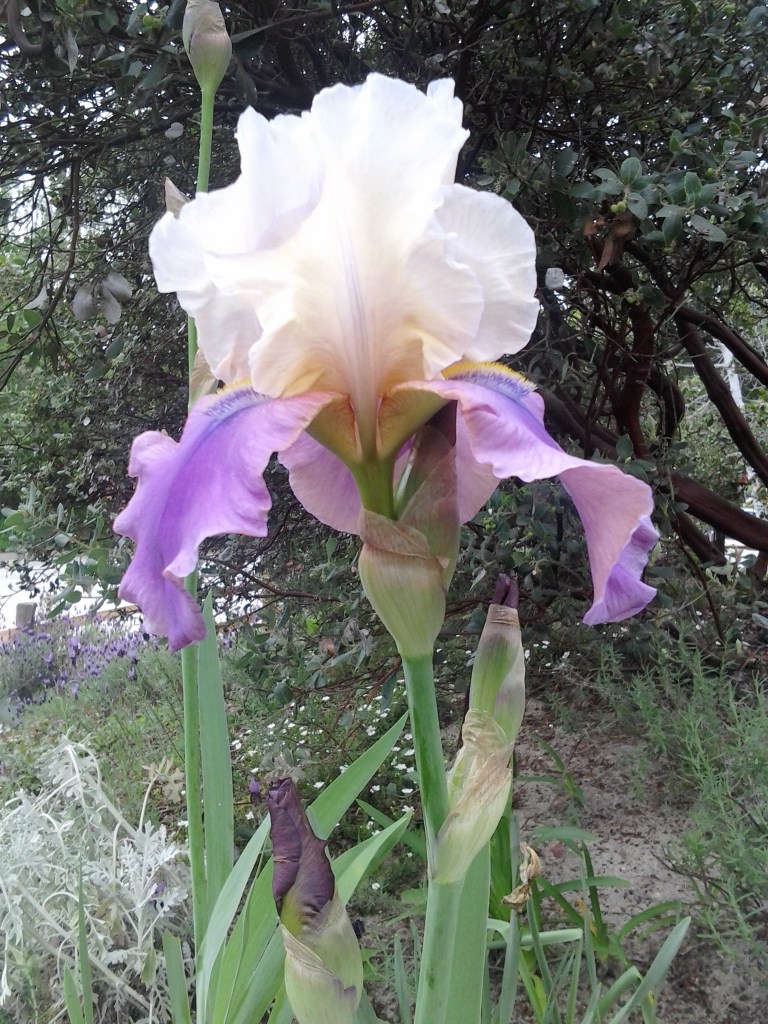
When there is not an app for that, there is probably a bearded iris that will work just fine. Really, there is just about every shade of yellow, blue, purple, orange, pink and almost-red imaginable, ranging from wildly bright to subdued pastel. There are actually several shades of white, and a few rare flavors of dark purplish black.
It seems that the most popular of the bearded iris bloom with two or more colors. The standards may be very different from the falls. Any part of the flower may be striped, spotted, blotched or bordered with another color. Flowers may be relatively simple or garishly ruffled. Many are fragrant.
Bearded Iris bloom between March and May. Some of the modern varieties bloom again in autumn. Flower stems can be as short as a few inches, or as tall as four feet, with only a few to several flowers. The rubbery and somewhat bluish leaves form flat fans that look neater if groomed of deteriorating older leaves. Each fan dies back after bloom, but is efficiently replaced by about two more new fans. Colonies of fans should be divided over summer every few years, or as they get too crowded to bloom well. Bearded iris likes well drained soil and at least six hours of direct sun exposure daily.